
Monday musings on Australian literature: Last minute Aussie lit shopping ideas

Wrapped Gift (Courtesy OCAL, via clker.com)

Wrapped Gift (Courtesy OCAL, via clker.com)

This is not my post on 2012 reading highlights … that will come at the end of the year … but, with Christmas just a week away, I thought I’d offer up some Aussie lit suggestions for your lovers-of-literature friends. Some of these may be tricky to find at this short notice – and these are by no means the only great bookish gift ideas – but I’m throwing them out there anyhow, so here goes.

For the Patrick White lover (or the Patrick White virgin): Patrick White’s Happy Valley. Published for the first time since its original publication, as part of the new Text Classics series, this is a treasure. I haven’t finished it yet, and it will be a little while before I get to write up a review, but nearly halfway in I can see why Grahame Greene described is as “one of the most mature first novels in recent years”. As I’m reading it, I’m pondering what is it that makes great writing, writing that makes you go “ah, how can something so simple sound so good”. I haven’t worked it out yet, but I’m enjoying the challenge … This is a book that belies the fear that White is hard. He’s not, not really … and for a Patrick White virgin Happy Valley is a highly accessible read and a good introduction to White’s concerns.

For a gift that will last all year: a subscription to the new-ish literary magazine, Kill Your Darlings. This is a gorgeous publication to hold, easy to carry around to read in those spare moments, and is also available in electronic version. This is just one of several Australian literary magazines around, and others would do the job I’m sure, but I am partial to this little publication.

For the person who’s a little scared of poetry: Suzanne Edgar’s Love procession from Gininderra Press. Poet Melinda Smith has said that “If a poem can’t speak to a person of ordinary intelligence without the help of a literature academic, the poet isn’t doing a proper job.” I defy anyone to argue that Edgar, in this often wry sometimes sad collection, isn’t doing her job.

For the indie supporting reader: a book from one of our wonderful SPUNC publishers, such as a Nigel Featherstone novella from Blemish books, or a “long story short” collection like Irma Gold’s Two steps forward from Affirm Press, or Francesca Rendle-Short’s Bite your tongue from Spinifex Press, or … well, if you want more ideas, just go to the SPUNC site and see what you can find.

For the non-fiction reader: Anna Funder’s Stasiland. A few years old now, I admit, and there has been some great non-fiction published this year. But it took me a long time to get to read Stasiland and now I have I’m like a born-again! I want everyone to read it! And, you never know, if you’re on a budget and are happy to give a secondhand book, then this could be a goer.

And last, but definitely not least …

For the gift-giver running out of time: think electronic! Many of the ideas I’ve listed above can be acquired in electronic version because this seems to be the year that Australian publishers – of journals and of books – embraced electronic publishing big time. Australian works can be found through a range of outlets – both local (online bookshops and publisher’s own sites) and international (like Amazon).

So, it’s not too late to wow someone in your circle with a great piece of Australian literature … but it will be soon if you don’t get onto it now. Happy shopping!

The gift of words

Xmas Tree

There be words in there

Middle age has come
and all the plans and needs
are chaff not seeds,
blowing down the blue air
to fall flat and trampled
by some window where
a hopeful girl braids
her thick hair and hums.

(“Humble”, by Ginny Jackson)

Better late than … hmm, perhaps not, but I’m going to tell you anyhow.

I’ve noticed in recent years that I don’t receive a lot of books for Christmas – and when I do, they are often not fiction – but a few hardy gift-givers still bravely feed my obsession. And so, I received a small but intriguing bunch this year, which I will list by category:

Fiction:

  • Margaret Atwood‘s The year of the flood. Atwood is one of my favourite writers but I’ve dropped the baton on her a bit in recent years. I hope to pick it up again and run this year with this, her most recent. Thanks, Mum.
  • Helen Simonson’s Major Pettigrew’s last stand. I have already read and reviewed this one – and suggested at the time that there were people I knew who would enjoy it. I didn’t have a copy then so couldn’t lend it to them. I now do … thanks Sandra, from my bookgrouplist swap.

Poetry:

  • Ginny Jackson’s The still deceived. I can always rely on my brother to choose something a little bit different for me, and this year was no exception. My brother lives in Tasmania and this book, published by Ginninderra Press, is by a Tasmanian poet/artist. I have only dipped into it – but if you like the poem opening this post you might like to dip into it too. Thanks, bro!
  • There’s something about a rose. I knew immediately who chose this book – my Dad, the rose lover. It comprises a selection of poems and art celebrating, yes, roses, and was compiled by the Friends of Old Parliament House Rose Gardens. The poems are by Australian poets, some well-known, such as Barbara Blackman, Les Murray and Chris Wallace-Crabbe, and others not so well known (to me at least). I have already dipped into and enjoyed several of the poems…and may share some with you as the year goes on. Thanks, Dad.

Non-fiction:

  • The Canberra gardener. I’ve had previous editions of this gardening bible, but not for some years. Published by the Horticultural Society of Canberra, this one is the 10th edition published in 2010. The previous edition was published in 2004, just as our last serious drought was starting to bite. As a result, this new edition focuses on how to create lovely gardens with less water. Funnily enough, our dams are now suddenly full (last year they were at 50%) but we have all learnt (if we didn’t already know it) that Australia is a dry continent and that we should make water conservation a permanent goal regardless of annual fluctuations in water levels. This book will help me in my endeavour. Thanks, Carmel.
  • Roger McDonald‘s Australia’s wild places. I do like a good coffee table book and this is a good coffee table book. It’s published by the National Library of Australia and comprises landscape photographs of Australia from the Library’s collection. The photos were chosen by award-winning Australian novelist, Roger McDonald, whose books tend to have strong rural themes. The book has an introductory essay, with a strong environment message, by McDonald, followed by gorgeous images by some of our top photographers, including Peter Dombrovskis and Frank Hurley. It is just the book for me to look at now, as we prepare for our annual foray into the Snowy Mountains for a bit of post-Christmas R&R. It was given to me by a friend who spent most of her career working with these images. Thanks, Sylvia.

So, there you have it, six books from six people, each book reflecting a little bit of both the giver and the receiver. What more can one ask of a gift?

And now, if it’s not too late, I’d love to hear if any of you received books this year, and what they were.

My second book for Christmas

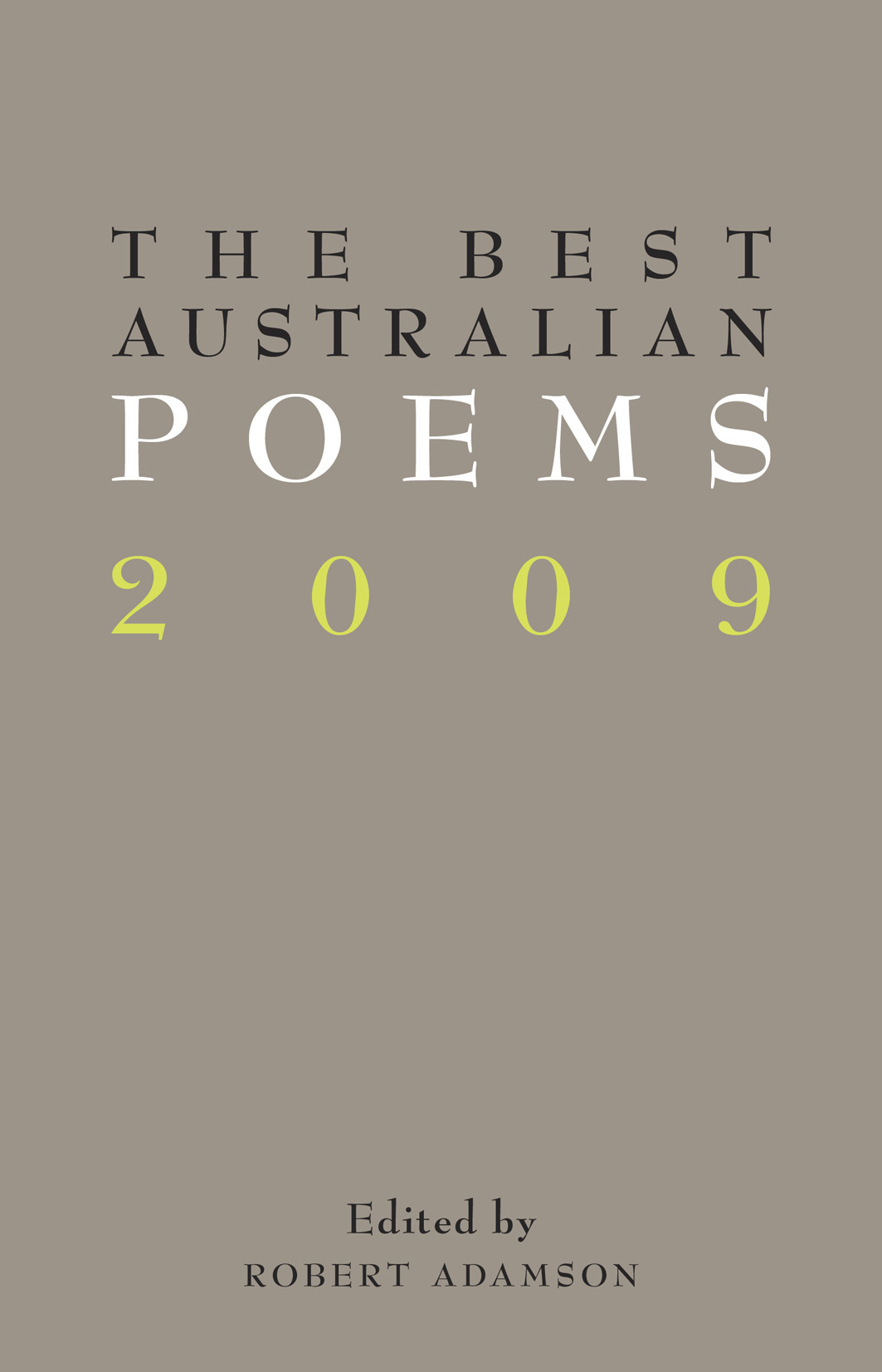
Is this starting to sound like a carol you know? Anyhow, I did say in a comment on my first Christmas book post that I had received another book for Christmas, The best Australian poems 2009 (edited by Robert Adamson). DKS’s comment about the value of this annual series to the cause of poetry made me think that I ought give it its own post.

I wouldn’t call myself a poetry expert, but I have mentioned poetry several times in this blog’s short life because I do enjoy reading it and wish, really, that I spent more time with it. Australian surgeon Mohamad Khadra, in his rivetting memoir, Making the cut, talks about the value of poetry, about how each day on his hospital teaching rounds he would begin by having his students recite a poem that might offer some entrée to understanding their patients’ states of mind. His view is that, as doctors deal daily with humanity, they, and by extension we, can learn from poets who have spent lifetimes making a study of humanity. Each chapter of his memoir commences with a poem.

The Best Australian Poems 2009

Cover image (Courtesy: Black Inc)

But I digress. Robert Adamson mentions three poets in the first paragraph of his introduction – Irish WB Yeats, English Gerard Manley Hopkins (one of my favourites) and Australian Meg Mooney – referring to use in their poems of birds and song. He says that there are many birds and lyrics in the anthology. I’m not quite sure why he singles out these two particular ideas in what is a general anthology – but maybe I’ll know by the time I’ve read all the poems?

To make the selection for this volume he “read all the poetry in the print publications as well as many of the electronic journals and even blogs that feature poems”. Isn’t it great seeing the blog world becoming an integral part of the publishing industry! He says about his selection that he “wanted to create a rhythm for the reader: shorter lyrics and some satirical poems, then hopefully a few love poems, poems of weather, landscape poems and, of course, bird poems.” Ah, the birds again…and then comes the explanation:

People ask me, why are so many bird poems being written and published? I have a theory : we miss having poets among us who can imagine that a soul can ‘clap its hands and sing, and louder sing’ [Yeats], that we need to acknowledge visitations by intense psychological presences, and that birds are the closest things we have, more or less, to angels.

Wow! I’m not quite sure how to respond to that.

The anthology commences with a lovely poem by Martin Harrison titled “Word” written for Dorothy Porter, after her death:

in which briefly suddenly one voice’s glimmer is lost

The anthology also includes a poem by Porter and, indeed, contains for the first time apparently more poems by women than men. The poems are listed alphabetically by poet – saves need of an index not to mention the problem of how to sequence the poems (and all those questions about how one poem’s proximity to another will affect its impact or meaning). He has also included a lot of new poets, more perhaps than in the past, as well as the tried and true. And that is how I like it (just as I like a “classical” music concert to mix it up a bit).

I think that’s about enough on a book I haven’t fully read, so I’ll just finish with some lines from Meg Mooney to whom Adamson referred in his opening paragraph:

The large, brown shapes of the wedgebills
their cheeky crests
disappear as I get closer

like they’re telling me
you can’t just look
and expect to see
in this country

(from “Birdwatching during the Intervention“)

The best Australian poems 2009
Melbourne: Black Inc, 2009
239pp.
ISBN: 9781863954525

My first book for Christmas

I know that Christmas is still over a week away but last night I received my first book of the season…and that, I think, is a litblog-worthy event!

Actually, I tell a bit of a lie, because last week I was sent, by a very kind internet bookgroup friend who knows my likes, the British Library Jane Austen appointment diary for 2010. It is gorgeous, containing Regency era images, silhouette images, and quotes from Jane Austen (from her books and letters). Being an appointment diary it notes standard public holiday dates, but being a Jane Austen appointment diary it also records dates important to Austen’s life – such as the poignant (possibly!):

January 15: I am to flirt my last with Tom Lefroy (from letter to Cassandra)

It is a lovely diary and I shall treasure it way past its expiry date (that is, past December 31, 2010).

Haruki Murakami (Photo by Wakarimasita, Wikipedia, under Creative Commons Attribution ShareAlike 3.0)

And now to the book I received last night. It is Birthday stories, an anthology of thirteen short stories “selected and introduced by Haruki Murakami“. (The givers knew that I like Murakami.) The book was originally published in Japanese, Murakami having both selected and translated the stories from English, but was later published in English with “a specially written introduction”. The stories all deal with birthdays and are by such luminaries as Raymond CarverDavid Foster WallacePaul Theroux, and William Trevor – as well as by Murakami himself. Each story has a brief – and delightfully personal – introduction by Murakami.

In his introduction to the anthology, Murakami writes that his inspiration for compiling the anthology:

was my consecutive reading of two outstanding stories that happened to be based on the theme of birthday: “Timothy’s birthday” by William Trevor and “The Moor” by Russell Banks. … Both stories left me feeling haunted.

I imagine that there will be various interpretations of “birthday” from the day of one’s birth to those days in which we celebrate our own or the births of others. I rather like themed collections of short stories, and so am looking forward to reading this book – perhaps by dipping into it over time rather than reading it all at once, so you’ll probably hear about it as I go.

Meanwhile, I’m thinking that if these are the sorts of gifts arriving before Christmas, some wonderful delights must be in store for me when the day itself arrives! After all, you can never receive too many books for Christmas – can you?

Haruki Murakami (ed)
Birthday stories
London: Vintage Books, 2004
206pp.
ISBN: 0099481553

A free range Christmas

Can you think of anything more free-ranging than a concert which includes the Inch Worm song and Blake’s Tyger, Rudolph the Red-nose reindeer and a 13th century Benedictine Nun’s lullaby, and much more besides? I certainly wouldn’t have before we attended a concert on Friday titled A Free Range Christmas by the wonderful Song Company.

The Song Company is an Australian vocal ensemble which was formed in 1984. It comprises 6 singers – and they perform music, often if not mostly a capella, in a wide range of styles. Their website states that they sing music from the 10th century to the present day – well, you can tell that from my little intro to this post can’t you! The website also states that they have an ongoing relationship with Australian poet Les Murray. That explains why our show was introduced by their Artistic Director, Roland Peelman, reciting Les Murray’s “Animal Nativity” poem.

Cartoon singers

Singing-Bunch (by Mohammed Ibrahim, from http://www.clker.com)

Anyhow, we have seen the Song Company before – back in 2003 when they did their Venetian Carnival, a theatrical musical  (or is it musical theatrical?) journey through the music of some of the great composers of Venice such as Monteverdi, for Musica Viva. It was an exciting concert and I’ve wanted to see more of them ever since. Their performances usually include a theatrical element and this was so on Friday night, though it was not quite as flamboyant as the Venetian Carnival.

A free range Christmas comprised a wide range (ha!) of songs about animals – many but by no means all – with a Christmas theme. Several were composed by contemporary Australian composer, Martin Wesley-Smith, including his humorous “Lost snail” and “I’m a slug”. They really did mean “free ranging”! The show was loosely held together by a little running joke to do with a Rudolph the Red-nosed Reindeer Christmas ornament…and we did eventually get, more or less, a rendition of the song. Highlights for me included a beautiful version of “Wimoweh”/”Mbube” (how many ways can you do this song?), a sung arrangement of Blake’s “The Tyger”, a gorgeous version of my sentimental favourite “Carol of the birds”, and a very entertaining presentation of “The twelve days of Christmas”. Put this together with three men and three women who can sing with great versatility, as well as recite and act a little, and you have a great night out.

Not everyone in our party loved it though. Some thought it a little slow to start – and perhaps starting with a set of serious but beautiful early and lesser known songs was not the way to engage the children in the audience. Some did not like the humour, which veered (though only lightly) I suppose towards the nonsense/silly/music hall variety, but the rest of us thought it just about right for the Christmas season – all the moreso when we repaired downtown for an after-show snack and had to battle our way through multitudes of pub-crawling Santas. Each to his (her) own as they say!

Singers:

Clive Birch, Bass
Richard Black, Tenor
Mark Donnelly, Baritone
Ruth McCall, Soprano
Nicole Thompson, Soprano (guest artist)
Lanneke Wallace-Wells, Mezzo-soprano (guest artist)