Monday musings on Australian literature: The Australian bildungsroman

Miles Franklin

Miles Franklin, c. 1940s (Presumed Public Domain, via Wikipedia)

I know the sad truth. About everything.
(Craig Silvey, Jasper Jones)

In past posts, I’ve talked of enjoying coming-of-age novels (aka bildungsroman) and so today I thought I’d share 5 (cos 5 seems like a manageable number for a list like this – and gives you an opportunity to contribute your own!) Australian novels in the genre.

In the introduction to a course on “The European bildungsroman” at Columbia University in the USA, there is a brief discussion on the definition of the term. The unnamed writer (so let’s call him/her Columbia) of the introduction says:

My particular approach to defining the genre … returns to Dilthey‘s original definition. According to Dilthey, the prototypical Bildungsroman is Goethe’s Wilhelm Meister’s Apprenticeship in which the hero engages in a double task of self-integration and integration into society.

Columbia then expounds a little on this definition arguing that, while Dilthey see this as an affirmative, conservative genre which aims to find the “hero” a productive place in a valid society, s/he sees it as involving a tension – that between “the priorities of self-integration and social integration”, between personal desire and social obligation. For Columbia this tension is a major criterion for the Bildungsroman genre. This makes sense to me … perhaps this tension isn’t an issue for every young person who is coming of age, but a coming-of-age story without that tension, without some conflict to resolve, is probably not going to be interesting to read!

(By the way, I’m not sure that this necessarily negates Dilthey’s definition. The difference between Dilthey and Columbia seems to me to be that Dilthey focuses on the end result, while Columbia focuses on the process which may or may not culminate in Dilthey’s goal.)

And so, five Australian coming-of-age novels (choosing from those I’ve read):

  • Miles Franklin‘s My brilliant career (1901) is probably Australia’s best known book of the genre. It’s a semi-autobiographical novel about Sybylla, a young girl on an outback property who must choose between her passion for a man and her passion to be a writer. It was made into a film by Australian director Gillian Armstrong.
  • Henry Handel Richardson‘s The getting of wisdom (1910) is another novel about a blue-stocking girl. Laura’s innocence and idealism are sorely tested by the city sophistication of her well-to-do peers. In this story, the awakening is more intellectual and philosophical than sexual. According to the Henry Handel Richardson Society, this novel was admired by HG Wells. It was also made into a film.
  • Melina Marchetta‘s Looking for Alibrandi (1992) is a young adult novel (and, later, a film) which adds an immigrant background to the heroine’s challenge. Not only is she a young intelligent girl who confronts her awakening sexuality but she must do so within the strictures of a conservative Italian family.
  • Tim Winton‘s Breath (2008) explores the youthful drive to prove oneself, to take risks, and the complications that arise from choosing an imperfect male role model and from becoming embroiled in a rather unhealthy sexual relationship with an older woman. Eva is no Mrs Robinson. The question left for the reader at the end goes to the heart of Columbia’s disagreement with Dilthey.
  • Craig Silvey‘s Jasper Jones (2009) is set in rural 1960s Western Australia and, with a nod to To kill a mockingbird, combines a somewhat Gothic mystery with a more traditional coming-of-age story. Racism (against immigrants and indigenous people), sexuality and learning who you can trust are some of the adult issues that Charlie confronts in his growth to maturity.

I’m intrigued by how many of these books have a rural or small town setting. (Even Laura, in The getting of wisdom, is a country child, though the book is set in a city boarding school. Looking for Alibrandi is the only truly urban novel here.) Is this because we equate country with innocence? Because rural life tends to be more conservative and therefore presents a greater challenge to a burgeoning self? Is it simply that the books I’ve chosen are not representative? Or? What do you think?

Hate trees! Love bumpy roads!

I was a contrary child. When my family went on long car trips, a few decades ago now, I would, in my sunny way, announce to my parents, “I hate trees, love bumpy roads”. Guess what my parents were talking about prior to this pronouncement from their co-operative first-born? This refrain, as you can imagine, has become one of those enduring family jokes, and particularly so now with my gums-inspired blog.

Anyhow, the thing is, while reading my current book, Andre Gide‘s The immoralist, I came across a description of trees:

Huge olive and carob trees, with cyclamen growing in their shadow; above, woods of chestnut trees, cool air, northern plants; below, lemon trees by the sea. The last are arranged in small terraces because of the slope, like a staircase of gardens, almost all the same, with a narrow path running through the middle from end to end. One enters them silently, like a thief. There one can dream, in the green shadows. The foliage is dense and heavy, no direct light can penetrate. The fragrant lemons hang like thick drops of wax; in the shade they look greenish-white; they are within reach, and taste sweet, sharp and refreshing.

And I realised that I have always loved trees. I did say I was a contrary child, didn’t I?

Pialligo gardenTrees are the stuff of childhood – they evoke adventure, magic, imagination. They are places to climb, to hide or rest in, to swing from or, of course, to read in. I had a climbing tree when I was young – a lovely old spreading custard apple tree. It’s an important part of my childhood memories. Naturally, this got me to thinking about my childhood reading and I realised that trees were always there too. I didn’t “know” many of them in my Australian environment but I loved the sound of them – large spreading oak trees, fragrant magnolias, lush weeping willows, elms, lindens, firs and so on. Trees, in fact, abound in children’s books, so I’m choosing just three that are particularly memorable to me. I’d love to know whether trees conjure up any special feelings from your childhood.

Like many young girls, I fancied myself Jo March (of Louisa May Alcott‘s Little women fame). What better role model could we find but this lively, adventurous young woman who also loved to read:

“No,” said Jo, “that dozy way wouldn’t suit me. I’ve laid in a heap of books, and I’m going to improve my shining hours reading on my perch in the old apple tree…”

Another favourite childhood novel was Johanna Spyri‘s Heidi (of which I was recently reminded by Iris). When Heidi is sent to Frankfurt to keep the sickly Clara company, she misses her home in the Alps:

It was still early, for Heidi was accustomed to get up early and run out at once to see how everything was looking, if the sky was blue and if the sun was already above the mountains, or if the fir trees were waving and the flowers had opened their eyes.

Heidi was one of those books which introduced me – an urban child – to the love of the countryside. (It also made me crave white bread rolls. Those rolls seemed so much better than anything I’d ever seen, and they introduced me to the vicarious enjoyment of food through literature, but that’s another story).

In Australian books, there were of course the gums, the most memorable being the one in Seven little Australians:

There was a tree falling, one of the great, gaunt, naked things that had been ringbarked long ago. All day it had swayed to and fro, rotten through and through; now there came up across the plain a puff of wind, and down it went before it. One wild ringing cry Judy gave, then she leaped across the ground, her arms outstretched to the little lad running with laughing eyes and lips straight to death.

I’ve always been fascinated by the fact that while Louisa May Alcott had the sweet, gentle Beth die, Ethel Turner did the reverse and chose that fate for the “cleverest” of the siblings, the one whose “brilliant inventive powers plunged them all into ceaseless scrapes”.  Interesting eh?


Monday musings on Australian literature: Guest post by Lisa from ANZLitLovers

When I started this Monday musings series, I said that I’d have the occasional guest post. The first one, I decided then, had to be Lisa at ANZLitLovers. Not only did she give me a lot of encouragement when I started blogging (thanks Lisa!) but she is one of our most committed bloggers on Australian literature. In her day life she is a primary school librarian, and so she decided to do her Guest Post on a subject dear to her heart. Read on …

How do we raise the next generation of booklovers?

In recent weeks there’s been a lot of chat in the blogosphere about the impact of eBooks in the marketplace, but I think reading is under more pressure from the diversity of entertainment choices that are available now, than it is from the method used to deliver the book.  I grew up without TV, so weekly visits to the library with my father were an essential component of my life from the time I first learned to read, and I’ve never lost that reading habit. Children now have so many choices, it can be hard for them to find time for a book.

So how do we raise the next generation of booklovers?  If you’re a booklover yourself, it’s important to you that your kids are too, but it’s important for all of us because reading books makes better people of us.  The world needs better people, right?

As a booklover myself I think children are deprived if they don’t have access to lovely books, so all the children in my life get books for presents until they turn into sulky teenagers, and then they’re on their own.  But getting books for presents doesn’t necessarily turn a child into one who loves books…

Remember little Scout, in To Kill A Mockingbird, when her foolish teacher forbids her to read with her father anymore? Scout is appalled.  ‘Until I feared I would lose it, I never loved to read. One does not love breathing.’  She learned to read not with pretty picture books but by reading the most boring of texts over her father’s shoulder.  She loved to do it because she was with him.  However that was in a different age, and there’s nothing to tell us that Scout went on voraciously reading books into adulthood.

As a teacher-librarian, it’s my job to share books with children.  Primary librarians don’t just manage library acquisitions and book processing, or guide students with their book borrowing and research.  We teach as well.  I have 17 classes for an hour each week.  I’m supposed to teach them research skills, and I do, but I think the literature part of my curriculum is much more important.  The kids I teach might not remember how to takes notes for a project but they will always remember the meaning of the word ‘perfidy’ – and the moral issues that lie behind it – because I read them Kate DiCamillo’s Tale of Despereaux.  They’ll also remember joining in that pleasurable gasp of woe at the end of the lesson because they have to wait till the following week to find out what will happen next.  Suspense is good!

Our definition of literature is ‘those books that you always remember, forever and ever’. What are the ones that they apply this definition to? Here are some of them:

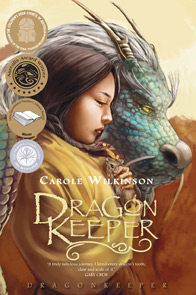
Dragon Keeper book cover
Cover image from Black Dog Books


DragonKeeper by Carole Wilkinson is a compelling fantasy/adventure series about a nameless slave girl in Ancient China whose job it is to feed the dragons.  Most boys past a certain age won’t put up with female central characters, but they sit still and listen for this one.  When the evil dragon hunter turns up to kill the last dragon for its body parts, she flees with it on an epic journey to protect a mysterious stone.  The book won the CBCA (Children’s Book Council of Australia) Book of the Year and took out a host of other awards, and my students and I went on to become keen fans of this wonderful Melbourne author. The sequel, Garden of the Purple Dragon, was shortlisted everywhere in 2006, Dragon Moon won the CBCA Award in 2008, and now there is a prequel – Dragon Dawn – which shows us Danzi as a young dragon, a mere 1000 years old.  A great favourite.

Sticking with dragons for the time being, I always read Lily Quench and the Dragon of Ashby by Natalie Prior to lure Years 3 and 4 students to reading.  Once again there is a female hero plagued by self-doubt, but she rises to the occasion (literally) when Queen Dragon lands in the grey, miserable town of Ashby and challenges the evil Black Count who has taken over everything and rules with an iron fist.  This one is rich in opportunities for discussion too, but it also features droll humour which eight and nine year old students can appreciate.  This is one of a series of seven, so the other six books are whisked off the shelves by borrowers before I’ve got to the end of chapter two…

The Deltora Quest by Emily Rodda series is a blockbuster.   Three trusty companions travel across Deltora to retrieve magic artefacts and defeat the evil Shadow Lord.  It’s a particular favourite with kids who play computer games involving collecting artefacts to fight off the Bad Guys.  No matter how many of these books I buy there are never enough, and I’ve given up trying to shelve them where they belong on the R shelf.  They have a tub of their own where the kids can riffle through looking for the title they want. (There are 15 in the series).

Another favourite is Truck Dogs, A Novel in Four Bites by Graeme Base.  He’s a picture book author and first editions of this book have full colour artwork, showing the bizarre creatures featured in this SF adventure.  It takes place at some time in the future in outback Australia when dogs have mutated into hybrid vehicles, part canine-part machine.  The hero, Sparky, (a Jack Russell/ute cross) is a scamp forever in trouble, but when a gang of Rottweilers come into town to steal all the town’s petrol, he leads the Mongrel Pack street gang to defeat Mr Big, (a Chihuahua/BMW cross) and save the day.  It’s an exciting romp with tongue-in-cheek humour and kids love it.

Do-Wrong Ron by Steven Herrick is completely different.  It’s a novel in free verse, and it tells the story of Ron who is good-hearted but manages to do almost everything wrong.  He tries to help Isabella’s grandmother who is too sad and lonely to go out of her house, and as usual things go wrong – but turn out right.  This is a great book for those under-confident kids who think they’re never going to belong, and the gentle humour is lovely.

Billy Mack’s War by James Roy is a great antidote to boys’ enthusiasm for war.   It’s set in 1945 and it tells the story of how shamefully the POWs were treated when they were evacuated back to Australia from Japan.  Billy doesn’t know his father, and he’s embarrassed and his loyalties are tested when he hears people talk about the POWs ‘sitting out the war’ while others fought.  His father’s experienced such horrors that he’s not coping with freedom very well. Not a book for under 11s, but a book that will intrigue older readers around Anzac Day…

Finally, although it’s British, I can’t resist including my favourite, Sir Gawain and the Green Knight, retold brilliantly by Michael Morpurgo, Britain’s Children’s Laureate.  This ancient tale from the 14th century takes place in Camelot, where on New Year’s Eve the feasting is interrupted by a strange green man who confronts the reputation of King Arthur’s knights with a fearsome challenge.  It is Sir Gawain who has to prove that he has courage, determination and honour, and it is this one that has my students pleading for me to read the finale even after the bell is long gone for them to go out to play.  We talk about the seven knightly virtues, and whether they still apply today; we talk about why Gawain says his life is less important than his king’s, and we talk about why flirting with your best mate’s girl is so wrong.  I read Michael Morpurgo’s version of Beowulf to Years 5 & 6 too and they love that as well (especially the gory bits), but it is Sir Gawain and his quest to do the right thing when tempted not to, who speaks to them across the centuries.

While nearly all my students love listening to stories in the library each week, I know that they don’t all turn into booklovers.  However some kids, who never used to borrow, now do so regularly and they’re in the library before school pestering me to buy new books as well.  I wish I knew the secret that makes this happen for more of them…

Back to Sue … Thanks Lisa for this inspired and inspiring guest post. Now, we’d love to hear your thoughts on the issue …