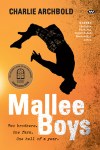
 Reading synchronicities strike again. Both my last read, John Clanchy’s Sisters, and this one, Charlie Archbold’s Mallee boys, are family stories with a guilt about the death of a family member at their centre. Both, too, are set in non-urban areas, Clanchy’s in coastal New South Wales and Archbold’s in the dry Mallee region of western Victoria. Here, though, the similarities end. Clanchy’s book chronicles a month in the lives of three late-middle-aged sisters, and the person who died was their four-year-old baby brother – a long time ago. Also, Clanchy is a male writer, writing about women, in third person voice. Archbold, on the other hand, is a female writer writing about men. Her subjects are farmer, Tom, and his two sons, Sandy and Red, 15 and 18 at the beginning. The death they are dealing with is their wife and mother, who died just a year before the book opens. This novel, which spans a year, is told in the alternating first person voices of the two brothers.
Mallee boys, however, also reminds me of another book about a farming father and two sons whose wife and mother had died, Stephen Orr’s The hands (my review), but while Orr’s book sits squarely in the literary adult fiction fold, Mallee boys is Young Adult fiction. Its concerns are, therefore, a little different, but it is worth looking at. It won the 2016 Adelaide Festival Unpublished Manuscript Award, and has now been shortlisted for the Children’s Book Council of Australia Book of the Year for Older Readers Award.
Now, that was a long intro – even for me – but I have managed, I think, to include in it a fair introduction to book and its main storyline. I’ll add that while the story is told in the alternating voices of Sandy and Red, the main protagonist is Sandy. He starts and ends the story, and he is presented as the more thoughtful, more reflective, of the two boys. Also, he is not the one carrying the guilt. This is his brother, who was with his mother when she, a pedestrian, was hit by a car.
Like Clanchy with his women characters, Archbold captures the voices of the boys and their father well, their tensions, their squabbles, and most of all the challenges they face in running their home without a mother’s touch! “Chops” for dinner again tonight says it all. Late in the novel, the father Tom admits to being lonely, but his pain is not the focus, this being a YA novel. Sandy is in Year 10, and as a rural boy, is at schooling cross-roads. Their farm can’t afford to send him to boarding school in the city, but can he get a scholarship? Red, on the other hand, is not the scholastic type. He has left school and works the farm with his father, with the usual father-son tensions. Added to this are the boys’ relationships with their friends – not all of whom are “suitable” but Red, in particular, can’t be told and needs to learn the hard way. And, of course, there are girls.
This is all told naturally, neither sensationalised nor sentimentalised, but with enough drama, and humour, to keep readers, particularly the intended audience, interested. I wouldn’t call this a crossover novel exactly, but I did enjoy the read despite its YA intent.
Underpinning the narrative, the plot, is the setting, and this also the London-born Archbold, who has lived and worked as a teacher in the area, evokes beautifully. The setting is the Mallee, which borders the riverland area in which Laguna’s The choke (my review) is set. It’s a dry area, known for sheep and dryland crops like wheat. Farming is tough here, but communities are close. This comes through too, with locals helping each other out, in the natural way people do, something which is surely good for young readers to see and relate to. I do love to see good – but realistic – role modelling in media!
In addition to this, there’s the language. I enjoyed the descriptions of the Mallee, such as Sandy’s of Lake Bonney:
When the river runs low, the water in the lake huddles to the middle, leaving it fringed with smelly sticky mud. It’s a strange place. Because of the drought a lot of the trees around the edge have died. Bony old river red gums stick in the ground like a perching cafe for pelicans and kookaburras.
Tom, the father, tells Red what’s kept him going, despite his loneliness:
“I know it’s the rhythms of nature that have kept me going. This isn’t a glamorous landscape, but it’s in my veins.”
And I enjoyed how the boys describe feelings. Here’s Sandy describing his brother Red:
He acts hard because it gives him control but I know he’s all mushed up inside. Like a beetle with soft guts crammed in under the shell.
And here’s Red, just after his girl has suddenly broken up with him without explaining why:
And so she’s left me hanging, like a daggy bit of wool caught on a fence. Knotted in with no way to break free.
As you’d expect in a coming-of-age story, lessons are learnt, wisdom gained. Sandy says near the end, and this is surely one of the novel’s themes:
… because time doesn’t heal all wounds, like Dad once told me, but it does scab over them.
It sure does. And every now and then those scabs break off and have to re-form, n’est-ce pas? An effective metaphor I think.
Mallee boys, then, is an engaging book about growing up, about facing some of the hardest challenges, and most of all about being male. It’s a book that has something to offer both rural and urban young Australians, and I hope it gets widely read.
 Charlie Archbold
Mallee boys
Mile End: Wakefield Press, 2017
285pp.
ISBN: 9781743055007
(Review copy courtesy Wakefield Press)
 Whispering Gums