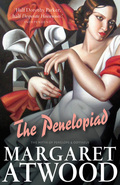
The Penelopiad bookcover (Courtesy: Text Publishing)
This is the second time I have read Margaret Atwood’s The Penelopiad. Much as I enjoyed it the first time around, I probably wouldn’t have read it again if it hadn’t been scheduled for one of my online bookgroups. However, given that scheduling and the fact that I had recently listened to Simon Armitage’s dramatisation of The odyssey, I didn’t mind reading it again – and it is short! My rereading though ended up being a little disjointed as I was trying to finish off a number of competing contracts at the time as well as prepare for a ten-day trip to our warm Top End. This review may be similarly disjointed!
The book is part of Canongate’s Myths series in which recognised writers were asked to retell well-known myths. At the time of publication, Atwood said that she tried a number of myths and had nearly given up when she suddenly recollected the story of Penelope and her hanged maids – and her childhood reaction to it. The result is a rather fresh – and cheeky – look at the story told through Penelope’s and the hanged maids’ eyes, from, not surprisingly, a feminist (or at least female) perspective.
The story is told through a large number of short chapters in Penelope’s voice, and these are interspersed with commentary from the hanged maids, emulating, appropriately enough, the idea of a Greek chorus. The way Atwood uses it, the chorus provides a satiric perspective on Penelope’s view of the story. The story is told in flashback, with the narrators all speaking from Hades, where they now reside. It is not a standard revisionist feminist treatise that simplifies the world to one of gender power discrepancies (even though that is what underlies it all). We get to “feel” what it might have been like to have lived then. Atwood’s characters are “real” and operate in a complex world where game-playing and manipulation are de rigueur if you are going to survive.
In Homer, Penelope is presented as “the quintessential faithful wife” (Atwood’s introduction) who brings up their son and cleverly fends off suitors while waiting patiently for Odysseus’ return. When he returns, he kills the suitors and twelve of Penelope’s maids. Atwood, again in her introduction, says that in choosing to tell the story through Penelope and the maids she wanted to focus on “what led to the hanging of the maids, and what was Penelope really doing?”. Her Penelope is something rather more than the constant wife of The odyssey. She, the part daughter of a watery Naiad, is a slippery character to pin down. She is highly jealous of her beautiful cousin Helen (she of Troy fame) and she is capable of making her own power plays. She is of high birth, contrasting her with the twelve maids who, by their own admission “were born to the wrong parents. Poor parents, slave parents, peasant parents, and serf parents…”.
What I enjoyed most about this book – besides the story Atwood tells – is its sly humour. It is genuinely funny, albeit in a dark or sometimes gruesome way. Much of the humour arises out of Penelope’s playing with the truth. In fact the book plays continually with the idea of “stories”. In the first chapter, Penelope says:
Now that all the others have run out of air, it’s my turn to do a little story-making. I owe it to myself. I’ve had to work myself up to it; it’s a low art, tale-telling … So, I’ll spin a little thread of my own.
A little further on in the book, she says, when reporting one of the prevailing stories about her, that “there’s some [my emphasis] truth to this story”. And so, as we read we need to remember that she too is telling us a story, and that there’s no guarantee that her story is any more “true” than another’s. This idea is reinforced by the fact that the maids comment on what Penelope tells us. Their and Penelope’s perspectives are not always the same. That is, their truths are different. This notion of stories versus stories is made even more clear in the chapter titled “Waiting” in which Penelope recites all the opposing stories and rumours about what Odysseus was doing/what was happening to him during the 10 years of his return. Reader beware, I say. In fact, at one point in the book where Penelope questions whether the “maids were making some of this up”, I wrote in the margin “Where is the truth”? I love the way Atwood plays with myth-making in a book about a myth – and, in doing so, also calls into question her own storytelling. Very postmodern!
I won’t go on. It’s a little uneven, with the maids’ story in particular being not quite as well integrated as it perhaps could. And yet, I’d recommend it, if you haven’t already read it. It’s clever, funny and compassionate – but its compassion is not a naive one. Rather, it has wide open eyes and knows that nothing is ever as simple as it looks – particularly when you find yourself in a situation where there is imbalance of power. Games will be played – and the powerless, such as women and particularly poor maids, will usually lose. And this, in the end, is Atwood’s (somewhat heavy-handed) point. As Penelope says in her last chapter:
Even with my limited access I can see that the world is just as dangerous as it was in my day, except that the misery and suffering are on a much wider scale. As for human nature, it’s as tawdry as ever.
Margaret Atwood
The Penelopiad
Melbourne: Text Publishing, 2005
199pp.
ISBN: 9781920885953
NB: Cover image used above is from the new 2007 edition.

 Whispering Gums