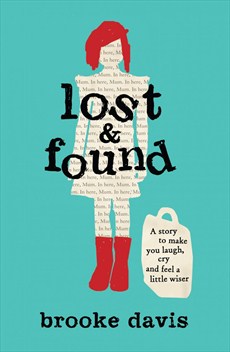
 I must say that my antennae go up when I hear a book being touted as a publishing sensation even before it is published, as Brooke Davis’ recently published debut novel Lost & found, was. What does that mean? That it was the subject of a mega-dollar bidding war like, say, Hannah Kent’s Burial rites? Well, not necessarily, but Davis’ novel, according to hoopla.com, was “one of the hit titles at the 2014 London Book Fair and has since gone on to sell into 25 territories”. The question is, does it live up to this, hmm, hoop-la?
You’re all going to die (Millie)
I’ll start by saying that this “sensation” comes dressed as a light book and is, in fact, an easy and delightful read, but it also offers something more, content-wise and stylistically. For those of you who haven’t heard, the novel was inspired by Davis’s grief over the sudden death of her mother in a freak accident in 2006, and was written for her doctorate at Curtin University. It tells the story of three characters: seven-year-old Millie whose father has died and whose mother subsequently abandoned her in a department store; 87-year-old Karl whose wife has died and who has escaped the nursing home to which his son had abandoned him; and 82-year-old Agatha who hasn’t left her house since her husband died seven years ago, and who fills her day shouting insults at passersby. Three lost characters who come together, looking, though not initially consciously, to understand the old question: what is life about, or, more specifically, how do you live life when it is defined by loss, or even, as Agatha wonders, wouldn’t it be better to never care for anyone?
At the end of my edition is a short version of an article titled “Relearning the world” that Davis wrote about grief. If you have experienced the terrible grief of sudden or before-its-time loss, you will relate to much of what she writes. She talks of the moment when the loss becomes real (a moment I vividly remember in my own life), and of “feeling outside of everything and looking in” (another sensation I remember). She talks of theories of grief, like Elizabeth Kubler-Ross’s, and how it makes sense because “we like order”. “Isn’t that”, she asks, “why we like narrative?”. But, she says, there’s been a backlash against the compartmentalisation of grief towards a recognition of “the disorder of grief”. Grief, she has learnt, is part of everything she says and does, all that she is. It is never resolved.
We’re just living, Derek (Karl)
This all sounds pretty heavy, albeit sensibly heavy. Davis’s book, however, is quite the opposite. The narrative line owes something to the picaresque novel, and the linear but choppy structure supports this form. The main body of the story concerns a rather wild and wacky journey the three characters take, some of it on the Indian Pacific train, to help Millie find her mother. As befitting the picaresque, they meet various colourful characters along the way, such as Stella the bus driver and Derek the train conductor. As the journey progresses, the adventures and mischief get sillier and sillier, and less and less “real”. But then, this isn’t a realistic novel. In fact, it is quite slapstick, which is not my favourite form of humour. However, Davis makes it work, pretty well anyhow, because we are invested in her characters by then. We want them to find what they are looking for – or something equally worthwhile.
Old is not a choice (Agatha)
Davis also makes it work because of the voice. Using third person, it’s fresh, and direct, and authentically captures the perspectives of a curious young child, a loving old man, and a grumpy old woman. It might be a “light” novel, but it’s not a prosaic or formulaic one. Each character is associated with various “things” or “recurring behaviours”. Just Millie writes “In here Mum” messages whenever she goes to a new place so her Mum can find her. Karl the Touch Typist, who had deeply loved his wife Evie, carries around Manny the store mannequin, with which he had helped Millie escape the authorities in a department store and which is mistaken for a sex doll by some of the people he meets. Agatha Pantha, a closed-off woman who had not been a kind wife, has her Age Book, in which she obsessively records her day in third person. Some of the character “associations” might, depending on your point of view, be a little overdone, just as the slapstick, depending on your tolerance, may be pushed a little too far. Overall though, I found Davis’ characterisation effective and engaging.
All this is supported by the narrative, which is moved along through delightful language, from the zippy dialogue to tight descriptions that nail with their acuity.
Here, for example, is Agatha trying to explain to Millie why at seven she can’t start a family:
You can’t get pregnant.
Why not?
You have to get your! Your! Agatha gulps. Your monthly womanly visitor!
Are they from the government?
Good God, no!
Where from then?
They’re not from anywhere!
Why are they called visitors, then?
That’s just what we say!
Who?
Agatha sighs loudly. Okay, I give up! Someone from the government comes to your house and makes you a woman!
Millie eyes the breastfeeding mum, and leans in close to Agatha. Will they bring me boobs too? she whispers. Because I’m not going to take them.
And here is Millie’s view on dates on gravestones:
The start date and the end date are always the important bits on the gravestones, written in big letters. The dash in between is always so small you can barely see it. Surely the dash should be big and bright and amazing, or not, depending on how you had lived. Surely the dash should show how this Dead Thing had lived.
Besides the loss-grief theme, Lost & found is about many things – loneliness, love, friendship and caring, and, above all, about taking risks because this is your life. It’s not a challenging novel, as it wears its heart on its sleeves, but it is lively, inventive and wise. It will be very interesting to see what Davis does next.
 Brooke Davis
Lost & found
Sydney: Hachette Australia, 2014
280pp.
ISBN: 9780733632754
(Review copy courtesy Hachette Australia)



 Whispering Gums