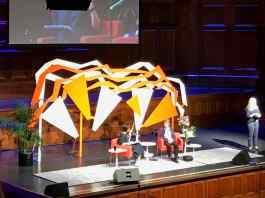
Krasnostein (L) and Garner (R), & Auslan interpreter
To say I was thrilled when Son Gums’ partner offered to buy tickets for us to see Helen Garner in conversation (last Saturday) would be an understatement. I have never seen Garner live before so that would be one bucket-list item ticked had I a bucket list! The fact that the conversation was to be conducted by Sarah Krasnostein (author of The trauma cleaner) was the icing on the proverbial cake.
This conversation was, in fact, the opening event of the Wheeler Centre’s inaugural Broadside Festival, promoted as “two days of an unapologetically feminist agenda”.
The Festival was opened by the Governor of Victoria, Linda Dessau, who referenced Barack Obama’s recent statement that “tweeting and hashtagging isn’t activism”. Festival Director Tam Zimet then started proceedings, explaining that the Festival’s purpose was “to bring conversations that are too hard or too much to Melbourne Town Hall”. She quoted Zadie Smith who was also in Melbourne for at the Festival, and who described writing as “taking the temperature of the moment”. This, of course, beautifully describes Helen Garner’s writing.
The Conversation
 The conversation centred around the recent release of Garner’s Yellow notebook: Diaries, Volume 1, 1978-1987, so the conversation began by discussing both diary writing and the process of preparing them for publication. Krasnostein, who asked rather long but always thoughtful questions, talked about the role and function of diaries, suggesting they exist for their own sake but are also works in themselves. Garner’s diaries, she said, contain harvested and preserved details from the world, but also show Garner’s “fearless self-scrutiny”, plus “the things one can think but not say”. Garner said that she has always loved notebooks and pens, and how as a child she loved the peace and solitude she got from writing her diaries.
Several times through the conversation, Garner described her diary-writing as being partly about practising writing. She writes everyday, agreeing that you can’t wait “for ideal conditions”. For her, it’s all about “mother discipline”, by which she meant using the time given to you. She also commented on how much work you do when you are asleep, and referred to lessons from Marion Milner’s book, An experiment in leisure which taught her to sit quietly, with a sense of “nothingness”, to let ideas sort themselves out. This is not the same as waiting for inspiration, though. Garner, being her plainspoken self, said that “inspiration is bullshit”. Instead, “you do things little by little”. Writing, said Krasnostein a little later, is not the hard part. It’s getting to the desk.
Later in the conversation, we returned to diary-writing as stacking up the practice hours. Garner said she knows “how to put a sentence together”. (If you love Garner, like I do, you love her sentences.) But, said Garner, writers also need to know grammar. Without it, you can’t criticise your own work. The lack of grammar teaching is a “terrible loss”. Writers also need to read a lot to see how other writers do it. She bemoaned the fact that some books look like no editor has been near them. You see their “life-force leaking out of every joint”.
Krasnostein quoted Joan Didion’s statement that “style is character”, which somehow led to Virginia Woolf’s statement that you tell the truth about yourself first before you can do so about others. Krasnostein wondered whether being clear-eyed about yourself – one of Garner’s strengths, for me – was training for how to write in public. Garner took this to suggest that being honest about yourself gave you permission to write about others, but she didn’t think that would “stand up in court”! Garner suggested that memoirs can sometimes play fast and loose with other people!
Around here, Krasnostein asked whether revisiting earlier diaries – for any of us I think – shows that we are unreliable narrators of ourselves! Garner essentially agreed, saying that “memory is a creative act”. Reading one’s own diary “can be bracing” because it shows how over time you change stories, often showing yourself in a better light. There’s no way out of this, Garner believes, you just do the best you can. “Everything is fleeting, fleeting, fleeting”, she said. Writers write down stuff because they are terrified of forgetting. (I know the feeling!) “Writers are afraid of losing things”. This returned us to an idea that recurred through the conversation, that of writers preserving. Krasnostein quoted Philip Larkin’s statement that “the urge to preserve is the basis of all art”.
Of course, the process of making private diaries public was also discussed. Garner said she cut a lot. Her challenge was to decide what others might find interesting. She established certain criteria, such as she would not rewrite, and would only change (or add) something if it would otherwise be meaningless. A diary, she said, “has no voice over, unlike a memoir”, meaning that you can’t say “I did that then, but no way would I do that now, because now I’m a nicer person”. Accepting herself as she was at the time of her writing brought her to understand that she wasn’t unique, which made her feel more “comradely” with others. “We all hurt and are hurt,” she said. Krasnostein offered the idea that “the more vulnerable you are, the more you connect” to which Garner replied that this is what she hopes!
Another point Garner made was that tone is important, that “tone is character”, to which she then gave a feminist twist by saying that women have felt they’ve had to tone themselves down. She writes short books, she said, because she feels she has only a limited amount of reader’s attention.
I loved Krasnostein’s summation of the diaries as offering a new expansive view of Garner, but retaining her familiar voice, her “forensic eye for detail”, and her “lean lyricism”. I can’t wait to read my copy.
Q&A
There were several questions, but I’ll just share a couple:
- on her daily writing practice: She rents an office, which stops her getting caught up housework! (In other words, she has “a room of her own”!) I particularly liked her point that she makes her notes about the details, say, of the court cases she attends, but, separately, she also documents her engagement with what she’s seen/heard, what she thought and felt. This material is “brightly alive … a treasure trove of information”. It doesn’t fit into the other boxes but it’s the richest when she comes to write. This is what I think is often missing from my reports of literary events. I need to do more of it.
- on whether her views on Feminism had changed since the me-too movement: Not really seemed to be the answer. Garner, like many of us I believe, simply knows that when she discovered Feminism it changed her life: “It was like I’d been underwater and I finally put my head up and took a breath.” The me-too movement, like most movements, has been mixed, but “these things keep developing”.
Kate (booksaremyfavoaiteandbest) also wrote this up – including Garner’s comment about age freeing her to talk to random people on trams.
Helen Garner in conversation with Sarah Krasnostein
Broadside Festival 2019
Melbourne Town Hall
9 November 2019
 Whispering Gums