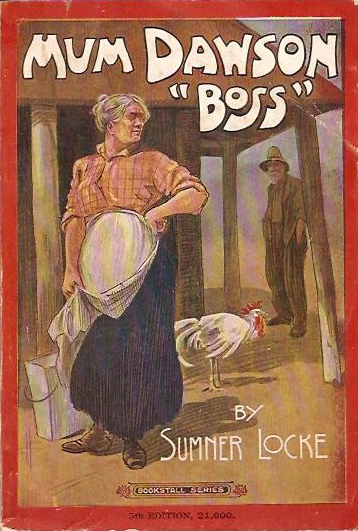
Monday musings on Australian literature: on 1924: 1, Bookstall, again

During 2022 and 2023, I wrote a series of posts on Australian literature as it was read, and thought about, a century earlier, in 1922 and 1923. Last year, I researched 1924, with a view to doing the same, and in fact heralded the upcoming 1924 series, but didn’t end up writing any posts. This was partly because many of the concerns were the similar to those of 1923, and partly because other ideas overtook me. But there were some interesting things said, so, nearly a quarter of the way through 2025, I’ve decided to write at least a couple of posts relating to 2024, starting with the Bookstall Company’s Bookstall series of Australian fiction.

This series of cheap paperbacks of Australian novels, as I have posted before, were introduced to the Australian market in 1904. I featured them in posts on 1922 and 1923, and am here updating us with 1924’s output. The series continued to serve its purpose, it seems, of supporting Australian writers as well as of providing reading matter at an affordable price. The Queenslander, introducing two new books in the series, started its brief article on June 7 with:

Australian novelists owe a great deal to the New South Wales Bookstall Company, which, during the last few years, has published more than 200 novels by Australian writers. 

Sydney’s The Labor Daily made a similar comment on December 16.

As far as I can tell from the research I did, publication did slow down with significantly fewer books published in 1924 than in 1923. Here is what I found.
  • Roy Bridges, By mountain tracks
  • Ernest Osborne, The copra trader
  • S.W. Powell, The trader of Kameko: South Seas
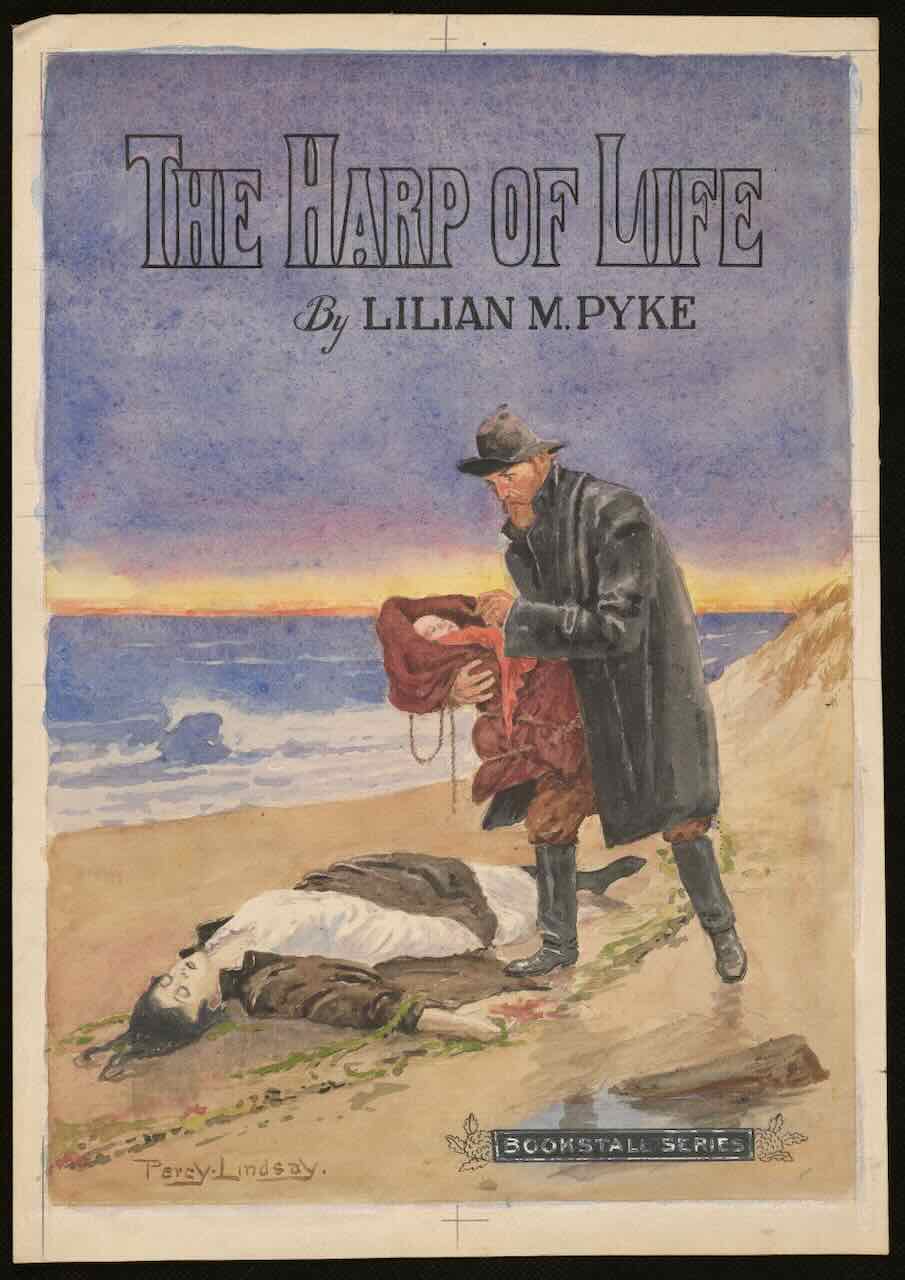
  • Lilian M. Pyke, The harp of life
  • W. Sabelberg, The key of mystery
  • H.E. Wickham, The great western road

So, just 6 books, compared with 20 in 1923, and only one by a woman. (There may have been a few more, but it’s these six that kept popping up in my searches.) Most are adventures of some sort and most feature a “love interest”.

Bushranger stories were still popular at this time, even though the worst of the bushranger era had ended by the 1880s. Both Roy Bridges’ By mountain tracks and Wickham’s The great western road belong to this genre. That said, Bridges’ book is described in The Queenslander (7 June) as “a story associated with the Kelly gang, but the theme generally is that of a romantic love episode”.

Two of the books, those by Pyke and Sabelberg, seem to be contemporary stories, Pyke’s being a tangled story about a waif rescued from the arms of its dead mother on a Queensland beach, and Sabelberg’s a mystery/thriller.

Adventures in the South Seas were apparently making a come-back around this time, with Jack McLaren (who appeared in my 1923 post), Ernest Osborne and S.W. Powell all setting books there. Hobart’s World (12 February) wrote of Powell’s novel as being “full of incident and adventure, and aglow with the rich color of the South Seas. A good shilling’s worth.” This latter point was frequently mentioned in reviews of Bookstall books. Indeed the World, in the same article, said of Wickham’s novel that

“Most of the characters in the book are well-drawn, and convincing, and there are humorous episodes to relieve the tragedies, and compensate for the author’s rather marked tendency to waste words in trite moralisings, and in a too-conscious elaboration of dialogue. Just the same, it is a marvellous shilling’s worth.”

Most reviewers of these books understood their intention as escapist reads or, what we would call today, commercial fiction, and wrote about them within that context. They either praised the works – with one, in fact, describing Osborne’s novel as “brilliantly written” – or, where they were critical, they tempered it with this understanding, as in the Powell example above. However, a report in the Murray Pioneer and Australian River Record (5 December) was not so generous. Sabelberg’s The key of mystery, it said, “is a crude murder story, crudely written”; Powell’s The trader of Kameko, “is a story, with no literary merit, of a white man, two brown girls and a hurricane”; and Wickham’s The great western road “is a story of the early gold rushes in N.S.W. of the same crude character as the other two”. Of course, reviewers do pitch their writing to their audience. Perhaps readers of the Murray Pioneer and Australian River Record had more refined tastes, and more money to spend, and our writer recognised that?

Some newspaper articles noted that some of these writers had already developed their writing skills in other forms. Sabelberg and Wickham, for example, are described as established, successful short story writers, and Lilian Pyke as a writer of “capital” stories for boys and girls – all of which proves, I guess, the point about Bookstall’s role in supporting Australian writers. How better to cut your teeth as a novelist than with a company like this?

And I will leave 1924 on this point. Life has been very busy this last week … so I have not been able to pay as much attention to reading and my blog as I’d like, but I do hope to post a review this week.
Monday musings on Australian literature: on 1923: 1, Bookstall Co. (update)

Last year I wrote a series of posts about 1922, drawing primarily from Trove. I enjoyed doing it, and have decided to repeat the exercise this year, and perhaps continue annually, to build up a picture of the times. My first 1922 post was about the NSW Bookstall Company which was established in 1880, but which around 1904 began publishing and selling Australian books for one shilling each. When I started my 1923 Trove search, this company featured heavily, so I’ve decided to lead off with an update of it.

Now, I noted last year, that the company’s longstanding managing director, A.C. Rowlandson, had died that year, but that the company planned to continue. During this year’s research, I found that in 2000 the University of Melbourne’s Baillieu Library put on an exhibition titled “Sensational Tales: Australian Popular Publishing 1850s-1990s”. One of the “tales” concerned the NSW Bookstall Co. They confirmed that the Company had “helped make writing a viable occupation for a generation of Australians, a number of whom – including Norman Lindsay, Vance Palmer and ‘Steele Rudd’ – achieved lasting reputations”. However, they also say that the Company’s publishing program did decline after Rowlandson’s death, and that it issued fewer than 70 titles between 1924 and 1946. By the end of World War II, the Company had “reverted to being a retail distributor of books and magazines”. How much of this decline was due to Rowlandson’s death and how much to changing times, they don’t say, but, from what I’ve read of him, I suspect the former played a role, as Rowlandson was clearly a powerful and inspirational force.

Anyhow, on with 1923. I plan to share the fiction that I’ve identified as published by them in 1923. What is interesting is not just who the Australian authors were and what they were writing, but what the reviewers and commentators were saying about both the company and the specific books, and what it all reveals about Australia’s literary environment of the time.

Bookstall Series books, 1923

Although the University of Melbourne’s exhibition notes the company’s decline, it was still going strong in 1923:

  • Vera Baker, The mystery outlaw (pub. 1920, and 1923)
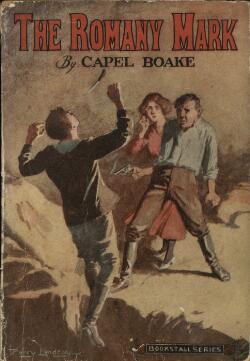
  • Capel Boake, The Romany mark
  • Dale Collins, Stolen or strayed
  • Arthur Crocker, The great Turon mystery
  • A.R. Falk, The red star
  • J.D. Fitzgerald, Children of the sunlight: stories of Australian circus life
  • Jack McLaren, Fagaloa’s daughter
  • Jack North, A son of the bush
  • Ernest Osborne, The plantation manager
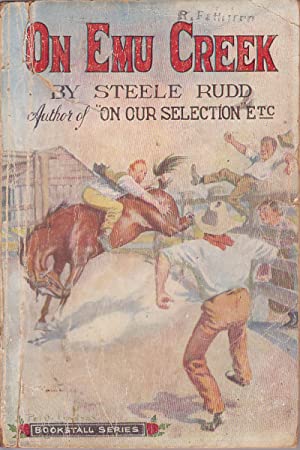
  • Steele Rudd, On Emu Creek
  • Charles E. Sayers, The jumping double: a racing story
  • H.F. Wickham, The Great Western Road

Most of these authors are male. Indeed, Capel Boake and Vera Baker seem to be the only woman here.

I found several references for most of the books listed above. Some were not much more than listings, and some seemed to be somewhat repetitive (which could be due to syndication and/or drawing from publisher’s publicity. It’s hard to know without deeper analysis.) However, there was also some more extensive commentary.

First though, as you can probably tell from the titles, the books tend to be “commercial” or genre books, most of them adventure with some mystery thrown in. One of my 1922 posts focused on the time’s interest in adventure, so I won’t repeat much of that except to say that many of the reviewers/columnists talked about “thrills”, “exciting reading”, fast pacing, and the like. The majority of the novels are set in the bush, reflecting our well-documented ongoing interest in outback stories. But A.R. Falk’s detective novel The red star, is set in Sydney. The Brisbane Courier’s reviewer (23 June) argues that Australian writers hadn’t “developed the field of detective fiction to any extent”, which is interesting given its popularity now. This reviewer praises the book saying that Falk had “written a far better detective story than the majority of those that are imported”. S/he says that “the fight between detectives and a clever gang of thieves and murderers is told in a very convincing manner” and that while “the ending, perhaps, is forced” the story “takes a high place among current detective fiction”.

That’s higher praise than some of the books received at the hands of our reviewers. J.Penn tended to write a little more analytically. I haven’t been able to identify who J.Penn is, but s/he wrote a new books column in Adelaide’s Observer and Register titled “The Library Table”. S/he generally praised Ernest Osborne’s The plantation manager but did note a weakness at times for ‘making people “talk like a book”‘ (Observer, 5 May) and was critical of Steele Rudd’s On Emu Creek which s/he felt lacked the satirical edge of his Dad works. S/he writes that “Steele Rudd is firmly convinced that his readers will find sufficient fun in the mere fact of some one being humiliated or hurt, without the author’s having to worry to hunt for words” (Register, 19 May). The Murray Pioneer and Australian River Record (3 August) described On Emu Creek as humorous but qualified this with “the reader may be pardoned if he fails to see in the more recent books the same rich vein of humor that characterised the earlier chronicles of the Rudd family” while The Age (5 May) was gentler, calling it “an agreeable story, without any affectation of style, and containing points of humor”

Penn described (Register, 21 April) Dale Collins’ Stolen or strayed as ‘a “shilling shocker” of modern Australia’. Set mostly on the Murray, “it is,” writes Penn “a joyous yarn, and, as generally happens nowadays, the literary style is more than worthy of the tale it unfolds”. Interestingly, though, Collins’ book generated more disagreement than most. The Queenslander (12 May) was less impressed, saying that “neither the workmanship nor the characterisation show any especial ability” and The Sun (22 April) said that “It is a story just good enough, so far as construction is concerned, to lead one to hope that the author will do much better some day.”

Overall, several reviewers commented along the lines of Perth’s Western Mail (26 April) reviewer, who said, regarding Stolen or strayed and The planation manager, that “both books will no doubt be read with avidity by those who care for stories of this kind”. This is fair enough given these readers were Bookstall’s target market.

Now, some quick observations, before closing. I was interested that some reviewers seemed to give the whole plot away, which we don’t see now. Also, I’ve not (yet) been able to identify several of the authors, but a few were also journalists – like Dale Collins and Jack North – and some used pseudonyms, like Capel Boake about whom I’ve written before.

Finally, despite what seemed to be qualified praise for many of the books, it’s clear that the endeavour was valued for providing a career for Australian writers and illustrators at a time when they struggled to get published. And, as Hobart’s Mercury (18 August) wrote

Beyond question, they are more than worth the money, the thing most prejudicial to their success being the gaudy “Deadwood Dick” types of covers in which they appear.

Trove (et al) under threat

You all know how much I rely on Trove. Back in 2016 I wrote a post in support of it when its survival was threatened. Well, it’s under threat again, and Lisa posted on it today. She references an(other) article in The Conversation that addresses not only the situation for the National Library of Australia and Trove, but other significant national cultural institutions like the National Film and Sound Archive and the National Gallery of Australia. These services and institutions are the lifeblood of academics, writers, journalists and other researchers (professional and general). Their role is to acquire, preserve and make available our heritage. They are not dispensable. They are essential.

Monday musings on Australian literature: on 1922: 1, Bookstall Co.

I haven’t done many Trove-inspired posts lately, but, I do enjoy pottering around Trove’s Newspapers and Gazettes database, so thought that for today’s Monday Musings I’d have a little look at what was happening in the Australian book world in 1922. My broad search retrieved around 8,000 articles! I can’t read them all, but I found several items of interest, to me at least, that I’d like to share, which I’ll do over the year.

For my first post, I’ve chosen a new publisher to me. In the Books Received column in the Kadina and Wallaroo Times of 8 March, the columnist refers to the N.S.W. Bookstall Company, writing “now that publishing difficulties have eased, the N.S.W. Bookstall Co. proposes to add rapidly to its popular Australian fiction series”.

Who was this company I wondered? Well, they were “notable” enough to have a Wikipedia page, and the man who turned it into a successful business, A. C. Rowlandson, has an entry in The Oxford companion to Australian literature. The Companion tells me that in 1991, the book, The New South Wales Bookstall Company as a publisher, by Carol Mills, was published. The Publishing History website also devotes a page to them.

So, the company … It was started by Henry Lloyd around 1880 as a newsagent, with its first foray into publishing possibly being racebooks for the Hawkesbury Race Club around 1886. The Wikipedia article stops with a discussion of World War Two, which suggests that the company folded soon after the war, but I haven’t confirmed this.

I have however found out a bit about Alfred Cecil Rowlandson. He started with the company in 1883 as a tram ticket seller, presumably from one on the company’s bookstalls. Wikipedia says that “the greatest part of the company’s business consisted of retailing local, interstate and overseas periodicals, postcards (Neville Cayley produced a series) and stationery from its eight city shops and fifty-odd railway stall outlets”. Rowlandson worked his way up, and in 1897, bought the company from Lloyd’s widow. He ran it from then until his death in, coincidentally, mid-1922.

From the Bookstall series. Image: Publishing History website

He was clearly a visionary, because, as the Companion says, the company became “one of Australia’s most successful book-publishing and selling ventures, publishing in paperback about 200 titles by Australian authors and selling four to five million copies”. The above-linked Publishing History page lists some of its books in chronological order, while the Wikipedia page lists a selection by author’s name. The authors include names familiar to me like Louis Becke, Charles Chauvel, Norman Lindsay,  Sumner Locke, Vance Palmer, and Steele Rudd.

Rowlandson came up with the idea of selling Australian books at one shilling each, and created the Bookstall series in 1904. Wikipedia says that despite his belief in a market for cheap Australian books, the prospects were not encouraging, because Australians had not shown much faith in the the work of their own novelists.

However, Rowlandson put his money where his mouth was. He paid £500 for the publication rights for Steele Rudd’s Sandy’s Selection. It was the largest sum paid in advance for an Australian book at that time. Rowlandson also apparently spent “comparatively large sums in readers’ fees”. And, he believed, it seems, in bright catchy covers, employing artists and cartoonists as illustrators, like Norman Lindsay, Sydney Ure Smith, cartoonist Will Dyson, and war artist George W Lambert.

The Companion says that “the remarkable sales of of these Australian books confirmed Rowlandson’s intuition that the Australian reading public was keen for local reading matter, and the impact of his company on the development of Australian writing was considerable.”

Now, back to Trove. The columnist of the aforementioned Kandina and Wallaroo Times, writing, remember, in 1922, says “now that publishing difficulties have eased, the N.S.W. Bookstall Co., proposes to add rapidly to its popular Australian fiction series”. My guess is that these “publishing difficulties” stem from the war. The Companion says that during the war, due to the shortage and cost of paper, the “bob” (or “shilling”) price was increased by threepence, but Rowlandson – good for him – reverted to the “bob” after the war.

Anyhow, our columnist wrote that three new novels were in the presses, and that “the enterprising publishing house” had nearly 20 more under way. One of the books was S.W. Powell’s Hermit Island. It’s “of the Islands adventure class, but, like its predecessor, is off the beaten track”. Our columnist says that the predecessor, Powell’s first novel, The maker of pearls, was “one of the best of last year’s contributions to Australian fiction”. Still 1s 3d at this stage. 

Rowlandson died in June 1922 at the age of 57. Soon after, in July, Freeman’s Journal advised that the Company’s intention was to “continue the publication of Australian novels at popular prices, as during the life of the founder, Mr. A. C. Rowlandson, the late managing director”. Founder? Not correct. And so inaccuracies creep into the historical record, eh?

Freeman’s columnist goes on to say that

The late Mr. Rowlandson had profound faith in the literary resources of the Commonwealth, and during his life was wholly responsible for the publication of at least 150 Australian novels, the sales of which have totalled nearly four millions. During recent years the standard of the series has been steadily improved; and the manuscripts now in hand show still further improvement. 

And, s/he announces that the next book is Vance Palmer’s The boss of Killara, which is “an entertaining story, … most entertainingly written, and … true in every detail to Australian, bush-life”.

Trove provides information about more books published in 1922, including:

  • J.H.M. Abbott’s Ensign Calder, which contains stories which originally appeared in the Bulletin. These are historical fiction, being set in the nineteenth century during the governorship of Macquarie. The Western Mail‘s correspondent says that the stories “are very faithfully rendered, and … highly amusing”.
  • Hilda Bridges’ The squatter’s daughter, which interests me because it’s an adaptation of a 1907 play pf the same name by Bert Bailey and Edmund Duggan. The play was adapted into film twice, one silent and one talkie, as well as into this novel. The Midlands Advertiser says it’s “capably written, and gives a faithfully and permanent record of the play”
  • Jack McLaren’s Feathers of heaven from, says Freeman’s Journal correspondent, “one of the most popular Australian authors”. It’s set in “the wilds of New Guinea” and is “a novel of stirring adventure written round the illegal hunting of New Guinea’s beautiful birds-of-paradise”. A volume of “wholesome adventure”!

Of course, there were also reports of Rowlandson’s death, funeral and estate, but I’ll end with some comments on his legacy from the The Australian Worker:

Some of the writers taken up by A.C.R. have since capitalised their ‘bob’ start, and made overseas reputations. Rowlandson, by instinct and practice, was a tremendous live-wire hustler, and probably his business intensity contributed to his all too early death—a death which will grieve hundreds of thousands who enjoyed cheap local fiction of exceptional merit as a result of his enterprise, and by scores of young writers who never would have been heard of only for his faith in local literary products, his kindly and sympathetic disposition, and his never-resting determination to give Australian literature a show.