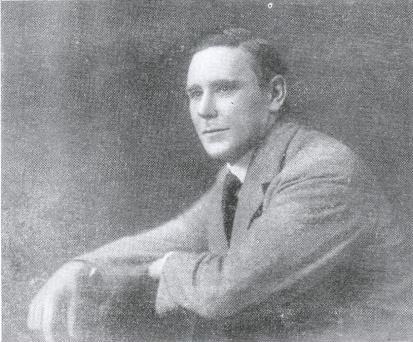
Bernard Cronin (1884-1968) has featured in this blog a couple of times, but most significantly in a Monday Musings which specifically featured him. He was a British-born Australian writer who, in his heyday in the 1920s to 40s, was among Australia’s top 10 most popular novelists. And yet, along with many others of his ilk, he has slipped from view. However, I did find a short story of his published in 1954 so decided this was my opportunity to check him out.
The reason I wrote my Monday Musings on Cronin was because in 1920 he founded (with Gertrude Hart) the Old Derelicts’ Club, which later became the Society of Australian Authors, but I have mentioned him in other posts too. For example, in one post, I noted that in 1927, Tasmania’s Advocate newspaper had named Cronin as being “amongst the leaders of Australian fiction”. And, in my post on Capel Boake I shared that he had written collaboratively with Doris Boake Kerr (aka Capel Boake) under the pseudonym of Stephen Grey. In fact, he used a few pseudonyms, another being Eric North, which he used for his science fiction. Cronin wrote across multiple forms (publishing over twenty novels as well as short stories, plays, poems and children’s stories) and genres (including historical fiction, adventure stories, metropolitan crime fiction, romances, and science fiction and fantasy).
Wikipedia’s article on him includes a “partial” list of his works, with the earliest being The flame from 1916, and the latest novel being Nobody stops me from 1960. What the list tells us is that his most active period occurred between 1920 and 1950, so the story from 1954 that I read comes late in his career.
I had initially chosen a different story, “Carmody’s lark”, which was published in late 1954 in several newspapers, but belatedly discovered that one paper had printed it in 1951! Wah! Fortunately, I found another, “The last train”, that, as far as I can tell, was first published in newspapers in 1954. They are very different stories, the former being a character piece about a lonely suburban railway worker whose friends notice a change in behaviour and think he’s finally found a woman, while the latter is a more traditional suspense story set, coincidentally, on a surburban train. Both convey subtle wordplays in the their titles.
“The last train” picks up that conversation-with-a-stranger-on-a-train motif, a conversation that will change the life of the protagonist. It’s midnight, and a “nondescript little man in sports coat and baggy slacks” rushes onto the train at Ringwood in the outer suburbs of Melbourne heading for the Dandenongs. There’s a broken light in the carriage so it’s (appropriately) dim. He thinks he’s alone until he notices “a man in a rather comical misfit of hat and light raincoat”. He’s “slumped forward with his elbows on his knees, staring at him”.
Now, our “little man” has had a rather dramatic night. The story continues …
there was nothing in the least sinister in the indolent down-at-heel looks of his solitary companion. He seemed, indeed, exactly the type preyed on by the garrulous; and the newcomer, who was shuddering deliciously with a sense of rare importance, instinctively shifted over to the corner immediately opposite him.
You have probably worked out already that all is not as our “little man”, as he is repeatedly described, thinks. The story builds slowly, starting with a bit of general chat that, if you are looking for it, already contains little hints of menace. But, our “little man” blunders on, ostensibly uncertain at first but in fact keen to tell of his experience that night, while the “other man” listens, gently encouraging him on. Too late does our “little man” realise the truth of the matter, but the story ends there, leaving it to the reader to imagine the rest from the clues given.
Lest you be thinking, it is not the same story as Patricia Highsmith’s 1950 novel, Strangers on a train (adapted by Hitchcock into a film of the same name). And it is not like Christie’s earlier 1934 novel, Murder on the Orient Express. However, it is a well-told, if traditional, suspense story, that is typical, I’d say, of 1950s popular crime fiction and perfect for a newspaper readership. (Whatever happened to the inclusion of short stories in newspapers?)
And that, I think, is the best I can do for Karen and Simon’s #1954Club.
Bernard Cronin
“The last train”
in Maryborough Chronicle (Maryborough, Qld)
22 November 1954
Available online
 Whispering Gums