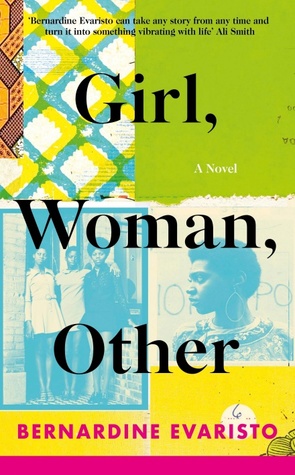
If ever there was a “zeitgeist” book, Bernadine Evaristo’s 2019 Booker Prize winning novel, Girl, woman, other is it. It might be an English-set novel about black British women, “the embodiment of Otherness”, but its concerns, ranging from ingrained inequality, racism and sexism to newer issues such as globalisation, are contemporary – and relevant far beyond its setting.
Take, for example, sexual violence. One young woman, after being raped, is not sure exactly what happened:
wondering if he’d done anything wrong or was it her fault
(Chapter 2: LaTisha)
she should have stayed and talked to him about it
he might have said he hadn’t heard her saying no
This could have been set in Australia, given discussions happening here right now. It is truly troubling how many young women apparently feel uncertain about what they’ve experienced, and turn it back on themselves. But now, having leapt in to make my “zeitgeist” point, I’ll start again, properly!
Girl, woman, other is an astonishing book, as most of my reading group agreed. It’s fresh and exuberant, but oh so biting too. As much poetry as prose, it has minimal punctuation and yet it just flows. It’s a risky book – what great art isn’t? – because, in addition to its idiosyncratic style, it comprises multiple points-of-view that move back-and-forth in time. There are four main chapters, each divided into three parts with each part in the voice of a different character. This makes 12 voices in all! The voices within each chapter are closely related in some way – mothers, daughters, friends – but the links between the four chapters are more subtle. This demands much of the reader.
Fortunately, the voices are captivating. Spanning over a century, they range from the ultra-confident 19-year-old Yazz, daughter of a lesbian mother, to 93-year-old Hattie, a strong-minded farmer and great-grandmother. All are women, and all have some genetic links with African or Caribbean cultures, some from a few generations back, others being themselves migrants. Through them, Evaristo interrogates a diversity of experiences and responses to colour, in particular, in contemporary England. Hattie’s mother, for example, had an Abyssinian father, and she herself had married an African-American GI. However, with the colour fading amongst her descendants, the family is less than happy when it is reintroduced by Julie who “saw not the darkness of his skin but the lightness of his spirit”. Hattie reflects
none of them identifies as black and she suspects they pass as white, which would sadden Slim if he was still around
(Chapter 4: Hattie)
she doesn’t mind, whatever works for them and if they can get away with it, good luck to them, why wear the burden of colour to hold you back?
the only thing she objects to is when they objected to Chimango when he arrived on the scene, a fellow nurse at the hospital where Julie worked, from Malawi
Hattie was sickened by their behaviour, they should’ve been more enlightened
but the family was becoming whiter with every generation
and they didn’t want any backsliding
You can see how well the language flows, and how accessible it is. It’s experimental but unforced. You can also see the author’s approach to her subject matter, which is to show, through her characters, different behaviours, values and attitudes. With 12 characters telling of their interactions with even more people, the breadth of humanity Evaristo encompasses is breathtaking – and it is all done without judgement. Some characters might, and do, judge each other, but Evaristo doesn’t. She lets them speak for themselves, which requires us to read attentively.
So, when Dominique’s female lover increasingly restricts her life, we see abusive control long before she does. And, when 93-year-old Hattie’s mother, Grace, experiences postpartum depression in the early 20th century, it is not named. Who talked about that then? But we recognise it immediately.
Issues come and go in this novel, whether they are up-to-the-minute topics, such as Brexit or transgender rights, or ongoing issues in women’s lives such as violence or ageing. Underpinning it all, however, is race and inequality. Being “othered” is common to Evaristo’s characters, and they all deal with it differently, but we see very clearly its debilitating, devastating impact.
oh to be one of the privileged of this world who take it for granted that it’s their right to surf the globe unhindered, unsuspected, respected
(Chapter 2: Carole)
By now you might be thinking a few things – that the novel is heavy-going, perhaps, or that it’s chaotic. But nothing doing. For all its seriousness – and there are definitely grim moments – the novel has a light touch, frequently bitingly satiric, sometimes simply funny, always human. Nineteen-year-old Yazz, for example, is a hoot with her teenage know-it-all confidence. Many recognise their failings, as they grow older, such as Amma appreciating her father too late or Carole realising her supportive teacher had feelings. Transgender Morgan, the epitome of the modern activist, speaks many truths:
Megan was part Ethiopian, part African-American, part Malawian, and part English
Chapter 4: Megan/Morgan
which felt weird when you broke it down like that because essentially she was just a complete human being
And, although the novel may sound chaotic, it does have an overarching structure. It starts hours before Amma’s play – the one she hopes will finally make her name – is to premiere at the National Theatre, and it ends with the After Party and an Epilogue, which, combined, bring most of the characters together. The ending, in fact, is clever. The After Party is political, drawing together the threads and reminding us that there’s a long way to go before black people in white societies are not defined by their colour. The Epilogue, on the other hand, is personal, showing us that there’s always human connection and that that, really, is the stuff of life – if only we could all see it.
Girl, woman, other is such a read. Uncompromising in its politics, but also warm and cheeky, it offers heart and intelligence in equal measure.
Bernadine Evaristo
Girl, woman, other
Hamish Hamilton, 2019
453pp.
ISBN: 9780241985007 (ebook)
 Whispering Gums