Courtesy: Annette Marfording
Having been intrigued by comments made by Annette Marfording, Program Director of the Bellingen Readers and Writers Festival, about running a literary festival, I approached her about writing a guest post for my blog. I thought her experience might intrigue at least some of my readers here too.
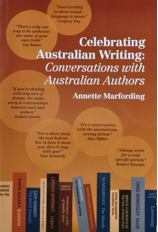
Marfording chairs one-on-one conversations and panels at the Festival, and is also a broadcaster at Bellingen’s community radio station 2bbb fm for which she created a monthly program on Australian writers and their work. Marfording’s recently published book, Celebrating Australian Writing: Conversations with Australian Authors, is based on in-depth interviews broadcast on this program. All profits from the sale of the book will go to the Indigenous Literacy Foundation. What a generous gesture! I have bought a copy of this book, which includes writers like David Malouf, Cate Kennedy and Larissa Berendt. You can too at lulu.com.
Now, here’s Annette’s post …
Some time ago, Sue asked me as Program Director of the Bellingen Writers Festival (full name Bellingen Readers and Writers Festival) to do a guest post for her wonderful blog on the joys and challenges of organising a writers’ festival. I’m delighted to do so.
This year the Bellingen Writers Festival (full name Bellingen Readers and Writers Festival) had its fifth birthday. In the period since our first in 2011, there’s been an explosion of new literary festivals all around Australia. With the exception of big city specialised sub-festivals, such as the Sydney Jewish Writers’ Festival and its Festival of Speculative Fiction, and some school or suburb festivals, such as the Abbotsleigh Literary Festival and the Sutherland Shire Writers’ Festival, most of the new festivals are in small regional towns and not specialised in any particular genre. Even though not all of them survive (for example the Gloucester Writers Festival), at the time of writing there are at least nine such regional festivals in New South Wales alone in addition to the big ones: the Sydney Writers’ Festival, the Byron Bay Writers’ Festival and the Newcastle Writers Festival.
On the one hand, this proliferation of festivals is wonderful for readers and book sales and demonstrates that the book is not dead. On the other, for several reasons, it is cause for concern:
- All these festivals compete for government grants and sponsorships.
- They also compete for authors, and understandably authors tend to prefer the greater publicity and book sales associated with the big festivals. Our invitations are often declined on the grounds that the author is overseas at the time/wants to concentrate on her/his next book/can’t possibly attend every writers’ festival in the country.
- Several of the festivals are scheduled in winter, enhancing the competition for authors during those months.
- Sadly these difficulties are compounded when other regional festivals choose to schedule theirs at the exact same time as another, as the newer Batemans Bay Writers Festival did with the Bellingen Writers Festival. Thus two of the authors we had invited appeared in Batemans Bay instead. Similarly it is confronting to find that other regional festivals have copied your advertising slogan, as the Southern Highlands Writers’ Festival in Bowral did with their adoption of ‘Be a part of the story‘ (in comparison to Bellingen’s ‘Be part of the story.’
Even if there were only one literary festival in the country, organising a festival is not for the faint hearted. The large festivals attract big money from government agencies and sponsors while the smaller ones have to make do with far less. That usually means that large festivals have a large number of paid staff, while the smaller ones tend to be organised and run by volunteers.
In Bellingen all festival committee members work as unpaid volunteers, which means they have to be brimming with passion and enthusiasm for there is a lot of work to be done: books must be read, authors and chairs selected and invited, contracts drawn up, funding applied for, sponsorship sought, venues booked, an experienced bookseller chosen, transport and accommodation organised, possibly a schools program organised, the program put together and proof-read multiple times for print and website, newsletters written for the website, social media and print publicity employed to spread the word. For the event itself, you need an event producer/organiser, sound engineers, microphones for all venues and multiple speakers, additional volunteers and an organiser for those volunteers. After each festival there are clean-up tasks, author payments and accounting to be done. Over the five years we have lost several festival committee members due to burn-out or the need for an income-generating job. We have also gained a few new ones each year, but they don’t always stay. Only four members have been involved since the beginning.
Government funding bodies often demand the introduction of a new aspect or theme for each year’s festival. For 2013 the Bellingen Writers Festival chose Celebrating Women Writers and Women’s Stories, because 2012 marked the beginning of a conversation about gender in literary culture. In 2013 the Stella Literary Award was awarded for the first time. As the readers of this blog may remember, a number of women authors, critics and publishers pushed for the introduction of an award for women writers after women had been left off the shortlist for the Miles Franklin Literary Award for Fiction for two years in a row. Another response was the creation of the Australian Women Writer’s Challenge. For 2015 the Bellingen Writers Festival chose Politics and Society and attracted a number of politicians, journalists, screenwriters and fiction writers exploring social issues and added three forums on mental health issues with Professor of Psychiatry Gordon, clinical psychologist David Roland and author of Australia’s first memoir on youth suicide Missing Christopher Jayne Newling.
Festival visitors often don’t realise that authors need to be paid not only for their transport costs and accommodation, but also earn a fee for every festival appearance (in accordance with standards set by the Australian Society of Authors). In small regional towns such as Bellingen, where small businesses often struggle, it is very difficult to attract sponsorship from local businesses, especially since Bellingen hosts several music festivals as well. Government grants are difficult to obtain on a recurring basis, especially in these times of funding cuts to the arts. This means that smaller festivals become ever more reliant on ‘big name’ authors to attract visitors prepared to pay for tickets. The further away authors live from the festival location, the higher the authors’ transport costs. This means that authors who live on the other side of Australia, in Tasmania, let alone the US, are unaffordable for the Bellingen Writers Festival.
I think it’s obvious from the above that the challenges are formidable. The joys of organising a writers’ festival require far fewer words, but nevertheless win in the end for those who are engaged and passionate about reading and/or writing. The joys of introducing favourite authors to new readers, observing the audience’s enthusiastic faces, rapt attention, and long queues for books and autographs. Even better if the authors have a good time, too, and in Bellingen, they always do. For me personally, involvement in the festival has also made it easier to interview some of the authors in my recently released book Celebrating Australian Writing: Conversations with Australian Writers which has sold 80 copies in the first two weeks – to the benefit of the Indigenous Literacy Foundation, which will receive all the profits from the sale.
****
Thanks so much Annette for this wonderful behind-the-scenes insight into running a festival. Readers like me owe a big debt to people like you who are willing to undertake the hard yakka of putting on a regional festival. I wish I lived closer to Bellingen!
 Whispering Gums