As many of you know, my father turned 100 this year, and three weeks later, my mother died. Life is sad, but Dad and I are soldiering along – with support of course from Mr Gums, not to mention family elsewhere in Australia. What is amazing, though, is how often new little pieces of information, or insights into Dad’s life, are still cropping up! I’m sharing a couple here, to document them for myself and because they might interest readers here too.
Wattle Day
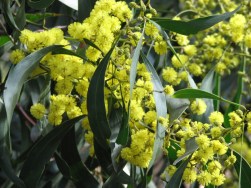
Acacia pycnantha or Golden Wattle, by Melburnian (CC BY-SA 3.0).
Wattle Day, as most Australians now know, occurs on 1 September, celebrating the first day of spring here downunder. The golden wattle (acacia pycnantha), which was included in Australia’s coat of arms in 1912, is just one of many wattle species found around Australia, but most tend to blossom in late winter to early spring. Wikipedia provides the complicated origins of Wattle Day, but by the 1910s it seems, most states in Australia were celebrating it, though it wasn’t a nationally gazetted day until 1992.
So, on this year’s Wattle Day, as I was visiting my Dad, he burst into song, with these opening verses:
The bush was grey
A week to-day
(Olive-green and brown and grey);
But now the spring has come this way,
With blossoms for the wattle.It seems to be
A fairy tree;
It dances to a melody,
And sings a little song to me
(The graceful, swaying wattle)– by Veronica Mason
I was astonished. I’d never heard this song. Indeed, I had only become aware of Wattle Day relatively recently. However, on discussing the Day with my patchwork-now-coffee group, I discovered that all present, except one other, were very familiar with Wattle Day. What? Then the penny dropped. My father was born in 1920, and most of this group were born in the late 1930s to 1940. The “one other” was, like me, born in the 1950s. So, on thinking about it, I realised that they were born during times of pro-Australian nationalism, whilst that other and I grew up during a period of cultural cringe, a time when we turned away from things Australian.
Wikipedia helped confirmed this. Referencing Libby Robin, Wikipedia advises that “the day was originally intended to promote patriotism for the new nation of Australia”. I sussed out Libby Robin’s article, “Nationalising Australia: Wattle Days in Australia”, in which she talks about the linking of nature with nationalism. After discussing some of the various nature days that were created, she writes that
Wattle Day was the most aesthetic and human-centred of the three ‘days of nature’, and its influence waned as the century wore on. In the 1930s and later the Gould League went from strength to strength. Arbor Day had a steady and strong following, reinventing itself in the 1990s as ‘Arbor Week’. But Wattle Day changed in the early 1930s, eventually fading away altogether. A Wattle Day League limped on in Victoria until the mid-1960s, but the other states were no longer interested.
So, those born in the first half of the twentieth century were well familiar with the day – and its various songs and poems – while those of us born mid-century have only discovered it in recent years, with its revival and 1992 gazetting. Thanks Dad for the song – and the inspiration to suss out Wattle Day a little more.
A Jimmy Woodser
And then, just this week, Dad mentioned a “Jimmy Woodser”! I looked blank! Do you know what a Jimmy Woodser is, because I sure didn’t!
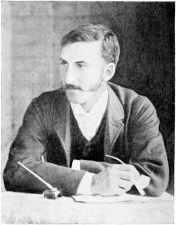
Barcroft Boake, by George Lambert, pre 1913, Public Domain.
So, back to Google I went. I found several references, but this one on Time Gents (Australian Pub Project) blog is particularly good. The post starts by saying:
Jimmy Woodser is a name given to a man who drinks alone, or a drink consumed alone. The name is thought to come from a poem by Barcroft Boake, published in The Bulletin on May 7 1892, about a fictional Jimmy Wood from Britian [sic] who is determined to end the practice of ‘shouting’ (buying rounds of drinks for a group of mates), by drinking alone.
“One man one liquor! though I have to die
A martyr to my faith, that′s Jimmy Wood, sir.”
“Jimmy Wood, sir” to “Jimmy Woodser”!
Barcroft Boake (1866-1892) was an Australian poet best known for his poem “Where the dead men lie”. (In a little digression, I have posted on, and reviewed works by, his niece Capel Boake.)
Back, though, to Jimmy Woodser. There is an alternative anecdotal version of the term’s origin provided in The Brisbane Courier (May 11, 1926), which dates it to the 1860s and a story about two rival publicans. There’s another one in the Dungog Chronicle (July 14, 1942), while this one in Adelaide’s The Mail (7 July, 1945) provides a rundown of several theories. Without doing more research I can’t confirm which is right, but the meaning doesn’t change. (In a fun little aside, the Glen Innes Examiner and General Advertiser (11 May, 1906) has an article titled ‘A “Jimmy Woodser” Club’ about the creation of the Non Shouting Club, in Araluen, near where I live. Its aim was to reduce the drunkenness that they believed shouting encouraged!)
Meanwhile, Time Gents go on to share a poem by Henry Lawson, titled “The old Jimmy Woodser” (c. 1899). They suggest it could be about a Wollongong character, Billy Fitzpatrick. Its first verse is:
The old Jimmy Woodser comes into the bar
Unwelcomed, unnoticed, unknown,
Too old and too odd to be drunk with, by far;
So he glides to the end where the lunch baskets are
And they say that he tipples alone.
“Too old and too odd to be drunk with, by far”. Well, my Dad is pretty old, but I’ll have a drink with him any day – and look out for more little treasures like this to research and share.
 Whispering Gums