Monday musings on Australian literature: Writers from South Australia

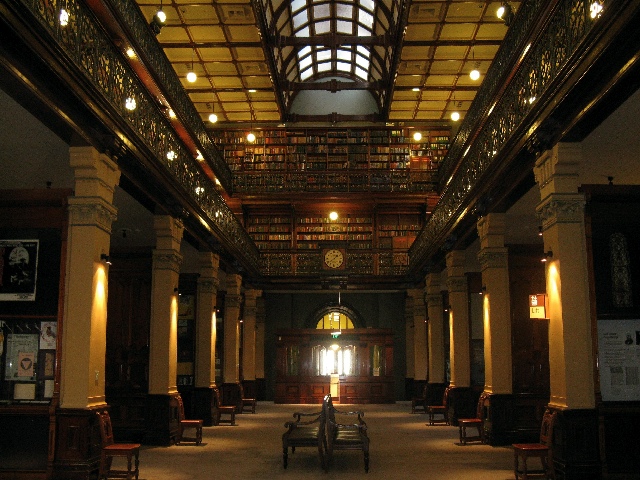
Mortlock Wing, State Library of South Australia

Mortlock Wing (1884), State Library of South Australia

In the decade from the late 1960s to the late 1970s, South Australia, under premier Don Dunstan, was Australia’s most progressive state. I won’t list all the achievements – you can read them in the Wikipedia article linked on his name – but there were big social justice ones including the recognition of Aboriginal land rights, decriminalisation of homosexuality, and abolition of the death penalty. Dunstan was also known for supporting the arts … and South Australia became a mecca for anyone interested in the arts. Things have changed now, as they always do, but the Dunstan legacy remains in the Adelaide Festival Centre, probably Australia’s first real multi-purpose arts centre.

The state also hosts an internationally recognised arts festival, the Adelaide Festival of the Arts, and Australia’s oldest writers’ festival, the Adelaide Writers Week, which has run for over 40 years. And yet, most Australians would probably be hard-pressed to name writers from the state. In fact, probably the best known writer now living in the state is J. M. Coetzee! A great writer, but in my state-focused posts I like to look at writers’ formative years …

And so who? Well, I’ll name a few but I must admit I couldn’t think of many myself:

  • Barbara Hanrahan (1939-1991) whose The scent of eucalyptus I reviewed some months ago. That book – autobiographical fiction – is an idiosyncratic (but universal too) evocation of an early-mid twentieth century Adelaide childhood. She was also an artist of note. But, she is no longer alive.
  • Peter Goldsworthy (b. 1951) whose Three dog night I read, and enjoyed,  before I started blogging. He is also a poet, librettist and screenwriter. His daughter, Anna Goldsworthy, has written a well-reviewed memoir, Piano lessons (which is on my virtual TBR).
  • Colin Thiele (1920-2006) who wrote primarily for children – for the late primary-early secondary years. He is most famous for his novel Storm Boy which was made into a highly successful movie by another of Don Dunstan’s initiatives, the South Australian Film Corporation. I don’t usually include children’s writers in my lists but his writing is so evocative of South Australian landscapes that it seemed wrong to omit him.
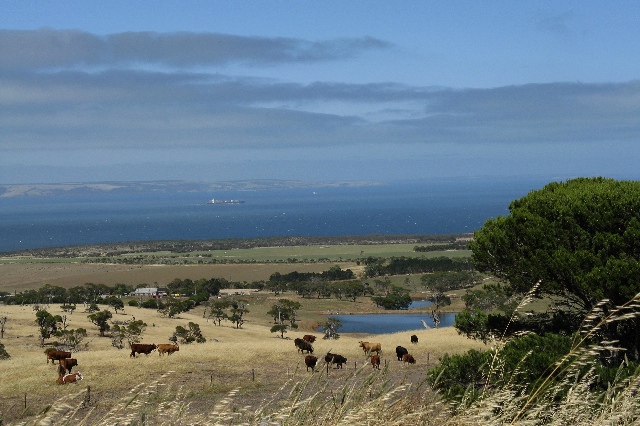
Fleurieu Peninsula, South Australia

Fleurieu Peninsula, South Australia

South Australia, like each state, has a distinctive geography, which ranges from its golden Mediterranean-like south to its arid north, with lakes, mountains and pockets of lush green in between. I’ll end with an excerpt from a Peter Goldsworthy poem titled “Yorke Peninsula, Easter”:

Returning to childhood.
To fields of sweat and dust,
scraps of eucalypt,
wheezing crows.

To the backyard of summer,
the brown brown grass of home.
(excerpted from The Australian Poetry Library)

Several well-known Australian authors currently live in South Australia – including Brian Castro and children’s writers, Mem Fox and Gillian Rubinstein – but I’d love to hear of any other (reasonably) contemporary South Australian writers.

Barbara Hanrahan, The scent of eucalyptus

Writer-artist Barbara Hanrahan was born half a generation before I was and in the city of Adelaide not a country town in Queensland, but the childhood she depicts in her first novel, The scent of eucalyptus, could almost have been mine. Almost, but not quite, as I was brought up in a standard nuclear family and she by three women – her mother, grandmother, and Aunt Reece (who had Downs Syndrome) – resulting in a somewhat different experience of home-life even if not of wider society.

And there’s another more crucial difference. The half generation time lag accounts for a major change appearing on the horizon – in the education of women. Hanrahan, like my mother who was born nearly half a generation earlier, suffered from the reduced opportunities and low expectations that were women’s lot back then. Both were expected to undertake commercial training at high school – rather than join the academic streams they desired – in order to fulfil “the plan” as Hanrahan calls it:

“( … Our expectations were swallowed by shorthand symbols, hammered by typewriter keys, imprisoned by the columns of a neatly-ruled ledger whose credit column never balances its debit.)

I was part of a school that was a factory, pumping forth each year, from the swollen Commercial class, the girls of fifteen who would go to work as typists and clerks. At eighteen they would be engaged, at twenty, married, at thirty – old. These were the girls I stood with under the lacquered fig trees in the Grade Seven photograph. (They are at their prime at the age of twelve … )

How sad that is. I loved this book from beginning to end. The writing is poetic – not the sort of poetry that is full of allusions and ambiguities in which you have to work hard to locate meaning, but the sort that paints word pictures of both the physical and emotional landscape. An example is her description of a visit to relations in the hills:

“I remember rising while it was still dark to visit them; … watching the sky turn pale and frayed with light; seeing houses jump forward from the darkness; hearing the cold voices of first roosters, the kookaburra’s ruffled peal.”

The writing is rhythmic. There are few wasted words, there is effective use of repetition, there is stream of consciousness, and she uses punctuation precisely to control flow and meaning.

Hanrahan tells her story more or less chronologically, with thematic chapters interspersed at appropriate points and occasional asides foreshadowing her future. The novel spans her life – this is an autobiographical novel – from birth to puberty. It’s not strong on plot, but there is a powerful story here about the development of self. For example, in chapter 2, we see the origins of the artist she was to become: “As a child and ever after, the minute, hidden facets of things intrigued me”.

The first few chapters introduce us to the significant people – the “important” three – in her life. Here she is on her mother:

“My mother was a lark whose tongue was cut; a gull with clipped wings. She learned to expect nothing that she did not strive for … My mother trod a familiar path; hedged by as many briers as Sleeping Beauty’s ever was”.

Such economy of expression that conveys so much. She writes similarly of her grandmother and aunt, and we learn how “the three” love and support each other but also harbour disappointments. These, though, our narrator is barely aware of:

“(I was deceived by familiarity. I didn’t see, couldn’t see, forgot to reason.)”

And so the novel progresses through infancy, kindergarten, and primary school until we reach the point at which I began this post. She paints perfect pictures of school days, of special holidays, of childhood friendships, of fears and hobbies, of a flirtation with religion, and of a sense throughout, but becoming stronger as she grows older, of being “different”:

“And as I grew older I became adept at leaping quicksilver from one of my selves to the other. And as I grew older the split grew deeper, yet I forgot it was there.”

This is a delicious novel – the language is almost mesmeric, capturing a world that has passed and yet is still part of our cultural landscape. I will finish with one final excerpt which delighted me. She, like most Australians, grew up with the image of outback Australia, our “sunburnt country”, firmly entrenched in her mind, but she, also like most Australians, was “a city child” and so she asks:

“But where were the hills of the history book, stitched with the pathways of Burke and Sturt and Leichhardt?- the hills of the sun-burned earth and budgerigar grass, and azure skies and fiery mountains we sang about at school before the flag spangled with all the stars of the Southern Cross I was never sure of seeing? Where were the old dark people I did not link with the lost couples on suitcases at the railway station? Where were the crocodiles and brolgas, the billabongs and snakes? Where were the flowers that wilted in blistered clay, the rusty waves of Spinifex that looped the cliff?

… I looked about me for the sunburned land. In vain.”

This is not the end of the book … but is as fine a place as any to end my review because it, as much as anything, conveys the paradox of her childhood – the knowing one thing but the seeing of/the being something else. This is a book for all Australians to read … and for anyone else who is interested in a thoughtful, lyrical rendition of a childhood.

Barbara Hanrahan
The scent of eucalyptus
St Lucia: University of Queensland Press, 1973
188pp.
ISBN: 0702225169