Carmel Bird, Fair game: A Tasmanian memoir (Review)

Courtesy: Finlay Lloyd

Courtesy: Finlay Lloyd

As I started reading this next fl smalls offering, an essay this time, I was reminded of one of my favourite Australian writers, Elizabeth von Arnim. Von Arnim was a novelist, but she also wrote several pieces of non-fiction, including her delightful non-autobiography, All the dogs of my life. The similarity stems from the fact that both writers play games with the reader regarding their intentions or subject matter – “This not being autobiography, I needn’t go much into what happened next”, writes von Arnim at various points – but this similarity fades pretty quickly because Bird’s piece, despite its similarly light, disarmingly conversational tone, has a dark underbelly.

I thought, given its subtitle, that Fair game was going to be a memoir of Bird’s growing up in Tasmania. But I had jumped too quickly to conclusions. The subtitle “a Tasmanian memoir” means exactly what it says, that is, it’s a memoir of Tasmania. Her interest is Tasmania’s dark history – “the lives of convict slaves, and the genocide of the indigenous peoples”. The title Fair game, you are probably beginning to realise, has a deeply ironic meaning.

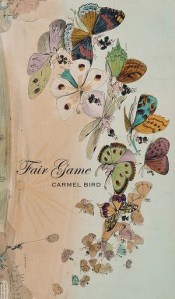
However, getting back to my introduction, Bird does start by leading us on a merry little dance. Her essay commences slyly with a discussion of epigraphs – hers being taken from one of her own books – and the cover illustration. She doesn’t, though, identify the illustration at this point, but simply describes it as “an image of a flock of Georgian women dressed as butterflies, sailing in a glittering cloud high above the ocean”. She then takes us on all sorts of little digressions – about birds, and gardens, and collectors, about her childhood and such – but she constantly pulls up short, returning us to “the story”, or “rural Tasmania”, suggesting that the digressions are “not relevant to this story”. Except they are of course, albeit sometimes tangential, or just subtle, rather than head on. Indeed, she even admits at one stage that:

I have wandered, roving perhaps with the wind, off course from my contemplation of the butterfly women of 1832, they roving also with the wind. It must be clear by now that frequently in this narrative I will waver, will veer off course, but I know also that I do this in the service of the narrative itself. Just a warning.

I love reading this sort of writing – it’s a challenge, a puzzle. Can I follow the author’s mind? One of the easier digressions to follow – and hence a good example to share – is her discussion of a 1943 book published by the Tasmanian government, Insect pests and their control. Need I say more? Bird does, though – quite a bit in fact – and it makes for good reading.

Anyhow, back to the image. A few pages into her essay she tells us more. It’s an 1832 lithograph by Alfred Ducôte, and it is rather strangely titled “E-migration, or a flight of fair game”. On the surface it looks like a pretty picture of women, anthropomorphised as butterflies, flying through the air with colourful wings, pretty dresses and coronets. However, if you look closely, you will see that what they are flying from are women with brooms crying “Varmint”, and what they are flying to are men, one with a butterfly net, calling out “I spies mine”.  Hmm … I did say this was a dark tale, didn’t I? The illustration’s subject, as Bird gradually tells us, is that in 1832, 200 young women were sent from England to Van Diemen’s Land on the Princess Royal. They were the first large group of non-convict women to make the journey, and their role was to become wives and servants in a society where men significantly outnumbered women. As Bird says partway thought the book, “it is not a joyful picture; it is a depiction of a chapter in a tragedy”.

I’d love to know more about Ducôte, and why he produced this work, but this is not Bird’s story. Her focus is the history of Tasmania, and these particular women – who are they, what were they were going to? It appears that Bird has been interested in this story for a long time, since at least 1996 when Lucy Halligan, daughter of Canberra writer Marion Halligan, sent her a postcard with the image. Since then Bird has researched and written about the story. In fact, as she tells us, her research led to the creation of a ballet by TasDance in 2006. They called it Fair Game.

Finally, she gets to the nuts and bolts, and the so-called digressions reduce as she ramps up the story of how these women were chosen, their treatment on the ship, and what happened on their arrival. It is not a pretty story, but represents an important chapter in Australia’s settlement history. I commend it to you – for the story and for the clever, cheeky writing.

awwchallenge2015Carmel Bird
Fair game: A Tasmanian memoir
(fl smalls 7)
Braidwood: Finlay Lloyd, 2015
63pp.
ISBN: 9780987592965

(Review copy courtesy Finlay Lloyd)

Paul McDermott, Fragments of the hole (Review)

"Paul McDermott DAAS" by Canley - Own work. Licensed under CC BY-SA 3.0 via Commons.
“Paul McDermott DAAS” by Canley. Licensed under CC BY-SA 3.0 via Wikimedia Commons.

If you’re an Australian, you are sure to know who Paul McDermott is. If you are not Australian, you may not, and this book in fact would not enlighten you, because nowhere on the book is it made clear that “this” Paul McDermott is indeed “that” Paul McDermott. It doesn’t take much reading though to realise that indeed it must be. Have I intrigued you? I hope so.

Fragments of the hole is the first of the second set of fl smalls released by small independent publisher Finlay Lloyd. I mentioned them in my recent post on small books, and said then that I’d review them individually as I read them, so here I am.

I’ll start, having already mentioned him, by telling you about the author. Wikipedia describes him as “an Australian comedian, actor, writer, director, singer, artist and television host”. I knew about most of those, but I didn’t realise that his writing included more than writing scripts for his shows, or that he was an artist too. He first came to public notice as a member of the satirical musical comedy group the Doug Anthony All Stars. The Doug Anthony in their name refers to the longtime leader (1971-1984) of the National Party of Australia, which will, perhaps, give you a sense of his political leanings. However, Fragments of the hole is not political satire, so let’s get onto it …

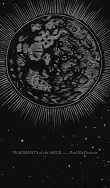
McDermottFragmentsFinlay

The jokes start pretty much on the title page when we are told that the book comprises:

a collection of previously unpublished work from various writer/artists:

Young Master Paul, The Nymbus Art Collective, The Marvellous Mr Me, The Generator, Paul McDermott, Ol’ Miss Daisy & The Caravan King.

Hmm … the way I read it they were all written and illustrated by Paul McDermott but, you know, I could be wrong! Whoever wrote them, though, they are delightful – dark, whimsical, and a little cryptic. The collection comprises one prose story, followed by five in verse form, and most read a little like fairy stories or fables. There’s usually a little point to ponder at the end, even if that point raises another question.

Take, for example, the first poem, “The Bread Girl and the Sparrow”. It is reminiscent of “The Gingerbread Man” which, Wikipedia tells me, is just one of many folktales about “runaway food”. Who’d have thought?  Anyhow, in McDermott’s story, in addition to the issue of trust, there are layers of sacrifice and loyalty between food and predator which adds quite an interesting philosophical twist.

There’s a Roald Dahl-esque edge to the stories. The humour is dark. These are not for (most) children. “Asleep/Awake”, for example, is about the sleeping (real) self meeting the dream self. The exhortation at the end, if you are suggestible, could very well bring on a nasty case of insomnia. You have been warned. I loved too “The man who thought (he was a fog)”, and McDermott’s suggestion that perhaps the initial assumption was not the right one at all. “You look for answers where you may/You find them when you can” he says, but, are you asking the right question?

If any single idea underlies the stories it is something about “self” – what is your “self”, do you protect it, how does it interact with others? Sacrifice – sometimes chosen, sometimes inadvertent – appears in a couple of the stories; the idea of alternative selves appears in others. There is also a sense of life not going to plan. It may not always be –

That evil and sorrow await the naive
At every twist and turn

– but it doesn’t hurt to always have your wits about you.

The poems are told in a fairly simple a-b-c-b rhyming pattern, but the line lengths vary at times to change the pace. McDermott, a comedian who lives by his words, is sure in his language, which is clear and unforced. The pencil drawings are delightful. You can feel the twinkle in his eye – the fun he is having – as you read the stories and look at the pictures. They made me chuckle.

And here I will end because this is a book that is best experienced rather than described or analysed. It’s a cheekily clever but also delightfully charming “little book”. It would, dare I say it, make a perfect stocking stuffer for the discerning reader on your gift list.

Paul McDermott
Fragments of the hole: an illustrated collection (or, Odds and ends, bibs and bobs, and little bits of nothing)
(fl smalls 6)
Braidwood: Finlay Lloyd, 2015
[60pp.]
ISBN: 9780987592958

(Review copy courtesy Finlay Lloyd)
Paul Hetherington and Jen Webb, Watching the world (Review)

Hetherington and Webb, Watching the worldI hope it’s not condescending to suggest, at this time of year, that a book would make a good Christmas present? I know some publishers, and fair enough too, choose around now to release certain types of books deemed to be good gift material. That, however, is not the case with this book, Watching the world, as it was in fact published back in July. It’s just that I’m reviewing it now and, quite coincidentally, I think it would make a good Christmas book. This is not because it’s a light, easy summer read, as it’s not your typical beach book, but because it’s a very attractive book that is priced reasonably and that can be enjoyed in multiple ways. You can meander through it sequentially, stopping to ponder, or dip in and out, exploring what catches your fancy.

Subtitled Impressions of Canberra, Watching the world comprises poems by Paul Hetherington paired with photographs by Jen Webb. It has a rather interesting genesis, as the Introduction explains, in that it’s the “result of an extended collaboration” between the poet and the artist. Their aim was to explore Canberra as a place in which people live and work, rather than, as is usually the case, as a planned city that is also the national capital. I like that idea. Too often Canberra is used as shorthand for the federal government – as in “Canberra said today ….”. But, as we who live here know, there is far more to Canberra than that.

Hetherington and Webb’s method of working was interesting too. They worked, they say, semi-independently:

Jen took photographs, which Paul then used as springboards into poems. Paul’s poems led, in turn, to Jen taking new photographs, or editing existing ones.

They continued this “iterative process” until they found “enough poem-photo pairs” that would satisfy their intention. They suggest that in this method of working a new “reality” appeared, one that was somehow separate both from themselves as individuals and from their partnership, a reality which confronted them with ideas about “the incommensurability of world, image and word”. That makes sense to me – I think! At least, it makes sense to me that we never can completely or exactly capture in one form – say poetry – that which is in another form – in this case life in Canberra. It seems both obvious and sophisticated at the same time to make this point! And so, when you have a poem and a photograph both “commenting” on each other and on life in Canberra, then the meaning (or the “reality”) surely becomes multi-layered? Hmmm … I think I’ll leave the philosophising here, but I hope that I’m making sense and that I’ve understood what Hetherington and Webb are saying.

Now, I’ll get to more concrete stuff (a very poetic word, that), starting with the wider project. In the Introduction, again, we are told that it was initially produced as an installation for the Imagine Canberra exhibition during Canberra’s 2013 centenary celebrations. It then had a couple of other iterations – at a conference, and as a set of scholarly essays – before finding its way into this book form this year. I love that they have managed to achieve such varied mileage out of their work.

And finally, the book itself. The poem-photo pairs are divided into three sections – Where we live, Memory places, and Paddocks and perambulations. They are, as you’d expect from the process described, idiosyncratic, although there is logic too to the groupings. The first poem-pair is titled “Waltz” and captures the physical sense of Canberra. I was amused by the poem’s opening:

Like algebra, these straight-drawn streets,
curves, crescents and rounding circles

Starting with the “straight-drawn streets” must surely be a little provocative gesture to the popular cry from tourists that they get lost in Canberra’s circles! We do, I’m sure, have far more traditionally designed streets than circular ones. It’s just that the circular pattern is a feature of the inner, early Canberra where tourists focus. The accompanying image is a low aerial shot of a warm, cosy looking Canberra suburb in autumn. The poem suggests that there is magic in Canberra, that for all the apparent “algebra” in its straight lines and curves, there is much here that cannot be easily defined or narrowed down to simple formulae.

The poems vary in tone. There is, for example, a subdued reference to indigenous inhabitants in “Ainslie”, whimsical self-deprecation in the simply titled “Canberra”, and wry or defiant humour in “Letter”. At least, it made me laugh: a woman hands her letter to someone, perhaps a husband she is leaving:

‘I know it’s not done
to be so formal
but just this once
I’d like the last word’

The accompanying image shows the back of a blue car driving away in light rain.

Sometimes the meanings of the poems and the connections with the photography are clear and unambiguous, more literal perhaps. Other times they are more tenuous, or abstract, as in “Handkerchief” with its accompanying leaf-litter image, encouraging the reader-viewer to delve further. I enjoy these challenges. It would be interesting to see whether different combinations challenge different readers.

The images are, of course, important, though being primarily a verbal/textual person, my focus tends to be the words. However, there are some gorgeous images here. I’ve mentioned a couple already. I also like the mystical tone of the poem-photo pair titled “Boundaries”, the sense of coming into and out of our different spiritual and physical selves, our individual and our social selves, and so on. A simple image and a two-line poem. Perfect.

Some of the pieces are universal, that is, they could apply to a lot of places in which people live, but many draw on signs and symbols familiar to Canberrans – the circles, the balloons, and Black Mountain Tower, for a start. We are a bush capital, and along with our trees come the birds. I enjoyed the cheekiness of the poem titled “Birds” (and the accompanying image setting movement against stillness) which suggests that for all the planning, life in the city might have other ideas. If you are now intrigued, have a look at the sample provided online by Blemish Books. That will probably speak louder than my 1000 words!

Watching the world is a quietly subversive work that looks at Canberra from an insider’s point of view – with a lot of affection but a willingness to cast an acerbic or questioning eye at times too. And remember, it’s Christmas soon!

Paul Hetherington and Jen Webb
Watching the world: Impressions of Canberra
Canberra: Blemish Books, 2015
79pp.
ISBN: 9780994250827

(Review copy courtesy Blemish Books)

Caroline de Costa, Double madness (Review)

De Costa, Double madnessI’m not a crime reader as most of you know, and in fact most of the crime novels I’ve read here have been review copies sent to me. Caroline de Costa’s Double madness is one of these. I accepted it for a couple of reasons. It’s a debut novel by a doctor, indeed a professor of Medicine at the James Cook University in Cairns, who has been shortlisted for a nonfiction work in the Queensland Premier’s Literary Awards. And it is set in beautiful far north Queensland, my home state.

Not being an expert in crime writing, I can’t really compare it with other novels, but I’d say it’s in the sub-genre known as police procedural. According to Wikipedia, in police procedurals the detective is a police officer and the story depicts the activities of the police investigating the crime. Tick. However, Wikipedia also says that in police procedurals the perpetrator is often known to the reader, but this is not the case here, and that the novel will often deal with a number of unrelated crimes, which is also not the case here, though several references are made to one other crime. None of this matters, really thought, does it? Categories can be helpful in analysis, but in the end what counts is the work itself. I was just intrigued.

Double madness opens with the victim’s body being found, by accident, in a secluded part of the north Queensland rainforest, by a doctor and his wife who are driving home the scenic way. Finding the body is, I presume, a pretty traditional opening for a crime novel of this sort. The dating, like the setting, is also precise – 27 February 2011, which is three weeks after the category-5 Cyclone Yasi hit northern Queensland, causing significant destruction. The novel is told in almost straight chronology, with each chapter titled by a date, the last being 17 March 2011. Early in the novel, though, there are a few flashback chapters – mostly to 2009 – which flesh out a few characters for us.

Our main detective is the 30-something now-single mother, Cass Diamond. She’s of indigenous Australian background. Ah, so we have a non-indigenous writer, as far as I know anyhow, writing an indigenous character. You may remember discussions we’ve had here on this topic. I’ve quoted writer Margaret Merrilees, “To write about Australia, particularly rural Australia, without mentioning the Aboriginal presence (current or historical) is to distort reality, to perpetuate the terra nullius lie”. De Costa is writing about Far North Queensland, a place with a significant indigenous population, where it would indeed be poor form to ignore indigenous characters. My assessment is that de Costa has done it well. Cass makes some references to her indigeneity, and to some of the challenges she faces, but this is not her defining characteristic in the novel. She is “just” another police officer, and is defined as much, if not more, by being a single mother whose “fridge was a temple consecrated to convenience foods”. In other words, she’s in that band of job-jolly detectives who struggle to keep their personal life going, though Cass does a better job than most (that I’ve seen on TV anyhow). She does, for a start, seem to have a good relationship with her teenage son. Moreover, she’s not drunk, middle-aged or unduly cynical – yet, anyhow!

Back now, to the plot. Tucked into the copy sent to me was a slip of paper containing a short interview with the writer by reviewer Fiona Hardy. De Costa tells Hardy that she had “for some time been interested in the concept of folie-à-deux [share psychosis]”. Folie-à-deux translates as double madness – hence the book’s title. De Costa also tells Hardy, when describing the sort of detective she has created, that she has to write what she knows. And she knows medicine. Consequently, not only does the investigation and resolution of the crime involve some medical knowledge, but the story is set largely amongst the community’s medical fraternity. In other words, the good doctors of Cairns have been getting up to a bit of mischief with our victim, so when the murder is committed they find themselves in the frame. They are not, however, the only ones. There be a husband, and sons, and sundry other possibilities. All I’ll say is this is a tricky plot with a goodly dose of red herrings. For more, you’ll have to read the book.

I wouldn’t call Double madness a ground-breaking or particularly innovative detective novel, but it’s an enjoyable read. The writing is clear and straightforward, keeping to the point and moving along at a fair pace. There’s no unnecessary description, but where it is needed, such as to describe the bush or, say, a doctor’s experience of working through a cyclone, it feels real and authentic. Hardy, in her interview, notes that the cyclone Yasi makes an effective metaphor for the havoc wrought by the victim, Odile Janvier, on those around her. She’s right, it does.

When I read fiction, as I’ve said before, I look for some underlying messages or themes or issues being explored because I like my reading to further my understanding of humanity. Double madness is not, in this sense, a deep or enquiring book, but it is quietly subversive in the way it handles race and gender. Its indigenous characters are not defined by their indigeneity, and women detectives and medicos play important, but accepted and unremarked, roles in the investigation and resolution of the crime. Moreover, while the murder victim is a woman, she is far from the norm of murdered women victimhood. Good on de Costa.

So, if you are looking for a new crime author for your crime fan friends this Christmas – because yes, it’s that time of year again – then Double madness is well worth putting on your list.

awwchallenge2015Caroline de Costa
Double madness
Witchcliffe: Margaret River Press, 2015
359pp.
ISBN: 9780987561565

(Review copy courtesy Margaret River Press)

Emily Bitto, The strays (Review)

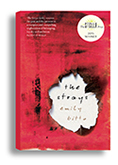
Emily BItto, The strays, book coverLet me start by saying I really enjoyed reading Emily Bitto’s The strays. It was scheduled for my reading group the day after my return from Tasmania, and I suddenly found myself in the last day of my Tasmanian holiday without having started the book. Wah! I read it in two days, helped by several hours in a couple of airports. I haven’t done that for a long time, and what a joy it was to have a real length of time to commit to a book. It helped, of course, that having both a strong plot and an intriguing set of characters, The strays is compelling to read. It reminded me, albeit loosely, of Evelyn Waugh’s Brideshead revisited and Ian McEwan’s Atonement.

This is a debut novel, which also won this year’s Stella Prize. Set primarily in the 1930s, with the last of four parts set in the 1960s, The strays is both historical fiction and a coming-of-age novel. It is also a classic outsider story. Lily, who tells the story first person, is befriended when she is 8 years old by schoolmate Eva, the middle daughter of the Trenthams who, early in the novel invite a number of artist “strays” to form a utopian-bohemian artistic community. The Trenthams are inspired by the Reeds and their Heide group, but The strays is not a Heide story*.  This may be the strength of the novel, but also perhaps its weakness – a strength because it frees Bitto to tell her own story, but a weakness because it removes potential ideas on which to hang her story.

Before I get to that, though, a little more about the story. The first three parts follow the Trenthams for 8 years, from when Lily is 8 to 16. During this time Lily becomes increasingly involved with the Trenthams, in preference to her boring, conservative, middle-class parents, eventually living with them full-time. Some members in my reading group found her parents’ relinquishing of their daughter unbelievable, but this was during the Depression, and Lily’s parents did have some problems of their own to manage. I could suspend my disbelief. From Lily’s point of view, she was in thrall to the excitement of the Bohemian life, telling her parents, “I love you both but I want to be different”.

Her parents, however, should have been concerned, because the Trenthams are rather casual, neglectful parents and the four girls more or less run their own lives, sometimes being fed properly, sometimes not, sometimes, in the case of one in particular, going to school, and sometimes not. The story is as much about them, as about the artists, though we do hear about the artists too. There’s exploration of experimental art and its acceptance or otherwise by society, obscenity charges, mentee supplanting mentor, and so on. There are parties, and other occasions, where artists and children come together. Bitto, through Lily, paints all this beautifully. Indeed, I loved her ability to evoke scenes, people and places with effective, yet tight imagery.

Bitto’s use of Lily as her narrator works nicely. Through most of the novel, we see the story through her child’s point-of-view, but occasionally, with a “later I realised” type of comment, we are reminded that this is an adult telling the story of her childhood:

When was it that I became a voyeur in their midst? I was the perfect witness, an unsuspected anthropologist disguised within the body of a young girl, surrounded by other young girls who were part of the family. Yet I was cuckoo in the nest, an imposter who listened and observed, hoarding and collecting information.

This narrative style keeps the story grounded. We see the dysfunctional dynamics and its effects before Lily, wooed by the excitement, does – though she does have moments of clarity. When the youngest daughter goes missing on one occasion, she writes:

I drew in my breath. These adults were no use in a crisis.

The subtext is that her parents would be.

But, here’s the thing. The book tackles a lot of ideas. There’s the exploration of society’s reaction to experimental art; the idea of coming to terms with the past (for Lily); the utopian artist community and whether it can really work; indulgent or neglectful parenting, creating a dysfunctional family life that comes back to bite; the exploration of girlhood friendships and the whole coming-of-age thread; not to mention those big issues like loyalty and betrayal, envy, sexuality and sensuality. It’s not that these were uninteresting, or even that they weren’t well developed. It’s more that I struggled to find Bitto’s main focus, and I guess I like some sort of central idea on which to hang my understanding of a book.

My reading technique is that when I finish a book I go back and reread the beginning. This usually puts the whole into context, pinpointing what the author was about. However, this technique didn’t work wonderfully with The strays. Bitto’s Prologue starts by discussing the mystery of instant attraction between people, and then moves on to the idea of past life connections and that people’s souls can be twinned from one life to the next. These ideas are used to explain Lily’s relationship with Eva, but I’m not sure that this is fundamental to the book’s meaning. The prologue then discusses the past. Three decades after the main events, Lily receives a letter:

and I become aware of an old compulsive pain I have pressed like a bruise again and again throughout the years.

AND

I feel a tenderness in my chest, and the past rushes in as a deluge I can no longer hold back …

AND

I let my mind turn back once more, to recreate again that distant, still wracked past.

Is it this, the idea of coming to terms with or resolving the past, that binds the book together? It is partly. By the end of the novel, Lily has come uneasily to terms with what happened those three decades ago, and its impact on her life. I say uneasily because – and here we come to the epigraph, by William Pater, which expresses a different idea again to those in the prologue: “To burn always with this hard, gem-like flame, to maintain this ecstasy, is success in life”. Lily’s uneasiness is that she has chosen “conventionality”, but recognises that part of her “is still drawn to the romance of the fully lived life”. Then we have the book’s concluding paragraphs, which are more concerned with mothering and family in Lily’s recognition that it was the Trentham children who paid the debt for their parents’ experiments. See my problem regarding central idea? Or, is it just that I’m being boringly 20th century?!

Whatever it is, they are just niggles. As a read, The strays is up there as one of my most enjoyable for the year – for its lucid writing, for the story and a setting that had such appeal, and, yes, even for that whole raft of ideas that she throws so determinedly at us. Even for that.

Lisa at ANZLitLovers enjoyed the book too.

* Interestingly, a couple of “real” people are mentioned, one being politician and later judge, Herbert Evatt – as a supporter of modern, experimental art.

awwchallenge2015Emily Bitto
The strays
South Melbourne: Affirm Press, 2014
290pp.
ISBN: 9781922213211

Danielle Wood, Mothers Grimm (Review)

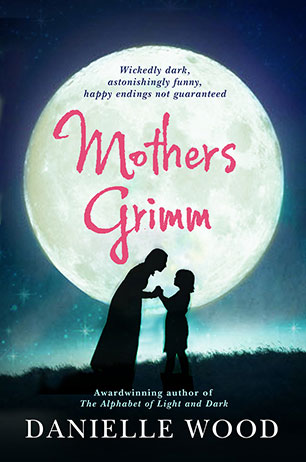
Danielle Wood, Mothers Grimm, book cover

Courtesy: Allen & Unwin

If you thought from the title of Danielle Wood’s latest novel, Mothers Grimm, that it comprises a retelling of fairytales you’d be right – and wrong. Right, because the stories contained within do springboard from specific fairytales, but wrong if you expect the new stories to be retellings. The wordplay on the title – Mothers Grimm/Brothers Grimm/Grim Mothers – sets the tone. This is a clever, wicked, funny but also heartrending look at modern motherhood.

Now, if you’re not an expert in fairytales, you might be relieved to know that it’s not necessary to know the source story to understand Wood’s “version”. While knowing the source story may add a lovely (and clever) fillip to our understanding, Wood’s stories stand well on their own. The collection starts with a prologue, which also draws from a fairytale, Hans My Hedghog. Here, Wood puts on a pedestal and then takes apart the idea of “the good mother” showing it for the myth it is, that is, an idea primarily concocted by advertisers to show us the way to perfect family life. Wood writes this opening section in second person, gathering us effectively into her wisdom. She shows us the “truth” behind the myth but assumes that, deep down at least, we already know it: “You could tell them [the literary scholars and psychoanalysts, she means] exactly why it is, in fairy tales, the Good Mother is always dead”. I knew by the end of the Prologue that I was going to like this book.

The thing about the myth, of course, is that no matter how much we might see its falsity, we still get pulled in. Why? Because we want to be the best mothers we can, we want to do the best for our children, we want them to be better and happier than we were/are. It’s a big ask, as life has a way of showing – and if life hasn’t, Wood certainly does. So, how does she do it? After the prologue, there are four stories: Lettuce (“Rapunzel“), Cottage (“Hansel and Gretel“), Sleep (“Sleeping Beauty“), and Nag (“The Goose Girl“). In each, Wood takes the original concept and spins a tale that can be darkly funny at times, but that is always devastatingly honest. This is a book which must surely bring a rueful laugh to most parents, but is perhaps best kept away from potential or new ones – though, if I remember my own youth, I probably wouldn’t have believed it anyhow. Sometimes empathy really does spring best out of one’s own experience!

In “Lettuce”, a beautiful pregnant woman is envied by the other women in a pregnancy yoga class. She seems perfect and becomes the focus of their obsession and envy. The story is told, third person, through the eyes of one of the mothers, Meg. Now Meg grew up with an earnest, sheltering mother who somehow missed the point about joy and pleasure. So when young Meg is introduced by a school friend to the delights of eating only the cream out of cream biscuits (Orange Slices, to be exact), she is shocked. She

couldn’t have said what exactly it was that was so profoundly bad about eating only the cream out of the biscuit, but she knew it was worse than just the waste.

Through gorgeous descriptions of familiar actions – such as how you twist a biscuit to separate its two parts and thus expose the cream – and by conveying often inchoate feelings or longings, Wood manages to expose the quiet deceptions and jealousies, but also the fear, confusion and love, on which motherhood is often built.

If “Lettuce” focuses on imagining an impossibly ideal “good mother”, “Cottage”, explores the guilt mothers feel about leaving their children in childcare. Nina makes a deal with her husband: he will support her staying home until their son goes to school, and she will not ask for another child. Best-laid plans – but of course we all know what happens to them. In this story Wood explores that still-familiar territory – the vexed question of child-care and the distressing way women judge each other. Indeed, mothers judging each other is one of the darker, sadder themes of the book. In this story, Nina’s dreams and ideals of motherhood are brought down, partly by her own unrealistic expectations (and oh, how I recognised those), but partly too by the economic pressures of modern life.

In “Sleep”, Wood turns to a teenage Mum. While the previous two stories are told third person from the perspective of one mother, in “Sleep” the perspective, though still third person, is shared, mainly between two sisters, Liv and Lauren. This is a well-to-do family, shamed by a teen pregnancy. There are wicked twists and wordplay here on the main motifs of “Sleeping Beauty” – the prick, and sleep – but in the end the story is about new mothers who do it alone. It’s about how easy it is to lose self and perspective when you have no support and don’t get enough sleep. It’s the most shocking of the stories – particularly because Liv doesn’t get the support she needs from the one she most needs it from, her mother.

And then there’s “Nag”, about Stella, a young woman who, trained as a nurse, goes about as far away as she can from her loving, but long-suffering mother. The story starts in 1958, and unlike the previous three, is told first person by Stella, who is telling her story to her daughter. She describes how she married:

He was twenty-two years old and starting to look about for a wife and I came to him like a lost banknote on a windy street: a windfall that he quite reasonably thought he may as well put in his wallet as throw back on the ground.

Stella finds herself, lonely, on a dusty farm with a remote, unsupportive mother-in law, and a nagging (I won’t reveal the gorgeous wordplay on this one) voice that tells her “If your mother could see you now, it would break her heart in two”. The focus here is the often fraught mother-daughter relationship.

What Wood shows is that grandmothers, mothers, and daughters are all complicit in maintaining and perpetuating the myth of “the good mother”. There is the occasional subversive mother, or the one who seems to steer an easy course through the minefield, or the one who manages to rise above the competition to reach out to a sister-mother, but for most the gap between ideal and reality defeats them. The “F” word – Feminism I mean – is not explicitly discussed but it lurks underneath. Indeed, I suspect many of the characters would eschew the word, but their lives and expectations are shaped by it nonetheless – and not, it seems for the better.

The accommodations and compromises, together with the emotional and physical losses, are grinding. I’m making it all sound rather grim (excuse the pun), and there is that, but it’s not what I came away with. The humour, warmth and lack of judgement with which Wood delivers her truths suggest that her aim is not to be negative but to shine a light on the issues and encourage discussion. If there’s a lesson to learn, it’s that there are many ways of being good mothers … and they start with being easy on yourself.

awwchallenge2015Danielle Wood
Mothers Grimm
Sydney: Allen & Unwin, 2014
214pp.
ISBN: 9781741756746

Paddy O’Reilly, Peripheral vision: Stories (Review)

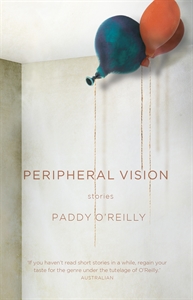
Paddy O'Reilly, Peripheral vision Book cover

The title of Paddy O’Reilly’s latest collection of short stories, Peripheral vision, comes from the story “Restraints”, in which the narrator, standing in a robotics lab where things have gone awry, says:

… and I caught again a flicker in my peripheral vision.

It’s a good title for the book because the stories are about people or events that happen to the side of “ordinary” life, however we might frame that. (I don’t talk enough about titles in my reviews, but they are important.) O’Reilly’s characters vary greatly – in gender and age. Short story writers, I’ve noticed, pay little attention to the criticism novelists often face regarding the voice they write in, like, can a man write a woman, can an anglo-Australian write an indigenous or immigrant person, and so on. Short story writers frequently range far and wide in the voices they write in. As I was reading this collection, I found myself thinking about short story writers, and what writing short stories might mean to them. While some people see short stories as a training ground for the “real” thing, novels, the writers themselves, I suspect, see them as a form in which they can let their imaginations fly. They can try being anyone or anything, anywhere, and are less likely to be taken to task for it. Certainly, in Peripheral vision, O’Reilly’s characters range from a teenage schoolgirl to a homeless man, from a twenty-something brother to a ten-year-old step-daughter, from a Filipino man to a young Australian teacher in Japan.

There are 18 stories in this collection, of which 12 have been published before. I had in fact read two of them: “The salesman”, a powerful and confronting story that I reviewed here as an individual story, and “Serenity prayer”, which was published under the title “Reality TV” in Angela Meyer’s The great unknown (my review). Another story also underwent a title change, from “Friday nights” to “Territory”. Titles! Clearly important. Well, I presume these title changes are O’Reilly’s and that she thought the same story presented in a different collection would work better under a different title. “Reality TV”, for example, is a straightforward descriptive title, with a little hint of irony, for an anthology about inexplicable things. “Serenity prayer” is a more subtle title encouraging multiple readings, particularly if you consider the ways in which this prayer is, and has been, used. This story, about a publicly betrayed wife, gets you in, and then, at the end, makes you wonder.

Simplistically speaking, the stories can be divided into two types, plot-driven and character-driven. “Territory” is a fairly traditional plot-driven story about a group of six girls out on the town on a Friday night, but, there are clues that there’s something more going on. For one, there’s the way they dress:

That was the one thing you might question about us. Other girls who went out in a group looked more alike. Arty types with arty types; girls who knew how to pick up wearing the uniform of short hip-hugging skirt, skyscraper heels, mascara and lipstick … We were a mixed-up crowd …

Then there’s the reference to a seventh girl, Suze, and the suggestion that everything might be alright now she’s been accepted into medical studies. Gradually hint upon hint is dropped suggesting that these girls aren’t just out for a good time. A very effective story. “Serenity prayer”, mentioned above, is another with a strong plot line. “One good thing”, one of the longer but still nicely sustained stories, is about the friendship between two school girls, and a violent act that occurs during a holiday visit. Its resolution, as in most of the stories, is open, leaving us to consider the short and long-term ramifications of such acts. Each of these explores a core idea – but sharing that idea could spoil the plot, so I’ll leave it here.

I can though talk about the ideas underpinning the character-focused stories. “Caramels”, for example, is about a homeless man. The ideas underpinning it relate to pride and dignity. It has a story of course, describing his life, but in these character-focused stories, plot is not the driving force. “After the Goths” is about a young twenty-four-year-old man working through guilt about something that happened in his teens. It makes him behave meanly to his older brother but, in a nice touch, his brother doesn’t rise to the occasion. Not everything, O’Reilly knows, has to be high drama to be interesting.

Other stories are perhaps better described as slice-of-life. “Deja vu”, set in a small town in France known for its medicinal hot springs, is one. It’s about holiday relationships. There’s Anthony with unexplained concerns of his own, who meets an older couple and finds himself drawn into their company against his will, as can happen when you travel. And there’s the older couple, comprising a whining dissatisfied wife and a long-suffering husband. It’s, partly anyhow, about the accommodations you make. Martin “had never been able to speak rudely to anyone” and George, the husband, seems to do a good job of accommodating his wife. The language here is delicious. The whining wife’s “mouth held the shape of a drawstring purse”. A little later, “her lips grew tighter, as if someone had pulled the drawstring”.

There’s wry humour in some of the stories, like “Breaking up” and “The word”, and a couple of the stories, “Procession” and “Restraints”, tip, intriguingly, into the speculative genre. In all, though, O’Reilly presents humans facing challenging situations – some violent, some threatening or risky, and others confusing or unsettling. Whatever it is, she rarely fully resolves the tension, leaving it instead to the reader to think about the morality, the values, the accommodations at play. This can be disconcerting if you like closure. But I like it, not only because closure can be boring and, frankly, not realistic, but also because it means you can read the stories again and again, and come to a slightly different conclusion or, should I say, understanding, each time.

Peripheral vision is exciting to read. Each story is so different that I was driven on to the next one, wondering what I’d find there. What I invariably found was a new world with another challenge to my way of seeing. I wonder what her peripheral vision will pick up next.

awwchallenge2015

Paddy O’Reilly
Peripheral vision
St Lucia: UQP, 2015
200pp.
ISBN: 9780702253607

(Review copy supplied by UQP)

Rochelle Siemienowicz, Fallen (Review)

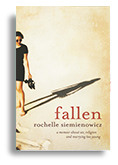
SiemienowiczFallenAffirmBeing a reader who focuses more on “truths” than “facts”, I’m not averse to writers playing around with fact in their fiction or fiction in their fact. This issue raises its head most frequently in historical fiction of course, but it’s also present in autobiographies, memoirs and even biographies. And so, here I am, having just reviewed Kate Grenville’s biography-cum-memoir of her mother, talking about another memoir, Rochelle Siemienowicz’s Fallen.

“It is a story …”

Siemienowicz’s memoir commences with – well, a literary in-joke – “Call me Eve”. What? It’s a memoir the front cover tells us, and the author’s fist name is Rochelle. Who’s this Eve? Rochelle explains in her brief introductory note, a note that precedes the Prologue, that her parents would never have named her for “that original sinner” but that it’s the name she gives herself when she thinks back to that time when she was a young wife, “so very young, so very hungry”, when she “picked the fruit and ate and drank until I was drunk with freedom and covered in juice and guilt”. The name Eve then has a symbolic meaning that forces us, as we read the book, to consider the idea of “fallen women”, but it also enables Siemienowicz to distance her present self from that young woman she once was. This reminded me of Kate Holden’s memoir, The romantic (my review), in which she chose a different path to create that separation – the third person voice.

Anyhow, having explained the name issue, Siemienowicz continues with the point that interests me, the form of her memoir. She writes that “it is a story, with parts made up and fragments rearranged like a dream half remembered now that twenty years have passed”. In the Epilogue, she mentions, almost in passing, that she’d originally written the book as a novel.

So, in Fallen we have a memoir that has strong novelistic elements, including a tight cast of characters, a deliberate narrative structure, and dialogue. You don’t find dialogue in traditional autobiographies. We readers would not believe that the writer could remember verbatim conversations held so long ago. But, dialogue is increasingly being incorporated into memoirs. Dialogue can engage readers, and while it may not represent verbatim “fact” it can convey the “truth”.  If you are starting to question by now whether this really is a memoir, I should confirm that it is fact-based, at least I believe it is, unless Siemienowicz has pushed artifice so far that her apologetic-cum-warning phone-call to her ex-husband in the Epilogue is fake! But I don’t think this is the case. There does come a point where you must suspend your disbelief and go with the writer after all.

“I feel something breaking inside of me”

Now, having spent paragraphs on introductory discussion, it’s time to say something substantial about the book’s content. Fallen is the story of a young woman raised by devout Seventh-Day Adventists (SDA) who believe, among other things, that premarital sex is a sin. To satisfy her intense sexual longings and remain “clean in the Lord’s sight”, Eve, who feels a freak in a freakish religion, marries Isaac, another SDA, in 1992 when she’s only 20. She’s deliriously happy. They love each other, and they’re free. They rebel – drink alcohol, eat meat, spend hours in bed – but then, within a couple of years, Isaac starts to withdraw, losing interest in their sexual relationship. The solution – because they love each other, and are committed to their vows (to stay married, at least) – is to have an open marriage. There’s only one rule, they must always ask permission first.

Most of the book is set in Perth in 1996, when Eve returns home to attend a conference and catch up with old friends. Her lover, Jay, is to follow for a week, followed by her husband the week later. Before Jay arrives, she reconnects with her first love, and has a fling with another conference attendee. Oh what tangled webs! Things, in other words, start to unravel, and Eve’s faith in her marriage and her vows starts to break down under the weight of secrets. She begins to question whether their rules can work “in the real world” – but the alternative, and its implications, are confronting.

“Can the centre hold …”

Memoirs are interesting beasts. Why do we read them? Sometimes it’s obvious. The memoirist is famous, or is writing about something we love (like literature, for example, for me). Sometimes it’s less obvious. It might be that the memoirist has experienced something we are experiencing like, say, grief. With Fallen, however, neither of these reasons really apply for me. So why read this one? Well, for two main reasons. One is that while the circumstances – a young woman of a strict religious upbringing trying open marriage – are rather narrowly specific, there are some broad themes. One has to do with sexual freedom. What does it mean, before, within and without marriage? How does it affect relationships? What has it to do with sincerity, intimacy and honesty? How do principles fit with feelings? There’s a broader theme too – the formation of identity. The subtitle of the memoir, “marrying too young”, hints at this. How easy is it to sustain a marriage made before you have fully formed your identity?

I feel myself spread all over the nation, with loyalties and loves and lusts from the east coast to the west, and no idea what to do with them. I’m a girl with no qualities and no boundaries, with legs wide open and a beating heart exposed. I’m appalled by myself, but also intrigued. How many tiny pieces of myself can I give away before there is nothing left? How curiously exhilarating. It feels like vertigo.

The other reason for reading this memoir is the writing. Siemienowicz knows how to tell a story. She structures the memoir around a trip back home, which she tells chronologically, but into it she weaves the story of her life and relationships to that point. We see a young woman who can be confident and brazen one moment, and vulnerable and uncertain the next, who throws herself wholeheartedly into life but doesn’t always think about where she’s pointing. And we see all this through a focused narrative and clear, direct but spirited language.

Fallen is, at times, an uncomfortable read but Siemienowicz’s honesty, her angst about her “fraying code of honour” versus her desire to fully engage in her life, captured my imagination and had me wanting her to find an honourable conclusion to a painful part of her life. This memoir is testament, I’d say, that she does.

Rochelle Siemienowicz
Fallen: A memoir of sex, religion and marrying too young
South Melbourne: Affirm Press, 2015
263pp.
ISBN: 9781922213655

(Review copy supplied by Affirm Press)

Kate Grenville, One life: My mother’s story (Review)

Kate Grenville is one of Australia’s best known contemporary writers, and is one of that small band to have succeeded both critically and commercially. Most know her for The secret river, which was shortlisted for the Man Booker Prize among other awards. I enjoyed that, and the other novels of hers that I’ve read, with my favourite being The idea of perfection which won the, then, Orange Prize. I also loved her non-fiction work, Searching for The secret river, about researching for and writing The secret river. I was, consequently, keen to read her latest book, One life: My mother’s story, when I heard it was to be published this year.

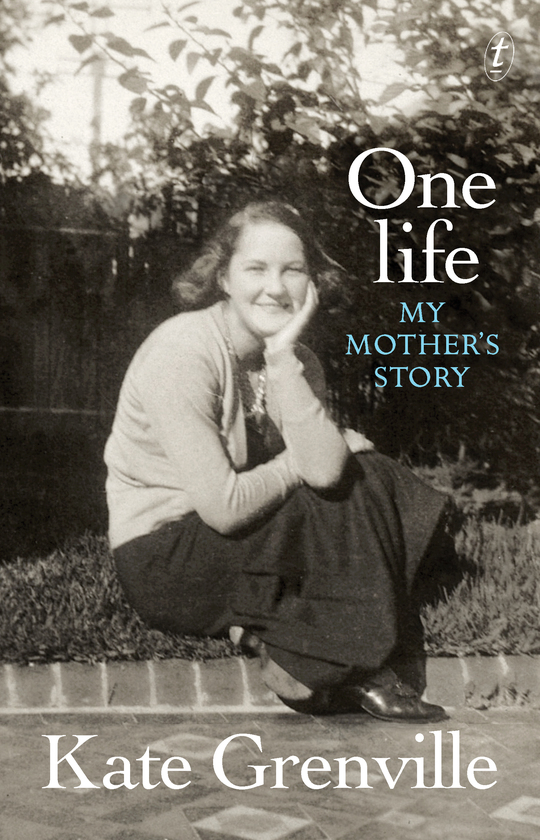
Kate Grenville, One lifeGrenville’s mother, Nance, was born in 1912, and died in 2002. Sorting through her mother’s papers later, Grenville discovered multiple notebooks containing her mother’s attempts to write her story. Nance apparently tried different ways of writing it – including, Grenville quotes, trying “to write it backwards”. However, her attempts always petered out, never going past her early forties “perhaps because by then she felt less need to look back and try to understand”. And so, Grenville’s book sticks to that, stopping (except for a short postscript) when Nance was 38 and pregnant with Kate. Wah! How disappointing not to be able to read about Kate’s childhood!

When I first heard of the book, I thought of Meg Stewart’s fascinating Autobiography of my mother, which I read a few decades ago. Stewart is the daughter of artist Margaret Coen and author Douglas Stewart (who, coincidentally, was born in 1913, one year after Nance). They are, however, very different books, not only because these two women led very different lives – one an artist married to a writer, and the other a pharmacist married to a lawyer – but because Stewart wrote her book in first person, as if she were indeed writing her mother’s autobiography, while Grenville opted for the more expected third person approach of a biography.

Given Grenville’s mother was not an artist or famous in any way, and given, as I’ve already said, she doesn’t write about her writer-daughter’s childhood, why is this book worth reading? Grenville, in her prologue, admits that her mother “wasn’t the sort of person biographies are written about” but argues that her story is worth telling because “not many voices like hers are heard. People of her social class – she was the daughter of a rural working class couple who became pub-keepers – hardly ever left any record of what they felt and thought and did.” The result, as Grenville – ever with an eye on history – says, is that “our picture of the past is skewed towards the top lot”. Grenville argues convincingly that the stories of people like her mother are well worth hearing, though I do think the argument has largely already been won. Many contemporary historians (and others, like museum curators) are, as we’ve seen in the books now being published and exhibitions being created, demonstrably interested in the lives of “ordinary people”.

The paradox, though, is that Grenville’s mother’s story is not at all an “ordinary” one. She was born to rather mis-matched parents, Dolly and Bert, whose marriage had been orchestrated, in 1910, by Dolly’s mother. Nance and her two brothers were “dragged” around the state as their parents worked on farms, in pubs, in the city, in country towns. Nance was sent away to a convent school, where she was very unhappy, wanting always to be part of a family. They experienced the Depression, and her parents lost their pub in Tamworth as a result. At the end of her teens, Nance wondered:

what would have happened if her parents had been unadventurous and contented with their lot. She’d have grown up in Gunnedah, left school at fourteen as they had, married a farmer and had six children … Yes, she wanted to meet someone, get married, have children. She wanted to be happy. But she knew now that she wanted something else as well.

What that “now” refers to is completing her first year of pharmacy studies in 1930. It is this, I think, that proves Nance, while never famous, to be no “ordinary” woman – but one who was “part of the world of the future, not the faded past”. So she becomes a pharmacist, and, after a few romantic adventures, some of which also prove her to be not quite “ordinary”, she meets Troskey-ite lawyer Ken Grenville Gee, the man she married and with whom she had three children.

It was not an easy marriage. Nance fell in love with Ken, but she gradually realised that he didn’t love her. He was a fair but remote man. He acknowledged women and respected Nance’s intelligence. He was happy for her to return to work – particularly when they needed the money! – though he, for all his forward thinking in some areas, never gave a thought to the necessary childcare arrangements or to the housework that still needed to be done. It might be a devoted daughter’s bias, but Grenville presents her mother as a loving woman, with a strong mind and a wonderful can-do attitude.

Running through the story of a woman is also the story of a time and place, of Australia in the first half of the twentieth century. Nance, from a working class background, comes to agree with middle-class-but-socialist Ken that ordinary people never have a chance. She realises that

what people called destiny was really the system everyone was part of. The ones on the top of the pile kept everyone thinking they could get ahead, when in fact ordinary people never had a chance.

War and the Depression taught her that. Nance also faces the challenges of being a woman in a patriarchal society. Not only was there the expectation that she would manage the domestic realm while working outside the home, but she was treated with unfairness and disdain when she applied for her pharmacist licence, despite having the required qualifications and paperwork.

I loved all this, but I did find it an odd book to read, and I think this is due to the voice, to the fact that while it’s not an autobiography it is far more intimate than the usual biography. Kate’s knowledge – or understanding – of her mother’s motivations and behaviour is so intense that I found the third person voice disconcerting at times, all the while enjoying the insights. Grenville’s prose is simple, straightforward, but not plain. Imagery is used with restraint, with the focus primarily on the story and Nance’s thoughts and feelings. Here’s an example, a description of Nance, always wanting family, returning home between her first and second year of pharmacy study:

Nance leaned on the windowsill of her old room, looking up at the washed-out green of the hill behind town. There was nothing for her here. Only that failing hotel, the cranky mother, the father muddled up with some other woman. If this had ever been any kind of home for her, it wasn’t one any longer.

One life is a fascinating, engaging book. Grenville’s insights into her parents’ marriage, and particularly her mother’s thinking, reflect the empathy you’d expect from a novelist. How much comes from Nance’s own words, and how much is extrapolation, is not clear, but the book is convincing – on both the psychological level and as a social history. It is well worth reading for both those reasons.

awwchallenge2015Kate Grenville
One life: My mother’s story
Melbourne: Text Publishing, 2015
260pp.
ISBN: 9781922182050

(Review copy courtesy Text Publishing)

Tony Birch and Ellen van Neerven in Review of Australian Fiction 10 (4)


Review of Australian FictionI have been wanting to write about the oddly titled Review of Australian Fiction for some time. I say oddly titled because, contrary to what it might sound like, this does not contain reviews but short fiction. Established in 2012, it is published, electronically (or digitally), every two weeks. Each issue contains two stories by Australian authors: one by an established author, and the other by an emerging author, chosen by the established author. Funnily, in the issue I’m reviewing here, it’s the emerging author, Ellen van Neerven, whom I’ve read before, not the established one, Tony Birch. But, I’m so glad that Lisa’s Indigenous Literature Week has given me the opportunity to a) finally read something by Birch, and b) finally read Review of Australian Fiction issue.

Tony Birch, “Spirit in the night”

Birch’s story is told first person by a young indigenous boy, the 11-year-old Noah Sexton. He’s dirty, smelly, poorly dressed, and no-one wants to know him – except the new girl, Heather, who invites him to sit next to her. She’s “the cleanest person I’d ever seen” with “no pox rashes, bites or scars like I had”. At lunchtime, Heather offers the hungry Noah a sandwich and engages him in conversation. She asks him why he sits alone, and he gives the classic reply:

‘I sit here because I’m a Sexton.’

She doesn’t know what that means of course. When he discovers that her father is the policeman “in charge of the station”, he assumes:

Our mob was well known to the police, and I knew straightaway that as soon as her father got the story on the family name, she wouldn’t be sitting under any tree offering me a vegemite sandwich.

But, it doesn’t quite work out the way he expected. When he explains to the friendly Heather that he’s from “the only abo family left in town”, she tells him that “abo” is “a dirty word” and that “people like you, we call them half-castes. It’s more proper”. Noah disagrees, telling her that “an abo’s an abo, no matter how black or white he is … Far as whitefella is interested, the shit smells just the same.” Heather shows discomfort at this language, but Noah doesn’t care. He’s “beginning to think she was only another do-gooder”. He tells her about how his people have been treated in town, but Heather tells him her father will be different, that “he’s always fair, to both sides”. Not surprisingly, Noah is (silently) sceptical. Nonetheless, this little bit of kindness from Heather brings out a new sense of self in Noah – he doesn’t wolf down the sandwich, pretending he has a few manners, and when he gets up to go into school after that first lunch he dusts his pants off “for maybe the first time in my life”.

And so Heather spends most lunchtimes with Noah, because she’s a Christian and it’s “a sin to turn away from those in need”. Noah doesn’t like being seen as a “charity case” but is so enamoured of Heather that he’ll “put up with anything”. Understandable, given his treatment at school before.

I won’t describe any more. This is a clever story about do-gooders. Birch has astutely chosen for his protagonist a young boy on the cusp of puberty. Noah, straddling that line between childhood and adulthood, has a sense of his agency, and yet not quite the experience, nor the resources, to insist on enacting it. It’s a story about confused emotions, and about smugness and self-satisfaction. It’s about the right to dignity, and, of course, about power.

Ellen van Neerven, “Sweetest thing”

awwchallenge2015Unique, original, fresh are words I avoid when writing reviews, not only because they feel cliched but because they can be contested by anyone whose reading experience is wider than mine. So, instead, I’ll just comment on Ellen van Neerven’s capacity to surprise. I found it in her Heat and light which I reviewed earlier this year, and in “Sweetest thing”.

“Sweetest thing” is a third-person story about Serene, the child of an indigenous mother and the town’s Dutch baker. She is addicted to having her breasts suckled. It all started in puberty (“that pertinent time of a woman’s life”) with her first experience of having a man suckle her breast occuring with a male tutor when she’s nearly fourteen. He lifts up her shirt:

Beautifully out of herself, she was open and messy and dislocated like a bouquet being readied for a vase, flowers, stems, spores spread everywhere.

Nothing else happens besides this suckling, but Serene feels “bliss” and “knew then that this was what she had been programmed to need”. Slowly, as Serene schemes and positions herself to have her need met, we learn about loss. We learn, for example, about the Kedron pub, which “had refused Serene’s grandparents entry” but which is now

a haunt for women of her mother’s ilk: divorced, discarded, with loose threads of long silent and secret relationships carried under their shirts.

Under their shirts. A reference to their breasts? We learn about the gradual withdrawal of her father as he starts to focus on his “real daughter”. Serene feels anger at “the silence in her life, at his hypocrisy”.

Born into this in-between world – not quite rejected as her grandparents were, but not fully accepted either – Serene believes she deserves “comfort, worship, devotion. Trust and understanding”, but fears “hollowness”.

And so, her life progresses through school and early womanhood into mature adulthood. She has friends, she experiences casual sex, she becomes a masseuse – but still there’s the need for suckling, to have “the most basic of her needs met”. Again, I’ll leave the story here. It’s longer than Birch’s and spans a few decades of Serene’s life, which includes a meaningful relationship and a successful career.

“Sweetest thing” is an edgy story. Serene’s unusual addiction works as a rather confronting metaphor for what all humans need – love and acceptance. What I like about Van Neerven, here and in Heat and light, is that her indigenous characters are not “types”. Their indigeneity is part of who they are, and is fundamental to the challenges they confront, but her characters are also “universal” – that is, they are needy, flawed characters who muddle along, just as the rest of us do, in the lives they find themselves in. It’s powerful stuff.

ANZ_ILW2015Read for ANZLitLovers’ Indigenous Literature Week.

Tony Birch, “Spirit in the night”
and
Ellen van Neerven, “Sweetest thing”
in: Review of Australian Fiction 10 (4), May 2014