Elizabeth Jolley, Hilda’s wedding (#Review, #1976 Club )

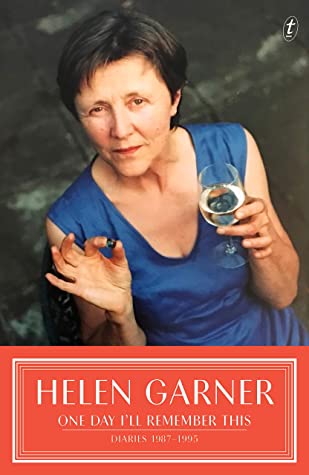
One of Elizabeth Jolley’s biggest fans is Helen Garner, as I have said before. Garner often mentions Jolley, and my current read, the second volume of her diaries, One day I’ll remember this, is no exception. She writes:

Elizabeth Jolley’s new novel, My father’s moon [my review]. She re-uses and reworks images from her earlier work, brings forth experiences that she’s often hinted at but never fully expressed. I can learn from this. I used to think that if I said something once I could never say it again, but in her book I see how rich a simple thing can be when you turn it this way and that and show it again and again in different contexts.

This is not the only reason Garner admires Jolley, but the reasons are not my topic for today! I will add, though, because it is relevant to my topic, that another thing Garner appreciates about Jolley is that both draw closely from their own lives in their writing.

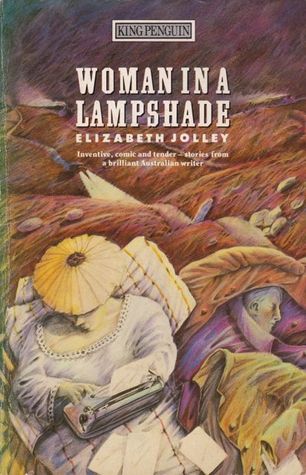
So now, “Hilda’s wedding”, which I read for the 1976 Club, hosted by Kaggsy’s Bookish Ramblings and Stuck in a Book. It’s not the short story I had planned to read, but I couldn’t find that one – also a Jolley – in my collection or online. Fortunately, during my hunting, I found this one from the same year, and it exemplifies the two points I made at the beginning. Firstly, it features a character, Night Sister Bean, who appears in other Jolley works, including the first of hers I read, the short story “Night runner”. And, being a hospital-set story, it draws on (let’s not say “from”) her own experience of nursing.

“Hilda’s wedding” is a rather bizarre or absurd story – which, again, is not a surprise from Jolley. In it, the narrator, who is a relieving night nurse – so somewhat of an outsider – organises an on-the-spot wedding for the very pregnant, apparently unmarried, kitchen maid Hilda. The various roles – husband, celebrant, parents of the bride, pages – are played by night staff including the cook, cleaners and porters. The bride is dressed, with a veil made of surgical gauze and a draw sheet as her train (which contains a hint of the Gothic that we can also find in Jolley’s writing). Immediately after the ceremony, Hilda goes into labor and gives birth in the elevator.

What does it mean? I’m not sure, but this little story about an impromptu wedding sounds like children’s play-acting. It’s a game which uses imagination and creativity, which provides a sense of fun in a grim place, and which brings a little joy to Hilda, whose “melon-coloured face shone with a big smile”. Melons, as you may know, are often associated with pregnancy and fertility. However, injected into the story at various points is the real world, one characterised by rules and impersonality. There’s also the unresolved mystery about Sister Bean and rumours about her negative impact on transfusions/drips. Is she a witch, they wonder?

Sister Bean opens and closes the story, but otherwise appears only occasionally. There are various ways we could read her. One could be people’s need to find a reason or explanation or scapegoat for the bad things that happen in a world where you have little control. In the third last paragraph, our narrator comments on the early morning, and the city waking up:

A thin trickle of tired sad people left the hospital. They were relatives unknown and unthought about. They had spent an anonymous night in various corners of the hospital waiting to be called to a bedside. They were leaving in search of that life in the shabby world which has to go on in spite of the knowledge that someone who had been there for them was not there any more.

It is against this backdrop of sadness that our nurse narrator was there for Hilda. In the next and penultimate paragraph, the narrator is standing outside, taking “deep breaths of this cool air which seemed just now to contain nothing of the weariness and the contamination and the madness of suffering”.

In this story, as is typical of Jolley, there is humour alongside sadness, comedy next to tragedy, unreality bumping up against reality, and, appropriately, no resolution at the end.

In Central mischief – a collection of Jolley articles, talks and essays compiled by her agent Carolyn Lurie – is a talk Jolley gave to graduating nurses in 1987. Before I get to my concluding point from it, I’ll just share something else she says, which is that “for me fiction is not a form of autobiography”. This is an important distinction, which I think Garner would also make. Writers like Jolley and Garner may draw on their own experiences, but what they write is something else altogether.

But now, I want to conclude on this that she tells them:

There is a connection between nursing and writing. Both require a gaze which is searching and undisturbedly compassionate and yet detached.

What a clear-eyed view – and how hard to achieve. What do you think about this?

Challenge logo

Elizabeth Jolley
“Hilda’s wedding” (first pub. 1976, in Looselicks)
in Woman in a lampshade
Ringwood, Vic: Penguin Books, 1983
pp. 139-46
ISBN: 0140084185

Monday musings on Australian literature: Writers’ notebooks

If you’ve attended writers festivals, you are sure to have heard writers talk of using notebooks to jot down ideas on the run, to record conversations overheard on public transport, cafes, etc, to capture the thoughts of the writers they read, and so on. These notebooks are not works of art in themselves, but part of a writer’s toolbox for creating their art – except, of course, writers being writers can turn anything into art, if they set their minds to it.

Some time ago, an article appeared in The Guardian on writers’ notebooks. It starts by discussing:

the way notebooks seem to offer access to hidden origins, and to the creative processes by which works we value come into being. Notebooks record early versions and impulses, and though sometimes the writer has an eye to posterity, the privacy of self-communing allows things that can’t be shared with others to be said, within what Coleridge, one of the great notebook-keepers, called in 1808 a “Dear Book! Sole Confidant of a breaking Heart”. For Virginia Woolf, her notebook helped to “discover real things beneath the show”; flashes of perception, phrases, half-formed and potential ideas …

The article was written by American Professor Philip Horne, who commissioned ten authors to write new stories based on “germs” left behind by Henry James in his notebooks. That book has been published, Tales from a master’s notebook: Stories Henry James never wrote. (Anyone read it?) Apparently, Horne is also editing an edition of James’ notebooks.

I’ve digressed a little – into American writers, and third-party-edited notebooks – when I really want to focus on Australian writers. But, sorry, I’m going to digress again, this time to lithub.com staff writer, Dustin Illingworth:

Few literary artifacts remain as consistently enigmatic as the author’s journal. … The very names we employ—the aforementioned “journal,” the stuffy “diary,” the tepid “notebook”—are failures of imagination, if not outright misreadings. Staid synopses and ossified lives these are not. Rather, what we find within their pages are wild, shapeless, violent things; elegant confessions and intricate codes; portraits of anguish; topographies of mind. Prayers, experiments, lists, rivalries, and rages are all at home here, interbred, inextricable from one another. A piece of petty gossip sits astride a transcendent realization. A proclamation of self-loathing becomes a paean to literary art. News of publication shares the page with the most banal errands imaginable.

Perfect, including his reference to nomenclature – journal, diary, notebook. Writing courses specifically recommend keeping a “writers notebook”, but writers themselves – if they do it at all – keep diaries, journals, notebooks, even loose pieces of paper like backs of envelopes. Many of these eventually find their way into libraries and archives.

Here, though, my focus is those that are published – by the writers themselves, not posthumously by academics or other editors. These works are clearly part of a writer’s oeuvre – and I’m calling them “notebooks”. They tend to be highly edited and somewhat different from traditional diaries, which, of course, can also be carefully edited. But, these “notebooks” have minimal diary framework, in terms of day-by-day dear-diary accounting.

Selected Aussie writers’ notebooks

I don’t know how many writers have published the sort of “notebooks” I’m talking about, but I have three on my shelves, to get the discussion going.

The first one, chronologically in terms of publication, is the most unusual, Beverley Farmer’s A body of water (1990). I’ve had it on my TBR since it came out. How embarrassing. Luckily for you, though, Lisa has reviewed it, so do go there if you are interested. Meanwhile, I’ll just make a few comments. I bought it because I loved Farmer’s writing, and looking at it again – as I have many times over the years – I feel the urge to dive in, but, no, on with this post.

Farmer’s book takes place over a year from February 1987 to the next February. The thirteen journal chapters are named for the month, but what makes this notebook a little different is that interspersed between the months are five short stories. The content of the journal chapters, however, is very much as described in the quotes above. There are references to her life (particularly her relationship angst), to books she is reading, to her own writing, to her environment. I am, cheekily, going to quote from Lisa’s review, because – well, you’ll see why later:

Farmer reads Alice Munro, and makes notes about the structure of her stories; she goes to the Spoleto Festival (forerunner of the Melbourne Festival) and brings home the books of A.S. Byatt from which to learn.  She wishes she had the insouciance of Olga Masters, she admires the ‘spirals within spirals’ in V.S. Naipaul’s The Enigma of Arrival (p192) and she reads and re-reads cherished authors, to ‘rebuild and restore’ (p169) finding a ‘fearful symmetry and sureness of touch’ in Jessica Anderson’s Tirra Lirra by the River (p219).

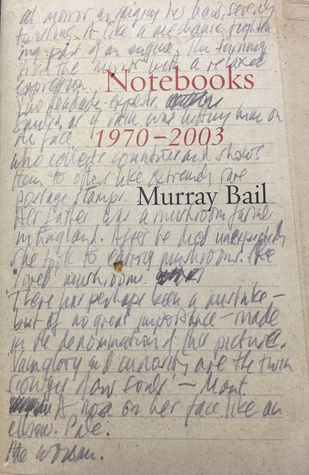
My second book is actually called a notebook – Notebooks 1970-2003 (2005) – and it’s by Murray Bail. I bought it because I like Bail and was intrigued by this notebook form, but I haven’t read it yet, either. It has just two parts: London June 1970-November 1974 and Sydney September 1988-November 2003.

It is more spare than Farmer’s and Garner’s books, but that in itself provides insight into him, as well as its content sharing what he’s observing, reading, thinking about. Here’s something quite random:

Strolling from one picture to another in art galleries, even commercial ones, I am assailed by literary ideas which beg to be resolved.

Book cover

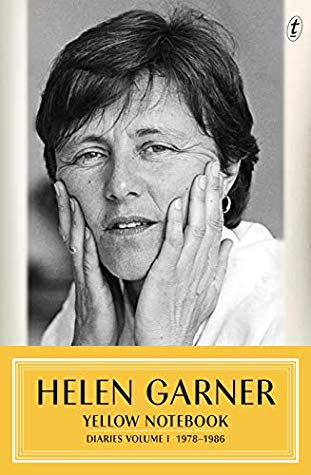
And finally, the book – or books – that inspired this post, Helen Garner’s first two volumes of her diaries, Yellow notebook: Diaries Volume I 1978–1986 (my review) and One day I’ll remember this: Diaries Volume II 1987–1995. Interestingly, the first one is called “notebook” and “diaries” while the second one is just “diaries”. I am including them here because the content, though arranged by year, looks like a collection of snippets, rather than a traditional diary.

In my review of volume 1, I focused on Garner’s writing about other writers, such as Elizabeth Jolley. In volume 2, she mentions other writers again, of course. One of these is – yes – Alice Munro, whom Lisa says Farmer also mentions. Here’s Garner:

Alice Munro is deceptively naturalistic. All that present tense, detail of clothes, household matters, then two or three pages in there’s a gear change and everything gets deeper and more wildly resonant. She doesn’t answer the questions she makes you ask. She wants you to walk away anxious.

Anyone who knows Garner and/or Bail will know that they were married (1992-2000) during the periods covered by their “notebooks”, and Bail certainly appears in Garner’s. But, more on that when I review it.

Why read these notebooks?

For me it’s because although, fundamentally, the text is the thing, I do think that understanding something about the writer can enhance what we get out of our reading.

Garner’s notebooks are a perfect example, because she writes much about what she thinks it worth writing about and what sort of writing she strives for. She wants, for example, to understand “what people do to each other”, and she writes of striving to let “the language tell the story”, and of “trying to trim adjectives without losing the sensuous detail they afford”. Of V/Bail, she admires “the bright freshness of his writing, its muscle, its dazzling turns. Carved free of cliché. Scrubbed till it hurts.”

There are many reasons for reading these notebooks, but another big one is discovering what our favourite writers read and what they think about what they are reading, as Lisa shares from Farmer. Here is Bail, being his spare self:

Emerson’s ‘Self reliance’: line by line, blow by blow.

I remained seated and immediately read through it again.

There is also just the joy of reading their writing. These notebooks are full of insights and descriptions that make you stop, but if I start sharing them, I’ll never stop. Instead, I’ll end with Farmer from near the beginning of her book. She’s writing about her “new phase of writing”:

This new writing: I want it to be an interweaving of visual images–more open, loose and rich, and free of angst. And if I keep a notebook this time …

Have you read any writer’s notebooks?

Nancy Jin and Rosalind Moran, These strange outcrops (#BookReview)

Bagging Canberra – often used synonymously for the Federal Government – is almost a national sport, but in recent years anthologies have appeared to counter this with more complex stories about this place. The first two I’ve read – The invisible thread, edited by Irma Gold (my review) and Meanjin’s The Canberra issue (my review) – commemorated Canberra’s centenary, but last year saw the publication of the evocatively titled These strange outcrops.

This anthology is the work of two young Canberrans, Nancy Jin and Rosalind Moran, who founded Cicerone Journal. Established in 2018, it is, they say,

a Canberra-based publication that seeks to encourage an open curiosity about the world in a socio-political climate of disconnection and disenchantment. We aim to publish writing that is exploratory and thoughtful, and new and unusual.

The journal’s fifth edition will be devoted to speculative fiction, and is due soon.

So now, These strange outcrops, which is subtitled, Writing and art from Canberra. It comprises original short stories, poems, and visual art created by established and emerging Canberra writers, and has a specific goal, as the editors write in their Foreword. It “grew out of a desire to question media narratives that portray Australia’s capital city as a place of disconnection and insularity”. They note that with a population of 400,000, Canberra and the surrounding region is “home to far more stories and perspectives than are commonly depicted in the news”. They wanted, they say, to “challenge the prejudices and stereotypes” and “celebrate the varied lives and imaginings of this unique place”.

“blurry at the edges” (Owen Bullock)

They have achieved their goal, and with style. This publication is physically gorgeous, from the cover, with its iconic Canberra bus stop framed by two Canberra floral emblems (the Royal Bluebell and Correa), through its beautiful endpapers comprising a correa blossom pattern, to the care taken with the design of the individual pieces. I can’t imagine any contributor not being thrilled with the look of their contribution.

But, the main point is, of course, the content. It more than lives up to the appearance, by which I mean, the book is not just a pretty face. An important thing with anthologies is the order, and it’s clear that the editors thought carefully about this. They start with the physical Canberra, and its natural environment, which is one of the reasons many of us love this place, and conclude with the experiences of different members of Canberra’s diverse population. In between, are various explorations of a wide range of aspects of life in Canberra, from those common to us all (like Cheryl Polonski’s poem “Wintertime in Canberra” and Penelope Layland’s poem “Showtime”) to some that speak to more specific experiences (like Daniel Ray’s prose piece about that challenging post-Year-12 time, “Queanbeyan: Quinbean: Clear water”). Some contributions are movingly personal, while others are unapologetically political. The end result is an authentic whole, that shows Canberra to be a rich and complex place, a bit “blurry at the edges” but with enough commonality at the core that makes us real, regardless of what outsiders might think.

Now, I did have some favourites, and will share a few of them over the rest of this post. The opening set of poems, “Canberra Haiku” by Owen Bullock beautifully introduces the collection, with its series of little impressions portaying Canberra’s breadth, from flowers peeking through a cracked pavement to a tattooed bus passenger and a permaculture working bee, from magpies and our mountains and lake to heatwaves and “blurry … edges”. The next few pieces explore place, often with an awareness of what was before we came, such as Janne D Graham’s poem “Crace Park” which conveys a sense of wrongness in our “calculated spaces”. A sort of antidote – or comment on this – is Helen Moran’s vibrant painting “Rainbow Serpent sleeping in Lake George”, the Rainbow Serpent being significant to many First Nations Australia peoples. It mesmerises me, because, while looking simple, it evokes complex and conflicting ideas. Set against a dark blue and black background, the bright, cheery serpent also looks ready to pounce. At least, that’s how it appears to me.

Patricia Piccinini, Sky Whale, pic: Nick-D from Wikipedia, using CC-BY-SA 3.0

Some of the pieces invoke wry humour to make their point, like Fiona McIlroy’s poem “sky whale” which uses the Patricia Piccinini’s Canberra-Centenary-commissioned hot-air balloon “The Skywhale” to reflect on attitudes to public art that challenges perceptions.

Canberra is
determined
to have a whale of a time
in the Centenary
to live it up
to lighten up
kick up our heels
yet a flying
maternal mammal
is just pushing the
envelope

The wordplay throughout the poem is delicious.

“come so far, lost so much” (Joo-Inn Chew)

Some of the strongest pieces concern migration and racism. Canberra, like much of Australia, is a multicultural place. We have Ngunnawal and other First Nations people here; we have Australian-born residents who have come from around Australia for work; and we have migrants including refugees. We have – or had, before the pandemic – an annual, vibrant and successful Multicultural Festival, which celebrates this aspect of the region, but several pieces in the anthology convey the sadness and pain that must always come with migration, regardless of its cause. Anita Patel speaks in “What are you cooking?” of the sadness of losing her mother in another part of the world, so that even those weekly phone conversations are no longer possible, while Joo-Inn Chew’s poem “A new arrival at Companion House” talks of the hope contained in the birth of a baby to people who have “come so far, lost so much”.

Others are much darker, speaking to non-acceptance, such as Michelangelo Curtotti’s ironically titled poem “The welcome”. In one of those perfect segues, this poem is followed by Stuart McMillen’s graphic short story, “I used to be a racist”.

As frequently happens when reviewing anthologies, I’ve only cursorily dipped into the treasures contained within. I apologise to all those contributors whom I don’t mention here, but know that you’ve been read and heard. The best thing would be for more to read your work in this thoughtful, considered anthology. It can be purchased from Cicerone (linked above).

Meanwhile, let’s finish on Rafiqah Fattah’s defiant poem, “Generation selfie”, about the 16 to 25 year olds who are too often ignored or passed over:

And now, there is a tremor in the air
We are here

Challenge logo

Nancy Jin and Rosalind Moran
These strange outcrops: Writing and art from Canberra
Canberra: Cicerone Journal, 2020
74pp.
ISBN: 9780646814155

Irma Gold and Susannah Crispe, Where the heart is (#BookReview)

I don’t normally review children’s books, particularly children’s picture books, but I do make exceptions, one being Irma Gold. I have multiple reasons for this. Irma Gold is local; she is one of the Ambassadors for the ACT Chief Minister’s Reading Challenge; she writes across multiple forms (including, novels, short stories and children’s books, in all of which I’ve reviewed her); and, if you click my tag for her, you will get a sense of just how active she is as a writer, editor and supporter of literary culture, particularly in the ACT. Hence this exception!

But, there is another reason too, which is that Where the heart is not only a delightful book but it slots very nicely into her growing oeuvre. Before I discuss that, though, I’ll describe this, which is her most recent book. Gold explains on its opening page that it was inspired by the true story of Dindim, a Magellanic penguin which, in 2011, was washed up on an island village outside Rio de Janeiro. The bird had been caught up in an oil spill. The fisherman who found him, Joao, cleaned and cared for him until Dindim returned to the wild. However, ever since then, Dindim has returned, annually, to Joao to spend several months of the year with him. There are questions about where he goes, but in Gold’s story it is Patagonia. Patagonia is one of the theories, because it is a major breeding ground for these penguins.

This sort of detail, however, is not critical to the story. It is fiction after all. What is critical to the story is that it tells of the potentially disastrous impact of oil spills on animals. It also tells of the importance of wild animals being free. This is what Joao believed. He brought the penguin back to health and set him free. It’s just that the penguin had other ideas. It also tells of the friendship that can develop between humans and wild animals.

What makes this a gorgeous book is the way Gold tells the story. It’s simply told but the language is not condescending, and it naturally incorporates local culture. Joao and the penguin mend nets, eat sardine sandwiches, and go shopping together, with this “shopping” being at a village market stall. It’s also warm-hearted. It encourages us to think about kindness, tenderness and loyalty, making it a feel-good read. Yet, there is also a narrative arc that encompasses a variety of emotions, including a sense of fear and drama as Dindim journeys back.

Not far from Joao’s beach, the sky swelled and lightning jagged. Dindim rode waves and wondered if he would make it. He was exhausted.

A little bit of drama makes it fun to read aloud to littlies, which I look forward to doing when lockdowns end and I’m able to see our little grandson again!

However, this is a picture book, so for it to succeed the illustrations have to be good as well. Fortunately, they are. I think this is illustrator Susannah Crispe’s first book, though she has another coming out this year. I’m not surprised she has, because she has done a beautiful job with this one. The colours are bright and inviting, but are conveyed with a warmth and softness that support the story. This is nowhere more obvious than in the two facing pages that contain only penguins. The expected intense black-and-white of the penguins is there, yet muted, and the white space surrounding Dindim visually conveys the text’s description of the “ache” in Dindim’s heart. Crispe also incorporates lovely little details from nature in her illustrations, like hummingbirds, butterflies, turtles and albatrosses. These all support the story by adding to its sense of place, but they also create interest when reading to littlies. “Can you find the turtle”, etc!

What I’m saying, in other words, is that this picture book is just the right package.

Irma Gold Craig Phillips Megumi and the bear book cover

And there I’ll leave it to return to my opening comment on Gold’s oeuvre, because I am seeing a pattern. The obvious one – from her previous picture book Megumi and the bear (my review) and The breaking (my review) – is her interest in wild animals, and in the relationship between humans and animals. Closely related to this is an interest in conservation, animal rights and the environment. And then – yes, there’s more – overlaying all of this is the importance of friendship, between humans, and between animals and humans. There’s a quiet joy in this, which is something Gold said, in a recent conversation, that she wanted to convey. I believe she has, and look forward to what comes next.

Challenge logo

Irma Gold and Susannah Crispe (illus.)
Where the heart is
Chatswood: EK Books, 2021
[32pp.]
ISBN: 9781925820874

Delicious descriptions: Sara Dowse on Canberra

In my recent post on Sara Dowse’s West Block, I ran out of time to share some quotes and thoughts on her depiction of Canberra and the heritage building, West Block. Soon after, I wrote a Delicious Descriptions on West Block, promising another one on Canberra – because, well, I can, and Canberra is my city.

Introducing that West Block post, I said that I love reading for its ability to take me to other places, lives and cultures – of course – but that there it is also special to read about one’s own place and life. It can reinforce our own impressions; it can enable us to just sit back and remember; and, most interestingly, it can encourage us to look at things from a different angle or perspective. West Block does all of these for me.

Canberra

So, Canberra. As many of you know, it’s a planned city, designed from the start to be Australia’s federal capital. It was formally “named” in 1913, but, of course, the land it was built on had been occupied for over 20 thousand years before that by Indigenous people, including the Ngunnawal and Ngambri peoples whom we honour today. In colonial times, it had also been farming/grazing country. All of this is referenced in West Block, though it is the contemporary built and natural environment which take precedence in the descriptions because they are what directly impact the characters.

Early in the novel, Dowse addresses the creation of the city when describing old-school George Harland’s decision to move to Canberra from the “hell” of western Victoria, the hot, dry “grass, scrub, dusk”. It had been the same, he thinks, in Canberra, but

With effort and planning and the help of some mountain streams they had beaten it. Everyone planted, in a peculiarly catholic way: silver birches and liquidambers, poplars, willows and rowan-trees, mixed with all manner of eucalyptus and acacia; the claret ash and grevillea, banksia, oleander, jonquils and hyacinth, till the colours of spring splashed over the streets, and autumn cart such a brilliant shadows they could never forget how they came to be.

I suspect there’s an intimation here too of the “catholic” development of Canberra’s population, of its comprising all sorts of people who came to work in this government city. Most of us were transplanted from elsewhere, like the exotic shrubs and trees; few of us had a family history in the place to ground us. Nearly 50 years on that has changed dramatically, but it wasn’t so at the time West Block is set.

Harland’s chapter in the novel contains some of my favourite descriptions of the city. I loved the account of his walk to work, and the various references to Canberra’s paradoxical nature as a city of physical beauty which also lacked “animation”. Harland thinks of Canberra’s past in terms of the farms, the “fields of lucerne that in earlier times had grown on the river flats”. It’s his Canberra-born daughter who reminds him of those for whom it had really been home. She takes him to her favourite park, telling him:

When I first started coming here I had no idea where I was. I mean Corroboree Park. Well, there’s nothing unusual in that. We’ve taken their language just as we have their land, and everything else. To make use of it as we will. But then I found out that this is really where they came to meet, all the tribes of this region, I like to imagine, under this very tree.

The novel is not about Indigenous dispossession and politics, but this reference, along with mentions of the Aboriginal Tent Embassy and of refugees, gently introduces the idea of all the people, in addition to Cassie’s women, whose needs were being ignored.

As well as its beautiful autumns, Canberra is known for crisp winters and clear, blue skies. There is a scene just after the new-style, more proactive bureaucrat, Henry Beeker, has been through a bruising IDC (interdepartmental committee) which had to prepare a joint submission to Cabinet on uranium development and the controversial Ranger Uranium Environmental Inquiry. Games are played and deals done to get the relevant departments to “work out some of the differences” between their ministers. Beeker goes outside with Cassie:

Outside the ground was damp from the morning’s frost, melting now with the warmth of the midday sun. Their feet made soft squishes in the turf. The sky was an uncompromising blue. Clouds bumped into each other, as if they too were invigorated by the crisp winter air.

These descriptions – “melting”, “uncompromising”, “bumping together” – perfectly evoke the physical environment but surely also reflect what Beeker has just gone through?

I have focused on a few examples that particularly speak to the novel’s meaning, but I revelled in all its descriptions of this beautiful city I call home.

Do you love reading novels set in your place – and if so, please share some!

Sara Dowse, West Block (New Ed.), For Pity Sake Publishing, 2020.

Price Warung, Selected tales of Price Warung (#BookReview)

Price Warung, as I wrote in my previous post on him, is the pseudonym used by English-born Australian writer, William Astley, who came to Australia with his parents in 1859 when he was still a child. Astley became a radical journalist and short-story writer, with particular interests in transportation/convict literature, and the Labour and Federation movements. Tales of the early days, the book I reviewed in my first post, was republished by the Sydney University Press, and was entirely convict-focused.

I didn’t expect to see Price Warung again, but here he is, a few years later, in a book containing a selection from three of his five books: Tales of the convict system (1892), Tales of the early Days (1894), and Half-crown Bob and tales of the riverine (1898). Given I’ve already devoted a post to the convict stories – four of which are included in this collection’s eleven, including the well-regarded “Secret Society of the Ring” – I will focus here on editor Lucas Smith’s introduction to the collection and Warung’s riverine stories, which are new to me.

Introduction

The first thing to say is that these stories were written between 1888 and 1898, but are mostly set decades earlier.

Smith starts by stating that, after Marcus Clarke’s For the term of his natural life (1874), “no writer did more to forge the myth of Australia’s convict heritage than William Astley”. However, Astley’s work a journalist included rural newspapers, like the Riverine Herald in Echuca, where gathered material for his “poignant and humorous stories about early steamboat traffic on the Murray River”. Smith says that these stories, which were “reminiscent of Joseph Furphy*”, were “his only departure from depictions of the convict system’s grimness”.

Astley’s popularity was brief, but it did make him a prominent “literary and political figure”. He is, claims Smith, “our Chekhov to Clarke’s Tolstoy”. Big claim, eh? Smith says that, with Clarke, Warung “is responsible for our colloquial [my emph.] understanding of the convicts as victims (although usually not innocent ones) of an inhuman system.” While historians like Russell Ward describe “how Australian convicts often enjoyed higher-quality food and working conditions than the labouring classes in England”, the brutal images of “striped backs”, “broken bodies” and “unrepentant gangs bent of revenge” persist. They are based in fact but were “a small aspect of the transportation system”.

Smith goes on to briefly discuss the origins – the facts and fiction – of the “convict myth”, before explaining why Warung is worth reading:

Warung is far from the supreme stylist of colonial Australia. He is often sub-Dickensian in his sentimentality, and rigid in his humour. Nevertheless, his realism, irony and humour, as well as his diligent research, exhaustively undertaken from both archival research and his associations with “the ghosts of Old Sydney”, make him worthy of reintroduction to a contemporary audience.

This collection, he says, represents “a cross-section of his work: the lured convict tales, the laconic riverboat yarns, and the anti-System diatribes”.

Regarding Warung’s reputation, Smith says that unlike some of the other men and women of the Bulletin school of the 1890s, Warung has attracted little academic attention, being seen, with a few exceptions, as an also-ran. One of these exceptions is, intriguingly, an American, Edward Watts, who believes that Warung has been “unfairly marginalised”. While not quite convinced by Watts’ suggestion of a “faint comparison to the infamous neglect of Herman Melville prior to the 1920s”, Smith argues that Warung is “more than a penny-a-liner and well deserving of further study”.

The Riverine

Smith says of the riverine stories that, “freed from the grim and technical language of the penal system”, they contain Warung’s “most fluid and picturesque writing”. He’s right, though these stories have their own technical language to confront. They are more humorous, but can also be “political”, with issues like labour practices, land-deals, political bribery, and so on, revealed through their narratives. Smith suggests that the convicts were violent to authority, while the riverine folk were “merely contemptuous”.

Book cover

The four riverine stories – “The last of the Wombat Barge”, “Dictionary Ned”, “The incineration of Dictionary Ned”, and “The doom of Walmsley’s Ruby” – all concern the steamboats that plied the river system, carrying cargo, particularly wool, from producers to ports, and bringing needed goods back. Given this industry’s demise by the 1930s, Warung’s stories offer insights from one who knew (versus Nancy Cato’s more romanticised historical fiction, All the rivers run trilogy). Echuca, where Warung spent some time, was a major port on the Murray.

“The last of the Wombat Barge” revolves around a woman working on the boats. While Jim, who managed the river pontoons to let boats through, was partial to “womanines”, others were not impressed by a woman taking a man’s job (whether it directly concerned them or not). Indeed, “the whole river population … were in agitation”:

The mate, whom Mrs Kingsley had displaced had almost as much to say as Sooty Bill the loafer, who never had a wash except when he was thrown in the river in a squabble, and who never did an honest day’s work out of gaol.

Various men try to change Captain Kingsley’s mind, but things turn to custard when the deckhands, for whom “the idea of being bossed by a woman galled their manhood” quit, and he is forced to employ scab Chinese labour. While “missie mate” was good at her job, the Kingsleys are, ultimately, brought down by pride and greed. However, the language used to describe the Chinese is shocking, with the novel’s moral being not to employ the Chinese, whose intelligence was limited to “imitation”, who lacked “initiative and readiness of wit”, and who brought disease.

“Dictionary Ned” is my favourite riverine story. Bargeman Ned buys a dictionary when he’s around forty years old, “in the vain hope of making up the deficiencies his early education”. He carries it everywhere, studying it, rigorously, at every opportunity, “when other men smoked, or swapped yarns, or drank”. He is also scrupulous about keeping his person and clothes clean. He is noticed by College Bill who, in addition to being of “odorous carcass”, has squandered his education. He accosts Ned, but comes off worse in a game of words, resulting in Ned’s star rising among his river peers, who had previously ridiculed him. The story’s end, though, is one of kindness and redemption. “The incineration of Dictionary Ned” is an entertaining tale about Ned’s desire for cremation, but it also exposes some of the politics and land deals between squatters and selectors in colonial Australia.

Warung’s stories aren’t particularly subtle but even the more gruesome ones exude a life and energy in their characters that engaged me. The stories also offer insights into the times about which he writes, and the times from which he writes! Worth reading.

* You can follow Bill’s current slow reading engagement with Furphy here.

Price Warung
Selected tales of Price Warung: Selected and introduced by Lucas Smith
Bonfire Books, 2020
236pp.
ISBN: 9780646819273

(Review copy courtesy Bonfire Books)


Delicious descriptions: Sara Dowse on West Block

In my recent post on Sara Dowse’s West Block, I ran out of time to share some quotes and thoughts on her depiction of Canberra and the heritage building, West Block, in which the novel is set. I am remedying that now.

But, I’ll start by saying that, like most readers, I love reading because it takes me to other places, lives and cultures. Not only is this stimulating, but it helps me understand others more – and that can only be good. However, there is also something special about reading about one’s own place and life. Sometimes it reinforces our own impressions, sometimes it just enables us to sit back and remember, and sometimes it encourages us to look at our things from a different angle or perspective. Sara Dowse’s West Block, which is set in the city in which I’ve lived the majority of my adult life, does all of these for me.

When I say I’m going to remedy that now, I mean I’m going to partly remedy that now because I’ve decided – for my benefit if for no-one else’s – to make two posts, one on West Block and one on Canberra.

West Block

So, West Block – which features on both the original Penguin cover and the new For Pity Sake one. You can find a succinct history of the building on Architect and Heritage Consultant practice Lovell Chen’s site. West Block is part of what was the Parliament House Secretariat group of buildings designed in 1925 by the Chief Architect of the Commonwealth Department of Works and Railways, John Smith Murdoch. The central building was Provisional Parliament House (now Old Parliament House, since the completion of our current Parliament House in 1988). East Block was the other building. The architectural style was, says Lovell Chen, “Stripped Classical”, though changes, including an additional wing, were made to West Block over the next couple of decades. 

As I wrote in my post, West Block housed the Department of Prime Minister and Cabinet, and Dowse describes the regular trips made by its inhabitants through some of the parliamentary rose gardens to Parliament House. Another point made by Dowse is that across the road from West Block were – and still are – the British and New Zealand High Commissions.

However, by the late 1970s when the novel is set, the building was 50 years old, and it was showing. Not only was Cassie’s Women’s Equality Branch (WEB) to be moved out of the Department, but Departmental head, Deasey, had “pulled a deal” to move his Department to another nearby building, so West Block could be demolished. Cassie is “appalled”, but no-one else seems to be:

They had no sense of history, these men.

West Block was being discarded, just like the WEB! (In the event, West Block has survived, but in what form is still unknown, though a boutique hotel is, controversially, the latest. Seems anomalous in the location, to me, but …)

I enjoyed the many descriptions of the building – of the light playing on the walls, of what could be seen out of the windows – but another issue related to the characters’ offices. As in most hierarchical organisations, where you are in a building says something about your status. So …

Economist Jonathan’s boss, Kenneth Olman

had one of the best rooms in West Block. Red silk drapes. Mahogany walls. On which he hung original Australian paintings, the kind that were bound to increase their value. A Whiteley. A Williams. An Olsen. Jonathan used to gaze at them during lulls, love his eyes from on to another, congratulating Olman on his taste and good sense.

We learn here of course, about the building, and about the characters of Olman and Jonathan.

Another senior bureaucrat, Harland, also had a good room.

a large, teak-panelled room with windows facing west and south. His desk was poised between them. He liked to turn in the swivel chair and, flexing his fingers, look down on the cars below, streaming along Commonwealth Avenue.

Facing west and south aren’t ideal, of course, but he did have a view of Commonwealth Avenue and those High Commissions I mentioned. However, the aspect meant that it was cool in the morning, and in the afternoon,

was filled with shadow.

And little else.

It formed part of the executive section, the refurbished front of West Block that faced the rear of Parliament House, and hid its own rather mangy tail. Despite certain luxurious touches – panelling, furniture, carpet, drapes – his office had all the persona of a monk’s cell.

Harland, we come to know, is a sober, reliable public servant – and his corner of West Block tells us that!

Can you guess where Cassie’s office is? On the “gloomy” side of the building, albeit the wind does blow in “wattle smells from Yarralumla and the embassies”. This building, Dowse conveys, was old and had no air-conditioning. It was cold in winter, but, on the plus side, they could open windows! As for Cassie’s interior decoration?

Under Rita’s supervision, the Women’s Equality Branch had dressed Cassie’s wall, with posters left over from International Women’s Year.

These are just a few examples of how Dowse describes the building, and uses it to evoke the characters of its people and their relationships. You don’t have to know West Block – which I have never entered – to enjoy Dowse’s writing about it. It lives – we have cold and sun, we have shadows and floral scents, we have views and some old building idiosyncrasies – and it acts on its occupants.

Have you loved novels in which buildings are quintessential?

Sara Dowse, West Block (New Ed.), For Pity Sake Publishing, 2020.

Sara Dowse, West Block (#BookReview)

The decision to republish, last year, Sara Dowse’s pioneering 1983 novel, West Block, was prescient. Think about this. In last weekend’s The Saturday Paper (14 August 2021), journalist Karen Middleton wrote about an issue involving the Department of Prime Minister and Cabinet. In her article, she shares some comments made about this Department by law professor Anne Twomey. Twomey, Middleton writes, called

the department “disorganised, shambolic and disrespectful of the legal process”.

“In days gone by, the department was full of extremely competent people – the traditional mandarins,” she says. “Look what’s coming out of it now.”

Now, this is the Department Sara Dowse worked in during the 1970s. It was housed in a wonderful old Canberra building called West Block, and it’s this building, and Dowse’s work there, which inspired her eponymous novel. I read it back in the 1980s, and loved it, but have always wanted to read it again. How would it stack up – as a novel, and as a document about Canberra and the public service – decades later? Having now reread it, I think it stacks up very well, and clearly so did For Pity Sake Publishing.

This new edition is prefaced by an Author’s Note, in which Dowse provides a background to the novel, including her career trajectory which inspired it. Dowse headed up the Whitlam government’s new Women’s Affairs Section, from 1974 to 1977. Dowse resigned partly in protest at the section’s removal from the Department by the Fraser Government, but partly also because what she really wanted to do was write.

But, what to write about? She was American-born, living in Australia at a time when Australian women’s writing was flowering – with Australian stories. Although she’d been in Australia since 1958, it was her experience working in West Block, that gave her such a story:

The building itself galvanised me. The minute I walked into it, I wanted to write its story, but now that I was in a position to, I was up against the prejudice against Canberra, most particularly, Canberra’s public service.

As a Canberran and a public servant myself – albeit a librarian/archivist rather than a bureaucrat – I know whereof she speaks.

‘Nuff said, so I’ll return to my opening description of the novel as “pioneering”. Some of you may have wondered about that call. First, few novels had been set, to then anyhow, in Canberra. There’d been some, like M. Barnard Eldershaw’s Plaque with laurel, but not many. That has changed, since, due partly in fact to Canberra’s group of Seven Writers, of which Dowse was a member. Second, not many novels had been written about the workings of the public service, particularly Australia’s. And finally, Dowse’s writing, particularly the structure she used for her novel, was innovative. Dowse said in the book’s zoom launch I attended last year, that one of her inspirations was John Dos Passos, and how he can tell a big story through overlapping individual stories.

All this makes West Block an excellent and meaningful read, not just for Canberrans, but for Australians and readers of thoughtful novels anywhere.

Servants of a nation (Harland)

With that long preamble, let’s now get to the book. Set in 1977, it tells the intersecting stories of five public servants: conservative, “sober-faced” bureaucrat George Harland; passionate, progressive Henry Beeker; socially conscious, dedicated but lonely Catherine Duffy; young, up and coming economist Jonathan Roe; and the femocrat, Women’s Equality Branch head, Cassie Armstrong, whose story bookends the novel, making her its main and unifying character. While each character’s story occupies a separate chapter, giving each centre stage in turn, they do occasionally appear in each other’s stories, and they all work in West Block to Departmental head, Deasey.

Through these characters we see the workings of government, and here, as a plus, we also gain insight into the issues of the time which, besides women’s affairs, included Australia’s uranium policy and Vietnam. Dowse uses these big issues to show what happens behind the scenes – trips overseas to negotiate with other governments, the IDCs (interdepartmental committees) and argy-bargying between departments as public servants try to find compromise between their various political masters, relationships between politicians and bureaucrats. Underpinning these is the daily life of public servants as they navigate the ethics of public service and their career ambitions alongside their jobs. We see tensions between different perspectives and approaches – the sober conservatives like Harland versus the crusading progressives like Beeker – of service. Dowse gives both their due.

This sounds dry, but it’s not because Dowse infuses her story with humanity. Her characters are not just public servants, but human beings with lives, and feelings. At the launch I attended, interviewer Seminara said she loved the characters for their commitment to public interest and because they are “admirable as characters, flawed as people.” Harland struggles to understand his daughter who has left her husband and children; Catherine confronts the ethics of personal relationships that intrude into work life; and Jonathan reacts poorly to his girlfriend’s unplanned pregnancy, for example.

Cassie, the main character, is not Dowse but is clearly inspired by her. The angst is palpable as she and her staff struggle to get their voices heard and women’s agenda on the table. There is a telling scene with Deasey that says it all. She presents him with her Branch’s thorough report into women’s needs cross-government. He’s not impressed:

‘Seriously now. We’ve had enough of your fingers poking in every pie. Causes no end of trouble. I can’t allow it, do you hear? It’s no way to run a department. So, be a reasonable girl. Pick out one, two, maybe three things to concentrate on.’ He stopped for breath. ‘Discrimination legislation, for instance.

“Girl” eh! Would he have said to Harland, “be a sensible boy”? I reckon not.

There are two more crucial characters in this novel, Canberra and West Block. They breathe life into and enrich the read immensely, but this is getting long, so watch for a Delicious Descriptions in a couple of days

While West Block’s style and structure is not as unusual as it was in the 1980s, it will likely still challenge those who like straightforward chronological narratives with deeply interacting characters. For me, though, there is a overarching narrative arc concerning Cassie’s devastated realisation that she is not going to effect the change for women she’d envisaged – and I enjoyed every beautifully-delineated character.

Ultimately, West Block pays tribute to the public servants who understand that their role is to be “servants of a nation” not of their political masters. This is the role of the public service, no matter how much its political masters would like to make it otherwise. Unfortunately, this fundamental principle has been increasingly tarnished over recent decades, which makes re-publication of this novel, now, all the more relevant and, dare I say, necessary.

Challenge logo

Sara Dowse
West Block
Book designer: Barbie Robinson
For Pity Sake Publishing, 2020 (New Edition, Orig. ed. 1983)
348pp.
ISBN: 9780648565789

Review copy courtesy For Pity Sake Publishing and the author

Nardi Simpson, Song of the crocodile (#BookReview)

Nardi Simpson’s Song of the crocodile is a tight multi-generational saga set in the fictional town of Darnmoor over the last decades of the twentieth century. It tells the story of the people of the Campgrounds, who are ostracised, exploited and abused by the white townspeople. Between the Campgrounds and the town proper, with its ironically named Grace and Hope Streets, is the tip, which was created by knocking down “strangely scratched gums” on the old bora grounds. The road to the tip, and on to the Campgrounds, is Old Black Road. The stage is set …

“trespassers on their own country”

The story is told in three parts which span three generations of the Billymil family – Celie, her daughter Mili, and Mili’s eldest son Paddy. Celie’s part starts, however, with her mother, Margaret. Margaret not only runs the town hospital’s laundry, but also undertakes the major load of nursing the hospital’s First Nations patients. They are housed on “the back verandah” and are mostly ignored by the hospital’s medical staff. In this way, very early in the novel, we get the picture loud and clear about how the town’s Indigenous people are treated. The racism, the omniscient narrator tells us, is “hidden yet glaring. It’s the Darnmoor way”.

But there is a parallel story going on here, too, that of the spirits and ancestors, the “knowledge keepers”, who reside among the stars. They “wait for their loved ones to arrive” but they also introduce an important idea underlying this story – the “connectedness” of “all living or once lived things”. This connection is symbolised in the novel by threads and ropes that join sky and earth through birds and trees to the roots underground. I loved that Simpson shared this, that she trusted her readers to respect a worldview that’s foreign to many of us.

Intrinsic to this connectedness, of course, is the land. Some of the book’s most lyrical writing comes from descriptions of the country – rivers, trees, birds – in which it is set. This country is the freshwater plains of northwest New South Wales, the traditional lands of Simpson’s Yuwaalaraay heritage. In her novel its main feature is the Mangamanga River, “known by some as the wide-bodied, liquid boss of the plains.” It is to this river that Mili and/or members of her family go to refresh their spirits, but the men of Darnmoor want to control it, and protect themselves, by building a levee between the town and the Campgrounds.

Essentially, then, Song of the crocodile is the story of people who are made to feel “trespassers in their own land”. But, it’s also the story of strong, resilient women who forge a community on the Campgrounds. With guts and confidence, Celie turns her mother’s laundry skills into a business called the Blue Shed, providing work for herself and the other women. These women are a joy to read about, but they and their families are barely tolerated by the town, which ensures they know their place. When Mili’s bright young friend Trilpa wins a mathematics prize she is disqualified on trumped-up grounds, and when Mili, herself, applies for permission – permission, would you believe – to continue school past the age of 15, she too is brought down, by Mayor Mick Murphy, in the worst way.

“threads of broken lore”

Needless to say, it’s a difficult story. Too many people, people we’ve come to love, “pass” too young. As the oppression of those left behind builds, creating “hopelessness and grief”, the beast – Garriya, our titular crocodile – starts to stir. Regular hints of his rumbling imbue the novel with a sense of foreboding.

The crocodile is apparently a creator being in Yuwaalaraay country, but his evocation in this novel, as Garriya, is unleashed by the evil that has been visited upon the Campground people, evil that has broken the country’s lore. We feel him coming, and Mili’s alienated son Paddy is the conduit. Desperate to counteract this, spirit songman Jakybird wants to reconnect the “threads of broken lore”. He prepares his spirit “choir” for one last, powerful song, Garriya’s cycle. The climax is shocking, but the ending is cheekily open.

All this sounds grim, but I didn’t find it hopeless. There is delightful warmth and humour in the interactions between the Campground women, and there is humour and hope in the spirit world. Through these, Simpson gives us a complex story of oppression and survival. For all the misery suffered by the Billymils and their community, there is hope in their resilience, in their ongoing connection to country, and in their determination to keep passing on culture. Early in the novel, laundry worker Joyce addresses the parcels for delivery, using drawings that convey “a belonging, a knowledge, a truth of the place on which they walked and worked”:

In most cases the recipients failed to notice the mark, tearing the paper off and crushing it into a ball. It didn’t matter that eventually it was taken to the tip and returned to the earth. What mattered were the boys on the bikes that delivered them, that read the symbols then read the land. The drawings and the washing restored old journeys, countrymen walking on places they knew.

Simpson also, as First Nations writers are increasingly doing, uses Yuwaalaraay language throughout. She doesn’t directly translate it and there is no glossary. This bothered some of my reading group, while others of us felt the meaning was always clear – or clear enough. Here, for example, is Margaret in Chapter 1:

“Yaama. Dhii ngaya gaagilanha. Who wants a cuppa?” Margaret pushed open the door to the hospital’s back verandah, its hingers squealing as she entered. “How are we all today?”

Song of the crocodile was my reading group’s July book, and it resulted in one of our liveliest discussions this year, as we defended our diverse responses to its ideas, style, characters and tone.

For me it was an absorbing read. It is uncompromising in its portrayal of the insidious racism that First Nations Australians confront and the devastating impact of that on the spirit, but it also shows resilience in the face of that, and it affirms that culture is strong. That has to be a positive thing?

For Lisa’s and other blog reviews, check her ILW Fiction Reading List.

Challenge logo

Nardi Simpson
Song of the crocodile
Sydney: Hachette Australia, 2020
401pp.
ISBN: 9780733643743

Monday musings on Australian Literature: Stilettos and Sponsors

Has that got your attention? If it has, I’m sorry if you think I’m going to talk about high society fund-raising parties. I’m afraid it’s a bit more mundane than that … but interesting I hope.

The Stilettos

I have in fact written about the Stilettos before, the Scarlet Stiletto Awards to be exact. To recap, they are Sisters in Crime Australia’s annual awards for best short crime and mystery stories by women writers. This year they are offering a record $11,910 in prizes this year. As Carmel Shute, secretary of Sisters in Crime, says

“Crime does pay – at least on the page. And writing is a lot safer than holding up your local service station, especially during a pandemic.”

Fifteen awards are offered:

  • Swinburne University Award, 1st Prize: $1500
  • Simon & Schuster Award, 2nd Prize: $1000
  • Sun Bookshop & Wild Dingo Award, 3rd Prize: $600

  • Affirm Press Award for Best Young Writer (under 19): $500
  • Monash University Award for Best Emerging Writer (19-25): $500
  • Melbourne Athenaeum Library ‘Body in the Library’ Award: $1250 (plus $750 for runner-up)
  • Booktopia Publisher Services Award for Best Environmental Mystery: $750
  • Clan Destine Press Award for Best Cross-genre Story: $750
  • Every Cloud Award for Best Mystery with History Story: $750
  • Kerry Greenwood Award for Best Malice Domestic Story: $750
  • Viliama Grakalic Art and Crime Award: $750
  • Writers Victoria Crime and Punishment Award for the Story with the Most Satisfying Retribution: $660 (Studio Residency, Old Melbourne Gaol)
  • HQ Fiction Award for Best Thriller: $500
  • ScriptWorks Award for a Great Film Idea: $500
  • Liz Navratil Award for Best Story with a Disabled Protagonist Award: $400 

There’s a lot of opportunity here, as you can see, for different sorts of stories – and past winners have included writers I’ve reviewed or mentioned here, like Angela Savage. The monetary amount isn’t huge, but it’s something, and, as Shute says:

Since the awards began 28 years ago, 3896 stories have been entered and 30 winners – including winners of the Shoe and category winners – have gone on to have books published.

The closing date for entering this year’s awards is 31 August, 2021. There is an entry fee of $25 (less for Sisters in Crime members), and stories must be 5000 words or less. More information and the entry form can be found at Sisters in Crime.

The awards will (hopefully) be presented in Melbourne in late November.

The sponsors

From the above list of awards, you’ve probably guessed the inspiration for the second part of this post – the sponsors. Most awards – literary or otherwise – are sponsored. Some, like the Prime Minister’s and various Premier’s literary awards, are funded by governments, but many are offered by individuals and organisations. The Miles Franklin Literary Award, the Barbara Jefferis Award and the Kibble Literary Awards, are all funded by bequests which identified the purpose of the award. Other awards or prizes are funded by a range of people and organisations, including philanthropic people and foundations, and like organisations (such as publishers and bookshops).

But, keeping awards funded is a challenge, and something I have planned to write more broadly on for some time. I will still do that. However, Sisters in Crime provided a good introduction to the subject in their promotion of this year’s award, because they say that only one sponsor pulled their funding “despite these financially fraught times” and “two new supporters” came on.  Excitingly for them, several sponsors not only continued their awards but increased the amount.

Watch for a future Monday Musings on this and related issues – but no promises when!

Meanwhile, any thoughts?