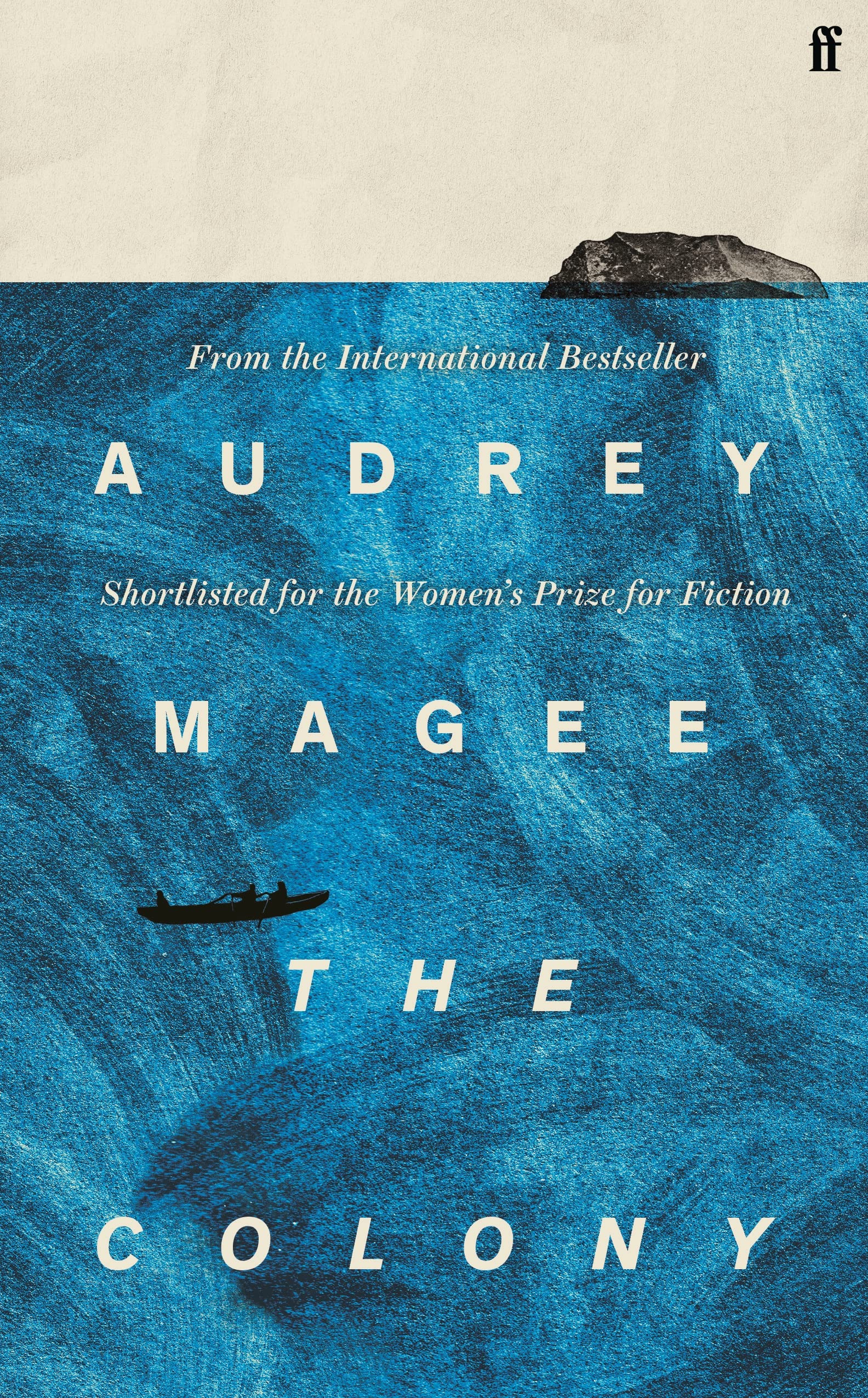
Irish novelist Audrey Magee’s second novel, The colony, was my reading group’s August book, and it proved an excellent choice. Literary and highly readable, with vivid characters and a sophisticated exploration of its subject matter, The colony engaged us on all levels. It was longlisted for the 2022 Booker Prize (and may yet be shortlisted. We will know next week.)
The novel’s overall subject is, as the title implies, colonisation – and Magee teases out its personal, cultural and political ramifications through a small island colony off the west coast of the Republic of Ireland. The word colony, like much in this book, is multi-layered. The novel is set over the summer of 1979, easily dated for readers by reporting of the assassination of Louis Mountbatten in August 1979.
“the battle of the colonisers”
The colony is carefully structured, with chapters about what’s happening on the island alternated with reports of sectarian killings from the Troubles in the north. These reports are brief, stark, and devastating, and serve as a constant reminder of what colonisation can do. But these reports are just one of the layers in the novel, which starts with the arrival of the ambitious British artist Lloyd (whose name is not random. He has plenty of money!)
Lloyd is coming to the island to make his name. He is a modern colonialist in the way he assumes he can buy what he needs, and manipulate others, to achieve his goal. He promises, for example, to respect the islanders’ wishes that he not paint them, but this doesn’t last. The way Magee unfolds his role is clever and subtle, because the islanders, whose numbers have dwindled to twelve families, want and need his money to survive. His perspective is told through terse, poetic language.
Arriving soon after Lloyd is the French linguist, JP Masson. He has been visiting this Gaelic-speaking island for years, undertaking a longitudinal study of the island’s linguistic patterns for his PhD. JP is fierce about the need for the islanders’ language to preserved as is. He resents the infiltration of any English into the island, so Lloyd’s appearance is the last straw. It will, he believes, force a “sudden and violent ” shift to English, instead of the slow “linguistic evolution” to bilingualism that was under way:
The Irish here was almost pure, Lloyd, tainted only by the schoolchildren learning English, by the intermittent visits of emigrants returning from Boston and London with their sophisticated otherness, and by mercenaries in linguistic mediation, men like [islander] Micheál who want only to communicate, indifferent to the medium or its need for protection …
JP’s perspective is told through the carefully thought prose of a writer, though when he is writing his paper on colonisation and language, I found it a bit heavy-handed, a bit too much of the telling not showing.
However, this issue of maintaining language – and its relationship to the colonial project – is intelligently explored. JP argues uncompromisingly for preserving the language, because it “carries their history, their thinking, their being”, and resists the fact that languages change. He rides roughshod over the islanders, insisting that they must use their language. Lloyd, on the other hand, wipes his hands of the issue, “not my concern” he says. Meanwhile, the islanders go about their business, continuing to speak their language with each other, while being willing to use English where it benefits them. They are no fools, for all JP’s exhortations:
What do you think, Micheál? said Masson. Are you less Irish when you speak English?
I don’t talk politics, Masson. You know that.
We’re talking about language, Micheál.
Same thing.
Just this topic alone, and how Magee uses it to expose colonialism’s short, medium and long tail, could take up a whole review.
Throughout the novel, the islanders are caught in the middle, but maintain a healthy perspective:
Imagine that, said Mairéad. A Frenchman and an Englishman squabbling over our turf.
They’ve been squabbling over our turf for centuries, said Francis.
There is a wonderful, dry humour in this novel. And much of it comes from the islanders, who have their own way of dealing with things. But they, too, are not united. The matriarch, 89-year-old Bean Uí Fhloinn supports the old ways, and is a perfect subject for JP’s research, while her granddaughter Mairéad tends to be the voice of humane or sometimes just resigned reason. Her son James sees Lloyd as his way out. He doesn’t want to be a fisherman, as all the men before him have been (including his drowned father, grandfather and uncle). He shows real talent as an artist, and believes Lloyd’s promise to take him back to England at the end of summer.
And so, as summer progresses, tensions increase, between Lloyd and JP (who both come from colonising nations, for all JPs attempts to ignore his own complicated origins), but also between the islanders as they respond to what’s happening on the island and up north. They comment on the violence in the news reports. In one telling moment, Mairéad and her brother-in-law Francis discuss the Mountbatten assassination in which two teenage boys were also killed. For Mairéad this is wrong, whilst for Francis it’s “collateral damage”:
Where does this end, Francis?
In a united Ireland, Mairéad. One free of British rule.
And you’ll blow up innocent children to get it. Mairéad swallowed the last of her whiskey. You’re pathetic, Francis Gillan.
Violence is a constant presence in the book, from the relentless news reports to young James’ brutal killing of rabbits for food. Francis hangs over the novel ominously. What does he do on the mainland? What will he do to “get” Mairéad, for whom, she knows, he is “Waiting. In the long grass. Waiting for me to fall flat on my face so that he can pick me up and make me his.”
I am interested in this issue of violence and how it permeates society. It’s what I think Tsiolkas was on about in The slap (my review). When people are confronted with violence on a regular basis, how do they respond? How should they respond?
Another issue Magee explores is art. While Lloyd hides away, painting his magnum opus – which draws inspiration from Gauguin (another artist who worked in a colonial, exploitative environment) – the islanders discuss whether they should be worried. Is it “just” art, or something else?
James clearly understands that art has meaning, and recognises the message in Lloyd’s final painting:
It’s me as you want me to be seen, Mr Lloyd. As you want me to be interpreted.
It’s certainly not James as he wants to be seen. It’s a cruel scene, particularly given Lloyd’s earlier lofty dreams of showing “that art is greater than politics. Art as peacemaker, as bridge builder.”
Truly, The colony is, to use a favourite word of the islanders, a “grand” book. The writing is expressive, with various motifs running through it – like rabbits, apples, smells – and refrains, like “young widow island woman”. There are gorgeous descriptions of landscape and nature, and of daily life. There’s rhythmic variation, finely evoking different characters and tones. And there’s the shifting of perspectives, sometimes within paragraphs, which brought to mind Damon Galgut’s The promise (my review).
The colony recognises some of the fundamental ironies in the situation the islanders find themselves in. Both JP and Lloyd, who look like they might (or, at least could) do good, are ultimately there for their own aggrandisement. The little island colony, to which they come, functions then as a perfect microcosm of the colonised. With dwindling numbers, those remaining need to do what they can to survive, but the odds are stacked against them. It’s an all too common story, and Magee tells it skilfully, giving her novel an ending which makes its point without going for the high drama I half expected. It’s all the more powerful for that.
Coincidentally, Lisa and Jacqui (JacquiWine’sJournal) both reviewed this book last month, and both are worth reading.
Audrey Magee
The colony
London: Faber & Faber, 2022
376pp.
ISBN: 9780571367627 (Kindle ed.)
 Whispering Gums