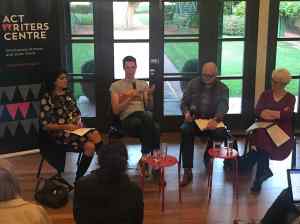
The Constructive Critic (Panel discussion)

For some reason that I can’t quite explain – a sudden rush to the head methinks – I agreed to be part of a panel being organised by the ACT Writers Centre for this year’s Design Canberra Festival. The panel, called The Constructive Critic, was described as

a unique panel discussion about art criticism across multiple disciplines including visual arts, design, theatre and literature, and its importance and impact.

What is the point of arts criticism? What has changed now everyone has a voice via social media? What is the relationship between artist and critic, and what about the blurred lines of artists who critique others?

The panelists (check bios on the event website) were art curator and critic Peter Haynes (also the moderator), local authors Jack Heath and Karen Viggers, and me. This is not one of my verbatim reports because I was too busy taking part, but I want to document some of the things I remember that we discussed.

It was an enjoyable evening – for me, anyhow – largely because both the panel and the audience were friendly and engaged. We didn’t always completely agree on topics, but the ensuing discussion invigorated rather than diminished our thoughts and ideas.

My favourite description of arts criticism came from the most experienced critic amongst us, Peter, who said that:

For me writing criticism is about opening a dialogue and first the critique is for me to explore the work. Whatever medium. A review should start with a question. The critic opens the questions that the artist and curator have posed. (Tweeted by the ACT Writers’ Centre whom I thank for capturing this so nicely!)

I love this, the idea of opening the questions posed by the creator of the work (the book, the play, the exhibition, the film, etc), and will try to do it more. [PS: I forgot to say that we later talked about how social media at its best can encourage this dialogue/conversation.]

The topics we covered included defining what criticism is, what creators want from criticism, who criticism is for, the role of social media in contemporary criticism (is everyone really a critic?), the economic impact of criticism, whether creators can critique or review each other’s work, and what we think about negative criticism.

Most of us seemed to agree that there is a review-criticism continuum. The highest level of criticism we saw as comprehensive, academic, knowledgeable about the wider culture/genre/context within the work fits, while reviewing at its most basic can be short, narrowly focused and, perhaps, more oriented to promoting the work. This is not to say, however, that high level criticism can’t/doesn’t promote a work too, but the link is, I’d say, more tenuous.

Related to how we define criticism is the question of who/what criticism is for. For some critics*, it seems to be for the consumer (the reader, for example), for some it can be for the creators (the authors), and for others seems to be more for the producers (the publishers). At least, this last is how it looks when you get to the emerging “influencer” role, upon which we touched briefly. For the authors in our panel, the second was particularly relevant. They appreciate criticism which can help them develop their own work. There is a fourth option, which is the one I ascribe to. It’s that criticism is about contributing to the wider culture. While of course what critics write will encourage or discourage people from reading the book, going to the show, whatever, the main loyalty is to the culture. This means I’m keen to see the work I’m discussing within the context of both literary and social culture, to talk about how it adds to the body of work to which it belongs and how it addresses or contributes to the society in which we live. Looking at it this way, I’m less interested in ascribing value – this is a “good” or “bad” book – than in where it fits. I’m not sure I achieve this, but that’s my goal.

We talked briefly about social media: the destructive impact of thoughtless negative comments on authors; the positive and negative economic impact social media can have; the impact and application of ratings (like those on GoodReads); the current plethora of free review copies which can result in reduced early sales; and the value of hindsight versus the immediate response that is common in social media.

Opposing opinions were offered about whether artists can critique artists. The affirmative suggested that artists know what’s involved in creating the work and can therefore bring that understanding to their review, while the negative suggested that it is hard to properly critique people you know, and that creators, knowing the techniques involved, will often focus on technical aspects rather than the work as a whole.

Negative reviews came up several times throughout the discussion, and again at the end. Peter announced early on that he didn’t write negative reviews, which, regular readers here know, would appeal to me. What he meant by this – and how I also see it – is that if he doesn’t like something, he won’t review it. However, he will, in an overall positive review, refer to aspects that might not have worked so well. Yes! However, a question came from the floor about negatively reviewing a work that is against current social values – that is blatantly sexist, racist, ableist, for example. Karen spoke for all of us when she said that such ideas should be called out. Jack, earlier in the session, had entertained us by describing how he had learnt from a one-star review. The reviewer had missed the main point of his work he felt, but nonetheless the comment had made a valid observation, one that he used in the next book in his series!

Of course, like my old school exam days, I came away thinking about all that I could have, or wished I’d, said. One issue we didn’t discuss in any detail was the critic him/herself: the degree to which critics should aim to be “impartial” (whatever that is) versus put their preferences and background on the table, and, indeed, whether, in our current environment regarding who can write what, whether there’s also a question concerning who can critique what? But, I’ll leave those for another day!

Meanwhile, thanks to Paul and the ACT Writers Centre for asking me to be on the panel, and to Peter, Karen and Jack for being such fun and so interesting to talk with.

* I’m using the term “critic” broadly in this write-up to cover the whole continuum of arts writers, and my examples are mostly from the book world (but in most cases you can substitute your art form of choice!)

The Constructive Critic
Design Canberra Festival 2019
Gorman Arts Centre, Main Hall
12 November 2019
On understanding the arts

Earlier this year I wrote a post about reading difficult literature. I said that I like to be challenged by literature, and discussed the features that define “difficulty” for me. Since then I’ve come across various statements, some contradictory, about the role of “difficulty” in the arts – and I thought I’d share them with you as part of a continued discussion.

Australian art critic Robert Hughes (quoted from the recent documentary series, Brilliant creatures):

You have to realise, of course, that no painting that’s of any quality is really very easy to understand because the function of a painting is always to expand one’s experience and so if it were easy to understand, then it would fall within what you already knew.

I’m not sure I agree with this. Surely art, and here I’m extending Hughes’ statement to all art forms, doesn’t have to be difficult to introduce a new idea or experience way of seeing things? Difficulty can be useful because it can force us to think, but I don’t see it as essential. Am I reading this statement too simplistically?

In Tolstoy’s book, What is art (which I admit to not having read, so I may be taking this out of context), he says that:

The business of art lies just in this, — to make that understood and felt which, in the form of an argument, might be incomprehensible and inaccessible.

Here Tolstoy seems to be saying pretty much the opposite to Hughes, arguing that the aim of art is to make an idea accessible, which I read, in my simple way, as “easy” to understand.

I’ve read similar contradictory statements about poetry.

Methinks the difference relates to their ideas about the role of art. Hughes, I suspect, saw art as expanding our experience and, perhaps as a result, leading to new thinking, wheras Tolstoy saw art, I believe, as having a moral purpose. It can’t just be for its own sake. If you see art in those terms it must be comprehensible, eh?

I’d love to know what you think about these two ideas. Are they totally contradictory, or can we encompass them both! I know I’m being somewhat wilfully simple here, but sometimes that is the place to start?

Monday musings on Australian literature: Pascall Prize

The Pascall Prize is one of those under-the-radar sorts of awards, that is, one that tends not to get much general press. However, that doesn’t mean it’s not significant. In fact, I’ve had it in my list of topics for a couple of years but, having mentioned in my David Malouf birthday post last week that he was a recipient, I decided that now’s the time.

The Pascall Prize has another name which better explains what it is – “The Australian Critic of the Year”. Its aim, defined on its website, is:

to reward a critic or reviewer whose work changes the perceptions of Australians, opens their eyes to a different perspective of their culture, develops a new interest in the subject and is both imaginative and creative.

The Pascall Prize celebrates incisive and well-crafted critical writing in areas including literature, art, architecture, food and wine, music, theatre, film, television, and radio [and now the Internet].

It specifically excludes sport from its definition of culture. Fair enough. I suspect there are significantly more well-paying opportunities for sports writers/analysts than there are for those in the arts, though maybe I’m biassed. I have, for the record, read some excellent pieces of sports journalism. But, enough of that, back to Pascall. The website tells us that it was named after Geraldine Pascall, “a flamboyant journalist” who died suddenly of a stroke/brain haemorrhage in 1983, when she was just 38. (Scary!) She apparently didn’t have a will, so her Estate passed to her father, Fred Pascall. He wanted to establish a memorial to his daughter, and so the Pascall Prize was born. It’s awarded annually, usually I believe at the Sydney Writers’ Festival, and currently provides $15,000. David Malouf is listed as the first recipient, having received the award in 1988.

I could be clichéd and say that the recipients represent a veritable who’s who of Australian critics, but I won’t, although it does – at least as far as I can tell from my admittedly uneven knowledge of the field! Last year’s winner was Kerryn Goldsworthy. The announcement describes her as “a writer, critic, reviewer, essayist, columnist, fiction writer and blogger”. She has reviewed for many of Australia’s most significant publications, for over 30 years. I have quoted her here more than once, the first time being in 2009 in a post on Thea Astley when I quoted Goldsworthy’s reasons for loving Thea Astley. That they happen to accord with my reasons was the icing on the cake. I’ve mentioned her several times since, including recently in relation to her being the chair of the Stella Prize Judging Panel.

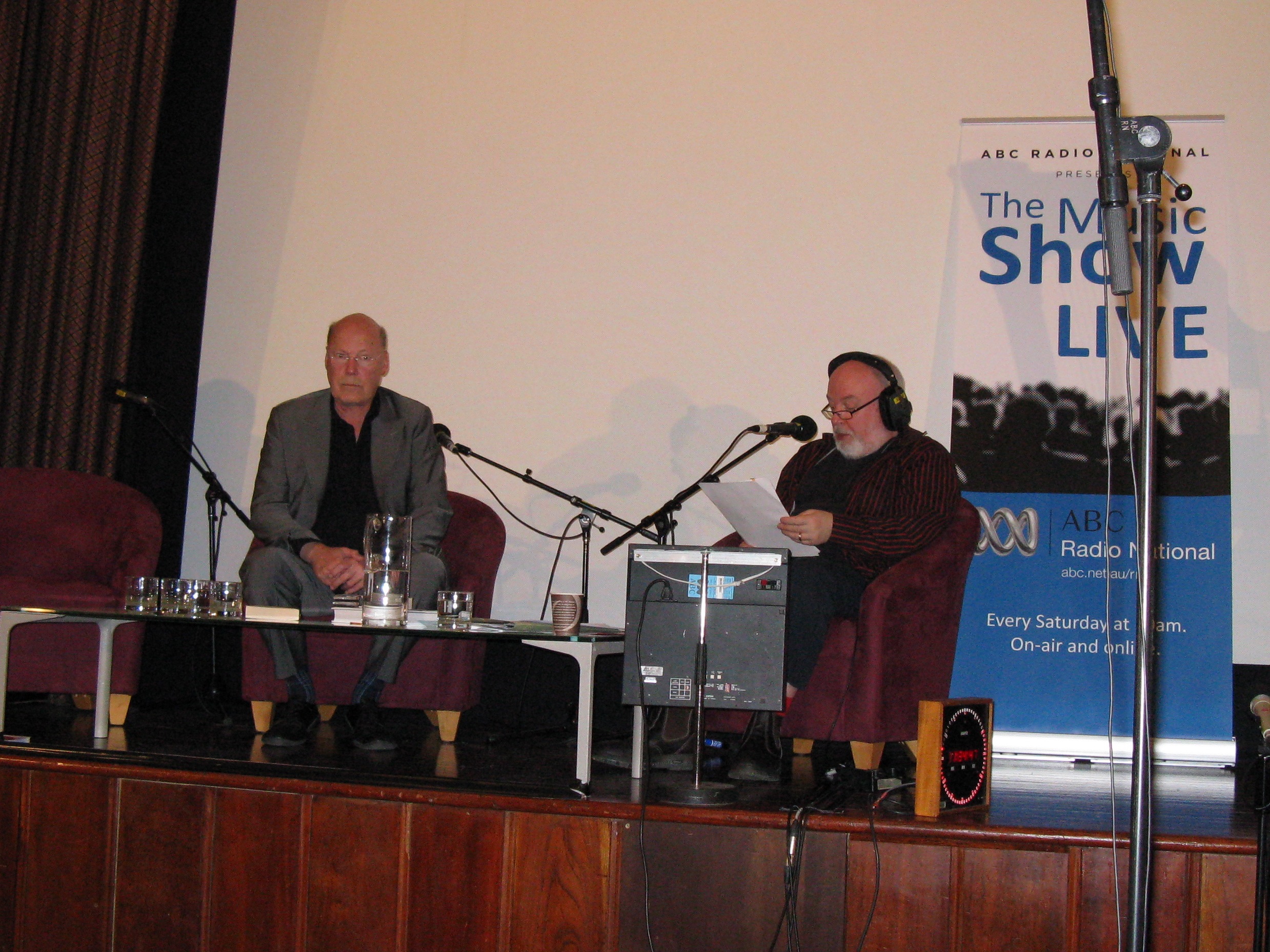
Andrew Ford and Jim Sharman

Andrew Ford interviewing Jim Sharman, Voss Journey, 2009

Of the other winners, the best known to me (which says more about me than anything else), include Andrew Ford (1998, music critic, composer and radio presenter), Marion Halligan (1990, critic and author), Andrew Riemer (1990, critic, academic and author), Peter Craven (2004, literary critic and editor), and Geordie Williamson (2011, literary critic). You can see a full list of the winners and the judging panels on the Prize’s Wikipedia page.

I’m not going to ramble on for long about this award, important as I think it is, but I would like to share a couple of comments made by Goldsworthy in her acceptance speech, one about the essence of being a good critic, and the other about the future. Here’s the first one:

in order to be an effective critic, you need a left brain that knows what your right brain is doing. My ideal as a critic is to come up with a rational intellectual response while at the same time continuing not just to acknowledge but to honour those mysterious places of the oceanic deep, the places where you connect most vitally and instinctively and electrically with whatever is going on in a work of art.

It’s a real juggle, and one that many of us bloggers (of whom Goldsworthy has also been one) try also to achieve. It’s what she calls “a critical brain finding ways to articulate the heart’s response”.

Regarding the future of criticism, she says:

There’s a lot of talk as we move into the digital age about what the fate of criticism will be, but I’m an optimist who thinks the that cultural conversation will continue no matter what medium it moves through, or what form it takes. What I worry about more is whether critics will go on being able to balance hearts and minds as the humanities continue to be devalued in the universities, the arts continue to be devalued in government, and fewer and fewer people are formally taught how to expand their knowledge and hone their critical skills as we navigate our way through cultural life.

Being an optimist too, I can’t believe that there won’t always be people ready, willing and able to engage with the arts in a critical way. Life sure would be poorer if there weren’t.

Do you have favourite critics you like to read? And what do you think about Goldsworthy’s left brain right brain approach to analysis?

The Role of the Arts Critic: a Childers Group Public Roundtable

Last week, I reorganised my Friday Lunch Group’s schedule in order to attend a public roundtable on the role of the arts critic organised by the Childers Group. This group, formed in late 2011, describes itself as an “independent arts forum … committed to the long-term viability and vitality of the arts”. It aims to advocate for the arts across government and private sectors. Last week’s roundtable was, I think, the third public forum they’ve held. All have been well-attended, which hopefully bodes well for the arts!

The event ran for two hours and featured a large panel of local critics/reviewers, administrators and practitioners in a wide range of the arts. They included the universally well-known, like Robyn Archer and Marion Halligan, and more local luminaries such as arts critic Helen Musa and Canberra Times editor-at-large Jack Waterford. It was emceed by writer and arts administrator Yolande Norris, who put questions herself and managed contributions from the audience. The ideas and viewpoints flowed – with a lot of concordance but some differences as well. Below is my summary.

Trader in ideas

Lucy – with a self-deprecating “I’m a poet so you won’t know me” – Alexander made the point of the day, for me. Late in the panel, she (from the audience) suggested that the critic is a trader in ideas. By this she meant that, in looking at a work, the critic picks up the ideas contained within it, weighs them, and explores what they might mean for people.

Another arts practitioner from the audience said, along similar lines, that she values information and insight into what is going on – into what the creator may have intended and what the critic actually “read”.

Somewhat related to these ideas, Marion Halligan said earlier in session that she regularly reads reviews (or criticism) of books, plays etc, she doesn’t expect to see or read, because “a critic tells you what’s going on” and gives you “a sense of the arts landscape”. A critic, therefore, she and others said, needs to be able to write (or speak) authoritatively and engagingly.

All this neatly sidestepped discussions about negative and positive criticism and got to the nub – to my mind anyhow – of the real value of criticism. While negative or constructive “criticism” of a work may be useful for the creator, Alexander’s point captured the bigger picture value of criticism. And it reflected, I think, what Robyn Archer meant at the beginning of the session when she suggested that “the arts” comprises three prongs: artist, audience, and the dialogue between them. These three need to be in balance she said for there to be a strong culture.

There was some discussion about the form of this dialogue, with film critic Cris Kennedy suggesting that dialogue is easier in the digital age. Robyn Archer queried the role of expertise in the digital age. She was concerned about the rise of “a new cultural democracy” – the world of “likes” and “unlikes” – and the resultant attitude that “if it’s popular it’s good”. I suspect there has always been this tension – but I guess it’s increasingly visible in our social media dominated world, isn’t it?

Overall, it was agreed, at least as far is there was agreement, that the critic should be knowledgable, that criticism should be “artful”, but that the important thing is opening dialogue.

What is criticism?

There was, of course, quite a bit of discussion about what criticism is. The point was quickly made that a review or criticism does more than describe. It takes up broader questions relating to the art form being reviewed, and should involve a studied reaction drawing on knowledge. It should illuminate and “bind things together” and requires a “critical” frame of mind. This was contrasted to “opinion” which seemed to be defined as “judgement” without a firm basis of knowledge.

Jack Waterford suggested that a lot of cultural discussion is occurring, such as on local ABC radio, but that this isn’t necessarily the same as criticism. Related to this, an audience member mentioned the issue of public art in Canberra, suggesting there’d been a lot negativity in the news pages and not enough criticism in the arts pages of the newspapers.

There was discussion about the need for disinterest, and that this was tricky to achieve in a small arts community like Canberra. (Marion Halligan suggested most arts communities are small – take England, she said, where the writers all review each other!)

One contributor suggested that food criticism is currently leading the way, and that the arts could look at what’s happening there! (There wasn’t discussion, however, on what this criticism entails and how it is leading the way.)

Who is criticism for?

The general view was that criticism is for the reader, though who the reader is wasn’t fully teased out. Those writing for papers and journals clearly see the reader as their public, and feel a responsibility to inform. One panel member made the point that criticism written for, say, a specialist dance journal should be different to that written for a general newspaper. An audience member pointed out that in the online world, the audience is international, and that this can (should) impact style and content.

There was also some discussion about creators and the role of criticism for them. Many appreciated constructive criticism, but quite a few said they use trusted friends to vet criticism, as negative criticism (that written from a point of ignorance) can be destructive. Criticism is also affirmation that people are looking at their work. As Marion Halligan said, the worst thing is silence. No review, she said, is worse than a bad review.

What is the aim of criticism?

In addition to the ideas implied above – contributing to the culture, informing the consumer and increasing people’s knowledge, providing constructive feedback to creators – it was also suggested that “the critic is a cog in the marketing machine”. I wouldn’t like to think that “marketing” per se is the critic’s role – and I don’t think that’s quite what was meant. But the critic does help promote the culture, can function as an advocate – in both cultural and political spheres.

This is certainly how I see my blog – as an advocate for Australian (in particular) literature . Of course, I’d like to think my reviews encouraged people to actually buy books, but my specific goal is to raise awareness about Australian literary culture.

Conclusion

Hmm … this is the hard part. Did the roundtable come to any final agreement or resolutions? No, I wouldn’t say it did. But I assume the organisers will take away the ideas presented and feed it into their future activities.

Near the end, it was suggested that it’s time to start populating the digital media with criticism and dialogue. This is an area that was not really tackled – that was just played with around the edges – and is possibly a good subject for the Childers Group to take up for their next roundtable.  What is happening in the online world and how can it best be harnessed to support and promote the arts. What impact does the growth of the amateur reviewer/critic have? Is there a difference between reviewer and critic?

Finally, returning to the opening idea of the critic as a “trader in ideas”, I liked the related suggestion that arts criticism is about the big things, about living and who we are. Can’t say better than that, eh?

A big thankyou to Nigel Featherstone and the Childers Group for holding this roundtable.