Canberra Writers Festival 2018, Day 2, Pt 2: Words (Last ones) and Music

My last Canberra Writers Festival event was, in a way, a little left field, because it primarily comprised a musical performance – but one with a strong literary element …

Turning Last Words into Music

I chose this one, for a couple of reasons, but mainly because it involved music and was at a time that would work for Mr Gums to join me. It featured a composition by Australian composer, writer and radio presenter, Andrew Ford (who appeared here long ago in my post on the Voss Journey). The session was MC’d by Jane O’Dwyer, Deputy Chair of the Canberra Writers Festival Board.

So, what was it about? Well, it was a performance of Ford’s 30-minute song cycle titled, yes, Last words. It comprises “the final poems, letters and diary entries of some of history’s most iconic figures” set to music. However, before we heard the music, Ford talked about its genesis and some of the challenges he faced in creating it.

He started by describing music as the most abstract of the arts, and song as the most ubiquitous type of music. But, he said, listeners will only pay attention to the words if the music attracts them first. He then explained that his wife suggested the project – that he set people’s last words to music, for soprano Jane Sheldon, and that he include Captain Scott’s last words.

Then the challenges started. For example, he said, “last words” tend to be very short which is hard for song, but then a friend suggested “last poems”, which he took up. Another challenge was the order, and structure. Given the topic, the mood/tone of course tended to the slow and mournful. Something fast, some relief, was needed to prevent its becoming tedious, but what? He lit upon the idea of including a fiction character, and chose Fish Lamb’s death from Tim Winton’s Cloudstreet. Then there was Virginia Woolf’s suicide note. What sort of music would work with that? In the end, he decided it didn’t need music (though in fact some minimal cello and piano did sound occasionally during that song.)
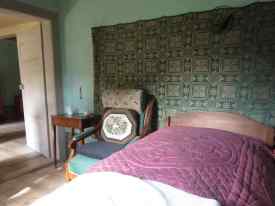
Goethe's bed, Goethe House, Weimar

The bed Goethe died in, Goethe House, Weimar

Finally, there was the challenge of his opening “last words” from Goethe: “Mehr licht, mehr licht” (More light, more light.) He was reading them as portentous, but then his wife suggested that perhaps they could be read simply – as Goethe simply wanting more light!

Responding to a question from moderator O’Dwyer, he talked a little about music and emotion. Debussy apparently said that music is “pure emotion” but Ford said that he didn’t consciously try to “embed” emotion in the music, because that would be manipulative. In composing this piece he tried to find the notes that would approximate how he would say the words. Simple, eh?

Anyhow, then the concert started, and I found it engrossing and moving. It’s not easy music, but neither is it hard – and it was performed beautifully, even though the performers had their first and last rehearsal only two hours before they took to the stage. The lyrics were provided to the audience, and are available on line at Andrew Ford’s website.

Some of the things I liked included the structure (or order). I liked, for example, that it starts with some of those brief last words …

Mehr licht, mehr licht … (Johann Wolfgang von Goethe)

Now comes the mystery. (Henry Ward Beecher)

Auftakt! Auftakt! (Alban Berg)

… and ends with some more brief last words:

Mehr licht, mehr licht …

Goodnight, my darlings. I’ll see you tomorrow. (Noël Coward)
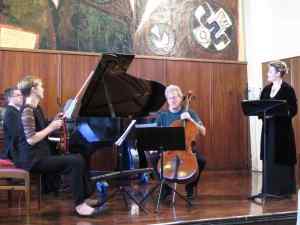
Last Words trio and sopranoI think these beginning and endings gave the cycle a bit of a narrative arc, albeit the actual plot is death, death and death – if you know what I mean.

I also liked that Goethe’s words are used as a refrain, appearing intermittently to provide a transition between some of the songs – but sung with different dynamics or emphasis in different places.

I was particularly moved by Captain Scott’s last words, and thought that Ford, and singer Sheldon, handled its prose form very well. (As they did Fish Lamb’s faster piece, And Woolf’s suicide note.)

Appropriately, Emily Bronte’s last words were set to heavier more dramatic music, and ended in a screeching “Me”, which surely alluded to Cathy (from Wuthering Heights.)

And, I loved that texts included a favourite (last or otherwise) poem of mine, Dorothy Porter’s “View from 417”, with its final lines:

Something in me
despite everything
can’t believe my luck

The music here was more lightly lyrical. In other words, the mood and tone of the music did shift during the piece, despite the repeating death motif.

Performers: Jane Sheldon (Soprano), Helen Ayres (violin, replacing the advertised Tor Frømyhr), David Pereira (cello) and Edward Neeman (piano).

Q & A

There was some time for Q&A at the end, during which people asked:

  • does some writing “fit” music more easily than others (yes)
  • can music create new emotions (are there new emotions to be found?)
  • why does the voice occasionally get lost in the music, where mostly the music was subtle (it got “lost” in Fish Lamb’s scene because he’s drowning, so here the voice becomes another instrument.)

This was, for me, a delightful last session of the Festival – despite its theme!

A lovely night out … at the theatre

You know the year has really started when the concerts and shows start up again – and for us they’ve started with a bang. We had three events in four days: A Pacifist’s Guide to the War on Cancer (Playhouse) on Saturday night, The Weight of Light (Street Theatre) late Sunday afternoon, and the first Musica Viva concert (Llewellyn Hall) on Tuesday night. This post, though, will just discuss the middle one, because it’s Australian, having been written by local author Nigel Featherstone who has featured on this blog several times. I’m not, however, an experienced theatre reviewer. I don’t have the language, and as a reader, I find it challenging seeing something only once, and not being able to go back to check something out, as you can with a book!

The Weight of Light

I’ve been surprised in recent years to discover how many Australian novelists are also librettists. David Malouf, Peter Goldsworthy, Dorothy Porter (ok a poet but also a verse novelist), and Louis Nowra immediately spring to mind – and now, local novelist and short story writer Nigel Featherstone can also claim this title. Described as a song cycle, The Weight of Light had its origins in a residency the very peaceful, non-warlike Featherstone had at the Australian Defence Force Academy in late 2013. I remember it well because he wrote about it on his blog. It all came to a head in 2014, when time came for him to do a presentation on his three months. He wrote:

I already had the questions – What is a man?  Who is a good man?  Who is a good being? – but I didn’t have the stories, or anything remotely resembling stories.  Bearing in mind that my intention in doing the residency wasn’t to write about war as such; I’m disinterested in guns, and the infinitely complex political contexts require a much bigger brain than mine.  I was interested in the small moments, the hidden fears and thoughts and dreams.

So there, in 2014, he had an idea in mind about soldiers. Then, later that year, as Featherstone tells it, Paul Scott-Williams from the Goulburn Regional Conservatorium met Nigel and told him that he wanted to create “an original song cycle”. He felt that “art song did not have much of an Australian tradition”, and wanted to do something about it, starting with Nigel as librettist. From there, the project slowly grew. Nigel has documented the process on his blog. The end result was the highly moving performance we saw on Sunday afternoon.

How to describe it? We entered the lovely Street Theatre to be faced with a minimally lit stage, comprising a minimal set. There were two large crisscrossed beams, a wire wending across the stage like a fence, brown fabric on the floor emulating a river, and, to the right, a grand piano. The show started with Alan Hicks on piano, with singing starting up soon after from somewhere backstage. The voice, coming from baritone Michael Lampard, turned out to be a mother calling her soldier-son home to the farm.

From here Lampard, with Hicks at the piano, took us on a journey, through fourteen songs, in which the soldier faces a tragedy at home which recalls to his mind a secret tragedy that had occurred during his tour (that’s a weird word really, isn’t it, for a military posting) of Afghanistan. It’s a dark story, a grim one at times, as the soldier confronts a number of challenges in his life. But, it’s also a beautiful show. If that makes sense.

This was the whole package – words, music, performance, set and lighting. Lampard’s vocal range was impressive, enabling him to differentiate characters (his mother, father, girlfriend) as they interacted with him. The lighting remained dark throughout, in keeping with the theme, though placement and levels did vary with the mood. The set was in that modern minimalist style in which a few objects are used to convey different ideas or places at different times – in this case, both the field of war and the fields of a farm. The two large semi-reclined crossed beams also, I thought, conveyed an idea of the cross, which, at one of the darker points in the performance, our soldier seemed to shoulder, recalling Christ’s journey to Calvary.

And then there was James Humberstone’s music. It included elements, we felt, of art-song, opera and church music, and was completely involving – both the sound of it and the performance of it, which included both Lampard and Hicks bowing the piano strings to create a mournful atmosphere. Other effects included paper being laid across the strings creating a fluttery, buzzing effect, and Hicks hitting the strings with small mallets. None of these were tricks for tricks’ sake, but enhanced the meaning or mood of the story.

I found these demos below on SoundCloud. They’re from earlier in the development when the program was still called Homesong, but they give an idea of the range we heard, from the sweetly lyrical to the more sombre, minimalist pieces.

I would love to be able to share some of the words with you, but not having the libretto and having only seen the performance once, that’s not possible. I did find it hard to hear them all with so much going on, but I loved the poetry of them, the use of repetition, and the imagery – of birds in particular. In the second last song, I think it was, our soldier needs to make a decision. Can he be strong, or will he give up? “Be brave enough to stay” is the call to him. The program ends, happily, on a note of hope.

Mr Gums, two acquaintances and I enjoyed, at the end, sharing notes on the performance, combining our various impressions. We all felt we’d experienced something special. I’d say Paul Scott-Williams has got what he wanted – a quality contribution to Australia’s art-song repertoire, with a story that’s right up to the moment in its concerns. I hope it gets more outings.

The Weight of Light
Words by Nigel Featherstone
Music by James Humberstone
The Street Theatre, 4 March 2018, 4pm