Monday musings on Australian literature: Arnold Haskell on the arts (3)

This should be my last post on Mr Haskell’s survey of the arts in Australia, and it focuses on Radio and the Movies. First though, in his section on literature, he talked about Australian readers and bookselling. He wrote that the average Australian “is a great reader; more books are bought per head of population in Australia and New Zealand than anywhere else in the English-speaking world”. He admires Australian booksellers who can’t quickly acquire the latest success. So, “they buy with courage and are true bookmen in a sense that is becoming rare in this [i.e. England] country.”

I believe Australians are still among the top book-buying nations, per capita, but I couldn’t find any supporting stats, so I may be making this up! However, I did love his commendation of the booksellers of the time, and his sense of their being “true bookmen” (as against their peers in England). He certainly wasn’t one to look down on the colonials!

“an admirable institution”

He writes about the “admirable” ABC (Australian Broadcasting Commission). He recognises that wireless has become a necessity “in a country of wide open space” because it is, for many, “the only form of contact with the world”. He says the ABC “supplies much excellent music, and at the same time appeals to the man-in-the-street through its inspired cricket and racing reports”. You all know how much I like the ABC.

BUT radio is a vice too, he says, when it is left on all day “in every small hotel, seldom properly tuned and dripping forth music like a leaky tap”. He is mainly referring here to commercial broadcasting which he describes as “assaulting popular taste by their dreary programmes of gramophone records and blood-and-thunder serials … Unlike America, they cannot afford to sponsor worthwhile programmes”. Hmm, my old friends at National Film and Sound Archive might disagree given Australia’s large and by all accounts successful radio serial industry, though perhaps much of this occurred from the mid 1940s on – i.e. after Haskell did his research.

“isn’t Ned Kelly worth Jesse James?”

Haskell has a bit to say about Australians’ love of cinema, with “the consumption per head being greater than anywhere else”. Film theatres are “the largest and most luxurious buildings” in Australian cities, but

the films shown are the usual Hollywood productions. There is as yet no public for French or unusual films.
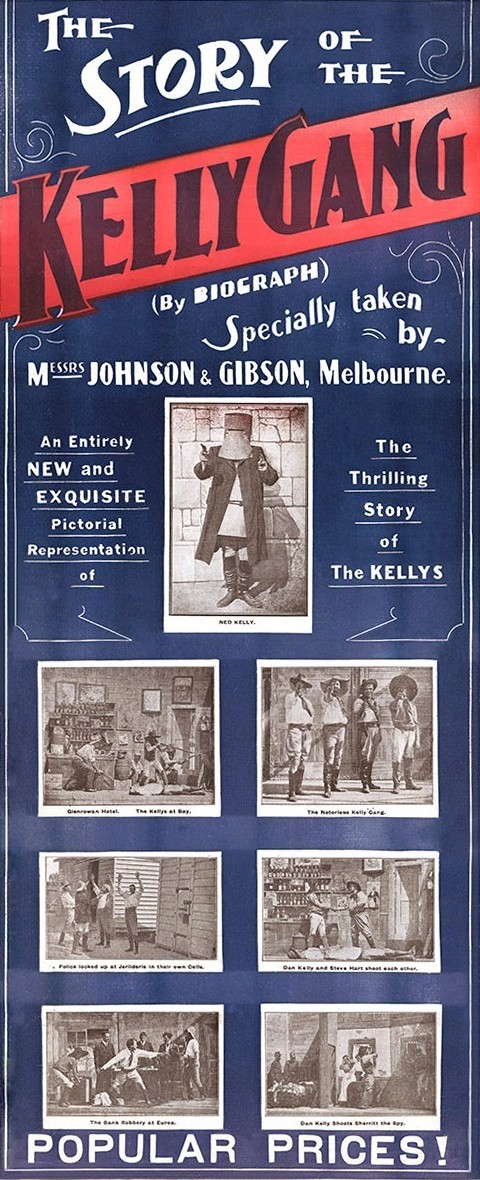
Poster for 1906 movie (Presumed Public Domain, via Wikimedia Commons)

Poster for 1906 movie (Presumed Public Domain, via Wikimedia Commons)

Australian films are being made, he said, “in small quantities” but are “not yet good enough to compete in the open market.” He is surprised that given Australia’s “natural advantages”, it had “produced so little in a medium that would encourage both trade and travel”. He goes on to describe how much people knew about America through its films -“we have seen cowboys, Indians, army, navy, civil war and Abraham Lincoln”. He suggests that Australia had just as interesting stories to tell and places to explore:

What of the Melbourne Cup, life on the stations, the kangaroos, the koala bear, the aboriginal, the romance of the Barrier Reef and the tropical splendour of the interior, the giant crocodiles of Queensland? What f the early history, as colourful as anything in America? isn’t Ned Kelly worth Jesse James?”

He suggests that films could do more for Australia in a year than his book, and yet, he says it seems “easier and safer to import entertainment by the mile in tin cans and to export nothing”!

He makes some valid points but he doesn’t recognise that Australia produced, arguably, the world’s first feature film, back in 1906, The story of the Kelly Gang – yes, about Ned Kelly.  It was successful in Britain, and pioneered a whole genre of bushranging films that were successful in Australian through the silent era. Three more Kelly films were made before Haskell visited Australia – but films were pretty ephemeral, and he clearly didn’t know of them.

At the time he researched and wrote this book, 1938 to 1940, there was still an active film industry. Cinesound Productions produced many films under Ken G Hall from 1931 to 1940, and Charles Chauvel made several films from the 1930s to 1950s, but the war years were lean times, and it was in those early years that Haskell did his research. It’s probably also true that then, as unfortunately still now, Australians were more likely to flock to overseas (that is, American, primarily) productions than their own.

Anyhow, I hope you’ve enjoyed this little historical survey of an outsider’s view of Australia as much as I have – though I guess it’s all rather irrelevant, and even self-indulgent, if you’re not Australian! Apologies for that!
Monday musings on Australian literature: Arnold Haskell on the Arts (2)

Arnold Haskell, Waltzing MatildaBack in November, I wrote a post on the Arts chapter in dance critic Arnold Haskell’s book Waltzing Matilda and focused on theatre and literature. In this post, I’ll look at his discussion of the press.

“compares … favourably”

Haskell starts by saying that Australia’s press started in a “thoroughly unprincipled and worthless manner”, though he doesn’t explain what he means by this. However, by the time he is writing, he says it “compares, as a whole, favourably with the English and American”, adding that its style is “English and not American”. He describes the press’s treatment of “the abdication” (Edward VIII) and “the September crisis” as “dignified and free from deliberately fostered sensation”.

There were, he admitted, sensational papers, such as Truth and Smith’s Weekly, which “at first glance are not a good advertisement for Australia”. At times their humour is raw and undergraduate, but he comes to admire their humour, even when they targeted him. He praises their writers as “excellent”, and writes:

These papers greatly upset me at first, but I can now appreciate their value as an antidote to wowsing. For all their presentation and methods they are usually on the side of the angels.

Wow, no faint praise here – and rather a long way from today’s “fake news”! Anyhow, he shows himself to be an open-minded traveller.

And then, of course, there’s “Grannie” or The Sydney Morning Herald, which he describes as “the dean of papers” and

the organ of conservative views and amazing respectability. Its very make-up clears it of any suspicion of frivolity. It is a power in the land and it knows it.

Next he discusses the Sydney Daily Telegraph suggesting it might become a rival. It’s owned he writes

by a young man, Frank Packer, a colossus with the figure of a prize-fighter and the flair to do great things. It is brilliant, erratic, out for scoops at all costs, technically well presented.

Packer sold it in 1972 to Rupert Murdoch. And this brings me to Melbourne, which my Melbourne readers will be relieved to read that Haskell doesn’t ignore! He writes:

In Melbourne, probably in Australia, the greatest power in journalism is Sir Keith Murdoch; he has been called ‘Lord Southcliffe’ and also ‘the maker of Prime Ministers’. He looks the part.

Haha … I enjoy Haskell’s references to physical appearances. Haskell praises several Melbourne papers, Murdoch’s Melbourne Herald, as well as The Age and Argus. He’s surprised that they didn’t take sides in Victoria’s “drink referendum”. Of papers in smaller cities, he is similarly positive, saying they “are also of a high standard, and are surprisingly free from parochialism.”

And then he – remember he was an arts critic – says something even more interesting:

The Australian press as a whole gives considerable space to art criticism and treats the artist with far greater respect than our own popular press, though its criticism of local artists tend to be too benevolent to be of the greatest value.

This is interesting on two fronts. One is his praise of the commitment to arts criticism, which suggests too that there was a readership for it. The other is his belief that criticism of the arts can have value – that it is important – but that to have value it needs to be willing to be a bit tougher than it is.

He says Keith Murdoch is interested in art, and that he has “an admirable critic” in Basil Burdett. Haskell describes Burdett as “a man with an artistic background that would be exceptional in any country”. Now, I hadn’t heard of Burdett, so I decided to check him out in Trove. The first hits I got were about his death in an air crash Singapore in 1942. He was Assistant Australian Red Cross Commissioner in Malaya. The Sydney Morning Herald, reporting his death, quoted Australian artist, and President of the Society of Artists, Sydney Ure Smith:

He had taste, knowledge, and that rare quality — enthusiasm … As a writer on art, he was well-informed and progressive without being narrow. He was a valuable art critic.

Anyhow, Haskell mentions two other critics, and I’ll share his description of those too. There’s The Sydney Morning Herald’s “well-informed art critic”, Kenneth Wilkinson, whose field, Haskell writes, “is made to cover painting, music, the drama and the films; probably too much for any one man”. Fair point, don’t you think? And there’s “J.S. McDonald, now curator of the Melbourne Museum”. He “was formerly an art critic” and “whether one agrees with him or not” he “is one of the most entertaining and forceful writers on art”. Has anyone heard of these?

Haskell then turns to the social pages, which occupies much space in all papers and which Australia’s intelligentsia describes as “provincial”. However, Haskell again shows his independence of mind when he suggests it probably is, but why “very lengthy accounts of the doings of that small clique known as cafe society in the London and New York press should be worthier of attention I cannot understand”. Why indeed! Further, he comments that Australian gossip columns are “not snobbish”. They are, and this must clearly be a dig at the British equivalents, “written by journalists about people and not by titled amateurs about their friends”! He writes that

Miss Brown of Wagga, Miss Jones of Gundagai, will both find a space when they come to Sydney or Melbourne, and, what is more, their dresses will be described as minutely as the Governor’s Lady’s.

Perhaps this is a good time to remind you of my first post on Haskell in which I quoted his being (initially) “aggressively uninterested” in visiting Australia.

Haskell also talks about “the paper that has represented Australia the most and that has a place in the history of Australian literature … the famous Sydney Bulletin.” He admits it’s “a little tamed today” but still represents “a national way of thinking”. Its goals, which were to encourage Australians to love their own country, have resulted in “the formation of an Australian manner of expression” which is “often crude, never ‘literary’ from the English point of view”, but is “vigorous and creative”.

I love that an English visitor was able to assess Australia, as a place in its own right and not a little England.

Monday musings on Australian literature: Arnold Haskell on the Arts (1)

Arnold Haskell, Waltzing MatildaA couple of months ago I wrote a post on British dance critic Arnold Haskell’s book, Waltzing Matilda: a background to Australia (published in Australia in 1944). I said then that I’d come back to it, so here I am, focusing this time on his chapter on “The Arts”. It comprises 22 pages covering, according to the chapter subtitle, “The theatre – The cinema – Painting – The press – Literature”. Today, I’ll just discuss the theatre and literature.

“a national theatre is not yet born”

He starts with the theatre, and says that although he knows “from experience that Australia has a vast theatre-going public and a fine theatrical tradition … the theatre is unfortunately in decay”. Performances are more likely to be “Gilbert and Sullivan” or English or American musicals or sensational-type plays with imported stars. When an Australian does show ability “he [of course, it’s a “he”] promptly leaves for England or America”. If he stays he’ll “probably starve, both artistically and financially”.

Serious theatre – performing, say, Chekhov or Gogol – mostly occurs in amateur repertory societies and some of these “reach an extraordinarily high standard”. He blames the lack of development of a national theatre on “apathy and the great national inferiority complex” (aka “the cultural cringe” I’ve often mentioned here). However, when it comes to music, ballet and opera things are a little better, particularly in opera where Melba, who had died in 1931, had “dealt a smashing blow to the inferiority complex”.

“still in the formative period”

Haskell spends more of his chapter on painting than on anything else but let’s get to literature. He says, it has “not produced men who are the equals of Streeton, Heysen or Gruner”. Interesting. I might be wrong but I’d say that now Miles Franklin, Katharine Susannah Prichard, and Eleanor Dark are at least as well-known as those three artists.

Anyhow, here is his impression:

Those who could write the great Australian novels, who are neither apathetic nor complacent and who correspond in some way to our Bloomsbury, are unfortunately too busy talking to accomplish more than a poem, a pamphlet or a short story. They are dissatisfied, they hate the squatter, despise the ‘dinkum Aussie’ and are well to the left of his traditional labour. Their thoughts are in Spain or Russia. They have both imagination and compassion, but there is more of bitterness in their make-up… They concentrate on the ideal of some vague revolution just as the masses concentrate on sport.

He argues that the “flourishing school of contemporary American literature was started by such minds as these in their magnificently creative intervals from drinking and posing in Paris.” (Don’t you love it?) He’s referring, I presume, to Hemingway, F Scott Fitzgerald, et al. He sees – quite perspicaciously I’d say – that the problem is that Australians were looking to Europe, were seeing the distance between them and Europe “as a handicap” BUT he says “the differences between Australia and England will produce a national art and literature, not the similarities.” In other words, look to your own. America has recognised this, he writes, “and has made her differences a source of pride”. Our own Nettie Palmer saw it too, and argued strenuously for an Australian literature. She pondered in her 1929 article, “The need for Australian literature”, on what recognition the work of Australians had received. “To what extent, ” she asked, “have their efforts been made barren by the ingratitude and even hostility with which they have been met at the outset.” Cultural cringe again? For Palmer, it is the artist (the writer, in her case) who illuminates, or makes understandable, our lives for us.

Anyhow, Haskell does recommend some Australian authors/works which have become “part of the Australia scene”, which I’ll share as I know we all like lists:

  • Marcus Clarke’s For the term of his natural life: Haskell writes beautifully about this book and how Kensignton-born Clarke used his two years’ bush experience to make himself “an Australian writer”. He argues that Clarke’s characters “have a humanity not unworthy of Dostoievsky” and compares him favourably against Henry Kingsley’s Geoffrey Hamlyn which he describes as “stilted and old-fashioned” and Rolf Boldrewood’s Robbery under arms which is just “a typical boy’s yarn”.
  • Henry Lawson’s While the billy boils, and other works: Haskell says Lawson’s work is universally seen as “honest Australian” and that “no interested tourist should omit reading these sketches of the Australian character”.
  • Vance Palmer and Brian Penton “depict the Australian scene with skill and conviction”, and Mrs Aeneas Gunn’s The little black princess “gives a particularly delightful picture of the aboriginal mind and was highly recommended to me by a distinguished anthropologist”. (Oh dear, but these were different times.)
  • Ion Idriess, who covers “the more adventurous sides of Australian life”, is “not a polished writer” but tells “magnificent” stories from his own experience.
  • Katherine [sic] Susannah Prichard, Helen Simpson and Henry Handel Richardson “are so well known in England that they are accepted as English writers”! What does this mean? And interesting that these are all women writers who are described this way. He says that The fortunes of Richard Mahoney “gives a gloomy picture of Australia but it is surely the greatest contemporary work of Australian fiction”.

Haskell also mentions several poets – Adam Lindsay Gordon, Henry Kendall, CJ Dennis and ‘Banjo’ Patterson [sic] – as worth reading. I’m just going to share, though, what he says about Paterson because Paterson, himself, felt he was just a ‘verse-maker’ not a poet. Here is Haskell:

Patterson, a bigger figure [than Dennis], might be called Australia’s Kipling, though there is little actual resemblance. It might be very easy to dismiss this very hearty verse as being of little account, easy but superficial. When one knows Australia this is altogether impossible. It has a quality of greatness because Patterson has written folk-songs and ballads of Australia. His verse has an extraordinary quality of spontaneity. It is truly indigenous.

Dennis, he writes, “is famous for his amusing doggerel in the Australian vernacular” and “has left behind some humorous journalism. It is more deliberate and sophisticated; it is a tour de force and not a cri de coeur.”

Haskell admits that there are other names he could share. However, his aim has not been, he says, to produce “a study of Australian literature” but rather a “personal account” of his “journey” because his prime goal has been to “see Australia at first hand and not through literature”. I understand that …

Monday musings on Australian literature: Arnold Haskell’s Australia

Arnold Haskell, Waltzing MatildaWho is Arnold Haskell you are probably asking, if you are anything like me. The answer will probably surprise you: he was a British dance critic, who wrote many books on ballet, and was, in fact, involved in the development of the Royal Ballet School. But, he also visited Australia a couple of times, first in 1936, as a publicist-reporter with the Monte Carlo Russian Ballet. He returned to Australia in 1938 to research his book Waltzing Matilda: a background to Australia, which was published in England in 1940 (though not published in Australia until 1944). And guess where I found this book? Yep, in my aunt’s house.

So, he visited Australia a couple of times before the Second World War, but his book was published during the war. I find that quite fascinating – who would be interested in what is really a travel book in such  abnormal times? (I looked at the records for this book in Trove. There are several editions: most are categorised as “description and travel”, but some as “civilisation” and “history”. I think the former is better, but it just goes to show that categorisation is never easy!)

Anyhow, here is how he starts his Introduction:

I happened on Australia four years ago, at four days’ notice and by complete accident. Had I been given a week’s notice I probably would not have come at all. I was completely, even aggressively uninterested in that continent. … When I let my friends know where I was going, they said “Why?” which did not encourage me, and left me speechless for once.

His lack of interest wouldn’t surprise Australians who are aware that for the British, particularly at that time, we Australians were simply colonials, and had nothing of interest to offer, and particularly nothing for those who saw themselves as sophisticated. Haskell saw Australia, for example, as offering “hospitality, hearty but uncouth”. He says in this first paragraph that he was “bribed” to accept the trip, partly by the work (the ballet company) and partly by the opportunity to visit Ceylon (now Sri Lanka) and Honolulu, en route. Harrumph!

However, he “became … enchanted”, and so returned later for 6 months to see more. As there were no books that described Australia in the way he as a traveller wanted, he decided to write it himself:

Australia, in comfort at all costs, in luxury if possible; Australia, stressing the modern plumbing in the most modern hotel in Sydney rather than the lack of plumbing in the dead centre [had he visited his own counties I wonder?]; recounting the lives, thoughts and works of many eminent painters rather than the pathetic state of the rapidly dwindling aboriginal; in fact to write of Australia as one writes of Europe or America: positively and without the eternally negative point of view.

It would be easy for us to take exception to this, but it’s more interesting to read it as a reflection of (a certain segment of) the times, and as something that can provide insight into the world as it was then. And anyhow, he goes on to say that he want to trace

the evolution of a society from brutality and chaos to as perfect an expression of ordered democracy as can be found, to show the amazingly rapid transition from an unhappy group of felons, often not so bad, and their gaolers, often not so good, of overbearing petty Himmlers and dictator governors to a civilised community of amazingly tolerant people living in a country freer from crimes of violence than any other, in a continent that has never known the hatred, violence, hypocrisy and destructiveness of Europe.

Ah, it would be lovely to pat our own backs at this, except that we know that there has been violence here. It just wasn’t spoken of back then.

He goes on, completely oblivious to Australia’s long history of occupation by indigenous people, talking about how Australia’s history is still mainly a “family tradition rather than history”, one in which “I remembers” have not yet made it into “the ordered framework of text-books and university courses”. Again, although his view is myopic, I love this way of describing the “short” history as he saw it.

However, his book is not, he says, a history but a personal story which he hopes will “provide the background” that he found lacking.

I will come back to this book, I think, because as well as travelling around the states, he also did some of his own primary research checking letters, manuscripts etc to obtain his own perspective. It should make for fascinating reading … but for now, I’m tired folks, so signing off with a shorter than usual one!