Anna Funder, Wifedom (#BookReview)

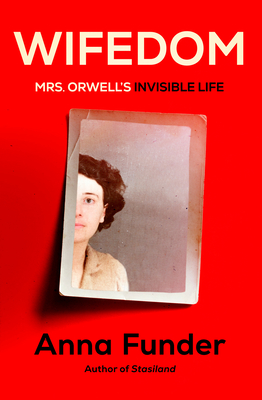
Anna Funder’s Wifedom: Mrs Orwell’s invisible life is a book with a mission, a mission that is implied in its full title. That mission is to examine the notion of “wifedom”, and the way patriarchy works to construct it, through the example of the invisible – or, as Funder also calls it, erased – life of George Orwell’s wife, Eileen O’Shaughnessy.

To do this, she wrangles Eileen out of the shadows of history to produce an intelligent, funny, warm-hearted, loyal and hard-working woman who, observed novelist Lettice Cooper, loved George “deeply, but with a tender amusement”. It’s an engrossing story, well-told. However, it’s a challenging read too.

Funder explains early in the book that her interest in Eileen came from reading something Orwell wrote about women and wives – after Eileen had died. It’s astonishingly misogynistic, and made her wonder who Eileen was and what she might have thought. Funder set about reading six Orwell biographies written between 1972 and 2003, but she found them unhelpful when it came to Eileen. Indeed, she says, they gave so little that they “started to seem like fictions of omission”. Funder then, logically, went to these biographers’ sources. She found some more bits and pieces about Eileen, but it wasn’t enough. All she had was “a life in facts, a woman in pieces”, so she “considered writing a novel – a counterfiction to the one in the biographies”. But, she was fascinated “by the sly ways” in which Eileen had been hidden, and she felt a novel couldn’t effectively explore this. Then she “found the letters”.

These were six letters that Eileen had written to her good friend Norah from just after her marriage in 1936 until 1944, but they had not been discovered until 2005. These letters gave her Eileen’s voice – and this voice was “electrifying”. Funder believed she could no longer write a novel. She writes,

I wanted to make her live, and at the same time to reveal the wicked magic trick that had erased her, and that still holds sway today. I thought of it as writing a fiction of inclusion.

“it’s hard … for history to find you”

This is where the book gets tricky, because, while I found Wifedom a fascinating read, it raised questions too, and they are intrinsic to what Funder is trying to achieve, and how she goes about achieving it. The book is divided into five parts, with the first part titled “Wifedom, A Counterfiction”. What does this mean? She doesn’t immediately explain what I have described above. Instead, she opens her book on a scene in which she imagines Eileen writing a letter to Norah – and she includes excerpts from that letter. This throws us readers in at the deep end. As we get into the book, we come to recognise these imagined sections, because they are identified by indentation, and opening and closing graphical symbols, but at the beginning it’s a bit mystifying, albeit an engaging way to capture our interest.

Early in the read, then, it becomes apparent that Wifedom comprises a complex mixture of processes and forms. The imagined sections are interspersed throughout the book between more traditional biographical writing about Eileen and George’s life. And interspersed between these are reflections from Funder’s own life, because one of her points is that the patriarchy, the “patri-magic”, which erased Eileen’s life from George’s biography, still exists and is evident in her own life as a wife and mother, despite her supportive husband and “egalitarian” marriage. I’m not going to focus on this aspect of the book, though, because it seems to fade away somewhat as Eileen and George’s story picks up, and is not, anyhow, where I want to go in this post.

Instead, I want to tease out the process. Early on Funder writes that

Looking for Eileen involved the pleasure of reading Orwell on how power works. Finding her held the possibility of revealing how it works on women: how a woman can be buried first by domesticity and then by history.

This is not particularly new. Anyone interested in feminism is aware of how women have been lost in (and thus to) history. However, Funder’s book is enlightening in this regard. She does an excellent job of interrogating how it can happen. It happens when biographers ignore or play down the role of women in their subjects’ lives. Through cross-matching her sources she finds example after example of Eileen’s contributions being downplayed or omitted. She shows how the use of passive voice and terms like “wife” rather than Eileen’s name work to make her disappear. (Orwell does it himself in Homage to Catalonia.) She finds examples where biographers, disconcerted by some of George’s behaviour, excuse it (how often are men excused!), or, uncertain about evidence, will rephrase it. For example, Funder writes that Eileen

noted his extraordinary political simplicity – which seems to have worried one of the biographers, who rewrote her words to give him an ‘extraordinary political sympathy’.

Eileen’s words come from a 1938 letter to Marjorie Dakin. The biographer is Crick. (Another of the textual clues to readers in this book is that Eileen’s words are conveyed in italics, while the words of others are enclosed in quotation marks.)

But here’s the challenge – interpretation. Funder writes early in her book that,

As serendipity would have it, in 2020 Sylvia Topp published Eileen: The Making of George Orwell, which contained much material I hadn’t found, and was thrilled to read, though we interpret it differently, and so build differing portraits of Eileen.

She does not explain what she means here, but in the very thorough Notes at the end of the book, Funder elaborates on Topp’s approach to Eileen. Put simply, Topp, Funder says, sees Eileen as one of those celebrated people’s partners who devoted their lives “joyfully to assisting the talented partners in all their various needs knowing all along that they would be under-appreciated, and often ignored, and yet never faltering in their dedication, or in their willingness to submerge their own personal talents into their partners’ success.” Topp, then, sees Eileen as a “helpmeet of genius” while Funder is interested, as she writes in these Notes, “in examining what it took, perhaps, to be in that marriage, and that dream”.

So, what we have here is interpretation. Topp had the same sources that Funder did. Indeed, she added some to Funder’s arsenal. But, she interprets them differently. As a feminist, I easily aligned with Funder’s interpretation, but as I read I also had this little niggle that Funder was interpreting her sources – from the perspective of her times, values and gender – just as other biographers had before her.

Wifedom was my reading group’s April book. Our conversation focused mainly on the biographical content – on Eileen’s life, on George Orwell and his books, and on the impact of patriarchy on Eileen. We were horrified by the life led by Eileen, as Funder tells it – and the facts seem inarguable. Their relationship appeared to us to have been so one-sided. Eileen did all the domestic work, and it was hard work given the primitive rural cottage that they called home. She was, often, the main breadwinner, and she did his typing, as well as offering editorial comment. She was necessary to him. Meanwhile, he focused on his writing and, we gathered, chasing other women. And yet, Eileen stayed with George. Why, we wondered?

We didn’t delve into the interpretation issue, albeit I would have loved to, but I needed more time to collect my thoughts. We did, however, discuss why we thought Eileen stayed with George which, I guess, was us interpreting what we’d read! Various ideas were put forward, including that Eileen might have been a “rescuer”, or that she knew she was unlikely to have been published herself (in a patriarchal world) and so channelled her energies through George, or, simply, that she loved him and, much like Topp argued, willingly helped him in any way she could.

So, there you have it! History, biography, it’s all a matter of the facts you have, and the way you see them. I don’t mean to devalue the biographer’s art by that statement, but simply to recognise that even the most formal, most rigorously documented biography will, necessarily, be affected by the biographer and their times. For this reason, I found Wifedom an absorbing and provocative read, though perhaps only partly in the way Funder intended.

Anna Funder
Wifedom: Mrs Orwell’s invisible life
Hamish Hamilton, 2023
511pp.
ISBN: 9781760143787

Anna Funder, Everything precious (Review)

Anna Funder, Everything preciousI must thank John aka Musings of a Literary Dilettante for introducing me to this intriguing little e-work by Miles Franklin award-winner, Anna Funder. When John read it, back in October, it was in daily instalments, but when I clicked the link in his post I was offered several e-book versions, including for the Kindle and iPad, or for an audiobook which I believe is read by Funder. It’s free.

So, what is it? Here’s the description at the start of the story:

This story is a unique collaboration between Paspaley, acclaimed author Anna Funder, photographer Derek Henderson and award-winning actress Teresa Palmer. It’s an original story of love, self and all things precious, featuring the most beautiful pearls in the world.

Paspaley, for those who don’t know, is an Australian-based company founded in the pearling industry of northwestern Australia. Although it has now diversified into other businesses, it is probably still best known for its pearling arm. As you might assume from the title of Funder’s story, “Everything precious”, it is the pearling arm that sponsored Funder. John wrote his post before he finished reading the story, and said he feared finding some product placement at the end. However, in a postscript added later, he advised there was no such thing. He’s right – in a sense – as there’s no reference to pearls or Paspaley in the text. But, in my e-book version, between chapters 4 and 5, there is a series of five photographs taken presumably by Derek Henderson and featuring, again presumably, actor Teresa Palmer. They are tasteful in that high-class-magazine way … no text, just beautiful images of a lovely woman wearing gorgeous pearls.

I researched a little more, and discovered that the story is part of a “multi-channel campaign” to launch Paspaley’s new Touchstone collection. The “campaign uses storytelling to engage a new, younger, more fashion conscious audience and make pearls relevant and appealing to them”. Intriguing eh! I wonder how successful it’s been?

What, besides presumably money, did it all mean for Anna Funder? Here’s what she says:

Working with Paspaley has been one of the most exciting writing experiences I’ve had. To have total creative freedom, a time limit and an audience turn out to be the perfect conditions for writing a short story. And the idea that a company, which makes things of great beauty and value from nature, values literature, which (on a good day) is also something of beauty and value that reflects the world around us, was inspiring. Writing this story has been a joy and a privilege, and was some of the most fun I’ve ever had writing.

Now, let’s talk about the story, which the promoter’s website I’ve linked to above describes as “a short story of desire, need, love and all that is precious”. The plot is pretty simple. It’s about Tess, who works in online legal publishing, and would be in her mid thirties. She has a husband, Dan, head of epidemiology in the State Health Department and a lovely SNAG if ever there was one, and three children, Charlotte who is 13, and the twins, Tom and Lorna, who are 6. She also has a father, Howard, a retired judge who is in Assisted Living because he has dementia. This is, then, an upper middle class, professional family. Tess and Dan have been together for 17 years and she’s feeling a little trapped and restless. A bit of a midlife crisis, in other words, or, as Funder writes in the story, Tess is:

at a hinge moment: between youth and age, between the life you thought you wanted and the one you feel might, now, suit you better.

So, Tess decides to consider that other life she might have had, but … well, I won’t give the ending away because it’s easy for you to access at Paspaley.

It’s interesting to look at this story in terms of the campaign because I’m presuming that although Funder had “total creative freedom” there must have been a brief – one that at the very least identified a target market, oops audience, for the story. This audience would, I’m sure, identify pretty easily with the character and set up, with the restlessness attended by guilt that she should be so restless. The brief must surely have identified a tone too. You wouldn’t sell pearls with a grim story – or did they assume Funder would have the nous to make the story appropriately positive? Regardless, the story would clearly suit what I assume was Paspaley’s target market – upwardly mobile or already there professional thirty-to-forty-something women who have the disposable income but who may see pearls as the province of their Baby Boomer mothers.

This all sounds pretty cynical, and to some degree it surely must be. I would describe the story as “chicklit” for the well-to-do married woman. It’s not challenging reading. The resolution is easy to comprehend and reassuring. However, it is written by Funder. This means that the writing is good, there’s intelligence at play (including an allusion to Chekhov!), and the insights into the pressures of early 21st century professional family life are authentic even if not explored in any depth.

awwchallenge2015Overall, then, it’s an enjoyable read and an interesting concept to ponder. I certainly wouldn’t criticise Funder for taking up the opportunity offered to her. Writers, like all of us, have to live – and if a company like Paspaley is prepared to pay, and offer “complete freedom”, why would you say no?

Anna Funder
Everything precious
Sydney: Paspaley, 2014
Smashwords Edition
Available: Gratis at Paspaley

Anna Funder, Stasiland (Review)

Anna Funder's Stasiland bookcover

Funder’s Stasiland (Courtesy: Text Publishing)

Anna Funder‘s Stasiland, which won the Samuel Johnson Prize for Non-Fiction, is one of those books that can be reviewed from multiple angles, and I know that when I get to the end of this review I’m going to be sorry about the angles I didn’t get to discuss. But, I can only do what I can do, eh?

I found it interesting to read this book immediately after another non-fiction book, Brenda Niall‘s biography True north, because the contrast clarified for me why I liked True north but loved Stasiland. To put it simply, True north is a well-written but pretty traditional biography, while Stasiland is what I’d call “literary non-fiction”. In other words, in Stasiland, Funder uses some of the literary techniques – relating to structure, voice and language – more commonly found in fiction to tell her story. It’s not surprising really that this is the case, because when I heard her speak last month, she said that she had initially planned to write Stasiland as a novel but, having done the research and interviews, it “didn’t feel right” to turn those people’s stories to another purpose. She was also aware that there were things in these stories that might not be accepted, that might seem too far-fetched in fiction! Such is the fine line we tread between fact and fiction.

At this point, I should describe the book, though its broad subject is obvious from the title. Funder (b. 1966) has a long-standing interest in things German, from her school days when she chose to learn German, and has visited and/or lived in Germany several times. She writes of travelling through the former German Democratic Republic, a country that no longer exists, that comprises “tumble-down houses and bewildered people”, and she describes feeling a sense of “horror-romance”:

The romance comes from the dream of a better world the German communists wanted to build out of the ashes of their Nazi past; from each according to his abilities to each according to his needs. The horror comes from what they did in its name.

And so she decides to try to understand this dichotomy and places an ad in the paper:

Seeking: former Stasi officers and unofficial collaborators for interview. Publication in English, anonymity* and discretion guaranteed.

This is, depending on how you look at it, either a very brave or naively silly thing to do. Funder, who sees writing as an act of empathy or compassion, interviews several Stasi men who answer her ad, as well as other East Germans who suffered at Stasi hands. It might be coincidental, but essentially all her subjects who suffered were women, while the perpetrators were men. In fact, when she visits the Stasi HQ in Berlin, she’s told it only had toilets for men! All this is not to say, however, that men didn’t suffer (or, even, that there weren’t women perpetrators). Indeed, some of the Stasi men she interviewed were themselves bullied, blackmailed and otherwise stood over to keep them in line.

What makes this book compelling are the stories she gathers, partly because the stories themselves are powerful and partly because of Funder’s own voice. Funder places herself in the book. This is not a third person “objective” recounting of the interviews she conducted but a journey we take together to find some answers. When she interviews Herr von Schnitzler, who hosted the Black Channel, a television program in which he presented a Communist commentary on excerpted programs from the West, we are in the room with her, hearing not only what he says, but getting a sense of his personality alongside her. We see her being fearless in sticking to her questions in the face of a man who frequently shouts. “I recognise”, she writes, “this pattern of unpredictable shouting followed by bouts of quiet reason from other bullies I have known”.

It is particularly in the von Schnitzler section that the GDR paradox becomes most clear. Von Schnitzler was, Funder tells us, molded by the injustices of the Weimar Republic. We see how the drive to create a new society not bedevilled by the iniquities – that is, the inequalities – of capitalism (or imperialism as many of the Stasi men call it) resulted in the creation of an authoritarian society where freedom was minimal (or non-existent) and dissent not allowed. In stark contrast to von Schnitzler and his refusal to see any error in, or critique, the GDR, is Julia, one of the “victims”, who had believed in the GDR but, through having an Italian boyfriend, had become caught in the Stasi net. She discovered that the “state can be so dangerous, so very dangerous, without me having done anything at all” and was completely traumatised by the extent of surveillance and loss of privacy she experienced. And yet, having experienced the East and the West, she can still say

you see the mistakes of one system – the surveillance – and the mistakes of the other – the inequality – but there’s nothing you could have done in the one, and nothing you can do now about the other … and the clearer you see that the worse you feel.

The GDR story is, as Funder tells it, one of grand humanitarian aims but one also riddled by paradox and irony. She asks Herr Bock, a recruiter of informers, what qualities he looked for in an informer:

‘… and above all else,’ he says, looking at me, his eyes distorted and magnified through the glasses, ‘he needed to be honest, faithful and trustworthy.’

I look back at him. I feel my eyes too, getting wider.

How can you resist a writer who tells a story like this, who shows without telling exactly what is going on, who can inject sly touches of wit and humour into the tough stuff?

I can’t possibly relate all the stories – many quite horrendous – in this book. All I can say is that it is a book that manages to show how history writing can be intimate while at the same time conveying facts and hard truths. It is a memorable book, and worth reading if you have any interest at all in politics and human behaviour.

Anna Funder
Stasiland
Melbourne: Text Publishing, 2002
ISBN: 9781877008917
282pp.

* I’m intrigued by the promise of anonymity because it seems that in some, if not in all, cases, real names are used. I presume the people involved agreed to this.

What do Anna Funder and Amarcord have in common?

Leipzig! It’s funny isn’t it how some person, place, idea (or whatever) that you hadn’t come across in who knows how long suddenly makes its presence felt more than once in a short amount of time. This is what happened to me this week when I attended, on Sunday, a conversation at the National Library of Australia with Miles Franklin award-winning author, Anna Funder, and then two nights later a Musica Viva concert by all-male a cappella group, Amarcord. For those of you who know these people, the Leipzig connection is pretty obvious, but for those who don’t, I’ll explain. Anna Funder’s first book was the non-fiction work Stasiland which explores the impact of the Stasi on those affected by it. And Amarcord was founded in Leipzig from members of the St Thomas’ Boys Choir (which was established in 1212!).

The connection, though, is a little more complex than a purely physical one. In talking about Leipzig and her book promotion tour there, Funder commented on the paradox of being in the building* in Leipzig that the Stasi operated from and that had also been used by some of the world’s greatest musicians such as Bach (who is buried in St Thomas’ Church) and Mendelssohn. Amarcord, during the concert, talked of Leipzig’s musical heritage – of Schumann, Mendelssohn and Bach – but in the programme they also referred to the time under the Stasi:

Living in East Germany required conditioning. You needed to know whom you could trust. I really had to be careful what I said to whom. And then we had the privilege of a choir that was an island of relative freedom of speech and thought. That of course attracted children from families who needed that freedom of speech. Even as a child I felt that atmosphere strongly. In the choir, I could breathe again. (Daniel Knauft, bass)

I won’t say much more about Amarcord except that the concert was magnificent. The program, themed “The Singing Club – Four  Centuries of Song”, comprised music mostly from the Renaissance and Romantic eras, but concluded with a small selection of folk songs from around the world, including Korea and Ghana. It was a beautifully varied program, each of the singers addressed us during the performance to explain the pieces being sung, and the singing was glorious. I love performers that are serious about their music, but don’t take themselves too seriously. That was Amarcord, and if they come again, I’ll be lining up at the door.

But now to Anna Funder. She was a very thoughtful considered interviewee, which is not surprising I guess from someone who took 5-6 years to write her last novel, All that I am. She talked, for example, about how Stasiland had started as a novel but that she’d decided “it didn’t seem right” to use other people’s lives for a fictional purpose. She also talked about the challenge of believability. In All that I am she said she modified the facts because in fiction authors ask readers to jump into a world they create, but she felt there were things about the “real” story behind All that I am that are “unbelievable”, that no-one would believe in a novel! As one who doesn’t find it too hard to suspend disbelief, I was intrigued by the care she takes to make sure her fiction is believable – and she is probably sensible to do so!

While her main concerns, she said, are social justice and what it means to be human, her aim in writing fiction is not “to make an argument” but “to make a beautiful piece of work, a literary artefact”. Every nation, she said, has something in their history that is “disenchanting” (don’t we Aussies know it) but the function of literature is to “enchant us”. I must say I was enchanted by the way she juggled these two conceptual balls, by her clear fundamental commitment to her art and to her moral-ethical world view.

Louise Maher, the host of the conversation, asked her about awards and prizes, and referred to Funder’s letter to Premier Campbell Newman regarding his cancellation of the Queensland Premier’s Literary Award in which she described his action as “a step towards the unscrutinised exercise of power”. She told us that given the book she’d just written – about a totalitarian state – she had to write what she did. Funder clearly supports prizes – and has won a goodly many. She sees them as a “signpost to quality” and said that while they don’t make writing easier, they improve the likelihood of having your next work published.

I did enjoy my little forays into Leipzig this week – and the places they took me.

* Probably the “Round Corner” house, though I don’t recollect her actually naming the building.