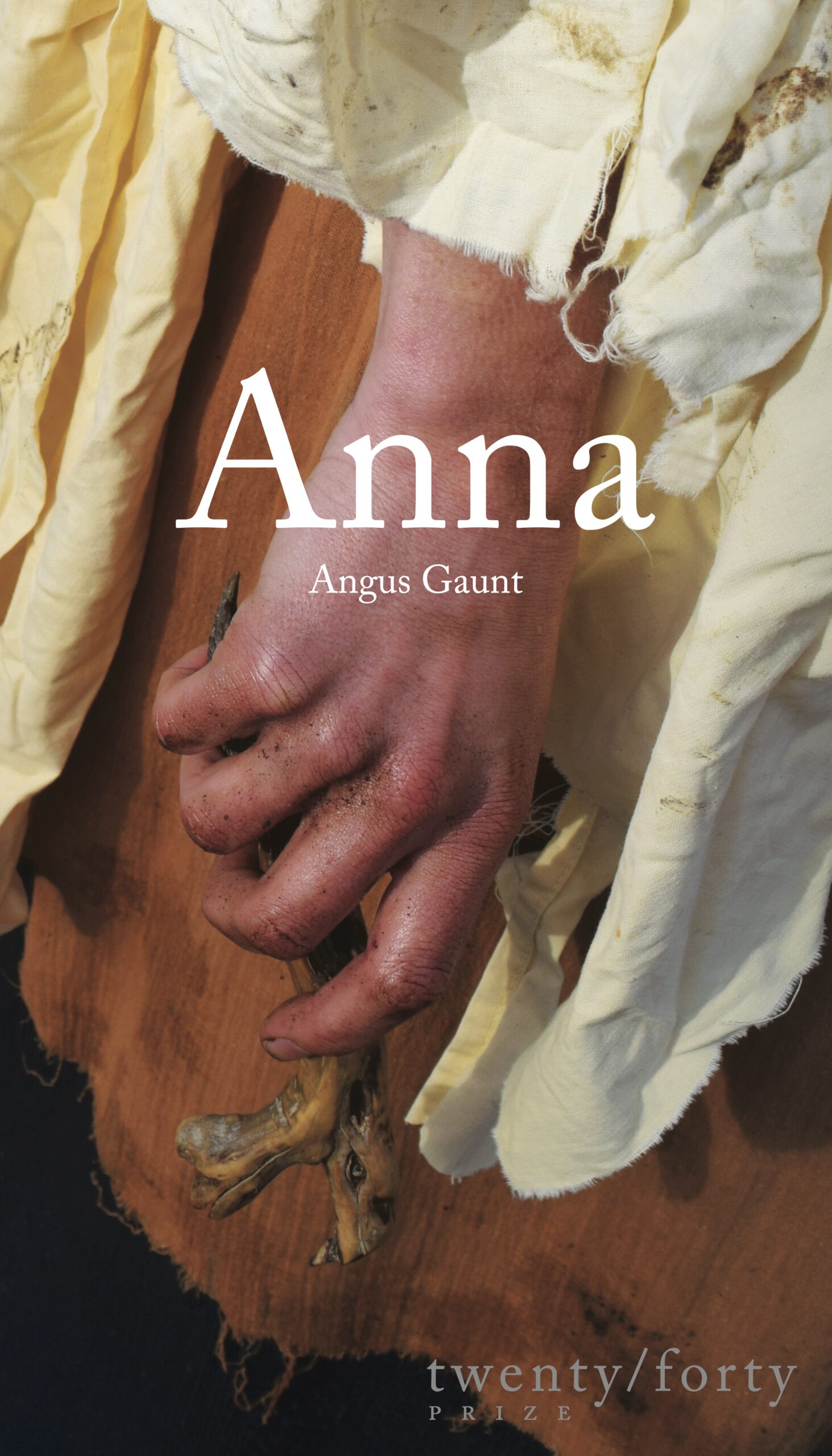
Last month, I posted on the winners of the 2025 Finlay Lloyd 20/40 Publishing Prize, of which Angus Gaunt’s Anna was one. I am thrilled with this prize, not only because I love the novella form, but because of the variety of stories we are seeing. So far the fiction winners have been an historical novel from Kim Kelly, a contemporary coming-of-age novel from Rebecca Burton, and an audacious “what if” story from PS Cottier and NG Hartland. Three very different books, and now Anna makes it four.
When I started reading Anna, I thought I was heading into a dystopian novel. It is told third person from Anna’s perspective, and starts with her walking in the woods. A young man is following her. The woods are not identified, and neither is the young man, but she recognises him as a guard from the place she’s just left. Through their initial interaction, we learn that “the war is over” and the gates had been opened. Therefore, she firmly implies, he has no jurisdiction over her.
Anna, we discover as her journey continues, is about 15 years old, and had been taken to a labour camp with her family about three years ago. Her parents had died but she’s hoping her remaining siblings are ahead of her, safe in the exodus she’d missed. We know nothing about the woods – but they do not sound Australian – nor do we know the time setting. It is cold. There are some generic animals and plants – deer, hares, mushrooms, berries. The story focuses on Anna’s thought processes and her survival. There is almost nothing about the sociopolitical situation that got her there. We do know that Anna and the guard speak different languages, which suggests an invasion or some sort of oppression of minorities, but Gaunt does not go there. The notes I made during my reading, include this: “Timeless, placeless, non-political, means not dystopian? More allegory?”
The judges don’t call it either of these, but on “why this book is different” they say:
Winter is only beginning to thaw in a remote forest as Anna treks for her survival, accompanied by someone she cannot trust. With distilled clarity, this short novel carries the reader on a journey from victimhood to self-possession.
So, it is about survival, or, more precisely, about the inner resources you need to develop to overcome a dire situation.
Anna is a moving and absorbing read. Gaunt quickly engages our sympathy for his protagonist, young and defenceless in the woods. The language in the first two paragraphs sets up uncertainty. It starts:
Anna had already walked further than she meant to, but did not want to go back, not yet. She was basking in the sun … also in the silence. She had not done something like this for a long time … (p. 9)
Then she stops and looks up, where she sees “a large predatory bird … floating on secret air currents, delicate wing tips spread”. “Predatory” but “delicate”. Should we be worried? Then she sees the young guard, later identified as Yevgeny. He’s very young, uncertain, and in a show of bravado he tries to shoot the bird, but fails. He’s never shot anything before. And so the narrative and its main characters are established. Anna is alert, sensitive, intelligent and has some nous and wisdom about her. The guard, also young, lacks confidence, experience and nous, and is confused about his role as a man, a soldier, a human. This makes him potentially dangerous but also vulnerable. We – like Anna – are on the watch for which way he might go.
And so the novel progresses as this uneasy, wary-of-each-other pair journey through the woods, looking for the railroad and its promise of civilisation. Early on, during a brief time when she and Yevgeny are not together and she has returned to the camp, Anna meets a dying man who gives her his last food. Then later, together, they come across a cottage containing a barely surviving couple.
This brings another literary form to mind, the journey narrative, the search for home, a new one or old one, and – perhaps – for self. In journey narratives, physical and spiritual or emotional challenges are faced, and people are met. The journeyer must rely on inner resources to overcome the challenges, including assessing whether the people met are to be trusted or not. This is what we watch Anna do. We are privy to her thoughts as she goes, as she draws together past knowledge and present experience, and we gain confidence in her ability to make good decisions. Nearly half way through the story, her mind drifts to the schoolroom. It is comforting, but she stops herself,
recognising that she was attracted by the emotion of it rather than its practical application. There was not room for emotion. She was glad of this thought. Feelings and emotion could only cloud the mind, waste precious resources. All resources were precious. Her mind was clear now. She had a choice to make and she made one. (p. 56)
Of course it’s not a straight line, and Anna, like any journeyer under stress, slips back several times before getting a grip once more.
Anna is beautiful to read, from the first sentence. The language is tight but expressive. The necessary tension is off-set by moments of tenderness and hope, not to mention some subtle foreshadowing. And the characterisation is warm and empathetic.
I concluded my post on last year’s winner, The thirty-one legs of Vladimir Putin, that it was an audacious “what if” story. Anna is also audacious, in a different way. It calls on the tropes of established forms, like allegory and the journey narrative, but makes them into something new, something that confronts issues like trust and power in a way that feels both modern and timeless.
Read for Novellas in November.

Angus Gaunt
Anna
Braidwood: Finlay Lloyd, 2025
110pp.
ISBN: 9780645927047
Review copy courtesy Finlay Lloyd.

 Whispering Gums