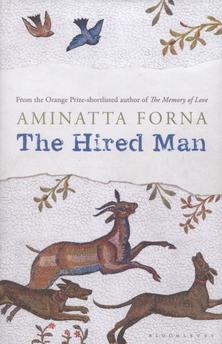
 Early in Aminatta Forna’s The hired man, the narrator Duro is told by his old, ex-best friend Krešimir, “People have moved on, Duro. Maybe you should too”. At this point we are not sure exactly what they have moved on from but we guess it might have something to do with war – and as the story progresses we discover we are right.
The hired man is Forna’s third novel, but my first to read. All of them, together with her memoir The devil that danced on water, deal with the prelude and aftermath of war. In The hired man it’s the Croatian War of Independence which occurred in the early 1990s. Forna, though, never names the war, and while there is some description of war-time action, she doesn’t provide any real historic details about who, what or where.
The novel is set in the fictional town of Gost, and commences in 2007 with Duro, our first person narrator, telling us that “at the time of writing I am forty-six years old”. Later we realise he is writing for a future reader, after he dies. He writes
… I have to tell this story and I must tell it to somebody, so it may as well be you, come to sort through my belongings.
The trapdoor is opened …
So, what is the story he has to tell – and why is he suddenly compelled to tell it now? Well, towards the end of the novel he says this:
Laura arrived in Gost and opened a trapdoor. Beneath the trapdoor was an infinite tunnel and that tunnel led to the past.
You don’t know who Laura is, though, do you, so it’s time I introduced the plot. The novel spans Duro’s life from his childhood to his mid-forties. He tells of his family, and his boyhood friends, particularly the aforementioned Krešimir and his younger sister Anka, with whom Duro fell in love. He tells how his relationship with Krešimir crumbled as Krešimir’s true, cruel, nature became apparent, and why he left Gost for a few years, returning just before the war started. And he tells us about the “chaos” that ensued during the war, “when men turned to hunting each other”. I don’t want to give too much away here, but let’s just say that by the time the war starts his relationship with Anka had moved, necessarily, from that of lover to good friend.
We jump then sixteen years to 2007 – when Duro is living alone and friendless – though the novel is not told in this linear way. It’s told more organically as the changes resulting from the opening of the “trapdoor” stimulate memories and bring the past back to Duro. This trapdoor is opened because Krešimir sells the “blue” house, the home he’d shared with Anka and their parents, to Laura and her husband who plan to renovate it, sell it, and move on. Duro, we discover, is a handyman, and he becomes Laura’s “hired man” for this renovation, and in the process becomes the family’s friend.
There is an underlying theme here of the British moving into Europe, oblivious of history and inherent dangers:
The way the English saw it, the past was always better. But in this country our love of the past is a great deal less, unless it is a very distant past indeed, the kind nobody alive can remember, a past transformed into a song or a poem. We tolerate the present, but what we love is the future, which is about as far away from the past as it is possible to be.
These English do not understand, for example, that the “fields that used to be ploughed … are now full of wild flowers because nobody dares to walk in them in case they put their foot on a mine and are blown to pieces.”
“I imagine myself with the body of a bird, a raven. Outstretched wings and neck, rigid beak and shining eye, I swoop over the ravine and hover over the town.”
So, here is Duro, standing “guard over the past” like a predatory bird. And here is Laura, reminding him of Anka who, though we don’t know why, is no longer in Gost. And here is “the chill of unfinished business”. The stage is set … but here I’ll leave the plot.
What is beautiful about this novel is that, despite its depiction of brutality and betrayal, and despite a sense of menace, it is restrained – and it’s restrained because Forna’s focus is not violence and revenge, though there are elements of these in the novel. Her interest is how people live with each other after war, and particularly after Civil War when traitors, collaborators, opportunists and victims, depending on your point of view of course, must all live together. The novel made me think of Olivera Simić’s Surviving peace which I reviewed last year. It’s a memoir, and Simić does not still live in her Serbian home, but she makes very clear that surviving a war, particularly ethnically-driven civil war, is just the beginning.
What is also beautiful about this novel is Forna’s writing – her use of imagery, symbolism, irony and parallels to convey her meaning. Birds and colours have multiple connotations, some positive, natural, others menacing. The “ravine” on the edge of town bears witness to beauty and horror. Hunting suggests violence and predation, but is also a source of sustenance and defence. The title, itself, “the hired man”, has both benign and malignant meaning …
As does the idea of masculinity, “with its undercurrent of aggression”. For Duro, it encompasses loyalty, protectiveness, and reliability alongside strength and control, while for men like Krešimir and Fabjan, the town bully, it means power and competitiveness, and is attended by a sense of menace.
Nothing, in other words, is simple in Forna’s world, and the language conveys this subtly but emphatically.
‘Well this is one of the most beautiful places I’ve ever been. You don’t notice it any more, but you don’t know how lucky you are.’
Laura, new to the town, is oblivious to the irony of her utterance, and so are we as the novel starts – but, we soon learn differently. It is not a pretty town but by the end some rapprochement, uneasy though it still may be, has been achieved. This is a moving but realistic book about just how difficult it is to survive peace.
Aminatta Forna
The hired man
London: Bloomsbury Publishing, 2013
ISBN (Kindle ed): 9781408818770
 Whispering Gums