Joyce Carol Oates, Beasts

Joyce Carol Oates @ The Belmont Library

Creative Commons licensed image by San Mateo County Library via Flickr

If we wanted to be writers we must examine the world with fresh, sceptical eyes.

Beasts is, I’m ashamed to say, my first Joyce Carol Oates. She’s one of those writers who has kept crossing my path but whom I’ve never quite got to read. I bought Beasts a couple of years ago when I saw it on the remainder table of my favourite independent bookshop – and still it took me some time to get to read it, but I’m glad I finally did. I didn’t really know what to expect – and I’m not quite sure what I got – but I nonetheless found it a compelling read that is staying with me.

Take the opening quote, for example. On the surface it makes perfect sense, and yet when we know who says it we see a whole different layer of meaning to it, a layer that doesn’t necessarily remove the fundamental truth but that certainly shows how such a truth can be twisted or, at least, complicated.

The plot concerns a young college student and her obsession with her poetry writing class teacher, Andre Harrow. The novel (novella, in fact) starts some 25 years after the main events of the novel, when our narrator is at the Louvre in Paris and sees a piece of sculpture that reminds her of the work of Harrow’s wife, Dorcas. The sculpture is an earthy totemic piece that is “primitively human” or, in fact, rather beast-like. In this short three page chapter we are introduced to the notion that something not quite right has happened. “It wasn’t burned after all”, the narrator says, and then soon after mentions the horrible deaths some quarter of a century earlier, of “two people I’d loved”. The final sentence of the chapter is:

This is not a confession. You will see, I have nothing to hide.

As soon as you see a statement like that you can be pretty sure you are in the hands of an unreliable narrator, and this is so here – though she’s cleverly disguised and could be taken to be reliable. It’s all a matter of perspective really! The novel is told first person, in flashback, so we do need to be aware that what she is saying may very well be coloured by her knowledge and experience, that what she says she was feeling at the time, may not be quite right. This adds to the complexity of the book. The structure, though, is pretty straightforward. There’s the first chapter in Paris in 2001, followed by a chapter, set in 1976, describing the night of the house fire (in which the two people died). The third chapter takes place four months before that. From this, the novel works chronologically forward again to the fire.

The novel has a smallish cast of characters – there’s the narrator (Gillian), Andre Harrow and Dorcas, and the girls of the poetry class. Gradually a complex picture is built up of surface friendships with secrecy and jealousy lying just beneath. The reason for this is that pretty well all the girls are obsessed with Andre and each it seems, in turn, have their way with him (or, should I say, vice versa). But here the plot thickens … though perhaps I’ll leave it there for you to discover for yourselves.

Let’s just say that this book is an unsettling exploration of the (sexual) games people play, games in which people can and do get badly hurt. It’s easy to see the young women as the victims – and I must say that to a large degree I think they are. Whenever there is a power imbalance (and this is why I disagree with Helen Garner‘s take in her non-fiction book, The first stone), I see the major wrong as being with those in power. However, that does not mean that the less powerful are not complicit in some way, because often they are, and this seems to be the case with Gillian. She says “I was not predator seeking prey, I was myself the prey. I was the innocent party”. But she has choices, and she makes them, knowing ….

I was in love now. I took strength from my love for Mr Harrow. Though knowing, for I was no fool, that it could never be reciprocated.

And yet, she of course, like the girls before her, lets herself be drawn into a situation that is both thrilling and destructive. Harrow is an aficionado of DH Lawrence – Lawrence was big on campuses in the 1970s as I recollect – and tells his students (with terrible irony) that:

Lawrence is the supreme poet of Eros. No recriminations, no reproaches, no guilt, no ‘morality’. For what’s ‘morality’ but a noose around the neck? A noose? What’s ‘morality’ but what other people want you to do, for their own selfish unstated purposes.

Hmm … this sounds a bit like the Nietzschean conundrum explored in The immoralist doesn’t it, but Oates plays it out in a very different way by exploring its implications across gender, age/experience and power differences to see what falls out.

The novel starts with an epigraph from a DH Lawrence poem:

I love you, rotten
Delicious rottenness

… wonderful are the hellish experiences

Wonderful for whom one may well ask? The ending – or is it the beginning – provides no definite answer but it sure teases out the complexity of “love” running rather amok amongst people who think little about the ramifications of their actions. Damage, as it usually does in such situations, ensues. What price morality, eh?

Joyce Carol Oates
Beasts
London: Orion, 2002
138pp.
ISBN: 0752855921

David Foster Wallace, All that

I have not yet read anything by David Foster Wallace and so when I came across his short story*, “All that”, in The New Yorker, I jumped at the chance of an introduction.

It has a first person narrator, who is looking back on his childhood and recalling, in particular, his fascination with magic and religion. It is a clever – and rather sad – little piece about the mismatch between the rationality of parents and the incredulity of children, especially highly imaginative ones. The prime technique Wallace uses to explore this mismatch is that of an unreliable or, more specifically, naive narrator, so that we ache for the little boy while also recognising where the parents are coming from (even if we hope we would not be quite like them). As the narrator says:

That is why it is that adults and even parents can, unwittingly, be cruel: they cannot imagine doubt’s complete absence. They have forgotten.

And so they tease, and set children up, unaware of the impact of their behaviour.

The story’s tone is one of uncertainty and qualification. The narration is peppered with such expressions as “I’m ninety percent sure”, “as I remember”, “I’m positive it was”, “I believe”. And, on occasions, he uses ambiguous syntax and then has to clarify the meaning for us, as in “It was (‘it’ meaning the cement mixer) the same overlarge miniature …”. All this gives the reader the distinct sense of a disconnect between what the narrator is saying and what he is really feeling. For example, the parents lie to their son in the teasing but cruel way that adults do, by telling him that his cement mixer is magic, that it mixes cement while he pulls it along but that it stops the minute he turns around to look at it. He is mystified why his parents, knowing of this “magic”, hadn’t told him immediately but waited some weeks or months. He says of his parents:

They were a delightful but often impenetrable puzzle to me; I no more knew their minds and motives than a pencil knows what it is being used for.

Now that’s an interesting image to unpack, eh? The first time he mentions his parents, he calls them “my biological parents”, providing another clue to a disconnect.

Then there is the intriguing pacing. Most of the story is written at a normal pace with a mix of simple and complex sentences, but, every now and then, there is an excessively long sentence, as in:

Sometimes the experience of the voices was ecstatic, sometimes so much so that it was almost too intense for me – as when you first bite into an apple or a confection that tastes so delicious and causes such a flood of oral juices in your mouth that there is a moment of intense pain in your mouth and glands – particularly in the late afternoons of spring and summer, when the sunlight on sunny days achieved moments of immanence and became the color of beaten gold and was itself (the light, as if it were taste) so delicious that it was almost too much to stand, and I would lie on the pile of large pillows in our living room and roll back and forth in an agony of delight and tell my mother, who always read on the couch, that I felt so good and full and ecstatic that I could hardly bear it, and I remember her pursing her lips, trying not to laugh, and saying in the driest possible voice that she found it hard to feel too much sympathy or concern for this problem and was confident I could survive this level of ecstasy, and that I probably didn’t need to be rushed to the emergency room, and at such moments my love and affection for my mother’s dry humor and love became, stacked upon the original ecstasy, so intense that I almost had to stifle a scream of pleasure as I rolled ecstatically between the pillows and the books on the floor.

Phew! That is one mouthful and a half. It relates to his discussion of his childhood “voices” and his religious feelings (which were not shared by his rational parents), but the language used here and the sudden breathless pace speak to all sorts of undercurrents. The story ends with his recounting watching a movie with his father, in which his and his father’s memory of some critical points vary significantly.

The thing is, I don’t know much about Wallace’s writing and his specific concerns but I did find this a rather disturbing tale … partly because it is hard to decide just how unreliable the unreliable narrator is!

David Foster Wallace
“All that”
The New Yorker, 14 December 2009
Available: online

* I believe this is an excerpt from his posthumous “novel”, The pale king, which will be published this April.

Helene Hanff, 84 Charing Cross Road

Before you all (well, those of you of a certain age at least) gasp and wonder how it could be that I haven’t read this delightful little tome before, I assure you that I have. However, on our drive home today from our week at the coast, we listened to an unabridged audiobook version, and I can’t resist sharing some thoughts from this most recent acquaintance with the book.

For those of you who haven’t read it, 84 Charing Cross Road could I suppose be described as a sort of epistolary memoir. It comprises the correspondence between an American writer and bibliophile, Helene Hanff, and Frank Doel of Marks & Co, a London bookshop specialising in secondhand and antiquarian books. The correspondence starts in 1949 and covers the next two decades. Over time, others in the Marks & Co family join in, but the essential relationship is always that between bookbuyer Helene and bookseller Frank. In a horrible bit of blurb writing, it is described on the back of my (almost antiquarian itself) paperback as “the very simple story of the love affair between …”. Well, that cheapens it because it’s not a love affair in the usual sense. It’s a business relationship that also becomes a friendship. He is married, she is not … and no romance ever ensues.

I am not going to write a full review of the “story”, about how Helene sent “care packages” to the staff of Marks & Co to brighten up their postwar rations-ridden lives, about its humour and humanity. Rather, I thought I’d just share a couple of the comments she, a true bibliophile, makes about books and reading.

One is to do with marginalia. Hanff, like me, likes marginalia. She does it herself, and she likes it in the secondhand books she buys. She says in response to a book received as a gift:

I wish you hadn’t been so over-courteous about putting the inscription on a card instead of on the flyleaf . It’s the bookseller coming out in you all, you were afraid you’d decrease its value. You would have increased it for the present owner. (And possibly for the future owner. I love inscriptions on flyleaves and notes in margins, I like the comradely sense of turning  pages someone else turned, and reading passages some one long gone has called my attention to.) (16 April 1951)

Another year, another book gift, and here is her response:

I do think it’s a very uneven exchange of Christmas presents. You’ll eat yours up in a week and have nothing left to show for it by New Year’s Day. I’ll have mine until the day I die – and die happy in the knowledge that I’m leaving it behind for someone else to love. I shall sprinkle pale pencil marks through it pointing out the best passages to some book-lover yet unborn. (12 December 1952).

Hanff was clearly a slow-reader and liked re-reading, but she was not sentimental about books per se. Here she is on managing her books:

I houseclean my books every spring and throw out those I’m never going to read again like I throw out clothes I’m never going to wear again. It shocks everybody. My friends are peculiar about books. They read all the bestsellers, they get through them as fast as possible, I think they skip a lot. And they NEVER read anything a second time so they don’t remember a word of it a year later. But they are profoundly shocked to see me drop a book in the wastebasket or give it away. The way they look at it, you buy a book, you read it, you put it on your shelf, you never open it again for the rest of your life BUT YOU DON’T THROW IT OUT! NOT IF IT HAS A HARD COVER ON IT! Why not? I personally can’t think of anything less sacrosanct that a bad book or even a mediocre book. (18 Sept 1952)

Ellen of Fat Books and Thin Women would agree I think. Check out her recent post in praise of re-reading, and see for yourselves. Those of you who’ve been reading my blog for a while will know that I too am not averse to a bit of re-reading. There is a special joy in revisiting loved books and learning from them anew, isn’t there?

Finally, (only) because I’m missing my Jane Austen meeting today due to the aforesaid travel, I will share with you her discovery of Jane Austen. Hanff, you see, was not one for “stories”. “It’s just stories. I don’t like stories” she wrote in an undated letter around 1963/64. She preferred history (“i-was-there-books”), essays, poetry and the like. However, in 1952, she discovered Jane Austen “and went out of my mind over Pride & Prejudice …”. I’m sure I would have liked Helene Hanff.

Helene Hanff
84 Charing Cross Road (Audio CD)
Read by Juliet Stevenson and John Nettles
Hachette Audio (orig. pub. 1970)
2 hrs (approx) on 2 compact discs
ISBN: 9781405502559

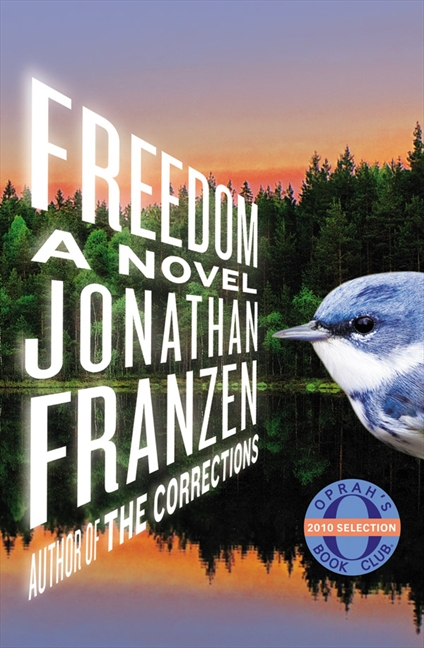
Jonathan Franzen, Freedom

Freedom bookcover, by Jonathan Franzen

Freedom bookcover (Courtesy: HarperCollins Australia)

Hmm … where to start? Half way through this book I was tiring. I wanted to say to Franzen “Enough already” (which, if you’ve read the book, has a certain appositeness). I also started to think of those song lines, so well-known to my generation:

Freedom’s just another word for nothing left to lose.

In fact, I thought of starting this post with that quote, but decided it would be just a little too twee – but somehow it ended up in the first paragraph nonetheless.

In some ways, Jonathan Franzen‘s latest novel, Freedom – which I must be the last blogger to read – is an interesting companion piece to Peter Carey‘s Parrot Olivier in America. They are wildly different in tone, style and historical setting but both explore the foundation upon which America is based, that of freedom of the individual. America tends to parlay this word about a little too, shall I say, freely, a little too unaware at times that freedom is not a simple concept but one that needs to be modified by a few “ifs” and “buts”. It’s these “ifs” and “buts” that confront Franzen’s characters, and that are recognised in those now immortal song lines. In other words, what Franzen’s characters find is that freedom in and of itself is no great shakes. It cannot exist in a vacuum …

But first, the plot. It chronicles the relationship of nice-guy Walter and mixed-up Patty Berglund (and, along the way, their family and friends). The opening paragraph starts around the middle of the chronology, with a rather teasing statement that Walter “had made a mess of his professional life” and then tracks back a few years to the early years of Walter and Patty’s marriage, before tracking back further to their youth and courtship, and then returns to the starting point and on to their future. Through this journey, Walter and Patty, residents of the Twin Cities, grow up, get married, have children, move east, get into a range of “pickles”, and … but that would be telling so I’ll leave the plot there.

It’s a rather complicated structure that owes a lot to postmodernism with its forwards-backwards movement, stories within a story (that is, Patty’s autobiography, told third person, in two distinct parts), a certain intratextuality (such as Patty’s autobiography being read by characters in the novel), the odd font change, and shifting points-of-view. It’s not, however, postmodern in its concerns – and is instead rather earnest, which is part of its problem. I’m not saying that it needs to be postmodern – we don’t need more self-conscious irony and clever playing with the idea of fiction – but it needs something fresh and challenging in characterisation, language and/or tone to carry it right through its 560 pages. Instead, it gets bogged down in too much earnest detail about life in modern America. It’s as though Franzen had a lot of things he wanted to say – about middle-class life, parenting, education, the environment, gentrification, politics, and music – and he was darned sure he was going to say them. We get, therefore, references to 9/11, Cheney and Bush, the war in Iraq, Obama, hints about the GFC, and so on. It’s a bit like Dickens, but without the sustained satire.

That said, there are some funny set pieces, such as the interview Richard (Walter’s friend and rival, and also lately successful rock star) gives to a young fan who wants to use Richard to attract a girl. Richard likens rock music to making chiclets, to being part of not against corporate, capitalist America. And I did love the description of why Walter preferred the aggressive driving of his young assistant, Lalitha, to driving himself:

Walter had come to prefer the anxiety of being her passenger to the judgmental anger that consumed him when he was at the wheel – the seemingly inescapable sense that, of all the drivers on the road, only he was traveling at the right speed, only he … [and on it goes for a page of road-rage inducing complaints].

But, getting back to the main game, what is this “freedom” all about? Most of the characters yearn for and/or experience freedom of one sort or another – they want to live their own lives their way. This can include not working, following one’s own heart regardless of the needs of those around you, having sex with whomever whenever you please, not being responsible for others, not doing the hard yards. And most find that the end result is not a satisfying one.

Walter, whom I presume is Franzen’s main mouthpiece, says:

The reason the system can’t be overthrown in this country … is all about freedom. The reason the free market in Europe is tempered by socialism is that they’re not so hung up on personal liberties … The Europeans are all-round more rational, basically. And the conversations about rights in this country isn’t rational. It’s taking place on the level of emotion, and class resentments, which is why the right is so good at exploiting it ..

This makes sense to me … but, the thing is that there are so many references to freedom that it is hard to locate the main message. This one is political. There are also more personal messages. Here is a description of Walter’s grandfather:

(The personality susceptible to the dream of limitless freedom is a personality also prone to, should the dream ever sour, to misanthropy and rage.)

And of Walter’s father:

He hated the blacks, the Indians, the well-educated, the hoity-toity, and especially, the federal government, and he loved his freedoms (to drink, to smoke, to hole up with his buddies in an ice-fishing hut) the more intensely for their being so modest.

We see parents giving children a “free pass” only to find those children, such as Walter’s brother Mitch, being a “free man” in the sense that he has no home, no secure job, no responsibilities. We see men, like Richard and Joey, thinking the freedom to have sex with anyone anytime will make them happy, but Joey, for example, after an amusing (to the reader!) scene in which he tries to live his fantasy, discovers who he really is:

This wasn’t the person he thought he was, or would have chosen to be if he’d been free to choose, but there was something  comforting about being an actual definite sometime …

And at this point he starts to grow up …

There is a lot to enjoy about this book, despite its bagginess. The characters do engage, flaws and all, and Franzen’s heart is, for me, in the right place. When I got to the end, I smiled and felt that Franzen had achieved something, even if it is simply to show that Freedom is a far more complicated concept than people like to think.

Jonathan Franzen
Freedom
London: Fourth Estate, 2010
562pp.
ISBN: 9780007318520

Mary Church Terrell, What it means to be colored in the capital of the United States

Mary Church Terrell

Mary Church Terrell (Public Domain from the National Park Service, via Wikipedia)

I heard a radio interview this week with Jane Elliott of the brown-eye-blue-eye experiment fame, and she suggested that racism is still an issue  in the USA (through the efforts of a vocal minority) and is best demonstrated by the determination in certain quarters that Barack Obama will not win a second term*. It’s therefore apposite (perhaps) that my first Library of America post this year be on last week’s offering, “What it means to be colored in the capital of the United States” by Mary Church Terrell (1863-1954). This essay originated, according to LOA’s introductory notes, in a talk Terrell gave at a Washington women’s club in 1906. It was then published anonymously, LOA says, in The Independent, in 1907.

Now, I’d never heard of Terrell, but she sounds like one amazing woman. Not only did she live an impressive-for-the-times long life, but she had significant achievements, including being, it is believed, the first black woman to be appointed to a Board of Education (in 1895). She also helped found the National Association of Colored Women. On a slightly different tack, she was a long-time friend of H.G. Wells. Interesting woman, eh?

I have a few reasons for being interested in this essay, besides Jane Elliott’s comment. I lived in the DC area – in Northern Virginia – for two years in the early-mid 1980s and was surprised by some of my own experiences regarding race there. And, as a teen in the 1960s and early 1970s, I was aware of and fascinated by the Civil Rights movement in the USA. I was surprised but thrilled to hear, late last year, an audio version of John Howard Griffin‘s book, Black like me, that I read and loved back in those days.

But enough background. To the essay… I’ll start by saying that I’m not surprised that it began as a talk, because it seemed to ramble a bit. However, as I read on, some structure did start to appear. She starts by listing the various areas in which she, as a black woman, was (or would have been if she’d tried) discriminated against in the national capital. These include finding a boarding house and a place to eat, being able to use public transport, finding non-menial employment, being able to attend the theatre or a white church, and gaining an education. She introduces her section on transport as follows:

As a colored woman I cannot visit the tomb of the Father of this country, which owns its very existence to the love of freedom in the human heart and which stands for equal opportunity for all, without being forced to sit in the Jim Crow section of an electric car …

The irony here is not subtle – but she’s in the business of education where subtlety would not get her far!

She then returns to many of these issues – and this is where I started to wonder about her structure – but what she does is move from introducing the issues by using herself as an example to exploring each one using real examples of people she knows or has heard of. She describes, for example, how employers might be willing to employ a skilled black person, but are lobbied by other staff and threatened with boycotts by clients and so take the easy path of firing (or not hiring) the black person in favour of a white person. In one case the employer is  a Jew,

… and I felt that it was particularly cruel, unnatural and cold-blooded for the representative of one oppressed and persecuted race to deal so harshly and unjustly with a member of another.

You can guess why, in 1907, this was published anonymously!

Anyhow, I won’t repeat all the examples she provides to demonstrate the extent of prejudice at play, because you can read the essay yourself. I will simply end with her conclusion:

… surely nowhere in the world do oppression and persecution based solely on the color of the skin appear more hateful and hideous than in the capital of the United States, because the chasm between the principles upon which this Government was founded, in which it still professes to believe, and those which are daily practiced under the protection of the flag, yawns so wide and deep.

Some 100 or so years later, the US sees itself as the leader of the free world and yet it seems that this chasm is still rather wide. What are the chances that it will completely close one day?

* Please note that this is not a holier-than-thou post. We Aussies have our own problems with racism and prejudice, and so I am not about to throw stones at anyone else.

Joanna Biggar, That Paris year (Guest post)

When I received That Paris year via the LibraryThing Early Reviewers Program, I got the sudden attack of the guilts! How was I to review this book alongside all the other books I wanted to read? And then the thought struck me! My daughter, Hannah (aka Wayfaring Chocolate), is a reader, was an exchange student (albeit in the USA), and had recently been to and fallen in love with Paris. Perhaps she might like to read and review it  – and, yes, she would (with not too much arm-twisting). I posted a version of that review, as required, on LibraryThing, and then suggested we post it here too. She did some small revisions and … here it is … Thanks, Hannah!

Wayfaring Chocolate’s review of That Paris year, by Joanna Biggar

That Paris year, book cover
Book cover (Image: Courtesy: Alan Squire Publishing)

That Paris year weaves together the story of five American female college students on exchange at the Sorbonne in Paris in 1962. There is something dream-like about the narration of the girls’ lives as it is J.J., one of the five, who recounts the story of each, through her own memories, tales the others have told her and, at times, her own surmising about what may or may not have happened in their lives. It is not that J.J. is an unreliable narrator, but that the novel reads in the same way that life is experienced – as a sometimes clear, sometimes hazy pinning together of what we ourselves remember and feel, what others have told us of their own lives, and the threads we create in our minds to tie the two together. Moreover, this novel shows how sometimes, in pulling together our own and others’ stories, we have the potential to blur the boundaries of our selves:

Still, I wondered at it, wondered where she had disappeared when she recited Eve’s thoughts as if they were her own.

Each of the five girls followed in this novel is initially set out as markedly different. Yet for all their varied degrees of attractiveness, confidence, studiousness and self-awareness, ultimately each girl seems focused on one thing above all else: the quest for love, sex, and a life partner. It is this that weakened the novel a little for me as, while I myself am a female university student in my early twenties with a deep love of Paris who wouldn’t mind not being single, I felt suffocated by the constant idea thrumming through this novel that a man is what will, ultimately, define me as a young woman.

The novel certainly deals with other aspects of women’s coming-of-age, such as coping with parents’ divorce, class dichotomies, living in a foreign country, and navigating the limits – or limitlessness, it seems at times – of friendship. I only wish some of these narrative threads had been fleshed out in more detail. Such issues are as relevant today as they were during the novel’s 1962 setting, and the evocative writing of Joanna Biggar ensures that the reader is cognisant of this. The political tension between America and France at this point in history, the insecurities one character (Gracie) faces when comparing her homeliness with the long-legged grace of her statuesque friends, even the novelty of putting on an American Thanksgiving dinner in Paris – these are concepts that Biggar tackles with humour, grace, and a fair degree of sympathy.

For example, even when Gracie’s dogged belief that her intelligence is a curse preventing men from liking her made me want to reach into the book and shake her by the shoulders, I couldn’t help but feel both sympathy and understanding for her in the following:

By trusting me, by believing there was a place of revelation – Paris – where possession of all womanly secrets was obtained, she had simply been delivered into another of Dante’s circle. In only a few short weeks, she already felt doomed … by being short, ill-dressed, and homely in the world capital of style.

One thing I did particularly enjoy was that there were times during the reading when I felt that all I had to do was close my eyes to believe myself back in a smoky Parisian cafe, or perhaps on a beach in Avignon with the wind rising, or sitting by the Seine watching stylish Parisian women strut past me. Biggar has a talent for evoking a Paris, and a France, that is both familiar yet not clichéd, and this was something I particularly took pleasure in. There were also moments when particular lines jumped out at me as if they were my own, such as when one character tells another that:

Maybe it’s just that you have a way of listening like you’re hearing more than I even know I’m saying […] Jocelyn listens too, so much so that sometimes I think she can play back to me what I’ve said. Maybe she doesn’t hear in quite the same way.

Haven’t we all had people in our lives who, we know, implicitly “get” us, and others with whom conversations only ever take place on the surface? I think Biggar captures the way in which both types of friends are valuable in different ways. In fact, you could read her novel as a study of different types of friendship (and, as I’ve mentioned above, how for some women friendships are apparently mediated through and in reference to men).

Yet despite my slight reservations with the novel, I would still recommend it for anyone who has had, or wants, a Paris Year of their own. This novel brought back memories of my own time in the City of Lights and, for that, I am grateful.

Joanna Biggar
That Paris year
Bethesda: Alan Squire Publishing, 2010
469pp
ISBN: 9780982625101

(Review copy courtesy Alan Squire Publishing, via LibraryThing Early Reviewers Program)

Edith Wharton, A journey

According to Keirsey, Edith Wharton may have b...

Edith Wharton (Presumed Public Domain via Wikipedia)

I am a fan of Edith Wharton and have read around seven of her novels, some of which are part of my personal canon. However, I have only read a couple of her short stories, and she wrote quite a few of those too. In fact, she was a prolific writer. And so, when last week’s Library of America story turned out to be one of hers, I decided to read it.

“A journey” was written, according the brief introductory notes, in the 1890s when Wharton was in her late 20s to early 30s. It was written during the time when she was married – unhappily – to Edward Wharton, from whom she was eventually divorced in 1913. The notes say that three of the stories written during the 1890s explore marital misery, and that the journey in this story “becomes a metaphor for an unhappy marriage”.

That could be so, but let’s get to the story. It describes a train journey in which a young woman is accompanying her terminally ill husband back to their home in the East after having spent some time, under doctor’s orders, in Colorado. The story starts with:

As she lay in her berth, staring at the shadows overhead, the  rush of wheels was in her brain, driving her deeper and deeper into circles of wakeful lucidity. The sleeping car had sunk into its night silence. Through the wet window-pane she watched the sudden lights, the long stretches of hurrying blackness …

The next paragraph briefly chronicles their short marriage and the sudden disparity between them as his health collapses:

a year ago their pulses had beat to one robust measure; both had the same prodigal confidence in an exhaustless future. Now their energies no longer kept step …

And then here is the entire third paragraph:

When they married, she had such arrears of living to make up: her days had been as bare as the white-washed school-room where she forced innutritious facts upon reluctant children. His coming had broken in on the slumber of circumstance, widening the present till it became the encloser of remotest chances. But imperceptibly the horizon narrowed. Life had a grudge against her: she was never to be allowed to spread her wings.

Oh dear … methinks the note-makers at the Library of America are right. It’s not what is said so much as what is not said and how what is said is said. What is not said is anything about true love and empathy (though we are told in the fourth paragraph that “she still loved him of course”). In other words, there is no sense of the looming tragedy of the loss of a soul-mate. As for how it is all said, the language is heavy and gloomy. It’s clearly raining, and there are “shadows” and the “hurrying blackness” (a metaphor, presumably, for his coming death, as well as being a literal description of night). The paragraph describing his appearance in her life and their marriage is not exactly joyful either. The focus here is more on where she’d been, so the language is negative (“arrears”, “slumber”). And even the description of the possibilities opening up to her through marriage – “the encloser of remotest chances” – is not what you’d call expansive. No wonder she thinks life has a “grudge against her”. I would too.

The rest of the story is about a rather self-focused young woman. She goes through the motions of caring for her husband – and occasionally “warm gushes of pity [not “sympathy” or “love”, note!] swept away her instinctive resentment of his condition” – but her thoughts are all for herself. Here is her reaction to being in Colorado:

Nobody knew about her, or cared about her; there was no one to wonder at the good match she had made, or to envy the new dresses  …

This is early Wharton. The hallmarks of her writing style are here – the careful choice of words to convey meaning that may be opposite to what’s expected, the development of character through those words, the build up of atmosphere and tension through a well-sustained tone – but it doesn’t quite have the tightness and singularity of purpose of her later works. We don’t get to understand the young woman well enough to be able to respond to her on anything more than a superficial level. I suspect that Wharton would want us to extend her some sympathy but I think we are more likely to see her as a little pathetic, and we really know almost nothing about the husband (except that he had been “strong, active, gently masterful”) so our reaction to his predicament is more intellectual than emotional.

As the journey proceeds, our heroine is faced with a moral dilemma, but she doesn’t take full responsibility for what is happening: “it seemed to be life that was sweeping her on with headlong inexorable force – sweeping her into darkness and terror”. The story, in fact, takes on some elements of horror fiction but that is not its intent and it doesn’t develop along those lines.

I particularly like Wharton when she tackles the intersection between societal expectations and character. This story has glimmers of that – but it’s not really elaborated. Nonetheless, it’s a good story that grabs you from the start with its oppressive atmosphere and foreboding tone. Even early Wharton, I’ve found, has much to offer her readers.

Edith Wharton
“A journey”
The Library of America
Originally published in a collection in 1899?
Available: Online

Note: Stef at So many books has recently reviewed Hermione Lee‘s biography of Wharton, and Kevin at Interpolations has extensively reviewed some of her novels.

Nicole Krauss, The young painters

In her work, the writer is free of laws. But in her life, Your Honour, she is not free.

Nicole Krauss‘s short story, “The young painters”, is a sly, clever little piece. I have not read Krauss’s novels so came to this short story with no preconceptions, other than that I’d heard of her. The story starts with:

Four or five years after we got married, Your Honor, S. and I …

Ah, I thought, so the narrator is defending herself in a court for some crime she’s committed. And so it turned out – more or less – because this is not about the usual sort of crime nor the usual sort of court. It is about the crime of art, that is the crime of stealing the lives of others for art’s sake. In this case, the artist is a writer and she has “stolen” a tragic story from a dinner host about “the young painters” of the title. She has also written a novel using her father’s last days, telling stories about him (particularly regarding his loss of control of his bodily functions) that she knows he would have seen as a betrayal. She does it nonetheless, justifying herself in two ways: one is that she doesn’t write the novel until after his death and the other is that the story reflects

less on him than on the universal plight of growing old and facing one’s death – I did not stop there, but instead I took his illness and suffering with all its pungent detail, and finally even his death, as an opportunity to write about his life and, more specifically, about his failings, as both a person and a father, failings whose precise and abundant detail could be ascribed to him alone. I paraded his failings and my misgivings […] even if the final notes of the book were of triumphant love and grief at the loss of him, in the weeks and months leading up to its publication a sickening feelings sometimes took hold of me  […] In the publicity interviews I gave, I emphasized that the book was fiction and professed my frustration with journalists and readers alike who insist on reading novels as the autobiographies of their authors, as if there were not such thing as the writer’s imagination …

Later in story she runs into the dinner party host and senses, rightly or wrongly (the point is not what others think but her own conscience), his displeasure at her use of the story. She defends herself, to his Honor, by saying the story had not been told in confidence, that she had not discovered it surreptitiously by sneaking around his diaries and journals (which of course begs the question of those writers who do!).

And so, here we have laid before us various writerly defences:

  • I’m universalising from the particular;
  • I’m not writing autobiography but fiction;
  • the story was “given” to me (and, presumably, you knew I was a writer when you told me).

But, for this writer, it all starts to play on her conscience … and here I will end so you can read the story yourself. It’s very short – just 4 pages if you print it out from the link below – and I’ve only touched the surface. The ending is effective.

If this story is a guide to Krauss’s ability as a novelist, and the way she thinks about her “art”, then I’d like to read more, as I found it a cleverly – and dare I say it, poignantly – conceived and executed story.

Nicole Krauss
“The young painters” (from “20 under 40”)
The New Yorker, 28 June 2010
Available: Online

Note: As with several of The New Yorker short stories, this is apparently an excerpt from her novel Great house.

Ruth Reichl, Not becoming my mother

Ruth Reichl, Not becoming my mother
Book cover (Courtesy: Allen& Unwin)

Ruth Reichl and Kate Jennings were both born in 1948, the former in the USA and the latter in Australia. Both had problematic relationships with their mothers and have written about those relationships, Reichl in memoirs and Jennings in her autobiographical novel, Snake. In her first memoir, Tender at the bone (1998), Reichl tells a few (many of them funny) stories against her mother, and describes her urgent need to escape home. Some 20 years later in Not becoming my mother, she revisits her mother – but with the wisdom that time brings. Similarly, in Snake, Jennings’ major focus is “Girlie” and her mother, and particularly Girlie’s desperation to be loved by a woman who was fundamentally unhappy and unable to provide that love.

The thing is that these mothers* were born in the first two or three decades of the twentieth century. They experienced war, depression and, worse still, the awful restrictions imposed on women of that era. Not only were education and work not encouraged, but they were told that marriage was the only life for them. This is the story Reichl tells in Not becoming my mother, and in doing so explores who her mother really was and finally recognises (and appreciates) why her mother behaved the way she did. Here she is on her mother and her mother’s friends:

I have never seen so many unhappy people. They were smart, they were educated and they were bored. Some of them did charitable work, but it wasn’t fulfilling. Their misery was an ugly thing, and it was hard on their families. It was a terrible waste of talent and energy, and watching them I knew that I was never going to be like them.

The mother in Jennings’ novel tells her daughter:

‘She’ll be married at eighteen, a hag by the time she’s thirty’, continues Irene. ‘Don’t let it happen to you’.

Ruth’s mother, on hearing of Ruth’s engagement:

‘Isn’t this very old-fashioned?’ she asked, coolly … ‘I thought that these days people your age just lived together.’

I was certain that Mom would eventually warm to the idea. She did not …

She had introduced me to her friends, shown me the drawbacks of a traditional marriage and offered me what she herself had wanted – permission not to marry.

Both mothers – Ruth’s real one and Kate’s (semi)fictional one – seek meaningful things to do with their lives and to them this primarily meant (preferably paid) work. Both manage it in fits and starts but society was not enamoured of working women and did not make it easy for them. Both mothers experienced some degree of mental illness – which reflects that well documented fact that married women were (and still are, I believe) the highest risk group for mental illness.

These are not pretty stories but they need to be told. Interestingly, Reichl’s story has a positive ending. Late in her life, her mother does find meaning and spends her last years actively involved in her community. Jennings’ fictional story, on the other hand, ends far more equivocally. Despite these differences, both books are powerful reminders of what life was like for a whole generation of women. And they remind us why we need to keep working to ensure self-actualisation for everyone, regardless of gender or other socially imposed limitations.

By the time she wrote Not becoming my mother, Reichl had made her peace with her mother’s memory, had finally realised that much of her mother’s seemingly bizarre or erratic behaviour was borne of the frustration in her life and her desire that her daughter not follow her footsteps. Luckily for me, my mother, also born in the first third of the century, managed to convey similar messages about education, work and marriage, while also providing the love and support that all children need and deserve.

Ruth Reichl
Not becoming my mother, and other things she taught me along the way
Crows Nest: Allen & Unwin, 2009
112pp
ISBN: 9781741757538

* These are just two examples of sad, difficult mothers from those decades. There are many more, such as Jill Ker Conway‘s mother in The road from Coorain.

Kate Chopin, Désireé’s baby

Kate Chopin

Chopin (Public domain, via Wikipedia)

I read Kate Chopin‘s short story “Désireé’s baby” (1893) back in March when Kirsty mentioned it in her comment on my last Chopin post, but I didn’t blog it then. However, when it appeared a couple of weeks ago as a Library of America selection, I felt its time had come. But, what to say? It is, in a word, gut-wrenching.

The first short story to create a lasting impression on me was Guy de Maupassant‘s “The necklace” (1884). It was that short story, really, that launched my enjoyment of short stories. I found them particularly appropriate for my student days when I couldn’t justify reading a novel but wanted some escape from set texts. I was consequently interested to read in the Library of America’s introductory notes to “Désireé’s baby” that Chopin has been compared to such writers as Maupassant and Flaubert. I can see the connection.

“Désireé’s baby” starts off gently – and, more to the point, innocuously:

As the day was pleasant, Madame Valmondé drove over to L’Abri to see Désireé and the baby.

It made her laugh to think of Désireé with a baby. Why, it seemed but yesterday that Désireé was little more than a baby herself…

We then discover that Désireé had been an abandoned baby and brought up by the childless Madame Valmondé and her husband, hence I suppose her name. As this (very) short story unfolds, subtle hints of something not quite idyllic are introduced. A young man of an old wealthy family, Armand Aubigny, falls in love with and insists on marrying the nameless, but now 18-year-old Désireé. He fell in love “the way all the Augibgnys fell in love, as if struck by a pistol shot”. What an odd image to use for love eh?

Then we hear that Aubigny is a strict master of his estate. The home is “sad-looking” with its roof “black like a cowl” and “solemn oaks” growing near it. And, more telling, under his rule “his negroes had forgotten to be gay, as they had been during the old master’s easy-going and indulgent lifetime”. Set against this is Désireé in her “soft white muslins and laces”, so we are not surprised when we read that

Marriage, and the birth of his son, had softened Armand Aubigny’s imperious and exacting nature greatly. This was what made the gentle Désireé so happy, for she loved him desperately. When he frowned she trembled, but loved him. When he smiled, she asked no greater blessing of God. But Armand’s dark, handsome face had not often been disfigured by frowns since the day he fell in love with her.

Now, there is a clue to the dénouement in this excerpt, but if you don’t know the plot I’m not giving it away. All I’ll say is that Chopin’s writing is superb in the way she uses imagery and irony to subtly set the scene and leave the clues so that the conclusion, though shocking, meets Amanda Lohrey’s criteria for endings.

In less than 6 pages, Chopin explores a complex set of themes, including the psychological and social ramifications of young love, old wealth, race and gender, with a clarity that is breath-taking. I’m not surprised that it is a much-anthologised and studied story.