Alice Dunbar-Nelson, Sister Josepha (#Review)

It’s a year since I’ve posted on a Library of America (LOA) story, but I was driven to post on this one for two reasons. I have just posted a review of “The scapegoat” by Dunbar-Nelson’s first husband, Paul Dunbar, and, earlier this year, I reviewed “A carnival jangle”, written by Alice Dunbar-Nelson, before marriage when she was Alice Ruth Moore.

Alice Dunbar-Nelson

In my post on “A carnival jangle”, I provided a brief biography of Dunbar-Nelson, so I won’t repeat that here, except to remind us that she was a poet, journalist and political activist, born to a black mother and white father. She was prominent in the Harlem Renaissance, and lived in New Orleans for 21 years, as well as Boston, New York, and elsewhere.

In that bio, I also wrote that racism was an important issue for her, but that she also took a wider view of human rights. It is this point that I would like to explore further in this post, due to some ideas raised in LOA’s introduction to her story. They focus quite a bit on her relationship with Paul Laurence Dunbar, noting that the two communicated with each other by letter for a couple of years before meeting. Dunbar asked for her opinion on using “Negro dialect in Literature”, which he sometimes did. LOA shares her response, which was that she saw no problem with using dialect if you knew it and had “a special aptitude for dialect work” but that she saw no necessity to do so just because “one is a Negro or a Southerner”, and if, like her, you were absolutely devoid of the ability to manage dialect“. This makes good sense, but the main thing I want to share is what she says next:

Now as to getting away from one’s race—well I haven’t much liking for these writers that wedge the Negro problem and social equality and long dissertations on the Negro in general into their stories. It’s too much like a quinine pill in jelly—I hope I’m not treading on your corns. Somehow, when I start a story, I always think of my folks (characters) as simple human beings, not as types of a race or an idea—and I seem to be on more friendly terms with them.

After detailing more of Dunbar-Nelson’s biography, LOA returns to the issue of subject matter, saying that “the ambiguity of racial identity for the Creole characters” in her stories resulted in several critics in recent decades arguing that

she “camouflaged the issue of race,” that she “spurned that racialized element of her identity,” or that she “shaped her tales of Creole life for white audiences.” In “Sister Josepha,” which we reprint below as our Story of the Week selection, the reader realizes that the lead character is not white only through descriptive hints (“brown hands,” “tropical beauty”) and by what the other nuns do not say about her.

However, continues LOA, another commentator, Caroline Gebhard had noted in a recent article that Dunbar-Nelson

“presumes that readers already read her work as ‘black.’” In the 1890s and early 1900s, most of Dunbar-Nelson’s stories, essays, and poems appeared in Black newspapers and magazines; The Monthly Review, for example, advertised itself as “the only illustrated periodical published by Negroes in this country.” … “Dunbar-Nelson knew she would be read as a Black author and never tried to pass in print,” Gebhard concludes. “To read Dunbar-Nelson’s fictions as addressing only white readers, which the accusation of passing implies, is to dismiss the fact that Dunbar-Nelson’s first and most loyal readers were African Americans.”

This point reminded me of the discussion my American friend Carolyn and I had about “The scapegoat” concerning the fact that it is almost completely set in the black community. White people are not identified, except for the Judge, so we have to work out, between the lines, who else might be white in that story. I think Paul Dunbar assumed we’d know – just as Alice Dunbar-Nelson did, according to Gebhard. It’s a lesson in how difficult it is to read out of one’s own time and culture.

It also reminded me of something more contemporary, a post I wrote in 2021. The focus was memoir, but the point was that ‘diverse writers’ are expected to write narrowly about their diversity, and their frustration that they are not encouraged to write, as Dunbar-Nelson explained, about “simple human beings, not as types of a race or an idea”.

“Sister Josepha”
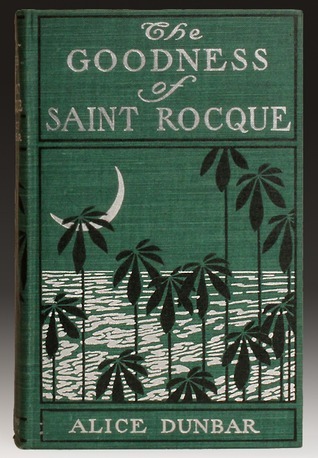
“Sister Josepha” appeared in Dunbar’s 1899 short story collection, The goodness of St Rocque and other stories, and can be read at the link below. It tells the story of a young three-year-old orphan named, Camille, who was left at a convent orphan asylum. The story opens 15 years later when this orphan has just finished her novitiate and is a fully-fledged sister, but she’s unsettled.

Dunbar tells us that when she was 15, and still Camille, she had “almost fully ripened into a glorious tropical beauty of the type that matures early” and had attracted the attention of a couple who offered to take her in. Her Mother Superior calls her in and makes the offer:

Camille stole a glance at her would-be guardians, and de­cided instantly, impulsively, fi­nally. The ­ woman suited her; but the man! It was doubtless intuition of the quick, vivacious sort which belonged to her blood that served her. Untutored in worldly knowledge, she could not divine the meaning of the pronounced leers and admiration of her physical charms which gleamed in the man’s face, but she knew it made her feel creepy, and stoutly refused to go.

To justify her decision to Mother Superior, who did not force her to go, she announces that she loves the convent and sisters, and would like to be one too. However, three years later, the life is palling for this lively young woman. She’s tired, and bored, and plans her escape, but this is a story about the few opportunities available to a young woman in her situation. Should she live the confining but secure life of a nun, or could she make it out in the world where she has no identity, no name other than Camille, and “a beauty that not even an ungainly bonnet and shaven head could hide”.

What lifts this story out of the large body of often cliched stories about young nuns like Camille/Sister Josepha is the situation and Dunbar’s expressive writing that subtly conveys the reality of our sister’s position. Race is never mentioned but there are hints regarding Camille’s background. This is a different story to “A carnival jangle” but no less powerful.

Alice Dunbar Nelson
“Sister Josepha” (1899)
First published: in The goodness of St Rocque and other stories
Available online: Library of America
Alice Ruth Moore, A carnival jangle (#Review)

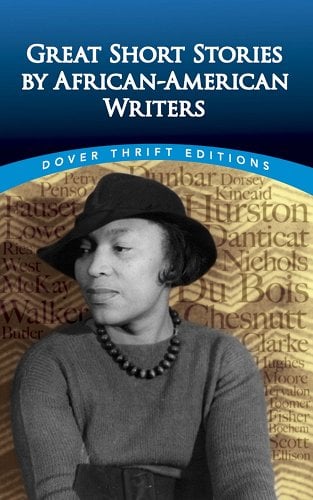
Over the last two years I worked my way through the anthology Great short stories by contemporary Native American writers that was sent to me by my American friend Carolyn. It introduced me to many writers I hadn’t read before, and, valuably, to the issues and concerns facing some of America’s first peoples. Many of these issues – such as identity, and the long-lasting, all-encompassing fallout from dispossession – overlap with the issues First Nations Australians are confronting. It was an excellent reading project, so I was thrilled when, a year ago, Carolyn sent me another Dover anthology, Great short stories by African-American writers. I’ve read a few more of these authors than I had of the Native American collection, but not many, so I’m looking forward to another worthwhile reading project. Thanks again, Carolyn!

Alice Ruth Moore

The first thing to say about Alice Ruth Moore is that she is better known as Alice Dunbar Nelson, which is the name Wikipedia uses. Born Alice Ruth Moore in New Orleans in 1895, she married three times – Paul Laurence Dunbar (1898–1906), Henry Arthur Callis (1910–1916), and Robert J. Nelson (1916–1935). Poet Dunbar died in 1906, but it had been an abusive relationship and she’d left him before his death. Her marriage to physician and professor, Callis, ended in divorce, and she did not it seems take – or keep – his name. Her final marriage was to poet and civil rights activist, Nelson, and this marriage lasted for the rest of their lives. His name she used, but she also retained Dunbar. Fascinating.

A poet, journalist and political activist, Dunbar Nelson, who had a black mother and white father, was among the first generation born free in the South after the Civil War. She was also one of the prominent African Americans involved in the Harlem Renaissance (about which I wrote in my post on Nella Larsen’s Passing.) She lived in New Orleans for 21 years, and briefly taught primary school there, before moving to Boston and then New York, where she co-founded and taught at White Rose Mission, a school for coloured working girls (in the non-euphemistic meaning of the term!) She also lived in Washington D.C., Delaware and Pennsylvania.

Racism was an important issue for her, but she also took a wider view of human rights. She was an activist, for example, for African American’s rights and women’s rights. By the 1920s, she was concerned about social justice and the struggles of minorities in general. Wikipedia’s article concludes with this:

Much of Dunbar-Nelson’s writing was rejected because she wrote about the color line, oppression, and themes of racism. Few mainstream publications would publish her writing because they did not believe it was marketable. She was able to publish her writing, however, when the themes of racism and oppression were more subtle.

“A carnival jangle”

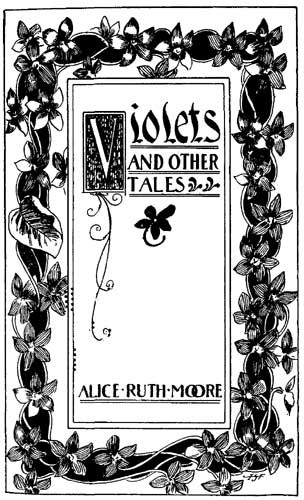
“A carnival jangle” appeared in her first collection of stories and poems, Violets and other tales, which was published by The Monthly Review in 1895, while she was still in New Orleans. She wrote a brief, self-deprecating introduction to the collection, commenting on the number of books being foisted on the market, and then offering her “maiden effort, — a little thing with absolutely nothing to commend it, that seeks to do nothing more than amuse”. Many of “the sketches and verses” had appeared in before, but many others were new.

There is also a preface by Sylvanie F. Williams (d. 1921) whom Wikipedia describes as New Orleans-based “educator and clubwoman“. (Click on the link to find out more about the women’s club movement in the USA.) She says the author ‘belongs to that type of “brave new woman who scorns to sigh”, but feels that she has something to say, and says it to the best of her ability”. However, she is also young, “just on the threshold of life, and with the daring audacity of youth makes assertions and gives decisions which she may reverse as time mellows her opinions, and the realities of life force aside the theories of youth”. Love this.

Williams also writes that “there is much in this book that is good; much that is crude; some that is poor”. I haven’t read any Moore/Dunbar Nelson, so I have no way of knowing where “A carnival jangle” sits in terms of her oeuvre, but it certainly feels like a standout in this collection.

Set during New Orleans’ Mardi Gras festival, “A carnival jangle” is fundamentally a mistaken identity story. It is just 4 pages, but delving into it – as the podcasters at CodeX Cantina did – reveals an impressively complex story offering multiple readings. I don’t usually go looking for analyses before I write my posts, but I came across CodeX Cantina when I was researching who Moore/Dunbar Nelson was. I’m glad I did because they teased out some culturally specific aspects that I didn’t know. For example, I completely misread the use of “Indians” in the story. These are the New Orleans or Mardi Gras Indians – an African-American carnival subculture, not Native Americans.

The story opens:

There is a merry jangle of bells in the air, an all-pervading sense of jester’s noise, and the flaunting vividness of royal colors; the streets swarm with humanity, — humanity in all shapes, manners, forms, — laughing, pushing, jostling, crowding, a mass of men and women and children, as varied and as assorted in their several individual peculiarities as ever a crowd that gathered in one locality since the days of Babel.

It’s tight and short, and tells of a young girl named Flo, who, hovering “between childhood and maturity”, is drawn away from her “unmasked crowd” by a “tall Prince of Darkness”, “a shapely Mephisto”, who promises to “show [her] what life is”. She is swept away to a costume shop and disguised as a “boy troubadour”, before joining the masked dancers – but things don’t turn out the way she is promised.

The two podcasters discussed “the tower of Babel”, which is alluded to in the opening paragraph and which suggests the idea of people coming together, until all falls apart, and the Faustian bargain, which is implied through the narrative and which presages a promise not fulfilled. The masked society can be understood as one in which all are equal, regardless of race or gender. However, masked people can also be invisible, unknown, and this tension between freedom and danger underpins this story.

The language is vibrant and lush capturing the excitement of the carnival, but is also constantly subverted by references and allusions to darker things. Carnivals, after all, tend to encompass opposing ideas – fun versus pandemonium, humour versus derision. The revellers here include “jesters and maskers, Jim Crows and clowns, ballet girls and Mephistos, Indians and monkeys…”, an odd and unsettling assortment which reflects not only traditional carnival characters but the diversity of New Orleans, and the racial tensions developing as Jim Crow laws were being enacted. Moore’s New Orleans is a place in flux, and the carnival motif is a perfect vehicle for conveying that.

The CodeX Cantina podcasters don’t talk much about Flo, and the fact that we don’t know what she wants or thinks. Described as “the quietest and most bashful of the lot” when she is drawn away, she seems to have no choice or agency in what happens to her. Is this because she’s simply a tool in the wider story, or is there a comment on gender, or both? What does it mean that she’s white?

“A carnival jangle” is a sophisticated story about a complex place and time, written by someone who was just starting her writing journey. It warrants more teasing out than I’ve done here, because it has so many angles to think about. Do read it, and, if you have time, listen to the CodeX guys. They don’t have all the answers but they do some good thinking.

Alice Ruth Moore
“A carnival jangle” (1893)
in Christine Rudisel and Bob Blaisdell (ed.), Great short stories by African-American writers
Garden City: Dover Publications, 2015
pp. 1-4
ISBN: 9780486471396
Available online at louisiana-anthology.org