Karen Viggers in conversation with Alex Sloan

When Colin Steele emailed out the schedule, to date, for this year’s Meet the Author series, I immediately marked in my calendar those events I could attend. There weren’t many, as life is busy with yoga, tai chi, reading group and concert subscriptions, but the first I could attend was local author Karen Viggers (who has appeared several times on my blog) in conversation with Alex Sloan about her latest novel, Sidelines.

The conversation
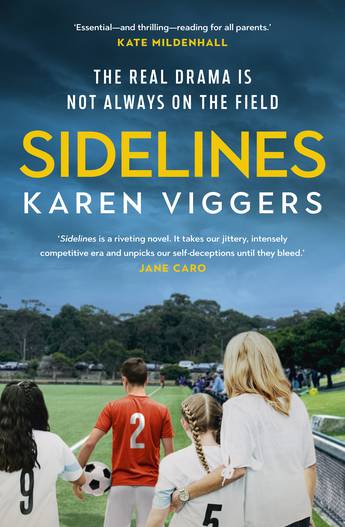
MC Colin Steele, who was so deservedly made a Member of the Order of Australia in this year’s Australia Day Honours, opened proceedings by acknowledging country and introducing the speakers. He then paid tribute to Marion Halligan who had died this week, and who had planned to attend this event. There was an audible sigh in the audience because she really was much loved here. But, moving on, as we must … Colin introduced the conversation, describing Sidelines as “social commentary on modern society”, before passing us over to another local luminary, Alex Sloan.

Alex opened with a point I had planned to make in my post on the book, which is that it’s quite a departure from Viggers’ previous environment/landscape-based novels. Sidelines is set in the suburbs, whereas her previous four novels are set in “wild, rugged places”. But then, on reflection, she added, suburban Sidelines is “rugged” too. It “has teeth”.
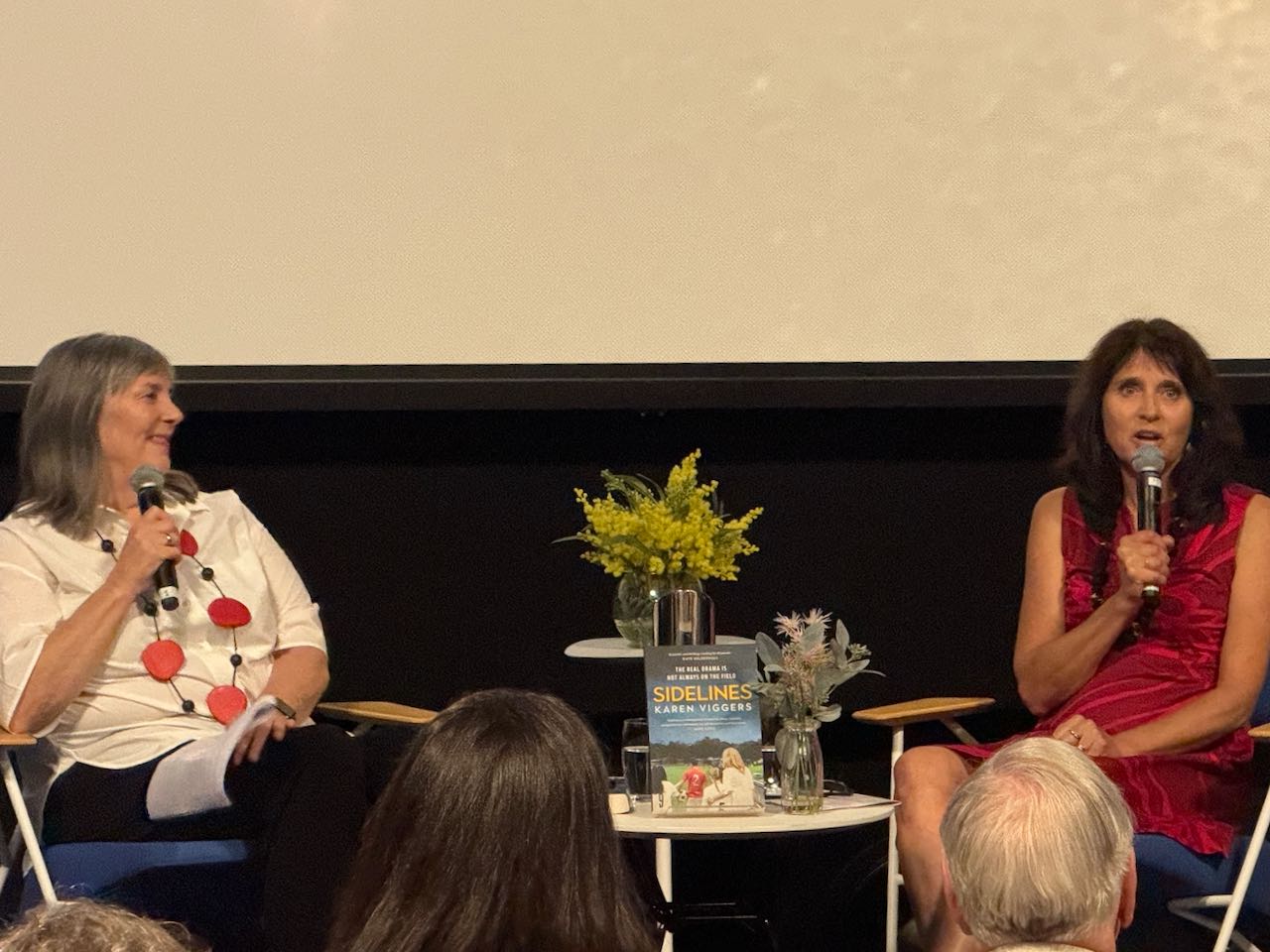
However, before asking Karen about her novel, she too paid tribute to Marion Halligan. How could she not, given this week, this place, and this interviewee? Karen responded by saying what a “terrible loss” Marion’s death is. She had been a “huge supporter” and friend, and had lived life right to the end. Isn’t that how we’d all like to go?

Karen then shared a statement made by Marion, in an interview with Gillian Dooley, about what novels are about:

It seems to me that novels are very much about this question of how shall we live, not answering it but asking it, and what novelists do is look at people who live different sorts of lives, and often people who live rather badly are a good way of asking the question.

This is so Marion! Karen suggested that Sidelines looks at people living badly … but not at bad people. There’s a difference – one that people don’t always make, I think.

She also said – and this is the other thing I was planning to raise in my (coming-soon) post on the book – that she realised she is an “issues-based writer“. She can only write what is inside her. This book grew partly out of her thinking of her own behaviour but was also inspired by an Under-12 Canberra football game in 2014, which had ended in parents brawling on the field. Were these, she wondered, really bad parents or parents who had got carried away?

There is a line between support and pressure, and she wanted to use fiction to consider the issue – not just in sport, but in society overall. Where is the line drawn?

Alex asked about the fact that she has said that her first draft was written in anger. Karen explained that she had seen her son, a volunteer referee, cop a lot of abuse which has resulted in his giving up refereeing. This and other injustices she’d seen had made her angry.

Alex then moved to the characters, asking Karen to talk about them and their role in the novel – the well-to-do Jonica and Ben who start the book, and the succeeding characters who include the working-class Greek-Australian family, Carmen and Ilya, and the young talented player Griffin. Alex, as became clear through the rest of the interview, disliked Ben and loved Griffin.

Karen teased out her characters a little. Ben is one of those fathers who have to win at everything. For him winning at sport is all, and it gives social currency. However, Karen wants people to think about what success really is. Sport brings very different people together, people who may not otherwise ever meet each other. Choosing this subject-matter gave her an opportunity to explore class.

Turning to Griffin, Karen talked about how sport can also be a way out of poverty. She wanted to include all the different elements of sport – class, cultural, economic, and so on. She said if a child shows an ounce of talent, parents are sold the idea that their child can play for Australia, but only a tiny percentage do. Later in the conversation, Karen said that the lovely Griffin had been inspired by a particular young player she knew. He provides one of the novel’s epigraphs.

Karen said she had started this novel thinking she was writing about sport, but soon realised that, in fact, she was writing about modern society and parenting.

Alex mentioned the dog Honey and its importance to teen Audrey, noting that there’s always a dog in Karen’s books. Doglover Karen commented that animals are a great support to families, and that we can’t underestimate their role in our mental health. (Yes! Like her character Audrey, I found much-needed solace from my beagle when I was a teen.)

The conversation then segued to how well Karen had got into the heads of teens. We often forget the pressures of being a teen, Karen said, and how something like sport, which is meant to be fun, becomes pressure.

From here, we moved on to writing characters. Karen said she likes it when her characters start to take over and tell her who they are. Her first angry draft was too black and white. It needed more nuance. Alex, still disliking Ben, asked about the writing of badly behaving characters. Karen didn’t see the characters as all unlikable, and anyhow, she said, characters don’t have to be likeable. The structure of Sidelines is like The slap (my post). It is told chronologically but through six different characters, with each character picking up the story from the one before.

Alex mentioned the references to the arts in the novel. Had Karen specifically intended to pit the arts against sport? Audrey, said Karen, is a teenager who is interested in many things. She did want to play for Australia, but she also wanted to try other things like theatre. However, her father had told her to choose what you are best at. The arts vs sports question hadn’t been a conscious theme, but she had pared the novel back to leave gaps for people’s own thoughts. She didn’t want to be didactic.

The conversation turned to specific examples of young talented sportspeople and the role of parents in their lives – like Jelena Dokic (whom the world had watched being abused by her father), David Beckham whose parents had different ideas about their role in his success, and Ellyse Perry whose parents had never applied pressure but had always supported her. There is, said Karen, a wide range of parental behaviours and she wanted to leave space for readers to think about all this, particularly in terms of expectations and ambitions.

Regarding writing about the actual playing of sport, Karen said that watching someone who is really good is a form of beauty, like experiencing poetry or music. Alex suggested that beauty is usually revealed in her novels through nature, but in Sidelines we see it through Griffin.

Given how well Karen had captured teens, Alex wondered whether this novel would be suitable for schools. Karen felt that it could work for, say, Year 10, but is more interested in seeing it discussed in book and sports clubs. She’d like people to think about about how to be better parents, how to be better sports parents, and, more broadly, about our society and its attitude to competitiveness. She shared the story of a child being asked about the best thing about playing sport, and answering that it was the time with her friends before and after their games. If we want children to keep playing sport through childhood and into adulthood – something that is good for people’s health – we need to tap into how to make it enjoyable.

Q & A

On her professional versus writing life, and how the former helps the latter: Karen said her work as a vet keeps her in touch with the real world, and enables her to meet people from all walks of life.

On what talented athletes need besides their natural talent: Karen felt it was all those obvious things, like grit, the inner desire to play, support from others, persistence, willingness to take risks, knowing what to do afterwards (which Audrey points out to Griffin in the novel). In particular, she said, it’s the ability to be a team player, and being able to make the team look great as well as oneself.

On (referencing the Adam Goodes booing affair) being a good watcher: Karen talked about the importance of adults role-modelling good behaviour. When parents and coaches abuse referees, so will children. She hopes her novel will stimulate discussion about these sorts of issues.

On her popularity in France and how she thinks this book will go: The novel is currently being translated. The French love her “big landscapes”, but they also like philosophical questions so she hopes this novel will appeal to them for that.

On whether parents and children have different wants, different attitudes to winning and losing: After some sharing of quotes about winning and losing, Karen said that “how” you win or lose is more important than “whether” you win or lose.

Vote of thanks

Emma Pocock, wife of Federal independent senator David Pocock, gave the vote of thanks. (Pleasingly, it was Emma, not the organisers, who referred to her husband. She was introduced in her own right, as the founder of FrontRunners and an emerging writer). She shared a poem she had written at the end of her husband’s sporting career. It concludes with a reference to all those winning trophies/cups. They are, she wrote, all hollow, and must now be filled with something tangible, something that was really him.

Sidelines isn’t, she said, about neatly sorting characters into good and bad – as she’d initially tried to do – but about our behaviour individually and collectively. It asked her, she concluded, to think.

This was a lively but warm-hearted evening at which the local literary community came out in numbers to hear and talk about Karen’s timely book, to think about its intent, and to share in some camaraderie in a sad week.

ANU/The Canberra Times Meet the Author
MC: Colin Steele
Australian National University
22 February 2024
Melissa Lucashenko in conversation with Alex Sloan

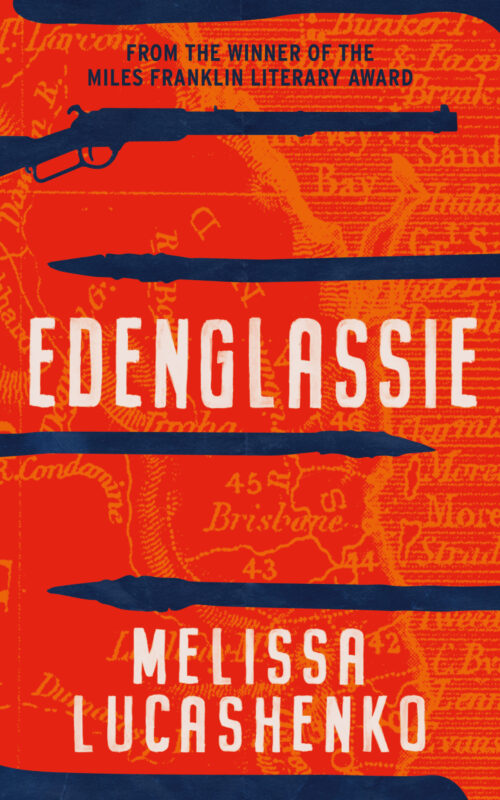
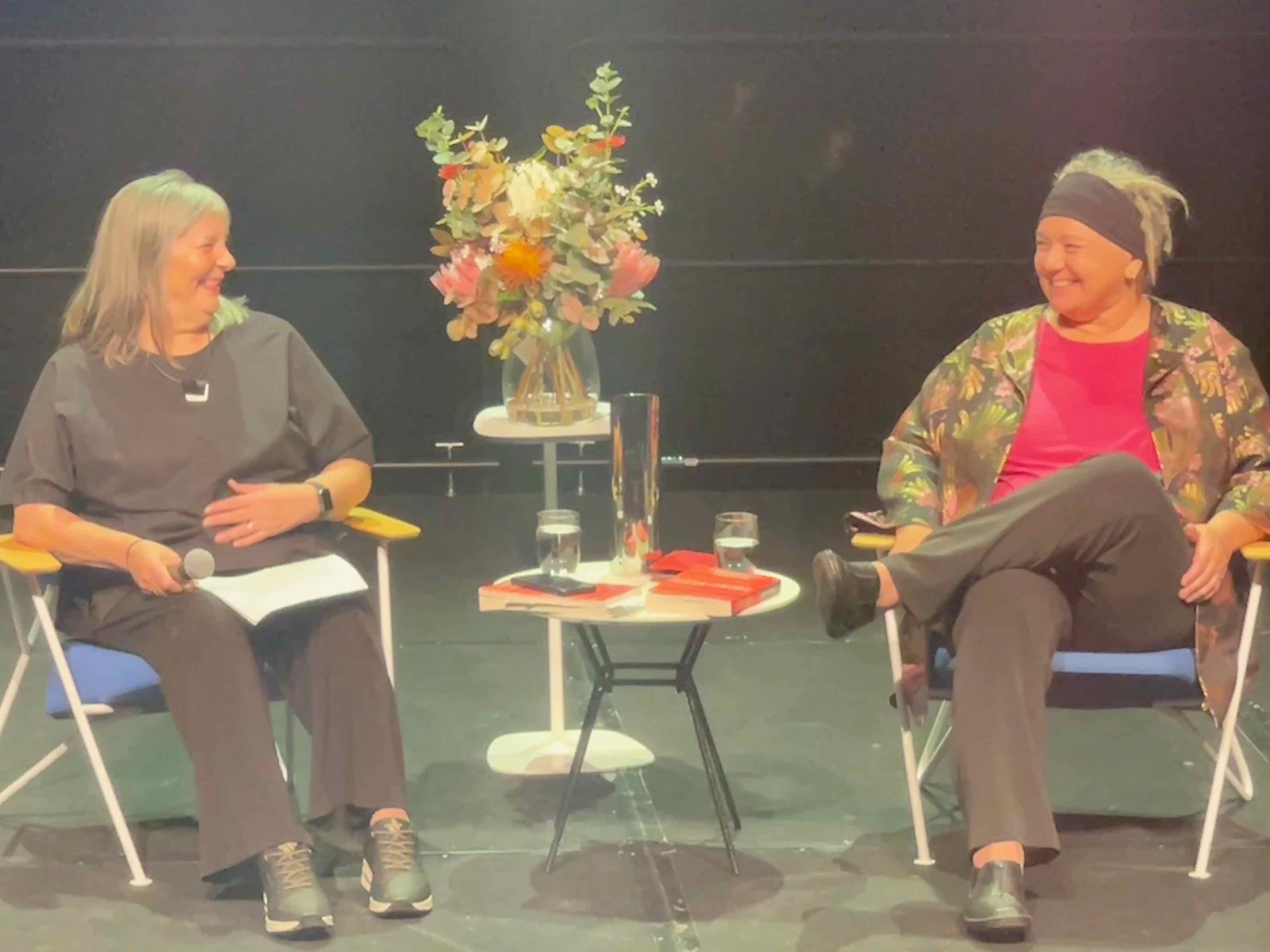
I can’t believe it’s been a year since I attended an ANU/The Canberra Times Meet the Author event, but this year has been packed. Finally, though, we were free on at the right time – and the event happened to be one of high interest for me, Melissa Lucashenko being interviewed about her latest book, Edenglassie. The interviewer was popular ex-radio journalist and well-known Canberra booklover, Alex Sloan.

I have posted on Lucashenko several times before, including on her Miles Franklin award winning novel, Too much lip. I don’t always hang around for book signings these days – do authors really like doing them? – but we thought we’d see how long the line was. It wasn’t too long, so I decided to hang around. When it got to my turn I told her that I loved that she could write with humour about serious things. It’s a skill. Quick as a flash, she signed my book “For Sue / Keep laughing/ Melissa Lucashenko”. It was worth lining up for.

The conversation

The event started as always with MC Colin Steele, acknowledging country and introducing the speakers. He explained that the title of Lucashenko’s latest book Edenglassie, comes from the name, combining Edinburgh and Glasgow, that was nearly given to Brisbane in early colonial times. He summarised the book as being about the “impact of loss of country” but also being a “novel of strength and love”.

Before getting into the conversation, Alex Sloan referred to the elders at Uluru and their request of us, the Voice, that we are now voting on in this weekend’s referendum – and asked us all “to do the right thing”. Problem is she was probably preaching to the converted.

I’m going to use first names, mostly, in the rest of the report where the alternative would feel too formal.

Alex started the conversation by referring to a review in The Guardian which described the novel in terms of its “flair, humour, generosity” and as being a novel about ongoing resistance. She then asked Melissa to share the origins of her novel.

Melissa commenced with “hello friends” and said she’d like to “extend good feelings to anyone touched by events in the Middle East”. There’s nothing much else she can say, she said, but “war crimes are never ok”.

She then introduced her novel, describing it as a historical novel, with a contemporary thread to add some humour. She said it had grown out of the memoir she’d read of the Queensland “pioneer” Tom Petrie. She told an amusing story about being in London at the same time as Alexis Wright, then working on Carpentaria (my post), and as Peter Carey, who had won the Booker Prize with True history of the Kelly Gang. We are talking around 2001, I guess. Apparently, after they’d had a brief moment with Carey, Wright, who liked Carey’s book, also said that the problem was that Australians “write too many historical novels”.

Melissa took this to heart, and so her first three novels were contemporary novels. But, on catching up with Alexis Wright several years later, she reminded Wright of her comment. Wright looked at her, and clarified that she meant “white people write too many historical novels, not us”. Lucashenko went back to her historical novel interest!

Alex then moved the discussion on to place, noting the epigraph from Jean Rhys’ Wide Sargasso Sea. It comes from when the now locked-up Antoinette is told she is in England, and responds “I don’t believe it…and I will never believe it”. Lucashenko explained its application to her novel, to the fact that Australia is “aways Aboriginal land”. All her books are about place she said.

Alex asked about the novel’s first line, which describes Granny Eddie “falling, falling, falling”. Lucashenko said that besides Granny’s literal fall, it also alludes to an old woman “falling, falling, falling” in a Thea Astley* novel, and to the biblical fall.

Next, Alex turned to the novel’s love theme. Lucashenko said it has two love stories, one in each time period. Blackfellas are human too, she said, and deserve “love, joy and peace” like anyone else. I hate that she feels she has to say this. What sort of world do we live in? Anyhow, Alex described the historical lover Mulanyin as “hot, move over Mr Darcy”, she said. She asked Melissa to do a reading, which she did, from Chapter 8, when the historical section lovers meet. “Love at first sight,” said Alex.

The conversation moved from Mulanyin and his love interest Nita to the modern storyline and the character of Winona, who, Lucashenko said, is around 27 or 28, and “likes to tell it straight”. Alex asked her why she interlinked this modern story with the historical one, and the answer was clear and to the point. She wanted to counteract the trope of the dying race. It has been slowly changing since Mabo, but is still evident. Because of it, she never kills off her Aboriginal characters. She also wanted to balance feisty characters still here in 2024, who are talking back, with her historical figures.

From here, Alex asked Melissa about Edenglassie being a work of fiction. Lucashenko responded that although it was a work of fiction, she’d done a lot of research. She’d agonised on getting facts right, because she had Keith Windschuttle on one shoulder and Andrew Bolt on the other (an image that tickled Alex.) She knew her novel would be attacked because she was telling the story from a non-conservative position. Her historian friend reassured her, though, that “it’s all fiction” – a position I don’t disagree with. Melissa also shared Barry Lopez’s point that everything in life is “story and compassion”.

At this point we returned to the title. Lucashenko elaborated on Colin Steele’s intro, saying it had come from the Scottish Chief Justice Forbes who had established a property in NSW called Edenglassie, and had liked it so much that he tried to later give this name to Brisbane. It’s a great find for a writer. Lucashenko loved it with its “Eden” and “lassie” (for a feminist like her) references. 

In terms of the novel’s perspective, she said that at the time the historical part of the novel is set, the Aboriginal people, who were in the majority at that point, felt the whites would go away. This brought us back to discussing Mulanyin, whom Lucashenko described as brave, and a fisherman. She did another wonderful reading from early in the book, when he is taught some lessons by his elders, but taught in the way First Nations culture does it, which, as Lucashenko describes it, is “you go work it out”. In this case, the lesson involved honouring old ones and not being destructive out of greed. 

Lucashenko also explained that her idea for the novel had its origins in the fact that next year will be the bicentenary of white Queensland. She wanted to provide an Aboriginal perspective on the story but it developed into something more complex, that included love, and also encompassed the idea of “what could have been”. 

She talked quite a bit about Tom Petrie who had established a pastoral station with the permission of the local Aboriginal headman – in a location that was strategically chosen by that headman. The central question of the novel concerns “what was going through these people’s minds”. Things could have been different then, she said, and could still be now. There’s the paradoxical idea of British pluck and courage versus the facts involving murder, mayhem, theft. The conversation teased out several complex ideas about colonisation – attitudes to law, and to beliefs, for example. Lucashenko talked about pastoral workers being branded, and how that can be seen in two ways – it marks a person as a slave, but it can also work as protection (as in “don’t shoot me, I belong to Petrie”.)

Her story explores how colonisation could have been done differently. In Petrie’s case, for example, it was still colonisation, but the way he did it saved Aboriginal lives and partly at least protected their culture. I’m intrigued. Without having read it yet, I can see why she felt the need to prepare herself for attacks. (She’s been attacked before for her “non-conservative”, confronting exploration of difficult subjects.)

Alex talked about the section in the book where Mulanyin asks for permission to marry Nita. She felt it explained things about Aboriginal practices and beliefs that she had not known (which is how Debra Dank’s We come with this place impacted me, so I look forward to continuing that journey here.) Lucashenko then talked about the novel’s modern thread, about Winona confronting the wanna-be (my term) Aboriginal, and her upfront message to him. About this, Lucashenko said that “being harsh is not blackfella law” but there is also a “right way”.

Q & A

On what she learnt about herself through writing each novel: That she has stamina for writing, though not for much else. So, the lesson is, “Do what you are good at”! 

On not providing a glossary for words in language: Meaning can be understood with a little work; knowledge is best earned not given. (Love this.) 

On the novel taking four years: She has been writing this novel her own life, but serious research for it started in 2019, just before the fires, floods and pestilence!

On how Brisbane is affected by its history: All Australia is affected by colonisation, but in Brisbane’s case it was a brutal penal settlement, giving meaning to that phrase, “Another day in the colony”, which still has meaning today. Melissa talked about the question “Are you a monkey or an ape” experienced by an Aboriginal woman prisoner in Logan in 2014.

Vote of thanks

Lucy Neave (whose novel Believe in me I’ve reviewed), gave a sincere vote of thanks, which included thanking Melissa for the special readings from her book (there were three.) She described Edenglassie as a generous book, that’s “compelling, accessible, and meticulously researched”. It encompasses diverse values, she said, and shows what enormous value we can get “if we listen”. 

I would add thanks to Lucashenko for her gracious handling of occasional clumsiness from her questioners, because we whitefellas can be hamfisted at times.

* First Chris Flynn (Here be Leviathans) and now Lucashenko admit to the influence of Thea Astley. Love it

ANU/The Canberra Times Meet the Author
MC: Colin Steele
Australian National University
12 October 2023

Jane Caro in conversation with Alex Sloan

It was to the ANU’s brand new Kambri Cultural Centre that we went for this week’s ANU/The Canberra Times Meet the Author event with Jane Caro, who is doing a book tour with her new book Accidental feminists. Kambri is not as cosy as the old venue but is bigger, more flexible, and offers a cash bar! What’s not to like? Oh, and to add to the enjoyment, there is, on the lecture theatre’s side wall, an impressive 20-metre-long Sidney Nolan mural, The Eureka Stockade, which was donated to the University by the Reserve Bank of Australia, for whom it was originally created in 1966.

Anyhow, as always MC Colin Steele started the evening off with some housekeeping and then introduced Jane Caro (who needed no introduction) and her interlocutor Alex Sloan (who needed no introduction – in Canberra, anyhow). And then we were  off …

With no beating about the bush, Sloan got stuck right in by sharing the Walkley Award judges’ comment that Caro was “an invaluable warrior for women’s rights”, and then referring to Caro’s comment on the morning’s TV show Sunrise regarding the renewed asylum-seeker/people smuggler debate. Caro said that “Australia needs to find its moral compass again” and that the scare campaigns being waged against “people who are in tragic circumstances” means we “have reached a new low in this country.” Sloan asked Caro to comment on this, particularly regarding the reactions to it.

Say what you think

It was the perfect question for Caro to explain her modus operandi. She’s not “going to play the stupid game” and hide from unpleasantness, she said. This is about morality, and she believes that “If you say what you think, and mean it genuinely, nothing bad happens.” I like this faith!

The problem, she says, is that we worry too much about what we say, and how we look. She learnt – with, she wasn’t afraid to admit, the help of therapy – that she can’t control how people respond to her, so she now just says what she wants. She’s not here, she said, to be liked or approved of. Confidence, she believes, comes from recognising this, and from realising that there is no magic formula, that risk is a reality.

Jane Caro, Accidental feministsThe conversation then moved to the main reason we were there, her book Accidental feminists. It was inspired by her discovery that women aged over 50 comprise the fastest growing group of homeless people. She was shocked because this was her age-group, a group she’d believed revolutionary because they were the first cohort to earn their own money for most of their lives. Why were they ending up in this situation?

At this point the conversation turned historical, to how things were in the 1950s to 70s:

  • many girls were discouraged from continuing their education because they’d only be working for a while and then getting married.
  • many women were suspicious of/didn’t support Women’s Libbers (Feminists today), feeling that their lives were being criticised rather than that they were being “offered new horizons.”
  • women were brought up with a sense of inferiority, of feeling lesser, something which continues today. (For example, women are still less likely to speak up in public gatherings.)

Caro quoted Hugh Mackay’s definition of feminism from his book What makes us tick?:

Feminism is the fight by one half of the human race to be taken seriously by the other half.

Sloan asked Caro, how, then, had these “accidental feminists” come about. Caro identified a few causes, which were obvious to those of us who lived through this time:

  • the Pill which “unshackled women from their reproductive system” providing them with choices never available before
  • the Whitlam government’s provision of free tertiary education, which saw more young (and in fact middle-aged middle-class) women go to university.

What about the men?

Next Sloan moved onto the role of men, quoting ACT feminist Virginia Haussegger’s suggestion that men should be seen as crucial part of the solution, not the problem. Caro agreed, suggesting that feminism, in fact, offers men, too, the opportunity to live broader, freer lives. She also said that men are starting to defend women. Hmmm, my immediate reaction was why should women need to be defended by men, but Caro second-guessed that when she went on to explain that male champions are important because they put people on notice that it’s all about being human.

A brief reference was made to the #metoo movement whose main benefit Caro suggested is that it is shattering the silence, because silence puts the vulnerable at risk.

From here the conversation covered a variety of topics. One concerned “dutiful daughters” and the fact that women tend to take on the major caring roles – for children, for parents – which interrupts their working lives. She reported Betty Friedan’s criticism of the anti-feminist group, “Women Who Want to be Woman”. Friedan pointed out that such women “are one bread-winner away from the poverty line”. Caro discussed this in some detail in the Australian context – particularly regarding women’s inability to get jobs when they are older, the gap between when they are no longer employed and are able to access the pension. She somewhat jokingly suggested that the most important financial advice for women is to “work on your marriage!” Hmmm, perhaps that’s what the “women who want to be women” think they are doing, but my, they are taking a risk.

I have just given the bare bones here. The actual conversation included several anecdotes, not to mention facts and figures, to support Caro’s arguments, but you’ll just have to take these as read I’m afraid. That sort of detail is hard to capture while trying to enjoy yourself as well!

Q & A

There was a Q&A but the session was recorded so if you are interested, do Google the event in a couple of days. Meanwhile I’ll just share a couple of the points that were made:

  • Caro hates the term “work-life” balance because she doesn’t see them as separate things. Work is part of life. Now this could lead to a whole new conversation and what “work” is and how we “value” it, and it was clear than Caro has a raft of arguments to support her view.
  • Reference was made to Julia Baird’s recent article about politicians, merit and quotas. Worth reading if you haven’t seen it.
  • Caro argue that there’s nothing wrong with preaching to the converted. If you don’t keep them on-side someone else may convert them! Further, “the converted” have a sphere of influence which they can impact if they are kept informed and on-side.
  • Caro critiqued women taking their husband’s names. Women, she said, argue they’re assertive at work but then take on a “placatory” attitude at home. Yes! I truly cannot understand why contemporary young women are regressing in this regard. It’s a small thing in one sense, but in another it feels indicative.

Finally, when asked what advice she’d give young girls, Caro said:

Look to your Super. You are not here to make someone else’s life brilliant. You do not have to perform a role. Your job is to become as fully yourself as you can.

An interesting, inspiring and, yes, entertaining conversation, that was nicely managed by Sloan who, with the professionalism she’s known for, went with the flow while also ensuring the main issues were covered.

ANU/The Canberra Times Meet the Author
MC: Colin Steele
Australian National University
18 February 2019

My literary week (14), lists and a celebrity

I don’t really need to write a post today having written two in the last two days, but there are a couple of things I’d love to share with you, so here I am for the third day in a row.

Reading group schedule

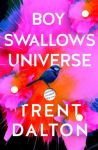
Trent Dalton, Boy swallows universeFirst up is my reading group schedule for the first half of the next year, which we decided by consensus – with a bit of the usual argy-bargy – a few days ago. Here’s the list in the order we’ll read them:
  • Trent Dalton, Boy swallows universe : strongly recommended by an ex-member (“ex” because she moved away) whose recommendations are usually spot on – and with supporting recommendation by Brother Gums whose taste is also impeccable.
  • Anita Heiss (ed), Growing up Aboriginal in Australia : for obvious reasons, and because if the University of Melbourne believes its staff should read it, then so should we!
  • Marilynne Robinson, Gilead : because many of us have been wanting to “do” Marilynne Robison for some time.
  • Amor Towles, A gentleman in Moscow : because many of us have heard good things about it.
  • Sayaka Murata, Convenience store woman : because we’d like to include more translated fiction in our reading diet and this sounded interesting.
  • Mary McCarthy, The group : our “classic”, which some have never read and others are interested to read again in our current climate.
You will of course hear more about these as 2019 progresses …

Eric Idle in conversation with Alex Sloan

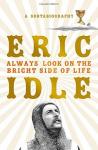
Eric Idle, Always look on the bright side of lifeAs most Aussie readers will know, Monty Python member Eric Idle is currently doing the rounds in Australia promoting his book Always look on the bright side of life: A sortabiography. I’m intrigued by that subtitle given the various discussions we’ve had here recently about memoirs and biography – but I haven’t read it yet so I can’t tell you what angle, if any, Idle has taken on the biography form.

Anyhow, the event I attended was part of the ANU/Canberra Times Meet the Author series, this one a paid event, with the ticket price including a signed copy of the book. I went with friends so didn’t take my usual copious notes. Indeed, I took no notes, so this will be a brief report.

I suspect most of the events ran pretty similarly, with a few variations depending on who “conversed” with Idle. Anne of Cat Politics, who occasionally comments here, went to the Melbourne event where the conversation was conducted by Michael Williams of The Wheeler Centre. She has written about it on her blog. We had a similar discussion, led beautifully by Alex Sloan, about Idle’s life and, career and his friendships with people like George Harrison. We also had a couple of songs, including the “Selfies” one (for which Anne provides a Youtube link.) Our event, like hers, ended up with Idle singing “Always look on the bright side of life”, except we had a small backing group, The Idlers, drawn from the Canberra Choral Society. That was fun – and I think they enjoyed themselves, too.

But, I think we may have had something else unique to us – a discussion about physics. Our event commenced with a YouTube video of Idle doing his “Galaxy Song”, after which ANU Vice-chancellor and Nobel Laureate in Physics, Brian Schmidt, came to the stage to introduce Idle. In doing so shared with us some – let us say – disagreements between Eric Idle and physicist Brian Cox about certain facts in the song. Schmidt suggested that, on one fact at least – to do with the power of the sun – he’s decided to agree with Idle. There was some lovely banter about all this, with Idle, who has performed the Galaxy Song with Cox, telling us that he’d told Cox that the facts were correct when he wrote the song: it was Science that had changed (due to that darned Hubble Telescope). You can Google Brian Cox and Eric Idle to find out more – if you haven’t seen them already.

Kate’s list of lists

As a service to us all, Kate (booksaremyfavouriteandbest) has published a post titled Best Books of 2018 – A List of Lists. In it she has listed the Best of 2018 lists already published by magazines and newspapers around the world – with annotations explaining what they cover. For example, of Esquire’s list she says “excellent mix of 50 fiction and nonfiction titles” and for NPR’s Best Books of 2018 she writes “use the filters to wade through this 300-strong list”.
Kate will be adding to this post as more lists are published. If you love book lists, bookmark her post!

Quote of the week

Clare Wright, You daughters of freedomHopefully, by the end of next week I’ll have written my post on Clare Wright’s You daughters of freedom, but I can’t resist sharing just one of many wonderful quotes from the book. This one is not Clare Wright’s own words, but a description of England’s “suffragette agitators” by the UK’s attorney-general at the time. He called them “those unsexed hyenas in petticoats”. Really!? You have to laugh!