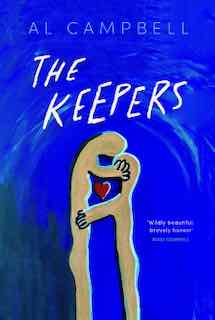
Al Campbell’s debut novel, The keepers, is a complex and ambitious novel about parenting, specifically about parenting children who are deemed too difficult by society, leaving their mothers, or carers, to survive, or not, as best they can. It’s confronting but, unfortunately, all too real.
That this is its theme is obvious from the novel’s opening page, which is titled “Scrapbook #12”, and comprises a news report from abc.net.au, 23 April 2018 (original here). The lead sentence reads, “special needs group pays tribute to 11yo boy with autism killed by train after escaping from respite care”. I remember this case.
We are then launched into the main storyline, which concerns Jay, a mother and full-time carer for her twin autistic sons, Frank and Teddy, and features a cast of other characters, some real, like her unsupportive husband Jerrik, and some imaginary, mainly her childhood “friend”, Keep (short for Keeper). Alternated with this storyline, which is told chronologically through time-stamped sections (like “Monday 2:06am” and, later, “4 days till extubation”), is the story of Jay’s childhood, in which she had experienced abuse and neglect at the hands of a grandfather and her dysfunctional mother. These sections are also time-stamped (such as “10 years old, autumn). Interspersed with these are scrapbook entries, like the one opening the novel. They are compiled by Jay, who clips and shares stories about the neglect and, even, murder of children with disabilities. As I said, complex and ambitious.
There is so much to like about this novel, starting with Campbell’s characterisation of Jay and her sons. It’s vivid and empathetic, which is not surprising given her own life experience. Write what you know, authors are told. These people are not her and her sons, but she knows them intimately, and the scenes featuring them shine off the page, even non-verbal Teddy who communicates via iPad, and especially patient, stuttering Frank. I’d love to share some of the interactions between Jay and her sons, because the warmth, the humour, the patience, the imagination make for some great reading and convey some of the joys in their relationship, but I’m not sure they’d work out of context, so you’ll just have to take my word for it.
Meanwhile, another strength of the novel is Campbell’s energetic, evocative writing. It starts with a bang and rarely lets up. The language is often breathtaking in its ability to capture a moment, a feeling. On the first page after the scrapbook entry, Jay refers to it as “the horror on the page a thing of thorns in my hands” and on the next page, the unsettled night outside is conveyed through a “lone plucky lamppost mooned by wanton whacks of lightning”. She’s talking in these opening pages to the mysterious and shape-shifting Keep, whose “latest incarnation” is “bald as bone and mouthless. No breath of course. Without ears … Some ancient mica, colourless and brittle? … His appearance is rarely the same”. The reader is immediately introduced to one of the meanings of the title, Jay’s “keeper”. Described later as her “poultice and protector, destroyer of others”, Keep has been with her since her difficult childhood. Another meaning is that her two sons, despite what the system might think or suggest, are “keepers” – at least until she is no longer around. What then? This question underpins all that Jay does and feels, and lies just beneath some of the uglier scrapbook items.
But, Campbell, does ask a lot of her readers. The structure is complex, which, on its own, would not be a problem, multiple storylines, after all, not being new. But, there is a lot going on. The exciting but idiosyncratic style, the switches in voice, the sudden appearances of Keep and later “the Other Things”, the shifts in storylines from mother-Jay to youthful-Jay, demand a level of attention that can sometimes get in the way of the story. I’m not convinced, in fact, that Jay’s childhood story – readable and interesting though it is – adds enough. Is it intended as another example of how the system lets children down? If so, I don’t think it’s needed, as Jay’s story with her sons, is powerful enough. Is it intended to contrast her own style of mothering with that of her mother, or to introduce the idea of child abuse? If so, these seem like different stories, and ones that potentially weaken what seems to be her intention to highlight the desperate situation families with special needs children find themselves in.
In other words, Campbell’s main story, as I see it, is a mother’s “warrior” style love for her “different” children, and the system that lets them – the children and the parent/carer – down, again and again. She tells of doctors who refuse to listen or heed, of the social welfare bureaucracy (through the NDIS) with its irrational rules, of schools which can be inflexible, of people in parks and shops who would rather not see her children – and so on. If it’s infuriating for the reader, imagine what it’s like for the parents.
Overall, The keepers is a powerful story that wants us all to understand the life of the carer, the very difficult questions confronting them as they and their children age, and the way the system all too often treats them as lesser or as too hard or as “types” to be slotted into rules and regulations. For Campbell, the personal is the political, and vice versa in fact. She would like to believe there is real truth and commitment to the idea that it takes a village to raise a child, but “some village we turned out to be”, she says to Keep at one point. And right there it occurred to me that this book, despite its flaws, is the sort of thing that should be selected for the Prime Minister’s Summer reading list.
Al Campbell
The keepers
St Lucia: UQP, 2022
336pp.
ISBN: 9780702265488
 Whispering Gums