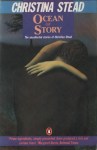
 Contribution no. 2 for Lisa’s Christina Stead Week from Ocean of story: the uncollected stories of Christina Stead.
My first post was on the titular story, “Ocean of story”, which is also used as the collection’s Introduction. After this Introduction, the stories have been organised into 7 sections by editor RG Geering. These sections are presented chronologically, Geering says, reflecting Stead’s timeline, not when they were written. The first is, therefore, logically titled “The Early Years – Australia”. It contains three stories – “The old school”, “The milk run” and “A little demon” – all of which have children as their central subject, which is, perhaps, interesting given Stead had none of her own.
Now, if you ever went to primary (or elementary) school, and that’s all of you I presume, you will enjoy “The old school”. If you were a girl, you’ll probably enjoy it even more. “The old school” was, Geering says, one of the few things Stead worked on in the last years of her life. It was published in Southerly in 1984. It’s like a little slice of life, and like the other two stories, starts with a fairly detailed setting of the scene before she gets to her main subject matter.
So, “The old school” starts with a description of the school, followed by a description of what happens at the school, or, more precisely of what the rumours say happens. But, we are told, in spite of this, “cause and effect” are clearer at school than at home, and “mostly concerned the boys”. Boys who are bad – who truant for example – will go to “the reformatory”. And if you go to the reformatory, your next stop will be prison. And who knows all this? Why “the informants” of course. And who are these “informants”, these “small sages”? Well, Stead writes, they are the “natural moralists, two or three to a class and as far as I knew, all little girls”. From here we are regaled with stories about these informants’ moral pronouncements by this “I”, this “I” who appears in two of the stories and who is an observer, rather than a participant, from within. In “The old school” then, the “I” is a student at the school.
The rest of the story explores the “moral questions” debated by these “informants”, whom Stead describes in more detail:
The informants, our moralists, had clean dresses, pink, blue or sprigged, patent leather shoes and white socks, and curls natural or rag. They did clean school work too, even when we got pen and ink. Goodness alone knows how, with their pink cheeks and shiny curls and neatly dressed brink little mothers, they got all this news about jails, reformatories, judges and sentences, lashings, canings, bread and water.
They are, of course, often little tyrants, deciding which child will be approved and which won’t. The rest of the story chronicles some of their pronouncements and their impacts on their peers. Whenever anything happened in the school “they knotted together, a town moot: they discussed, debated and delivered an opinion.” What the teachers said was to them only “hearsay”. Our “I” character doesn’t have an opinion. She “thought then that cruelty and injustice were natural and inevitable during all of a poor creature’s life”. (The use of “then” would be worth exploring.)
The main story concerns poor little Maidie Dickon who is, literally, “poor” and thus ostracised by our “natural moralists”. She didn’t have the right shoes, didn’t bring the right notes from her mother, and didn’t have her own pen and paper and so would be given some from the school supply. “It isn’t fair” cry the well-provided “informants” who also prove, mystifyingly to our “I”, to be excellent “newsgatherers”. They somehow know about Maidie’s roadworker father, who is (illegally, in those days) striking, and washerwoman mother.
You are getting the drift I’m sure of the story and will be realising that Stead’s focus is on the “natural” justice delivered by these “sages” or “moralists” to those less able to defend for themselves, while the “I”, Stead’s young self, tries to make sense of it all, of how the world works. The ending is gorgeously sharp. The story could take up a whole post – I loved its vivid picture and its passion – but I’ll move on.
“The milk run” was published in The New Yorker in 1972 (and later appeared in a Penguin anthology, The Penguin book of the road, published in 2008). It is set in the same area of southern Sydney as “The old school”, but it tells the story of a family and a little boy whose job it is to get the family’s milk from the grandfather’s dairy a mile away. Stead takes some time setting the physical scene, and describing the family and the boy, Matthew, who worships his father.
It is a beautifully detailed story of a particular place and time. Stead captures ordinary family life and tensions with such precision – a comment here, a brief conversation there, convey all we need to know about the various relationships. It conveys a child’s eye view of the world, the child’s incomprehension of adult behaviour. Things happen. Sometimes they make sense to Matthew, sometimes they don’t. Sometimes the father he worships supports him, sometimes he doesn’t. But, after a lucky find, Matthew gathers to himself a warming thought, something that offers him comfort when all else is uncertain.
And finally, “A little demon”, which was published, Geering says, in “an almost identical version” in the Harvard Advocate in 1973. It’s a satire, which again starts with setting a wider scene by describing a large and successful but rather insular family, the Masons. On the surface, they seem to be perfect, but asides and hints suggest that the surface is just that. There’s something a little claustrophobic and inward-looking about them with their “same notions” and suspicion of travel.
Into this family is born Stevie, the titular “little demon”. We hear a lot about him – the horror of his behaviour and what a trial he is to his mother, though, strangely, not to his teacher who finds him “very good” – but we don’t meet him until the last couple of pages. We are told what an “adorable” person his mother is, and how much she loves her two dogs, Duff and Rags. And here come some hints about who this adorable Mariana really is because, you see, she loved Duff and didn’t want her to ever have puppies. Why would you, after all, “spoil” that beautiful dog by letting her have puppies? Hmm, does this tell us something about Mariana’s attitude to motherhood? Ironically though, she falls in love with Rags, one of Duff’s unwanted puppies, the irony doubled because she doesn’t love her own offspring.
It all starts to go bad for Stevie when the cat that he found upset the dogs. He took the cat’s part, “just for a day or two; and then he saw which way the wind was blowing and lost interest”. And here the rot sets in. Stevie is depicted as having no feelings for animals, and as doing everything he can “to be disagreeable, to annoy, to tease”. How old is this Stevie that everyone – except perhaps his grandmother who defends him – hates? About 5!
It’s a satirical story in which Stead skewers shallowness and self-centredness, not to mention lack of maternal feeling. The language here is more heightened, using exaggeration and exclamation, than the more natural language of the previous two stories. It also has a somewhat stronger plot: we are set up to want to meet this Stevie, and there is a delicious little twist or sting in the tail, which the other two stories don’t have.
I’ve enjoyed reading these stories for Christina Stead Week. I’ll try to read more down the track, but in the meantime they have given me added insight into Stead, into the variety in her writing and into some of her broader themes. Thanks Lisa for the little push to read at least a bit of Ocean of story!

Christina Stead
“The old school”, “The milk run” and “A little demon”
in Ocean of story: The uncollected stories of Christina Stead
Ringwood: Penguin Books, 1986
552pp.
ISBN: 9780140100211


 Whispering Gums