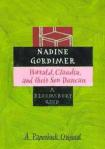
Nadine Gordimer, Harald, Claudia, and their son Duncan (#BookReview)

There are authors I read long before blogging whom I really want to document here, in some way. One of these is Nobel Laureate Nadine Gordimer who first came to my attention in 1983 with her memorable, confronting 1956 short story collection, Six feet of the country.

Nadine Gordimer, as I’m sure you know, had a lifelong concern for economic and racial inequality and injustice in South Africa, and this is evident in her short story, Harald, Claudia, and their son Duncan. The story is told third person through the perspectives of a mother and father, the titular Claudia and Harald. Early in the story, they are visited by Julian, their 30-year-old son Duncan’s friend. They assume there’s been an accident, but

This Julian draws the flaps of his lips in over his teeth and clamps his mouth before he speaks.

A kind of … Not Duncan, no, no! Someone’s been shot. Duncan, he’s been arrested.

This description of Julian is so typical of Gordimer in the way, in a few words, she conveys something grotesque, something that feels more than the bringing of bad news, even before we know why he is there.

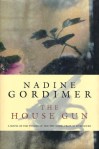
Book coverHowever, this 1996 story is particularly intriguing because it seems to be related to her 1997 novel The house gun. As far as I can tell, the first third of the story I read is very close to the first chapter of that book, but after that I don’t know. I do know that the details of the crime seem a little different in “my” story (but it may just be that they are not fully revealed). Also the novel’s Duncan is 27, while the story’s Duncan is 30. So, did Gordimer write the short story and then decide to flesh it out into a novel? I don’t know, but here is what Wikipedia says about The house gun, which was her second post-apartheid novel:

It follows the story of a couple, Claudia and Harald Lingard, dealing with their son Duncan’s murder of one of his housemates. The novel treats the rising crime rate in South Africa and the guns that virtually all households have, as well as the legacy of South African apartheid and the couple’s concerns about their son’s lawyer, who is black.

While the short story doesn’t emphasise all this, there is a reference to people having guns for protection, and there’s the sense that we are dealing with the post-apartheid world.

Anyhow, back to the story. What I love, as I’ve already intimated, is how Gordimer creates tone. Here’s our couple on hearing that the crime for which Duncan has been arrested is murder:

He/she. He strides over and switches off the television. And expels a violent breath. So long as nobody moved, nobody uttered, the word and the act within the word could not enter here. Now with the touch of a switch and the gush of breath a new calendar is opened. The old Gregorian cannot register this day. It does not exist in that means of measure.

What a wonderfully fresh way of conveying the sense of discombobulation, of unreality, that results when the world seems to change in an instant.

From here – it’s a Friday – we follow Harald and Claudia through to their son’s arraignment on Monday, and into the hours immediately after, at which point the story ends, fairly suddenly.

One of the themes, in the story anyhow, concerns the idea that no matter how much you try to lock yourself away from the “outside”, you can’t keep it from coming in. This has a political as well as a personal reading. The story starts by telling us that Harald and Claudia had recently moved from a house to a “town-house complex with grounds maintained and security-monitored entrance”. Later in the story, Claudia, a doctor, does her shift at the clinic which services “areas of the city and once genteel suburbs of Johannesburg where now there was an influx, a rise in and variety of the population.” During this shift, she considers the pain that it is her job to assuage – the pain that comes from inside, like a tumour, and that which comes from the outside, like being burnt or, yes, hit by a bullet. She reflects:

The pain that is the by-product of the body itself, its malfunction, is part of the self; somewhere, a mystery medical science cannot explain, the self is responsible. But this – the bullet in the head: the pure assault of pain.

This is surely a metaphor for that fear of the “outside” by the well-to-dos who choose to live in security-monitored complexes. What’s inside, the implication is, cannot be necessarily controlled but it’s part of your own world; what’s outside is to be feared. In this section of the story, there are references to socioeconomic differences. Claudia gives out diet sheets, for example, to people, mostly black, who, she knows, are “too poor for the luxury of these remedies”.

It is, then, just the sort of story I like to read. The careful word choice, the slightly odd syntax, plus things like the references to class and race, combine to convey something that is more than a simple murder plot involving a son and his devastated parents. As the narrator slyly says:

This is not a detective story. Harald has to understand that the mode of events that genre represents is actuality, this is the sequence of circumstantial evidence and interpretation by which a charge of murder is arrived.

Circumstantial evidence and interpretation. The stuff of complex lives in complex times, eh? I’d like to read the novel now.

Nadine Gordimer
Harald, Claudia, and their son Duncan
London: Bloomsbury Publishing, 1996
(A Bloomsbury Quid)
41pp.
9780747528913

Sayaka Murata, Convenience store woman (#BookReview)

Book coverConvenience store woman, which won Japan’s prestigious Akutagawa Prize, is Sayaka Murata’s 10th novel, but her first translated into English. Hopefully, it won’t be the last. A rather unusual book, it elicited a stimulating discussion at my reading group last week.

The convenience store woman of the title is 36-year-old Keiko Furukawa. She isn’t “normal”, and her family worries she will never fit in to society. However, when 18 years old, she obtains work at a newly opened Smile Mart convenience store, and quickly feels comfortable, undertaking routine daily tasks, and following the store’s rules. Eighteen years later, she’s still there. This is not seen as a valid situation for a woman of Keiko’s now mature age. Why isn’t she married? And why doesn’t she have a better job? Then she meets another convenience store worker, the also, but differently, nonconformist Shiraha, and she thinks she can solve both their problems by having him move in with her.

It’s a short book, at just 176-pages in the print edition, and is told first person. Now, for those of you who remember my recent discussion of first person voices, Convenience store woman is a perfect example of an effective use of first person. The main theme is the push for conformity, the push to follow the expected narrative of a life, but our narrator, Keiko, is not, for whatever reason, able (or willing) to conform. This theme is particularly relevant to Japan, which has a reputation for conformity and group behaviour, but it’s also universally relevant, because many societies, my own included, are not good at coping with people who stray from the “norm”.

So, Keiko is different. She’s been different all her life. She knows it, and she’s mystified. She’s particularly mystified by the way people often behave which seems counter to logic, and also by the way people cheer up when they think she’s behaving “normally”. An example of the former happens in her childhood, which she tells us via flashback. There’s a schoolyard fight. The kids call for the fight to stop, so she goes to the toolshed, gets a spade and bashes one of the kids with it. Everyone is horrified,

“But everyone was saying to stop Yamazaki-kun and Aoki-kun fighting! I just thought that would be the quickest way to do it,” I explained patiently. Why on earth were they so angry? I just didn’t get it.

An example of the latter occurs after she invites Shiraha to live at her place. Everyone assumes they are in a relationship. “They were all so ecstatic”, she wondered, she says, “whether they’d lost their minds”. Listening to her friends “go on”, she says,

was like hearing them talk about a couple of total strangers. They seemed to have the story wrapped up between them. It was about characters who had the same names as we did, but who had absolutely nothing to do with me or Shiraha.

There it is – the expected story or narrative of life!

Of her convenience store colleagues, she says:

I was shocked by their reaction. As a convenience store worker, I couldn’t believe they were putting gossip about store workers before a promotion in which chicken skewers that usually sold at 130 yen were to be put on sale at the special price of 110 yen. What on earth had happened to the pair of them?

As you can see there’s a good deal of humour in this book. You can also see why this story could only be told first person. Any other voice would risk undermining Keiko’s authenticity, her reality.

So, for Keiko, it’s “convenient” having Shiraha at her place. Everyone is happy for her, and she likes that “they’ve stopped poking their nose into my business”.

However, while Keiko, for all her strangeness, is a likeable character, Shiraha is not. He has no desire to work, and takes advantage of her wish to appear “normal”, even though it satisfies his need for the same. He excuses his laziness by criticising society and its unfair gender expectations on men:

“Naturally, your job in a convenience store isn’t enough to support me. With you working there and me jobless, I’m the one they’ll criticize. Society hasn’t dragged itself out of the Stone Age yet, and they’ll always blame the man. But if you could just get a proper job, Furukura, they won’t victimize me anymore and it’ll be good for you, too, so we’d be killing two birds with one stone.”

Worse, he’s arrogant and cruel:

“I did it! I got away! Everything’s okay for the time being. There’s no way you’ll be getting pregnant, no chance of me ever penetrating a woman like you, after all.”

Actually, he only “got away” because Keiko had the idea of his moving in. Fortunately, she has no interest in sex, so his comment falls on flat ears – but we notice it.

The novel, then, hinges on the idea of normality, with the word “normal” recurring throughout the novel. Early on, Keiko realises that “the normal world has no room for exceptions and always quietly eliminates foreign objects”. This is why, it dawns on her, her family wishes to “cure” her. She is therefore grateful for the convenience store, where she can operate as “a normal cog in society” – until her age makes it no longer “normal”. The charming Shiraha has his own take:

“People who are considered normal enjoy putting those who aren’t on trial, you know. But if you kick me out now, they’ll judge you even more harshly, so you have no choice but to keep me around.” Shiraha gave a thin laugh. “I always did want revenge, on women who are allowed to become parasites just because they’re women. I always thought to myself that I’d be a parasite one day. That’d show them. And I’m going to be a parasite on you, Furukura, whatever it takes.”

Shiraha shows us that Murata’s understanding of deviations from the norm is nuanced, not simplistic.

Anyhow, later in the novel, after her sister asks “How can we make you normal?”, Keiko comes to recognise that her sister is happier seeing her as “normal”, albeit with “a lot of problems”,

than she is having an abnormal sister for whom everything is fine. For her, normality—however messy—is far more comprehensible.

In the end, Keiko does resolve her conundrum regarding how to live in a way that is true to herself. It is inspired, in fact, by the convenience store, which I think we can read as a microcosm of society. She suggests that “a convenience store is not merely a place where customers come to buy practical necessities, it has to be somewhere they can enjoy and take pleasure in discovering things they like”. She can play a role in that.

Convenience store woman is a wonderful read. Perfect in tone and voice, and fearless in its exploration of the confining nature of “normality”, it forces us to look beyond, and imagine other lives and ways of being.

Sayaka Murata
Convenience store woman
Translated by Ginny Tapley Takemori
London: Portobello Books, 2016 (trans. ed. 2018)
eISBN: 9781846276859

Enza Gandolfo, The bridge (#Bookreview)

Book coverIf there are people I admire more than any others, it’s those who are able to empathise with, and forgive, someone who has done them great wrong. This complex question of forgiveness – of self and of others – is one of the issues explored in Enza Gandolfo’s Stella Prize short-listed novel, The bridge. However, it’s only one aspect of this intelligent, moving book.

Melburnians, and Australians of a certain age, will remember the West Gate Bridge disaster in 1970. The bridge collapsed during construction, killing 35 and injuring 18 of the 60 workers there at the time. It was, and still is I believe, Australia’s worst industrial accident, and it frames Gandolfo’s book. The novel starts in 1970, introducing us to 22-year-old Italian-born Antonello and his workmates, another Italian Sam, and Slav (whose nickname conveys his origins). Gandolfo quickly sets up the scene – the bonding between these men, and something of their lives and aspirations – before describing the collapse in the next chapter. She captures the horror of those hours in clear, descriptive, but not overblown language that perfectly captures the shock, panic and emotion of the event for all who experienced it – the workers, their families and those in the vicinity.

Antonello survives, but some of his friends don’t, and nor does his boss, Bob, who’d been “like a father” to him. Antonello, along with Bob and his mates, had started to realise that things weren’t right, but, as a rigger, he had no formal responsibility for what happened. However, guilt and trauma attach to him. His lovely relationship with his young wife Paolina survives, but is never quite the same. Gandolfo conveys so well how devastating to a life – to lives – a traumatic event can be, how life can change in a moment. You understand why, these days, counsellors are immediately sent in when tragedies occur.

The book then jumps, in Chapter 4, to 2009, and we meet 19-year-old Jo. Like Antonello she belongs to the working class. She lives in a rather dilapidated weatherboard house near the bridge, with her single supermarket worker mother, Mandy. She is in her last year of school, and has a best friend, Ashleigh, who comes from a comfortable middle-class family where the mother is a high school principal. Jo is the needier of the two, Ashleigh being more clever, more confident, and increasingly more involved with her boyfriend. Jo feels she’s losing her.

And now, here’s the challenge reviewers face. How much to give away of the story. What happens next, happens before a third of the novel is over, and you see it coming, but nonetheless it’s a shock, so I won’t give it away. (I note that some reviewers have, and some haven’t.) Let’s just say that a tragedy ensues and Jo is responsible – and, as it turns out, her friend Ashleigh is Antonello’s grand-daughter.

So, given I’ve decided not to spoil the plot, how best to discuss the rest of the novel, which still has over 250 pages to go?

Well, I could talk about the writing and characterisation. The novel is told chronologically, in third person, from multiple perspectives – from Antonello and Jo of course, but also Mandy, a legal aid lawyer Sarah, and a few others later in the novel. Gandolfo captures their feelings with such sensitivity and realism that by the time the novel is over we feel we know them. We experience their emotions, and go through their thought processes with them as they ponder what’s happened and whether they can possibly keep living in the face of their respective tragedies. It feels so true – and because of that, it breaks our hearts, more than once.

Then there’s the bridge. Its prime meaning here is literal, of course, but it is a gift to a writer because bridges can represent so many things – positive or negative, or, paradoxically both – that are reflected in this novel. They can symbolise progress, for example, but West Gate, which would bring two worlds closer together, was not seen positively by all:

“We don’t want those rich bastards coming over to the west”, was the general sentiment.

Bridges can also suggest connection and transition. In this novel, transition encompasses the idea of social mobility, which West Gate exposes, but it can also mean the transitions individuals make psychologically. It is this latter, often aided by the good connections that can occur between people, that ultimately brings some redemption in the novel.

This brings me to Gandolfo’s themes. Antonello, who has suffered from PTSD since the accident, realises late in the novel that his friend Sam, who had become a union activist, had made the more positive choice. It takes him a long time but finally he learns the lesson:

For years, the most persistent impulse was towards death; a desire to stop living … But life didn’t stop. It went on whether you lived it or not. You have to choose life. This is what he needed to tell them – if you stop living, you may as well die. If you stop living, you aren’t going to be able to love again, and everyone you know will pay for that, everyone.

Empathetic Paolina has always known this, but it’s a lesson that comes hard to the other characters. Anger, revenge, guilt – depending on their role in the events that occur – overwhelm them. And it is Antonello who is the lynchpin. He is able to help Jo, telling her that the best thing she can do is forgive herself and allow herself to live. Similarly, he encourages his own family not to succumb to the sadness, anger and bitterness which brought him such waste and pain.

Enza Gandolfo’s achievement is impressive. She presents us with a bunch of flawed – as in ordinary – characters, and she puts them in terrible but not unrealistic situations. She then has them experience all the emotions that you would expect. And she doesn’t judge. Instead, she makes us feel, confronting us to think about how we would react, and hoping that we will come to the same conclusion that Antonello does.

A character I’ve only briefly mentioned is Sarah, Jo’s legal aid lawyer. She talks about the storytelling aspect of trials:

That was the danger of a good story: you could elicit pity and empathy for even the worst sociopath … Sarah believed telling good stories, the ones people listened to and were swayed by, was a responsibility. It worried her that some people did not take it seriously enough.

It’s not a big leap, I’d say, to suggest that Gandolfo would extend this responsibility to novelists – and in The bridge, she shows what a responsible story can look like. Such a novel.

Lisa (ANZLitLovers) was also moved by this book.

AWW Challenge 2019 BadgeEnza Gandolfo
The bridge
Brunswick: Scribe, 2018
375pp.
ISBN: 9781925713015

Amanda Duthie (ed.), Kin: An extraordinary filmmaking family (#BookReview)

Book coverKin: An extraordinary filmmaking family is the second tribute book I’ve reviewed in Wakefield Press’s Don Dunstan Award series. The first, Margaret & David: 5 stars, was also edited by Amanda Duthie. Like that book, Kin contains short reflections and essays on the contribution made to Australia’s film industry and culture by Freda Glynn, her children Erica Glynn and Warwick Thornton, and her grandchildren Dylan River and Tanith Glynn-Maloney. The book also includes brief biographies of the five individuals involved, and a family tree, all of which help orient the reader.

In my review of Margaret and David, I focused on one aspect of the pieces that interested me, which was the commentary on what I called “the practice of criticism”. That made sense, because Margaret and David are critics. Freda Glynn and family are a very different awardees. They are indigenous Australians from central Australia, and they have championed and practiced Aboriginal screen story-telling for over three decades, their influence reaching way beyond Australia. Freda Glynn helped establish CAAMA (the Central Australian Aboriginal Media Association) and Imparja Television. Erica Glynn and Warwick Thornton are internationally renowned filmmakers (and more), with third generation Dylan River and Tanith Glynn-Maloney following in their filmmaking footsteps.

The pieces are written by a wide variety of indigenous and non-indigenous arts people from around the world, such as actor Deborah Mailman, authors Bruce Pascoe (whose Dark emu I’ve reviewed here) and Larissa Behrendt, critics Margaret and David (of course!), arts administrator Kim Williams, and American academic Faye Ginsburg, to name just some of the over 20 contributors.

Most of the pieces comprise personal reflections and heartfelt tributes to the various individuals in the family, but for those wanting a good overview of how it all started, Philip Batty’s longer piece, “Freda Glynn and the evolution of CAAMA: A personal reflection”, is well worth reading. Too few Australians know about our indigenous pioneers – who they are, let alone what they’ve done and the challenges they’ve faced doing it. Having worked, as most of you know by now, in the film archive/library industry most of my career, I became aware of CAAMA early in its existence, but I didn’t know half the story told by Batty – the personal and the political! He tells of CAAMA applying for money in 1988 from the Australian Bicentennial Authority:

Some city-based Aboriginal groups protested again CAAMA accepting the bicentennial ‘blood money’ and, on several occasions, Freda fronted up to these groups to argue that all government funding to Aboriginal organisations could be described as ‘blood money’. Indeed, at a particularly hostile meeting, I remember thinking back to the first time I met Freda when she was confronted by the all-white Citizens for Civilised Living [can you believe such a name!!]. On this occasion it was an all-Aboriginal crowd she confronted with the same bravery.

It’s important to note here that, as Stan Grant and so many others have stated, indigenous people are not united in their responses to how their cause should be progressed – any more than non-indigenous people are about their lives. I’m frequently astonished by how we white Australians seem to expect all other groups to be united in a way that we are not. It denies people the individual agency in their lives that we demand for ourselves.

Anyhow, rant over. I’m not going to spend a lot of time on this book. I’m unusually behind in my reviews, and this book is, in one sense, of specialist interest, though in another I’d argue that it would offer something to all Australians interested in our cultural history. It does have a political thread – of course – but that thread is unified by a single foundational idea, the idea that sits at the bottom of all that this impressive family does. I’ll let Bruce Pascoe tell you:

The real history of the country was eliminated from our curriculum, our society, our politics, our morality. If the best-educated people in the land, the mild professors and urbane historians, can fabricate a history of such blinding connivance then another tactic has to be employed if the oppressed are to receive any form of justice. And that tactic is on old one: story.

What Freda Glynn and her family have done – as this book shows – is to set up infrastructures (the CAAMA group supports music, film, television, radio, for example) that facilitate that story being told, to provide training for indigenous people in creating and producing their stories, and of course, to make stories themselves. Warwick Thornton’s films Samson and Delilah and Sweet country are just two examples of a swathe of productions members of this family have made and/or facilitated.

All I can say is may the Glynn family continue to make stories that tell us as it is! Meanwhile, I commend this book to you as an excellent introduction to all that can be done when people put their hearts and souls into something they believe in.

AWW Challenge 2019 BadgeAmanda Duthie (ed.)
Kin: An extraordinary filmmaking family
Mile End: Wakefield Press, 2018
176pp.
ISBN: 9781743056028

(Review copy courtesy Wakefield Press)

Janet Lee, The killing of Louisa (#BookReview)

Book coverI started reading Janet Lee’s historical fiction The killing of Louisa straight after reading Amor Towles’ A gentleman in Moscow (my review), which is also a work of historical fiction. They couldn’t be more different. Not only is one about a real historical figure in late 19th century Australia, while the other is about a fictional one in 20th century Bolshevik Russia, but one is told first person present tense, while the other is third person past tense.

Now, when first person present tense started appearing on the contemporary literary scene as the style-du-jour, I rather liked it. I liked its freshness, and the sense it gave of speaking directly to me. But then it started to wear a bit thin. This is not to say that I don’t like it – ever – just that it can be overused and not necessarily add to the experience. I loved the measured, sometimes wry, third person voice in Towles’ novel. It suited a book that seemed to be critiquing both human nature and an historical period. Did the first person voice suit Lee’s novel?

Well, let’s see. The novel is about Louisa Collins who, in 1889, was the last woman to be hanged in New South Wales. Her story is a horrifying one: she was tried four times for murder, with the fourth trial convicting her after the three previous ones failed to come to a decision. There’s more to it though, in that the first two were for the murder, by poison, of her second husband. When the juries could not agree, she was charged with the murder, also by poison, of her first husband. When that too failed, they returned to the first husband, and finally a guilty verdict was achieved, largely using the testimony of Louisa’s 11-year-old daughter May who admitted to seeing a box of “Rough on Rats” in the kitchen. The novel tells this story from Louisa’s point of view.

Formally, the story takes place over six weeks, from 26 November 1888, when she is in gaol waiting for her fourth trail, to 8 January 1889, when she is executed. However, of course, we want to know the full story of Louisa’s life and how she got to be where she was. Lee does this by having her tell her story to the prison chaplain, Canon Rich, while she awaits her execution.

It’s a moving story – of course. Born to a poor family in a country town, Louisa, when still a young teen, is found a job in the home of a lawyer by, it seems, the mother of a wealthy young man who fears her son is becoming too close to the girl. Louisa’s employer is good to her, and she’s happy, but at the age of 18, she is married her off to a man around 15 years her senior whom she barely knows. Charles is a butcher with his own business, and they both work hard, but, more through bad luck than bad management, the family, which seemed to be making a go of it, ends up living in Sydney, and poor. They take in boarders to supplement their income. It’s a world, of course, where women had no rights and little power, though Louisa does stand up for herself within her marriage, exerting a right to wrest some enjoyment out of her life. Things, however, become complicated when the flashy, confident Michael appears on the scene.

All, or most of, this Louisa tells Rich, with a fair degree of self-knowledge about her own failings but also with some insights into human nature (such as how recollections can change!) and how the world works. On her mistress spending years in mourning for a dead baby, Louisa says to Rich:

But the Missus had become like this because she was allowed to dwell upon her sadness for so long. Sometimes folk who suffer a tragedy can pick themselves up and dust themselves off and keep going on through life, and it is often the poorer ones who do this because they don’t have the luxury to stop and mourn […]

Mourning and feeling feeble is a luxury, and it is my observation that only the rich have that luxury, sir.

Louisa is not speaking from theory here; she has learnt the truth through her own experiences of loss.

However, hers a tricky story to tell, because, ultimately, we don’t know whether she was guilty or not, and Lee is not about producing a work of romantic fiction. So, she needs to tread a fine line. Using the primary resources available to her which comprise some letters, court and parliamentary records, and newspaper reports, she tells Louisa’s story.

And Louisa’s story is worth telling for several reasons. First, there’s that reason why many of us enjoy historical fiction, which is to learn, to feel, the social history of a period. Louisa’s first person voice conveys perfectly the lives of poor working women of the time – the hard work, the dust and grime, the worry, the powerlessness. She also conveys her increasing awareness of the need for representation for women in parliament. Knowing where we’ve come from and why we should do all we can not to go back there is a good reason for reading books like this.

But, unfortunately, the book also reminds us of how far we still have to go. One of the features of Louisa’s case is that old story of women being tried by society and the media for not behaving with the propriety expected of them. Louisa likes to have a good time, so she would dance and drink when an opportunity arose, and she argues for her right to do so. Worse though, she appears “cold” after the deaths of her husbands. She doesn’t wear mourning and she doesn’t cry and wring her hands. Heard that before? (Australians will immediately recall the Lindy Chamberlain case.) Louisa’s awareness of this issue is supported in the text by well-placed excerpts from primary sources, such as the snide remark in Parliament, comprising all men of course, about her “method of procuring divorce by means of arsenic”. The problem is that, still, even after Lindy Chamberlain, things haven’t changed, or not changed enough … we still have trial-by-media and women are still excoriated for not behaving in a so-called “womanly” way.

Janet Lee’s is not the first book about Louisa Collins. In 2014, journalist Caroline Overington published her history, Last woman hanged, after researching the case for some years. I haven’t read that, but I understand that she too presents an “open” story, that is, one that leaves it to the reader to consider the rights and wrongs of the case. And that, I think, is the right way to handle this story. What is wrong, though, is capital punishment! It is wrong for so many reasons, but one of the greatest of these is the risk of executing innocent people.

But now back to my original question regarding voice. As I started The killing of Louisa, I felt I wanted a third person omniscient voice telling this story. I wanted a considered voice giving me the pros and cons of the case. However, as I read on, I became engaged by Louisa’s voice, particularly by the tone Lee achieves which, while containing an element of sorrow and self-pity, is neither pathetic nor whiny. By adding excerpts from the sources, Lee provides some of that overview I wanted.

The killing of Louisa, then, is not only an engrossing story about a shameful case from the past, but one that intelligently grapples with the challenges of presenting such a case through historical fiction.

AWW Challenge 2019 BadgeJanet Lee
The killing of Louisa
St Lucia: UQP, 2018
268pp.
ISBN: 9780702260223

(Review copy courtesy UQP)

Vicki Laveau-Harvie, The erratics (#BookReview)

Book coverTruth is that, while I like to read at least some of the Stella Prize shortlist, I didn’t have Vicki Laveau-Harvie’s memoir, The erratics, on my high priority list, though the more I heard about it, the more intrigued I became. However, it was winning the prize that tipped it over into my must-read category. What a challenging read it is.

The erratics is the story of how Laveau-Harvie and her sister responded to their estranged aging parents’ needs as infirmity caught up with them. Canadian-born Laveau-Harvie had, decades earlier, escaped the family home in rural Alberta moving, eventually, to Australia. Her younger sister had also escaped, though not so far. She lived in Vancouver. It all came to a head when their 94-year-old mother’s hipbone “crumbles and breaks” putting her in hospital. Laveau-Harvie and her sister regroup to help – their father, in particular, who, they discover, had been being systematically starved by their mother. The story of this dysfunctional family, and the sisters’ actions to save their father and ensure their mother is deemed incompetent, never able to return home, is arresting.

Equally arresting is Laveau-Harvie’s writing. It’s not surprising that she won the Stella (not to mention the Finch Memoir Prize and being shortlisted in the NSW Premier’s Literary Awards), because the writing grabs your attention with an impressive sureness of tone and language. It’s particularly impressive because it is, apparently, 70-something Laveau-Harvie’s first book.

The back-cover blurb of my edition concludes with: “a ferocious, sharp, darkly funny and wholly compelling memoir of families, the pain they can inflict and the legacy they leave, The erratics has the tightly coiled, compressed energy of an explosive device  – it will take your breath away”. It does all of that.

First, it’s an astonishing story of a mother who seems incapable of the love we expect from a parent. I’ll share the quote that you’ll have read before if you’ve read about this book:

One of the few coherent messages my mother repeated to me and my sister as we grew up, a message she sometimes delivered with deceptive gentleness and a touch of sadness that we weren’t more worthy prey, was this one, and I quote: I’ll get you and you won’t even know I’m doing it.

If you are a parent who feels guilty about mistakes you made in your parenting, you can rest easy after reading this (unless of course you are like Laveau-Harvie’s mother!) Most of us, I’m sure, made our mistakes inadvertently, not with the intent behind this woman’s behaviour. The problem in Laveau-Harvie’s family was compounded by the fact that their father, while not brutal like their mother, was weak, believing (or, at least accepting) everything his wife said about their daughters.

So, the story, itself, is compelling – in the strange behaviour of these two parents, and in the willingness of the daughters, despite being rejected by their mother, including being given no formal role in managing her affairs, to step in and do the hard stuff out of love for their father and, I guess, a sense of responsibility. But, in addition to the story, what makes this memoir particularly compelling is, as I’ve already said, the writing itself.

It’s a tight, spare read at just over 200 pages. It has stunning descriptions, but I’ll exemplify it with the metaphor contained in the title itself, a metaphor that draws from a geologic formation called the Foothills Erratics Terrain in the town nearest her parents’ home:

Countless years ago, the Okotoks Erratic fell in on itself and became unsafe to climb upon. It dominates the landscape, roped off and isolated, the danger it presents to anyone trespassing palpable and documented on the signs posted around it.

Unfortunately, Laveau-Harvie’s mother came with no such sign.

There is a deft handling of chronology, with the occasional bit of foreshadowing. And then there is the tone, which is achieved by a crisp story-telling style that is direct, colloquial, witty even, and that focuses on the facts with little explication, all the while conveying the challenges faced by the two sisters in negotiating their relationships with each other, their father and their mother. One of Laveau-Harvie’s techniques is to undercut a description or plan with a short, emphatic sentence like “That was the plan” or “I can’t fix this” or “I don’t do this”.

It’s an invidious situation, and you can’t help but feel their pain. She writes at one stage of not remembering certain events:

I do know this: where there is nothing, there must be pain; that’s why there is nothing. Be glad if you forget.

There’s another of those short concluding sentences – “Be glad if you forget”. It’s powerful.

The strongest part of the narrative concerns the relationship with her sister who, still living in Canada, is the person on-site, and who has always been less able distance herself from the pain. There’s a telling sentence about their choices of mementoes from the house:

I salvage a few other things … things from my childhood … my sister takes only things acquired by my mother after we had left home, heavy crystal goblets, silver serving plates, full dinner sets of translucent china. I want only the connection to the past, she wants never to feel it again.

So, this sister, the one who wants to distance the past takes on, at a cost to her health, more than Laveau-Harvie believes sensible: “I can see sinkholes of simmering resentment about to develop between us.” Laveau-Harvie explores the challenges of siblings negotiating the care of aging parents with the clear-eyed honesty she applies to the whole story, albeit, at times, I wondered how the sister felt about her depiction. Presumably, it’s ground they’ve well-covered between each other.

The book, then, is compelling and many readers, like Kim (Reading Matters), have found it a “compulsive read”. I did too. But, there was also something about the tone that disquieted me, as it did Kate (booksaremyfavouriteand best). This surprised me because I wasn’t expecting to feel this way. I love fearless honesty. It’s one of the reasons (besides her writing) that I like Helen Garner so much. She is not afraid to say the hard, unpalatable things. And yet, I found it difficult at times here. I think it’s because I felt some of this “honesty” was attended by an unkindness, by a willingness to laugh at another’s expense (though, admittedly, she also frequently laughs at her own).

An example is her description of the array of carers she and her sister put in place for their father. It’s funny, and has an element of truth, recognisable by anyone who has experienced the situation. But I bridle at name-calling, so “the gold-digger” and “the housekeeping slut” did not make me laugh. (I particularly hate women calling other women “slut”, even a “housekeeping” one – but that may just be me!) And then there’s the description of the breakage of some fine china freighted to Australia:

I imagine customs officers dropping the box because it has a label that says ‘Fragile’, satisfied at the sound of something delicate breaking.

Ultimately, however, although I couldn’t help reacting, occasionally, with the disquietude that I did – I realise I can’t judge. How can I, when the family life she experienced is beyond my ken? And, the ending is inspired. She draws on myths about the Okotoks to lay her mother – that “bitterly unhappy and vindictive old woman” – to a potentially more peaceful rest.

The erratics, then, is an impressive debut. It’s compelling and, significantly, it prompts us to think about the importance of love, responsibility and respect within all families.

AWW Challenge 2019 BadgeVicki Laveau-Harvie
The erratics
Sydney: Fourth Estate, 2019 (Orig. pub. 2018)
217pp.
ISBN: 9781460758250

Stella Prize 2019 Winner announced

The Stella Prize winner was announced tonight while I was at yoga so I had to wait, impatiently – oops, no, it was yoga, so I was very calm thanks to my wonderful neighbour and teacher – until I got home, to discover the winner. I only managed to read three of the six, which is one more than I had read by last year’s announcement, but I do have a fourth on my TBR.

Before I announce the winner, which most of you will have heard by now anyhow, here is a quick recap:

  • the longlist was announced on 7 February: check out my subsequent Monday musings post for an interesting conversation about the judges’ comments; and
  • the shortlist was announced, as is tradition, on International Women’s Day: Jenny Ackland’s Little gods; Enza Gandolfo’s The bridge; Jamie Marina Lau’s Purple Mountain on Locust Island; Vicki Laveau-Harris’ The erratics; Melissa Lucashenko’s Too much lip; Maria Tumarkin’s Axiomatic.

Vicki Laveau-Harvie, The erraticsAnd the winner, from around 170 books submitted, is a memoir, Vicki Laveau-Harris’ The erratics, a book that intrigues me, although I have to admit I wasn’t expecting it to win – but there you go, you never can tell. It is the third non-fiction book to win the award in seven years, nicely confirming Stella’s aim to be broad in the forms it encompasses. The other two were Alexis Wright’s collective biography, Tracker (2017), and Clare Wright’s history The forgotten rebels of Eureka (2014, my review).

The winner receives $50,000, and each shortlisted author receives $3000, as well as a three-week writing retreat on the Victorian coast, making it a generous prize.

Now, while I haven’t read The erraticsKim (Reading Matters) has, and found it “compulsive” reading. Kate (booksaremyfavouriteandbest) has too, and was less enamoured, but she explains her reactions in detail. These reviews are worth reading. Kim also has a postcript explaining book’s publishing trials.

Anyhow, here is an excerpt from what Louise Swinn, this year’s Judging Panel Chair, said at the announcement:

The six shortlisted titles all have something to say about the way we live today, two in the form of nonfiction and four novels. These books are very outward-looking and unafraid. They deal with complex and complicated issues. They can be unsettling.

The winning book elegantly tramples all over the Stella requirements: it is excellent, engaging and original in spades. It is moving and funny, and as powerful in what it leaves out as it is in what it includes. It is also a first book, and I hope it’s the first of many. It is my considerable pleasure to announce that the winner of the 2019 Stella Prize is Vicki Laveau-Harvie for her memoir, The Erratics.

She also made an interesting comment about the Stella Prize itself:

In this seventh year of the Stella Prize, the high quality of the general submissions could, for anyone not paying attention, make you wonder why we have this prize at all. But the Stella has never been about an actual lack of talent — it is about perception and how this has affected the amount of space women’s writing has been allowed to take up.

It will be interesting to see this year’s Stella Count, because that’s where we can see what progress (if any) is being made.

If you have any comments on the winner, I’d love to hear them.

Karen Viggers, The orchardist’s daughter (#BookReview)

Karen Viggers, The orchardist's daughterThe orchardist’s daughter is local author Karen Viggers’ fourth novel, but the first that I’ve read. She has, however, appeared on my blog before, being the person who conversed with Sofie Laguna about her novel, The choke. It was one of the most entertaining conversations I’ve ever attended.

Now, if you haven’t read or heard of Karen Viggers before, there are some facts worth knowing about her. Firstly, she’s a vet with special training in native wildlife health – and this background informs most if not all of her novels, I believe. It certainly informs The orchardist’s daughter. Another significant fact is that she’s a best-selling author in France! How wonderful that a novelist who writes strongly Australia-centric books does so well in France! Her previous novel, The lightkeeper’s wife, was, in fact, awarded the Les Petits Mots de Libraires literary prize.

So, an interesting author, and The orchardist’s daughter is an interesting, enjoyable book. It is set in a small logging town in Tasmania, and has quite a formal structure, starting with a Prologue, followed by four parts – Seeds, Germination, Growth, Understorey – and ending with an Epilogue. It is told third person through the perspective of three characters – Miki, the titular orchardist’s daughter who is 17 years old for most of the novel; Leon, a Park Ranger, who is 25 years old at the novel’s start; and Max, a 10-year-old boy who is Leon’s neighbour. Miki and Leon are relative newcomers to the town, Miki arriving with her older brother Kurt to run the town’s takeaway shop after they lose their home, farm and parents in a fire, and Leon moving from his Ranger job on Bruny Island to the mainland. All three are outsiders and serve to illuminate the tensions existing in the town.

Around these characters is a community comprising mainly logging families, Max’s being one of them. However, there are others who round out the town a little, including policeman Fergus and his sons, Geraldine who runs the information centre, and vet Kate. The narrative develops around a couple of situations. One is a mystery surrounding Miki’s brother Kurt. What does he do by himself in the forest when he insists that Miki wait in the ute, and what does he do during his weekly solo trips to Hobart (during which he locks Miki inside their shop/home)? The other concerns logging, and the dangerous unrest that develops when a temporary ban is placed on logging around a certain ancient tree. Jobs are at risk, the loggers believe, and the butt of their anger is of course Parkie Leon. From these two situations, Viggers builds tension slowly but inexorably, with the Kurt-and-Miki story becoming the prime focus, of course, given the book’s title.

So, there is a strong plot to the novel, but this plot, while driving us on to read, is there to serve some issues that Viggers wants to explore. These concern logging and the environment, bullying and domestic violence, not to mention more personal ones like freedom. These are big issues, and not only is Viggers clearly passionate about them, but her writing about them feels authentic. The characters may be a little less complex than, say, those in Lucashenko’s Too much lip, but they are believable. Logger and vicious bully Mooney is offset against Robbo, who is equally single-minded about logging but seeks more peaceful, law-abiding means of protest. Similarly, Max’s father Shane, another logger who is violent, is offset against colleague Tobey who has a tender, caring relationship with his wife. All of this is observed by Miki from her shop-counter – and she makes her own little attempts to lighten the lives of the bullied and the ostracised, by sneaking treats into their take-away bags. Through this little subversive action, we sense Miki’s inner strength and resourcefulness, something she takes to another level when she works out ways of escaping her “prison” while Kurt is away.

Freedom is one of the novel’s underlying drivers. Miki’s imprisonment is literal, but imprisonment takes many forms – the wives who are abused but feel incapable of escaping, and young Max who is bullied to behave in ways antithetical to his nature. Some of these are resolved, but Viggers recognises that there’s no magic wand for domestic abuse. The first step is moving from passive awareness (or acceptance, even) to taking action, and this starts to happen in the novel.

In the Tarkine, NW Tasmania

The book really stands out, however, in its writing about nature. A Booktopia interview with Viggers tells us that she grew up in the Dandenongs and has been to Antarctica. She has also spent time in Tasmania (and immersed herself in Tasmanian-set books, including two I’ve read, Anna Krien’s Into the woods, and Louis Nowra’s Into that forest). All of this has given her a sure feel for the wilderness, so much so that it’s difficult to choose an excerpt to share, but here’s one:

Miki loved the trees and the birds, but what she loved most couldn’t be seen. The way she felt in the forest. The scent of the bush after the rain. The sound of bark crackling. Branches squeaking. The feeling of patience and agelessness, growth and renewal. The aura of trees. The sense of connectedness. Of everything having its place. She could stay here all day, breathing with the tree, drawing its life into her lungs.

These forest descriptions move into Tasmanian Gothic realms during the climactic chase. The experience is both “terrifying and surreal” for our character who crawls and runs through, burrows and squats in the forest, “slipping from the thicket and weaving though the trees, ducking under tree ferns, past the tipped-up end of a fallen tree whose buttressed roots made a wall he could hide behind.” It’s muddy and dangerous with sword grass that scratches you and bark mounds that can trip you up. Viggers knows this landscape – and how to make it terrifying.

In the end, The orchardist’s daughter is about community and compromise, and about the courage to break free. It straddles the boundary between commercial and literary fiction. It is accessible, it has a strong plot and easy-to-engage-with characters, and it is hopeful (not that literary fiction can’t be!!) But, it is also gritty in subject matter and doesn’t offer neat solutions to the important environmental and social issues it raises. I like that in my reading!

Theresa (Theresa Smith writes) also loved the novel.

AWW Challenge 2019 BadgeKaren Viggers
The orchardist’s daughter
Crows Nest: Allen & Unwin, 2019
389pp.
ISBN: 9781760630584

Review copy courtesy the author, Karen Viggers.

Marilynne Robinson, Gilead (#BookReview)

Marilynne Robinson, GileadOnce again I have reason to start a book post with a discussion of the title, this time Marilynne Robinson’s 2005 Pulitzer Prize winning novel, Gilead. Gilead, in the context of this novel, has a literal and metaphorical meaning, literal because it takes place in the fictional Iowan town of Gilead, and metaphorical because “gilead” may also connote “hill of testimony”. This novel is, in fact, dying minister John Ames’ testimony of his life and values, something he is writing for his 7-year-old son to read when he is older.

Given Gilead was published in 2004,  many of you may already have read it, as well as her next two books, Home and Lila, which form a trilogy and which, I understand, cover the same people but from different perspectives. I read Gilead with my reading group. Responses were mixed, but many of us were interested enough to want to read Lila, at least, to see her perspective.

I was, though, one of those who liked the book unconditionally. I agree that it’s slow to get into, which is not helped by the fact that it has no chapters, excepting one “break” heralding a slight change of pace towards the end. This break occurs when a certain piece of information comes out about John Ames’ namesake, Jack (John Ames Boughton). It is around here that the book picks up in interest significantly because there’s a suggestion that there might even be a plot! However, given I’m a reader who doesn’t seek a strong plot and that I rather like spare writing in a melancholic tone, I was engaged from the beginning. It is melancholic, naturally, because the narrator knows his life is running out, but it’s more resigned than sad.

So, what is this essentially plot-less book about? That depends a bit, I’d say, on each reader’s perspective. For some the book is very much about theology and religion. John Ames speaks a lot about the Bible, about biblical characters and stories, and about death and heaven. Some in my group found his religion old-fashioned. And it is to some extent – partly because of its era. Ames was born in 1880 and the book is set in 1956 when he is 76 years old. John Ames also talks a lot about his family – his father and grandfather, in particular, who were both ministers. Now, Ames’ being born in 1880 means his father, and grandfather, were alive during the Civil War. We learn quite a bit about the history of the abolitionists in Iowa and Kansas. Ames’ grandfather was a John Brown follower, which meant that he was not above using violence to achieve the goal. His father on the other hand, having seen what his father did and thought, was a pacifist. Most of my reading group enjoyed this historical-cultural aspect of the novel.

But, what interested me most about the book was what I saw as one of its main themes, which concerns how to live a good life. In the opening paragraph Ames refers to a conversation with his young son. He writes

I told you that you might have a very different life from mine, and from the life you’ve had with me, and that would be a wonderful thing, there are may ways to live a good life.

Late in the novel, he says something much simpler than this, though. He says

There are a thousand thousand reasons to live this life, every one of them sufficient.

Is he departing from the idea of living a good life, to just living your life? I’m not sure. Pretty much at the novel’s central point he refers a statement by theologian John Calvin that we are actors on a stage with God being the audience. Ames interprets this as suggesting that we are “the artists of our own behaviour”, and, further, that God as audience implies an aesthetic rather than (as well as?) a moral aspect to God’s reaction to us. He explores the implications of this role of God’s a little further but, while it was interesting, it’s not where I want to take this post. I have other ideas to share!

One of the main threads – or themes – in the novel concerns fathers and sons. This is pretty obvious, really, given the whole book is framed as a letter from a father to a son in which Ames discusses his wishes for his son, but it is amplified through his discussion of the relationship between his grandfather and father, and between his father and himself. The relationships are complex, as I’ve already suggested. But, his thoughts on these relationships are intensified by his relationship with and attitudes to his namesake, the aforementioned Jack, to whom he is a “second father”. It is Jack who forces Ames to reassess his values and attitudes, not to mention his understanding of his worth as a Christian minister.

The problem is that Jack has been a bad boy. He became involved with a young girl, and a child ensued – after which he scarpered, leaving his family to work out what to do. Ames struggles with his attitude to Jack – particularly when Jack reappears 20 or more years later, as Ames is writing this letter. He says of Jack’s behaviour:

It was something no honourable man would have done … And here is a prejudice of mine, confirmed by my lights through many years of observation. Sinners are not all dishonourable people. But those who are dishonourable never really repent and never really reform … in my experience, dishonour is recalcitrant.

This is his own view, he admits, because “no such distinction occurs in Scripture”. Again, we are turned to formal theology, but again, I am going to turn away. The point for me is, regardless of what is “scriptural” or not, that Ames struggles with the idea of forgiveness, of acting with grace towards Jack. This forms his inner conflict as he considers father-son relationships, his preaching to his flock, and his relationship with his old friend and Jack’s father, Boughton. It is through this conflict, through finally opening himself to really listen to Jack, that he comes to a deeper more all-encompassing idea of what “grace” and, within that, forgiveness, really mean.

And that’s why I liked this book. It’s quiet but it deals with the essence of what confronts each of us every day in our relationships with each other. It deals with the disquietude that we all confront when people don’t behave in the ways we think they ought. Ames describes it as “that old weight in the chest, telling me there is something I must dwell on, because I know more than I know and must learn it from myself.” You don’t have to be a minister or a Christian to have the same hope that John Ames does, which is “to die with a quiet heart”. Gilead is, to me, a lovely book about what it means to be human and to live with humanity.

Marilynne Robinson
Gilead
London: Virago, 2006
282pp.
ISBN: 9781844081486

Melissa Lucashenko, Too much lip (#BookReview)

Melissa Lucashenko, Too Much LipMelissa Lucashenko’s title for her latest novel Too much lip conveys a lot about what she is trying to do here. Superficially, the title refers to protagonist Kerry’s refusal (or inability) “to swallow her opinions”, but there are layers to the title which reflect the layers in the novel. Kerry is female and indigenous, and she is lippy, which gets her into trouble, sometimes rightly because she’s not always sensible and measured in her responses, but sometimes there’s a political layer. Sometimes she has something relevant to say but because she’s a woman, or because she’s indigenous, or because, “truesgod”, she’s a woman and indigenous, her “lippiness” is ignored or put down. I’d venture to say – and I don’t think this is a long bow – that this political layer extends to imply that all indigenous people can be seen by white Australians as having “too much lip”. It is this clever, wicked multilayering in Too much lip that makes it such an engrossing and confronting book to read.

Essentially, Too much lip is a contemporary story about an indigenous family living in the small fictional country town of Durrongo in Bundjalung country, in northeast New South Wales. The family struggles to keep it together – and, as the book progresses, we come to see why. And it’s no surprise: colonial dispossession, the massacres, the stolen children policies, not to mention the ongoing racism, result in poverty and dysfunction, in unemployment, drug-taking, violence and withdrawal from wider society. Lucashenko does not shy from exposing violence and conflict within the novel’s indigenous community but she also makes clear that the cause can be found in long-standing, intergenerational traumas experienced by the community – as individuals and as a group.

Now this might all sound very earnest, but it’s not. This is a ripping read with a strong plot about vibrant, beautifully differentiated characters. After a somewhat mysterious opening chapter whose import is not clear until well into the novel, we meet protagonist Kerry, the 34-year-old daughter of Pretty Mary. She’s coming home, riding into town on her stolen Harley, no less. It’s to be a quick trip. She wants to say goodbye to her dying grandfather and then get out of there. It’s clear there’s not much love lost between Kerry and her remaining family in town. However, she is at a bit of a personal crossroads. She’s fleeing a botched armed robbery which resulted in the imprisonment of her partner Allie, who has broken their relationship. Kerry is grieving this. When she and her family catch wind of plans to develop Granny Ava’s island, a sacred place for their people, she decides to stay a bit longer and fight the fight.

So, this becomes, also, a story about land and connection to country versus greedy developers and corrupt politicians who, in this small town, combine in the form of one man, Mayor Jim Buckley. There’s enough thrills and action in the novel, not to mention a romance, to keep lovers of exciting plots engaged, but there’s also enough about characters and their relationships, to keep us more character-oriented readers interested.

This is a confronting novel for non-indigenous Australian readers – but it’s a confrontation we need. It shows (not, didactically tells) what colonial settler societies have done to indigenous inhabitants and how this reverberates through the generations. My back cover blurb calls the novel “gritty and darkly hilarious” – and that’s a perfect description of its tone. Lucashenko privileges us to sit in on an indigenous family’s life. We get to see the world from their perspective, their pain, their frustrations, but also the jokes they make about white people’s ignorance.

Kerry had managed, on the surface anyhow, to rise above the racism she experienced at high school, but

her indifference – part pretence, part real – meant the insults quickly found their targets elsewhere, in the small handful of other Goories who usually decided to fight back, and who were quickly expelled for expecting a bit of common decency in their lives.

Disgusting, isn’t it? Examples of racism abound in the book, but there are also times where Lucashenko’s Goories critique white culture. One of these occurs when policemen, Jim Buckley’s henchmen, turn up at Pretty Mary’s home. The family retaliates by suggesting, at one point in the confrontation, that white people need a refresher on their old ways, and more:

‘How to invade other people’s countries and murder em, and call it civilisation …’ Ken couldn’t remember when he’d enjoyed himself this much.

‘Child stealing 101,’ Black Superman nodded enthusiastically. ‘Interventions for fun and profit.’

‘Globalised capitalism for the one per cent,’ Zippo called out.

Eventually they force the police to retreat, and feel a great sense of victory. They rework the story, savour and analyse it, embellish it, agreeing that “Glenrowan had nothing on Durrongo”. Haha! It’s a wonderfully written scene that makes us whitefellas squirm.

It’s not all hilarious though. The dysfunction is serious. There’s heavy drinking and violence. Brother Ken is irrational, violent, and neglectful of his adolescent son Donny, who is struggling to find his way. Kerry sees this, but is struggling with her own demons, including living in a gendered world where her word counts for little. Even her mother, Pretty Mary, is more likely to turn to Ken than to her daughter. It’s tough. There is hope though, and it comes mainly in the form of two characters – Ken and Kerry’s younger, successful city-dwelling brother, Black Superman, and Uncle Richard.

Uncle Richard, in particular, embodies both strength and wisdom. He’s not a push-over, but he exerts leadership when it’s needed. He says to the incendiary Ken:

‘Yeah, okay. We need to fight. But first I think you’d better come to Men’s Camp this weekend. Get yer head clear, neph. Manage your anger so you use it, not it using you.’

It takes some talking, but he eventually prevails. A little later, Uncle Richard brokers a reconciliation amongst the family, encouraging past hurts to be put into context rather than poison their futures:

‘History’s made us all hard … We had to grow hard just to survive, had to get  as hard as that ol’ rock sitting there. But the hardness that saved us, it’s gonna kill us if it goes on much longer. People ain’t rocks …’

Pervading all this is a strong sense of indigenous culture. Connection to the land is palpable, as is its power to revive the family. Birds, particularly crows, play a subtle role. There’s the “king plate” with a power “too dangerous” to leave lying around. There are references to totems, including tongue-in-cheek jokes that suggest indigenous people are serious but not humourless about their culture. And then there’s the Doctor, a shark which swims around Granny Ava’s island, waiting for a blood debt to be paid.

There are some books you read that you just really want to write about. Too much lip is one such book. I so looked forward to writing this post, but I was challenged at the same time. How to do justice to Melissa Lucashenko’s achievement? By wrapping a rich contribution to truth-telling inside an entertaining story guaranteed to keep you turning the page, she has pulled off something impressive. I really hope I’ve been up to the task. Perhaps you’d better read the book – if you haven’t already – to judge for yourself!

Lisa at ANZLitLovers was also impressed by the book.

AWW Challenge 2019 BadgeMelissa Lucashenko
Too much lip
St Lucia: UQP, 2018
318pp.
ISBN: 9780702259968

(Review copy courtesy UQP)