Sue Ingleton, Making trouble: Tongued with fire (#BookReview)

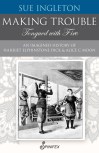
Book coverIn my recent post on Jessica White talking about her hybrid memoir-biography Hearing Maud, I commented that I’m intrigued by the ways in which biography is being rethought in contemporary literature. When I wrote that, I not only had White’s book in mind, but Sue Ingleton’s Making trouble. You can probably guess why from its sub-sub-title: “an imagined history of Harriet Elphinstone Dick and Alice C. Moon”.

“An imagined history”? And yet, it is classified on the accompanying media release as “Non-fiction (biography, history, crime)”. What does all this mean? Making trouble is about two English women, Harriet Elphinstone Dick (1852-1902) and Alice C. Moon (1855-1894), who, in 1875, left England for Australia. As the media release says, they were champion swimmers at a time when women did not swim in the sea; they refused to wear the corsets that women had been told were necessary to hold themselves up; and they were in love at a time when – well, you know the story. The problem, however, is that there is not enough documentary evidence for a traditional, formal biography. Ingleton writes in her Prologue that there were

no letters, no direct descendants both women being childless, no personal communications, only some newspaper stories, advertisements and sections of a thesis written in 1985.

In other words, their achievements are primarily documented in newspapers (“may the gods bless TROVE”, Ingleton writes): through ads for gymnasiums and physical education lessons, articles on talks and lectures, and death notices. Ingleton also had access to a master’s thesis by Lois Young titled Feminism and the physical sex sex education, physical education and dress reform in Victoria, 1880-1930).

To flesh out their lives, to give sense to these determined, influential women, Ingleton fills in the gaps using her imagination and her understanding of the history of the time. Describing herself as a “detective in time”, she had no choice, she writes, but to call this book “an imagined history” or, what is defined elsewhere, “speculative biography.” There is, in fact, a growing awareness, perhaps even acceptance, of this speculative approach to biography, but it’s tricky. At what point does such a work tip over into historical fiction?

Writing on the Australian Women’s History Network about her imaginative book The convict’s daughter, historian Keira Lindsey shares the contradictory responses she received to her requests for endorsement. One historian said she had “fearlessly carved a new path between history and fiction,” while another was “infuriated that she had gone “beyond the historian’s remit”. Clearly then, it partly depends on the reader. Some of us have more tolerance for straying from fact than others. But the writer’s approach and style also affects how readers respond.

Lindsey, for example, did not footnote, but she referenced the sources “with an index and bibliography”. She also provided “chapter notes at the end of the book for those wanting to know which portions of the book were fact and which were not”  and she explained her approach in an Afterword.

Ingleton took a different approach. She writes a Prologue and provides endnotes. I haven’t read The convict’s daughter so can’t comment on how Lindsey’s approach worked, but I did like Ingleton’s Prologue, albeit she argues that there are three components to her work – the Fact line, the Fiction line, and the Spirit world which, she says, can result in the revelation of “hidden facts” or “invisible truths”. This takes us into somewhat strange territory for a biography, speculative or otherwise, but in fact it doesn’t intrude too disconcertingly into the narrative proper.

“a barely documented history”  (Ingleton)

So, to tell the story of her two women, Ingleton interweaves more formal writing, which conveys the facts as she knows them, with a narrative style that is much closer to historical fiction. It generally works well, by which I mean you can usually tell which is fact, or draws on fact, and which is invented or imagined. While I’m happy to accept the use of imagination to fill in gaps, I did feel some of the imagined sections went a little too far into the historical romance fiction vein. I understand why, though. Ingleton is, among other things, an actor, director and stand-up comedian, and so is drawn to dramatic action. She also wanted to convey the love and romance between these two who dared to be different. How to do that in the absence of letters, was her challenge.

Now then, to the women, and why they’re worth reading about. Have you heard of them? Probably not, which is not unusual for women’s stories. Dick and Moon were, says Ingleton,

early pioneers* of physiotherapy, healthy diet, gymnastics and swimming for women and girls, biodynamic farming, journalism, breaking the barriers of women creating their own businesses and most importantly they were lesbians living together – the final bastion against the Patriarchy.

They also fearlessly advocated for sensible women’s attire, that didn’t cripple them physically and mentally. It’s an amazing story really. We follow them from England, to Australia, back to England when Moon’s father falls ill, and back to Australia. We see them build their gymnasium business in Melbourne, develop a teaching practice in schools, and establish a farm at Beaconsfield. Then we see Moon, devastatingly for Dick, cut loose and move to Sydney where she builds a career in journalism, only to die, before she’s 40, in seemingly mysterious circumstances, circumstances for which Ingleton believes she has an answer and builds a fair case.

All this is set against the backdrop of the burgeoning women’s movement in Australia – it was the time of the New Woman and the suffrage movement. Although Dick and Moon “were never deeply connected to the suffrage movement”, they did move in some of the circles mentioned by Clare Wright in her You daughters of freedom (my review), and “certainly were outspoken in the area of women’s rights over their own bodies and minds”.

Making trouble is an unusual book, but Harriet Elphinstone Dick and Alice C. Moon are two women who played a significant role in promoting women’s rights and proving, by their achievements, that women are as capable of living independently as men. They should be better known. Ingleton has done us a service in bringing them to our attention with such passion and flair.

* Not long after, another woman, Marie Bjelke Petersen (1874-1969) also pioneered physical culture for women, and was accused of dressing mannishly.

AWW Challenge 2019 BadgeSue Ingleton
Making trouble: Tongued with fire: An imagined history of Harriet Elphinstone Dick and Alice C. Moon
North Geelong: Spinifex, 2019
276pp.
ISBN: 9781925581713

(Review copy courtesy Spinifex Press)

Monday musings on Australian literature: 1930s, moving beyond “gumleaf and goanna”

Time for another post inspired by Trove, this one, as often happens actually, discovered while researching something else. What I discovered was the discussion that went on in the 1930s about Australian fiction’s coming of age – and the fact that much of this was down to the women writers of the time (about which I have written before).

This post will focus on what critics and reviewers were saying about the Australian novel and its creators, and I’ll start with an intriguing competition that was run by Sydney’s The Sun in 1934. The competition was, apparently, for “a short comment on the progress of Australian fiction since the war”. What a fascinating competition idea? The competition report sums up the entries as follows:

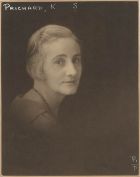
Nobody expressed regret at the passing of the “gumleaf and goanna” phase — that tiresome exploitation of externals, of the obviously distinctive things in the Australian scene. Contestants commented on the decline of blood-and-thunder melodrama, and on the entry into Australian prose of high imagination and feeling for style (notably in the works of Henry Handel Richardson). Several commented on the success of women writers (H. H. Richardson, Kathleen Pritchard [sic], G. B. Lancaster, Helen Simpson, and others), and the use of themes of universal interest, even if the setting be Australian.

Katharine Susannah Prichard

Katharine Susannah Prichard (1927/8) (State Library of New South Wales [Public domain], via Wikimedia Commons)

This idea that Australian prose was moving away from a focus on melodrama and simple plots to exploring deeper issues and concerns runs through all the articles I read from the decade. As The Sun’s writer says, the setting, for most, was still Australian, but the core issues were becoming more universal. (Also running through the articles, unfortunately, was an ongoing issue with getting Katharine Susannah Prichard’s name right – something I’m sure biographer Nathan Hobby knows all about, and then some!)

Anyhow, the winner of the competition, a Miss Constance Wallace of Roseville, wrote that:

The Australian novel at last has broken from the convention of gum-trees and wide open spaces. It is losing its colonial, narrow atmosphere for a more vital and a broader national—and International—outlook. It has achieved a deeper humanity and a more virile quality. No longer is it mere landscape painting; the canvas begins to glow with the warmer tones of human emotions.

She names, among others, Henry Handel Richardson, Helen Simpson, G.B. Lancaster (pseudonym for Edith Joan Lyttleton), M Barnard Eldershaw, and a man or two, including Ion Idriess.

Meanwhile, back in 1931, The Canberra Times reported on two talks given to the Canberra Society of Arts and Literature by eminent men of letters of the time, Kenneth Binns and Harold White. Binns discussed M Barnard Eldershaw’s Green memory. He described the plot as “strong, dramatic and dignified” and as proceeding “with that quality of inevitableness which is characteristic of all great dramatic writing”. He liked the characterisation, describing the interest being in “the pull of character against character, instinct against instinct” in the two main characters, but he also commended the authors’ ability to delineate their minor characters. In terms of style, he described the pair as “masters of vivid, picturesque yet dignified writing”, likening them to Robert Louis Stevenson, “in their use of picturesque and arresting words and metaphors, and also in their command of highly pregnant short sentences”. Binns believed that Marjorie Barnard and Flora Eldershaw had “produced a book which not only delights but which also adds dignity and significance to Australian letters”.

Book coverWhite talked about Henry Handel Richardson’s The fortunes of Richard Mahony (1930), starting by contesting some of the criticisms from Australian critics. He described the trilogy as having “a structural harmony found only in very great novels” and he dispensed with “the question of whether the author had produced a typicallv Australian book or not” by saying it was “a universal work, and that should be enough”. (So there!) White, like Binns, then went on to talk about the work in detail – plot, characterisation, style, and so on, concluding, our reporter says, that
with this one book, Australian fiction took its rank with European conception of the novel as a form of art through which the real experiences of life are recorded sincerely and honestly. At the same time the author had recreated a period in our social history and added two living creations to the world’s great characters in fiction.

In 1934, a writer in The Age reviewed a later work by Henry Handel Richardson, The end of a childhood, which s/he described as “a collection of odds and ends”. Some of this the reviewer felt would “add little to the author’s reputation”. However, the work includes some sketches of girlhood, in which, says the writer, “slight as they are, Mrs. Robertson [sic!!!] displays a penetrative knowledge of the mentality of young girls”. The book concludes with four stories, which, our writer finally praises, reveals the “psychological subtlety which has proved a valuable asset in her portrayal of characters on a larger canvas”.

Moving on, in 1937, an article in Adelaide’s The Advertiser discussed Katherine [sic] Susannah Pritchard’s [sic] (honestly!) novel Intimate strangers, which the writer argues represents a development in Australian fiction because it “gives one the impression that Mrs. Pritchard [sic] is feeling her way towards what one may call the sociological novel”. The writer has some reservations about the book, but also praises it because Prichard

has grasped so well … the essentially challenging nature of marriage — the surrender that it calls for but which cannot wholly be given; the individual aspirations that, in its infinite demands, it so often submerges; the regrets it cannot completely banish; and the whole complex and unfathomable business of two distinct personalities being required to find a common denominator.

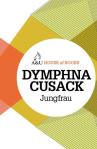
Dymphna Cusack, JungfrauAnother writer praised during the decade is Dymphna Cusack. In another 1937 article in Adelaide’s The Advertiser, the reviewer praises Cusack’s Jungfrau (my review). The reviewer starts with:

“IT is not wholly fanciful to suggest that within a decade or so most novels of ideas will be written by women,” a distinguished English literary critic wrote recently. “Modern intelligent men,” he added, “express themselves and their thoughts more easily in autobiographies, biographies, essays, and books of travel than in the form of fiction. And the future of the English novel is already largely in the hands of women.”

Our reviewer goes on to suggest that we should test this idea against the Australian novel, and starts by referencing Henry Handel Richardson. However, “are there”, s/he asks, “any young Australian women writers to succeed her in making the future of the Australian novel a brilliant one?” Well, yes, is the answer, and one of these is Dymphna Cusack as evidenced by her debut novel Jungfrau. I loved the writer’s reference to the cover, when s/he describes it as “a novel that — despite its title and its publishers’ absurd pictorial jacket— is arrestingly Australian in every way as well as being a fine piece of fiction”.

S/he goes on to praise Jungfrau, for its portrayal of Sydney, giving

a valuable picture of our city life that should do much to dispel persistently recurring illusions abroad concerning Australians’ homes, culture, manners, and way of speech.

Not only is Jungfrau “interesting and convincing”, s/he writes, it is also

extremely well-written, the prose having an effortless continuity and forcefulness which make it delightful to read, as, one feels, it must have been delightful to write.

The writer praises Cusack’s “lesser characters”, saying she “has endowed the very least of them with life; they are all so easy to believe in, and so easy to like or laugh at or despise.” And finally, s/he concludes that “altogether, the young writer is very much to be congratulated on her first book; on her irony, insight, and deft handling of human nature”.

So, Henry Handel Richardson, Katharine Susannah Prichard, Marjorie Barnard and Flora Eldershaw, and Dymphna Cusack … all praised, with clear argument, for progressing Australian fiction through the quality of their writing and their characterisation, and by tackling bigger and more universal ideas.

Have you read these authors, and, if so, what would you say?

Special Book and Event Giveaway for Jessica White’s Hearing Maud

Book cover

Regular readers here will know that I very rarely do give-aways. However, when Jessica White, who is on the Australian Women Writers Challenge team with me and whose novel Entitlement I’ve reviewed, asked whether I’d be happy to do a giveaway for her latest book, Hearing Maud, and her conversation with Inga Simpson at Muse, how could I refuse? Of course, I couldn’t, and didn’t want to.

So, here’s the deal:

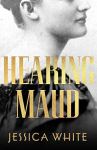
On Saturday 2nd November, from 4.30 – 5.30pm at the wonderful Muse Books and Cafe, Jessica will be in conversation with writer Inga Simpson about her hybrid memoir on deafness, Hearing Maud, which details Jessica’s experiences of deafness after losing most of her hearing at age four. It charts how, as she grew up, she was estranged from people and turned to reading and writing for solace, eventually establishing a career as a writer. Central to her narrative is the story of Maud Praed, the deaf daughter of 19th century Queensland expatriate novelist Rosa Praed. In researching Maud’s story, Jessica reached back into the history of the deaf and realised how, although her and Maud’s stories are a century apart, they both still struggled with the expectations that they be like hearing people.

Jessica is offering not one but TWO giveaways:

  • a copy of the book and a free ticket to this event; or,
  • a copy of the book

Please leave your name in the comments, noting which of these two draws you wish to go into, by midnight AEDST Tuesday 29th October.

The draw, using a random number generator, will be made on Wednesday 30th October:

  • The winner of the book and event will just need to turn up at the event as his/her name will be recorded at the door.
  • The winner of the book will need to email his/her address as requested in the announcement email.

Jessica and I look forward to hearing from you!

Ros Collins, Rosa: Memories with licence (#BookReview)

Book coverMemoirs are tricky things. There are readers who love them, readers who hate them, and readers like wishy-washy me who sit in the middle. I sit in the middle because, for a start, I don’t like to say “never” when it comes to reading. I sit in the middle because I couldn’t cope with a steady diet of memoirs, particularly those how-I-got-over-my-[whatever trauma or challenge it was], which is certainly not to say that I don’t admire those memoirists or don’t enjoy some of their fare. And, I sit in the middle because I don’t like formula, because I like books that try to tackle their subject or their form a little differently. So, the memoirs I mostly read are those which play with form or whose subject matter offers something different. Ros Collins’ memoir, Rosa: Memories with licence, does both of these.

First, the subject-matter. Rosa deals with, as the book description says, “Anglo-Australian Jews [who are] often overlooked in fiction and memoir.” Having known many Anglo-Australian Jews through my life, I was interested to read Collins’ discussion of her family’s life, as a contrast to those more directly Holocaust-influenced lives of European Jews we’ve all read about. It’s not easy being Jewish, I believe, regardless of personal or family history, so I was interested to read this story.

Then there’s the form. The subtitle, “memories with licence”, suggests that this is not going to be your usual memoir. For a start, it is told third person about a person called Rosa, which is the name given to the author Ros by “two elderly men from Southern Europe” whom she met on a recent Anzac Day Eve. She goes on to say, in her Introduction, that it is this “Rosa who wanders through the following stories, sometimes fictionally, sometimes autobiographically”, though I hazard to guess it is mostly autobiographical – just told one voice removed! Near the end of the introduction, she says that:

Rosa is much more personal [than her previous family history book, Solly’s girl] – and freely written – and I have taken liberties with the truth. Memoir with a little fiction, or fiction with a little history? It’s hard to say. Memories with licence.

The book has been classified on its back cover as Memoir. And that is how I have read it, as it reads true.

So, why tell it this way? Collins says she wishes “to entertain”. Her aim is not to delve into world history, cataclysmic events, or, even, dystopian futures. She wants, instead to shine a light on lives that may not be well known to many Australians, on Anglo-Australian Jewish lives. Taking a third person voice enables her to tell her story a little more objectively, to comment on what people, in particular Rosa, were, or may have been, thinking and feeling. Third person also enables her to get out of the main subject’s voice and head. It enables her to suggest what others might be thinking, such as Rabbi Szymanowicz:

Rabbi Szymanowicz stopped surreptitiously searching the room for younger people with whom he might more profitably connect, and looked at her. Seldom, if ever, had he met an elderly congregant quite like her; for an eighty-something-year-old Rosa did not come across as a sweetly gentle Miss Marple – more likely to be opinionated and argumentative.

This sort of statement could not be made in the same way in a traditional memoir. A traditional memoirist can not so directly get into the head of another character. A traditional memoirist can only suppose what another character might think (unless they are quoting documented facts from, say, letters). Taking this third person approach gives Collins more licence. She can, for example, “guess” about the relationship between her two grandmothers, two women who were not happy because they lost significant supports, when Rosa’s parents married.

All this could be disconcerting to some readers, but Collins has been honest from the start about what she is doing. Ultimately, the important thing is whether the book rings true and I believe it does. Rosa’s character – her humanity, her sense of her own flaws, her uncertainties, as well as her pride in her achievements – shines through.

Another way in which the book departs from traditional memoir is in its lack of linearity. While there is an overall movement from past to present, Rosa is not told chronologically. Instead, each chapter or “story” takes up a theme through which the story of English-born Rosa (Ros) and Australian-born Al (Ros’s husband Alan) is told. Chapter 4, “Jellied eels”, for example, explores food, Jewish culture, and Rosa’s navigation of it all. Collins explains how, as a child, Rosa had been told what she could and couldn’t eat, but not told why. Her mother expected her to “just accept the traditions” but of course this is not the way to hand down traditions, not, certainly, “to a difficult daughter – full of unnecessary questions”!

Collins also tackles, gently and without polemics, what Israel means (or, might mean) for Anglo-Australian Jews. For those of us who find Israel and the politics of the region highly problematic, it’s useful – though not necessarily convincing – to be reminded that in Israel, as Rosa quotes Golda Meir saying, “nobody has to get up in the morning and worry about what his neighbours think of him. Being a Jew is no problem here.”

Rosa, then, is a warm-hearted, open-minded “memoir” written by an Anglo-Australian Jewish woman for whom being Jewish, as for many I believe, is as much, if not more, about history and heritage as god and religion. In this book, Collins interrogates her family’s past, and her late husband’s story, in order to come to a better understanding of herself, and of what she would like to pass on to the next generation. This book is testament to that soul-searching, and makes good reading for anyone interested in the life-long business of forming identity, Jewish or otherwise.

AWW Challenge 2019 BadgeRos Collins
Rosa: Memories with licence
Ormond: Hybrid Publishers, 2019
ISBN: 9781925736113
186pp.

Jocelyn Moorhouse, Unconditional love: A memoir of filmmaking and motherhood (#BookReview)

Book coverAlthough it is quite a traditional memoir, style-wise, Jocelyn Moorhouse’s Unconditional love: A memoir of filmmaking and motherhood is particularly interesting for a couple of reasons. Firstly, she’s an artist who had a happy childhood. Who knew that could happen? Secondly, while most memoirs focus on one aspect of the writer’s life – such as their career (sport, for example), their trauma (childhood abuse, perhaps), their activity (like travel) – Moorhouse intertwines two ostensibly distinct parts of her life, her filmmaking career and her life as a mother.

Jocelyn Moorhouse will be known to many filmgoers as the director of the critically successful Proof, How to make an American quilt, and The dressmaker. She is also the wife of PJ Hogan who directed Muriel’s wedding, My best friend’s wedding, and Peter Pan. This is one amazing couple. Not only have they each made critically successful films, but they are lifetime creative and life partners, working on and/or supporting each other’s movies, negotiating the logistics of parenthood, and so on. They have made it work for over 30 years, in a way that few do. That’s impressive.

It could all, then, have been pretty idyllic, but life rarely turns out that way, and for Moorhouse and Hogan it didn’t. The reason is that of Moorhouse and Hogan’s four children, the middle two are autistic. This resulted in an 18-year hiatus in her filmmaking career, although during that time she kept her hand in, mostly working in some way with PJ on his projects. The book, then, tells both stories, the development of her career from her early studies in media and drama at Rusden State College and then at the Australian Film and Television School, where she met Hogan, and her very particular and demanding life as the mother of two autistic children.

She shares the emotions of giving birth to two gorgeous children only to have them regress around two years of age, as is apparently typical with autism, into unhappy, and therefore difficult children. I say unhappy because it is clear that the children suddenly find the world confusing and frustrating. Their language and communication skills regress so they resort to screaming and crying, and other difficult behaviours. Moorhouse talks about the shock of diagnosis, the therapies they try, including the ones that work (for them), and the logistics of running a family whose life is peripatetic and dependent on the next film job coming along.

Moorhouse, the experienced storyteller (and in fact problem-solver), tells her story carefully. It’s not until halfway through the novel that she brings us to her growing uneasiness about her second daughter, Lily, and Lily’s diagnosis. It’s a tough chapter, because it was a shock to her. She realises that her discussion of causes, not to mention possible preventions and cures, could upset some readers:

I am aware that some of the readers of this book may be autistic themselves and could possibly find this chapter upsetting. Please understand that I wasn’t rejecting Lily because of her autism. If you keep reading, you will discover that I love her autism and her brother’s too. But twenty years ago I was afraid for Lily’s future …

It is tricky to write about issues like this, without offending unintentionally. It’s a long “journey”, to use current terminology, that she and her family go on. And it’s a hard one. Late in the book she says that it took her years to realise that a lot of the pain she was feeling stemmed from “an internal war between my instinct to cling to the dreams about life, and my need to accept the truth”. By the end, she and PJ learn to rebuild their dreams for Lily and Jack, and she learns to balance her need to work against the family’s needs.

This brings me to her career. I enjoyed reading about that, about her own films and the insight she gave me into a film director’s work in general. I worked with film – from an archival point of view – and met various film industry people over the years, but I still learnt much about just what a director does from this book, such as the amount of script work they (might) do, the work involved in casting, choosing location and designing sets, and so on. Each director has his/her own way of doing things, it’s clear, but I greatly enjoyed reading about Moorhouse’s experiences – the wins and losses, the need to be philosophical about those that got away or didn’t go to plan.

Style-wise, Unconditional love is a straightforward chronological memoir, told in plain language, making it an accessible read. A lovely, though not unusual thing she does, is to begin each chapter with a quote. They come from diverse sources, including filmmakers (like Ingmar Ingmar Bergman and Frederico Fellini), writers (like Virginia Woolf and Maya Angelou), people who treat or have autism (like Oliver Sacks and Temple Grandin), and artists (like Marc Chagall). The opening quote, for the introduction, comes from Margaret Atwood, saying that, “in the end, we’ll all become stories”, which seems perfect for both a memoir and a filmmaker.

This is a generous memoir, rather than a tell-all one. There’s little name-dropping, though of course names are dropped because that’s the business she and Hogan are in. There are references to relationship and financial challenges – you’d be surprised if there weren’t any – but these aren’t dwelt upon. She also seems careful to not intrude unnecessarily on her children’s rights to their own lives, particularly as they get older.

Unconditional love is a book that will appeal to readers interested in Australian filmmakers, to those interested in families with autistic members, but most to anyone interested in a story that shares the challenges of a life but focuses more on the solutions.

AWW Challenge 2019 BadgeJocelyn Moorhouse
Unconditional love: A memoir of filmmaking and motherhood
Melbourne: Text Publishing, 2019
296pp.
ISBN: 9781925773484

(Review copy courtesy Text Publishing)

Grace L. Chao and Amanda Ambinder Shapiro, Bookclub social: A reader’s guide to online book clubs (#BookReview)

BookcoverBack in 2016, I completed a survey about online bookclubs, and answered some supplementary questions about “my” sort of club. I also took part in a follow-up telephone interview with the two American researchers involved, Grace Chao and Amanda Shapiro. Now, three years later, they have completed their research and self-published it in their book, Bookclub social: A reader’s guide to online book clubs. Of course I bought it, because although it’s some time since I’ve been active in online book clubs (or, OBCs), I am interested in reading communities of all sorts.

Chao and Shapiro explain their research process in the opening chapter. They describe their work as an ethnography, and so used “anthropological methodology”. This involved the survey (for which they received 840 responses, a 22% response rate), followed-up by in-depth interviews with around 100 participants, and participant observation of a number of clubs in operation. They divide the clubs into seven genres:

  • Classics (which includes Literary)
  • Erotica
  • General Reader
  • Horror
  • Mystery/Thriller
  • Romance
  • Sci-fi

You won’t be surprised to hear that I slotted into the Classics group.

Anyhow, in this chapter they explain their aim as being to look at “how the nature of community is being redefined and shaped in the digital age”. I wouldn’t say, necessarily, that what they found was surprising – at least not in terms of my own experience of such clubs – but the book makes some cogent points about how international online communities can work, what they can offer, and some of the challenges they face too.

Of course, Chao and Shapiro found that, overall, female readers dominate most of the clubs, which is similar to face-to-face clubs, although in certain genres, like sci-fi, men are involved in greater numbers than in others. They found that people join these clubs to converse about books, “to deepen and enhance their reading experience”, and often, to seek both intellectual and social outlets. Face-to-face clubs can do these too, but OBCs can offer more.

For example, and this is something that I particularly liked, in a traditional face-to-face book club, there is limited time for discussion, usually just an hour or so. As Chao and Shapiro put it, these groups require “a faster thought process where there is less time to analyze or to react”. In an OBC, you can read a comment by another reader, mull it over, and write a response in an hour, a day, or whenever (within the rules or practices of the club.) I learnt so much during my 10 years or so of active involvement in these clubs.

However, it’s not only the extended time-frame which enables deeper or more expansive discussion. The global nature of these clubs allows for a more “diverse cultural exchange of perspectives and opinions”. This diversity can be generational, gender, racial, ethnic, socioeconomic, political and/or religious based.

For some readers, Chao and Shapiro found, OBCs represented the only outlet available to them for book discussion. These are readers who live in countries/places/situations where “a shared reading culture is not prioritized” (or, even, approved of), or who read genres (like Erotica) for which it is not always easy to find local reading communities, or who, for some reason (such as being housebound), are unable to access activities like face-to-face reading groups.

A propos the first group, Chao and Shapiro write that “for members from more restrictive cultures and communities, a virtual shared reading community could be their first foray into a community which allows personal expression and choice”. They include some moving stories about such readers, mostly women, who are desperate to be part of a reading community. A member of a Romance bookclub told Chao and Shapiro about a member from Pakistan, who was being pressured to marry “an elderly gentleman”:

Shortly thereafter, she told us that her family was not allowing her to post in the group anymore and even restricting her access to the internet. In her last post, she wrote: ‘Think of me.’ I didn’t know what to do. We never realized the risk she was taking by being a member of our book club. Through our book discussions, she was exposed to different cultures, religions, politics, morals, and values; she was able to speak her mind freely, things we take for granted in Western society. It’s like the club was deemed a bad influence…

Stories like this are saddening, but not surprising.

They note, in fact, that the social aspects of these clubs disprove the popular misconception that OBC members are “anti-social because they prefer online to face-to-face interactions”. Socialisation does take place, they say, with “intricate networks of friendships” being created across “national borders, time zones, and cultural barriers”. Here I’ll share a quote from the book that I’m sure another survey participant wrote about me:

I met another gal from Australia when she and her hubby were visiting here. We went to a great museum in Los Angeles.

Mr Gums and I did indeed meet two OBC friends of mine, and we had a lovely day at the J. Paul Getty Museum in Los Angeles. My OBC experience has had a significant and ongoing influence on my life, even though I am no longer active.

The book is logically structured, with the main body comprising chapters focusing on specific questions, such as Who’s in charge? (on the role of moderators) and Who’s anchoring the club? (on the role of core members). Other chapters explore social connection in OBCs, how they create virtual safe havens, their role in exposing members to new ideas, and the way they are able to create a sense of belonging among members. Chao and Shapiro support these discussions with evidence from their field research and from relevant academic writings by anthropologists, sociologists, information scientists, and others. The chapters are carefully footnoted and there is an extensive list of references at the end.

I’m not sure whether what they found can be extrapolated to other online communities and the book ends with advice about OBCs rather than making such extrapolations, but they do make some cogent points about the way OBC’s support and promote diversity and inclusivity, and they identify the main factors that make these sorts of communities work (or not). For these reasons, Bookclub social is a worthwhile read, as well as, for me at least, an enjoyable one.

Grace L. Chao and Amanda Ambinder Shapiro
Bookclub social: A reader’s guide to online book clubs
BookBaby, 2019
ISBN (ebook): 9781543947526

Monday musings on Australian literature: Introducing Charmian Clift

There’s no way I can do justice in a short post to such this complex woman about whom so much has been written, but I’d like to add Charmian Clift to Monday Musings posts featuring Aussie authors, not only because she and her husband, author George Johnston, were one of our significant literary couples, but also because, according to academics Tanya Dalziell and Paul Genoni writing The Conversation, she is enjoying somewhat of a renaissance.

This renaissance includes that:

  • in 2018 she and Johnston were inducted into the Australian Media Hall of Fame (see my post); and that
  • she is the subject of two recent/upcoming novels, Tamar Hodes’ The water and the wine (2018), English writer Polly Samson’s A theatre of dreamers (coming in 2020).

Nadia Wheatley, The life and myth of Charmian Clift, book coverIntriguing, because there was also flurry of interest in her back in the 1990s-2000s, with:

  • Suzanne Chick’s Searching for Charmian: The daughter Charmian Clift gave away discovers the mother she never knew (1994): autobiography/memoir
  • Susan Johnson’s The broken book (2004): novel
  • Nadia Wheatley’s The life and myth of Charmian Clift (2001): biography

There’s clearly something about Charmian! (I have read Chick and Johnson, but before blogging)

Potted bio

Clift was born in the gorgeous NSW south coast town of Kiama in 1923, and served in the Australian Women’s Army Service in World War II as an anti-aircraft gunner. After the war, she worked as a journalist on Melbourne’s Argus, and married journalist George Johnston in 1947. They had two children, before moving to London in 1950 for his job as European editor for Sydney’s Sun. In 1954, they went to Greece to live writers’ lives, where they lived, mostly on Hydra, for 9 years, before returning to Australia in 1963. Clift then worked, primarily, as a freelance journalist, until she died tragically, by suicide, in 1969.

Clift (see Wikipedia) wrote novels, three in collaboration with Johnston, two autobiographies/memoirs, short stories, and many essays/columns (collections of which were published after her death.) She was working on an autobiographical novel, The end of the morning, before her death.

The Charmian renaissance

Dalziell and Genoni (D&G) say that “the revival of interest in Clift is more than a collective nostalgia or feminist correction of the historical record, although both are relevant”. It’s also due, they say, to increasing interest in their Hydra years, where they met other writers and artists including Leonard Cohen, and where they were visited by people like Sidney Nolan and family. D&G refer to two events in Melbourne in 2015: an exhibition called Homage to Hydra, which included paintings of them, and a show, Hydra: Songs and tales of Bohemia, by musicians Chris Fatouros and Spiros Falieros in which they use Cohen’s songs to tell about Clift and Johnston’s time on Hydra.

Ah, and then it comes out! In 2018, D&G themselves published a book, Half the perfect world: Writers, dreams and drifters on Hydra, 1955-1964, in which they tell of the “fabled decade of Clift’s life as a bohemian expatriate”. But there’s more, they share: Sue Smith has written a play called Hydra, which casts “Clift in ways that resonate sympathetically with the concerns of contemporary audiences”. Smith describes Clift as “a woman ahead of her time”, in both her life choices and her writing. Queensland Theatre’s webpage on Hydra provides some useful background, including references to Johnson’s novel.

D&G, then, are particularly interested in Clift’s personality, and in how Johnston’s and her dream of “a cheap and sun-soaked creative island life slowly soured”. They reference Wheatley’s well-regarded biography. They suggest that Clift’s “first person narratives of a life lived with great passion and a sceptical eye to the consequences garnered a large readership” and that “these readers responded to an incisive intellect with a vision of a culturally enriched Australia” [my emph]. They see her as “one of the most important female voices” of her post-war time when a social revolution was on the horizon. Oh, and they argue that Clift was modern in her capacity for “self-creation”!

Searching for Charmian … in Trove

Of course, I had to check Trove to see what contemporary writings I could find, by or about her, but there’s not much, as I expected, because the post-1950s is still tied up in copyright. However, I did find a poem, “Kiama’s Blowhole”, written by her when she was 8 years old and published in The Kiama Independent, and Shoalhaven Advertiser (14 January 1933).

I also found a review by Sylvia Lawson in The Canberra Times (5 March 1966) of a collection of her newspaper columns/essays that was published in her lifetime, Images in aspic (1966). Lawson’s reaction is mixed. Indeed the review is headed “Popularity despite an irritating style”! She praises Clift’s style saying:

She does indeed write well (often better here, in fact, than in her two novels), but it’s what the style does that counts. The long, weaving, daydreaming sentences, the short brisk ones, and the way of letting reflections drift off in rows of dots combine to give readers the sense that her moods and responses have been fully handed over to them, transcribed as exactly and honestly as possible.

Lawson says this of the collection – and I love this – “Writing with humour and enquiry about mods, post-mods, squares and oldies, she does something (since they all read her) to make it one world after all”. However, she doesn’t like it all, saying that “Sometimes the nostalgia goes right over the edge into whimsy; sometimes it looks very like cashing-in on private experience”. This variety, this unevenness, though, is not surprising in this sort of collection I think.

I found an excerpt from Images in aspic in the Macquarie anthology of Australian literature. It’s about the parlous state of the Australian film industry. She writes that no-one has “exploited cinematically our stupendous beaches, or sought to portray the neo paganism of the surf-cult, which is utterly contemporary, utterly Australian …” Nor, she says, “has anybody touched upon the particularly contemporary problem of the integration of hundreds of thousands of Europeans into our communities. There is yeast enough there to ferment a dozen films without formula or cliché”. How much has changed? She writes:

Ever since I have been back here I have been conscious that Australians, caught in international cross-currents of ideas and manners and fashions, twisted about by reassessments of their own old myths, bewildered by elusive and changing standards, are desperate to be redefined.

This is interesting. Clift, the returned expat, seems to be somewhat positive about the state of Australia, and its capacity to grow, at a time when those famous intellectuals, Clive James (1962), Germaine Greer (1964) and Robert Hughes (1964), left for Europe, seeking something less stultifying!

I did find one article in Trove written by Clift, “Home from the Aegean” (Australian Women’s Weekly, 26 February 1964). It’s about the family’s decision to return to Australia, and concludes with:

“You must be out of your minds to leave this!” the latest batch of young Australians said with conviction.

But I don’t think so. In fact, I think that this last journey, which completes the circle of my journeyings, might turn out to be the most exciting one of all.

How sad that five years later she took her own life.

Louise Erdrich, The bingo palace (#BookReview)

Book coverWhen I bought Louise Erdrich’s The bingo palace in 1995, I never expected it to take me 24 years to read it but, there you go. Time flies, and suddenly it was 2019 and the book was still sitting on the high priority pile next to my bed! Truly! It took Lisa’s ANZLitLovers Indigenous Literature Week to make me finally give it the time it deserved – and even then I’m late. Oh well.

I have read Louise Erdrich before, back in 2000 when I read The crown of Columbus with my reading group. She it wrote with her then husband, the late Michael Dorris. While it was an enjoyable read, it didn’t make a big impression. However, I have always remembered it because of her. So now, her!

Erdrich is an enrolled member of the Anishinaabe nation (also known as Chippewa), and it is among the people of this nation that The bingo palace is set. One of the reasons the novel captured my attention all those years ago is because when we lived in the USA, we became aware of the importance of gambling as a major source of income for many Native American communities. Erdrich’s narrative draws from this fact, but it also provides her with the “luck” or “chance” metaphor – “the drift of chance and possibility” – which underpins the novel. One-third of the novel’s twenty-seven chapters, in fact, include the word “luck” in their titles, as in “Lipsha’s luck”, “Shawnee’s luck”, “Lyman’s luck”, and so on. Luck, good and bad, is a constant in the novel, and Erdrich constantly puts her characters to the test, as they navigate their rocky worlds. How much “luck” is of their own making is a question for them, and us the readers, to consider, I think.

Anyhow, the story centres on an unsettled young man, Lipsha Morrissey, and his love for Shawnee Ray, who has had a baby with Lyman Lamartine, manager of the titular Bingo Palace. The novel contains a complex web of relationships, which takes a while to unravel, but for which we are prepared in the first chapter:

The story comes round, pushing at our brains, and soon we are trying to ravel back to the beginning, trying to put families into order and made sense of things. But we start with one person, and soon another, and another follows, and still another, until we are lost in the connections. (p. 5)

Now, you might have noticed something interesting about the voice in the above paragraph – it’s a first person plural voice. This voice – which operates a bit like a Greek chorus, though here it’s the tribal Chippewa – disappears for most of the novel, reappearing near the end in chapters 25 and 27. The other chapters are told in first person for Lipsha’s story, and third person for all the other stories. This is tricky, daring stuff, but it works, partly because of the power of the stories being told, partly because of its unusual tone (to which I’ll return), and partly because of the language. Erdrich’s language is arresting:

As a baby, Lipsha knew how to make his hands into burrs that would not unstick from Marie’s clothing. (p. 28)

AND

Unwilling, I followed him out to the barn, placing no in my mouth like a pebble to throw. (p. 47)

AND

Albertine could see that Shawnee Ray bent her strength like a bow to the older woman’s need. (p. 210)

AND

We get into the car, pull into the pitted road, and I try not to brush too hard against my sorrows. (p. 215)

Now, back to the story, which concerns Lipsha’s attempts to win Shawnee Ray’s love, after being called back to the reservation by his grandmother, Lulu Lamartine. Life is not simple on the reservation, and as we follow Lipsha’s desperate quest, we are introduced, through a wonderful array of characters, to reservation life – to the tension between old traditions and new businesses, between spiritual life and the material one. Lipsha tries them all – he is initially lucky at bingo and wins a van, only to lose it to some white Montana boys. With a degree of easy-come-easy-go nonchalance, he then seeks out his great grandmother, Fleur Pillager, for love medicine. She lives on sacred land around Lake Machimanito, that Lyman has managed to have set aside for another bingo palace. Lipsha also, with Lyman, tries a spiritual retreat run by ceremony man, Xavier Toose.

All this is told with a tone that veers between resigned realism and sudden visions, a tone that effectively conveys the paradoxes involved in trying to retain tradition while surviving in a modern world. Lyman puts his faith in bingo entrepreneurship, while Shawnee sees education as her way. Zelda, on the other hand, has tried for decades to deny love and passion, while Fleur puts her faith in land and spirit.

Near the end, Lipsha, who has his moments of insight, says:

It’s not completely one way or another, traditional against the bingo. You have to stay alive to keep your tradition alive and working. Everybody knows bingo money is not based on solid ground […]

And yet I can’t help but wonder, now that I know the high and low of bingo life, if we’re going in the wrong direction, arms flung wide, too eager. The money life has got no substance, there’s nothing left when the day is done but a pack of receipts. Money gets money, but little else, nothing sensible to look at or touch or feel in yourself down to your bones … Our reservation is not real estate. Luck fades when sold … (p. 221)

Of course, as I read this, I wondered whether I could see any comparisons with indigenous lives and literature here, and one book immediately came to mind, Alexis Wright’s Carpentaria (my review). The likeness is loose, but both books have a wildness about them. Both confront the challenge of marrying tradition with contemporary life, and both do it by slipping easily between concrete reality and what we non-indigenous readers see as something more magical, but which for many indigenous people is all part of one spectrum. Both books are exhilarating, mind-expanding, to read.

Our “Greek chorus” tells us near the end, when “the federals” try to get the truth out of Lulu:

anyone of us could have told them they were getting into mazy woods when talking to that woman. (p. 265)

As you’d probably expect, there is no simple resolution at the end. Instead, there is, as the “chorus” says, “more to be told, more than we know, more than can be caught in the sieve of our thinking”. Like “the federals”, I got lost at times in the “mazy woods”, but I thoroughly enjoyed the humour and inventiveness, the warmth and heart – along with the challenge – to be had in reading this novel.

Canadian blogger Buried in Print has also reviewed this novel.

BannerLouise Erdrich
The bingo palace
London: Flamingo, 1995 (orig. pub. 1994)
274pp.
ISBN: 9780006547099

Australian Women Writers 2019 Challenge completed

As has become tradition, I’m writing my completion post for the Australian Women Writer’s Challenge, around the middle of the year, though I will continue to contribute until the year’s end, and do a final round-up then.

I signed up, as always, for the top-level, Franklin, which involves reading 10 books and reviewing at least 6, and as always I’ve exceeded this. In fact, by June 30, I had contributed 16 reviews to the challenge, including 3 guest posts by Amanda.

Here’s my list in alphabetical order (by author), with the links on the titles being to my reviews:

This slideshow requires JavaScript.

AWW Challenge 2019 BadgeIn last year’s completion post, I said that I didn’t have specific goals for the rest of that year but that I’d like to read more indigenous writers, more classics, and more from my TBR pile. These continue to be my non-goal goals, but I’ve not done particularly well with them so far this year, but I have read two classic writers (Capel Boake and Louise Mack) and I’ve also read three works by indigenous writers, two of which are anthologies. I’m pleased with all this, and hope to read more indigenous authors, in particular, men as well as women, as the year progresses. And, I’ve returned to my preferred fiction/non-fiction ratio, with 9 of my 13 being novels and short stories. Around 2/3 is my comfort zone!

I’m also pleased to include, this year, three guest posts by Amanda who offered to do these reviews to fill gaps in the Challenge. As Amanda doesn’t have her own blog, and didn’t want to review on GoodReads (another option for our participants), I happily offered her my blog for the purpose.

Watch out for my 2019 AWW Challenge wrap-up post for the year’s full story!

Mary McCarthy, The group (#BookReview)

Book coverMy reading group has a few loose “rules” for choosing our reads, but one of the more rigid ones is that each year we like to read at least one classic. This year’s first classic – yes, another is coming – was Mary McCarthy’s The group. As I wrote in last week’s Monday Musings, it was published in 1963 and became a New York Times best-seller. I was initially uncertain about this choice, because I had read it and there are so many classics I still haven’t read, but, as it turned out, I was glad to read it again. This is because it is a true classic, by which I mean it’s a book that you can read again, at a different time in your life, and find new richness.

For those of you who don’t know the story, it centres on the lives of eight women from Vassar College’s Class of ’33 (of which McCarthy herself was a member, so she knew whereof she wrote – Bill!) The novel follows their lives for the next seven years as they, variously, marry, divorce, have children, find jobs, and in the case of one, die. In doing so, it also evokes their era beautifully. This was a time when America was coming out of the Depression, when women’s expectations about their lives were starting to change, when medicine was starting to assert its authoritarian self, when Trotskyism was attracting the radical intelligentsia, and when Europe was moving into World War 2. Our eight women – Kay, Lakey, Polly, Dottie, Priss, Libby, Pokey and Helena – having received a liberal Vassar-style education, are engaged in the issues of their day. Indeed, the role of education is one of the themes of the novel. Early in the novel, Kay recognises that:

That was the big thing they taught you at Vassar: keep your mind open and always ask for the evidence, even from your own side.

Late in the novel, Norine, a friend of the group, and also Vassar ’33, voices the challenge their education has posed for them: “our Vassar education made it tough for me to accept my womanly role”. Some, of course, found it easier to accept than others.

[SLIGHT SPOILER ALERT FOR THE NEXT PARAGRAPH ONLY, BUT THIS IS A CLASSIC SO I’M INCLUDING IT]

I loved the novel – the satire, the writing, the details, the individuation of the characters. What was not to like? Well, there are flaws for some readers. It doesn’t have a strong plot, and the structure is episodic, so that just as you get into one person’s story, you leave her to move onto another. This can be alienating for readers who love to emotionally engage with their characters. I can see all this but, for me, they are not overriding issues. Firstly, while there isn’t a strong plot, there is a narrative trajectory that sees relationships develop and change over time as the girls mature from new graduates to experienced women. Also, the novel commences with the wedding of a character, who recurs more frequently than do others as the book progresses, and it neatly concludes with her funeral. Secondly, despite the episodic approach, I engaged with the lives of each character as she came into focus for a chapter or so. Of course, some engaged me more than others, and, in fact, McCarthy gives some more time than others. What made McCarthy’s approach work for me were the ideas being explored through the various characters, and the writing used to do this. Evocative and/or witty writing expressing interesting ideas or viewpoints will get me every time.

So, for example, the book contains wonderful set pieces that seem to just keep coming, including Dottie’s deflowering and the sociology of the “pessary”, Priss’s (shock! horror!) breast-feeding in hospital under the instruction of her paediatrician husband, Priss versus Norine on child-rearing, Hatton the butler’s management of “his” family, Kay’s time in a mental hospital, to name just a few. These vignettes – which provide such insight into the lifestyles, the political interests, health and medicine, and so on, of these women – make the novel a rich source for social history of the times. Being educated, and generally of a liberal bent, most of the group are actively engaged in the political issues of their day. Some support Roosevelt’s New Deal, while those more radical become involved in socialism, Trotskyism in particular. There are references to World War 2, and the tensions between the America Firsters (sound familiar?) and those who thought America should join the war.

Gender is also an issue. Educated they may be, but these women find themselves, more often than not, controlled by men in what was still a patriarchal society. The women believe that:

It was very important … for a woman to preserve her individuality; otherwise she might not hold her husband.

But the truth is somewhat different. Kay is mischievously committed to a mental hospital by her husband, without her knowledge, and finds she needs his agreement to be discharged, while Priss

did not recommend sacrifice, having meekly given up her job and her social ideals for Sloan’s sake. It was now too late, because of Stephen [her son], but she was convinced she had made a mistake.

And then, as you expect from a classic, these more temporal concerns are wrapped up in bigger, more universal themes, such as juggling love and friendship, managing relationships and work, balancing theory versus practice, or navigating the gap between appearance and reality. Our characters reflect the gamut of human nature, being, variously, conservative, radical, idealistic, pragmatic, confident, kind, empathetic, proud, manipulating, ambitious, pompous, opinionated, naive. You name it, you are likely to find it amongst the eight.

Besides its rich content is the writing. It’s so sly and satiric that it carries you on regardless of the story:

Now, in the chapel, they rearranged their fur pieces and smiled at each other, noddingly, like mature little martens and sables: they had been right, the hardness was only a phase; it was certainly a point for their side that the iconoclast and scoffer was the first of the little band to get married.

Moreover, McCarthy can skewer character with just a few words. Candace Bushnell, in her Introduction to my edition, writes that “Readers who desire ‘likeable characters’ in their fiction above all else may be disturbed to find that every one of her characters is flawed.” This is true, and is, in a way, what I liked best. There’s no perfection here, there’s just young women struggling to make lives for themselves with an education that didn’t always make it easy for them to live in the world they found themselves. Here are couple of McCarthy’s character descriptions:

she had an image of herself as a high-bred, tempestuous creature, a sort of Arab steed in an English sporting primitive. (Libby)

fat cheerful New York society girl with big red cheeks and yellow hair, who talked like a jolly beau of the McKinley period, in imitation of her yachtsman father. (Pokey)

a solemn, ashy-haired little girl who looked like a gopher and who felt it her duty to absorb every bit of word-of-mouth information that pertained to consumer problems. (Priss)

In the last chapter, Polly, the most sympathetic of the women, thinks “how young and superstitious they had all been … and how little they had changed.” Perhaps, though I think she’s being a bit hard and that some wisdom had been achieved. Regardless, the ending, when a certain male character gets his comeuppance, is delicious – and was loved by the members of my group!

Mary McCarthy
The group
London: Virago (Hachette Digital), 2009 (Orig. ed. 1963)
438pp.
ISBN: 9780748126934