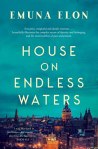
 I’ve said before that I’m surprised by how many takes there can be on World War II, and on the Holocaust, in particular – and once again I’m here with another such story, Emuna Elon’s House on endless waters. I hadn’t heard of Elon before but, according to Wikipedia, she’s an Israeli author, journalist, and women’s rights activist. Her first novel translated into English, If you awaken love, is about life on the West Bank, where she lived for many years.
House on endless waters, however, is historical fiction – or, at least, one of those novels which flips between the present and the past. It tells the story of successful Israeli author Yoel Blum who had been told by his late mother to never go to Amsterdam, from which they’d emigrated. However, the time comes when the middle-aged and internationally successful Blum is urged to Amsterdam by his literary agent to promote his latest Dutch-translated novel. While there, he and his wife visit the Jewish Historical Museum, and here, in a little looping video, he catches an image of his mother Sonia in Amsterdam during the war. Next to her is a man holding a little girl, his sister Nettie, but the baby she is carrying is not he! Who is this baby, and where was he?
Yoel returns to Israel, but, after obtaining the incomplete information his sister is able to provide (which is not divulged to the reader), he goes back to Amsterdam, alone, to research his past and write a novel about it. The result is one of those novels within a novel, as we follow Yoel’s journey alongside reading the story he is writing as he uncovers his family’s – and his – past. How much is “true” and how much Yoel imagines is not the point. We are carried along in the horrors of war-time Amsterdam, in stories of decent hardworking people’s disbelief that life could change so horribly so quickly, of Jewish collaborators, of the hidden children, of the most difficult choices people have to make. Elon conveys viscerally the shock felt by Jewish citizenry as one by one their rights are removed and as the foundations of their lives – something they thought immutable in such a place as Holland – crumble.
Much of this story has been told before. Anne Frank comes to mind of course, and many novels have dealt with the ways in which Jewish people were gradually ostracised and betrayed by their own society (the yellow stars, the loss of jobs, the resumption of homes, the rounding up, the transporting to concentration camps, and so on). What makes this one a little different – at least in my reading to date – is its exploration of the hidden child phenomenon, within a larger story of collaboration, betrayal, resistance and difficult choices.
The important thing, however, is less this difference than that it is a deeply absorbing read. Elon’s ability to manage her two story threads, and maintain our interest in both, speaks to a practised, skilled writer. There is no rigid chapter by chapter alternating of stories. Rather, as Yoel becomes increasingly invested in the life of his mother, Elon starts to blend the two stories, with Yoel sometimes feeling himself in both stories at once. As his sense of self becomes increasingly discombobulated, the line between past and present starts to blur:
Yoel would have liked to write about the architectural significance of Amsterdam, about the implication behind the labor invested in the rows of tiny reddish bricks, about the stylized cornices above the windows and the artistic embellishments that adorn every single building. But early the next morning, Sonia is walking along the street, and across the road the police are evicting a Jewish family from their beautiful art-nouveau-design house. The members of the banished family are trying to walk proudly to the truck that has come to take them away …
For Yoel, unlike the tourists he sees blithely enjoying the sun and culture of Amsterdam, “the past is still here” and it begins to overwhelm him.
Why a story-within-a-story?
This bring me to the question of why would Elon use the story-within-a-story-device? I can think of three reasons, the most obvious being that it draws the reader into the story, engaging us in its unravelling along with the protagonist. Secondly, in this case, it also mirrors how many children of the Holocaust generation didn’t know their parents’ stories – weren’t told them – and therefore had to work out those stories piece by piece. Finally, also in this case, it enables Elon to expose the personal development of her narrator, Yoel, who is initially revealed to be decent but emotionally remote. Very early in the novel, we learn this about him:
Perhaps the day will come when he’ll even train himself to live, a day when he will walk the earth like everyone else without being overcome by the thought that in fact it’s odd , even ridiculous to be a human being …
He is, says his wife, “scared of living”. This novel, then, is partly about identity. Yoel didn’t know his past but it’s clear that the traumas of that past had unconsciously impacted him, as we now know they do. Slowly, as he comes to understand who he is, he also starts to live, to be an engaged human being.
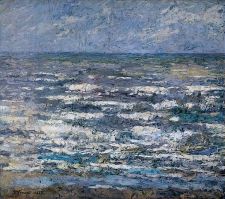
Jan Toorop, The Sea at Katwijk, 1887 (Public Domain)
There is much to this book, with Elon and her novelist Yoel drawing on art and music to reflect both Holland’s cultural achievements and its darker side. A motif running through the book is a stolen work of art – Jan Toorop’s The Sea at Katwijk – that had belonged to Sonia’s friends, Anouk and Martin, who are implicated in what happens. Martin suggests to Sonia that the painting is more about Toorop – “every painter evidently knows only how to depict himself” – than place. However, Sonia also sees herself in it: “there she is in black, there in red, there she is borne from wave to wave, moving in the infinite.” For Yoel, this sea “is a huge finite vessel containing infinite waters”. All this contributes to the novel’s message, one which Yoel finally realises Sonia was telling him:
Whatever was, was. Those waters have already flowed onward.
The trick is to know when to fight those waters, and when to let your “heart encounter the heart of the sea” and be at peace.
House on endless waters came to me out of the blue, but what a find. A Holocaust novel, it contains the horrors of that time but is also imbued with a generous, philosophical spirit that, without excusing atrocity, recognises the humanity of those who made selfish decisions and those who had to live with them. We need perspectives like this.
Emuna Elon
House on endless waters
Translated from Hebrew by Anthony Berris and Linda Yechiel
Sydney: Allen & Unwin, 2020 (Orig. ed. 2016)
309pp.
ISBN: 9781760877255
(Review copy courtesy Allen & Unwin)
 Not included in the above list is Heidi Sze’s book Nurturing your new life, which I have not specifically reviewed. However, I have read a significant proportion of it, and did write up
  Introducing
  Set in the satirically named town of Allbut, whose nearest large town is the equally satirically named Mainchance, Thea Astley’s An item from the late news is framed by the story of a man who comes to the town, fearful of “the atom bomb”, and wanting to live a quiet – sheltered, you might say – life.
 Thea Astley
 I read
  When historian Desley Deacon offered me her biography of Dame Judith Anderson for review, I was a little reticent because my review copies were getting out of hand. Little did I know then what was in store for me, and just how much more behind I would become. However, finally, its turn came, and here I am with my review.
 Desley Deacon
 Take Drylands, for example. It covers a lot of the things important to Astley. Two major ones are words and their importance/their power, and people’s cruelty to each other. Subsumed in this latter one are some recurrent issues for her – gender, race, and other power imbalances. She has several targets in this book: she’s not too fussed on computers, television, or our sports-mad society; she’s also critical about how women are treated, not to mention indigenous people and ‘oddballs’. She’s a writer with a strong social conscience – and, for example, tackled race issues head on in books like the ironically titled A kindness cup (1974) and the gorgeously titled The multiple effects of rainshadow (1996).
 Well-behaved women is a debut collection of short stories by Western Australian writer Emily Paull. It is one of those collections that has a unique title, and what a perfect – and teasing – title it is for a collection of stories focused on women.
 ‘No one,’ she says, ‘can write anything till they’ve had experience. Later on perhaps. You will write later on.’ (
 Whispering Gums
