The Story of the Oars

Back in 2018, I wrote a post on local author Nigel Featherstone’s first theatrical work, an art-song piece titled The Weight of Light. Seven years later, his second work of theatre, The Story of the Oars, has just finished its short season at The Street Theatre. Having just got back from Japan on Friday afternoon, Mr Gums and I managed to get to the last show this afternoon. For those of you who are not regular readers here, Nigel Featherstone, who has written several novellas/novels and has started spreading his wings into theatre, music and poetry, has featured on my blog several times. However, as I wrote in my post on The Weight of Light, I’m not an experienced theatre reviewer. I don’t have the language, and, as a reader, I find it challenging seeing something only once, and not being able to go back to check something out, as you can with a book! But, I do want to share something about this work.

The Story of the Oars
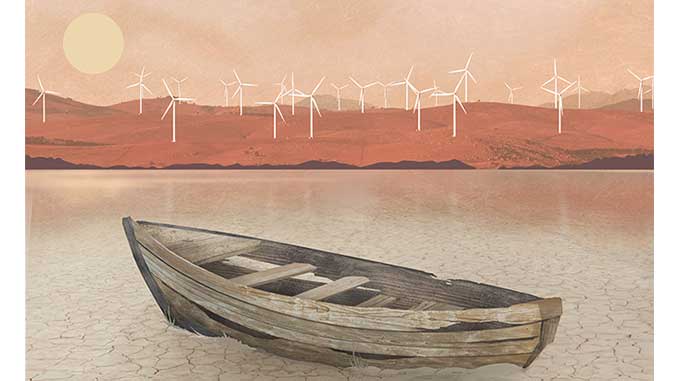
Promotion, designed by Tobi Skera

People from the Canberra region might get a hint about the setting of this play from the gorgeous graphic used to promote it. The setting, in other words, is Weereewa (in Ngunnawal language) or Lake George (as settler society named it), a lake that appears and disappears with changes in the weather. Over the 50 years I have lived in Canberra, I have seen it empty, full and in between several times.

So, this mesmerising lake and its behaviour is the setting for The Story of the Oars, which The Street’s promotion describes as “a play with spoken-word songs and music”. As the play opens, the lake is dry, and a father (Clocker) and son (Tom), played by Craig Alexander and Callum Doherty, have stopped to have a look. There is much intergenerational humour in the opening dialogue between these two as they spar about how much time to spend there, where to next, and so on. It’s “normal” Aussie stuff, until two women, played by Louise Bennet and Sally Marett, appear, and it soon becomes apparent that there’s a mystery involving Clocker that his son doesn’t know about. This mystery, and Clocker’s reluctance to admit to his son that he knows the lake, underpins the story. What Clocker learns though is, you can’t come back without the truth coming out …

“I am fictitious history” (Clocker)

The story draws on some familiar tropes – a father-son road trip, mysterious deaths in which bodies are never found, the master-servant class and privilege dynamic, a return from the past – but these are not heavy-handed. Instead, they are subtly revealed through a script which shifts smoothly back and forth between natural dialogue, with its humour and recognisability, and poetic soliloquies, with their strong rhythms. This is powerful, not only because the shifts between the two “forms” create breaks in intensity, but also because the natural dialogue conveys the main narrative thread, while the poetic pieces embody more of the emotional and thematic power. The language is beautiful, and it’s accessible, which frees the audience to focus on thinking about the themes and responding to the ideas rather than on trying to understand what’s being said and told.

Then there’s the music, which was composed and played by Jay Cameron on a partly dismantled piano that remained centre stage throughout. We attended a Meet the Makers panel before the performance, and the discussion about the music was particularly relevant. Nigel, for whom text and music are dual passions, had written the initial music, but then Jay was brought in for further development. They thought about the theme of revealing truth, of opening up things, and wanted a radical or physical approach to the music to support this. Then they had the idea of “opening up” the piano. The play commences with the piano’s boards or panels being removed, exposing its working parts. This is the condition in which it is played throughout. The music is minimally percussive at times, or softly melodic or intense at others, always supporting the prevailing emotions without dominating them or being cliched. We loved it.

It was clear from the panel discussion that much thought was given to the piano. It was seen as a core part of the show not just in terms of its role as music maker, but regarding its relationship to the actors, and to the lake. Which brings me to the staging. The stage itself represented the lake and all the action took place there. The titular oars – represented by two light rods – were also permanently on the stage. The lighting of the rods, of the lake’s outline on the floor, and of the backdrop, all changed dynamically to reflect who was in focus, or what was happening between the characters. The stage-lake, like the real one, thus came across as a living thing, a place within which people operate, to which they relate, and which can create fear or sustain or heal.

I wondered as we watched this show, how well it would translate to another place. Weereewa has such meaning for the Canberra region – physically and spiritually. Even if we understand the science behind its behaviour, we still respond to its mystery, to the way it dries up with what lies beneath being revealed only to be inevitably covered up again. Like truths and lies, perhaps. The universals – the narrative tropes and themes – would translate, but would the power of the place? It would all depend on the direction.

The story of the oars doesn’t resolve all the questions it poses about the decisions we make, the truths we withhold or reveal, but it ends on a moment in time when hope is a possibility. We liked that too. It’s a heartfelt, thoughtful and accessible work. It would be great to think that all this work doesn’t end here.

The Story of the Oars
Words and story by Nigel Featherstone
Music by Jay Cameron
Directed by Shelly Higgs
The Street Theatre, 19-21 September 2025
A lovely night out … at the theatre

You know the year has really started when the concerts and shows start up again – and for us they’ve started with a bang. We had three events in four days: A Pacifist’s Guide to the War on Cancer (Playhouse) on Saturday night, The Weight of Light (Street Theatre) late Sunday afternoon, and the first Musica Viva concert (Llewellyn Hall) on Tuesday night. This post, though, will just discuss the middle one, because it’s Australian, having been written by local author Nigel Featherstone who has featured on this blog several times. I’m not, however, an experienced theatre reviewer. I don’t have the language, and as a reader, I find it challenging seeing something only once, and not being able to go back to check something out, as you can with a book!

The Weight of Light

I’ve been surprised in recent years to discover how many Australian novelists are also librettists. David Malouf, Peter Goldsworthy, Dorothy Porter (ok a poet but also a verse novelist), and Louis Nowra immediately spring to mind – and now, local novelist and short story writer Nigel Featherstone can also claim this title. Described as a song cycle, The Weight of Light had its origins in a residency the very peaceful, non-warlike Featherstone had at the Australian Defence Force Academy in late 2013. I remember it well because he wrote about it on his blog. It all came to a head in 2014, when time came for him to do a presentation on his three months. He wrote:

I already had the questions – What is a man?  Who is a good man?  Who is a good being? – but I didn’t have the stories, or anything remotely resembling stories.  Bearing in mind that my intention in doing the residency wasn’t to write about war as such; I’m disinterested in guns, and the infinitely complex political contexts require a much bigger brain than mine.  I was interested in the small moments, the hidden fears and thoughts and dreams.

So there, in 2014, he had an idea in mind about soldiers. Then, later that year, as Featherstone tells it, Paul Scott-Williams from the Goulburn Regional Conservatorium met Nigel and told him that he wanted to create “an original song cycle”. He felt that “art song did not have much of an Australian tradition”, and wanted to do something about it, starting with Nigel as librettist. From there, the project slowly grew. Nigel has documented the process on his blog. The end result was the highly moving performance we saw on Sunday afternoon.

How to describe it? We entered the lovely Street Theatre to be faced with a minimally lit stage, comprising a minimal set. There were two large crisscrossed beams, a wire wending across the stage like a fence, brown fabric on the floor emulating a river, and, to the right, a grand piano. The show started with Alan Hicks on piano, with singing starting up soon after from somewhere backstage. The voice, coming from baritone Michael Lampard, turned out to be a mother calling her soldier-son home to the farm.

From here Lampard, with Hicks at the piano, took us on a journey, through fourteen songs, in which the soldier faces a tragedy at home which recalls to his mind a secret tragedy that had occurred during his tour (that’s a weird word really, isn’t it, for a military posting) of Afghanistan. It’s a dark story, a grim one at times, as the soldier confronts a number of challenges in his life. But, it’s also a beautiful show. If that makes sense.

This was the whole package – words, music, performance, set and lighting. Lampard’s vocal range was impressive, enabling him to differentiate characters (his mother, father, girlfriend) as they interacted with him. The lighting remained dark throughout, in keeping with the theme, though placement and levels did vary with the mood. The set was in that modern minimalist style in which a few objects are used to convey different ideas or places at different times – in this case, both the field of war and the fields of a farm. The two large semi-reclined crossed beams also, I thought, conveyed an idea of the cross, which, at one of the darker points in the performance, our soldier seemed to shoulder, recalling Christ’s journey to Calvary.

And then there was James Humberstone’s music. It included elements, we felt, of art-song, opera and church music, and was completely involving – both the sound of it and the performance of it, which included both Lampard and Hicks bowing the piano strings to create a mournful atmosphere. Other effects included paper being laid across the strings creating a fluttery, buzzing effect, and Hicks hitting the strings with small mallets. None of these were tricks for tricks’ sake, but enhanced the meaning or mood of the story.

I found these demos below on SoundCloud. They’re from earlier in the development when the program was still called Homesong, but they give an idea of the range we heard, from the sweetly lyrical to the more sombre, minimalist pieces.

I would love to be able to share some of the words with you, but not having the libretto and having only seen the performance once, that’s not possible. I did find it hard to hear them all with so much going on, but I loved the poetry of them, the use of repetition, and the imagery – of birds in particular. In the second last song, I think it was, our soldier needs to make a decision. Can he be strong, or will he give up? “Be brave enough to stay” is the call to him. The program ends, happily, on a note of hope.

Mr Gums, two acquaintances and I enjoyed, at the end, sharing notes on the performance, combining our various impressions. We all felt we’d experienced something special. I’d say Paul Scott-Williams has got what he wanted – a quality contribution to Australia’s art-song repertoire, with a story that’s right up to the moment in its concerns. I hope it gets more outings.

The Weight of Light
Words by Nigel Featherstone
Music by James Humberstone
The Street Theatre, 4 March 2018, 4pm

My literary week (8), a cultural life

There’s always something going on here in the nation’s capital, besides politics that is and despite the belief in some circles that it is a soulless place! In fact, it’s so busy here – so packed full of things to do – that my reading has been pretty slow of late. However, I have been active, and thought some of my activities might interest you.

Blog mentoring – and a question for you

In my last Monday musings I mentioned that I’ll be mentoring two ACT Lit-bloggers for the rest of this year. We had our first meeting last weekend, and one of the issues we talked about – and it’s one we’ll continue to talk about – relates to what litblogging actually is. What is the difference, we want to explore, between litblogging, review and criticism? Where are the lines, what are the crossovers? We tossed a few ideas around, including the issue of informality/formality, but there’s a lot more to explore regarding content (and these concepts of review, criticism, analysis) and audience (who reads blogs, what do blog readers look for, and can this audience be widened?)

So now I’m throwing it over to my brains trust – that is, you who read this blog – because you cover a wide range of backgrounds. What say you to these questions? And how (or where) do you think litblogs fit into literary culture?

Coranderrk

I mentioned Coranderrk on this blog a couple of years ago. It was an Aboriginal Station in Victoria, established and successfully run by some remaining local indigenous people, and it operated from 1863 to 1924. I came to the story through the Bread and Cheese Club’s activity in the 1950s when they held working bees to repair the cemetery and restore the monument of leader William Barak to its rightful place in the town.

So, when I saw that the play Coranderrk, which was first performed in 2013, was going to be part of his year’s Canberra Theatre Centre season, I bought tickets, and we finally got to see it this week. It tells the story of the community’s attempt to obtain formal control over the land when local farmers started making moves to move them on! They felt the land was too valuable to be run by Aboriginal people (!), and so, as the program says,

the men and women of Coranderrk … went head-to-head with the Aboriginal Protection Board at a Victorian Parliamentary Inquiry to be allowed to continue.

The play tells this story primarily using words from sources of the time – mainly evidence and testimony from the Inquiry. The four actors – three men and one woman – each play several indigenous and non-indigenous characters to tell the story of the conflict. It is, really, like a documentary in play form (called, I believe, verbatim theatre), and it could have been very dry. Fortunately, I like documentaries. And anyhow, the writers do manage to inject the words, the story, with a sense of theatre, partly through little recurring motifs, like banter over a hat, and word plays, as well as, of course, the drama of the story itself.

It’s not a happy outcome, as you’d expect for the time, but the program says “The production aims to encourage a shared understanding of the past between Aboriginal and non-Aboriginal people.” It is just one of the many stories that are coming out now about our colonial past and that we Australians need to know if we are to advance as a “real” nation, that is, as one that knows its true history.

Coranderrk
Written by Andrea James & Giordand Nanni
Directed by Eva Grace Mullaley
Produced by Ilbijerri Theatre Company & Belvoir
Canberra Theatre Centre, 14-15 June 2017

John Waters

John Waters, NFSAOne of my several post-retirement commitments is involvement in the Friends of the National Film and Sound Archive. Like most Friends organisations we volunteer for our “parent” body, and we organise events. Recently, we ran a bus tour of the suburb of Moncrieff, whose streets are named “to honour Australia’s music history”.  We enjoyed driving around the streets, being regaled by local music expert David Kilby with biographies of and entertaining clips from such performers as Johnny O’Keeffe, Jimmy Little, Harold Blair and June Bronhill.

Then, this week, we presented an evening, to a full house, with the wonderfully generous Australian actor John Waters who willingly gave up his time, driving himself to Canberra, to talk about his career in film and, at the same time, promote the importance of preserving Australia’s audiovisual history. The NFSA is “our nation’s album” he said, and “who doesn’t like a family album”. Exactly.

There was more to my week, including my local Jane Austen group’s discussion today of the plethora of biographies about our Jane – but I think I’ll save that for another post. There’s only so much culture you can manage at a time!