Teffi, The examination (#Review, #1925 Club)

Mostly for the Year Clubs, I read an Australian short story, usually from one of my anthologies. However, for 1925, I couldn’t find anything in my anthologies, so turned to other newspaper-based sources, including Trove, but I mainly found romances or works that were difficult to access. And then, out of the blue, I found something rather intriguing, a story titled “The examination”. It was written by a Russian woman named Teffi, translated into English by J.A. Brimstone, and published in The Australian Worker, an Australian Workers’ Union newspaper, on 25 November 1925. I don’t know when it was originally written, nor have I been able to found out who J.A. Brimstone was.

Who is Teffi?

The Australian Worker ascribes the story to N. Teffi. This nomenclature is interesting. My research suggests that Teffi, not N. Teffi, was the pen name of Nadezhda Lokhvitskaya (1872-1952). Wikipedia gives her pen name as Teffi, but its article on her is titled Nadezhda Teffi. Curiously, the article’s history page includes a comment from a Wikipedian, dated 11 June 2014, that “Her pen name is only Teffi, not Nadezhda Teffi”. This Wikipedian “moved” the article (Wikipedia-speak for changing titles) to “Teffi”, but it was later moved back to “Nadezhda Teffi”. Seems to me it should be under “Nadezhda Lokhvitskaya” or “Teffi”. But, let’s not get bogged down. There’s probably more I don’t know about how she used her name over time.

The more interesting thing is who she was. Wikipedia provides what looks like a fair introduction to her life, so I won’t repeat all that here. Essentially, it says she was a Russian humorist writer who could be both serious and satirical, but whose gift for humour was “considered anomalous for a woman of her time”. However, she proved them wrong, “skyrocketing to fame throughout Russia with her satirical writings, so much so that she had candies and perfume named after her”.

Literary scholar Maria Bloshteyn, writing in the LA Review of Books in 2016, would agree. She starts her piece by describing Teffi as “once a Russian literary superstar”, and says that “Nadezhda Lokhvitskaya claimed that she took the comic-sounding and intentionally androgynous nom de plume for good luck”. Bloshteyn writes:

She began to publish in her early 30s and tried her hand in various genres, but it was her short stories, with their keen and hilarious observations of contemporary society, that were read by everyone from washerwomen to students to top government officials. They won her literary success on a scale unprecedented in pre-Revolutionary Russia.

My short story, however, was written post-Revolution, given we are talking 1925. But, I’m jumping ahead. Tsar Nicholas II was a big fan, Bloshteyn says, as was Vladimir Lenin “with whom she worked in 1905 at the short-lived New Life [Novaia Zhizn’] newspaper”. She left Russia in 1919, during the “Red Terror” when things started to turn sour. Her popularity continued in the émigré world. After the collapse of the Soviet Union, her books were read again and “celebrated as recovered gems of Russian humor”.

This potted history sounds very positive, but Bloshteyn explains that there was also darkness in her life, including the death of her loved father when she was young, difficult relationships with siblings, a failed marriage, mental health problems, and more. Also, “she became a victim of her immensely successful but severely confining brand”, meaning editors and readers “only wanted the Teffi they knew” and, worse, “they perceived all of her stories as funny, even when they were clearly tragic”. How frustrating that would be, eh?

She was inspired by – and has been likened to – Chekhov. Bloshteyn says:

Her appreciation of the absurd, of the comic minutiae of life, helps set off the darker or more transcendent aspects of our existence, but her main focus, in the tradition of the great 19th-century Russian writers, was always human nature itself: what makes us tick and why.

I’ll leave her biography here, but if you are interested, start at Wikipedia, and go from there.

“The examination”

“The examination” tells the story of a young girl, Manichka Kooksina, who is sitting for her end-of-year exams which will decide whether she moves on to the next grade. Important things ride on passing them, including staying with her friend Liza who has already passed and getting the new bike her aunt promised her if she passed. However, instead of knuckling down to study she fritters her time, trying on a new dress, reading, and finally filling her notebooks with a prayer “Lord, Help”, believing that if she writes it hundreds or thousands of times she will pass. Needless to say, she does not do well.

The story is beautifully told from her perspective, with much humour for the reader as she flounders her way through preparation and the exam itself. She feels persecuted, an animal being tortured, and resorts to the absurd solution of writing lines, while her nervous peers have at least tried. I wondered why this particular story of hers was chosen by The Australian Worker. Was it the only one available to them in English? Did the examination theme feel universally relevant? According to Bloshteyn, Teffi said that “even the funniest of her stories were small tragedies given a humorous spin”. This is certainly a “small tragedy” for the – hmm, foolish, procrastinating, but believable – Manichka.

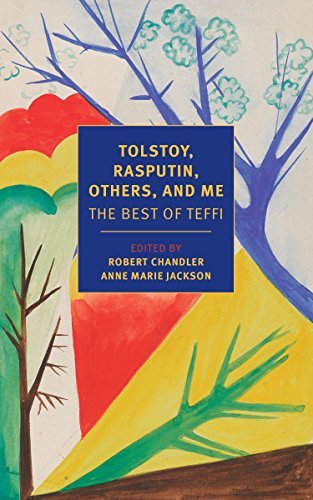
Bloshteyn’s essay is primarily a review of two books that had been recently published, Tolstoy, Rasputin, others, and me: The Best of Teffi and Memories: From Moscow to the Black Sea. The former includes sketches and some of her “best loved short stories”. GoodReads says of it that “in the 1920s and 30s, she wrote some of her finest stories in exile in Paris … In this selection of her best autobiographical stories, she covers a wide range of subjects, from family life to revolution and emigration, writers and writing”. I don’t know whether “The examination” is one of them, but Bloshteyn writes, of the child-themed stories she mentions, that all “show children in the process of getting to know the world around them and finding the means to cope with it”. Manichka, although showing some resourcefulness, has a way to go.

I was thrilled to find this little treasure in Trove, and will try to read more Teffi. Has anyone else read her?

* Read for the 1925 reading week run by Karen (Kaggsy’s Bookish Ramblings) and Simon (Stuck in a Book).

N. Teffi
The examination” [Accessed: 21 October 2025]
in The Australian Worker, 25 November 1925

Alice Dunbar-Nelson, Sister Josepha (#Review)

It’s a year since I’ve posted on a Library of America (LOA) story, but I was driven to post on this one for two reasons. I have just posted a review of “The scapegoat” by Dunbar-Nelson’s first husband, Paul Dunbar, and, earlier this year, I reviewed “A carnival jangle”, written by Alice Dunbar-Nelson, before marriage when she was Alice Ruth Moore.

Alice Dunbar-Nelson

In my post on “A carnival jangle”, I provided a brief biography of Dunbar-Nelson, so I won’t repeat that here, except to remind us that she was a poet, journalist and political activist, born to a black mother and white father. She was prominent in the Harlem Renaissance, and lived in New Orleans for 21 years, as well as Boston, New York, and elsewhere.

In that bio, I also wrote that racism was an important issue for her, but that she also took a wider view of human rights. It is this point that I would like to explore further in this post, due to some ideas raised in LOA’s introduction to her story. They focus quite a bit on her relationship with Paul Laurence Dunbar, noting that the two communicated with each other by letter for a couple of years before meeting. Dunbar asked for her opinion on using “Negro dialect in Literature”, which he sometimes did. LOA shares her response, which was that she saw no problem with using dialect if you knew it and had “a special aptitude for dialect work” but that she saw no necessity to do so just because “one is a Negro or a Southerner”, and if, like her, you were absolutely devoid of the ability to manage dialect“. This makes good sense, but the main thing I want to share is what she says next:

Now as to getting away from one’s race—well I haven’t much liking for these writers that wedge the Negro problem and social equality and long dissertations on the Negro in general into their stories. It’s too much like a quinine pill in jelly—I hope I’m not treading on your corns. Somehow, when I start a story, I always think of my folks (characters) as simple human beings, not as types of a race or an idea—and I seem to be on more friendly terms with them.

After detailing more of Dunbar-Nelson’s biography, LOA returns to the issue of subject matter, saying that “the ambiguity of racial identity for the Creole characters” in her stories resulted in several critics in recent decades arguing that

she “camouflaged the issue of race,” that she “spurned that racialized element of her identity,” or that she “shaped her tales of Creole life for white audiences.” In “Sister Josepha,” which we reprint below as our Story of the Week selection, the reader realizes that the lead character is not white only through descriptive hints (“brown hands,” “tropical beauty”) and by what the other nuns do not say about her.

However, continues LOA, another commentator, Caroline Gebhard had noted in a recent article that Dunbar-Nelson

“presumes that readers already read her work as ‘black.’” In the 1890s and early 1900s, most of Dunbar-Nelson’s stories, essays, and poems appeared in Black newspapers and magazines; The Monthly Review, for example, advertised itself as “the only illustrated periodical published by Negroes in this country.” … “Dunbar-Nelson knew she would be read as a Black author and never tried to pass in print,” Gebhard concludes. “To read Dunbar-Nelson’s fictions as addressing only white readers, which the accusation of passing implies, is to dismiss the fact that Dunbar-Nelson’s first and most loyal readers were African Americans.”

This point reminded me of the discussion my American friend Carolyn and I had about “The scapegoat” concerning the fact that it is almost completely set in the black community. White people are not identified, except for the Judge, so we have to work out, between the lines, who else might be white in that story. I think Paul Dunbar assumed we’d know – just as Alice Dunbar-Nelson did, according to Gebhard. It’s a lesson in how difficult it is to read out of one’s own time and culture.

It also reminded me of something more contemporary, a post I wrote in 2021. The focus was memoir, but the point was that ‘diverse writers’ are expected to write narrowly about their diversity, and their frustration that they are not encouraged to write, as Dunbar-Nelson explained, about “simple human beings, not as types of a race or an idea”.

“Sister Josepha”

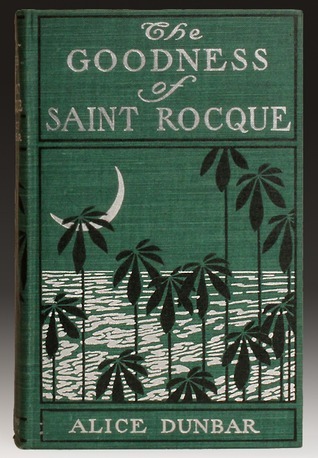
“Sister Josepha” appeared in Dunbar’s 1899 short story collection, The goodness of St Rocque and other stories, and can be read at the link below. It tells the story of a young three-year-old orphan named, Camille, who was left at a convent orphan asylum. The story opens 15 years later when this orphan has just finished her novitiate and is a fully-fledged sister, but she’s unsettled.

Dunbar tells us that when she was 15, and still Camille, she had “almost fully ripened into a glorious tropical beauty of the type that matures early” and had attracted the attention of a couple who offered to take her in. Her Mother Superior calls her in and makes the offer:

Camille stole a glance at her would-be guardians, and de­cided instantly, impulsively, fi­nally. The ­ woman suited her; but the man! It was doubtless intuition of the quick, vivacious sort which belonged to her blood that served her. Untutored in worldly knowledge, she could not divine the meaning of the pronounced leers and admiration of her physical charms which gleamed in the man’s face, but she knew it made her feel creepy, and stoutly refused to go.

To justify her decision to Mother Superior, who did not force her to go, she announces that she loves the convent and sisters, and would like to be one too. However, three years later, the life is palling for this lively young woman. She’s tired, and bored, and plans her escape, but this is a story about the few opportunities available to a young woman in her situation. Should she live the confining but secure life of a nun, or could she make it out in the world where she has no identity, no name other than Camille, and “a beauty that not even an ungainly bonnet and shaven head could hide”.

What lifts this story out of the large body of often cliched stories about young nuns like Camille/Sister Josepha is the situation and Dunbar’s expressive writing that subtly conveys the reality of our sister’s position. Race is never mentioned but there are hints regarding Camille’s background. This is a different story to “A carnival jangle” but no less powerful.

Alice Dunbar Nelson
“Sister Josepha” (1899)
First published: in The goodness of St Rocque and other stories
Available online: Library of America

Paul Laurence Dunbar, The scapegoat (#Review)

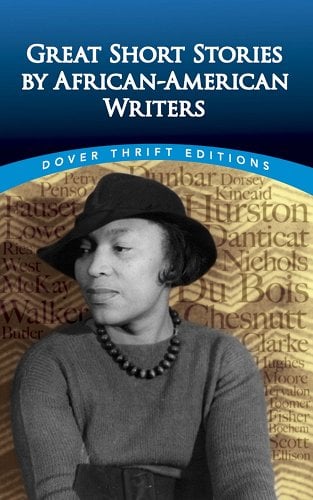
Paul Laurence Dunbar’s short story “The scapegoat” is the fourth in the anthology Great short stories by African-American writers, which my American friend Carolyn sent me. Compared with the previous author, Gertrude H. Dorsey Browne, Dunbar is much better known.

Paul Laurence Dunbar

Paul Dunbar c. 1890, from The African-American Experience in Ohio, 1850-1920, Public domain, via Wikimedia Commons

The biographical note at the end of the anthology provides good background, and Wikipedia has a detailed article on him. Dunbar (1872-1906) was, says Wikipedia, “an American poet, novelist, and short story writer of the late 19th and early 20th centuries”, and “became the first African-American poet to earn national distinction and acceptance”. In fact, it is through his poetry, which is frequently anthologised, that I recognised him when he popped up in the book. He was born in Dayton, Ohio, to parents who had been slaves. Indeed, his father had escaped slavery before the Civil War ended, and fought with the Union Army.

Dunbar, says Wikipedia, wrote his first poem when he was six, and gave his first public recital at nine. Both sources say he was the only African-American in his high school. He was apparently well-accepted, being elected president of the school’s literary society, as well as being the editor of the school newspaper and a debate club member.

Wikipedia provides much detail about his work and publishing history, his health issues (particularly with tuberculosis which killed him), and his failed marriage to Alice Ruth Moore, whose story, “A carnival jangle” (my review), opened this anthology. He was a prolific writer, and was famous for his use of dialect, although he also wrote in standard English. Recognised in his own time, his influence and legacy continues. Maya Angelou titled her book I know why the caged bird sings, from a line in his poem “Sympathy“. But I will conclude with an assessment from his friend, the writer James Weldon Johnson (1871-1938), who wrote in his 1922 anthology, The book of American Negro poetry:

He was the first to rise to a height from which he could take a perspective view of his own race. He was the first to see objectively its humor, its superstitions, its short-comings; the first to feel sympathetically its heart-wounds, its yearnings, its aspirations, and to voice them all in a purely literary form.

We see some of this in the short story chosen for this anthology.

“The scapegoat”

“The scapegoat” is the opening story in Dunbar’s 1904-published collection The heart of Happy Hollow. My anthology describes it as “Dunbar’s story of an ambitious and intelligent young man who sees no reason to sell himself short or accept defeat”. This is accurate, but only half the story.

It is told in two parts, the first before the protagonist Mr Robinson Asbury goes to prison, and the second after his release. The opening paragraph, after referencing the saying that the law is “a stern mistress”, chronicles young Asbury’s fast rise from a bootblack, through porter and messenger in a barber shop, to owning his own shop. The second and third paragraphs describe the story’s setting, the “Negro quarter” of “the growing town of Cadgers”. Here Asbury sets up his barber shop, and attracts customers with his ‘significant sign, “Equal Rights Barber Shop”‘, which our third person narrator says

was quite unnecessary because there was only one race about to patronise the place but it was a delicate sop to the peoples vanity and it served its purpose.

Whatever the reason, he was successful, and his shop became “a sort of club”, where the men of the community gathered to socialise and discuss the news. As a result Asbury soon comes to the notice of “party managers” who, seeing his potential to win them black votes, give him money, power and patronage. This Asbury accepts, and his power and status in the community grows. He then decides he’d like to join the bar, which, with the help of the white Judge Davis, he does.

And so the story continues. With success, he does not “leave the quarter” to “move uptown” as expected, though Judge Davis is prescient:

“Asbury,” he said, “you are–you are–well, you ought to be white, that’s all. When we find a black man like you we send him to State’ prison. If you were white, you’d go to the Senate.”

By now, Asbury’s success is arousing jealousy among his peers, particularly at a local coloured law firm. Two, Bingo and Latchett (great names eh?), are alarmed by Asbury’s fast rise to the top, but his putting out his shingle is “the last straw”. They plan to pull him down, and engage the services of another to lead an opposing faction in the community. However, with the continued help of the “party managers”, Asbury holds the day.

Now politics is messy, and allegiances switch. Along the way Bingo comes over to Asbury’s side. There’s an election, and Asbury’s side wins, but our narrator says:

the first cry of the defeated party was, as usual, “Fraud! Fraud!”

Was there fraud? Certainly there’s intimation of skulduggery, but without evidence it’s decided a “scapegoat” must be found – a big man – and so Asbury is deserted by the party “Machine”, and by his peers including Bingo, and charged. After the jury finds him guilty, Asbury seeks leave to make his statement, which Judge Davis allows:

He gave the ins and outs of some of the misdemeanours of which he stood accused showed who were the men behind the throne. And still, pale and transfixed Judge Davis waited for his own sentence.

It doesn’t come, because Asbury recognises Davis as “my friend”, but he exposes “every other man who had been concerned in his downfall”. He is sent to prison, for the shortest sentence the Judge can give, and is away for ten months, just long enough for him not to have been forgotten and, in fact, to be recognised as “the greatest and smartest man in Cadgers”. (This rehabilitation of Asbury in the eyes of the community while he is absent is just one of the many astute insights Dunbar makes about the way humans think and behave.) Part Two details Asbury’s revenge, but you can read it for yourself at the link below.

“The scapegoat” is a well-written, well-structured story set primarily within the black community, though the “party managers” who want the “black vote” are clearly white. Its main theme concerns political ambition and corruption, and racial oppression. It shows Asbury’s peers working to bring him down, putting their own ambition ahead of the good of the community, and overlays this with oppression by the string-pulling “Machine” uptown. I particularly liked the measured, neutral tone Dunbar employs which, together with his frequent insights into political behaviour and human nature, enables this story to read almost like a fable, a morality tale that says something in particular about this community, about the unfortunate behaviour of people who should support each other, but also something universal about politics and oppression.

It’s unemotional, clever, true – and, unfortunately, still relevant.

Paul Laurence Dunbar
“The scapegoat” (first published in The heart of Happy Hollow, 1904)
in Christine Rudisel and Bob Blaisdell (ed.), Great short stories by African-American writers
Garden City: Dover Publications, 2015
pp. 45-56
ISBN: 9780486471396
Available online (you can find the whole collection at this site)

Gertrude H. Dorsey (Browne), An equation (#Review)

Gertrude H. Dorsey’s short story is the third in the anthology Great short stories by African-American writers, which my American friend Carolyn sent me. It presented an unexpected challenge.

Gertrude H. Dorsey (Browne)

The biographical note at the end of the anthology is one of the shortest provided by the editors. It goes:

Who was Gertrude H. Dorsey Browne? By the evidence of her published work between 1902 and 1907 in Colored American Magazine she was a clever writer of literary short fiction at the turn of the twentieth century; the little romance “An equation” is possibly her first published short story.

She does not appear in Wikipedia, and an internet search found very little, but it did find something, an article published in 2021 by two journalism students, Sarah Barney and Smelanda Jean-Baptiste. They write how an interest in Dorsey was sparked in a Newark reading group in 2017, when they met to discuss ‘a story, a witty romance titled “An Equation”’. Intrigued by the author’s apparent Newark connection, they decided to research her life. They discovered that she was born on 1 August, 1876/77, in Coshocton, Ohio, to Clement Dorsey and Martha Johnson Lucas, and that she died in April 1963 and was buried in an unmarked plot in Cedar Hill Cemetery.

Dorsey graduated from Coshocton High School in 1896, the only African-American student in a class of 11. She maintained honor roll throughout her years and was a member of the school’s Literary Society. While in high school, she had been a sales representative for the Black-owned Cleveland Gazette newspaper, and did this same work when she moved to Newark as a representative for the Colored American Magazine.

Further, the book club found that while Brown (as they spell her name) worked as a sales representative, she also wrote some stories for the magazine. Some was nonfiction but most was fiction, and her writing “often engaged with pertinent issues such as racism and Jim Crow through wry story plots”. They say her stories

transcend, but do not dismiss, class, race, and gender. They often speak to the hidden truths of what makes us human and the pride involved in shielding those commonalities. 

Not much else is known about her life, but the book club women recognised that “Brown had literary talent in a time when graduating from high school was a feat for women, especially Black women, and writing for a leading national magazine was an even greater accomplishment”.

“An equation”

“An equation” was, it seems, her first story. According to Barney and Jean-Baptiste, another story, titled “A case of Measure for Measure,” is about a group of white women who blacken their faces to attend a “blackface ball.” Afterwards, they discover that the paint won’t come off, forcing them to ride in the segregated car on the train, and thus “learn firsthand some hard lessons about racism and class”. 

“An equation” is not so overtly political – perhaps because it was her first – but, whatever the reason, it is a witty romance that slots into that idea of “the hidden truths of what makes us human”. The anthology’s editors say in their Introduction:

All of the stories in part or in whole are necessarily about the human condition, such as Gertrude H. Dorsey Browne’s “An equation”, in which the narrator declares that “the power of loving is not variable”.

It tells of a young 19-year-old woman, Grace, who obtains a job as an assistant to the Principal of her college and as a result meets 26-year-old school inspector, Raymond Turner, to whom she finds herself attracted. The story is told from her point-of-view and progresses through a series of mathematical jokes which start with her describing Turner as an “Unknown Quantity”. Unlike typical romance stories, this romance doesn’t really get off the ground before it seems to be over. In fact, it nearly doesn’t happen at all due to missed communications, hurt feelings and too much attention paid to mathematical theories and concepts like certainties and uncertainties. But, our lovers are brought together at the end and the story concludes with yet another mathematical joke.

Race is not an issue here, and class differences, while evident, are a background factor rather than a major player in the story. It does have interest, however, beyond being an enjoyable story. This relates to the fact that it was published in the Colored American Magazine, which was, according to an article I found, “a Black-owned, -published, and -operated magazine catering to a Black audience”. Tanya Clark, the article’s author, talks about CAM editor Hopkins’ pedagogical intentions for the magazine, which encompassed “challenging the status quo and elevating the race”. However, she also wanted “to provide African Americans with narratives that simply bring them gratification”. This is, I think, where Dorsey’s story comes in. It’s an entertaining and intelligently written story that could be about a romance between any young educated couple. That, of course, is a political point, but it’s subtly made by just being the story it is.

Clark also makes the point that under Hopkins, “CAM was a publishing forum for women writing poetry, fiction, and nonfiction articles”. These women included “seasoned and budding writers, … race leaders who wanted to try their hand at creative writing, … and friends and subscription agents of the magazine” who included Gertrude Dorsey Browne. Clark says “their woman-centered stories honored sisterhood among Black women, showcased Black women’s intellectual capacities, and praised Black women’s desires to work, organize, and fulfill hopes for domesticity”.

“An equation” is one of these “women-centred stories”. The love interest (the “Unknown Quantity”), the romance’s trajectory calling into play questions of probability, and the resolution, draw on mathematical concepts which assume an intelligent, educated readership. It did feel a little clumsy in its exposition, due perhaps to the inexperience of the author, but it has much to offer as an example of African-American writing of the time, besides its being a clever story. I mean, talking of love in such mathematical terms. Who would have thought!

Sources

Tanya N. Clark, “Hagar Revisited: Afrofuturism, Pauline Hopkins, and Reclamation in the Colored American Magazine and Beyond” in CLA Journal, 65 (1): 141-162 (March 2022)

Sarah Barney and Smelanda Jean-Baptiste, “Uncovering a Literary Treasure: Local Book Club Re-discovers Newark’s Gertrude Dorsey Brown”, in The Reporting Project, 20 February 2021

Gertrude H. Dorsey (Browne)
“An equation” (first published in Colored American Magazine, August 1902)
in Christine Rudisel and Bob Blaisdell (ed.), Great short stories by African-American writers
Garden City: Dover Publications, 2015
pp. 36-44
ISBN: 9780486471396
Available online in the digital version: scroll to page 278

Charles W. Chestnutt, Uncle Wellington’s wives (#Review)

Charles W. Chestnutt’s long short story is the second in the anthology Great short stories by African-American writers sent to me by my American friend Carolyn. I have come across Chestnutt before, in the Library of America’s Story of the Week program, but they haven’t published this one and I haven’t written about him before.

Charles W. Chestnutt

The biographical notes at the end of the anthology provide a brief introduction to Charles Waddell Chestnutt (1858–1932), whom they describe as the “first commercially successful African-American writer of fiction”. Born in Cleveland, Ohio, and growing up in North Carolina, he “became a teacher, married, and moved to New York City, before returning to Cleveland, where he studied law”.

Wikipedia, of course, provides more. They describe him as “an American author, essayist, political activist, and lawyer, best known for his novels and short stories exploring complex issues of racial and social identity in the post-Civil War South”. His racial background is interesting, and I will quote Wikipedia here (without the references/links which cite sources for descriptors we no longer use):

His paternal grandfather was known to be a white slaveholder. He identified as African-American but noted that he was seven-eighths white. Given his majority-European ancestry, Chesnutt could “pass” as a white man, but he never chose to do so. In many southern states at the time of his birth, Chesnutt would have been considered legally white if he had chosen to identify so. By contrast, under the one drop rule later adopted into law by the 1920s in most of the South, he would have been classified as legally black because of some known African ancestry, even in spite of only being one-eighths black.

The anthology says that some of his best-known – and popular-at-the-time – stories, reproduced the dialect of uneducated storytellers, and Uncle Wellington is one such. Like this anthology’s first author Alice Ruth Moore, Chestnutt wrote about the color line, oppression, and themes of racism.

“Uncle Wellington’s wives”

I was rather tickled when I started reading “Uncle Wellington’s wives” because it delightfully pairs with the novel I had just read, Percival Everett’s James (my review). It is set post Civil War and satirically deals with the lure of the freedom of the North. The anthology describes it as ‘one of his fine and wry stories about “the Color Line”, a line that had consequential legal and social repercussions’. It tells of Uncle Wellington who, “living in a small town in North Carolina … yearns for something beyond his comfortable home with his impatient, hard-working wife”.

According to Wikipedia, the collection from which this story has been taken, includes many themes explored by 20th-century black writers. One of these, “the pitfalls of urban life and intermarriage in the North”, underpins “Uncle Wellington’s wives”. The story is built around the trope of a disgruntled, and somewhat lazy, husband – the titular uncle Wellington – of a hardworking, practical woman who keeps the show on the road. It opens with uncle Wellington Braboy returning home from a lecture at a meeting of the Union League (see Wikipedia) on the topic of “The Mental, Moral, Physical, Political, Social and Financial Improvement of the Negro Race in America”. It’s a topic, says the narrator, that is common in “colored orators” because “to this struggling people, then as now, the problem of their uncertain present and their doubtful future was the chief concern of life”. But, there was hope, and this speaker had “pictured in eloquent language the state of ideal equality and happiness enjoyed by coloured people at the North”. Indeed, the “mulatto” speaker had “espoused a white woman”.

Chestnutt tells of how the now inspired uncle Wellington goes about getting to the North to experience this land of milk and honey, this seemingly “ideal state of social equality”. He goes to a local lawyer to find out whether his wife’s money is his to control. It is, and it isn’t, he learns in a wonderful discussion of the finer points of law. Later, this issue of law’s finer points comes into play again when, now up North, he wants to get out of a marriage. The satire on the law is delicious.

Indeed, the satire throughout this story is delicious as uncle Wellington comes to appreciate the truth of that adage that “life is not always greener”. There might be more legal equality in the North, but that doesn’t mean people are equal. People don’t change overnight. White people don’t suddenly all treat coloured people as “equal”, regardless of what the law says. Coloured people can’t immediately achieve “equal” jobs, because they don’t have the skills and/or the education and/or the contacts. This is not all spelt out in the story, but it’s apparent nonetheless through what happens to uncle Wellington.

I mentioned at the start that an underlying trope for this story is the disgruntled, lazy, husband of a hardworking, practical woman. However, there are other tropes, including the prodigal son story. There are also other themes, besides racial equality, including that of the problems of illiteracy and poor education. Uncle Wellington’s not being able to read, for example, lays him open to not understanding his rights, or the law, and so on. It doesn’t play out badly here but we see the pitfalls and the risks he faces.

In the end, this story – without spoiling it too much – is not a tragedy. Chestnutt is generous to his protagonist, and so uncle Wellington learns a lesson without suffering too much. We see the truth in his wife aunt Milly’s response to him early on

“I dunno nuffin’ ’bout de Norf,” replied aunt Milly. “It’s hard ’nuff ter git erlong heah, whar we knows all erbout it.”

For aunt Milly, life with the people you know in the place you know is hard enough. This truth is repeated, in a different way, by the coloured Northern lawyer:

“Well, Mr. Braboy, it’s what you might have expected when you turned your back on your own people and married a white woman. You weren’t content with being a slave to the white folks once, but you must try it again. Some people never know when they’ve got enough. I don’t see there’s any help for you; unless,” he added suggestively, “you had a good deal of money.”

For Chestnutt, I understand, there’s the issue of loyalty to your race or people, or, to look at it the opposite way, of racial treason. The point is that there are no simple answers. Life and living are complex. Equality is the goal, but it doesn’t come easily, and it doesn’t come by denying your own. It comes with mutual respect and equal opportunity. These don’t change overnight. The Chestnutt Archive writes that:

As a young educator in Fayetteville, Chesnutt had remarked on the “subtle feeling of repulsion toward the Negro common to most Americans”; and yet he concluded that “the Negro’s part is to prepare himself for recognition and equality.” 

These ideas quietly, without didacticism, underpin “Uncle Wellington’s lives”.

Charles W. Chestnutt
“Uncle Wellington’s wives” (first published in The Atlantic Monthly, 1898)
in Christine Rudisel and Bob Blaisdell (ed.), Great short stories by African-American writers
Garden City: Dover Publications, 2015
pp. 5-35
ISBN: 9780486471396
Available online at ClevelandStateUniversityPressbooks

Kylie Tennant, The face of despair (#Review, #1952 Club)

Once again, as I’ve been doing for most to the Year Clubs, I am using it as an opportunity to read an Australian short story, usually from one of my anthologies. For 1952, however, the anthologies came up empty, but I did find one via AustLit, and then tracked it down in The Bulletin. The story, Kylie Tennant’s “The face of despair”, was first published in 1952, but has, I believe, been anthologised since.

Who is Kylie Tennant?

Kylie (or Kathleen) Tennant (1912-1988) was born in Manly, NSW, and grew up (says the National Portrait Gallery) in an “acrimonious household”. In 1932, she married teacher and social historian Lewis Charles Rodd, whom she had met at the University of Sydney, and they had two children. When Rodd was appointed to a teaching position in Coonabarabran in rural New South Wales, she left her studies and walked 450 kilometres to join him.

This must have worked for her because she did more firsthand research for her novels, taking “to the roads with the unemployed during the 1930s Depression, lived in Sydney slums and with Aboriginal Communities and spent a week in gaol” (NLA’s biographical note). She also worked as a book reviewer, lecturer, literary adviser, and was a member of the Commonwealth Literary Fund Advisory Board.

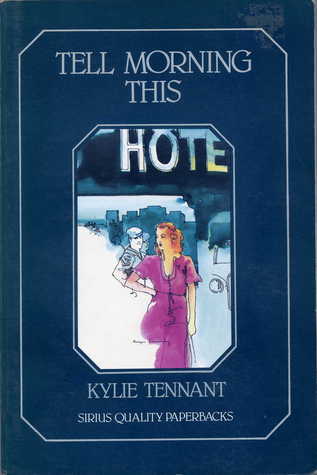
Tennant wrote around 10 novels, including Tiburon (1935); The battlers (1941); Ride on stranger (1943); Lost haven (1946); Tell morning this (1967, which I read with my reading group); and Tantavallon (1983). She also wrote nonfiction (including Speak you so gently, about life in an Aboriginal community), poetry, short stories, children’s books and plays. She won several literary awards, including the ALS Gold Medal for The battlers.

Her Australian Dictionary of Biography entry by Jane Grant says that although the early years of her marriage with Rodd “were complicated by the conflicts between Tennant’s attraction to communism and Rodd’s High Anglicanism, it proved to be an extremely successful creative partnership”. According to Grant, she was briefly a member of the Communist Party in 1935, but resigned a few months later believing the party had lost touch with working-class politics. Grant says that, like slightly older writers such as Vance Palmer and Katharine Susannah Prichard, she believed her novels could ‘educate the public about poverty and disadvantage and change what she termed “the climate of opinion”‘. In other words, she wrote more in the realist style, than the modernism of peers like Patrick White, Christina Stead and Elizabeth Harrower. However, as Grant says “the social message of her novels … was always leavened by humour” – and we also see this in my chosen short story.

“The face of despair”

“The face of despair” tells of a small fictional country town, Garrawong, which, at the story’s opening, had just survived a flood:

WHEN the waters of the first flood went down, the town of Garrawong emerged with a reputation for heroism. “Brave but encircled Garrawong holds out,” a city paper announced, and a haze of self-conscious sacrifice like a spiritual rainbow shone over everyone.

The story has a timeliness given our recent flooding frequency here in Australia. In the third paragraph we are told that “There was a feeling abroad that Garrawong had defeated the flood single-handed” but, a few more paragraphs on, “out of all reason, the rain began again”. Once again the librarians, who had just re-shelved their books, must carry them back out of harm’s way, emitting “small ladylike curses” as they did. But, others weren’t so willing:

“The police began to go round in their duck rescuing the inhabitants; but a strong resistance-movement was developing. They refused to be rescued. They had had one flood—that was enough.”

The story is timely, not only for the recurrent flood issue, but for its description of what is now recognised as “disaster fatigue”. Some residents, like the Doctor, don’t believe it will be as bad as before, that the dam won’t break this time, so they refuse to properly prepare or to accept rescue offers. Others, like the Nurse who runs a maternity home, just can’t do it again. She tells her housekeeper, “I’ll shut the place. I can’t start again, I won’t. No, not again.”

Now, when I was researching Tennant for my brief introduction to her, I found a 2021 article in the Sydney Review of Books. It was by poet and academic Julian Croft and focused on her novel Lost haven. It was published in 1946, just a few years after her best-known books, The battlers and Ride on stranger, but a few years before this story. He writes that Margaret Dick who had written a book on Tennant’s novels in 1966

saw Lost haven as a maturing step away from the ‘austerity’ of Ride on stranger towards ‘a resurgence of a poetic, instinctive response to nature and a freer handling of emotion, an unselfconscious acceptance of the existence of grief and despair’. This was a necessary step towards the maturity of what Dick considered Tennant’s best novel (and I would agree) Tell morning this.

I share this because “The face of despair”, published in 1952 – that is, after Lost haven and before 1967’s Tell morning this – feels part of this continuum. It has such a light touch – one I could call poetic, instinctive, freer – yet doesn’t deny the truth of the situation and what it means for the residents of Garrawong. Tennant uses humour, often lightly black, as she tells of the various reactions – stoic, mutinous, resigned, defeated – from householders, nurses, farmers, shopowners, not to mention the poor rescue police (who “did not seem to realise that they were now identified with the flood, were part of it, and shared the feelings it aroused”). It reads well, because it feels real – with its carefully balanced blend of adversity and absurdity.

Early in the story, the narrator writes of those who felt “mutinous”, who “refused to shift” as they had in the previous flood, adding that

… in the face of this renewed malice there was no heroism, only a grim indignation and a kind of dignity.

Towards the end, the title is referenced when Tennant decribes how “the face of despair” looks in different people as they ponder the flood’s impact. For example, “in the farmer in the thick boots it was the foam in which he had wiped his feet”, but in the poor old vagrant woman, it is “blue lips”. Tennant follows this with:

Despair does not cry out or behave itself unseemly, despair is humble. Its face does not writhe in agony. There is no pain left in it, because it is what the farmer said it was —“The stone finish.”

There is more to the story, and it’s not all grim. Rather, as Dick (quoted above) wrote, there’s “an unselfconscious acceptance of the existence of grief and despair”, and, as the last line conveys, one that encompasses a survivor spirit despite it all. A great story.

* Read for the 1952 reading week run by Karen (Kaggsy’s Bookish Ramblings) and Simon (Stuck in a Book).

Kylie Tennant
The face of despair” [Accessed: 16 April 2025]
in The Bulletin, Vol. 73 No. 3791 (8 Oct 1952)

Frank Dalby Davison, Dusty (#BookReview)

It’s a strange coincidence that my second review for Bill’s Gen 1-3 Aussie male writers week is for a novel titled Dusty, when my first was for a short story titled “Dust”. One of those funny little readerly synchronicities. The title, however, is about the only synchronicity because, although both stories allude to the dusty Australian landscape, Casey’s short story is about miners’ lung dust disease while Davison’s novel is about a part-kelpie part-dingo named Dusty.

A bit about Frank Dalby Davison

Davison (1893-1970) was best known as a novelist and short story writer, and was a significant figure in Australian literary circles of his time. There are useful articles for him in Wikipedia, and the Australian dictionary of biography, and I plan to devote a Monday Musings to him soon. Meanwhile, as background to this post, it’s relevant to say that he was born and schooled in Melbourne, but left school in his early teens to work on his father’s farm near Kinglake. The family moved to the United States in 1909, when he was 16. After working there in the printing trade, he travelled more, eventually enlisting for World War 1 in England. After the war, he took up a Soldier Settlement selection near Injune, in central western Queensland. 

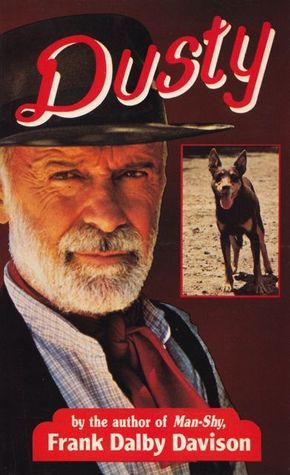
Davison wrote several novels, but his best known is probably Man-shy (1931), which won the Australian Literature Society Gold Medal. Featuring a red heifer, it was my introduction to Davison in my first year of high school in the 1960s. Dusty (1946) is also about an animal – this time a dog – and has been in my sights for some time. Both novels drew on his experiences in Injune. AustLit reports that the manuscript of Dusty, ‘entered under the title “Stranger”, and the pen-name “Tarboy”, won the Melbourne Argus and Australasian Post 500 pound Novel Competition in 1946′. 

Dusty

At the end of my edition of Dusty is a promotion for Man-shy which quotes from H.M. Green, the literary historian who inspired Bill’s “generations”. Green writes:

Although other novelists have made animals their principal characters and drawn them realistically, Davison is the first to make a serious attempt to get inside their minds. The red heifer and the mob of wild cattle to which she belongs stand for the spirit of freedom and dogged, untameable resistance; their struggle is made extraordinarily real to us … Davison has a genuine and individual talent.

This could equally apply to Dusty, which tells the story of a dog, sired by a kelpie to a dingo mother. Violently wrenched from his lair when he was a few weeks old, he is sold to a decent man, a bushman named Tom. Tom is no fool. He recognises the mixed blood, but also sees potential in the pup, and trains him to become a champion sheep dog. Their bond is strong but is tested when Dusty’s “dingo blood” starts asserting itself, and he turns sheep-killer by night. This will not do, and Tom knows it. The novel, however, does not play out quite the way you’d expect, and we are left guessing until the end about what will, indeed, happen to Dusty.

That’s the plot, but like many plots it doesn’t tell you much about what the book is really about, or what makes it a good read. Told in three parts, Dusty is a realist novel, detailing life on Australian sheep stations and cattle properties, and told mostly through the perspectives of Tom and Dusty. Yes, you heard right, Dusty, the dog. I was completely engaged because not only is there none of the sentimentality common in stories about a man and a dog, but there’s also nothing anthropomorphic in the dog’s point-of-view. He feels pure dog, which I thought quite a feat. Early on, for example, Tom, having previously given Dusty his dinner without ceremony, puts the food down and starts some training:

Then followed a series of mystifying events. A hand appeared just above the dish and twitched, giving forth a series of soft snapping sounds; then there was a little soft whispering, and then a voice that, like the hand, kept repeating a small noise over and over again. He could make nothing of it …

This dog’s-eye view of the world, based on his experiences to date, continues through the novel.

Soon, though, bigger issues are at play involving the two parts of Dusty’s being, “the ancient battle between conflicting heredities, and between early influence and present environment; the mother against the father, nature against art”. Then Davison adds something interesting. The dingo is the product of nature, while the kelpie, the working dog, is “a product of art”. But, Davison adds, “nature, if man fails in toil or vigilance, hastens to reclaim her own”.

In other words, beneath this deeply interesting story about a man, his dog and outback farming, is a wider story about “nature”, or the essence of our beings. Contained within Dusty is the struggle between the two forces – that of freedom, of following his instinct, and that of living by his training, by rules and responsibilities. After Dusty’s dingo side becomes apparent to all, Tom knows what must be done but chooses to change his life rather than kill his dog. He becomes a self-employed possum scalper in cattle country, and finds, “without meaning any ingratitude for past kindnesses”, that he relishes his new situation in which he is invited to share a meal as “a guest and not just the hired man”. In other words, as a possum scalper, Tom is freer to be his own man.

But, while I think Tom’s life is part of this wider theme, the main focus is animals, and the idea that, in them, “is a whole scheme of values outside those familiar” to us.

There is no easy ending for Tom and Dusty, and we are left, three paragraphs from the end, with a dingo howl, “a cry of mournfulness and dark mirth, of drollery and love and hate and longing, of the joy and sorrow of life, of the will to live, of mockery and despair”.

Dusty is not a didactic book. There is no moralising, no subjective pronouncements about choices. Instead, with its objective tone, and plain but expressive prose, it feels more elemental, something that examines the essence of who we are and what we do to live. And that makes it feel timeless.

Frank Dalby Davison
Dusty
Sydney: Angus & Robertson, 1983 (Arkon ed., orig. 1946)
244pp.
ISBN: 0207133891


Alice Ruth Moore, A carnival jangle (#Review)

Over the last two years I worked my way through the anthology Great short stories by contemporary Native American writers that was sent to me by my American friend Carolyn. It introduced me to many writers I hadn’t read before, and, valuably, to the issues and concerns facing some of America’s first peoples. Many of these issues – such as identity, and the long-lasting, all-encompassing fallout from dispossession – overlap with the issues First Nations Australians are confronting. It was an excellent reading project, so I was thrilled when, a year ago, Carolyn sent me another Dover anthology, Great short stories by African-American writers. I’ve read a few more of these authors than I had of the Native American collection, but not many, so I’m looking forward to another worthwhile reading project. Thanks again, Carolyn!

Alice Ruth Moore

The first thing to say about Alice Ruth Moore is that she is better known as Alice Dunbar Nelson, which is the name Wikipedia uses. Born Alice Ruth Moore in New Orleans in 1895, she married three times – Paul Laurence Dunbar (1898–1906), Henry Arthur Callis (1910–1916), and Robert J. Nelson (1916–1935). Poet Dunbar died in 1906, but it had been an abusive relationship and she’d left him before his death. Her marriage to physician and professor, Callis, ended in divorce, and she did not it seems take – or keep – his name. Her final marriage was to poet and civil rights activist, Nelson, and this marriage lasted for the rest of their lives. His name she used, but she also retained Dunbar. Fascinating.

A poet, journalist and political activist, Dunbar Nelson, who had a black mother and white father, was among the first generation born free in the South after the Civil War. She was also one of the prominent African Americans involved in the Harlem Renaissance (about which I wrote in my post on Nella Larsen’s Passing.) She lived in New Orleans for 21 years, and briefly taught primary school there, before moving to Boston and then New York, where she co-founded and taught at White Rose Mission, a school for coloured working girls (in the non-euphemistic meaning of the term!) She also lived in Washington D.C., Delaware and Pennsylvania.

Racism was an important issue for her, but she also took a wider view of human rights. She was an activist, for example, for African American’s rights and women’s rights. By the 1920s, she was concerned about social justice and the struggles of minorities in general. Wikipedia’s article concludes with this:

Much of Dunbar-Nelson’s writing was rejected because she wrote about the color line, oppression, and themes of racism. Few mainstream publications would publish her writing because they did not believe it was marketable. She was able to publish her writing, however, when the themes of racism and oppression were more subtle.

“A carnival jangle”

“A carnival jangle” appeared in her first collection of stories and poems, Violets and other tales, which was published by The Monthly Review in 1895, while she was still in New Orleans. She wrote a brief, self-deprecating introduction to the collection, commenting on the number of books being foisted on the market, and then offering her “maiden effort, — a little thing with absolutely nothing to commend it, that seeks to do nothing more than amuse”. Many of “the sketches and verses” had appeared in before, but many others were new.

There is also a preface by Sylvanie F. Williams (d. 1921) whom Wikipedia describes as New Orleans-based “educator and clubwoman“. (Click on the link to find out more about the women’s club movement in the USA.) She says the author ‘belongs to that type of “brave new woman who scorns to sigh”, but feels that she has something to say, and says it to the best of her ability”. However, she is also young, “just on the threshold of life, and with the daring audacity of youth makes assertions and gives decisions which she may reverse as time mellows her opinions, and the realities of life force aside the theories of youth”. Love this.

Williams also writes that “there is much in this book that is good; much that is crude; some that is poor”. I haven’t read any Moore/Dunbar Nelson, so I have no way of knowing where “A carnival jangle” sits in terms of her oeuvre, but it certainly feels like a standout in this collection.

Set during New Orleans’ Mardi Gras festival, “A carnival jangle” is fundamentally a mistaken identity story. It is just 4 pages, but delving into it – as the podcasters at CodeX Cantina did – reveals an impressively complex story offering multiple readings. I don’t usually go looking for analyses before I write my posts, but I came across CodeX Cantina when I was researching who Moore/Dunbar Nelson was. I’m glad I did because they teased out some culturally specific aspects that I didn’t know. For example, I completely misread the use of “Indians” in the story. These are the New Orleans or Mardi Gras Indians – an African-American carnival subculture, not Native Americans.

The story opens:

There is a merry jangle of bells in the air, an all-pervading sense of jester’s noise, and the flaunting vividness of royal colors; the streets swarm with humanity, — humanity in all shapes, manners, forms, — laughing, pushing, jostling, crowding, a mass of men and women and children, as varied and as assorted in their several individual peculiarities as ever a crowd that gathered in one locality since the days of Babel.

It’s tight and short, and tells of a young girl named Flo, who, hovering “between childhood and maturity”, is drawn away from her “unmasked crowd” by a “tall Prince of Darkness”, “a shapely Mephisto”, who promises to “show [her] what life is”. She is swept away to a costume shop and disguised as a “boy troubadour”, before joining the masked dancers – but things don’t turn out the way she is promised.

The two podcasters discussed “the tower of Babel”, which is alluded to in the opening paragraph and which suggests the idea of people coming together, until all falls apart, and the Faustian bargain, which is implied through the narrative and which presages a promise not fulfilled. The masked society can be understood as one in which all are equal, regardless of race or gender. However, masked people can also be invisible, unknown, and this tension between freedom and danger underpins this story.

The language is vibrant and lush capturing the excitement of the carnival, but is also constantly subverted by references and allusions to darker things. Carnivals, after all, tend to encompass opposing ideas – fun versus pandemonium, humour versus derision. The revellers here include “jesters and maskers, Jim Crows and clowns, ballet girls and Mephistos, Indians and monkeys…”, an odd and unsettling assortment which reflects not only traditional carnival characters but the diversity of New Orleans, and the racial tensions developing as Jim Crow laws were being enacted. Moore’s New Orleans is a place in flux, and the carnival motif is a perfect vehicle for conveying that.

The CodeX Cantina podcasters don’t talk much about Flo, and the fact that we don’t know what she wants or thinks. Described as “the quietest and most bashful of the lot” when she is drawn away, she seems to have no choice or agency in what happens to her. Is this because she’s simply a tool in the wider story, or is there a comment on gender, or both? What does it mean that she’s white?

“A carnival jangle” is a sophisticated story about a complex place and time, written by someone who was just starting her writing journey. It warrants more teasing out than I’ve done here, because it has so many angles to think about. Do read it, and, if you have time, listen to the CodeX guys. They don’t have all the answers but they do some good thinking.

Alice Ruth Moore
“A carnival jangle” (1893)
in Christine Rudisel and Bob Blaisdell (ed.), Great short stories by African-American writers
Garden City: Dover Publications, 2015
pp. 1-4
ISBN: 9780486471396
Available online at louisiana-anthology.org

Gavin Casey, Dust (#Review)

I have had to put aside the novel I was reading for Bill’s Gen 1-3 Aussie male writers week, as my reading group book called. I will get back to it, and post on it later, but in the meantime, I wanted to post something in the actual week.

So, I turned, as I have for other Reading Weeks, to The Penguin century of Australian stories, an excellent anthology edited by Carmel Bird. Given Bill’s week encompasses writers working from 1788 to the 1950s, Bird’s anthology offered almost too many choices. Besides the obvious Henry Lawson, there were Steele Rudd, Tom Collins, Vance Palmer, and more, ending with Judah Waten’s 1950 story, “The mother”. I considered several, but Gavin Casey captured my attention because in her Introduction to the anthology, Kerryn Goldsworthy, looking at the 1930s and 40s, commented that Gavin Casey’s “Dust” and John Morrison’s “Nightshift” exemplified the more overtly political stories of this era. She added that:

they are stories in simple, unadorned language … that focus on workers and workplace disasters, on the physical dangers lying in wait for working men and women.

I have been interested in this period – and its socialist-influenced political thinking – for some time, so it had to be Casey or Morrison. Casey it was because I have listed him in a couple of Monday Musings posts but knew nothing about him.

Who was Gavin Casey?

Casey (1907-1964) was an author and journalist, born in Kalgoorlie, Western Australia, to an Australian-born father and Scottish mother. 

He doesn’t have a Wikipedia article but there is a useful biographical entry for him in the Australian dictionary of biography (ADB). Written by Anthony Ferguson, it says he had a sketchy education before obtaining a cadetship with the Kalgoorlie Electric Light Station. However, he left there to work in Perth as a motorcycle salesman, only to be “forced” back to Kalgoorlie in 1931 by the Depression. He then worked “as a surface-labourer and underground electrician at the mines, raced motorcycles and became a representative for the Perth Mirror“. He married in 1933, but “poverty plagued them, long after their return to Perth next year”.

By 1936, he was publishing short stories in the Australian Journal and the Bulletin, and in 1938 he was foundation secretary of the West Australian branch of the Fellowship of Australian Writers. His two short story collections – It’s harder for girls (1942), which won the 1942 S. H. Prior memorial prize and in which “Dust” appeared, and Birds of a feather (1943) – established his reputation. Ferguson writes:

Realistic in their treatment of place and incident, his stories showed—beneath the jollity and assurance of his characters—inner tensions, loneliness, unfulfilled hopes, and the lack of communication between men and women.

You may not be surprised to hear that his first marriage failed!

Overall, he wrote seven novels plus short stories and nonfiction works. His novels include Snowball (1958), which “examined the interaction between Aborigines and Whites in a country town”, and Amid the plenty (1962), which “traced a family’s struggle against adversity”. There is more about him in the ADB (linked above).

Ferguson doesn’t specifically address the political interests Goldsworthy references. Instead, he concludes that critics liken Casey’s earlier works to Lawson, seeing “a consistent emphasis on hardship that is tempered, for the male at least, by the conviviality of mates”. Ferguson also praises both for “their perceptiveness” and “their execution”.

The reality of Casey is a bit more nuanced, I understand. For a start, his men are not bush-men but suburban workingmen. Consequently, I plan to write more on him in a Monday Musings Forgotten Writers post, soon. Meanwhile, on with “Dust”.

“Dust”

“Dust” features male characters only, and there are some mates but, while they are important, they are not central. “Dust” also must draw on Casey’s experience of working in Kalgoorlie’s mining industry. It’s a short, short story, and is simply, but clearly constructed. It starts with a physical description of dust swooping through the township, over housetops and hospital buildings, and “leaving a red trail wherever in went”. It sounds – almost – neutral, but there are hints of something else. Why, of all the buildings in town, are “hospital buildings” singled out with the “housetops”, and does the “red trail” left behind signifiy anything?

Well, yes it does, as we learn in the next paragraph. Although this dust comes from “honest dirt” and can do damage like lifting roofs off, it is “avoidable” and is nothing like the “stale, still, malicious menace that polluted the atmosphere of far underground”. Ah, we think, so the “dust” we are talking about is something far more sinister than that flying around the open air.

And here is where the hospital buildings come in. Protagonist Parker and his miner friends are waiting for their six-monthly chest x-rays checking for the miners’ dust lung disease which killed his father. Things have changed since his father’s times, Parker knows. Not only are there the periodic medical examinations, but there are mechanisms to keep the dust down, and a system of “tickets” and pensions for affected miners. But, the risk is still there, and Parker’s anxiety increases as he watches his mates go in one by one, while he waits his turn.

This is a story about worker health and safety – but told from a personal not political perspective. It’s left to the reader to draw the political conclusions. However, it is also a highly relatable story about humans, health, and risky choices and behaviour, because it seems that Parker does have a choice. I won’t spoil it for you, but simply say that the ending made me smile – ruefully.

Gavin Casey
“Dust” (orig. 1936)
in Carmel Bird (ed.), The Penguin century of Australian stories
Camberwell: Penguin Books, 2006 (first ed. 2000)
pp. 86-90

Sherman Alexie, War dances (#Review)

Sherman Alexie’s “War dances” is the fourteenth and last story in the anthology, Great short stories by contemporary Native American writers. It is also the longest story in the book, and the most intriguing in form.

Sherman Alexie

Anthology editor Bob Blaisdell introduces Alexie as “born in 1966, of Coeur d’Alene and Spokane heritage”, meaning he is from US’s Pacific northwest. Describing Alexie as the “most colloquial” of the writers in the anthology, Blaisdell also says that he writes “with a confessional voice that is often humorous”. Not surprisingly, given Alexie is a contemporary and award-winning author, Wikipedia provides quite a lot more, too much in fact to share here in even summary form, so click on the link if you are interested. There are personal and political controversies there, as well as several literary awards.

Essentially, though, Wikipedia describes him as “a Native American novelist, short story writer, poet, screenwriter, and filmmaker”. And, citing a couple of sources, Wikipedia says this about his themes:

Alexie’s poetry, short stories, and novels explore themes of despair, poverty, violence, and alcoholism in the lives of Native American people, both on and off the reservation. They are lightened by wit and humor. According to Sarah A. Quirk from the Dictionary of Library Biography, Alexie asks three questions across all of his works: “What does it mean to live as an Indian in this time? What does it mean to be an Indian man? Finally, what does it mean to live on an Indian reservation?” The protagonists in most of his literary works exhibit a constant struggle with themselves and their own sense of powerlessness in white American society.

“War dances”

“War dances”, as I wrote above, has an intriguing form. Blaisdell writes in his introductory Notes for the anthology that “we feel as if the writer [Alexie] is discovering the story himself and extending conventional short story boundaries as he composes it: we encounter an interview a checklist, a poem, a critique of that poem and continual jokes and revelations”.

Now, as far as I can tell, the “story” titled “War dances” comes from a book of short stories of the same name. It won the PEN/Faulkner Award for Fiction in 2010. GoodReads’ entry for the book describes it as “a virtuoso collection of tender, witty, and soulful stories that expertly capture modern relationships from the most diverse angles.” My problem is that I don’t know whether the “story” in Blaisdell’s anthology is a coherent excerpt from this book, or whether Blaisdell has selected disparate pieces to represent the work as a while. Whichever it is, I found an online version in The New Yorker. It comprises essentially the same content, with just a few differences that suggest some editing has happened between the versions. Also, in Blaisdell’s book the short pieces are numbered 1 to 16, while in The New Yorker they are not. None of this is probably germane to my comments so I’ll say no more. Consider yourselves informed!

I thoroughly enjoyed reading this piece (these pieces). The quotes I’ve shared about his work all ring true from what I read here – the mix of forms (lists, poems, interviews, and so on), the wit and humour, the “diverse angles”. It is a work that draws from Native American experience, but that encompasses wider personal and political issues.

By personal issues, I mean his dealing with significant familial relationships, and by political, I mean his recognition that Native Americans don’t exclusively suffer from the socioeconomic (including health) ramifications of racial discrimination. While the pieces seem disparate, there is an overall narrative arc concerning the narrator’s own health – he is diagnosed with a meningioma – and his father’s. There are also recurring motifs which connect many of the pieces – insects, like Kafka’s bug (or cockroach), being one. Here is a scene from the first person narrator visiting his father in hospital. You can see the pointed use of bees here:

How had this change happened? For the first sixty-seven years of his life, my father had been a large and dark man. And now he was just another pale and sick drone in a hallway of pale and sick drones. A hive, I thought, this place looks like a beehive with colony collapse disorder. (4, Blankets)

The imagery here is clear, but not laboured. Alexie doesn’t, in general, labour his points but lets humour do the talking. The second last piece comprises questions for his dying father, the first one being

True or False?: when a reservation-raised Native American dies of alcoholism it should be considered death by natural causes. (15, Exit Interview for My Father)

There are many references to race, and to its construction by other in the determination to distinguish and separate, while for our narrator, no such distinction truly exists:

And then I saw him another Native man … Well, maybe he was Asian; lots of those in Seattle. He was a small man, pale brown, with muscular arms and a soft belly. Maybe he was Mexican, which is really a kind of Indian too, but not the kind that I needed. It was hard to tell sometimes what people were. Even brown people guess the identity of other brown people. (4, Blankets)

This is followed by a self-deprecating racist joke … the reason a Mexican was not the kind of Indian our narrator needed was because he was looking for a blanket for his shivering, hospitalised father, and, well, Indians do blankets don’t they! The dialogue with the man, who is indeed Indian, is priceless.

So, these pieces build up. Entertaining to read, with their varied forms and chatty but cleverly humorous style, they convey specific truths about racism, and larger ones about identity, change and loss. In terms of this work at least, I’d say Sarah Quirk’s above-quoted three questions nail it. “War dances” – including for its very title – makes a worthy conclusion to this anthology.

(Thanks to Carolyn for this book.)

Sherman Alexie
“War dances” (orig. pub. 2009)
in Bob Blaisdell (ed.), Great short stories by contemporary Native American writers
Garden City: Dover Publications, 2014
pp. 104-127
ISBN: 9780486490953

Available online, with some differences, at The New Yorker (August 10 and 17, 2009)