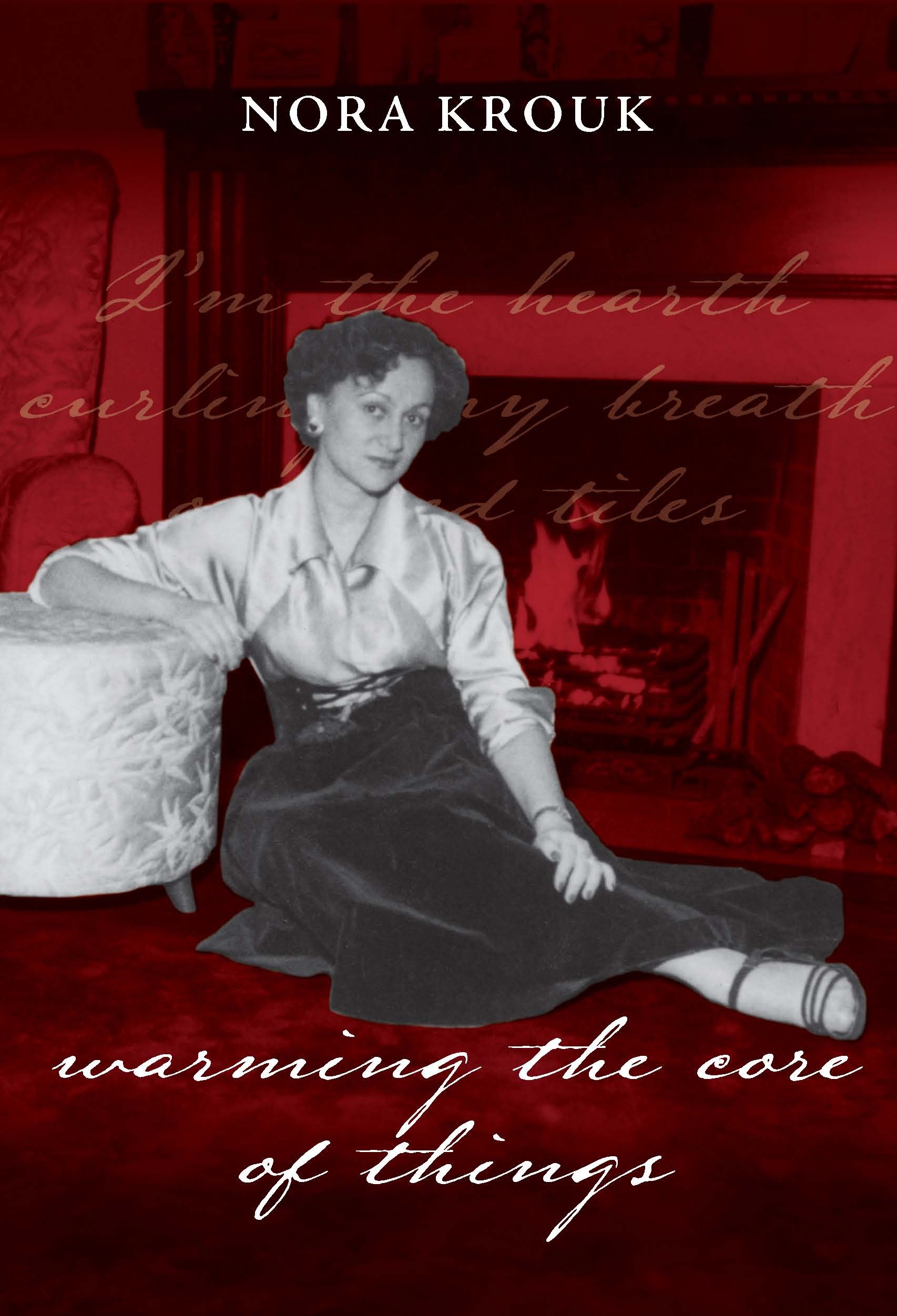
Nora Krouk, Warming the core of things

Nora Krouk, Warming the core of things, book cover

Nora Krouk, Warming the core of things (Image courtesy Hybrid Publishers)

life wrapped in bundles
of painful joy
(from “Skies will be luminous”)

The reason I like to read poetry is the obvious one – the way poets can capture a feeling or idea in just a few carefully chosen words that are presented through a controlled rhythm. Nora Krouk fills this bill nicely!

I hadn’t heard of Krouk before this book came to my attention … but she’s been around for a while. In fact, she’s 90 years old and has been in Australia since 1975. She is the daughter of a Polish Catholic father and a Jewish mother. She was born in China, married in Shanghai and lived in Hong Kong before emigrating to Sydney. She was educated in Russian schools and has written poetry in Russian and English. She has been published internationally, and has won several awards. Phew! I don’t usually provide such detail about authors, but it seems appropriate to do so here.

The collection is organised into three sections, and the order of these sections is interesting: In memoriam, Renewals, Transitions. I like the way it moves from death, through awakenings and rebirths, to change accompanied by uncertainty. This order keeps us on our toes. It offers no easy conclusions to the challenges posed in the first section but neither does it suggest hopelessness as the reverse order might have.

The poems are, for the most part, very accessible. Elizabeth Webby is quoted on the back of the book as saying that the poems “will appeal to both those who usually read poetry and those who don’t”. I’m in the middle ground here – I like to read poetry but don’t read it often enough – and I think Webby is right. Many of the poems have stories – seemingly about people Krouk knows – and those stories speak to the ordinary things of life which, for someone of Krouk’s age, include memory, aging, loss and death. These things are explored with a sense of enquiry and some resignation, rather than with a railing and ranting. The poems move between her daily life and historical events (some of which she or her family experienced), particularly the horrors that occurred under Hitler and Stalin.

I commenced this review with two lines from a poem in the Renewals section because they encapsulate what seems to be Krouk’s philosophy: Life is not easy, she’s saying, but there is much to enjoy and wonder at. The first poem in the book is a widow’s poem. It speaks of grief, but it also introduced me to something interesting about her poetry, what Anna Kerdijk Nicholson describes on the back of the book as her “idiosyncratic rhythm and lineation”:

I don’t weep much.     I read
and write     even cook     then
catch myself and return to you
(from “Fima (1914-2008)”)

These spaces in her lines control, force even, the rhythm for the reader. They allow us to breath, to feel the sense of the words and, in a way, they provide a more intimate, conversational tone to the work. They slow us down and prevent us from rushing through the poems.

Aging and memory, as I’ve already mentioned, are recurrent themes in the collection.  Memory, though, is a pretty broad church, and Krouk explores it in its various guises – from loss of memory to remembering the (often painful) past:

They chase a name
a thought     an event
(“The couple”)

It’s different for us
we have no grave
He was last seen
in the prison yard
(from “For Leon K” who died under Stalin’s regime)

But not all the poems are about challenge. There are lighter poems, and there is humour. I loved her short poem about a young smiling woman:

A smile is hovering over our street
a light funny quizzical smile
It slipped off her lips
brushed past the creamy cheek

dripped over a sunny wattle and stayed.
(from “A young woman”)

Much of her imagery is domestic, everyday. There are family dinners and bridge afternoons with friends. Jacarandas and gums, camellias and lavender feature, grounding her poetry in her Australian life. But, there are also allusions to things literary (such as Shakespeare and Tolstoy) and political/historical (as mentioned earlier), which confirm her as a poet of universal concerns.  Some of her poems combine the Australian and the political – such the example below, which demonstrates that she is capable of more than a little irony:

Where do we turn Matilda     Lead the dance
As promised in the anthem     we advance
(from “Sorry”)

There are also a few specifically religious poems, but I found some of these (“Widowed a hundred times”, and “I am not envious Lord”) a little too melodramatic for my liking, while others, such as her meditation on snakes (“Snakes are much maligned”), engaged me. Poetry, as I’ve said before, is such a personal thing.

Krouk has lived long and experienced much. There are many more poems I’d love to excerpt – and maybe I will in a future post. Meanwhile, I can’t think of a better way to summarise this book than through her own words:

Under the skies     luminous
things drop
(from “Skies will be luminous”)

Nora Krouk
Warming the core of things
Melbourne: Hybrid Publishers, 2011
126pp.
ISBN: 9781921665431

(Review copy supplied by Hybrid Publishers)

Ginny Jackson, The still deceived

Brother Gums and his partner, who live in our southernmost state, Tasmania, often give me books by local writers, many of whom I may not easily come across on “the mainland”. Their offering last Christmas was one of these, The still deceived, a collection of poems by Ginny Jackson. It was published by one of Australia’s wonderful, small independent presses, the Ginninderra Press. Tragically, Jackson died before the book was launched, though she did, I am told, see a copy. The cover image is a somewhat cryptic lithograph titled “High noses” by Jackson – a talented woman clearly – and the cover design is by her son Evan Dowling.

The title is that of the last poem of the book, and it puts a seal on the overall theme of the collection which has to do with the challenges we humans face in trying to understand, to make sense of, the life we find ourselves in. The last three lines are:

Even the less deceived
don’t seem to get it –
mortality, eternity.

There is a melancholic (“the slow crank of a melancholic tune”), even bleak, thread running through the poems. I don’t think this means that all the poems were written in the shadow of her imminent death. However, the last poems in the book do confront mortality head on, which could suggest that the 65 poems are presented chronologically in the order they were written. But maybe not. The idea of death is also a logical way to conclude a collection that deals, as this one does, with the challenges of existence.

And so to look at the collection a little more closely. The first poems could be loosely described as vignettes from a life though they are not so much about particular experiences as about the ideas and feelings engendered by the things we experience. The first poem, “Scientific method”, rather archly sets the scene for her exploration of the ways we humans misunderstand or misinterpret the things we see and experience:

When you’re first sent to the frontier

the sketches you bring back
will really be of your own world

and in doing so we “miss the hum of truths”.

The middle poems are about life cycle – about love, pregnancy, motherhood, and middle age, and about aging relatives. Some of her lightest poems are here, such as in her descriptions of babies (“Joy comes combing up your limbs” in “Baby love”) and children. “Domestic” conveys the monotony of housework in a nursery-rhyme-like jingle: “In the kitchen with the grimy doors/the pot is calling the kettle black”.

Moth (Courtesy: Myriorma, from flickr, using CC-NC-BY-SA 2.0)

Moth (Courtesy: Myriorma, from flickr, using CC-NC-BY-SA 2.0)

And then of course are the final poems which deal very specifically with death. I particularly like “Getting off the bus”:

It’s hard to get off right,
with dignity, it’s hard to leave
as they pull off from the curb,
a swaying cargo, brightly lit
of all the living, trundling on,
into their future lives.

What a devastatingly apposite image. And “Moths” whose behaviour is described as:

Like the story of this life
which flings itself at timelessness
while overhead the speedy flash
of multiple sunrises clash
with quick uncomprehended dusks.

There is a welcome and refreshing variety in the poems – in form and tone, as well as in subject. She uses rhyme at times – including, even, rhyming couplets – which provides a lovely change of pace. Much of her imagery draws from nature (“even the flight of a bee/forms a tacking jig with destiny”) and several poems describe Tasmania albeit often contrasting the power and permanence of nature (“and yet the tree’s roots grasp the rock,/the sea forever smashes on the shore”) with change wrought by humans (“where forests, still, are daily trashed”) and “our insect brevities”. But then there’s the occasional more industrial image, as in “Metal”. There are poems that don’t quite work, which may be because the image is too obscure or the logic not quite right, or simply because the connections don’t work for me. Poetry is such a personal thing. I enjoyed this collection for its world view, its intriguing imagery and the challenges it offered me.

I’m tempted to compare Jackson with Dorothy Porter who put her collection, The bee hut, together as she, too, was dying of cancer, but they are different. There’s more action and anger, and, paradoxically, also more joy in Porter’s poems, than in Jackson’s quieter, more resigned poems which see humans as either powerless (at best) or foolish (at worst). I’ll end though on a positive image. It’s a poem (“On planting”) praising trees, and it ends thus:

I wish we could all be as loyal.
If we could talk
only as that bright rush of leaves,
a haze of sun or moonlight
on our heads, softly embracing
one another and the sky.

If indeed …

The still deceived
Port Adelaide: Ginninderra Press, 2010
72pp.
ISBN: 9781740276122

Weekends with T.S. Eliot (2)

Jeanette Winterson (b. 1959), British writer

Jeanette Winterson, 2005 (Image: Courtesy Mariusz Kubik, via Wikipedia using CC-BY-SA 3.0)

We are all everyone and everyone is us. (Fiona Shaw, talking about The waste land)

Last weekend I finished the Perspectives section of The waste land app, by listening to Fiona Shaw, Frank Turner and Jeanette Winterson. The fascinating thing is that they all say the same things, albeit in slightly different ways.

Timeless, universal, undated

Shaw talks about the timelessness of the poem, saying it doesn’t need to be brought up to date. Cities still exist, we still commute, we still visit suspect clairvoyance, she says. She also argues for its universality in the sense that we can be Hector sitting in the chair, or ourselves. We may only have one life but through poems like this we can also have many different lives. But we readers know this don’t we.

Turner’s take is a little different. He likens Bob Dylan to Eliot suggesting that both were “bottom feeders of the culture around them”. Putting it another way, he says they both have a “prophetic voice of judgement”, like prophets from the Old Testament. And you can’t get more timeless than that!

Winterson argues that Eliot, way back in 1922, saw where we were going: The waste land, she says, is “about now”, and is not “dated in any way”.

Captures the twentieth century

I love Shaw’s description that Eliot

Scraped a rake around the 20th century and gathered a leaf mould heap of what it was about.

Not bad, if you agree with her, for a poem written in the first quarter of the century.

Turner, similarly, describes the poem as “zeitgeisty”. He says Eliot identified that the forward progression that had been happening from the Renaissance to the first World War had come to an end. The waste land documents, he says, the failure of the progressive idea.

Winterson and Turner both call it a prophetic poem. While many saw a bright future after World War I, Eliot, says Winterson, saw the spiritual malaise coming. She suggests that if Eliot visited London and New York today he would not be surprised to see the economic crisis we are in, the way we have forgotten all values except “making money”.

Reinventing the language of poetry

Shaw talks of the way Eliot mixes banality (the throbbing of cities and machines) with lyricism (“the violet hour” for example). Turner, likewise, talks of how Eliot’s language can be angular and uncomfortable, and then suddenly be intersected with something lyrical, with more traditional “poesy”. Winterson articulates all this beautifully by describing how Eliot recognised (consciously or unconsciously?) that the language of poetry needed replenishing. He used, she says, fresh, direct, colloquial language, “the language of the everyday” to express “eternal things, the big ideas”.

As I listened to these various perspectives and how each saw the relevance of The waste land to now, I wondered whether it has been continuously relevant over the nearly 90 years since it was published – and somehow I think it has been. World War 2, the Cold War, the Vietnam War, the troubles in Ireland, not to mention strife in the Balkans, the Middle East, Africa and South America. Even when on the surface – as in the 1920s – life has seemed comfortable for many, there has been something not quite right, and so:

What is the city over the mountains
Cracks and reforms and bursts in the violet air
Falling towers
Jerusalem Athens Alexandria
Vienna London
Unreal
(from “V. What the thunder said”)

I’ll just leave it at that.

Weekends with TS Eliot

Reading TS Eliot's SELECTED POEMS

Reading TS Eliot's Selected poems (Image: Courtesy RubyGoes via Flickr, using CC-BY 2.0)

Breakfast in bed is my weekend treat. It’s when I kick back with a book and simply relax – except this weekend and last I kicked back instead with my iPad and app for TS Eliot‘s The waste land. What fun I am having and intend to have over a few more weekends.

So, what have I been doing?

Fiona Shaw’s performance

Well, last weekend I pottered around the app checking out what’s there and how to navigate it, trying a couple of the readings (but not listening to the whole), and so on. And then I listened to/watched Fiona Shaw‘s performance of the poem. This is a performance rather than a reading. She uses gesture and limited movement (around the upper storey room in a house in Dublin somewhere) to convey the drama, humour and mystery of this rather tricky poem. If you hold the iPad in landscape orientation, Fiona Shaw’s performance fills the screen. However, if you rotate it to portrait orientation, the poem appears below the image with the text synchronised to the performance. This is what I did and, being a textual person, I preferred it this way. I loved seeing the words played out on the screen – and she was almost word-perfect.  I didn’t time it properly but it took, I’d say, 15-20 mins. I’d recommend this as a good way to start re-acquainting yourself with the poem if, like me, it’s been an embarrassing number of decades since you last read it.

Perspectives, from Seamus Heaney, Paul Keegan, Jim McCue and Craig Raine

I said above that I am a textual person and that’s true but, paradoxically I suppose, the thing that most grabs when I’m reading is rhythm and sound (something I’m loving in my current read, Kim Scott‘s That deadman dance, but that’s for later). And so, I have always loved TS Eliot:

In the room women come and go
Talking of Michelangelo
(from ‘The love song of J. Alfred Prufrock”)

And now a gusty shower wraps
The grimy scraps
Of withered leaves about your feet
And newspapers from vacant lots.
(from “Preludes”)

We are the hollow men
We are the stuffed men
[…]
This is the dead land
This is the cactus land
(from, of course, “The hollow men”)

Here is no water but only rock
Rock and no water and the sandy road
The road winding above the mountains
Which are mountains of rock without water
(from “W. What the thunder said” in The waste land)

…  and so on. Staccato or sing-song, repetition or not, rhyming or not. It gets into your bones.

This weekend I decided to explore the Perspectives section of the app which is where various luminaries talk about aspects of Eliot and the poem. I listened to/watched Irish poet Seamus Heaney, poetry editor from Faber and Faber Paul Keegan, Eliot expert Jim McCue, and English poet and academic Craig Raine …. and I gained some new perspectives! I’m not going to comment on all they say since you really should explore this app yourself (if, that is, you have access to an iPad). I’ll just focus on an aspect that most comment on, one way or another – Eliot and sound.

Heaney comments on the “musicality” of the poem. Paul Keegan goes a little further. He suggests that
“acoustic things, tonalities” are what attracts people more, today, to the poem than the “monolithic meanings”. These “acoustic things” though do convey meaning, don’t they, particularly when the allusions elude us. I do not, I admit, “get” all the allusions, but I love the sound of the poem and can sense his concerns even if I may not be able to articulate them in an analytical way.

Somewhat related to this, Keegan argues that Eliot showed it was possible for a poet to write without knowing exactly what larger meanings he was conveying. He suggests that Eliot didn’t necessarily know what he was getting off his chest and that he was more interested in “what poems do than in what they say”. This rather ties back to sound doesn’t it? Or, it does for me. What his poems “do” to me is complex – they move me emotionally but can often mystify me intellectually. They can sound at times like nonsense and yet you “feel” or “hear” something profound. How does he do that? Anyhow, Keegan expands his point, suggesting that Eliot’s poetry encouraged a new fearlessness about poetry “having to make sense, forensic sense”. It freed up, he says, some of those questions*.

Jim McCue’s contribution is a short but interesting one on the history of the poem’s publication. And then, Craig Raine takes up the sound issue again, but from a slightly different perspective. He describes Eliot, the American born English poet, as, really, a world citizen. The waste land is full of “voices” – something conveyed well by Shaw in her performance – from around the world including, most obviously, Germany, France and India. It’s like, Raine says, changing the radio dial (which was still a fairly new technology then.) He also describes the poem as “a fantastic operatic selection”, a not surprising description, I suppose, for a poem which Eliot considered titling “He do the police in different voices”!**

A technical (sort of) note

The app doesn’t always behave exactly as I would expect or like. Changing the orientation will sometimes bring a surprising result and take you away from where you were. It’s not hard to get back as there’s always the Home icon available at the bottom, but it can be disconcerting.

* I will though come back to meaning in my next post after I’ve finished the “Perspectives” section of this App.
** From Dickens’ Our mutual friend

TS Eliot’s The waste land, app-style

TS Eliot plaque SOAS London

Would Eliot have liked this new way of publishing? (Image, via Wikipedia, released into Public Domain by Man vyi)

Hands up if you’ve seen Touchpress‘s gorgeous iPad app for TS Eliot‘s poem The wasteland? Now, if your hand is up, why didn’t you tell me about it? Luckily, though, I have a real-life, dinky-di librarian friend who told me what my online friends didn’t!

This is not going to be a proper review as I only downloaded it yesterday, but it’s worth sharing sooner rather than later. At least , I think it is, because it’s a great example of how technology can enhance our reading experience, particularly of complex texts. The app comprises the following menu items:

  • Poem (the full text)
  • Performance (a filmed performance of the full poem by Fiona Shaw. You can watch the performance on its own, or with the text synced to it!)
  • Manuscript (facsimile of the original typed manuscript showing Eliot’s handwritten edits)
  • Perspectives (commentary on the poem and Eliot, by various people including Seamus Heaney and Jeanette Winterson)
  • Readings (several audio renditions of the poem, including two by Eliot himself, and others by Alec Guinness, Ted Hughes and Viggo Mortenson)
  • Notes (annotations and references explaining the poem)
  • Gallery (images relating to the poem).

There is a Home icon so you can quickly return to the menu screen to navigate around the app. And there are also well thought through navigations on other screens. For example, on the screen containing the straight text of the poem are icons linking directly to the annotations (Notes) and the list of audio versions (Readings).

I feel like the proverbial child in a lolly shop. Where do I start? Do I simply read the poem? Probably not, since if that’s all I wanted to do I’d have taken my lovely old Collected Works down from my bookshelf. So, what do I do? Do I read it with the annotations? Or listen to TS Eliot read it or watch Fiona Shaw perform it? Or do I play around with the edited manuscript facsimiles? Whatever I do, though, I’ll be in good company. The app – for a rather challenging poem, remember – was one of the topselling apps the week it was released and was named “app of the week” in the US.

I read, much of the night, and go south in the winter
(line 18, The waste land)

It will take many nights to read, watch and absorb this terrific production, but it’s winter here so I’m starting now…

TS Eliot
The waste land
iPad app (AUD16.99) 
Touch Press and Faber and Faber, 2011
951mb

Edward Field, WWII (Poem)

Well, Library of America has surprised again. This week it is a poem (6 pages). I wasn’t expecting that, but as I like to delve into poetry every now and then I was rather pleased. The poem, “WWII” by Edward Field, was first published in 1967 in a collection titled Poets of World War II. According to LOA’s notes, the poem “recounts an actual incident” – and that’s certainly how it reads.

B-17 Bomber plan

B-17 Bomber (Royalty free image from Planes of WW2 website*)

It tells the story of an American bombing mission over Europe in which Field’s plane is damaged by flak and ends up having to ditch in the North Sea on its way back to England. It’s a very matter of fact poem that calmly documents the events, until the moment of ditching when, for a moment, the language becomes more expressive. Here is the beginning of the serious troubles with the plane:

Over the North Sea the third engine gave out
and we dropped low over the water.
The gas gauge read empty but by keeping the nose down
a little gas at the bottom of the tank sloshed forward
and kept our single engine going.

Pretty plainly descriptive. It sounds like they’re in a tight situation but they’ve got everything under control. And then, just nine lines on, that engine’s in trouble and we get:

listened as the engine stopped, a terrible silence,
and we went down into the sea with a crash,
just like hitting a brick wall,
jarring bones, teeth, eyeballs panicky.

Suddenly we get adjectives, a simile and a shift in rhythm, and we are right there with him. He then describes the exit from the plane, the rush for the life rafts which aren’t in a condition to accommodate them all, and the resulting loss of life among the crew. This, though, is not one of those heroic “band of brothers” war poems. It is about survival – our poet is not a coward, but neither does he risk his life to save others. He’s a realist. Soon after the plane ditches, he (the navigator) and the radio operator find themselves still on the plane, with the rafts already pushed off. Their colleagues tell him later that the cords holding the raft to the plane broke. He’s not 100% sure of that:

… but I wouldn’t have blamed them
for cutting them loose, for fear
that by waiting for us the plane would go down
and drag them with it.

Back to plain speaking. And it prepares us for when he too opts for survival – not by any sin of commission but by not engaging in heroics:

I chose to live rather than be a hero, as I still do today,
although at that time I believed in being heroic, in saving the world,
even if, when opportunity knocked,
I instinctively chose survival.

The poem ends – surely this is not a spoiler? can you spoil a poem? – with the idea that “This was a minor accident of war”. Life and death – all in a day’s work!

I liked this poem. It was not what I expected when I started it: it has few of the usual hallmarks of war poetry. There’s no breast-beating patriotism, no histrionics; its tone is neither tragic, nor melancholic, nor heroic. It’s a plainly told story about one man’s experience of one event in war, and its power lies in that and the understated style in which he tells it. Thanks, once again, to the Library of America for presenting me with something a little different.

*B-17 Bombers were flown by Field’s company, the Eighth Airforce. Attribution as requested: “This image comes from Airforce Image Gallery and has been modified and can be found at Planes of World War II page”.

Dorothy Porter, The bee hut

The bee hut, by Dorothy Porter

Cover image (Courtesy: Black Inc)

The most powerful presence
is absence
(from “Egypt”)

The above lines open Australian poet Dorothy Porter‘s The bee hut, a collection of poems mostly writen in the last five years of her life. The lines are prophetic … and they appropriately open a collection which deals very much, though not exclusively, with the tension between life and death. The poems are, in turn, angry, resigned, beautiful, humorous even, and philosophical. Some draw on Christian and other mythology, some allude to other poets, and some are simply founded in the unembellished here-and-now. And, despite the fact that we and she know that death is coming sooner rather than later, they are life-affirming.

The collection is divided into eight groups:

  • Head of Astarte
  • The enchanted ass
  • Poems: January – August 2004
  • Smelling tigers
  • Jerusalem
  • Africa
  • The freak songs
  • Lucky

The title poem, “The Bee Hut”, is in the “Poems: January – August 2004” group:

But do I love the lesson
of my thralldom
to the sweet dark things
that can do me harm?

In her brief introduction to the collection, novelist Andrea Goldsmith, Porter’s partner, writes that:

The bee hut became a metaphor for these last years of her life … She marvelled at the bees, as she had always marvelled at life, but she was also aware of the danger amid the sweetness and beauty.

Danger in life, the darkness that is found alongside beauty, is the defining paradox of the collection: “In living there is always/the terror/of being stung” (from “Bluebottles”). Not all poems explore this idea but many do.

There is some sort of thematic underpinning to the poem groupings, and there is a strong autobiographical flavour. The “Africa” section, for example, clearly relates to travels in Africa; “Poems: January – August 2004” were written about her time undergoing chemotherapy for the breast cancer that was to kill her; while “The Freak Songs” are “a song cycle written for performance with the music of Jonathan Mills“. These last are older poems, and therefore predate her diagnosis, but are an apt inclusion. They are wild and defiant: “I bite the apple/I lick the fire/I kiss the sweet sweet snake” (from “The Fruits of Original Sin”). But even here there’s recognition that death, in the end, has the upper hand: “You live your life/as if there’s a secure cage/for the clipped wings/you’re planning” (from “The Bluebird of Death”).

Even more than with a short story collection, it is impossible to discuss every poem in a collection – and, to be honest, I would find it hard to do so since while  some spoke to me easily and some I could grasp with a little thought, there are others that elude me, mostly because their allusions are not familiar to me. I am not, for example, an expert on French poets like Rimbaud, Verlaine, Baudelaire, so when she invokes them I can guess at their meaning but am not totally sure I “got” it. Consequently, I’m just mentioning a few of the poems which particularly appealed to me.

Her poem “Blackberries” in “The enchanted ass” deals with the imperative to write poetry and the urgency to get it down, to locate and express the idea:

and your pen slashes ahead
like a pain-hungry prince
hacking through
the bramble’s dragon teeth
to the heart’s most longed for
comatose, but ardently ready
princess.

Most of the poems are like this – strong, vivid and comprised of short active lines. There are quite a few recurrent images – blood, birds, incense. All very concrete and yet all highly evocative as well. I think that’s what I like about most of the poems – they work well on a visceral as well as a philosophical level. You feel them as well as hear them.

Also in “The enchanted ass” are “Three Sonnets”. The first refers to Byron, the second to Woolf and the third to Blake. In the Woolf one, she writes:

Life is so dangerous,
but this morning you can take
the wave
right to the sparkling shore

You can bear knowing
the street will one day dump you.
(from “What a plunge!”)

One day she finally is dumped … and yet, even then, just two-and-a-half weeks before her death she can write:

Something in me
despite everything
can’t believe my luck.
(from “View from 417”)

There are poems here that are a little obscure to me – that I will need to read again with Google at my side to check the allusions – and there are no amazingly new revelations about life and death, but their passion and vigour engaged me from the get-go! I’m glad I’ve finally been introduced to Dorothy Porter.

Dorothy Porter
The beet hut
Melbourne: Black Inc, 2009
146pp.
ISBN: 9781863954464

Geoff Page, The scarring

Geoff Page (born 1940) is a Canberra-based poet who has been active in the Australian poetry scene for many decades now. He was also, for nearly three decades, an English teacher. Page has published several volumes of poetry and at least three verse novels, of which The scarring is his first.

The scarring, which I read a few years ago but have been wanting to review here, is, I have to say, one of the most gut-wrenching works I have read. Page has set it in the landscape – rural northern New South Wales – of his childhood and says it was inspired by rumours he heard as a child (but it is not a “true” story). The story spans around seven decades from the 1910s to the 1980s, and chronicles the lives of a couple from their youth and courtship through to old age. As the blurb on the back cover says, “their separation through war sows the seeds of their eventual destruction”.

One of the things I love about the book is the way Page weaves so much of the social and political history of twentieth century Australia through the lives of this couple – war, the Great Depression, the boom of the 1950s, city versus country life and values, and of course gender inequity and the old double standard! The scene is set from the first line:

Breed em tough, the old man says.

Little do we know what lies beneath this seemingly innocuous opening – and I’m not about to give it away to you now. Let’s just say that Page deftly weaves the breeding motif through his tale of a young couple running a cattle property.

Here is an example of how history is told alongside life on the farm:

the new white stiffness of the sheets
where Sally will be his forever

‘Forever’ moves on two years more.
The set of skills they share between them
shoves them sideways from the news:
Sudetenland, then through to Munich,
Kristallnacht and into Prague.
It rattles in through bakelite
and once or twice on Cinesound
showing at the flicks in town,
that lifted arm and square moustache
relishing a massed salute.

And so the story moves on to its more or less inevitable – given the events that occur – conclusion. This is not flowery poetry. Page tends more to a spare style that is well suited to his setting and subject.  The poetry’s insistent rhythm draws you on, and Page’s use of repetition slowly but subtly builds up the tension. This is a novel that you’ll want to read in one sitting.

Page is, I think, a little too unsung … but then, isn’t that the case with most poets?

Geoff Page
The scarring
Alexandria: Hale & Iremonger, 1999
111pp.
ISBN: 0868066826

Simon Armitage’s The odyssey

Mostly when we travel we listen to the radio or music, but on our recent trip we listened to a 3-CD dramatisation of Homer’s The odyssey. The set was lent to us; the dramatisation was done by poet Simon Armitage for BBC-4. As my friend who lent it to us said, you need to get used to the British accents telling an ancient Greek story in modern idiom, but once you get used to that…well, this is a pretty good way of familiarising yourself with (or reminding yourself of) Homer’s work.

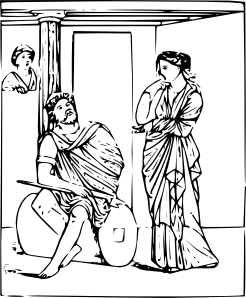
Odysseus and Penelope

Odysseus' return (Courtesy: OCAL @ clker.com)

The odyssey of course is Homer’s (ignoring here discussions of authorship) telling of Odysseus’ long journey home to Ithaca from the Battle of Troy. Armitage’s version begins with Zeus and Athena arguing over Odysseus’ fate and these two link the different phases of the story as we progress through them. This version essentially follows the sequence of the original but is pretty fast and furious, focusing mostly on the action and drama of the story…and that did, I must admit, get a little tedious for  a while around the middle of the production.

In other words, not much time is given for dwelling on the nuances or underlying themes…and there are many themes to explore in this work, including cunning and courage, fidelity and trust, the power of the Gods (in ancient Greek life), loyalty and greed. Some of the “truths” ring a little strange to our ears. Not only do we (most of us anyhow) no longer believe that our lives are at the mercy of the Gods, but there is also the old double standard: Penelope remained faithful while Odysseus had his flings. But other “truths” – the role of cunning, courage and loyalty in survival, and the vice of greed and gluttony, for instance – still work today, albeit in different settings.

I was intrigued though by Armitage’s allusions, such as the Bible’s “stranger in a strange land” (The Book of Exodus, King James’ version) and Shakespeare’s “screw your courage to the sticking-place” (Macbeth). But then, I guess literary allusions are as valid in adaptations as they are in original works?

There’s not much more I want to say about the adaptation: it’s fun, it’s well performed and it usefully and entertainingly recounts a classic tale. I’d recommend it on those counts.

The odyssey – Homer (Audio)
Adapted by Simon Armitage for full-cast dramatisation
BBC Audiobooks, 2004
3 hours running time

POSTSCRIPT: In the interests of maintaining synchronicities, a month or so ago I reviewed Arnold Zable’s Sea of many returns which focuses on Ithaca, and its literal and mythological contexts of “home”.

C.J. Dennis, The moods of Ginger Mick

Sometimes a bloke gits glimpses uv the truth
(“In Spadger’s Lane”)

I wasn’t sure, really, that I wanted to read CJ Dennis’ verse novel, The moods of Ginger Mick, which I received as a review copy from the Sydney University Press as part of their Australian Classics Library – but have surprised myself. I rather enjoyed reading it and am glad that I had this little push to do so!

The moods of Ginger Mick
The moods of Ginger Mick cover (Courtesy: Sydney University Press)

The moods of Ginger Mick was published in 1916 just weeks before the big Conscription Referendum, according to Philip Butters who wrote the new introduction to this edition. It does not however buy into that debate. The book comprises 15 poems “written” by Dennis’ other character, The Sentimental Bloke, at whose wedding Mick was best man. The poems introduce us to Mick and his larrikin life before the Great War and then go on to chronicle his life as a soldier.

Dennis writes his poems in broad Australian slang (but there is a glossary at the end). Most are 6-line stanzas with an ababcc rhyme (the same as Wordsworth’s “Daffodils”!) but every now and then there is a different rhyme scheme which mixes it up a little. The sweet poem “The singing soldiers”, for example, has a sing-song aab(with an internal rhyme)acc, while the poignant “Sari Bair” about the eponymous battle has 4-line stanzas with a simple aabb rhyme.

I enjoyed reading the poems, not only for their evocative language but also for their subject matter. While their setting and language make them very much of a particular time and place, their concerns have some universality. They are about egalitarianism vs class difference, and about what it means to be a man (a “bloke” as it were). Mick starts off as a bit of a larrikin – one who cares not for the “toffs” and for whom the “toffs” care not! As he says in an early poem:

But I’m not keen to fight so toffs kin dine
On pickled olives …
(“War”)

What sends him to war in the end is “The call uv stoush” but, when he gets there, he starts to discover that in uniform all men are equal, that

… snobbery is down an’ out fer keeps,
It’s grit an’ reel good fellership that gits yeh friends in ‘eaps.
(“The push”)

This poem, “The push”, provides a wonderfully colourful roll call of the sorts of men who enlisted. Other poems cover the support of women at home, hopes for work when they return home now they’ve proved themselves (after all the “‘earty cheerin’ … per’aps  we might be arstin’ fer a job”) and the sense that Australia has grown up as a nation (“But we ‘av seen it’s up to us to lay our toys aside”). There is ironic humour (as in “Rabbits”) and pathos (as in “To the boys who took the count” and “The game” in which Ginger Mick finally realises that he’s found his metier). There’s also some racism that was, unfortunately, typical of the time. And of course there is patriotism, with some rather lovely descriptions of the Australian landscape. I just have to mention here some references to gums:

An’ they’re singin’, still they’re singin’, to the sound uv guns an’ drums.
As they sung one golden Springtime underneath the wavin’ gums.
(“The singing soldiers”)

An’ we’re ‘opin’ as we ‘ear ’em, that, when the next Springtime comes,
You’ll be wiv us ‘ere to listen to that bird tork in the gums
(“A letter to the front”)

As a group, the poems offer an interesting insight into Australia’s experience of the First World War, particularly given their mix of realism and romanticism that belies perhaps the recent glorification that’s developed around our ANZAC heritage. If you are interested in Australia’s cultural and literary heritage, it is well worth giving this short little book a look.

C.J. Dennis
The moods of Ginger Mick
Sydney: Sydney University Press, 2009 (orig. pub. 1916)
87pp.
ISBN: 9781920898984

(Review copy supplied by the Sydney University Press)