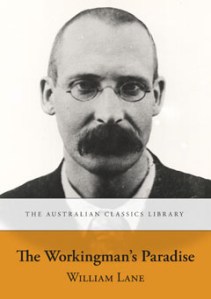
William Lane, The workingman’s paradise

Wealth and Poverty both seem to degrade most of us. (p. 249)

The workingman's paradise (Courtesy: Sydney University Press)

The workingman's paradise (Courtesy: Sydney University Press)

So says Bohemian Connie Stratton to the hero Ned Hawkins in William Lane’s 1892 novel, The workingman’s paradise. William Lane, an English-born journalist, union supporter and socialist, wrote under a number of pseudonyms including John Miller, the name he used for this novel which was re-published this year as part of the Australian Classics Library.

Lane writes in his preface that the book was titled and written “hurriedly”, in order to:

  • raise funds for unionists imprisoned during the Queensland Shearers Strike of 1891; and
  • explain unionism to non-unionists and Socialism “to all who care to read or hear, whether unionists or not”.

If this suggests to you that The workingman’s paradise is a social-realist novel, you would be right. It is very much a novel of ideas, which presents a bit of a challenge: shall I focus on the polemics or on the literary aspects? I will try to cover both – but it is worth reading this edition’s new introduction by academic, Andrew McCann, as it rather nicely explores the politics behind the novel.

As with many polemical novels, the plot is pretty minimal. It concerns two childhood friends, Nellie and Ned, who meet up again in Sydney in the 1880s having not seen each other for many years. Both are children of selectors who have struggled and both have become quite politicised, though at the beginning of the novel Nellie’s understanding of politics is broader and her commitment to the Cause (aka Socialism) more complete than Ned’s. Nellie loses no time in introducing Ned to the underside of Sydney life, and to her friends (who include the Connie of the opening quote). It is through these experiences that Ned’s political education is cemented. Oh, and there is of course an attraction between them!

The novel is divided into two parts: the first is set in the late 1880s when Ned comes to Sydney and meets Nellie and her friends, and the second takes place a couple of years later, on the eve of the Queensland Shearers Strike, when Ned returns to Sydney to garner support for the shearers. Without giving too much away, there is no real resolution to the plot, something which Lane refers to in his preface: “This plot got very considerably mixed and there was no opportunity to properly rearrange it”. If you read for plot, then, you may be disappointed, but if you read for characters, ideas and a fine use of the English language, this is well worth the effort. And there is some effort involved because, while it is not a particularly long novel, its main focus is its ideas and they require a reasonable level of concentration. There are a couple of places, such as socialist Geisner’s long discussion with Ned, which can become a little heavy-going if the subject is not to your interest.

Lane writes in a high rhetorical style that is rather typical of novels whose main purpose is didactic. He effectively uses such techniques as repetition (particularly anaphora), declamatory statements, and classical and biblical allusions to convey his message. This style can feel unsubtle and old-fashioned to modern ears but in Lane’s hands it has a certain beauty. There is, for example, a sophisticated use of repetition at the beginning of Part 2, Chapter 1: The slaughter of the innocent. Nellie is sitting with and thinking about a dying baby and, after each set of thoughts, is the following repetition:

So Nellie thought, sitting there beside it … (p. 152)

So Nellie thought, weeping there beside it … (p. 153)

So Nellie thought, the tears drying on her cheeks … (p. 154)

And that, you think is the end of them (three repetitions, after all, being the most common style), but then two pages later comes:

So Nellie thought, in her indignation and sorrow …

Through these repetitions we feel the buildup of her pain and see the progress of her thought from sadness to indignation.

The novel comprises more than simple argument though. In a nod to the romantic tradition, it is also a very visual novel with some effective descriptive passages, such as those showing us Sydney at its best and worst:

The streets, some wider, some narrower, all told of sordid struggling. The shops were greasy, fusty, grimy. The groceries exposed in their windows damaged specimens of bankrupt stocks, discoloured tinned goods, grey sugars, mouldy dried fruits; at their doors, flitches of fat bacon, cut and dusty. (p. 24)

and

At their feet the faint ripplings of this crystal lake whispered their ceaseless lullaby and close behind them the trees rustled softly in the languid breathings of the sleeping tree. Of a truth it was Paradise, fit above all fitness to gladden the heart of men, worthy to fill the soul to overflowing with the ecstasy of living, deserving to be enshrined as a temple of the Beautiful wherein all might worship together, each his own God. (p. 185)

The ideas expressed in the novel are simple, yet complex too. Through Ned and Nellie, and through discussions between two “masters”, the conciliatory Melsom and the “Capitalism personified” Strong, Lane explains the master-worker divide, the development of unions, and the “freedom of contract” idea. And through the meeting at the Strattons, and Ned’s later meetings with Geisner and then Connie, he conveys his conception of Socialism as a “religion” that “can only come by the utter sweeping away of competition, and that can only come by the development of the socialistic idea in men’s hearts”. (p. 138) True Socialism is defined by Geisner as “men working as mates and sharing with one another of their own free will [ie. not organised by the State]”. (p. 134) After reading this, you probably wouldn’t be surprised to hear that Lane ended up trying to establish a utopian community in Paraguay in 1893.

Using a variety of narrative techniques – including stories of characters met along the way – Lane manages to present a broad picture of working class 19th century Australia: the marine strike, the girls who end up on the street, the piece-workers at home, and the struggle to farm are just some of the stories woven through the book. Reading all this, you would think that Lane was the epitome of all that is humane, but for all the idealism – the arguments for gender equality, for the socialist ideal of equality between worker and master – the book has its discomforting side and this is its racist (specifically anti-Chinese) overtones. From very early in the book, the Chinese are held up, essentially, as the enemy in both city and country:

The fruiterers seemed not to be succeeding in their rivalry with each other and the Chinese hawkers. The Chinese shops were dotted everywhere, dingier than any other, surviving and succeeding, evidently by sheer force of cheapness … The day grow (sic) hotter and hotter. Ned could feel the rising heat, as though he were in an oven with a fire on underneath. Only the Chinese looked cool. (p. 24-25)

and

Then down would come the wages, up would go the hours and in would come the Chinese. (p. 238)

Even idealists, it seems, have their feet of clay!

This is the sort of book that can be read as a work of literature and as a work of political philosophy. While it can happily stand on its own as a literary classic for the quality of its writing, its prime value for me is its evocation of late nineteenth century Australia – an Australia which, you will have realised by now, was no “workingman’s paradise”!

Note on the text: The title page verso advises that the book is “a repaging of text files on SETIS, itself input from the 1892 edition …” I understand this text was input via OCR which is a boon for publishers wishing to reproduce pre-electronic texts but which can also result in a significant number of “artefacts” (misread characters). Sydney University Press has clearly worked hard to clean up the text but a number of these artefacts have slipped through. I understand they will be corrected for future printings.

(Review copy supplied by the Sydney University Press)

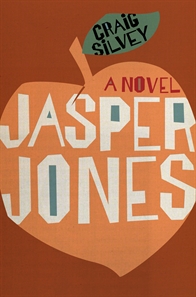
Craig Silvey, Jasper Jones (Review)

Jasper Jones cover (Courtesy Allen & Unwin)

Jasper Jones cover (Courtesy Allen & Unwin)

What is is about coming-of-age novels? Why do we like to read them long after we’ve (hopefully) come of age ourselves? Is it because we like to compare our own experience with that of others? Whatever the reason, it is clear that we do like to read them because they sure keep being written and published. In my few months of blogging I have already written about two, and have now read another, Craig Silvey’s Jasper Jones.

Like many, though not all, such novels, Jasper Jones has a first person narrator. It is set in a small country town in Western Australia in the late 1960s, and the protagonist, Charlie, is the nearly 14-year-old son of a high school literature teacher. He is a reader and therefore, almost by definition in the world of teenage boys, not “cool”. The book opens with the town’s bad-boy, Jasper Jones, knocking on his window in the middle of the night and, to Charlie’s surprise and delight, asking him for his help. The plot revolves around the shocking help that Jasper wants, how Charlie responds and the impact on him, his friends and family.

It is  a pretty dark and gritty story, and Silvey, mostly, controls it well, though there are times when he pushes the melodrama button a little too heavily. Silvey teases us at the beginning with the notion that the book will be a re-setting of Harper Lee’s To kill a mockingbird. There’s a death, an indigenous person likely to be blamed for it, a much maligned apparently “mad” person,  an apparently thoughtful and wise father AND Charlie’s own regular reference to the book and to how Atticus Finch might think in particular situations. However, fortunately I think, Silvey is a little more sophisticated a writer than that and Harper Lee’s book functions more as a frame for the story and the ideas being explored than as a direct model for the plot.

One of the things I like in the novel is the friendship between Charlie and his Vietnamese refugee school-mate, Jeffrey Lu. I’m not a teenage boy but I have known some in my time! The dialogue between the two boys rings pretty true – their puns, their ribbing of each other, their jokey arguments. True too is their uneven burgeoning interest in the opposite sex – Charlie is attracted to classmate Eliza Wishart  and to enjoying some “sassytime” with her, while Jeffrey’s focus is on making the town cricket team.

The novel is neatly plotted – and while some of it is predictable it is not all so. The fact that Charlie fears insects seems to be resolved when we discover that his love-interest Eliza has a similar fear – but it reappears again, cleverly, in the denouement. The story is well-paced, and it deals with a range of side issues, such as racism (against the Vietnamese refugee family, and the “half-caste” Jasper Jones), on top of the usual coming-of-age ones, such as loss of innocence (in several meanings of the word). Many of the characters could be seen as stereotyped – the “bastard” cricket coach who aligns himself with the “boorish” bully boys, and the cold-hearted status-seeking shire president, to name two – but most of them work despite this. Charlie’s mother though stretches the imagination a little too much: she has married down, she has been forced to live in a country town too small for her, and she has lost a child. This does seem a bit of overkill and the panning out of her part of the story feels a bit like one too many layers in the book.

One of the concepts that Charlie explores is that of “timing and chance”. He learns that despite your best laid plans, time and chance sometimes take over and there’s not much you can do about it. Another issue that runs through the book is that of reading, words and language. Early on Jasper Jones tells Charlie he trusts him because:

But I hope you might see things from my end. That’s what you do, right?  When you’re reading. You’re seeing what it’s like for other people.

With this coming near the beginning of the book, it’s not surprising that Charlie’s ability to empathise, to see things from other points of view, is pushed to the limits as the story progresses. Charlie, whose ambition is to be a writer, also learns about the limits of words, about when they are useful and when they are not, and about finding the right ones to use when they are.

There are many thematic and stylistic things that can be talked about in this book, making it a good one for discussion but, in the end, it is a fairly traditional coming-of-age story in its style, tone and structure. That said, if you like such stories, as I do, there’s a good chance you’ll find this a compelling and entertaining even if not a particularly challenging read. And is there anything wrong with that?

Craig Silvey
Jasper Jones
Sydney: Allen & Unwin, 2009
368pp.
ISBN: 9781741757743

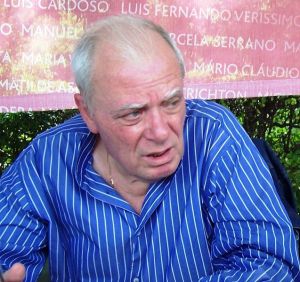
António Lobo Antunes, The natural order of things

António Lobo Antunes, 1998 (Photo: Gonçalo Figueiredo Augusto, from Wikipedia, under Creative Commons Licence, CC-BY-3.0)

António Lobo Antunes, 1998 (Photo: Gonçalo Figueiredo Augusto, from Wikipedia, under Creative Commons Licence, CC-BY-3.0)

Virtuosic? Tour de force? These are such clichéd terms to use in a review – and yet, I can find no other words to better describe Portuguese writer António Lobo Antunes’ 1992 novel, The natural order of things. This is one of those beautifully written, but rather challenging, books that you know you really should read again to get all those nuances, relationships, and connections that you sense but can’t quite fully grasp. If that puts you off reading the book, so be it, but in doing so you’ll miss something quite special.

As you might expect the title is ironic – there is very little natural order here. The novel does not follow the “natural (aka chronological) order” either of fiction or of life. The characters – including a middle-aged man living with a schoolgirl, a miner who “flies” underground, a girl/woman who spends her life in an attic, an ex-secret policeman who teaches hypnotism by correspondence – do not fit the “natural order” either.

The imagery is rich, evocative and effective in building up a picture (mostly of disorder and decay) and a feeling (mostly of melancholy, if not despair). The rhythm – produced by repetition, and by run-on paragraphs that don’t begin with new sentences – compels you on. The characters are convincingly drawn despite their often mad-sounding confusions. The mixing of the surreal with the real works – as does the weaving of two scenes from different points in time in the same sentence, not to mention the telling of a story by two voices in the same sentence. Somehow he makes it work. Here is an example:

…and eleven months later I met Mr Valadas at a restaurant and liked his double chin, he wasn’t as handsome as the skin doctor who hated Verdi, but I felt sorry for him, always by himself, eating lunch all alone,

and my sister Teresa, who kept looking at you and shaking as if she’d been hit by the world’s worst tragedy, “When is the wedding Fernando?” [p. 186]

Two voices alternating in one long run-on sentence – and for some reason, you go with the flow and know who’s speaking when. But that is the thing to do with this book – go with the flow.

So, what is it about? In superficial terms it’s about, as the blurb on my back cover says, “two families and the secrets that bind them”. But really, there’s not a strong plot, though several stories are told. The novel comprises 5 books, each of which is broken into chapters told from two alternating points of view, resulting in 10 voices. The stories are set between 1950 and around 1990 and deal, in their various ways, with post-1974 Carnation Revolution Portugal and the resultant disintegration of Portuguese society (not only in Portugal but in its African and Timorese colonies). This said, the over-riding sense of the book is one of personal stories, of past, present and the way memory works, and not of politics:

Relax, don’t lose your temper, I swear I’m doing the best I can, but that’s how memory is, it has its own laws, its own rhythm, its own whims, … (p. 23)

In a bit of self-consciousness that brings us back to earth, the second last voice in the book, the dying Maria Antonia, says:

I amused myself by imagining that the redheaded girl was the sister of my neighbours at the Calçada do Tojal, I moved her to the house of the Vacuum Oil employee and the imprisoned army officer … my nephew announced with a smile , “You’re going to live forever, Aunt Antonia”, and I nodded so as not to upset him, I stuck a Tyrolean hat on his head and place him in Hyacinth Park of Alcântra, married to a diabetic girl from Mozambique or … [p.263]

because we who are from here but are not from here, who are from a here that no longer exists, have filled up these buildings with the silt of mementos and albums and letters and faded pictures from the past, and our present is occupied by these ruins of memory, not only the memory of those who preceded us, but the memory of ourselves, because we also forget, because names and images and faces get lost in a fog that makes everything equally blurry, … [p. 274] … with me will die the characters of this book that will be called a novel, which I’ve written in my head, fraught with a fear I won’t talk about, and which one of these years someone, in accord with the natural order of things, will repeat for me in the same way that Benefica will be repeated in these random streets and buildings, and I, without wrinkles or gray hair, will water my garden with the hose in the late afternoon, and the palm tree at the post office will grow again, … [p.277-8] … even if we’re not very large trees, and even if they knock us down, we’ll remain in photos, in scrapbooks, in mirrors, in the objects that prolong and remember us, … [p. 278]

And so here is made clear what should already be clear through the way the book is written and structured – though the repetition of phrases, the recurrence of bird and tree images, and the intertwining of stories and voices – and that is that the present and past intermingle and repeat each other, that the real and the unreal both have a place, that nothing really ends or begins, and that, perhaps, no matter how bad things are there is hope. What also seems to be made clear is that this has all been the fabrication of Maria Antonia – or has it? After all it is not she but the redheaded girl (Julieta) who has the last say. Read it and decide for yourself.

(Translated by Richard Zenith)

Jim Crace, Being dead

The old “so many books, so little time” mantra means that I very rarely read a book more than once (other than my Jane Austens of course), but I have read Jim Crace’s Being dead twice. I love this book. I know some find the subject matter unappealing but I find it not only fascinating but rather beautiful.

Beach near Bermagui, New South Wales

Beach near Bermagui, New South Wales

For those who haven’t heard of this novella (really), its plot centres on a murder. Joseph and Celice, a middle aged couple (and, significantly, zoologists), are bashed to death on a secluded part of a beach at the book’s beginning and, from this point, the story moves in multiple directions to explore a number of before and after scenarios relating to this event. In fact, one of the things I like about the book is its four-part structure, and its forwards-backwards movement in time as the different strands of the story are played out. Crace moves backward from the moment of their death to the beginning of that day, and alongside this he recounts forward the story of their relationship from the point of their meeting. The third strand concerns their daughter as she reacts to the news of their disappearance, and the final strand, which is the one that turns off some readers, chronicles the decomposition of their bodies as they lie undiscovered in the dunes. It’s not for nothing he makes them zoologists!

Near the end of the book is a clue to why Crace has chosen this structure. He writes that “Earth is not a visionary and can’t be blamed for what’s ahead. It is retrospective … It is the past that shapes the world, the future can’t be found in it”. It seems to me to be a pretty fatalistic – what will be, will be – view of the world, and one I rather like. I don’t think he’s quite saying we can’t change our world but he is saying that what we do, what is now, shapes it and our lives, that there’s no future mystery out there waiting to make something of us. Right near the end is this:

Nothing could be changed or amended, except by the sentiment of those who were not dead. That’s the only Judgement Day there is. The benefits of hindsight. The dead themselves are robbed of hindsight.

So what about the characters who are the focus of all this? Crace has in fact chosen pretty ordinary, fairly unlovable (except to themselves) not-particularly-admirable characters. By doing this he makes the point that we all have our lives, that the only really important thing is love, and that there is dignity in that. As he writes: “Love songs transcend, transport, because there is such a thing as love”.

And it is all told in language that is rhythmic and oddly beautiful despite the horror of the subject matter:

The corpses were surrendered to the weather and the earth, but they were still a man and wife, quietly resting; flesh on flesh; dead, but not departed yet.

Crace is a great stylist, I think, which is why he can tell such a story in four parts but in less than 200 pages. Take the title for example: the use of the present participle “being” is very telling. Present participles imply action, continuation, ongoingness, but death is usually seen as the end. In this book there are several continuations: the world, the natural world in particular, continues, and Joseph and Celice’s love continues. Oh, and they stay dead. Great title.

So, to labour the point, his message is that we and only we make our lives:

There is no remedy for death – or birth – except to hug the spaces in between. Live loud. Live wide. Live tall.

Carpe diem I suppose – but an oh so eloquent evocation of it!

Imre Kertèsz, Fateless (or Fatelessness)

[WARNING: SPOILERS, of sorts]

Let’s get the first thing clear. I like holocaust literature – not because I enjoy the subject matter but because in it I find the most elemental, universal truths about humanity. Depending on the book, this literature contains various combinations of bravery and cowardice, cruelty and kindness, love and hate, self-sacrifice, self-preservation and betrayal, resilience and resignation, and  well, all those qualities that make up humanity and its converse, inhumanity. I have by no means read all that is out there but here are some that have moved me: Anne Frank’s The diary of a young girl (of course) and Anne Holm’s I am David, from my youth, and then books like Martin Amis’ Time’s arrow, Bernhard Schlink’s The reader, Marcus Zusak’s The book thief, and Ursula Hegi’s Stones from the river. There are gaps, though, in my reading, such as Thomas Keneally’s Schindler’s ark (I did see the film), the works of Primo Levi, and Elie Wiesel’s Night. I have, however, just added Imre Kertèsz’s Fateless to my list of books read.

Kertèsz, 2007 (Photo by Csaba Segesvari, from Wikipedia under GNU Free Documentation License 1.2)

Kertèsz adds a new spin to the universal truths explored by these books – it’s what he describes (in my 1992 translation anyhow) as “stubbornness” which seems to me to mean “resilience” or a determination to survive, and even to have, if possible, little wins against the system.

Anyhow, first the plot. The novel takes place over the last year of the war and concerns Gyorgy Koves, a 14-year old Hungarian Jew, who, one day, is suddenly called off a bus, along with all other Jews on the bus and transported to Auschwitz, and then Buchenwald, Zeitz and back to Buchenwald, before returning home at war’s end. It chronicles his experiences, his thinking, and the impact on him of his experience. He begins as the archetypal naive narrator…but by the end, though his tone has changed little, he is no longer naive. This is rather beautifully achieved as we see his youthful application of logic being changed into something more cynical and survival focused.

Gyorgy speaks with a strange sense of detachment borne, to start with, of an apparent unawareness of what exactly was happening to him and a disbelief that anything untoward would happen. And so, in the beginning, as events unfold he describes them as “natural” because of course, when they got to Auschwitz, it was sensible to inspect each person to see who was physically fit and capable of working. He didn’t know then what would happen to those not found physically fit. The horror gradually builds as reality sets in and he goes about making it through each day – through his share of beatings, the reduced food rations, and all the other deprivations that make up concentration camp life. In the first part of the book he uses the term “naturally” to mean some sort of normal logic but by the end it comes to mean, as he explains to a journalist who asks him why he keeps using the word for things that aren’t natural, that these things were natural in a concentration camp.

Early on in his captivity he says that they approached their life (and work) “with the best of intentions” but they soon discover that these “best of intentions” do not bring about any kindness from their overseers, and so his attitude to getting on, to surviving starts to change. As he starts to physically weaken, become emaciated and develop infections, he observes that “my body was still there. I was thoroughly familiar with it, only somehow I myself no longer lived inside it”. Always dispassionate, always matter-of-fact, while describing the most heart-rending things.

Towards the end, he is placed in a hospital ward and there he is treated better and, even, with a certain amount of kindness. This in its way is as shocking to him as the cruel beatings he experienced at Zeitz. He can see no logic, “no reason for its being, nothing rational or familiar”. He can only understand kindness in terms of the giver receiving “some pleasure” from it or having some “personal need” satisfied. Never is there any sense that altruism might come into play. His view of “justice” is based very much on survival. He says, when he is spared, “everything happened according to the rules of justice … I was able to accept a situation more easily when it concerned someone else’s bad luck rather than my own … This was the lesson I learned”.

And so, in the end he returns home, and finds it hard to explain to people just what happened and how he now views life. He describes getting through his time as “taking one step after another”, focusing just on the moment. He implies that if he had known his fate he would have focused on time passing – a far more soul-destroying activity than concentrating on getting through each day “step by step”. This brings us to the fate/fateless bit. He says at the end that:

if there is a fate, there is no freedom … if, on the other hand, there is freedom, then there is no fate. That is … that is, we ourselves are fate.

I find this a little hard to grasp but he seems to be saying that we are free to make our own choices, even in a concentration camp – we are not fated but make our own fate. He was and is not prepared to accept any other approach to life. But life will not be easy:

I am here, and I know full well that I have to accept the prize of being allowed to live … I have to continue my uncontinuable life … There is no impossibility that cannot be overcome (survived?).

And yet, at the very end of the book, he says “and even back there [in the concentration camp], in the shadow of the chimneys, there was something resembling happiness”. Wow! This is an astonishing book – it charts horrors with a calmness that is quite shocking, and it is particularly shocking not because Gyorgy is unfeeling but because he can’t quite grasp what is happening to him. This is the fundamental irony of the book, and the fundamental truth of a naive narrator: we the reader know exactly how it is even as Gyorgy tries to make sense of it using logic and reason. I must read this book again – and preferably the newer more highly regarded 2004 translation by Tom Wilkinson.

(Translated by Christopher C. Wilson and Katharina M. Wilson)

Elizabeth Jolley, My father’s moon

‘No one,’ she says, ‘can write anything till they’ve had experience. Later on perhaps. You will write later on.’ (Elizabeth Jolley, My father’s moon, 1989)

Although fiction demands imagination, it must be based on  some kind of genuine experience. (Elizabeth Jolley, “Only Connect”, essay first published in Toads, 1992)

My father’s moon is the first book in Jolley’s semi-autobiographical trilogy, the others being Cabin fever and The George’s wife. It won The Age Book of the Year Award in 1989.

I am an Elizabeth Jolley fan – and, along with Helen Garner, another Jolley fan, I enjoy the way she repeats and revisits stories and characters from one book or story to another. In this book is the chapter, “Night Runner”, which was published as a short story in Meanjin in December 1983, and again in a short story anthology, Room to move, published in 1985. The narrator of the story – and of the novel – typifies Elizabeth Jolley’s alienated protagonists and their often peculiarly self-centred and self-deluded ways of coping with their loneliness. Clearly Jolley decided that this was a character she wanted to develop further. And clearly she also drew a lot from her own experience to develop this character. Like Vera, Jolley was brought up as a Quaker, her parents sheltered refugees before and during the Second World War, and she trained as a nurse. Like Vera, Jolley probably experienced loneliness and alienation. However, this is fiction and so we need to be careful about how far we take these analogies between Vera and her creator. Much as I can empathise with Vera’s predicament, I must admit that I would hate to think she is Elizabeth Jolley.

It’s an uncomfortable novel. Vera, the first person narrator, is not a highly sympathetic character but neither is she totally disagreeable either. What she is, though, is lonely. The book has a somewhat challenging structure – and I had to concentrate to keep track of where I was. It starts with Vera, a single mother, leaving her parents’ home, with her young daughter, to live and work in a boarding school. Her hopes for a lovely life there among people “who feel and think as I do” are dashed. Such people “are not here as I thought they would be … I am by my own mistakes buried in this green-leafed corruption and I am alone”. In this first chapter are flashbacks to the past, and gradually the book moves into the past, providing us with insights into her character and how she has ended up where she is. Most of this past takes place in the hospital where she trains as a nurse during the war. The book finally returns to the beginning of the novel with Vera resolving to make a step towards alleviating her loneliness. However, we are by no means convinced she will.

Moon, by atomicshark @ flickr, licensed under Creative Commons CC-BY 2.0

Moon, by atomicshark @ flickr, licensed under Creative Commons CC-BY 2.0

The book comprises titled chapters, many if not all of which could be (and some have been) published separately as short stories. This gives it a somewhat disjointed feel – but seems appropriate for the story of a person like Vera. It is full of wonderfully drawn characters, with some very funny (if often dark) scenes and dialogue. Just think nurses and hospitals! There are many references to music – something that is common in Jolley’s works. Music is usually a comforting force for her characters, offering them respite from what is often a cruel world – and this is the case here, with Vera being drawn to characters who love and play music. There is a lot of irony, some of it subtle, some of it less so as in Magda’s comment to Vera who has fantasised about an affair with her husband: ‘You are so innocent and good … Don’t ever change’. Naive perhaps, innocent no!

So, what about the title? Funnily enough(!), it refers to Vera’s relationship with her father, a major stabilising influence in her life. He tells her throughout her childhood that wherever she is she can always look at the same moon he is looking at, ‘And because of this … you must know that I am not far away. You must never feel lonely’. A lovely concept and one to which Vera regularly returns in the book.

My father’s moon is not, I think, the easiest Jolley to read, and there are some things that might become clearer on a second reading. However, its concerns are very representative of her work – loneliness and alienation, homosexuality, parenting, memory, music and religion. While Vera is deeply lonely, while she often behaves selfishly, she can also be kind. She is also no quitter. For that I rather like her.

J.M. Coetzee, Diary of a bad year

Coetzee, Poland, 2006 (Photo: Mariusz Kubik, from Wikipedia)

Coetzee, Poland, 2006 (Photo: Mariusz Kubik, from Wikipedia)

J.M. Coetzee is one of those rare novelists who pushes the boundaries of what a novel is. The progression from his mid-career novel, the spare but terrifying Disgrace (1999), through Elizabeth Costello (2003) to Diary of a bad year (2007) is so dramatic that there are those who question whether these last two are even novels. It’s actually been a year or so since I read Diary of a bad year but it is currently being discussed by one of my reading groups so now seemed to be a good time to blog about it here.

One of the first things to confront the reader who picks up Diary of a bad year is how to read it. It has three (two to begin with) concurrent strands running across the top, middle and bottom of the page. Some readers try to read the three strands as concurrently as possible while others read the strands sequentially. Following this latter path, though, means you risk missing the way the strands comment on each other. The three strands are:

  • the narrator’s formal voice, basically taking the form of essays he is writing
  • the narrator’s informal voice in which he talks about his life as he is writing the essays
  • the voice of Anya, his “little typist”, and, through her, of her boyfriend, Alan

The three characters represent three modes of viewing the world: the narrator’s is primarily theoretical, while Anya’s is more pragmatic and Alan’s rational. Through these modes, Coetzee teases out the moral conundrums of the early 21st century both in terms of the political (the events confronting us) and the personal (how are we to live).

Towards the end, Coetzee refers to his love of Bach. To some degree the book is a paean to Bach: its three-part structure in which each part counterpoints the others seems to be a textual representation of Bach’s polyphony. The essays running across the top of the page, while a little uneven and dry on their own, are counterpointed by the views of the characters in the other two strands, resulting in our being presented with different ways of viewing the same world.

The characterisation is interesting: Senor C, the writer of the essays, is the logical, moral but somewhat pessimistic thinker; Anya is practical, down to earth, but with a strong moral sense; and Alan is the economic rationalist for whom money is essentially everything. The views of the two men are strongly contrasted, while Anya is caught in the middle. There is a Darwinian sense in Alan of the survival of the fittest, while Senor C spurns competition as a way of life, preferring collaboration. For all his “moral” views, though, Senor C is not presented as a paragon and we are discomforted at times by his attitude towards the beautiful Anya.

The overall theme seems to be how do we live in a world full of paradoxes and contradictions, a world that seems to be pervaded by dishonour and shame (the things Senor C explores in the essays). He talks about ordinary people and how they (we) cope with things they (we) don’t approve of. He wonders why they (we) don’t do something about it, but suggests in the end that they (we) practise “inner emigration”. He says:

The alternatives are not placid servitude on the one hand and revolt against servitude on the other. There is a third way, chosen by thousands and millions of people every day. It is the way of quietism, of willed obscurity, of inner emigration.

I like that concept though it does smack of burying one’s head in the sand. He also talks about collective guilt, and about bearing the dishonour of what’s gone on before. Through choosing a “novel” form like no other, one which blends but in no way harmonises fact and fiction, Coetzee shows in a very concrete way that difficult times need new ways of presenting ideas. He offers no neat conclusions, no easy outs;  he is quite subversive really. Late in the book he ponders the value of writing, and says:

Are these words written on paper truly what I wanted to say?

This then is another step in Coetzee’s path of trying to find the best, perfect perhaps, way of saying what he wants to say. I, for one, will be ready for his next step.

Orhan Pamuk, Snow

One of my rules of reading is that when I have finished a book I go back and read the first chapter (or so) and any epigraphs the author may have included. These can often provide a real clue to meaning. This rule certainly applies to my latest read, Snow, by Nobel Prize winner, Orhan Pamuk.

(WARNING: SOME SPOILERS)

Snow, in fact, has no less than four epigraphs:

  • lines from Robert Browning’s “Bishop Blougram’s Apology” describing the paradoxical nature of things: “the honest thief, the tender murderer,/the superstitious atheist”;
  • a quote from Stendhal’s The charterhouse of Parma which warns about the ugliness of “politics in a literary work”;
  • a quote from Dostoevsky’s Notebooks for the Brothers Karamazov which suggests ideals like the European Enlightenment are “more important than people”; and
  • Joseph Conrad’s statement in Under Western eyes that “The Westerner in me was discomposed”.

These four epigraphs pretty well sum up the concerns of the book. What about the title? The second chapter begins with:

Veiling as it did the dirt, the mud and the darkness, the snow would continue to speak to Ka of purity, but after his first day in Kars, it no long promised innocence.

Here then is the first paradox: snow is pure but not innocent, and it covers dirt, mud and darkness. Already, you can see that this book is going to be ironic. Just how ironic though is a matter for contention but my suspicion is that its very foundation is ironic, as it grapples with what it means to be an artist in a political society, with how one is to live in a conflicted nation. The plot centres on a coup – a coup which is variously called a military coup and a theatrical coup! In fact, it is a coup by a theatrical group that is supported by the military! Art and politics could hardly be more entwined.

Kars Photo: Jean & Nathalie @ flickr (Creative Commons licence)

Kars Photo: Jean & Nathalie @ flickr (Creative Commons licence)

Snow though is not an easy read. It is my third Pamuk, but only the second one I have completed. I loved his memoir-cum-history Istanbul but could not, hard as I tried, finish My name is red.

What then is it about? The main action covers three days in the life of Ka, a Turkish poet recently returned from 12 years exile in Germany, who comes to Kars (in far east Turkey) ostensibly to write about the suicide epidemic among young women, but whose secondary (or perhaps primary!) reason is to fall in love with an old school-friend, Ipek. Soon after he arrives, however, the coup occurs and Ka is, rather unwillingly, caught up in the intrigue between the competing interests: the secularists, the Islamic fundamentalists, and the Kurdish nationalists. This sets the stage for exploring the art-politics nexus. Ka says to Sunay, the leader of the coup AND of the theatrical troupe that comes into town:

I know that you staged the coup not just for the sake of politics but also as a thing of beauty and in the name of art … you know only too well that a play in which Kadife bares her head for all of Kars to see will be no mere artistic triumph; it will also have profound political consequences.

Here then is one evocation of the second epigraph. The third and fourth epigraphs refer to the running conflict in the book between European/Western values and Turkish/Eastern values. There is very much a sense that the people of Kars feel condescended to by European culture, but as a teen-ager says at one point, “We are not stupid! We’re just poor”. The people of Kars do not understand Western notions of individualism, and they see Western ideas of secularism and atheism as equating with immorality. Ka, as a Westernised Turk, acts as an uncomfortable, to him, bridge between the two worlds.

The core of the book is Ka. He is a sad and highly conflicted individual who, in his youth, had used words to argue that people should act for “the common good” but now finds himself using them to further his own happiness. Once politically active, “he now knew that the greatest happiness in life was to embrace a beautiful, intelligent woman and sit in a corner writing poetry”. The irony is that, for all his attempts to achieve this, he ends up with neither and dies four years after the coup a sad and lonely man.

The novel is interesting, stylistically and structurally. It is essentially a third person story about Ka but is told by a first person narrator, Ka’s friend, the novelist Orhan(!). This metafictional narrative technique, by adding another layer to the “conversation”, rather deepens the “artist in society” and art/politics themes of the book. Much of the story is foreshadowed: we learn of Ka’s death in Chapter 29, though the book has 44 chapters. The tone of the book is imbued with huzun, that very particular Turkish sense of melancholy that Pamuk explores beautifully in his book Istanbul. And, while it is about a coup and has a body count of 29, there are some very funny scenes, one being the political meeting at which the competing rebels prepare a statement about their beliefs for the Western Press. Anyone who has attended a political meeting will feel at home here!

All this said, the book is a challenge to grasp: there are a lot of characters, comings-and-goings, and ideas to track. Just why Ka is the way he is, just what did happen to him in the end, and just what Orhan is saying about art and politics are hard to pin down. I love the way the book is underpinned by paradox and irony – and yet at times the meaning can be a little tricky to discern. What is clear though is that Ka has found living by his political beliefs deeply unsatisfying but, ironically, is unable to bring about a situation in which he can live “happily” any other way.

Kadife, the leader of the headscarf girls, says (fairly early in the book):

…do not assume from this that our religion leaves no room for discussion. I will say that I am not prepared to discuss my faith with an atheist, or even a secularist. I beg your pardon.

Oh dear! Some reviewers call it a brave book. With its fearless exploration of the tensions in modern Turkey, it certainly feels that way. I am very glad that I put in the effort to read it.

Toni Jordan, Addition

Addition Pb cover, Courtesy Text Publishing

Addition Pb cover, Courtesy Text Publishing

(SPOILERS: FOR WHAT IT’S WORTH)

Looks like, feels like, is it? Chick lit, that is. Toni Jordan’s first novel Addition has all the hallmarks of chick lit. The cover design with its line drawing of a female form invokes chick lit – albeit chick lit with an edge as the heels aren’t quite high enough and the colours not quite girly enough. The plot though is pure rom com and pretty much standard chick-lit: girl meets boy, girl loses (kicks out) boy, girl gets boy back. So why has this book garnered more attention and positive critical response than its sisters?

Well, Jordan is no Jane Austen (who is sometimes called the mother of chick lit) but she has produced something a little fresh. Her heroine, Grace, is not quite the standard chick lit heroine. She has had a breakdown, she is not in employment, she is not upwardly mobile and she is not focused on fashion and appearance (though it has to be said that she’s not oblivious to these latter either). Instead, she’s an ex-primary school teacher (not the most fashionable career, anyhow, in the world of chick lit) and she suffers from an obsessive compulsive disorder that results in her need to count, anything and everything, in order to maintain control over her life. And her hero, Seamus, a happy, ordinary dresser in an ordinary go-nowhere job, is “average”. Fortunately, though, with the help of her smart young niece, Grace realises at the end “that average can actually be unique”.

Grace’s voice is chick-lit-sassy and the book is genuinely funny a lot of the time, but there are also times when it is forced and tips over into being smart-alecky, such as her reactions to the psychiatrist and therapist. Her other hero is Nikola Tesla, the not-properly recognised famous inventor of many things electrical, who also had an obsessive compulsive disorder relating to numbers. It is the presence of Nikola in Grace’s life which sustains her at the beginning, helps ground her at the end and gives the book its real hook – that is, that being different is to be cherished and encouraged, as long as it doesn’t drag you down.

Jordan has a nice flair for language too. I liked the change in tone and pace when Grace’s panic rises, and a similar change in Jill’s speech to Grace when they are in hospital discussing their mother’s future. She’s lightly ironic in places and includes the odd bit of wordplay. It will be interesting to see where she goes next.

In addition (excusez-moi!) to its trying sometimes to be a bit too funny and its somewhat preachy ending (“Listen … Life is ..”), the book’s main problem is it’s too close adherence to the formula. You know she is going to lose him and you know she is going to get him back. It’s just a matter of how. Some level this same criticism at that favourite author of mine, Jane Austen, but her books encompass way more than plot to say some fundamental things about the human condition. I can read her again and again and see something new, or take away another perspective. I can’t see anything in Addition, as delightful as it is, that would afford me that pleasure on multiple readings.

So, read it, enjoy it – as I did – but if you want something a little more sustaining, try Jane.

Four time winner: Tim Winton wins 2009 Miles Franklin

Photo by Denise Fitch, Australia Council for the Arts

Photo by Denise Fitch, Australia Council for the Arts

Well, it’s finally happened as I knew it must. Someone has equalled Thea Astley’s record number of four Miles Franklin Award wins as tonight Tim Winton was announced the 2009 winner with Breath. I was seriously considering making Thea Astley my third favourite writers post – I think this means that I will now have to.

Winton has won the award for Shallows (1984), Cloudstreet (1991), Dirt Music (2001) and now Breath (2009); and Astley for The Well Dressed Explorer (1962), The Slow Natives (1965), The Acolyte (1972) and Drylands (1999). Both writers are great stylists who use metaphor well, both tend to explore strong connections between character and landscape, and both are indubitably Australian! I think, however, that Astley’s pen ranged wider than Winton’s and she took more risks. That’s not to say that Winton doesn’t deserve his wins but I do think that Astley (she died in 2004) was and continues to be undervalued.

Breath

Anyhow, here is a brief recap of my thoughts on Breath which I read long before I started writing this blog. I’ll start with a quick plot summary just in case there’s someone out there who doesn’t know it! It is a first person, coming of age story told by Bruce “Pikelet” Pike. It starts with his boyhood friendship with Ivan “Loonie” Loon. As young boys, they dare each other to perform dangerous stunts in the local river, and then as teenagers, they take up surfing where they are encouraged into new levels of recklessness by a former professional surfer named Sando. As time passes, Pikelet’s friendship with Sando and Loonie disintegrates and is replaced by a rather equally scary relationship with Sando’s American wife Eva, an injured and therefore ex-skier.

Southwest Western Australia, by soulsurfer 3 @ flickr

Southwest Western Australia, by soulsurfer 3 @ flickr

I like the book. I like the way he sustains the “breath” metaphor throughout to represent various facets of life and life-giving (or life-taking) forces. Despite not being a surfer, I love his wonderfully visceral descriptions of surfing. I also like his exploration of the imperative to take risks that is so common in young men and that is often accompanied by a drive to “be someone”.

Related I suppose to the coming-of-age issue is the theme of learning to accept being ordinary.  After Sando and Loonie leave the first time, Pikelet goes out and surfs Old Smoky: the first time he does it he’s so successful he feels he’s not ordinary, but then in his overconfidence he does it again and nearly does himself in…this is the beginning of his changing point of view. As he says a little later when he reviews his relationship with Eva, “No, Eva was not ordinary. And neither was the form of consolation she preferred. Given my time over I would not do it all again”. In other words, while he had originally equated not being ordinary with doing big risky things, with courting fear, by the end of the novel he realises that life is “a tough gig” and is about more than courting fear and taking big risks. This doesn’t mean that he can’t do and enjoy a job that provides an andrenalin rush (paramedic/ambulance driver) but it does mean that he no longer seeks to be anything other than himself and that he now goes for an adrenaline rush in “safer” more acceptable ways.

Before he gets to this point, though, he has to come to terms with his Eva experience and with the fact that he spent a big part of his life blaming her for his problems. He eventually comes to the conclusion that “people are fools, not monsters”. This closely resembles my own world-view: that is, that mostly (there are obvious exceptions) when people do the wrong thing they do it, at best, from the best of intentions, or, at worst, for reasons of laziness, selfishness or just plain obliviousness.

There’s no neat ending or pat conclusion: Pikelet recognises that he has been damaged by his life experiences and that he needs to manage himself – but he still loves to surf, that is, to do something “pointless and beautiful”. In this sense it is very much a book of its post-modern age: the lesson almost is that there is no lesson, that each of us has to find our own way. Pikelet says to Sando “maybe ordinary’s not so bad”. As one who is rather ordinary herself, I concur!