Arnold Jansen op de Haar, King of Tuzla

Translated works always represent a challenge. There is something slightly disconcerting about knowing that you are not reading the actual words of the author, but someone else’s interpretation of them. There’s been some discussion of this around the blogs and in the media this year, partly because of the publication of Why translation matters by award winning literary translator Edith Grossman.

Ramona Koval, of Radio National‘s The Bookshow, interviewed Edith Grossman earlier this year. Koval introduced the interview with:

According to Edith Grossman, translation is a strange craft, generally appreciated by writers, undervalued by publishers, trivialised by academics, and practically ignored by reviewers.

Well, maybe translators are ignored by professional reviewers, but I’ve often seen the issue discussed in blogs and online bookgroups. We are keenly aware of the translator’s role and have been known to compare translations. Anyhow, to continue… The Wikipedia article on Grossman includes a quote from a speech she made in 2003:

Fidelity is our noble purpose, but it does not have much, if anything, to do with what is called literal meaning. A translation can be faithful to tone and intention, to meaning. It can rarely be faithful to words or syntax, for these are peculiar to specific languages and are not transferable.

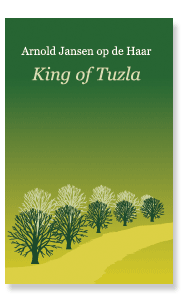
Arnold Jansen op de Haar, King of Tuzla bookcover

Book cover (Courtesy: Holland Park Press)

This brings me nicely to Arnold Hansen op de Haar’s King of Tuzla. I found it a strangely compelling book. I can’t say I loved it, and at the beginning I nearly gave it up, but it’s short and so I decided to push on. However, more of that anon. First a brief plot. It tells the story of a young Dutch army officer, Tijmen, who finds himself in the middle of the Bosnian War as part of a UN unit, and tracks his experience of the war and his feelings about it. Interspersed between his story are little “cameo” stories about various civilians and the impact of the war on them. In fact, the novel starts with one such cameo, the Muslim Galib who had been a civil servant but had lost his job due to the war and was now a farmer. These cameos do not become part of the main narrative.

The book is divided into 5 parts. The first three parts are essentially chronological, while the last two are told after the war, in flashback, some of it through Tijmen’s journal entries. Overall I liked the structure of the book. The early chronological sequence, the interspersed cameos that gave “life” (albeit often horrific) to the matter-of-factness of the military detail, and the change in pace and perspective in the last two parts give the book interest by layering meaning.

The characterisation of Tijmen and his fellow officers is effective. Tijmen himself is an intriguing character: a bit of a loner, interested in the arts (reading, ballet, iceskating), ambitious (but “Eleven years later and still he had got nowhere”), and a little proud (the King of Tuzla, the Duke of Sapna, is how he sees himself during the conflict). I must say, though, that I don’t quite know why the book has been described as a coming-of-age novel. He is an adult when the novel starts and, while he is a little naive in the ways of the world, I saw no coming-of-age focus.

The trouble is that the book is a bit of a plod to read at times, and I wonder whether this is to do with the translation. So, here’s the rub: do I place my concerns at the author’s or the translator’s feet? Part of the problem is the flow. It felt clipped and jerky, but not in a way that seemed like it was done for effect. And at times, the sentences just plodded on one after another, like a boring history text. Maybe all this was intended, but I found it hard going. In addition, there are errors, such as “the colonel still lay there snorting” (“Snoring” seems more likely) and some awkward expressions, such as “It was some minutes before Eddy was able to extricate himself from the situation with some difficulty”. Is this a translation problem? “With some difficulty” seems redundant, and makes the sentence clunky to read.

There are, however, also some lovely images and gorgeous rhythms. I particularly liked this, for example (despite the errant, to me, semi-colon after “popes”):

This was the area where the different population groups overlapped like different geological strata. It was the land of popes; the mullahs and rabbis, the Christians, the Muslims, the Jews and the gypsies. The land of the long hot summers and the long severe winters, of rakija, walnuts and prunes and the land of the centuries-old struggle between the Turks, Hungarians, Austrians and Germans…

And this poignant description of Tijmen’s flat:

Eight years in the same flat, where time’s mechanism had jammed. No-one had been loved there.

In the end, figuratively speaking as we learn this two-thirds of the way through the book, the war is too much for Tijmen and he leaves the army. The book concludes with some nicely structured words beautifully conveying what he had earlier described as “this uselessness, this futility, human helplessness”. (Wouldn’t it be better with another “this” before human?) This may not be the best war novel I’ve read, but it has its power.

This book has received some varied reviews. You may like to read a couple: Stu at winston’s dad and Lisa at ANZLitLovers.

Arnold Jansen op de Haar
(Trans. by Paul Vincent)
King of Tuzla
London: Holland Park Press, 2010
(Orig. pub. 1999)
199pp.
ISBN: 9781907320064

(Review copy supplied by Holland Park Press)

Helen Garner, Cosmo cosmolino

When I returned to seriously reading Australian writers back in the 1980s, there were four women writers who caught my attention, and I have loved them ever since. They were Elizabeth Jolley (1923-2007), Thea Astley (1925-2004), Olga Masters (1919-1986) and Helen Garner (b. 1942). Garner, the youngest by a couple of decades, is the only one still here, still writing novels, short stories, non-fiction and journal articles. I say I love her, but I can’t say I always agree with her. In fact, sometimes she makes me mad – but I admire her honesty and love her writing.

Cosmo cosmolino is not her most recent work. It was published in 1992 and has been on my TBR pile since my brother gave it to me in 1995. How embarrassing! But it finally managed to scramble to the top and I’m glad it did. It’s an intriguing book: it looks like two short stories (“Recording angel” and “Vigil”) and a novella (“Cosmo cosmolino”), but nowhere on the cover or the title page does it say “a collection of short stories”. This means, I think, that we are meant to see it as a novel.

So, how does it work as a novel? Each story would, I’m sure, stand perfectly well alone, but the two short stories also work as back stories to the novella. The tricky thing though is that the connections between these three are only obvious if you are an attentive reader – or, if you re-read it. For me it was a bit of both. I got some of the connections first time around, and others when I flicked through it to prepare this review. This is not a big problem but there is more depth if you have “got” the back stories when you read the final story.

And so, what are the three stories?

  • “Recording angel”. A recently separated woman (who is clearly Janet in the final story) visits an old friend and his wife in Sydney. This friend is seriously ill with brain cancer. He has not only been an important support and rescuer for her but the one who has “recorded” her life. And, he is never backward about telling her his view of what that is. She doesn’t always like or agree with this view, but she nonetheless fears the possibility that in sickness he will “forget everything” and that she will thereby lose an important connection with herself. There is a brief mention in this story of Ursula, who is the mother of the girl in the second story.
  • “Vigil”. A young woman, who is clearly “out of it” and waiting for her father to rescue her, has a boyfriend Ray(mond), who appears to be there more for the “good times” than for a mutually supportive relationship. When things go wrong, he’s not there for the count. This, we discover in the final story, is something he’s been trying to rectify ever since.
  • “Cosmo Cosmolino”. Three rather lonely people – the aforementioned Janet and Ray plus the rather fey artist, Maxine – find themselves sharing Janet’s house. It’s an uneasy grouping.  Ray is waiting for his big brother Alby (who once lived in Janet’s house) to arrive and take him away; Maxine would like a baby but is running out of time; and Janet is recovering from a broken marriage and doesn’t really know what she wants.

These are not strongly plot-driven stories. However, quite a bit happens on the emotional front, and this is Garner’s real subject.

Which brings us to the themes

Taken together, these stories are about the muddles people get into, particularly regarding their relationships with each other. Poor decisions, missed opportunities and the never-ending seeking for meaningful connection are the stuff of her fiction. But there is a departure in this book: the introduction of a spiritual (and at times magical) element, often involving some sense of “visitation”.

Angel Wings

Angel wings(Courtesy: OCAL via clker.com)

In the first story, the distraught woman is visited at the end by “a small, serious, stone-eyed angel of mercy”. In the second story Ray is dragged into a rather ghoulish underworld-like scene, after which he is told “You’ll be right … Things’ll be different now”. And in the final story there are all sorts of hints of spiritual happenings, including the “dark column” that shadows Janet, and Maxine’s “magical realist” flight “into the blinding upper sky” where “nameless souls and sacraments outrageously disport themselves”.

It all feels very un-Garner-like. She is usually firmly grounded in the real world of messy relationships where people struggle to connect and find meaning. But I should have been prepared: the novel’s epigraph from Rilke reads “Every angel is terrible”. “Terrible”, of course, has two meanings, and I suspect Garner is playing on both here – on the fear angels engender and the awe. As this paradox implies, there is no suggestion here of easy answers but more of possibilities. Here is Janet at the end:

Our minds are not hopeful, thought Janet; but our nerves are made of optimistic stuff.

I was intrigued by the use of “nerves” rather than “souls” or “spirits” given what had gone before, but I rather like her use of that word. It’s effectively ambiguous.

Finally, the style

The thing that marks Garner out for me is her expressive language. Her books are rarely long. This isn’t because she doesn’t have much to say but because she doesn’t waste words. Read this:

… The heart of the house was broken. It ought to have been blown up and scraped off the surface of the earth.

But houses as well as their owners must soldier on …

and this:

… and the architraves had lost their grip on the walls, and slouched this way and that …

and, finally, this:

The room contracted around Ray again, fitting itself tightly to the shape of him, squeezing …

I love the atmosphere and emotion conveyed by language like this.  Garner uses a lot of imagery and symbolism – but never simply. Birds, for example, can augur wonder and hope, or, particularly when “the failure bird” appears, something completely different. There are also biblical allusions, such as when Ray denies three times that he knew his girlfriend. No wonder he’s dragged into the underworld for a bit of shock therapy! From beginning to tend, the language never sways from conveying a sense of things being awry because the characters’ lives are so.

Cosmo Cosmolino is one of those books that is both accessible and challenging – and that is just the sort of book I like to read.

Helen Garner
Cosmo cosmolino
Ringwood, Vic: McPhee Gribble, 1992
221pp.
ISBN: 0869142844

Ian McEwan, Solar

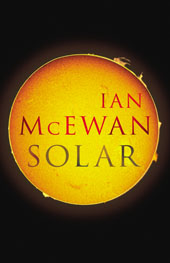
Ian McEwan Solar bookcover

Bookcover (Used by permission of the Random House Group Ltd)

I don’t know whether I believe your story, but I’ve enjoyed it.

So says McEwan’s latest creation, Michael Beard, to a character he has “done wrong”. This more or less sums up my feelings about Solar, the novel in which this statement appears. I am a McEwan fan and have greatly liked most of the 5 or 6 of his books that I’ve read but, while I found this one readable, I’m not convinced that it completely comes together into a coherent whole. This may have something to do with the fact that McEwan has tried for something lighter here and hasn’t quite pulled it off.

Do I need to describe the plot? It’s been reviewed so much by now that I presume most readers here already know it. However, to be on the safe side, here goes. It’s all about Nobel Laureate physicist, Michael Beard, who at the start of the book is 53 years old, 15lbs overweight and at the end of his 5th marriage (due to his incurable, it seems, womanising). On top of this he is struggling to keep his career alive: he is surviving, mostly on speaking engagements, while he waits, hopes, for a new inspiration. This is the set up. And, as is typical of McEwan, a little way into the book an event occurs that will be life-changing. In Beard’s case it will kickstart his career. How that occurs – and its eventual fallout – forms the rest of the book.

The novel is divided into three parts, labelled simply 2000, 2005 and 2009. If Beard was 15lbs overweight in 2000, in 2005 he is 35lbs overweight and by 2009 that has increased to 65lbs. This might tell you something about him: he is out of control in every aspect of his life – physically, emotionally, intellectually and morally. He is not, as you might gather from this, a likable man, but it is mainly through his eyes – told third person – that we experience the novel.

As the title suggests, the book’s subject matter is solar energy and climate change. And some of the best parts are those in which McEwan satirises the politics of climate change. In an amusing sequence, Beard is invited to the arctic along with a number of artists (making him the proverbial sore thumb) to experience climate change first hand. While he is there he observes the increasing chaos in the “bootroom” where the outdoor clothing is kept. From day one, the “bootroom” doesn’t work as people take items from pegs that are not their own resulting by the end of the week in no-one wearing a complete outfit that fits them. This works pretty well as a metaphor for the chaos and disorganisation in the climate change community. Add to this scenes like the idealistic climate-changers scooting about the ice in their gas-guzzling skidoos and you get a rather funny, and pointed, episode in the book.

The tone of the book is, in fact, comic-satiric which is a bit of a departure for McEwan who has tended to write books that are more dramatic, many with a “thriller” component. Here, though, there are even moments of slap-stick, such as when Beard early in the book pretends that he has a woman in the house in an attempt to make his wife jealous – all to no effect, but in terms of the novel’s plot it results in a deeply ironic statement:

Clearly he had been in no state to take decisions or to devise schemes and from now on he must take into account his unreliable mental state and act conservatively, passively, honestly, and break no rules, do nothing extreme.

Not long after this episode he does the complete opposite. Some of the members of my reading group found the book very funny but for me it fell a little flat. I saw the satire and thought it was clever at times, but it was sometimes more pathetic than highly comic, and at other times a little heavy-handed. Here, for example, is Beard on the bootroom:

How were they to save the earth – assuming it needed saving, which he doubted – when it was so much larger than the bootroom?

Now, most readers would already have got the point. I’m not sure that we needed to have it hammered home like this.

The focus of the book, as you will have gathered by now, is Beard and we spend a lot of time in his head. This is not a problem in itself, except that he never seems to change. He’s a gluttonous, arrogant, self-centred womaniser at the beginning and is the same at the end. He is also morally bankrupt – something you will discover soon enough if you read the book. Does a character have to change for a book to work? Not necessarily – think Jean-Baptiste Grenouille in Perfume – but we do have to stay interested in the character and Beard, for me, became a little boring. There was too much of the same – too much womanising, too much alcohol and fatty, fast food, too much self-aggrandisement – that I started to think “enough already”.

The key question to ask, then, is why has McEwan chosen such a character? The answer seems to be that McEwan wanted to express his fear – cynicism even – about 21st century humankind’s ability to enforce change. Early in the novel is this:

Beard was not wholly sceptical about climate change. It was one of a list of issues, of looming sorrows, that comprised the background to the news, and he read about it, vaguely deplored it and expected governments to meet and take action … but he himself had other things to think about …

Himself, basically. Is McEwan saying Beard is us, is Everyman? If so, I can’t help thinking he’s got a point, but I’m not sure he’s written the book – like, say, Animal farm – that sustains the trope well enough to last the distance.

Oh dear, I fear now that I have been more critical than I meant to, because I did find the book readable. I did want to know what happened. I liked a lot of the language. And I did enjoy many of the observations McEwan makes throughout the book – about reason and logic versus idealism, about feminism, and of course about politics. Take for example the following, which is very apposite given that we downunder are in the middle of a Federal election campaign:

He was aggressively apolitical – to the fingertips, he liked to say. He disliked the overheated non-arguments, the efforts each side made to misunderstand and misrepresent the other, the amnesia that spooled behind each ‘issue’ as it arose.

I can relate to that …

Finally, there is a sly bit of self-deprecation running through the book about stories, imagination and the arts. I had to laugh at Beard’s comment that:

People who kept on about narrative tended to have a squiffy view of reality, believing all versions of it to have equal value.

I’ll leave you to decide what you think of McEwan’s version here.

Ian McEwan
Solar
London: Jonathan Cape, 2010
283pp.
ISBN: 9780224090506

M.J. Hyland, This is how

Bookcover (Courtesy: Text Publishing)

If you want to read a book that is quick (and seemingly simple) to read and yet satisfyingly complex, then MJ Hyland’s This is how is for you. I’ve been wanting to read Hyland for a while and, having now done so, this won’t be the last.

So where to start? The novel is a first person story told by a young, somewhat disengaged 23-year-old man, Patrick Oxtoby. It is set in the late 1960s, perhaps early 1970s, but the setting and period barely matter really, as this is very much a book about character (and, humanity in general).

Now, my problem is what to say about the plot without spoiling the first third of the novel, so I think I’ll say nothing except what the back cover tells us. It says that “it is a novel about crime; though not a crime novel” and that “it has an almost stately pace and yet it’s thrilling”. These, together with my opening comment that it is simple but complex, should convey what a rather paradoxical read this is. The novel opens with the following:

I put my bags down on the doorstep and knock three times. I don’t bang hard like a copper, but it’s not as though I’m ashamed to be knocking either.

Who is this? Why does he describe his knocking in such terms? Well, we soon learn that Patrick, newly jilted by his fiancée, has come to this little seaside town to start a new job as a mechanic. He’s intelligent – though dropped out of university – and comes with good recommendations as a mechanic from his previous employer. But he is a very singular person, one who is not totally comfortable in his own skin. This is apparent from the beginning: here is more from the first page:

‘I thought you’d be here hours ago.’
It’s after ten and I was due at six. My mouth’s gone dry, but I smile, friendly as I can.
‘I missed the connection,’ I say.
I’ve not meant the lie, but she’s forced me.

Hmm, now I really was wondering who this is and, given the suggestion that the novel is about a crime, I wondered whether he is the criminal and whether he had already committed a crime? I also started to wonder as I continued to read the first few pages whether he was an unreliable narrator. But no, he is essentially reliable; he is, in fact, very much himself – but himself is a complex (aren’t we all) human being who carries quite a bit of baggage. I’m not quite sure how Hyland does it but throughout the novel she manages to unsettle her readers and keep us that way: at times we empathise with Patrick and feel sympathy for him and then suddenly he distresses if not horrifies us – and we wonder anew, Who is this man?

MJ Hyland

MJ Hyland, London, 2008 (Courtesy: MJ Hyland via Wikipedia, using CC-BY-SA 3.0)

In my opening para I said it was a quick and seemingly simple read. This is because the style is simple and direct. Patrick tells his story in present tense, with just the occasional flashback. Sentences are mostly short and simple, and the paragraphs tend to be short too. There is quite a lot of dialogue and not a lot of description. And what description there is tends to be short, sharp and vivid (“This blow is like a dose of poison in my veins, a hot sharp shot through my legs and arms, through my bowels and bladder”). Patrick is introspective at times but he doesn’t wallow in it. All this gives us a picture of a pretty simple character, which he is – and isn’t at the same time. There is, we are aware, quite a gap between what he says and thinks (most of the time) which could make him seem coldly manipulative. Yet, he’s not that. It’s more that he’s a somewhat damaged soul trying to survive in a world that doesn’t seem to go the way he would like – and it is this that leads to his trouble.

He likes to be in control (“I wanted her to go, and now she’s gone it’s like rejection, feels like it was her idea and not mine”) but he doesn’t try to bend others to his will. He has an uncomfortable relationship with the truth (“She put her hand on her heart and gives me a big smile and I’m reminded of when I told the girl in the theatre foyer that I was nervous and how the truth got a good reaction out of her as well”) but it’s more to do with self-protection than with any specific desire to deceive others. He has a complicated relationship with his family and they with him, but most of what we know is from his perspective so it is difficult to know the “truth” (if  a simple “truth” there can be in families). As he says:

I’m not sure if the truth will make any sense. The truth is, I thought I was rejecting my mother when I left home … But it turns out she was the one doing the rejecting and it’s just the same with my father.

The “real” truth, though, is probably somewhere in between.

Does he* grow throughout the novel and is there a resolution? To some extent he does get to know himself better but the resolution seems to be more that he learns to live with his situation (“life’s shrinking to a size that suits me more”) rather than grow as a person. But maybe that’s what maturity/development is really about?

Whatever the case, this is one of those truly original creations – a character who, as the back blurb says, “is fully himself and yet stands for all of us”. I haven’t been so intrigued by and engrossed in a character for a long time. The plot is slim but I barely noticed. I’ll definitely be reading more Hyland.

MJ Hyland
This is how
Melbourne: Text Publishing, 2009
376pp.
ISBN: 9781921656484

Review copy supplied by Text Publishing.

* An aside. I couldn’t help wondering at times whether Patrick, with his social awkwardness and slightly obsessive behaviour, might be autistic to some level, but this never comes out and I am uncomfortable ascribing a pathology to a character when the author hasn’t done so.

Eva Hornung, Dog boy

Eva Hornung, Dogboy

Dog boy cover (Courtesy: Text Publishing)

I first read Eva Hornung when she was writing as Eva Sallis. It was her second novel The city of sealions, which is a pretty passionate and evocatively written exploration of cultural alienation and dislocation brought about primarily by migration.

In some ways Dog boy explores similar concerns, but its alienation is played out in a different way – through that fascinating archetype of the feral or wild child. In the novel, Hornung refers to a few modern examples of feral children, such as Oksana from the Ukraine; in an interview on the Literary Minded blog she says that the novel was inspired by a news story about a child living with dogs in Moscow. Guess where this book is set? You got it – Moscow! This intrigued me somewhat. Why would an Australian novelist read about a feral child in Moscow, go there to research and then write a novel? But Eva Hornung seems to be no ordinary novelist. She did her PhD in the Yemen and her settings – even if not her overriding theme – range rather widely.

And so to Dog boy. At the beginning of the novel Romochka, 4 years old, is alone in an apartment. He hasn’t seen his mother for a week or more and suddenly his uncle does not return. He senses the apartment building is being emptied and so after a couple of days being alone he heads out, and manages to get himself adopted by a dog, Mamochka, who lives with her four young puppies and two older offspring. How and why he is left alone is not the concern of this novel (which reminded me a little of Cormac McCarthy’s The road in which the cause of the devastation is also not the point). The novel tells the story of his life with the dogs and of what happens when he, four years later, comes to the attention of humans, specifically two scientists/doctors working in a children’s rehabilitation centre.

[WARNING: MINOR SPOILERS]

The story is told chronologically, and is divided into 5 parts. The first two parts cover Romochka’s first two years in the lair and how he gradually learns “to be a dog”. In the third part, Mamochka introduces a baby to the pack – to provide human company for Romochka. The baby is, ironically, called Puppy (by Romochka). Without giving any important plot points away, the final two parts deal with the boys’ renewed contact with the human world. It’s told in 3rd person but the perspective does shift, particularly in the last two parts where we see what’s happening through different eyes – the two scientists, Dmitry and Natalya, and Romochka himself. But even before this, we occasionally move between Romochka’s and the author’s perspective. It’s a technique that encourages us to understand, if not empathise with, the various experiences as they play out.

As I read this book, I felt I was in the hands of someone who knew what she was doing – even though at times I wondered exactly why she was telling this story. Not only does she viscerally describe Romochka’s gradual acceptance into the dog clan, his learning to hunt and his slow rise to dominance, but she starts to introduce humans at a time when our interest in an ongoing dog story would start to pall. This shift starts with Romochka’s increasing interest in people and builds up to the more or less inevitable conclusion – but that conclusion is not simple and is open-ended.

The language is evocative – sometimes beautiful but more often earthy and confronting to our senses. Hornung evokes Romochka’s life with the dogs with such attention to detail that it is entirely believable. She describes his animality, without being heavy-handed – he moves in “a wide lope”, uses his “paws”, and carries with him a horrible “stench” – but also shows his ability to use human logic and reasoning. At the time of his first capture, Romochka’s inner dog-human conflict is obvious:

Romochka wished bitterly … for true doghood. Were he really a dog, he would understand only their bodies, and not their words. Were he really a dog, he wouldn’t know their names, and their kids’ names. He wouldn’t … be paralysed by these lives that stretched before and after the station: he would know only their smell, only their aggression and torments; and what they ate.

The fight went out of him altogether. He stared dumbly, balefully without growling or snapping, unresistant even when he was pushed around. He was no longer sure that hiding his human side would get him released, but he remained a dog …

The big question to ask is, Why did Hornung choose to tell such a story? There is the obvious reason, that of our ongoing fascination with the wild child phenomenon and what it might tell us about what it means to be human. But there is also Hornung’s ongoing interest in alienation and, related to that, the abuse of humans by other humans (particularly where there is social disintegration). For all our horror at the way Romochka lives, we also see that he is not only safe but well nurtured in his life with the dogs. Was this boy, Natalya and Dmitry ponder, “better off living with dogs than with humans”. This question, that comes towards the end, represents a big shift from Dmitry’s earlier “proper awareness of the philosophic and scientific divide between man and animal”. The second part of the novel, in fact, explores this question at some depth. How big is the divide really? And to what extent is man a beast? All this is explored with more than just a little skepticism about scientific research and the tension between nice neat theory (and the chance it offers for professional glory) and messy reality. There is a lot in this book for keen readers to consider. It’s one that I will remember for some time.

Dog boy is Sallis aka Hornung’s 6th novel. She has won or been nominated for awards for many of her novels and yet she is not particularly well-known. Her change of name may have contributed to this but, whatever the reason, I think it’s a shame. Her writing is clear, accessible and evocative – and yet has a depth and passion that is worthy of the prizes she wins. May we see more of her.

Eva Hornung
Dogboy
Melbourne: Text Publishing, 2009
293pp.
ISBN: 9781921656378

(Review copy supplied by Text Publishing)

Margaret Atwood, The Penelopiad

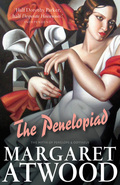
Margaret Atwood, The Penelopiad

The Penelopiad bookcover (Courtesy: Text Publishing)

This is the second time I have read Margaret Atwood’s The Penelopiad. Much as I enjoyed it the first time around, I probably wouldn’t have read it again if it hadn’t been scheduled for one of my online bookgroups. However, given that scheduling and the fact that I had recently listened to Simon Armitage’s dramatisation of The odyssey, I didn’t mind reading it again – and it is short! My rereading though ended up being a little disjointed as I was trying to finish off a number of competing contracts at the time as well as prepare for a ten-day trip to our warm Top End. This review may be similarly disjointed!

The book is part of Canongate’s Myths series in which recognised writers were asked to retell well-known myths. At the time of publication, Atwood said that she tried a number of myths and had nearly given up when she suddenly recollected the story of Penelope and her hanged maids – and her childhood reaction to it. The result is a rather fresh – and cheeky – look at the story told through Penelope’s and the hanged maids’ eyes, from, not surprisingly, a feminist (or at least female) perspective.

The story is told through a large number of short chapters in Penelope’s voice, and these are interspersed with commentary from the hanged maids, emulating, appropriately enough, the idea of a Greek chorus. The way Atwood uses it, the chorus provides a satiric perspective on Penelope’s view of the story. The story is told in flashback, with the narrators all speaking from Hades, where they now reside. It is not a standard revisionist feminist treatise that simplifies the world to one of gender power discrepancies (even though that is what underlies it all). We get to “feel” what it might have been like to have lived then. Atwood’s characters are “real” and operate in a complex world where game-playing and manipulation are de rigueur if you are going to survive.

In Homer, Penelope is presented as “the quintessential faithful wife” (Atwood’s introduction) who brings up their son and cleverly fends off suitors while waiting patiently for Odysseus’ return. When he returns, he kills the suitors and twelve of Penelope’s maids. Atwood, again in her introduction, says that in choosing to tell the story through Penelope and the maids she wanted to focus on “what led to the hanging of the maids, and what was Penelope really doing?”. Her Penelope is something rather more than the constant wife of The odyssey. She, the part daughter of a watery Naiad, is a slippery character to pin down. She is highly jealous of her beautiful cousin Helen (she of Troy fame) and she is capable of making her own power plays. She is of high birth, contrasting her with the twelve maids who, by their own admission “were born to the wrong parents. Poor parents, slave parents, peasant parents, and serf parents…”.

What I enjoyed most about this book – besides the story Atwood tells – is its sly humour. It is genuinely funny, albeit in a dark or sometimes gruesome way. Much of the humour arises out of Penelope’s playing with the truth. In fact the book plays continually with the idea of “stories”. In the first chapter, Penelope says:

Now that all the others have run out of air, it’s my turn to do a little story-making. I owe it to myself. I’ve had to work myself up to it; it’s a low art, tale-telling … So, I’ll spin a little thread of my own.

A little further on in the book, she says, when reporting one of the prevailing stories about her, that “there’s some [my emphasis] truth to this story”. And so, as we read we need to remember that she too is telling us a story, and that there’s no guarantee that her story is any more “true” than another’s. This idea is reinforced by the fact that the maids comment on what Penelope tells us. Their and Penelope’s perspectives are not always the same. That is, their truths are different. This notion of stories versus stories is made even more clear in the chapter titled “Waiting” in which Penelope recites all the opposing stories and rumours about what Odysseus was doing/what was happening to him during the 10 years of his return. Reader beware, I say. In fact, at one point in the book where Penelope questions whether the “maids were making some of this up”, I wrote in the margin “Where is the truth”? I love the way Atwood plays with myth-making in a book about a myth – and, in doing so, also calls into question her own storytelling. Very postmodern!

I won’t go on. It’s a little uneven, with the maids’ story in particular being not quite as well integrated as it perhaps could. And yet, I’d recommend it, if you haven’t already read it. It’s clever, funny and compassionate – but its compassion is not a naive one. Rather, it has wide open eyes and knows that nothing is ever as simple as it looks – particularly when you find yourself in a situation where there is imbalance of power. Games will be played – and the powerless, such as women and particularly poor maids, will usually lose. And this, in the end, is Atwood’s (somewhat heavy-handed) point. As Penelope says in her last chapter:

Even with my limited access I can see that the world is just as dangerous as it was in my day, except that the misery and suffering are on a much wider scale. As for human nature, it’s as tawdry as ever.

Margaret Atwood
The Penelopiad
Melbourne: Text Publishing, 2005
199pp.
ISBN: 9781920885953
NB: Cover image used above is from the new 2007 edition.

Herz Bergner, Between sky and sea

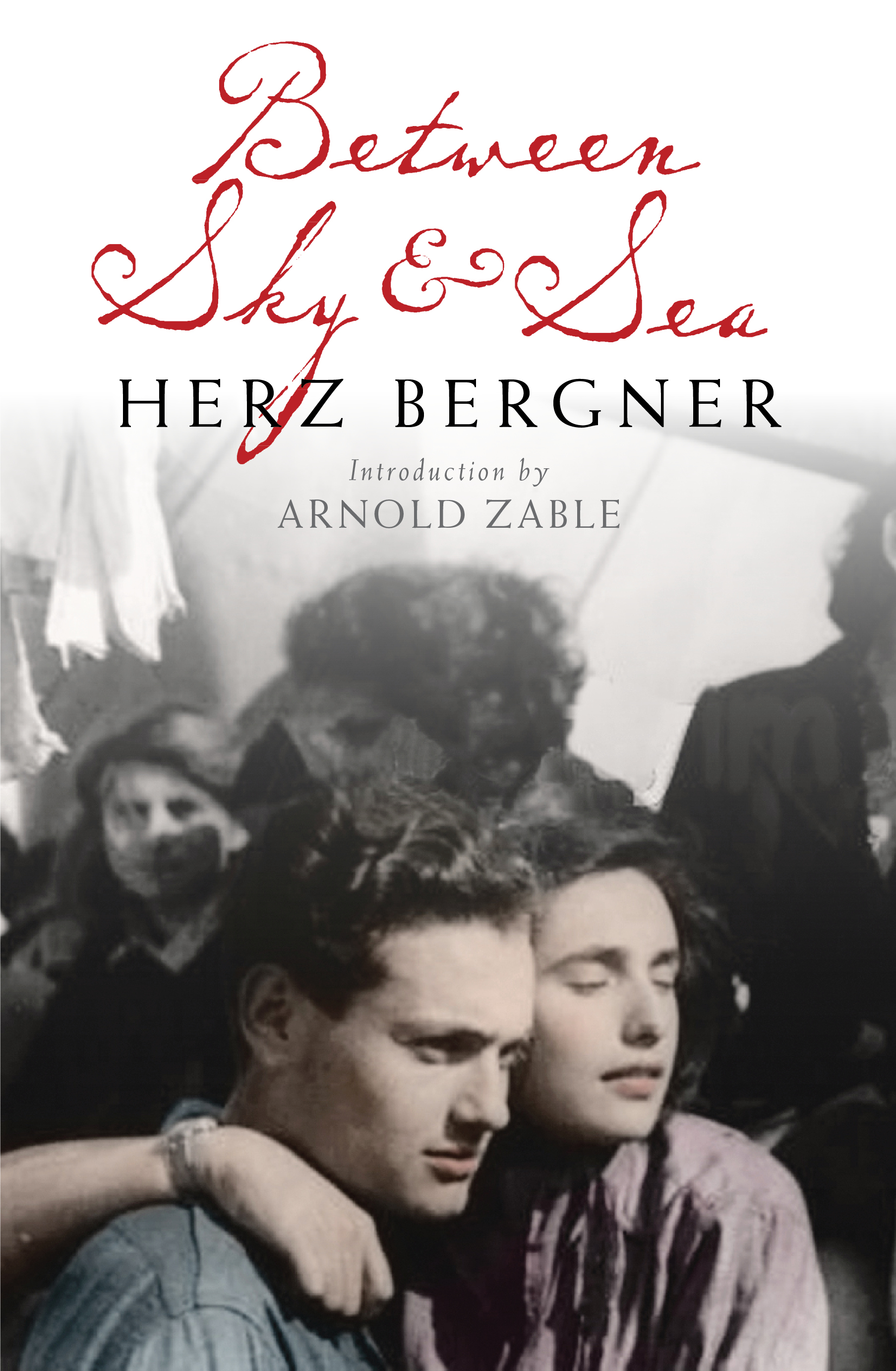
Hans Bergner, Between sea and sky
Book cover (Courtesy: Text Publishing)

Do you read introductions to novels? And, if you do, do you read them before or after you read the novel itself? I read them, but always afterwards because I like to come to  novels as objectively as I can. And so, this is what I did with Herz Bergner’s  Between sky and sea which won the Australian Literature Society’s Gold Medal for Book of the Year in 1948. I’d never heard of it. (Well, I wasn’t around then, but still …!) However, this year Text Publishing has republished it, which is a pretty savvy decision because, as Arnold Zable suggests in the introduction, it has some resonances for contemporary Australia – but more on that anon. Zable also tells us that while Bergner, a Polish Jew who emigrated to Australia in 1938, wrote the book in Yiddish, it was first published in English, having been translated by another Australian Jewish novelist, Judah Waten.

The novel has a straightforward plot. It tells the story of a group of Jewish refugees from the Nazi invasion of Poland who are passengers on an old Greek freighter bound for Australia where they hope for a new life. (Australians, at least, will see the contemporary resonances now. Think SIEV X, for example). There is, though, an older resonance which Bergner presumably knew – that of the MS St Louis which tried to find a home for Jewish refugees in 1939 after they were turned away from Cuba (and which later inspired the book Voyage of the damned, so titled because, as many of you know I’m sure, they continued to be turned away as they went from port to port). These resonances and more are all referred to in the Introduction. Knowing readers will pick many of them up, but isn’t that the fun of reading? To pick them up yourself? So, read the book, I say, and then the rather fine Introduction.

Anyhow, back to the book. As I was reading it, I couldn’t help also thinking of that allegorical boat trip, the Ship of Fools. This is not that allegory – they are not fools, and the boat does have a captain, but as I read the novel I felt that awful sense of a world out of control that the allegory represents.

If this book were a film, it would be described as having an ensemble cast, because it has no identifiable heroes or heroines, no real anti-heroes either. Rather, it has a bunch of people who are thrown together by circumstance but who have little in common other than that they are Jewish refugees. Their backgrounds are diverse and they vary in their practice of Judaism (if they practise it at all). They include Nathan and Ida (who lost their respective spouses and children while escaping the invasion), the know-it-all Fabyash and his family, the flirty but mostly kind-hearted Bronya and her stolid overweight husband Marcus, Mrs Hudess and her two daughters (whose only remaining possession is one doll), and several others. As you might expect with such a set up, the novel explores the increasing tensions – the arguments, the pettinesses alongside the kindnesses – that occur as supplies of food and water dwindle and people get sick, while the journey goes on and on without an end in sight:

They were ashamed to lift their heads, to look each other in the face, and for two reasons. Because Fabyash had sunk so low that he had stolen food from a child, and because Mrs Hudess, who was regarded as such a refined person, had burst forth with the language of the coarsest market vendor. To what depths suffering can bring a person.

The strength of the novel is, in fact, its characterisation. Despite its almost non-existent plot (though there is a climax that I won’t give away), the novel maintains our interest because its characters are real in the way they relate to each other and their circumstances. We know these people, we are these people. In this regard it is a little different from those Holocaust novels – many of which also deal with “ordinary” people – that work on a larger-than-life heroism-betrayal scale.

Towards the end of his introduction, Zable quotes Waten regarding the translation. Waten apparently translated it with Bergner by his side, and says that Bergner was “very odd because he wanted every word translated, and if the number of words came out fewer in English he wasn’t very happy. He never really mastered the English language”. This makes a bit of sense because there are times when the novel feels a little – well – wordy. This never becomes a big problem, however, because Bergner’s imagery (mostly simile and analogy) tends to be fresh and is often two-edged:

A soft haze shimmered in the summer air, caressing their faces like spider webs. [on Nathan and Ida’s escape from Warsaw]

and

For a moment the moon shone through, glittering like a lance, and then it was quickly hidden again.

and

… at midday when the sun was ripe and full like a great golden pear that hung heavily from the centre of the sky.

I enjoy writing like this that contains layers of meaning that make you think a little before you move on. The language is not particularly complex, but Bergner has a habit of inserting a word or phrase that undercuts your expectation and keeps you reading.

The themes are both particular and universal – particular because they specifically depict the anti-Semitism that was rife during World War 2 (to the extent that even the crew on the boat treat the passengers as less than human), and universal because they explore the various ways humans behave under stress. The overriding theme – the biggie, in fact – is the way we continue to turn away other. The irony is that even when we are the other – such as the Jews on this boat – we find otherness amongst ourselves to turn away (until a bigger calamity forces us to reconnect). Will we ever change? I fear not. In fact, that’s what makes the universal, universal, isn’t it?

It is encouraging to see publishers like Sydney University Press and Text Publishing – not to mention of course Penguin –  reissuing long out-of-print Australian classics. I hope it pays off, not only because I like to see forgotten Australian classics brought to life again but because, as in this book, the messages conveyed by these classics can be as valid today as they were when they were first written.

Herz Bergner (trans. by Judah Waten)
Between sky and sea
Melbourne: Text Publishing, 2010 (first ed. 1946)
215pp.
ISBN: 9781921656316

(Review copy supplied by Text Publishing)

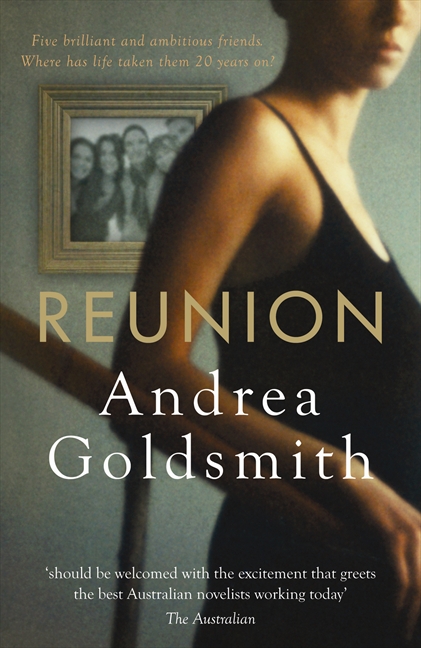
Andrea Goldsmith, Reunion

Andrea Goldsmith, Reunion bookcover
Reunion bookcover (Courtesy: HarperCollins Australia)

I wanted to love Andrea Goldsmith’s Reunion. And I expected to, as I remember enjoying the last book of hers that I read. But, somehow, I found it a bit of chore to read, though it did pick up towards the end. I think I understand why it was not listed for the 2010 Miles Franklin Award.

Friendships become swaddled in invisible protective layers and nothing short of a cataclysmic blow can break through to the inevitable stress points beneath.

The plot is fairly straightforward. Four university friends (three students, borderline baby-boomers and now in their mid-40s, and a lecturer, now around 60) find themselves all living in Melbourne again after some 20 years apart. All four had met in Melbourne, had moved together to England to continue studies and work, but had then gone their separate ways. At the beginning of the novel Jack, an academic and Islamic expert, is single and still in love with Ava; Ava, a novelist, is married to the unpopular Harry; Helen, a scientist, is a single parent; and Connie/Conrad, a philosophy lecturer, is on his third marriage but still philandering. Harry, who met them in England, is on the outer, but it is he who has engineered the reunion under the auspices of an organisation he has created, NOGA (Network of Global Australians).

The novel, then, is about this time of reunion: it explores who they are now, and the state of their relationships with each other. Sounds like the sort of thing that would interest me – Melbourne setting, characters with whom I would expect some level of identification, themes exploring love and friendship, and a writer whom I’ve enjoyed before. None of these, I should add, are essential for my reading enjoyment – I also like books set in exotic places and about very different characters – but familiarity often appeals too (doesn’t it?).

And yet, for me the book fell a little flat. It just didn’t feel quite original enough – in either ideas or language. It felt a little same-old-same-old. That said*, I found the characters interesting and convincing, although only one, Jack, changed in any significant way as the novel progressed. The narrative mode is multiple 3rd person subjective, with Jack’s perspective starting and ending it. It is told, chronologically, but with flashbacks to fill in the past. All this is well controlled and keeps the story moving nicely.

Goldsmith ranges across a lot of themes – love and friendship (of course); truth and fiction; secrets and memory; passion and obsession; modern communications; revenge and forgiveness; and science, ethics and politics. It is probably here that the novel palled most for me because many of these themes seem to go nowhere. Take the truth and fiction one. Those of you who read my blog know that I enjoy seeing this issue explored, but in this novel it’s raised, often with a nice level of irony, but is not really developed. For Ava, the novel writer, “there was no better vehicle for truth” than fiction, whereas for the scientist, Helen, “Ava’s work is only fiction – none of it is true”. Well, I thought, Goldsmith will unpack the ironies contained in these, but she doesn’t really. Perhaps that’s OK, perhaps it’s enough for us to notice them, but I wanted more.

At other times, the themes seem more like the author’s soapbox than ideas fully integrated into the story, albeit that the characters are her mouthpieces. Here, for example, is Jack expressing a rather stereotyped view of modern communication:

Whenever Jack looked back to his university experience and compared it with today’s university student life, so much seemed to have changed – even friendship itself. Without computers and mobile phones, face-to-face communication ruled the day.

The implication is that modern friendships are somehow less meaningful, but what does he really know and, further, what does the novel show us about it? Nothing really. Similarly, Helen rages about political interference in science, but the issue, while valid enough, seems a little fabricated in the context of the novel.

There are some funny set pieces, such as the young television make-up artist trying to hide Connie’s aging neck. Goldsmith does irony well – something I, as a Jane Austen aficionado, rather enjoy – and she peppers the novel with a lot of effective literary allusions – to Waugh, Wharton, James, and others. Moreover, there are some lovely descriptions, such as this one on Ava’s discomfort during her first weeks in England: “It was like being stranded on a sheet of clear glass with nothing but blackness underneath”. I’m not sure why I like this, but I do.

I’ve struggled to write this review, really, because there are things to like about this book. I decided to do a quick review of reviews out there and what I mostly found were positive reviews that each had some little reservation: “despite that minor misgiving”, “a rich and at times frustrating novel”, “despite a few stylistic glitches”, and “the novel was marred but not spoiled for me by …”. None though explored these reservations in any depth.

And so, rather than labour any more, I will close with the words of Helen’s teenage son, Luke. He says, in that simple, direct way that the young can do:

The truth can hurt. But that doesn’t make it less right.

The final irony is that Harry is hurt by a truth – but the truth he is hurt by and the real truth of the matter are two quite different things. And that, in the end, made the novel an interesting if not totally engaging read.

For a more positive perspective on this novel, check out Lisa’s at ANZLitLovers.

Andrea Goldsmith
Reunion
London: Fourth Estate, 2009
414pp.
ISBN: 9780732287832

*See my previous post on words to avoid!

Shaun Tan, Eric

Shaun Tan, Eric cover

Eric bookcover (Courtesy: Allen & Unwin)

When I bought Eric on a whim the other day (as you do!), I didn’t realise that it had been excerpted from Shaun Tan’s Tales from outer suburbia which I haven’t yet read, but have given to others. That’s okay though, because it means  that I’ve finally read a little of Shaun Tan, something I’ve wanted to do for a while.

Shaun Tan is an Australian multi-award-winning artist-writer (or is it writer-artist?) who has published books, worked in theatre and film, and had his work adapted by such luminaries as the Australian Chamber Orchestra. He is one versatile man! His best known works include The arrival (a wordless graphic novel about migrants) and Tales from outer suburbia (an anthology of 15 short illustrated stories about all sorts of strange things that happen in suburbia).

Eric picks up on what I believe is one of Tan’s common themes, that of being different or strange, an outsider. It is about a foreign exchange student who comes to stay with a family in – yes – suburbia, and how they all get along.

Tan’s is not a negative presentation – at least, not here. The mostly monochromatic drawings are whimsical and all focus on Eric, the visiting student, while the text is in the voice of a child of the house. The story is about tolerance and acceptance of what you don’t understand. It’s also about expectations that aren’t met – but accepting the things that happen instead. As Mum says in the book, “It must be a cultural thing”. Overall, it’s about the fact that other can reside with other – and yet it also allows discomfort and incomprehension to be an acceptable feeling.

This sounds like a simple book, and in some ways it is, but it’s not simplistic. Producing it as a gift-edition like this is a lovely idea. It will, I hope, introduce more people to Shaun Tan and his rather unique view on the world. It has certainly whetted my appetite.

Shaun Tan
Eric
Crow’s Nest: Allen & Unwin, 2010
[48pp.]
ISBN: 9781742372921

Alex Miller, Lovesong

Alex Miller, Lovesong

Lovesong bookcover (Courtesy: Allen & Unwin)

Lovesong is my first Alex Miller novel, which is a bit embarrassing, really, given that he has won the Miles Franklin Award twice.

John was the quiet type … Except when he was telling me his story. Even then there was something quiet and private in the way he spoke about himself and Sabiha; as if he was telling himself the story; going over it to find its meaning for himself. Looking for something he’d missed when it was happening to him.

As you can probably tell from this quote, Lovesong is one of those story-within-a-story novels. Its basic plot is fairly simple. John, an Australian, tells the story of his life in Paris with his Tunisian wife, Sabiha, to Ken, a retired novelist. Retired? Well, so he says, but can he resist a good story when he hears one?

John and Sabiha’s love story is not exactly straightforward, which is foreshadowed early in the novel when Ken first meets Sabiha and notes “a sadness in the depths of her dark brown eyes”. He begins to wonder about “her story”. Adding a little complexity to this is a loose parallel in Ken’s life. He lives with his 38-year-old daughter, Clare, who during the novel starts a love affair of her own. Sabiha is, coincidentally, about 38 when the “crisis” in her life occurs. There are other parallels in the novel, such as Sabiha’s aunt Houria and her marriage to Dom, and Ken’s marriage to his wife Marie. Again, these are loose. They provide depth and perspective rather than the direct commentary that parallels often seem to do.

This is a surely structured novel. Miller manages to be simultaneously subtle and obvious so that you are conscious of being led along, but you are not always sure where to or what it might mean. Early in the novel, Clare tells her father that “Love is never simple”. A little later, Sabiha’s father reflects on his daughter and wonders, rather more prophetically than he realises, what “makes some people so different from others that they cannot share a common fortune with them”.  Alongside these early thematic hints is a whole slew of comments about story-telling and writing, about story-telling as “confession”, as “craving for absolution”, as, in fact, catharsis. In other words, the novel is also self-consciously metafictional, which is not surprising given that the first person narrator, Ken, is a novelist.

Meanwhile, there is John and Sabiha’s actual story – and again, the plotting is sure. We learn early that Sabiha wants just one child, “her child. There was only one”. And we learn of her closeness to her maternal grandmother. These two things, dropped lightly in the book, play a significant role in the development of the plot.

The novel is full of irony, starting with the title and its romantic connotations being undercut by other sorts of songs. And there is this from Sabiha’s aunt Houria:

Don’t try sorting out the rest of your life tonight, darling. You’ll see, it’ll all work out in the most unexpected ways.

This is doubly ironic because, eventually, Sabiha does attempt to sort out her life, rather than let it work out, and the result, while giving her what she wants, is also not what she expected. What’s that adage? Be careful what you wish for? And yet, that’s not what the novel is about. It’s not a cautionary tale. Rather, without being coy, it’s a meditation on the mystery and power of love – and, I would say, on innocence and experience in its many guises.

But it’s about other things too, such as the importance of home and place. Both Sabiha and John spend much of their lives living away from their respective homes. Ken, at the novel’s start, has just returned from spending time in Venice and is trying to decide whether to return. It’s also about Life – and the inevitability of change: “Change being forced on them, even as they stood still”. John feels it, Ken feels it.

But again and again, we come back to stories and storytelling. Partway through the novel Ken thinks:

There were things I could have added to his story, but I didn’t want to make it up this time. The truth is … I have never really liked making it up. My imagination, such as it is, needs the facts to feed off. I could see the directions I might go in with John and Sabiha’s story, but I resisted. I wanted to hear the truth from John.

And yet, it is not so simple as it sounds. At the end, he wonders:

I had her story now, but it is one thing to have a story and another to write it. How was I to articulate the delicate complexities that must give weight and depth and beauty to her story, those things that most easily elude us?

I found Lovesong an engrossing read. Its writing engaged me, it’s accessible, and it tells a great story, while also exploring the art and meaning of storytelling. I am left though with one question: Whose story is it to tell?

Lisa at ANZLitLovers also liked this book. You can read her review here.

Alex Miller
Lovesong
Crows Nest: Allen & Unwin, 2009
368pp.
ISBN: 9781742371290