Peter Carey, Parrot and Olivier in America

Alexis de Tocqueville.

Alexis de Tocqueville (Presumed Public Domain, via Wikipedia)

It’s not surprising, really, that after living in America for two decades Peter Carey should turn his pen to it. Having lived in the US twice myself, I well understand the fascination of trying to understand that large and paradoxical country. In Parrot and Olivier in America, then, Carey sets out to explore America through the eyes of two men from early nineteenth century Europe: Olivier Jean-Baptiste de Clarel de Barfleur de Garmont, a French aristocrat whose parents had barely survived the French Revolution, and John ‘Parrot’ Larrit, a poor Englishman who had been brought to France as a boy by another French aristocrat.

Olivier was born in 1805, the same year that French writer and historian Alexis de Tocqueville was born. This is not a coincidence as the novel is Carey’s loose re-imagining of Tocqueville’s trip to America, with a friend, to study American prisons. Like Tocqueville, Olivier undertakes his trip with the support of the July monarchy, but Oliver’s companion is not an equal. Rather it is Parrot, servant-class and twice Olivier’s age. An unlikely pair, really, but perfect for Carey’s purposes …

… which are to pry into, poke at, and peer under that great American experiment, Democracy. Through having two protagonists of such diverse backgrounds and perspectives, Carey is able to explore the issues from different angles, that of master and servant. And through choosing the picaresque as his form (or style), he is able to do so without being ponderous. In other words, the tone is comic, as befits a picaresque novel, and the narrative comprises a series of adventures in which our “heroes”, Parrot and Olivier, meet a range of characters along the way who test them and their ideas. The novel is told in alternating, and well-differentiated, first person voices – starting with Olivier and ending, very even-handedly, with Parrot. It is basically chronological, but there are flashbacks to fill in gaps and frequent overlaps caused by one telling a story followed by the other giving his version.

That’s the nuts and bolts of it, but how does it come across? Well, in a word, exuberantly. That’s not to say it doesn’t have its serious side, but just that it’s rather fun to read. At least, it was for me, though that could be because of my personal history with America. Here, for example, are some of the observations which caught my attention:

On not needing government (Parrot talking with a tradesman):

‘When there is enough for all,’ the nail-maker said, ‘there is no need for government.’
‘But what of the poor.’
‘No man who will work can be poor.’

A little myopic methinks – but an idea that seems to be still entrenched in America?

On the focus on money and trade (Olivier):

No matter how strong their religious sentiments, or their passion about the reform of criminals, the Americans quickly revealed themselves to be obsessed with trade and money … They had got their hands on a mighty continent from which the least of them could, by dint of some effort, extract unlimited wealth. There being so much to be extracted it scarcely mattered how they were governed, because there is no need to argue when there is plenty for all.

For all, that is, if you are able to work, are not black and not indigenous! Even aristocratic Olivier noticed some of these contradictions.

On the ability to be self-made (Peek, the banker, to Olivier):

‘Experiment,’ he cried, laughing too violently for my taste. ‘There is no experiment. We make this transformation every day. It is called rags-to-riches …’

And on the possibility of art and culture in a democracy (Olivier):

… They [paintings in Philadelphia] made me think that the taste for ideal beauty – and the pleasure of seeing it depicted – can never be as intense or widespread among a democratic as an aristocratic people.

Hmm…Peter Carey is on record as expressing concern for the survival of culture. He said in his closing address at this year’s Sydney Writers’ Festival that ‘We have yet to grasp the fact that consuming cultural junk … is completely destructive of democracy’. In other words, Olivier/Carey question whether “high” art and “total” democracy are mutually exclusive? Somewhat related to this is Carey’s ongoing interest (see My life as a fake, and Theft: a love story) in authenticity in art. He explores it here through Olivier’s love of art, and the artistic endeavours of several characters, including Parrot and his mistress.

As for the story itself, there is a lot to enjoy. Olivier and Parrot have a complex relationship that develops from mutual disdain to a cautious friendship as the novel progresses. For all his attempts to be open-minded, Olivier never totally accepts the notion of equality between “men”, but Parrot, from both his early training and a generous nature, manages to tolerate and even accommodate this. Besides these two, there are characters from all strata of society: aristocrats, printers, bankers, land-owners, artists, actors, and so on. And, of course, there are romances, with Olivier’s playing out to a rather ironic conclusion.

One little demur, though. The book did not really engage me emotionally – something I tend to expect in longer novels – and I wonder whether this is partly due to the picaresque genre whose episodic and comic nature can have a distancing effect. Is this a failing? I think not, but it was noticeable, and means that the writing and ideas have to be powerful enough to carry the reader along. And mostly they do here, largely due to the novel’s pacing.

So, what is Carey’s conclusion? Well, it’s pretty even-handed, with both the aristocrat and the servant summing up their experience of America. But, in a twist on Tocqueville, the last words are Parrot’s. As a reader who always looks to see if structure informs the meaning, I wonder if this tells us something. Then again, there could be an element of irony in it. However you read it, there is no real answer to the question in the epigraph:

Can it be believed that the democracy which had overthrown the feudal system and vanquished kings will retreat before tradesmen and capitalists? (Alexis de Tocqueville)

Prophetic words, eh.

Peter Carey
Parrot and Olivier in America
London: Faber and Faber, 2010
578pp
ISBN: 9780571253319

Joanna Biggar, That Paris year (Guest post)

When I received That Paris year via the LibraryThing Early Reviewers Program, I got the sudden attack of the guilts! How was I to review this book alongside all the other books I wanted to read? And then the thought struck me! My daughter, Hannah (aka Wayfaring Chocolate), is a reader, was an exchange student (albeit in the USA), and had recently been to and fallen in love with Paris. Perhaps she might like to read and review it  – and, yes, she would (with not too much arm-twisting). I posted a version of that review, as required, on LibraryThing, and then suggested we post it here too. She did some small revisions and … here it is … Thanks, Hannah!

Wayfaring Chocolate’s review of That Paris year, by Joanna Biggar

That Paris year, book cover
Book cover (Image: Courtesy: Alan Squire Publishing)

That Paris year weaves together the story of five American female college students on exchange at the Sorbonne in Paris in 1962. There is something dream-like about the narration of the girls’ lives as it is J.J., one of the five, who recounts the story of each, through her own memories, tales the others have told her and, at times, her own surmising about what may or may not have happened in their lives. It is not that J.J. is an unreliable narrator, but that the novel reads in the same way that life is experienced – as a sometimes clear, sometimes hazy pinning together of what we ourselves remember and feel, what others have told us of their own lives, and the threads we create in our minds to tie the two together. Moreover, this novel shows how sometimes, in pulling together our own and others’ stories, we have the potential to blur the boundaries of our selves:

Still, I wondered at it, wondered where she had disappeared when she recited Eve’s thoughts as if they were her own.

Each of the five girls followed in this novel is initially set out as markedly different. Yet for all their varied degrees of attractiveness, confidence, studiousness and self-awareness, ultimately each girl seems focused on one thing above all else: the quest for love, sex, and a life partner. It is this that weakened the novel a little for me as, while I myself am a female university student in my early twenties with a deep love of Paris who wouldn’t mind not being single, I felt suffocated by the constant idea thrumming through this novel that a man is what will, ultimately, define me as a young woman.

The novel certainly deals with other aspects of women’s coming-of-age, such as coping with parents’ divorce, class dichotomies, living in a foreign country, and navigating the limits – or limitlessness, it seems at times – of friendship. I only wish some of these narrative threads had been fleshed out in more detail. Such issues are as relevant today as they were during the novel’s 1962 setting, and the evocative writing of Joanna Biggar ensures that the reader is cognisant of this. The political tension between America and France at this point in history, the insecurities one character (Gracie) faces when comparing her homeliness with the long-legged grace of her statuesque friends, even the novelty of putting on an American Thanksgiving dinner in Paris – these are concepts that Biggar tackles with humour, grace, and a fair degree of sympathy.

For example, even when Gracie’s dogged belief that her intelligence is a curse preventing men from liking her made me want to reach into the book and shake her by the shoulders, I couldn’t help but feel both sympathy and understanding for her in the following:

By trusting me, by believing there was a place of revelation – Paris – where possession of all womanly secrets was obtained, she had simply been delivered into another of Dante’s circle. In only a few short weeks, she already felt doomed … by being short, ill-dressed, and homely in the world capital of style.

One thing I did particularly enjoy was that there were times during the reading when I felt that all I had to do was close my eyes to believe myself back in a smoky Parisian cafe, or perhaps on a beach in Avignon with the wind rising, or sitting by the Seine watching stylish Parisian women strut past me. Biggar has a talent for evoking a Paris, and a France, that is both familiar yet not clichéd, and this was something I particularly took pleasure in. There were also moments when particular lines jumped out at me as if they were my own, such as when one character tells another that:

Maybe it’s just that you have a way of listening like you’re hearing more than I even know I’m saying […] Jocelyn listens too, so much so that sometimes I think she can play back to me what I’ve said. Maybe she doesn’t hear in quite the same way.

Haven’t we all had people in our lives who, we know, implicitly “get” us, and others with whom conversations only ever take place on the surface? I think Biggar captures the way in which both types of friends are valuable in different ways. In fact, you could read her novel as a study of different types of friendship (and, as I’ve mentioned above, how for some women friendships are apparently mediated through and in reference to men).

Yet despite my slight reservations with the novel, I would still recommend it for anyone who has had, or wants, a Paris Year of their own. This novel brought back memories of my own time in the City of Lights and, for that, I am grateful.

Joanna Biggar
That Paris year
Bethesda: Alan Squire Publishing, 2010
469pp
ISBN: 9780982625101

(Review copy courtesy Alan Squire Publishing, via LibraryThing Early Reviewers Program)

Toni Jordan, Fall girl

Jordan Fall Girl

Fall girl cover (Courtesy: Text Publishing)

It’s just as well I’m not one of those readers who likes to draw conclusions about writers’ lives from their writing, because if I were I’d be seriously concerned about Toni Jordan. You see, her latest novel, Fall girl, is about a con-artist, a very experienced one in fact. And Jordan writes so convincingly you’d almost think … ah, but we’re not going there, are we!

Now, Toni Jordan writes chick lit, but it’s chick lit with a difference. The heroine of her first novel, Addition (which I reviewed earlier in this blog’s history) has obsessive compulsive disorder and at the start of the novel is almost a recluse. She is not, in other words, your typical chick lit heroine.  And so it also is with Fall girl‘s heroine, Della. She too is a little off-the chick-lit-beaten track. She is:

  • not in normal employment;
  • not really upwardly mobile (as her family lives in a dilapidated mansion, and tends to spend up big “wins” rather than using the money to improve their lifestyle);
  • not focused on fashion and appearance (though she does prefer to dress well); and
  • not looking for a husband (though of course this being chick lit, romance does rear its head).

The hero, Daniel Metcalf, however, is somewhat more typical: “he looks like a model from an adventure store catalogue”. He is tanned, strong, big and muscled, and there is a little nod, I think, to Jane Austen’s Mr Darcy in him. But there is also a bit of a mystery about him that our heroine needs to resolve if she is to succeed in this, her biggest “sting” by far.

What can I say about it? It’s a fun read. The plotting and characterisation are good. It’s told first person, in a mostly light tone, but there is light and dark, as not everything runs smoothly (of course). There are some lovely comic scenes – particularly during the scientific expedition on which Della (aka Dr Ella Canfield) takes her mark, Daniel, to demonstrate how professionally his grant money will be spent. Without giving anything away, the resolution is in keeping with chick lit without being completely, neatly tied up.

Is there anything else to it? The writing is good – in a traditional, straightforward way – and the structure is generally chronological, with the odd flashback to fill in Della’s family background. It drips with irony, but in a light-hearted, rather tongue-in-cheek way. Jordan knows that we know the conventions of the genres – of both chick lit and the con – and plays them to effect. We read, and we smile, not grimace. But, there is something else here too, something besides the chick lit and the con story, and that is a coming-of-age story. Not the traditional adolescent story, but we discover as the novel wears on that twenty-something Della has not really achieved self-determination. Everything she does is in accord with her training and her father’s “rules”. Towards the end of the book, her stepmother Ruby talks to her about her upbringing in the family and her inculcation into its “business”, and says:

What you choose to believe is up to you, Della. You don’t have to listen to anybody. You have to make up your own mind.

But, of course, being a Jordan novel, it’s not typical “coming-of-age” either and what Della decides is part of the fun of the ending.

This is a light, entertaining read – and yet it’s not lacking in things for readers to think about. In fact, it’s just the right sort of read for the Christmas holidays. Lisa at ANZLitLovers would probably agree – but go check her review for yourself.

Toni Jordan
Fall girl
Melbourne: Text Publishing, 2010
234pp.
ISBN: 9781921656651

(Review copy supplied by Text Publishing)

David Mitchell, The thousand autumns of Jacob de Zoet

‘Oh I found ways to live to tell the tale. It’s my chief hobby-hawk is the noble art of survivin’.’

‘Loyalty looks simple,’ Grote tells him, ‘but it isn’t.’

‘…Expensive habit is honesty. Loyalty ain’t a simple matter, Di’nt I warn yer…’

It’s interesting that some of the main themes of David Mitchell‘s The thousand autumns of Jacob de Zoet are conveyed by one of its lesser (in terms of status) and more questionable (in terms of morality) characters, the Dutch cook, Arie Grote. Interesting because such a slippery and relatively minor character expresses some critical themes and because Mitchell’s making this choice provides a clue to the book’s tone and style. It has, in other words, a rather wry undertone.

Dejima model, Nagasaki

Model of Dejima, at Dejima Wharf, Nagasaki

So, what is its plot? Broadly, it is about the Dutch East India Company‘s activities on Dejima, a walled island in Nagasaki harbour, during Japan’s isolationist (or, “Cloistered Empire”) period, with most of the action taking place between 1799 and 1800. It follows Jacob de Zoet, a young man who arrives in 1799 to work as a clerk (and to make his fortune so he can return home to marry his love, Anna). What he finds is a multicultural community comprising Dutch, Japanese, a Prussian, an Irishman and others including Malay slaves, living and working within a complex web of ambitions, animosities and allegiances. He discovers pretty quickly that he’s going to need good survival skills to make it through. The question is: will he make it through, and will he do it with his integrity intact?

There is a love triangle of sorts, involving a young Japanese midwife named Orito. And there’s a drama centred on her “abduction” to a horrifying (invoking, for me, Margaret Atwood‘s The handmaid’s tale) monastery/nunnery called Mt Shiranui, which is overseen by the evil lord/abbot, Enomoto. This sounds, I admit, a bit melodramatic and in a way it is, but it seems to work, largely because of the characterisation.

The novel has a huge cast of characters, as this Character List (source unknown) shows and, over the course of 450+ pages, Mitchell gives us the backstories to many of them. At times I felt there was too much detail – as in “why do I need to know all this?” – but the stories were so interesting that I didn’t really mind. Mitchell is not, I have to say, a taker-outer and so, if you like your stories to move along at a fast clip, this is not for you. Many of the characters, from bottom to top of the hierarchy, are corrupt, as they scheme, bribe and manipulate for money, power and/or prestige, but not all are. Some of the most interesting characters are those who are not corrupt but are not perfect either. They include Jacob; the doctor/scientist, Dr Marinus, who tests Jacob somewhat cruelly; the young interpreter, Ogawa Uzaemon, who overlooks Jacob’s illegal importation of his Christian psalter; and John Penhaligon, the gout-ridden English captain who makes a play for Dejima late in the novel.

Having read and enjoyed Cloud atlas, I must say I kept expecting some, shall we call it, literary “tricksiness” but it never really appeared. This is historical fiction told in a linear fashion, albeit with the odd digression and some shifting perspectives. In fact, while not particularly “tricksy”, the style is not simple. There is a lot of variety in the telling:

  • dialogue (and italicised thoughts of characters, as conversations or action occur);
  • backstories;
  • set-ups that don’t always follow through as you would expect (such as that concerning Jacob’s hidden psalter);
  • scenes in which the main action is interspersed by something else going on (such as Cutlip preparing his boiled egg while Penhaligon negotiates with the slippery Prussian, Fischer);
  • action and adventure; and
  • a good deal of humour (including the scene in which a Japanese translator tries to translate a scientific lecture being given by Dr Marinus).

The language is similarly diverse. Mitchell uses irony, metaphor and symbolism, wordplay, and repetition, to name just a few techniques. Here, for example, is a rather lovely oxymoron:

The creeds of Enomoto’s order shine darkness on all things.

And here is a moving description related to an honourable death (without naming names):

An inch away is a go clamshell stone, perfect and smooth …
… a black butterfly lands on the white stone, and unfolds its wings.

I was impressed by the array of literary devices he used and how it never felt overdone. It was his language and characterisation, more than anything else, that kept me engaged.

The book does suffer a little, though, from the breadth of its concerns. I flicked through the book to jot down its themes and ran out of space on my page! So, I grouped them:

  • Political/historical: commerce, nationalism, colonialism and slavery
  • Philosophical: fate, faith and belief, truth
  • Social: education, oppression of women, science and enlightenment
  • Personal/psychological: loyalty and betrayal, honesty, love and integrity, survival

That’s a pretty broad church and, although some naturally overlap, the effect is to dilute the book’s impact somewhat.

So, how would I encapsulate it? Well, I’d sum it up as being about “imprisonment”, both literal and metaphorical. The Dutch are imprisoned on Dejima, the Japanese are imprisoned within their self-imposed isolationist policy, Orito and her “sisters” are imprisoned at Mt Shiranui. And people are imprisoned by their roles and/or culture. For example, women’s options are restricted, slaves have little control over their lives, and many of the characters, including Jacob, are imprisoned by their lack of economic resources that would enable them to freely choose their lives.

This is one of those rather unwieldy books that is hard to pin down but, despite this, I did rather enjoy watching Jacob and co. going about “the noble art of survivin'” in an intriguing place and time.

Ruth Park, Missus

Missus was the last written in Ruth Park‘s Harp in the South trilogy, but is the first in terms of chronology. The first two novels, Harp in the South and Poor man’s orange, were published in 1948 and 1949 respectively, while Missus was not published until 1985.

These first novels, which met with some controversy on publication, are set in early post-war Sydney, the tenements of Surry Hills, and deal with the lives of Mumma and Hughie Darcy and their daughters. Missus is set in the 1920s, in country New South Wales, and relates Mumma and Hughie’s youth and courting days. I have only just read Missus, partly because I read the first two in my teens which was, I have to admit, before Missus appeared on the scene.

You can tell that the writer of Missus is the writer of Swords and crowns and rings (1977). The latter is larger scale – and deals more consciously with its historical time-frame. That is, it more specifically addresses the wars and the Depression, and their impact on the main characters. However, the First World War and the coming Depression do provide the backdrop to Missus. Both books depict rural life and characters with convincing realism.

WARNING: SPOILER, IF YOU’VE NOT READ HARP IN THE SOUTH

Now, the plot. For those who’ve read the first two novels, the interest here is not whether Mumma (Margaret Kilker) and Hughie get together but how they get together and who they are. The first chapter – after a brief introduction to the town of Trafalgar including how the early settlers cruelly despatched the Indigenous inhabitants – introduces us to Hughie and his family. We meet his brother Jer (Jeremiah), who is born with “his feet back to front”, and we learn of the failure of his parents marriage, his mother’s early death and his being turfed out by his father when he was around 14 years old. Jer goes with him, and becomes both millstone and support from then on.

In Chapter 2, we are properly introduced to Margaret (who makes a brief appearance in the first chapter) and her family. Unlike Hughie, she grew up in a large, loving family, though not one without its stresses and losses. Margaret, we learn, has taken a shine to Hughie, much to her mother’s concern, because she sees Hughie for what he is, “a wild goose of a boy … [who’s] got flighty feet”, a “shifty article”. This mother (Rowena) is, in fact, a powerful presence. I love this description of Rowena after she decided to give up on (“on” being the operative word) her first true love:

Her chest ached as if it had a skewer stuck in it, but she tossed her head more often than she hung it.

From here on the story progresses chronologically as Hughie moves around the countryside obtaining and losing or leaving jobs, while Margaret stays at home waiting for Hughie’s occasional visits. The characters of our characters, if you know what I mean, are illuminated by the actions of, or their interactions with, other characters. Margaret’s younger sister, the jealous Josie, provides an interesting foil for Margaret as well as an opportunity for Park to explore women’s lack of rights. Josie marries young – for the wrong reason to the wrong man – and the marriage fails. She’s intelligent and manages to obtain accountant qualifications, but her attempt to set herself up as an accountant in the town fails because no-one will use a woman accountant. Other characters include Alf, Margaret’s long-suffering but sensible aunt who works as a housekeeper for the local priest and who, at different times, provides shelter and monetary support for Josie and Jer; the Biddles (the mustard-gas damaged Joe and his common law wife) who take in Hughie and then Jer at one time in their lives; and the redoubtable Bids Tookey who … but that might give away what little plot there is.

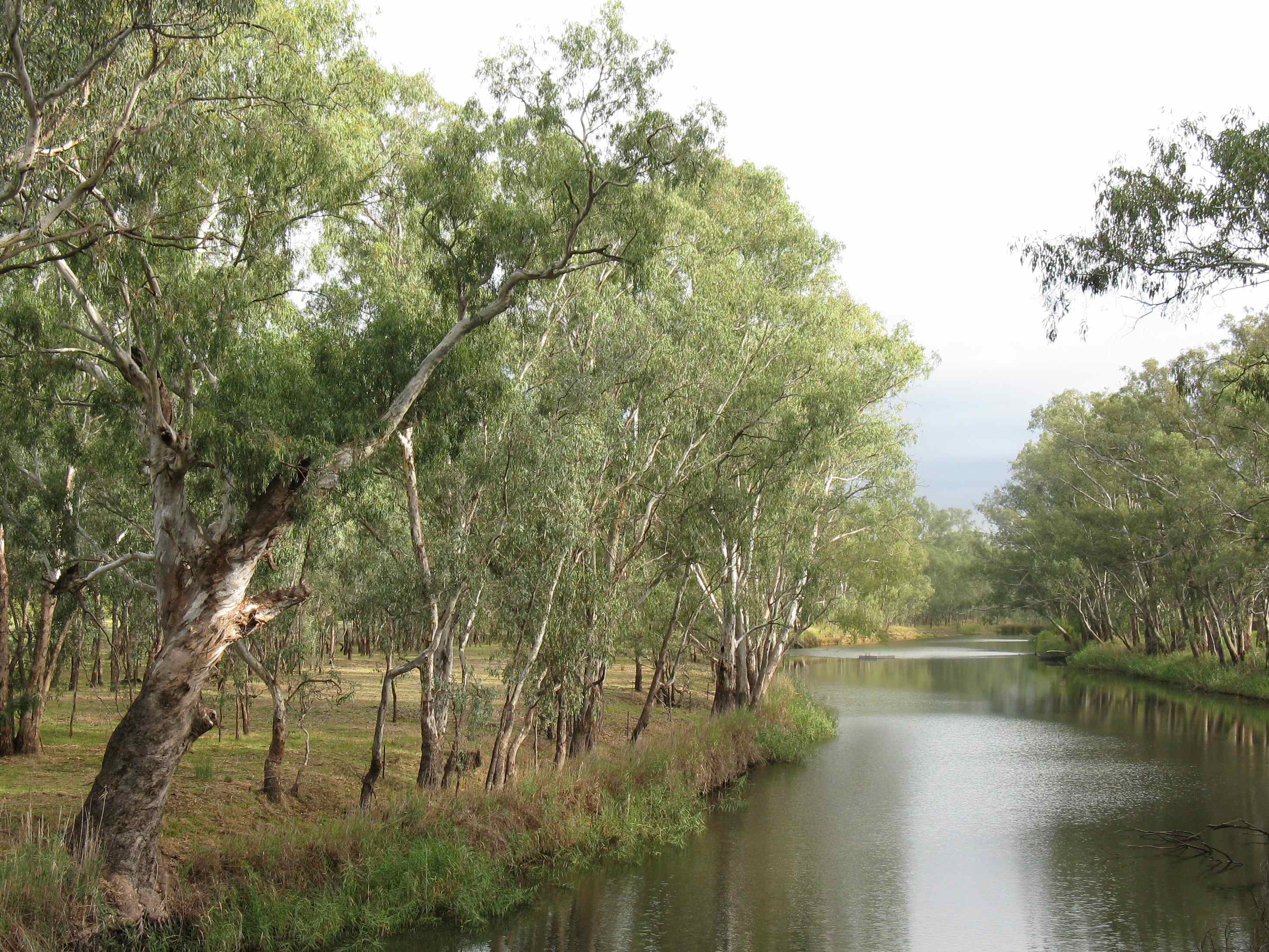
Sunday Creek, near Rutherglen

Australian country creek, lined by eucalypts

In just 250 pages Park paints a rich picture of 1920s life in rural Australia while at the same time developing Hughie and Margaret’s characters. Her characters are all flawed, some more than others, but she draws them with a clear-eyed warmth. She sees them for who they are but she respects them nonetheless. There’s no sentimentality here, but neither is it cynical or bitter. Her themes are universal ones: innocence and experience, familial and romantic love, deception and loyalty, most of it overlaid with that pragmatism that is necessary for survival in a hard place in hard times. As I wrote in this week’s Monday Musings, it’s not surprising that these books still resonate.

Finally, the language is lovely – simple, direct and evocative. Read this from the last few pages of the novel:

In the unkempt garden bloomed freesias and grape hyacinths. The eucalypt twig flushed red, the four creeks overflowed, lambs appeared on the hills, white as mushrooms and as sudden.

‘Them two had better wed quick,’ said Eny ominously, ‘or I won’t answer for Margaret’.

Ha! I think I’ll leave it there – pregnant with possibility …

Ruth Park
Missus
Ringwood: Penguin Books, 1985
247pp.
ISBN: 0140089438

John Banville, The infinities

Hermes, sculpted bronze figure by Lee Lawrie. ...

Hermes, sculpted bronze figure by Lee Lawrie (Presumed Public Domain, via Wikipedia

This is what Benny loves, what all the gods love, to eavesdrop on the secret lives of others.

Hmm … this is also, I think, what readers love! Readers after all are, surely, the ultimate voyeurs. And yet the god Hermes, who narrates John Banville‘s The infinities, also admits to the gods interfering in people’s lives, which is, in a way, what authors do. Is this double whammy – voyeur and meddler – one of the reasons why Banville chose a Greek god as his narrator?

The infinities is one of those books that takes place in a day, and it has a fairly small cast of characters. Adam Sr has had a stroke and is ostensibly on his deathbed. He is being cared for by his much younger second wife Ursula and his somewhat “loony” daughter, Petra. Also living on Adam’s Irish estate are the middle-aged employees Ivy Blount and Duffy.  The novel starts in the morning with the arrival of son, also Adam, and his wife, the aptly named Helen. During the day two more people arrive, separately, Roddy Wagstaff and Benny Grace. The only other characters are two Greek Gods, the narrator Hermes and his “father” Zeus.

You might presume from this that the novel is one of those traditional deathbed stories about a family which gathers to await the death of a loved one and lets loose their pent-up conflicts, but it’s not so. This is a more interior novel in which the interaction between the characters is less important than their individual responses to their rather messy lives. They are overseen by Hermes who watches with amusement and not a little envy while also trying to keep his father, the “randy” Zeus, in check.

Unlike The sea, that more sombre novel of Banville’s, this one has a light if not downright funny touch. The gods roam at will around the estate, occasionally taking the form of other characters in order to meddle a bit in their lives, or, in the case of Zeus in particular, experience a little human pleasure with the luscious Helen (“‘Oh’, she says laughing, ‘it was divine, surely'”). Some of the names are symbolic – Helen, of course, recalls Helen of Troy; Adam reminds us of the “first” man; Adam’s last name is Godley. But this isn’t overdone. Not all names are so laden with meaning – and those that are have a more playful than serious import. Added to this is the delightful humanising informality of Hermes talking of Zeus as “Dad”.

So, what is it all about? Adam Sr is (was) a mathematician who explored Quantum theory and developed his own theory of multiple infinities. By contrast, the gods of course are infinite (or, more accurately, immortal), but they envy humans their mortality. Hermes says of his father’s flirtations with women:

Each time he dips his beak into the essence of a girl he takes, so he believes, another enchanting sip of death, pure and precious. For of course he wants to die, as do all of us immortals, that is well known.

Towards the end Adam realises what the gods already know, that “somehow, extension brought not increase but dissipation”. He says:

I still do not understand it. The hitherto unimagined realm that I revealed beyond the infinities was a new world for which no bristling caravels would set sail. We hung back from it, exhausted in advance by the mere fact of its suddenly being there. It was, in a word, too much for us. This is what we discovered, to our chagrin and shame: that we had enough, more than enough, already, in the bewildering diversities of our old and overabundant world. Let the gods live at peace in that far, new place.

Ha! Except the gods already know what Adam and Benny learnt, which is why they keep hanging around the humans. They know that it is death that somehow gives life its meaning. This makes the ending, which I will not give away here, doubly ironic.

It feels impossible to do justice to this superficially simple but rather astonishing book and I have already laboured over my post far too long, so I’ll just make a couple more comments. One is the shifting POV from our narrator Hermes to interior monologues from others, particularly Adam Sr. It seems, at times, that Adam is Hermes, something both disconcerting yet also oddly logical. And there is the tight, evocative language. Take, for example, his use of colour. There’s a lot of blue-black-grey which expresses well the hovering death and its associated mystery, but there are also hints of the more earthy of-the-world green-brown colours and, in the cushion clutched by Ursula, a touch of passionate red. Banville’s intent can almost be read by simply tracking the colours.

In the end, the book is a hymn to the mortal world, in all the messiness that’s been laid before us:

This is the mortal world. It is a world where nothing is lost, where all is accounted for while yet the mystery of things is preserved; a world where they may live, however briefly, however tenuously, in the failing evening of the self, solitary and at the same time together somehow here in this place, dying as they may be and yet fixed for ever in a luminous, unending instant.

Couldn’t have said it better myself!

John Banville
The infinities
London: Picador, 2009
300pp.
ISBN: 978033045025

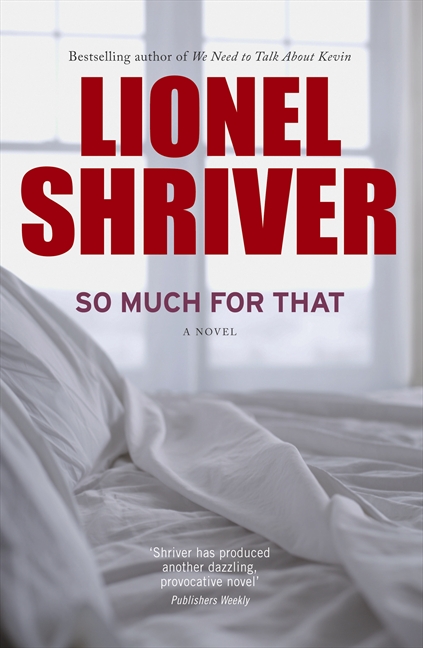
Lionel Shriver, So much for that

Lionel Shriver, So much for that

Book cover (Courtesy: HarperCollins Australia)

Having had my own rather traumatic experience of the American healthcare system back in the 1980s I was rather keen to read Lionel Shriver‘s latest offering, So much for that. And, I wasn’t disappointed – or, let me rephrase that, I found it an interesting and engaging page-turner though not a top-ten-of-the-year one.

First a quick plot summary. The book starts with 48-year-old nice-guy Shep Knacker planning to escape the American rat-race to his dreamed of, and as it turns out ironically named, AfterLife in Pemba off Zanzibar. Unfortunately, his plans turn sour with his wife’s announcement that she has a rare aggressive cancer called peritoneal mesothelioma and will need him to continue working, for his health insurance. Paralleling Shep and Glynis’ experience of health service and insurance – and told in roughly alternating chapters – is that of their good friends Jackson and Carol whose 16-year-old daughter, Flicka, was born with the degenerative disease, familial dysautonomia.

So, at the start we have a terminal cancer diagnosis and a child with a disease that is not likely to see her making old bones. Through the course of the novel, two more health issues are thrown in to round out the mix – aged care for Shep’s father after he falls and breaks his femur, and elective shall-we-say “vanity” surgery undertaken with disastrous results by Jackson. This all felt a little contrived to me – as did the occasional preachy dialogue that seemed to be there to make sure we got it. (Shriver is not a taker-outer I think!)

But, somehow, Shriver made it all work – right through to the rather surprising and, thus, risky ending. I liked the fact that she balanced the health care polemics with some wider issues such as the psychology and language of illness and the soul-destroying nature of the American (in particular) rat-race. And I liked the way she offset the plot and structural contrivances with a warm but unsentimental regard for her characters. Glynis and Flicka are not “pin-up” patients but “real” people who are angry with their lot and exhibit selfishness and petulance more often than meek forbearance. Glynis, like the character in Helen Garner‘s The spare room, is in denial about her fate pretty much to the end, and Flicka sees little value in living the sort of life she does. Both consequently feel little need to make it easier for those around them.

Most of Shep’s chapters commence with a statement of his net worth, which at the beginning of the novel is around $730K but which decreases with alarming rapidity as the months wear on and his poor insurance cover doesn’t begin to meet the costs of Glynis’ treatment. If you knew nothing before about co-payments, deductibles, co-insurers, out-of-network providers and lifetime payment caps, you’ll know all about them by the time you finish the book. (Apparently the most common cause of personal bankruptcy in the USA is medical debt.) But this is just the background – the polemics if you will – because the more interesting story is that of Shep and Glynis’ complicated but loving relationship, and of how friends and family react to the diagnosis. We feel Shep’s pain as he realises “he couldn’t fix things”. We understand Glynis’ eventual epiphany that “her husband had misguidedly hoarded his pennies, when the only currency they spent that had ever counted was time”. We cringe when we recognise ourselves in the friends who don’t visit often enough, who offer lip-service assistance rather than actual help. And we start to understand the real implications of cancer-speak that encourages an unrealistic belief in positive thinking, that suggests you can win the battle if you fight hard enough:

I know you mean well [says Shep to the oncologist], but after all this military talk she now equates – dying – with dishonor. With failure. With personal failure.

Near the end Shep asks the doctor what the $2 million spent on Glynis’ treatment (to date) had bought:

“Oh, I bet we’ve probably extended her life a good three months.”
“No, I’m sorry, Dr Goldman,” Shep said on the way out. “They were not a good three months”.

… leaving the real question, which Shep had previously asked his father, hanging:

“is there also a limit to how much you should pay to keep any one person alive?”

Lionel Shriver does not specifically answer this question in the novel but – despite the ending – you know exactly what she thinks.

There is more I could say about the novel. The story of Jackson and Carol, for example, offers the book more than a simple confirming parallel. There are some genuinely funny moments, particularly those between Shep and his free-loading sister Beryl, and those when Jackson pronounces yet another long-winded title for the book on “mugs and moochers” that he never will write. And there are some interesting discussions about art and artists, and about parenting in modern USA. But I’ve said enough I think to give a sense of what this book is about.

Shep says at the end that he’d “rather live a good story than read one”. I’ll leave you to ponder the implications of a novelist writing that line … and simply say that while this is not a perfect novel, I don’t begrudge having given up a bit of my good life to read it!

Lionel Shriver
So much for that
Sydney: Fourth Estate, 2010
433pp.
ISBN: 9780732287030

Kate Jennings, Snake

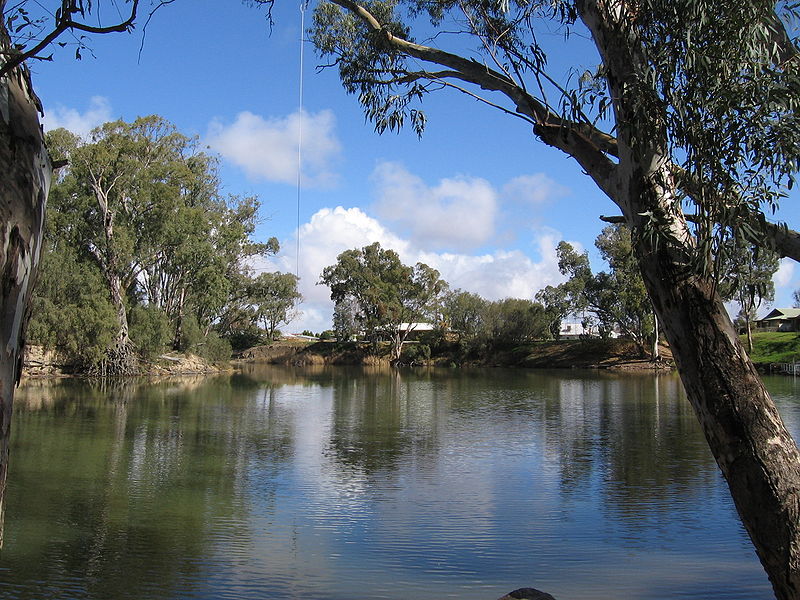
Murrumbidgee River

Murrumbidgee River in the Riverina (Courtesy: Mattinbgn, via Wikipedia, using CC-BY-SA 3.0)

In her “fragmented autobiography”, Trouble, Kate Jennings used excerpts from her first novel, Snake, to convey her childhood experience of growing up on a farm in the Riverina region of New South Wales. She had, she wrote, an “unhappy mother, diffident father”. Snake is the story of such a mother and father. While the novel is not totally “true” to her life in the factual sense, I have read enough novels and memoirs (such as Jill Ker Conway‘s The road from Coorain) about rural Australian life to know that it is “true” to the sort of experience it describes.

The blurbs on the back of my edition include the following descriptions: “a string of prose poems” (Times Literary Supplement) and a “domestic dystopia” (Sydney Morning Herald). The novel – novella in fact – is intriguingly structured. It has 4 parts. Parts 1 and 4 are short bookends, told in second person: the first part is addressed to the father and the last to the mother. The middle two parts are told in the more traditional third person voice and chronicle the life of the family: Rex the ironically named father, Irene the mother, and Girlie and Boy, the children who are caught in the middle. The chapters are short, some being only a paragraph or two long, and present vignettes of the family’s life rather than a simple this-then-that chronology. Dystopian is, unfortunately, an accurate description of their life. As Daphne, Irene’s sister, guesses on the wedding day,

Rex was a nice enough chap but about as interesting as a month of rainy Sundays. Irene will be bored with him before they arrive at the Blue Mountains guesthouse for their honeymoon.

While we never hear from Daphne again, she was not wrong. Rex is a “good man”, “decent”, a farmer of simple needs, while Irene, as her father realises, “dances to a tune no one else hears”. Not a likely recipe for success.

I thoroughly enjoyed this novel. Despite its unusual mix of voice and rather episodic form, it has a strong narrative that drives us on to its inevitable (but no spoiler here) conclusion. The snake motif runs through the book. Snakes are a fact of rural Australian life and so are a natural, real presence in the book, but their symbolic allusion to temptation, deceit and danger lurks behind every reference. Early in the novel, we are told of Irene’s youthful romantic tendencies – her love of

… smoky-voiced singers and innuendo-laced lyrics. Tommy Dorsey and Benny Goodman, Frank Sinatra and Peggy Lee, they were the snake charmers and Irene the snake.

Later, Girlie looks at snakes in a book on Australian fauna: they are “fanged, flickering, unblinking”.

Kate Jennings is a poet – as well as novelist and essayist – and it shows. The language is accessible but full of imagery. This is particularly apparent in the chapter titles, most of which are obvious in meaning, though some are more cryptic: “Home is the first and final poem”, “Send my roots rain” and “My mother has grown to an enormous height”. They are fun to think about as you read. There are some beautifully apposite descriptions. Here for example is Rex experiencing misgivings about his new wife:

The sight of her caused his nature – practical, honourable – to assert itself … What was done was done. Without being conscious of it, he coughed importantly – I am a man, I have a wife – and squirmed inside the jacket of his uniform until it sat better on his shoulders.

And here is Girlie reading:

Girlie read books like a caterpillar eating its way through the leaves on a tree.

Their town is, ironically, called Progress. However, very little “progress” occurs in the book. Rex struggles to keep the farm going in the face of mice and locust plagues, hail and dust storms. Irene tries to make a life that suits her romantic, imaginative spirit – she creates a garden, seeks friendships with interesting people, looks for work – but in the end nothing works:

Rex and Irene had given up arguing. He no longer bothered to tell her that he wasn’t asking much – harvest his crops, care for his animals, share it all with a good woman, tra-la – and Irene didn’t reply that far from not asking much, he was asking everything.

Such is the life of a mismatched couple. We’ve read of such couples before, and we will again, but for a clear-eyed, finely balanced, while also touching, portrayal, this one by Kate Jennings is hard to beat.

Kate Jennings
Snake
Sydney: Picador, 2003 (first pub. 1996)
153pp.
ISBN: 9780330364003

Jeremy Chambers, The vintage and the gleaning

Jeremy Chambers, The vintage and the gleaning Bookcover

Bookcover (Courtesy: Text Publishing)

There’s something I haven’t had an opportunity to share with you, until now that is – and that is that I love to visit wine regions. Not just because I like wine but also because I like the areas in which wine is made. The landscape is often beautiful, the wineries themselves vary so much in architecture and cellar-style, and, because of the culture that usually attends wine, there is often good dining and, if you’re lucky, some great music too. I was consequently very happy to read The vintage and the gleaning by the new Australian writer, Jeremy Chambers. It is set in in a winemaking town on the Murray River in northeast Victoria, an area I have visited and enjoyed many times – and so I was ready to sit back and enjoy.

And, enjoy it I did. However, there is very little – in fact, I’d go so far as to say none – of the glamour of the wine industry in this book. That this is so is clearly intended by Chambers. As one of the vineyard labourers says near the end, after a night of some violence:

I thought we was meant to be the civilised ones, he says. Winemaking town.

The irony, then, is keenly felt!

So, what is the book about? It doesn’t have a strong plot. Its first person narrator is Smithy, a man who would be in his 60s. He’s now a vineyard labourer, after having been a shearer for 47 years. He’s also now sober, necessitated by poor health from  years of heavy drinking. The story takes place over two weeks – starting on Monday and ending two Mondays later –  and the novel is structured by the days of this fortnight. Most “chapters” (unnumbered and unnamed) commence with the name of the day, and many are followed by “Spit doesn’t show”: “Tuesday, Spit doesn’t show and Lucy catches a snake”. Spit, we discover, is Smithy’s rather recalcitrant adult son, but the story is not about him. Rather, his chronic absence is symptomatic of the pretty dysfunctional masculinity that is the “stuff” of this novel.

Civilised Northeast Victoria - Sunday Creek Bridge, Pfeiffer's Winery

Smithy is a quietly engaging character. Through his inner reflections and discussions with others, particularly the publican’s wife, we learn that drink has been his ruin:

Can’t hardly remember me own life. Because I drank it all away, you understand.

And that

Nowadays I’m doing all the thinking I should have done when I was young … When I could have done things right. But all I got now is memories and regrets. And there’s not a thing in the world I can do about it. That’s it. That’s me life. Gone. Can’t change a thing. Can’t put it right.

Paralleling this is the story of Charlotte, the young woman whom he had found one night on the railway track after she’d been severely beaten by her husband, Brett. In the second half of the novel, just as Brett is being released from jail for this beating, Charlotte (in her mid 30s) stays with Smithy and tells her story. She also sees her life as having “gone”:

I just can’t make a new start … I just can’t. I don’t have it in me anymore. I feel like everything’s over, like it’s already ended …

Chambers gives a lot of time to Charlotte’s story – we learn that she was a “horrible private school bitch” who married Brett, already prone to violence, against her parents’ wishes. She’s inclined to blame others for her troubles – her father who indulged her and Brett for obvious reasons – though she does have the occasional flash of recognition of her own part in her life’s trajectory. And yet, unlike Smithy, who says his life is over but is quietly trying to change, she seems incapable of acting upon the little self-knowledge she has achieved, saying that her life is “not something I can change”. To tell more, however, would give away the plot, such as it is … so we shall leave Smithy and Charlotte here.

While the novel has some awkwardness – Charlotte’s story for example is a little drawn out – my only real reservation relates to the scattered references to Aboriginal Australians, and particularly to the institutionalisation of Aboriginal children. I understand where Chambers’ heart is coming from, but can’t quite connect it all with the rest of the story. It’s perhaps a case of the first-time novelist trying to include too much.

There’s a lot to like about the book. It is carefully structured but not slavishly so. The language evokes the rhythms and atmosphere of the place and its people: birds, insects, the sun, and the ever-present gum trees backdrop the story well and are made to serve the book’s resigned, if not downright foreboding, tone. The dialogue captures what I would describe as “laconic Australian”: terse but with the occasional touch of dry humour. The title is lovely: vintage refers of course to winemaking, but also evokes age in general (and thus Smithy); gleaning is an agricultural term and therefore appropriate, but also implies the gathering of knowledge (such as Smithy does through the course of his life).

This is a very new book, but it has also been reviewed by Lisa at ANZlitLovers. She believes Chambers is a writer to watch, and I can only agree.

Jeremy Chambers
The vintage and the gleaning
Melbourne: Text Publishing, 2010
264pp.
ISBN: 9781921656507

(Review copy supplied by Text Publishing)

Peter Temple, Truth

I think that every novelist has a single ideal reader (Stephen King, On writing)

Peter Temple, Truth

Truth bookcover (Courtesy: Text Publishing)

As I was reading Peter Temple‘s Truth I wondered whether I was Temple’s “ideal reader”. Somehow I think not. I am not a crime novel reader, but I did read and greatly like Temple’s previous book, The broken shore, so why did I feel less enthusiastic about Truth?

Part of the reason might be expectations. This novel won the Miles Franklin award this year. I don’t, theoretically, have a problem with a so-called genre novel winning literary awards but I did expect that if such a book won it would be out of the ordinary, and by that I mean that it would break the mould of its genre in some way. Well, I don’t think Truth does that. Of course, the Miles Franklin doesn’t explicitly say the work has to be innovative; it just says the work must be “of the highest literary merit” and present “Australian life in any of its phases”.

Another reason, related to the above, is that I found it to be a little too stereotypical. While I don’t read crime fiction as a matter of course, I do watch a lot of crime television, particularly those based on the writings of Ian Rankin, Val McDermid, and the like. I didn’t find Temple’s detective here, Steve Villani (who at one point talks of “the full stupidity of his life”), particularly different from many of the other contemporary angst-ridden middle-aged detectives I’ve seen. I didn’t find the plot, which deals with corruption (in the police force, politics and business) to be particularly different either.

So, did I like anything about it? Well, yes. But not for what Val McDermid would expect. She has said that:

As literary fiction became more hermetic, more concerned with literary theory and less concerned with narrative, crime writers assumed the mantle of turning the spotlight on the world we live in and doing it in a form where narrative was still of paramount importance.

Oh dear. I have to say this narrative bored and, at times, confused me. I was not interested in the plot – in remembering who all the characters were and guessing whether this one or that one might have “done it”. I just didn’t care. But, I was interested in Villani and his relationships with people – his father and brothers, his family, his old (now deceased) boss Singo, and his colleagues, particularly the indigenous policeman, Dove, who appeared in The broken shore. It was all a bit typical really – the workaholic cop with the troubled background and failing marriage – but Temple did manage to engage me in this character. He did this largely by telling the story through Villani’s eyes – through a third person limited point of view (or “first person in the third person” as he told Ramona Koval on the Bookshow). We are right there with Villani through one pretty hellish week in his life: horrific murders, bushfire threatening his father’s property, and a runaway daughter, alongside the odd bit of pressure to drop one of the cases because it was “just” a prostitute who’s not worth rocking the boat over.

Peter Temple is well-known for his writing. Ramona Koval describes this book as having “beautifully written ugly scenes”. I suppose they are. There is a lot of staccato dialogue, though Temple does little to explain the language used by the cops. If you don’t know the lingo, you are expected to pick it up as you go. (American readers, however, will apparently get a glossary!). There are a few motifs which run through the book. Smells are important – they convey the corruption and the social disintegration in the city and they play a practical role in solving a crime; and trees are also significant, conveying Villani’s connection with nature and his father, with, that is, something far more healthy than his homicide-driven life:

Below them a forest, wide and deep and dark, big trees more than thirty years old. Planted by hand, every last one, thousands of trees – alpine ash, mountain swamp gum, red stringybark, peppermints, mountain gum, spotted gum, snow gum, southern mahogany, sugar gum, silvertop ash. And the oaks, about four thousand, grown from acorns collected in two autumns from  every russet Avenue of Honour Bob Villani [father] drove down, from every botanical garden he passed.

Lists like this are a feature of the writing and they are effective in building up pictures in the fast moving, rather clipped world of this novel. Rhythm is in fact a significant aspect of the style. As you would expect, the story is mostly grim, but there is the odd bit of humour. I did love this one:

“Say police as caringly as possible. Like a blessing.”
“Jeez, that’s a big ask.”

The title seems to come from a horse which is mentioned only once in the novel:

…the first horse Bob raced, the best horse he ever had had, the lovely little grey horse called Truth who won at her second start, won three from twelve, always game, never gave up. She sickened and died in hours, buckled and lay, her sweet eyes forgave them their stupid inability to save her.

There’s a message in there somewhere – mostly ironic. I kinda like that.

So, my overall reaction? I don’t usually read reviews before I post, but I do when I’m preparing for my bookgroup. One of the reviews I read was Edmund Gordon’s in The Guardian. I like his conclusion that it’s an accomplished book but doesn’t escape the bounds of its genre. I was, I realise, hoping it would – and that means I’m not Peter Temple’s “ideal reader”. You, however, may be.

Peter Temple
Truth
Melbourne: Text Publishing, 2009
387pp.
ISBN: 9781921520716