Jane Austen, The Watsons (Unfinished)

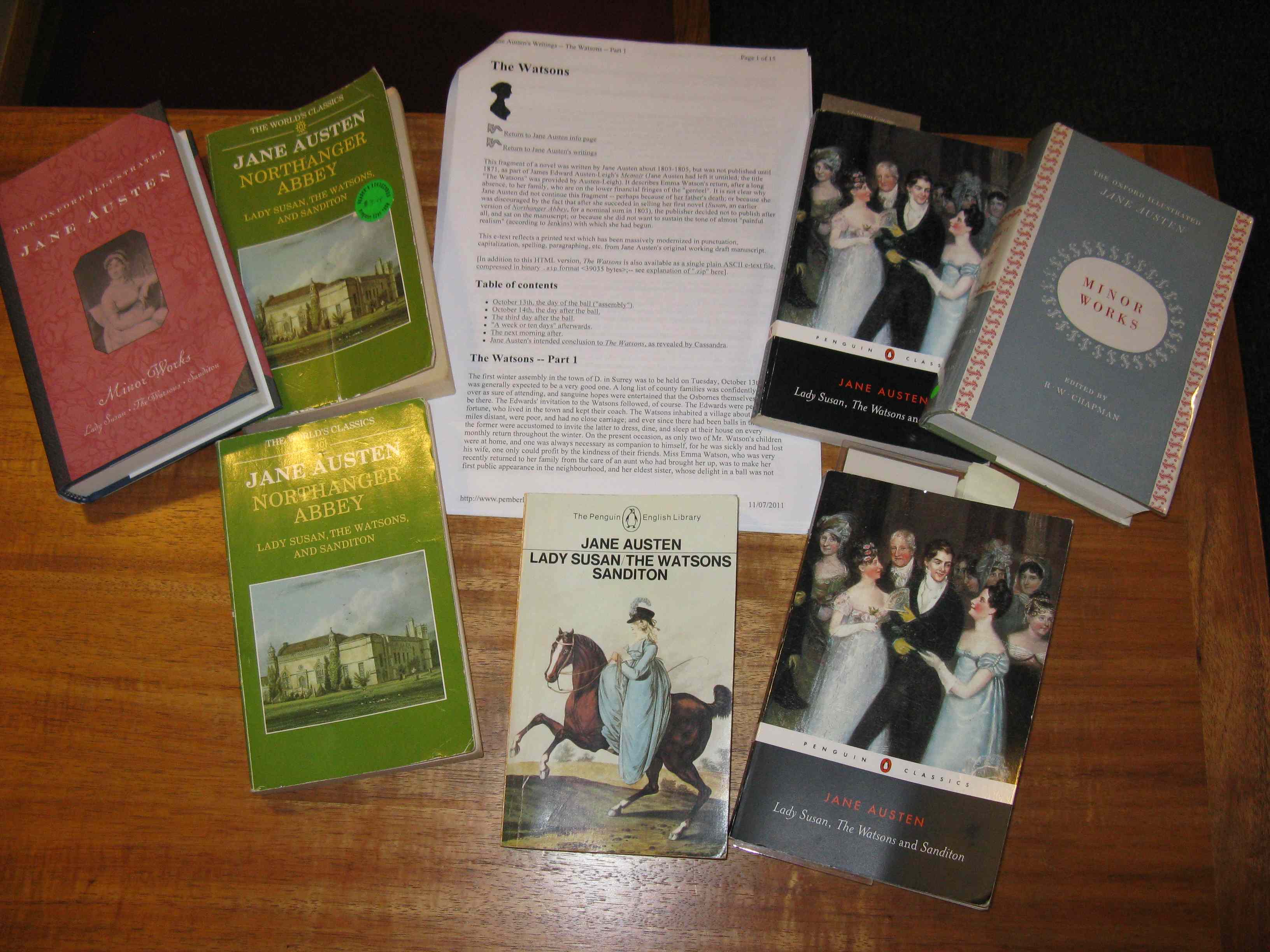
Book covers for Jane Austen's The Watsons

Book covers for Jane Austen's The Watsons

In one of those coincidences that we often bother about in fiction, my local Jane Austen group scheduled Jane Austen’s unfinished novel, The Watsons, for our July discussion. A coincidence because, if you are an Austen fan, you’ll know that just this week the manuscript was sold at auction for nearly £1 million. Thank goodness it was bought by an institution – the Bodleian at Oxford. Next time I’m in England I know where I’ll be going!

Anyhow, onto The Watsons. This unfinished novel was written in Bath probably around 1803-1805, though there is not consensus about this. A common belief is that she abandoned it after her father’s death due to sadness and the resultant uncertainty in her living conditions. Whether this is true or not, it is a fact that she didn’t take up serious writing again until she settled in Chawton in 1809 – which gives rise to the more interesting challenge. That is, why didn’t she take this one up again as she did with other early works such as First impressions which became Pride and prejudice. Enough of that, however, as all we can do is speculate. Let’s look at the work instead.

English novelist Margaret Drabble describes The Watsons as “tantalising, delightful and highly accomplished”. And it certainly is tantalising. We have only 68 pages (manuscript count). The story concerns 19-year-old Emma Watson who has returned, after living with her well-off aunt and uncle for 14 years, to her “poor” family. At the time of her return, just her oldest sister, the 28-year-old Elizabeth, is at home with their invalid father. The family however comprises four daughters and two sons, of whom only one son is married. The main plot-line is, of course, likely to be marriage, and so in these first chapters we are introduced to three men who could vie for Emma’s hand. We are also introduced to the characters belonging to Austen’s favourite subject, “3 or 4 families in a Country Village”. We know, from her sister Cassandra, how Austen intended the plot to play out. So tantalising that we never saw her do it!

Drabble’s next word is “delightful” and it is that too … because it contains those wonderful character descriptions and social observations that we have come to expect of Austen. I’ll share just a couple. The first one describes Emma (at the Ball where we meet three potential beaux):

… a lively Eye, a sweet smile, & an open Countenance, gave beauty to attract, & expression to make that beauty improve on acquaintance …

Contrast this to the following description of her sister Margaret:

Margaret was not without beauty; she had a slight, pretty figure, & rather wanted Countenance than good features; – but the sharp & anxious expression of her face made her beauty in general little felt.

There are also those delightful little set pieces we are used to finding in Austen, pieces that illuminate character as much as they move the plot along. One concerns Emma’s offer to dance with a 10-year-old boy when the snooty aristocrat Miss Osborne, doesn’t follow through on her promise to dance with him. “Oh Uncle”, the young lad says to one of the possible beaux, “do look at my partner. She’s so pretty.”

Sweet as she is, Emma proves herself to be well able – rather like Elizabeth Bennet – to hold her own. She refuses to pander to the flirtatious Tom:

Emma’s calm curtsey in reply must have struck him as very unlike the encouraging warmth he had been used to receive from her Sisters, & and gave him probably the novel sensation of doubting his own influence, & of wishing for more attention than she bestowed.

The last sentence of The Watsons starts, “Emma was of course uninfluenced …”. How sad we didn’t get to see more of this resourceful, delightful heroine.

Finally, “highly accomplished“. I’m not sure I totally agree with Drabble here. What we have is intriguing, tantalising us with its potential. It demonstrates much of what we know and love about Austen – and yet, despite evidence of extensive editing in the recently auctioned manuscript, it has (to my mind anyhow) an element of clumsiness. I find this particularly in an overuse of dialogue to convey information which the characters involved would surely already know – such as Elizabeth’s saying to her sister, Emma, “though I am nine years older”. It works well enough in the context but I believe the later, experienced Austen would have better conveyed this through authorial comment.

Nonetheless, it is accomplished. Its realism is remarkable and, like all her novels, it is clear from the beginning just what the targets are going to be. In this case, I see a major theme being the contrast between exterior and interior “refinement”. The fragment we have focuses heavily on the distinctions of class, often contrasting the superficiality of those who possess this so-called “class” with Emma whose refinement is more of the interior kind. This has the makings of a fascinating novel.

And yet, while it was not to be, we can point to many characters in later books who seem to draw, albeit with variations, from the characters here: the invalid father in Emma, the money-fixated brother in Sense and sensibility, the independent-thinking heroine in Pride and prejudice, the flirty young man of means in Mansfield Park, to name just a few. For whatever reason, Jane Austen did not return to this manuscript, but it’s obvious that she did not forget the characters nor some of the ideas behind their creation.

Jane Austen
“The Watsons”
in The Oxford illustrated Jane Austen. Vol VI, The minor works (ed. R.W. Chapman)
London: Oxford University Press, 1969
pp. 315-363

MJ Hyland, Carry me down

MJ Hyland, Carry me down bookcover

Book cover (Courtesy: Text Publishing)

If you like writers who unsettle, then MJ Hyland is a writer for you. Carry me down is my second Hyland. I read, loved and reviewed a later book of hers, This is how, nearly a year ago, and said then that I’d like to read more. I finally have, and am not disappointed.

Carry me down is a pre-coming-of-age story. John Egan is an 11-year-old boy living in Ireland with his parents. He’s an only child and is keen to be special, different. He is clearly pre-adolescent – he’s naive, for example, about some of his 15-year-old cousin’s behaviours. He’s an unreliable narrator: the world he sees and describes is rather skewed but the unsettling thing is that we, the readers, know it is skewed but we are not quite sure in which way. What is going on in this family is the question in our minds from beginning to end.

Like This is how, the novel has a vaguely unsettling beginning. The first paragraph sets up what looks like a cosy family scene. The three are sitting, companionably it seems, around the table on a Sunday evening. The third and fourth paragraphs read:

From time to time we stop reading to talk. It is a good mood, as though we are one person reading one book – not three people apart and alone.

These kinds of days are the perfect ones.

That “alone” is a little jarring, though not dramatically so. But then comes this on page 2:

“John,” she [his mother] says, “please come with me. “She is taking me out to the hallway, away from my father. She is taking me out of his sight, as though I am rubbish.

“Rubbish”? Now, that’s a strong word. What she tells him in the hallway is to stop staring at her:

“You were staring at me, John. You shouldn’t stare like that.”

“Why can’t I look at you?”

“Because you’re eleven now. You’re not a baby anymore.”

There seems to be something slightly strange going on here, or is there? Is this just a pre-adolescent bumping up against the adult world he is about to join, or is something far more complicated going on? As the book progresses, John’s relationship with his mother verges on “too close”. He seems a little too emotionally and physically needy, and she seems unsure of how to manage it. Is his need normal, is the question we ask. Meanwhile, his relationship with his father seems more typically adolescent. He wants his father’s approval and love, but he wants to be independent too. And, he wants to be special. He is an avid reader of the Guinness Book of Records, and decides early in the novel that he has a gift for lie detection for which he’d like to be included in the Guinness. He reads up on lie detection, and starts his own Gol of Seil (Log of Lies).

The situation is complicated by a number of facts which come out in the first chapters of the novel. John is unusually tall for his age and is under medical care for this. He regularly scratches a spot on his head until it bleeds. And he is bullied at school, because he is clearly a little different. His father is out of a job and studying for exams to be admitted to Trinity College. The book his father is reading at the start of the novel is Phrenology and the Criminal Cranium. Is this a hint to us – or a red herring? His mother works with a puppet show. This is interesting, too, as the idea of puppets subtly undercuts the desire for control and independence that John, like any pre-adolescent, is starting to strive for. The family lives with the paternal grandmother, with whom John’s father has a prickly relationship, mainly around money. And, underlying all this is John’s growing obsession with truth and lies.  This obsession is the framing motif in the book. John catches adults lying and takes them to task for it, all the while telling lies himself. He does not, by the end, come to a real understanding of how lying functions, of the difference between white lies and more serious ones. For this reason I don’t see it as a true coming-of-age story.

And now I come to my problem. How do I write about this book without giving it away? There are events – powerful, troubling ones – that occur in the book and that can be “read” in different ways. I’d rather like to analyse or explore the possible meanings, but that would require giving away some significant plot points. I don’t want to do that because this is a book that you need to discover for yourself, sentence by sentence.

What I’ll say though is that this is one of those books that has an open ending. (Indeed, giving nothing away, the last word of the book is “open”). How we read it depends on our own world view, on the weight we give to the various events in the novel, on how we read the specific words and images used by Hyland to describe the events and characters, and our personal understanding of adolescent and family psychology. The way I see it, the book’s ending hints at a number of possibilities but we do not know, at the point in their lives that we leave these characters, which of these possibilities will eventuate. And that, as they say, is life!

MJ Hyland
Carry me down
Melbourne: Text Publishing, 2007 (orig. 2006)
313pp.
ISBN: 9781921145780

Jay Griffiths, A love letter from a stray moon

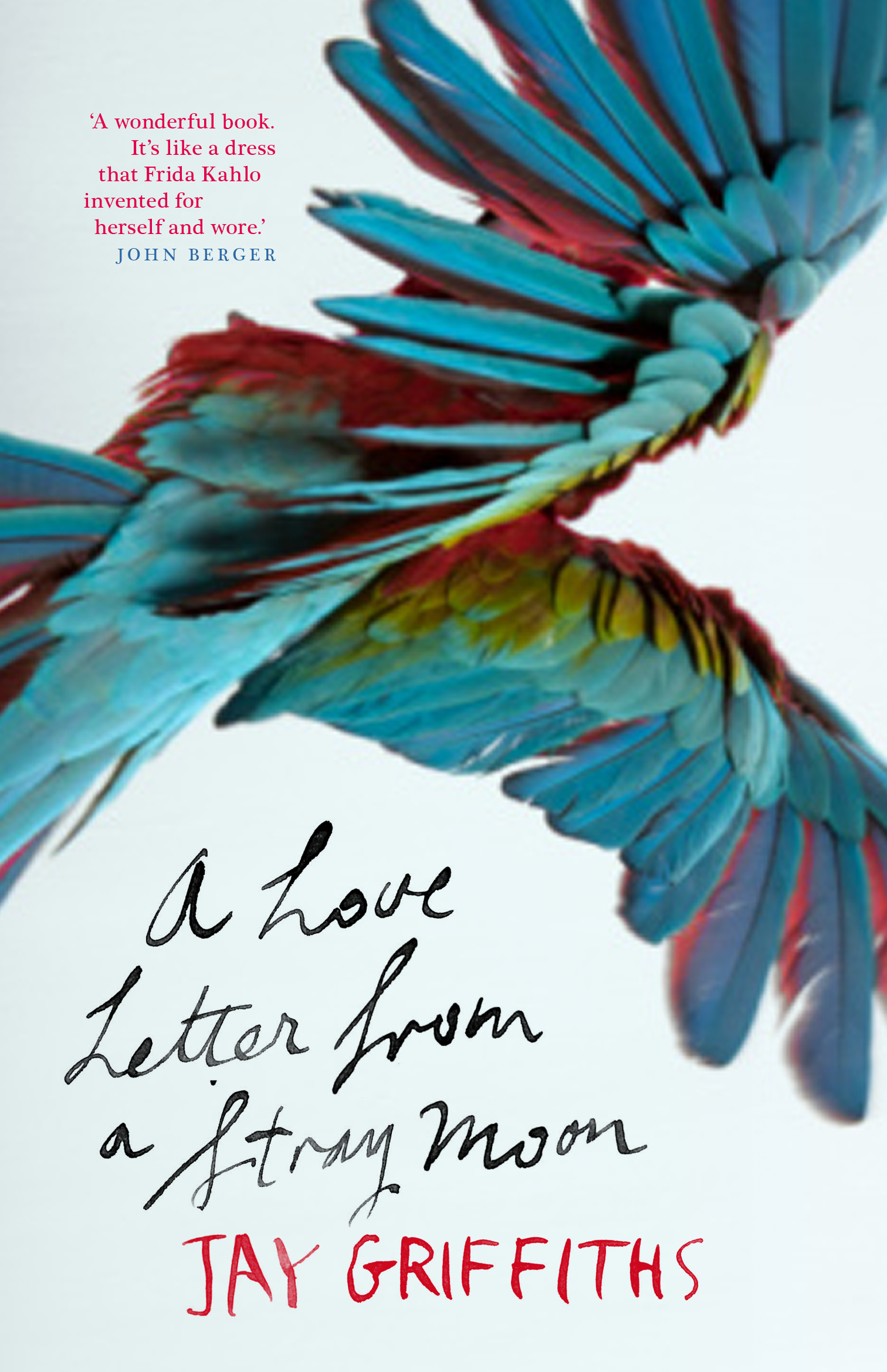
Jay Griffiths, A love letter from a stray moon cover

Book cover (Courtesy: Text Publishing)

I have always wanted wings. To fly where I belong, to become who I am, to speak my truths winged and moon-swayed.

I’m not sure I can do justice to this poetic, passionate novella by Jay Griffiths. Titled A love letter from a stray moon, it’s a first person outpouring in the voice of Mexican artist Frida Kahlo. I don’t use the term “outpouring” pejoratively, but rather to describe the full-on passion with which it is told. This is a book with confronts the senses with its power – the imagery is strong but beautiful, the story raw and honest (or so it seems to me.) It’s a book you want to describe as a “tour-de-force” but that would be too clichéd.

The opening lines of the novel quoted above introduce us to its two main metaphors – wings/flight and the moon. For Frida, flight equates with hope and with magic. The moon, though, is a far more complex image, and I’ll try to tease it out a bit as I go on. First though the story. This is biographical fiction (historical fiction?) in the form of a prose poem, told in the first person voice of Frida. The facts of Kahlo’s life are conveyed – such as the terrible accident when she was 18 which left her unable to bear children; her falling in love with, marriage to and divorce from Diego Rivera; her relationship with Trotsky; and even her death and cremation which requires some suspension of disbelief but that’s not hard to do given the novel’s style and tone. If you didn’t know much about Frida you could, I think, read this piece of fiction and feel you’ve got the basic facts, as well as a good understanding of the woman who “lived” those facts.

Woven through all this is the Mexican Revolution which started in 1910 (three years after she was born), discussions of the rise of Fascism, and her ideas on love, art and life (and particularly on how they interrelate). There are also, though this seems a bit anachronistic, some strong references to climate change. In fact, at the end of the novel, Griffiths dedicates her book to two groups of people, climate change activists and Zapatistas. Frida died in 1954. Was climate change an issue then? In the book Griffiths has Kahlo expressing concern about the Amazon and Tuvalu:

But the  Amazon will die of thirst, she will seize up with drought … One island nation, five atolls and four islands, pacific and named by doves, Tuvalu, is silently submerged as the quiet waters lap its shores, past the fishing boats, up its beaches, up, to the houses at the coastline, on, on, the gentle sea, the sea murmuring in quiet amazement at itself, on, until the centre where it can see itself coming, reflecting its rise, it meets itself in a full circle of embrace and Tuvalu will only be a story of mythic islands beneath the waves.

Let’s though get back to the moon. The motif is sustained throughout the novel. It’s appropriate of course for a woman, with its implications for women’s reproductive cycle, but Kahlo draws so much more from it than this single meaning. She layers meaning upon meaning for the moon, some of them superficially paradoxical but together they form a whole. Throughout the novel, for example, she opposes the ideas of gold, earth, sun and matter to silver, moon, and myth. The moon represents for her the mythical, the immaterial and creativity but it also connotes coldness and barrenness. I did say it was a complex symbol – but it’s fittingly s0 for a complex woman. In the first chapter, “Exiled from Casa Azul” she talks of wanting to fly to the moon, describing it as “pure idea” versus the sun which, more pragmatically, “lights the earth”. In the next (very short) chapter, “The moon’s instructions for loss”, she expands on her idea of the moon a little further:

And the moon? In the revolution of the earth’s turning – and I was a revolutionary – a shard of earth was flung off, coalescing, reforming further and later, far off as the moon. But shard is the wrong word, too hard and substantial; so immaterial was this moment, so unearthly the earth, so unanchored the moon, what word could be better? The moon was more like Idea, more like Metaphor, or Time, Flight, or Potential or Longing. A highly strung intensity of latency.

In the rest of the book, these ideas about the moon are explored, teased, stretched as far as they will go to convey the wild, free essence of her life. In her mind the moon is closely related to the idea of flight. She refers to Icarus (whose downfall of course was the sun), arguing that the important thing was not the fall but that he dared to fly.

In one of many references to flight she says:

… flight’s true reality was never in its being made material. What is real need not be material at all.

Given the challenges of her physical life (polio as a child and a leg amputation late in life in addition to her accident), it’s not surprising that Frida found significance in the life of the mind, the spirit and the soul.  “The mind needs myths, good ones”, she says.

And then there’s art. She was known for her self-portraits, in which she painted her passion and her pain. Her art was an extension of her “self”:

…so I make this as a votive painting, a prayer, a vow, a plea, painting to win him back to me…

Frida was a rebellious soul … whose passions were personal and political. Somehow Griffiths has managed to capture all this in a novel which could so easily have been over-the-top. It isn’t, because her Frida’s voice sounds authentic. Frida says, towards the end, ‘I would re-enchant myself with mankind, nothing less … I will promise to find the god of new beginnings.”

I have not done justice to this wonderful, complicated little book – but I hope I have conveyed something of its magic. After that, it’s up to you.

Jay Griffiths
A love letter from a stray moon
Melbourne: Text Publishing, 2011
117pp.

(Review copy supplied by Text Publishing)

Alan Gould, The lakewoman: A romance

Alan Gould, The lakewoman

Book cover (Courtesy: Australian Scholarly Publishing P/L)

I’m a little embarrassed to say that until The lakewoman was shortlisted in the 2010 Prime Minister’s Literary Awards, I only knew of Alan Gould as a poet. Turns out, though, that he has written several novels, of which this one is his most recent. It is, ostensibly, a war novel, in that much of it is set in or around World War 2, but it is not in fact about the war.

It’s an intriguing book that slides literally and metaphorically between the solidity of the earth and the fluidity of water, between pragmatism and magic (or enchantment). It tells the story of Alec Dearborn, an Australian grazier’s son who was born in 1918. He goes to Cambridge in England and, when the war starts, decides to join up with the British Army rather than return home. The novel starts with his having landed in a lake, after parachuting from a plane for the D-Day Invasion. He is drowning, dragged down by his weapons bag and parachute, but is rescued by – yes – a lady in a lake. Ha! Now you see why it is called a “romance” because, while it contains “a” romance, it also hearkens back to the “romances” of yore, like the Arthurian legend. Here is the set up, pp. 2-3:

As he vomited he also wondered why this sudden young Mamzelle happened to be present at the exact, unlikely spot in France where his foolish body had come to earth. It was a question that would usefully occupy his mind later, when he was behind the wire with the austere leisure to brood on the magic that settled into his life following this, his fluky rescue. Magic? He was not a fellow given to outlandish notions, and would interrogate the dubious word, looking for its sense, not in mumbo jumbo, but as some friable quantity existing within the very crevices of everyday occasions.

In this passage, we see how carefully Gould has laid out his novel. He introduces us to the ideas of coincidence (fluke) and magic versus the everyday business of living, and he uses foreshadowing to distract us from plot issues (what will happen next) towards more interior ones (what is the meaning of what happens). As the novel progresses, this fellow who is not given “to outlandish notions” finds himself drawn, almost telepathically (it seems), to his rescuer. She , Viva, rather like the Arthurian lady-in-the-lake, frames the rest of his life, one way or another.

What happens on the surface of the novel is fairly matter-of-fact. Alec’s life runs its course in a mostly unremarkable way. One of the central questions of the book is that which Alec poses to his sister, Bell, a little while after he returns to Australia:

What I can’t work out is […] Well, how a person knows whether the existence he’s been given has been of value to anyone else.

This is Alec’s conundrum. He does not fulfil the traditional expectations of a grazier’s son (“Dearborn”, after all), despite his “prospects” : he’s intelligent, sensitive, and physically capable (“the dynamism in balance with the dreaminess”). Much of this failure stems from his being “disarmed” on June 6, 1944, by Viva. There are some lovely, appropriate wordplays in the novel, and one of these centres on the idea of disarming/arming, which works beautifully against the novel’s military background:

‘If you think about me, then, when you are gone, I will be arming you still,’ she assured him, mysteriously.

Soon after he leaves her, he ponders what has occurred:

‘I feel distress at having relinquished you,’ he supplied on consideration. For it was distress, he recognised, to be walking away from this sudden new claim on his life. ‘It is this that has disarmed me, I reckon,’ he explained for her.

I will be arming you, she reminded.

It is difficult with this WordPress theme to get the formatting right: this last statement by her is in italics in the novel and suggests either his memory of her words or an actual telepathic communication. Which one it is, is one of the lasting ambiguities of the novel. Italics are used throughout the novel for “communications” like this and for interior monologues/reflections, usually Alec’s, since this is a third person narrative, told mostly from Alec’s point of view.

By now you may be thinking that this novel is a fantasy, even a romantic fantasy, but not so. Neither is it magical realist. It’s simply that there is a sense that slightly mystical things may be happening, things that make sense psychologically but that also convey another plane of human thought and behaviour. It reminded me, at times, of Patrick White‘s Voss, but to suggest more than that would be to do it a disservice because it is not at all derivative. Rather, it is simply that the story focuses on a dimension of experience that can’t always be logically explained but that is nonetheless very real. Gould has, I think, pulled this dichotomy off, by careful manipulation of tone: through language that is poetic but not overdone; a pacing that is meditatively slow at the beginning and pragmatically faster at the end; evocative chapter titles (such as “To Fling the Lovely Foolish Body”, “Had You Down Dead”); the occasional light touch (“‘You are the invasion?’, she asked”); and timing that foreshadows just enough to make sure we stay focused on the ideas and not the facts.

And for me, the main idea (the one that provides an “undercurrent” to all the others) is that of completing the self, which is something Alec struggles  to do. In the end though:

…the joy, the completion was her presence, and the talk was strangely superfluous. Yet by convention they did talk from some region of the mind where the words did not especially matter but the proximity of the person created an entirety of being.

This is a rather melancholic, but by no means sentimental, book – and it moved me deeply.

Alan Gould
The lakewoman
North Melbourne: Arcadia, 2009
296pp.
ISBN: 9781921509346

Joyce Carol Oates, Beasts

Joyce Carol Oates @ The Belmont Library

Creative Commons licensed image by San Mateo County Library via Flickr

If we wanted to be writers we must examine the world with fresh, sceptical eyes.

Beasts is, I’m ashamed to say, my first Joyce Carol Oates. She’s one of those writers who has kept crossing my path but whom I’ve never quite got to read. I bought Beasts a couple of years ago when I saw it on the remainder table of my favourite independent bookshop – and still it took me some time to get to read it, but I’m glad I finally did. I didn’t really know what to expect – and I’m not quite sure what I got – but I nonetheless found it a compelling read that is staying with me.

Take the opening quote, for example. On the surface it makes perfect sense, and yet when we know who says it we see a whole different layer of meaning to it, a layer that doesn’t necessarily remove the fundamental truth but that certainly shows how such a truth can be twisted or, at least, complicated.

The plot concerns a young college student and her obsession with her poetry writing class teacher, Andre Harrow. The novel (novella, in fact) starts some 25 years after the main events of the novel, when our narrator is at the Louvre in Paris and sees a piece of sculpture that reminds her of the work of Harrow’s wife, Dorcas. The sculpture is an earthy totemic piece that is “primitively human” or, in fact, rather beast-like. In this short three page chapter we are introduced to the notion that something not quite right has happened. “It wasn’t burned after all”, the narrator says, and then soon after mentions the horrible deaths some quarter of a century earlier, of “two people I’d loved”. The final sentence of the chapter is:

This is not a confession. You will see, I have nothing to hide.

As soon as you see a statement like that you can be pretty sure you are in the hands of an unreliable narrator, and this is so here – though she’s cleverly disguised and could be taken to be reliable. It’s all a matter of perspective really! The novel is told first person, in flashback, so we do need to be aware that what she is saying may very well be coloured by her knowledge and experience, that what she says she was feeling at the time, may not be quite right. This adds to the complexity of the book. The structure, though, is pretty straightforward. There’s the first chapter in Paris in 2001, followed by a chapter, set in 1976, describing the night of the house fire (in which the two people died). The third chapter takes place four months before that. From this, the novel works chronologically forward again to the fire.

The novel has a smallish cast of characters – there’s the narrator (Gillian), Andre Harrow and Dorcas, and the girls of the poetry class. Gradually a complex picture is built up of surface friendships with secrecy and jealousy lying just beneath. The reason for this is that pretty well all the girls are obsessed with Andre and each it seems, in turn, have their way with him (or, should I say, vice versa). But here the plot thickens … though perhaps I’ll leave it there for you to discover for yourselves.

Let’s just say that this book is an unsettling exploration of the (sexual) games people play, games in which people can and do get badly hurt. It’s easy to see the young women as the victims – and I must say that to a large degree I think they are. Whenever there is a power imbalance (and this is why I disagree with Helen Garner‘s take in her non-fiction book, The first stone), I see the major wrong as being with those in power. However, that does not mean that the less powerful are not complicit in some way, because often they are, and this seems to be the case with Gillian. She says “I was not predator seeking prey, I was myself the prey. I was the innocent party”. But she has choices, and she makes them, knowing ….

I was in love now. I took strength from my love for Mr Harrow. Though knowing, for I was no fool, that it could never be reciprocated.

And yet, she of course, like the girls before her, lets herself be drawn into a situation that is both thrilling and destructive. Harrow is an aficionado of DH Lawrence – Lawrence was big on campuses in the 1970s as I recollect – and tells his students (with terrible irony) that:

Lawrence is the supreme poet of Eros. No recriminations, no reproaches, no guilt, no ‘morality’. For what’s ‘morality’ but a noose around the neck? A noose? What’s ‘morality’ but what other people want you to do, for their own selfish unstated purposes.

Hmm … this sounds a bit like the Nietzschean conundrum explored in The immoralist doesn’t it, but Oates plays it out in a very different way by exploring its implications across gender, age/experience and power differences to see what falls out.

The novel starts with an epigraph from a DH Lawrence poem:

I love you, rotten
Delicious rottenness

… wonderful are the hellish experiences

Wonderful for whom one may well ask? The ending – or is it the beginning – provides no definite answer but it sure teases out the complexity of “love” running rather amok amongst people who think little about the ramifications of their actions. Damage, as it usually does in such situations, ensues. What price morality, eh?

Joyce Carol Oates
Beasts
London: Orion, 2002
138pp.
ISBN: 0752855921

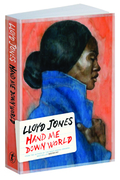
Lloyd Jones, Hand me down world

I used to find myself saying, I can’t imagine. But, I’ve since found out, you can – it’s just a case of wanting to.

Hand me down world, bookcover

Book cover (Courtesy: Text Publishing)

What this character is talking about is empathy – and empathy, the having or not having it, is for me a major theme of New Zealand writer Lloyd Jones’ latest novel, Hand me down world. The novel is chock-full of characters who vary in their ability to empathise or not with other humans, to behave altruistically or selfishly towards others, to treat others with the dignity that all humans deserve or as nobodies to be ignored (or worse). These are not, in the real world, absolute alternatives but continuums along which we all position ourselves when relating to others. I think this positioning is one of the fundamental challenges of being human, and Lloyd Jones explores it in a novel which got me in from the get-go. In other words, I loved it.

This is a novel with a simple plot but a complex narrative. The plot concerns a young, poor African woman, a hotel worker, who leaves Africa using human-traffickers to find her son in Berlin. Why she does this is a shocking story revealed in the first chapter. The book follows her journey until its inevitable but not totally predictable conclusion.

What is particularly interesting about the book is how Jones has chosen to tell the story. It is divided into five parts:

1. What they said
2. Berlin
3. Defoe
4. Ines
5. Abebi

The first two parts comprise 13 chapters, each named for the narrator telling that part of the story. All but one of the narrators are first person and they chronicle their experience with the woman (whom we come to know as Ines) as she journeys to and finally arrives in Berlin. The third person narrator is “The inspector”. Why he is third person initially mystified me, but it all becomes clear when he reappears in Ines’ part. As I was reading these early chapters, I was reminded of Gabriel Garcia Marquez‘s Chronicle of a death foretold because they sounded like witness statements (and that, in fact, is what we later discover they are). This is not, though, a whodunnit, any more than Marquez’s book is, although a death does occur. Intrigued? You should be.

Anyhow, it is in these early chapters that the “empathy” theme starts to play out as it is in them that we hear how Ines gets from Africa, via Italy, to Berlin. She is “helped” by a number of people including a truck driver, snail collector, an alpine hunter, a chess player and a film researcher. Some of these people help her expecting nothing, some help her only if she gives something in return (and I’m sure you can guess what that might be), some help her but would like something in return, some are unsure whether to help her or not, and so on. It certainly makes you wonder what you would do, how far out of your way you would go.

Suffice it to say, she makes it to Berlin, manages to find a job, and starts searching for her son. But, I won’t talk more on that, so you can discover for yourself how her story plays out. What I will talk about instead are some of the other features of the book that make it such an interesting read.

Several metaphors run through the novel, but they never feel overworked. One that I particularly liked concerns phantoms/ghosts. Lloyd uses them to describe the marginalised or dispossessed. The pastor (who better to talk about ghosts?) speaks of ghosts in a number of contexts, including:

The ghost remains a spectre, no more than a possibility. Something to be afraid of. A manifestation of fear, such as the opposition parties in each and every undemocratic regime in Africa.

The other ghosts – the real ghosts if I may call them that – are simply those whom we choose not to see.

Ines, of course, is one of these – and later, when she considers stealing her son, she talks of teaching him “to turn himself into a ghost”. Another motif that runs through the book is that of versions and lies. Most of the early narrators are not exactly reliable, several people do not go by their own name and there are references to things being transformed (such as snails which can change gender and lungfish which can live in and out of water). When Defoe describes the lungfish (below) we see its reference to the way people change, to how we can transform (for good) or dissemble (for ill, such as the father of Ines’ baby):

Now he arrived at the question that interested him. At which point does it become the one thing and cease to be the other? In becoming that new thing how much does it retain of the other?

One of the little side stories in this multilayered novel concerns the old blind man Ralf in whose household Ines finds work. We learn from Ralf’s ex-wife, Hannah, that after her gentle, kind father-in-law had died they found a photograph that revealed his secret past as a photographer of atrocities during the Nazi regime. Ralf’s inability to come to terms with his father’s contradictory, secret past brings about the breakdown of his marriage. Meanwhile, Ines lies, steals and pretends in order to achieve her goal of developing a relationship with her son:

I had to see him. And that need turned me into someone with no heart or conscience. I didn’t care how the money was earnt.

It is difficult in fact to know who the real Ines is … but she is a wounded soul. Who are we to judge? Throughout the novel, in fact, Jones confronts us with imperfect people and challenges us to consider both them and their circumstances. How far can, should, our empathy extend? Uncomfortable questions but ones we must face.

During Ines’ story she says “I was shown more kindness than abuse” which reminded me of Rieux’s statement at the end of The plague that “there are more things to admire in men to despise”. I like to think they’re right but, with Camus and Jones, I also know that we need books like this to remind us that we still have a way to go …

Lisa at ANZLitlovers also enjoyed this book.

Lloyd Jones
Hand me down world
Melbourne, Text Publishing, 2010
352pp
ISBN: 9781921656682

André Gide, The immoralist (or, L’immoraliste)

André Gide: pencil drawing

Gide, c. 1901, Pencil drawing by Henry Bataille (Presumed Public Domain, via Wikipedia

Reading synchronicities strike again – though on the surface it wouldn’t seem to be so. That is, could there really be synchronicities between Geoff Dyer‘s Jeff in Venice, death in Varanasi and Andre Gide‘s The immoralist? I think there are. Besides some comments on art – its value and meaning – in The immoralist, there is the grappling with what seems to me to be the paradoxes inherent in explorations of how to live our lives. In Dyer, as I wrote in my recent post, the paradoxes are front and centre. You can’t miss them. In Gide, they are there too, but tend to be more subtle.

The immoralist was published in 1902 and was at the time, I believe, seen as a rather shocking tale of dereliction. Over a century later, we are not so easily shocked by the behaviour he describes, but the book still has things to say. Gide writes in his preface:

If certain distinguished persons have refused to see this drama as anything other than the folding of a particular, unusual case, and its hero as anything other than an individual with an illness, they have failed to see that there are important ideas of interest to many to be found in it.

In other words, he claims some level of universality for his tale.

The first thing to note about the novel is that it has three parts – at least, from the second edition on when Gide included his preface. There’s:

  • the preface in which Gide, as I’ve explained above, argues that Michel’s “problem” exists regardless of whether or not he resolves it;
  • the letter in which one of Michel’s friends seeks a job for Michel to, in effect, save him from himself; and
  • Michel’s story, as told to his three friends.

And so what is Michel’s story? Well, it’s about an unworldly young scholar who marries a young woman, Marceline, whom he barely knows, at the request of his dying father. After their marriage, which they do not consummate for some time, he becomes ill with tuberculosis and nearly dies. As he starts to recover in beautiful Biskra to which they have travelled, he starts to see life in a new way – inspired partly by a young Arab boy, Bachir, introduced to him by his wife:

I thought of Bachir’s beautiful, glistening blood … And, suddenly I felt a wish, a desire, more pressing and imperious than anything I have ever felt before, to live. I want to live!

So, gradually, begins his life as an “immoralist”. This does not exactly mean that he lived an “immoral” life, though that he did to some degree, but that he rejected being bound by morality, by society’s rules and restrictions. Gide was influenced by the philosophies of Nietzsche, which in the novel are promulgated, somewhat extremely, by an older friend, Ménalque. For Michel, they mean, for example, learning to “feel” – and to eventually putting sensation (body) totally ahead of thinking (the mind):

The only way I could pay attention to anything was through my five senses …

From this time on, he tries out his new ideas and starts leading a self-centred life, ignoring his friends and his wife more and more to follow a life of freedom to do what he will. He wants to live a life that is individual, not imitative of others. He loses interest in the lessons of the past (which had once been his passion) because, as Ménalque says, the past (particularly through memory) “encroaches” on and thereby spoils the present:

Now I could only derive pleasure from history by imagining it in the present. I was much less inspired by great political events than by the new emotions stirred by the poets or certain men of action…

What he discovers, though, is that freedom does not, in fact, free him (or, make him happy). Paradox, n’est-ce pas?

I’m not going to detail the full story of his “decline”, his forays into low-living, his “repudiation of all culture, decency and morality”, the tragedies he experiences in his personal life, but he eventually arrives at the point where he calls his friends to hear his story, and help him. He says to them at the end of his story:

The thing that scares me, I have to admit, is that I am still quite young. I sometimes feel as if my real life has yet to begin. Take me away from here and give me a reason to live. I no longer have one. Maybe I have liberated myself. But so what? I find this empty liberty painful to bear.

This is a complex little book, and I’m not sure I’ve fully grasped its import. Does it, for example, reject Nietzschean ideas or simply the misapplication of them? Does the Michel at the end still believe in himself as the “perfectible being” he did earlier in the novel? Are we meant to see his as a cautionary tale, and if so, what particular lessons should we draw from it? Anyone?

Andre Gide
The immoralist
(trans. by David Watson)
London: Penguin Books, 2000
124pp
ISBN: 9780141182995

Geoff Dyer, Jeff in Venice, death in Varanasi

Geoff Dyer, Jeff in Venice, death in Varanasi

Bookcover (Courtesy: Text Publishing)

What, a few moments earlier, had seemed such a persuasive notion – that ridiculousness might be the animating principle of life –  seemed, in the face of this more pedestrian idea of progress, abruptly … ridiculous. No sooner had I thought this, than I’d suddenly had enough of walking. (“Death in Varanasi”)

Hmm … what has the “idea of progress” got to do with “the animating principle of life”? Geoff Dyer‘s Jeff in Venice, death in Varanasi, which comprises two loosely connected novellas, is full of non-sequiturs, paradoxes and other confusions – so much so that I’m not quite sure what to make of it, but perhaps by the end of this review, I will!

I wanted to read it because I’d been hearing about it around the traps, and had seen it recommended several times on people’s reading lists. There is, it seems, a vague autobiographical element to this book: Dyer has been to the Venice Biennale and to Varanasi, and he has written journalistic pieces as have the two (or is it one?) narrators the book. But, he went to both with his wife, not as a single man, and he is Geoff not Jeff. Methinks there is some teasing/playing with us going on here!

The first tease relates to the form. Are the two novellas connected by character? Is the third person Jeff in “Geoff in Venice” the same as the first person narrator in “Death in Varanasi”? And there are teases in the subject matter, but let’s talk plot first, such as there is. “Jeff in Venice” describes Jeff’s few days at the Venice Biennale, and particularly his falling in love (or is it lust) with the lovely Laura. There is quite a bit of explicit sex in the story: in other words, the so-called “little death” is well covered. This first story is about art, life and love – and yet encompasses, paradoxically, the idea of “death”. In “Death in Varanasi”, the main character, a freelance journalist who could very well be Jeff, goes to Varanasi for a few days to write a commissioned piece, but decides to stay. One of the first things he does in Varanasi is go to see the cremations by the Ganges. Death is all around, and yet, paradoxically, this is where many westerners turn up to find “enlightenment”, that is, to find the meaning of life. The narrator, himself, gradually drops all vestiges of his former self until, near the end, he has shaven his head and wears a dhoti.

So what is the background premise to these stories? As far as I can tell it is something to do with being in one’s mid-forties and starting to wonder what it’s all about. Jeff Atman, “stuffed with pastry, tense with coffee”, decides to dye his hair because:

For a long time he’d thought of grey hair as a symptom, a synonym of inner dreariness, and had accepted it as inevitable – but that was about to change.

There are a lot of sly little jokes and word-games in the book. When Jeff’s newly dyed hair is about to be revealed, he calls it “the moment of untruth” which, in a sense it is, though it is also his new truth. It’s all a matter of perspective isn’t it? (After all, the hairdresser had quoted Plath – a hairdresser quoting Plath impresses Jeff –  at him by saying “We do [dye] it so it looks real”.) And so the new real Jeff goes to the Venice Biennale, a place characterised as much by “party-anxiety and invite-envy” as it is by exciting new art to discover. This first story is about hedonism, about booze, drugs and sex. It’s a common story in literature – a certain dissipation that follows disillusion, and leads to … well, it seems to me, back to disillusion. See, it’s a tricky  book!

I enjoyed the satirical descriptions of the Biennale, of the art world and, particularly, of the more sycophantic adherents. But, I couldn’t quite believe the relationship with Laura – it felt more like male fantasy than real. Perhaps that’s how it was supposed to come across.

In the second story of the book, the tone becomes a little more meditative, lower key. I expected to meet the beautiful Laura again. After all, she told Jeff in the first story that she planned to go to Varanasi to be a hedge fund manager (of all things!). But, we don’t meet her and, if there’s a reference to her (and I think there is), it’s very obscure and does suggest we are dealing with Jeff again. “Death in Varanasi” starts with:

The thing about destiny is that it can so nearly not happen and, even when it does, rarely looks like what it is.

What happens is that the narrator’s brief stay turns into something longer term. It’s not so much that he makes a definite decision to stay as that he doesn’t decide to leave: “there was nothing to go home for”.

As I said at the beginning, this is a book full of teases and paradoxes. The narrator in Varanasi “invents” the God Ganoona who “is all that which is not anything else. But it’s also that which is everything else”. In a similar vein he talks of being desire-free:

… for the idea of desirelessness to take root, to set off in that direction, to try to free yourself of desire, surely that must manifest itself as a desire, a yearning, an urge. How then does desire transcend itself?

This book demands some mental gymnastics – not hard ones, necessarily, but ones asking you to keep on going without pondering too long or thinking each one is the answer. In a discussion about the book on The First Tuesday Book Club, English author Philip Hensher says that in all his books Geoff Dyer “seems to reinvent the genre, to make the reader think twice about what it is he’s reading … the book is constantly retreating from you” so you have to make up your own mind. And that, in my best Dyeresque way, is where I’ll leave you … it’s worth a look, even if at the end you are not quite sure what you saw!

Geoff Dyer
Jeff in Venice, death in Varanasi
Melbourne: Text Publishing, 2009
296pp.
ISBN: 9781921656897

(Review copy courtesy Text Publishing)

Jane Austen, Sense and sensibility (Vol. 2)

Austen, Sense and sensibility, Ch 36 illustration

From Chapter 36, illus. by CEBrock (Presumed Public Domain, from solitaryelegance.com)

…and because they were fond of reading, she fancied them satirical… (Lady Middleton on the Dashwood sisters, Ch. 36)

In January, I wrote about Volume 1 of Jane Austen’s Sense and sensibility, which my local Jane Austen group is reading volume by volume this 200th anniversary year of its publication. Unfortunately I missed the February meeting and so didn’t take part in the discussion. But, I am still reading it volume by volume. Here are some thoughts on Volume 2 (which comprises Chapters 23 to 36).

In my discussion of Volume 1, I suggested that the “sense” and “sensibility” dichotomy is not as absolute as the title would suggest. However, in Volume 2, Elinor and Marianne are pretty well entrenched in these two opposing positions. Marianne gives full rein to her emotions as the extent of Willoughby’s perfidy becomes clear, while Elinor takes tight control of herself to hide her emotional distress about Edward. Is this a flaw in the novel? Or Austen’s skill in setting up the characters and then, in this central section, using their prime characteristic to further her plot and themes? Let’s see how it pans out in Volume 3.

Also in my discussion of Volume 1, I talked about what I saw as the theme of “judgement” being developed in the book. The word “judgement” does not appear as frequently in this volume, but I think the idea is still there. Elinor is convinced that Marianne and Willoughby have a “secret” engagement because she does not believe Marianne to be so lacking in judgement as to behave the way she does (giving Willoughby a lock of hair, writing to him) without being engaged. And yet, she’s not totally confident in Marianne because she decides to go to London with Marianne and Mrs Jennings

as she did not think it proper that Marianne should be left to the sole guidance of her own judgement…

Is Elinor a bit of prig? Some think so, but I prefer to see her as a wise young person, who needed to be so, given the mother and sister she had. As the volume progresses, we see the failure of judgement in many of the characters, such as Fanny Dashwood who ironically prefers to have the Steele sisters as her guests over her relations, the Dashwoods, and Mrs Jennings whose general kindness makes it hard for her to see through more calculating characters like Lucy Steele.

For all this, though, it is money that drives the plot in this book, that generates its main plot crises, one of which occurs in this volume. Money is behind Willoughby’s callous treatment of Marianne, as Miss Grey has £50,000! Miss Morton has £30,000, and so is being promoted in this volume as a good catch for Edward Ferrars who has only £2,000 of his own (though he is promised more if he marries well. What’s that about money begetting money?) Lucy claims to love Edward for himself, and not his money. Money is the governing principle in the lives of Mrs Ferrars and her daughter, Fanny Dashwood. John Dashwood never appears without money being far behind. Money is a significant factor – particularly regarding women and marriage – in all of Austen’s novels, something she establishes clearly in this, her first one to be published.

One of the delights of this volume is the way characters are so beautifully and consistently delineated. For example, here is how some of the characters respond to the news of Willoughby’s engagement to Miss Grey:

  • Hail-fellow-well-met Sir John Middleton finds the behaviour “unaccountable” from such a bold rider;
  • Cheery but garrulous Mrs Palmer “resolved never to mention his name again, and she should tell everybody she saw, how good-for-nothing he was”;
  • Cold Lady Middleton shows “calm and polite unconcern”; while
  • Kind Colonel Brandon makes “delicate, unobtrusive enquiries”.

Austen’s ability to define character so clearly, using satire, irony or straight description as the character warrants, is one of the things I love about her.

Finally, I just have to share this little bit of “plus ça change”:

Why don’t he, in such a case, sell his horses, let his house, turn off his servants, and make a thorough reform at once? I warrant you, Miss Marianne would have been ready to wait till matters came round. But that won’t do now-a-days; nothing in the way of pleasure can ever be given up by the young men of this age.

What do I hear today about today’s younger generation wanting it all now?

Albert Camus, The plague (orig. La peste)

All I maintain is that on this earth there are pestilences and there are victims, and it’s up to us, so far as possible, not to join forces with the pestilences. (Tarrou)

and

… to state quite simply  what we learn in a time of pestilence: that there are more things to admire in men than to despise. (Dr Rieux)

Albert Camus 1957

Camus 1957 (Public domain from the New York World-Telegram and Sun Newspaper Photograph Collection, via Wikipedia)

I love Albert CamusThe plague. I loved it when I first read it in my teens, and I’ve loved it every time I’ve read it since. Why is this? Well, firstly, I have always loved Tarrou’s quote above. As Tarrou goes on to say, “This may sound simple to the point of childishness; I can’t say if it’s simple, but I know it’s true”. Someone once said to me in our current more cynical century, “Oh, but that means accepting victimhood!”. I don’t see it that way though … and neither I think did Camus.

Tarrou’s, and Rieux’s, statements, then, are one reason I love this book. Another is that it can be read on multiple levels … but first a quick rundown of the plot for those who haven’t read it. It is set in the town of Oran, on the Algerian coast, in the late 1940s. The town is stricken by the plague, and so closes itself off for the duration of the disease. The novel then follows the progress of the disease and how the citizens cope with such a pestilence and its impact on their lives. We see the story through the actions and conversations of several characters including Dr Rieux, Tarrou (a “goodhumoured” but somewhat mysterious visitor to the town), Rambert (a visiting journalist), and more secondary characters including the Priest Paneloux,  Grand (a minor government official), and Cottard (a criminal).

That’s the basis of the literal story … but there are other levels. It can be seen as an allegory of the French occupation in World War 2, but I prefer to see it more broadly as a metaphorical story about how to live in an “absurd” (that is, inherently irrational) world. It might have been inspired by the Nazi occupation and the French Resistance, but I think Camus’ concerns are more universal.

So, how to talk about this book? In the sixty plus years since its publication, it has been under almost constant analysis from every angle you can think of. What can I add? I’m not sure but I’ll give it a go – and talk about what I see as the three critical concepts explored in the novel:

  • pestilences;
  • their impact;
  • how we are to live in a world in which they occur.

Camus sees the world as “absurd”, that is, one in which the irrational can, and will, happen:

Everybody knows that pestilences have a way of recurring in the world; yet somehow we find it hard to believe in ones that crash down on our heads from a blue sky. There have been as many plagues as wars in history; yet always plagues and wars take people equally by surprise.

Camus’ point seems to be that it doesn’t matter where this “irrationality” comes from – man or nature – but that it  does come, and it’s always a surprise. “Pestilences” is his word for the things that come and destablise us; they are the “impossible” things that make normal life not possible.

The impact of these pestilences is, in Camus’ view, very specific – loss of freedom, loss of individuality, loss of planning for the future, and apathy:

They fancied themselves free, and no-one will ever be free as long as there are pestilences.

and

They forced themselves never to think about the problematic day of escape, to cease looking to the future.

and

They maintained saving indifference.

So, how do we react to and live under pestilences? Camus explores three main reactions – rebel, escape and accept – and decides, not surprisingly, that the only real response is to rebel. Rebelling to him, though, doesn’t require a heroic taking to the hustings. It can simply mean not giving in. Here is Rieux:

What’s true of all the evils in the world is true of the plague as well. It helps men to rise above themselves. All the same, when you see the misery it brings, you’d be a mad man, or a coward, or stone-blind to give in tamely to the plague.

And so you do the decent thing, you do what you can to “fight” the plague and help your fellow humans. This is what Rieux, Tarrou and Grand do – and what Rambert eventually decides to do (saying that “this business is everybody’s business”) after spending much of the novel trying to escape. Rieux, Tarrou and Rambert spend a lot of time intellectualising the plague, while Grand gets on with it. Grand could be a laughable character – he devotes his spare time trying to find the right words for the first sentence of his book – but the narrator doesn’t laugh at him. Grand:

was the true embodiment of the quiet courage that inspired the sanitary groups. He had said ‘Yes’ without a moment’s hesitation and with a large-heartedness that was second nature to him.

When Rieux thanks him Grand says in surprise:

Why, that’s not difficult. Plague is here and we’ve got to make a stand, that’s obvious.

Meanwhile, Father Paneloux tries to understand the plague in terms of religion. His first reaction is that traditional one of God visiting his wrath upon a sinful people. But, as the plague sets in and he sees an innocent child die a painful death, he is forced to rethink his religion. He sees two options: to reject God or to totally accept whatever God presents. Since he is not willing to reject God, he decides that he must surrender totally to God’s will. Camus, it’s clear, doesn’t buy it!

Then there’s the criminal Cottard who flourishes under the plague. I won’t labour his story, but just say that one of the issues for him is that he’s safe from the police while the plague exists, and he relishes the fact that suddenly he’s not the only one who is miserable. In fact, as the townspeople become more miserable, the cheerier he becomes. He’s not prepared to join Rieux et al in their fight:

It’s not my job … What’s more, the plague suits me quite well and I see no reason why I should bother about trying to stop it.

The irony is that the person who most cares about Cottard is Grand!

Well, I have gone on about this novel, and could go on more. I’ve barely touched on its literary technique (its narrative style, structure, characterisation and language) but I think I’ve written enough. I will end with Rieux’s assessment of what it all means, because it means as much today as it did when it was written. That makes it a universal work.

None the less, he knew that the tale he had to tell could not be one of a final victory. It could be only the record of what had had to be done, and what assuredly would have to be done again in the never-ending fight against terror and its relentless onslaughts, despite their personal afflictions, by all who, while unable to be saints but refusing to bow down to pestilences, strive their utmost to be healers.

Camus’ worldview here is a moderate form of humanism, one that is realistically rather than idealistically based. It makes a lot of sense to me.

Albert Camus
(Trans. by Stuart Gilbert)
The plague
Middlesex: Penguin Books, 1960 (orig. 1948)
252pp.
ISBN: 0140014721