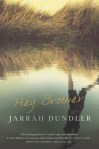
Jarrah Dundler, Hey Brother (#BookReview)

Jarrah Dundler, Hey BrotherIs she ever going to write another actual review you’ve been probably wondering but yes, I am – and it’s for the young protagonist book I mentioned in my recent Reading Highlights post. The book is Jarrah Dundler’s debut novel, Hey Brother, which was shortlisted for the The Australian/Vogel Upublished Manuscript Award in 2017 under the title Tryst. Tryst is quite a clever title: it’s the nickname of the 14-year-old protagonist Trysten, and suggests actual and hoped for trysts between the teen couples, but maybe it also has overtones of something more genre-like so was rejected? As it is, the published title conveys both the familial and broader meanings of brotherhood, which are played out nicely in the novel.

Publisher Allen & Unwin categorises Hey Brother as Popular Fiction, and describes it as “a genuine and compellingly portrayed family drama of a tough kid from rural Australia”. I would describe it, however, as a coming-of-age novel, and it reads to me as more Young Adult than Adult. There’s nothing wrong with this, but it explains my uncertainty about how to read it – or, to be more specific, how to write about it.

So, the book. Hey Brother has a first person narrator, the aforementioned Trysten who lives on a property in northern New South Wales with his mother, Kirsty, and his big brother Shaun. His father, Old Greggy, is there too, but prior to the novel’s start he’d been exiled by Kirsty to a caravan down by the river. So, it’s a somewhat fractured family, but not devastatingly so, because it becomes quickly clear that there’s an underlying love and respect between them all. The novel starts with big brother Shaun going off to fight “the Taliban in Afghanistan”, where he’d “been keen to head from the get-go, back when the dust from the Twin Towers was still settling”.

Into this mix comes uncle Trev who turns up to support his sister, Tryst’s mother who is worrying about her son off at war. Her form of “worrying” includes self-medicating with alcohol and letting her other responsibilities fall by the wayside. Unfortunately, Trev, who has some lovely moments of wisdom, also self-medicates his own demons the same way. It’s not a lethal mix, but it creates its challenges, and in fact offers Trev some insights. There is also Tryst’s best friend Ricky, and, as the book progresses, their girlfriends, Jessica and Jade. It’s a tight little community, and Dundler handles the relationships well. They feel real, with the tensions authentic, understandable, and not over-dramatised. In fact, Dundler’s characterisation is a strong point. His people live and breathe from the moment they appear on the page.

Hey Brother, then, features the typical YA narrative – a young teen meets his first love and is desperate to spend more time with her. But this particular story is complicated by the teen’s relationship with his brother whom he hero-worships but who returns from war psychologically damaged, suffering from PTSD. The novel’s crisis is, in fact, triggered by Shaun’s mental distress, and complicated by the conflict confronting Tryst between his love for Jessica and for his brother.

The novel is told first person by Tryst, in the vernacular of a rural, teenage boy. It’s fresh, direct, immediate, full of the profanity and colloquialisms that are appropriate to the context – but, here’s the thing, it is also more descriptive than reflective. Tryst comes across as a loving, heart-of-gold young man, but he is about the moment. To some extent we can see the deeper issues at play here – the PTSD, the complexity in the adult characters’ lives and relationships – but these are not the novel’s focus. The focus is Trysten, his life and, ultimately, his growth. This, to me, makes the novel Young Adult – and makes it quite different from, say, Laguna’s The choke (my review) where, although the story is young Justine’s, the themes focus on the impoverished environment – economically, socially, spiritually – that makes her life the way it is.

Did, then, I enjoy the novel? Yes, in that its protagonist and setting are foreign to my experience and I like to read about lives different to mine, and because the writing was engaging, lively, and appropriate in language and imagery. Here, for example, Tryst describes Trev confessing to past troubles:

It was like he wanted the words to go straight down the plughole after he’d uttered them.

And Trev, late in the novel, gives Tryst some advice:

‘Decisions, mate. That’s what defines you in the end. Some advice for ya–before you make one, try and give it a little thought beforehand, would ya? ‘Cause, believe me, regret’s a f****n c**t of a thing to live with.’

I also liked that late in the novel, we learn, in passing, that Ricky, Tryst’s friend, is indigenous. The reference is somewhat didactically done, but Dundler clearly wanted to do what we need more of, that is, to include indigenous characters without their indigeneity being an issue in the story. How you do this is the challenge.

However, Young Adult Fiction is not really my interest. Young Adult concerns belong to a long-ago part of my life. I appreciated Dundler’s skills in plotting and characterisation, not to mention his heart and desire to give life and air to some big issues, but I did tire at times of Tryst’s concerns, perspective and voice. Not his fault, mine. I would unhestitatingly recommend this book to YA readers – and would willingly check out Dundler’s next work. A good debut.

For a beautiful post on this book, check out Theresa Smith’s (Theresa Smith Writes).

Jarrah Dundler
Hey brother
Sydney: Allen & Unwin, 2018
281pp.
ISBN: 9781760631123

(Review copy courtesy Allen & Unwin)

Note: The asterisked words in the quote are to defect the wrong sort of hits coming my way.

Rodney Hall, A stolen season (#BookReview)

Rodney Hall, A stolen seasonRodney Hall is one of those Australian authors who deserves more attention than he seems to get. Consequently, I’m thrilled to at last include him in my blog, with his latest novel A stolen season. I was introduced to Hall back in the late 1980s when my reading group read his surprising novel, Just relations, and I’ve also read another surprising novel by him, The day we had Hitler home. Hall is good at surprising, because A stolen season isn’t exactly run-of-the-mill, either, in terms of its characters and set-up.

It’s a tricksy book comprising three different, more-or-less alternating, story-lines. The chapters go like this: Adam and Bridget, Marianna, Adam and Bridget, John Philip, Adam and Bridget, Marianna, Adam and Bridget. Adam and Bridget, then, form the driving story, and there seems to be no connection between the three sets of characters for a very, very long time. Indeed, by the middle story, John Philip, the only literal connection is a minor character from the first Adam-and-Bridget chapter appearing as a rather minor character in this one. Later, a similarly loose, not-exactly-direct, connection occurs between Adam and Marianna. What gives, we wonder? Who are Marianna and John Philip? Why are we also reading about them? And, will they all ever actually meet, as we expect in novels like this? Well, all I’ll say is that Hall does not, as is probably his wont, do the expected. No, I’ll say more in fact: if we focus our energies on worrying about this structural plot issue, we risk missing what’s important, which is the overarching idea that gradually reveals itself, an idea relating to money and power, and to the way they can not only deceive but actively generate inhumane/anti-human values.

The main story, Adam and Bridget’s, centres on soldier Adam. He returns from fighting with the Coalition of the Willing in Iraq so severely damaged that he can only live, get around, by means of an exoskeleton (the “Contraption”) that is activated and controlled by his brain, something which Hall explains at the end is not complete science fiction. Adam and Bridget’s story is surprising from the beginning, because, while we realise that this injured soldier, Adam, whom we’ve just met, has a wife, we don’t realise, until he arrives home, that the marriage was essentially over by the time he’d gone to war. This was not because they hated each other but because they’d married on a whim – “it seemed a fun thing to do at the time, but they were just kids and kidding” – and the marriage had run its course. Unfortunately for Bridget, she had never got around to legally leaving Adam after he had physically left her to go to war, because it had never seemed necessary. Now what was she to do?

Adam and Bridget’s story is darkly humorous, but also deeply moving, not least because Hall imbues them with a humanity that we can relate to and recognise. They embody the sorts of inner conflicts anyone would experience in a situation like this – Adam, desiring his wife but incapable of achieving what he most wants, wants, genuinely, generously, to set her free, and Bridget, feeling trapped but empathetic, increasingly tender, wants to do the right thing by this decent strong man. Hall writes their story – writes all of the stories in fact – from the individual characters’ third person points of view. Not only does this make for engrossing reading, but it reveals Hall to be a writer who knows, fundamentally, what makes us human.

Meanwhile, Marianna, a German-born Australian, is on the run in Belize after discovering that her husband had seriously deceived her and was implicated in the greed that underpinned what we Australians call the GFC. While Adam and Bridget’s story is the most personal one, hers is the more mysterious, mystical one. Why is she in Belize, and what does she want with the Mayan pyramid? It’s all to do with numbers, mathematics, and end-of-the world predictions. Hers is the hardest story to pin down, because of its more mystical quest. She sees the temple:

… the structural puzzle of steps and platforms on all sides forming a pyramid crowned by a little room with a single doorway–like the lonely eye of the soul.

Marianna gets it. With neither front nor back, nor left nor right, the geometry is inward looking.

And then there’s John Philip, 70-something, indolent and mega wealthy from family money, who suddenly finds himself in possession of a strange bequest – a long-lost book of “the” artist Turner’s erotic sketches of female pudenda. What he does with these is to thumb his nose at his family in a stylish but shockingly public way while, at the same time, making a statement about art. His is the central or peak story to and from which the other chapters formally if not narratively move. It is satiric, rather than tragic, and has a guffaw-producing, conversation-ending last line, but, in placing him at the centre of his story, Hall is surely presenting his manifesto on the meaning and role of art. John Philip realises:

‘The thing about art’–he finds words for the revelation taking shape in his mind–is that art can be a gift. It’s for whoever sees what it is. That’s what makes it art in the first place.’ He probes deeper. ‘I suppose that also makes it political. I mean, if you can’t stop it speaking the truth.’

Back to Adam and Bridget. What is so special about their story is the way Hall weaves the political into the personal so closely that they are almost indistinguishable. It is here that the “cost” of war is plain to see; it is here that the “money” theme – the idea that “the accountants” are at “the wheel” – is played out to its bitter end; and yet, it is also here that people’s ability to be quietly heroic in the only important way, in our treatment of each other, is laid bare. It’s an astonishing novel about some specific issues of our time, namely the Iraq War and the GFC, and about those wider questions concerning being human and the meaning of art.

Now, however, I’m kicking myself, because this book deserves a wider audience than I’ve seen it getting – and, unfortunately, its turn came up on my reading pile at the slowest time of year for blog reading. It’s a time when readers might peruse various “best-of” lists, but, at least as I’ve observed in previous years, pay less attention to more serious posts. This is a real shame, because both Rodney Hall and this, his latest book, deserve some real attention. It’s a book that will pay the reader who likes to take time to ponder in spades.

Lisa (ANZLitLovers) also enjoyed this book.

Rodney Hall
A stolen season
Sydney: Picador, 2018
342pp.
ISBN: 9781760555443

(Review copy courtesy Pan Macmillan Australia)

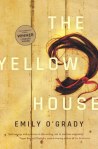
Emily O’Grady, The yellow house (#BookReview)

Emily O'Grady, The yellow house

Although Emily O’Grady’s debut novel The yellow house won this year’s prestigious The Australian/Vogel’s Literary Award for unpublished manuscripts by authors under 35, I wasn’t sure at first that I was going to like it. I think this was because I was feeling I’d read a surfeit of books this year about young people living challenging lives in rural settings – Charlie Archbold’s Mallee boys (my review), Jenny Ackland’s Little gods (my review) and Sofie Laguna’s The choke (my review). I wasn’t sure this was going to have anything new to offer.

However, it wasn’t long before ten-year-old Cub’s voice got me in and I realised that this book had a different spin again, which is that it explores how families of violent or sociopathic criminals, like serial killers, cope in the long years after it all comes to light. It’s a coming-of-age story, in a way, but a very different one. Cub, then, is our narrator. She lives on a “lonely property bordering an abandoned cattle farm and knackery” (back blurb) with her twin bother Wally, her 17-year-old brother Cassie whom she adores, and her parents, Colin and Christine. Within sight of their home is “the yellow house” in which her maternal grandfather, Les, had lived. He had died two years before the Cub and Wally were born – and in the prologue we learn that he had been a serial murderer of young women. The prologue closes with a now wiser Cub telling us:

Now, I know everything he did trickled down and created us all, because it turned out he was the god of all our lives.

So we know at the beginning something that Cub doesn’t know when the narrative “really” starts. Why does O’Grady take this approach? I’m guessing it’s to focus us less on that plot. We know what Cub doesn’t know – or at least enough of it. We can therefore focus on how a family lives with this knowledge rather than on trying to work out, as Cub has to do, what the secret is. It makes Cub a perfect naive narrator: she has the curiosity and loyalty of a child but lacks the wisdom necessary to make the right calls. There’s an added complexity to Cub’s situation which increases her isolation: everyone else in the family knows, including her twin brother. Cub wasn’t told because she’s a girl. It’s no coincidence that she, Coralie, has a baby-ish nickname, while her twin brother doesn’t.

The novel proper starts when Cub is approaching 11 years old, and her aunt, Helena, and 11-and-a-half-year-old cousin, Tilly, move into the yellow house. Tilly’s father, Dermott, we’ve already been told, had driven his car into the dam some time ago and died. It is Helena and Tilly’s appearance which sparks the events that play out in the rest of the novel, events that are “driven” by that violent forbear whose “rotten blood” is in their veins, whose legacy they struggle to shake off.

It’s a horrifying novel. We realise early on that the family is ostracised by the community in which they live, and is struggling emotionally. Cub’s Dad does his best to keep them together but is ill-equipped for the challenge he faces, while her Mum also does her best in her own way, but regularly takes to her bed, with various malaises, many depression-based presumably. Cub and Wally have no other friends at school, something Cub doesn’t fully cotton on to, but we do:

The kids at school were strange; Wally and I played by ourselves at lunchtime, always paired up when we did partner work.

Cub is consequently desperate to make Tilly, so close in age, her friend:

I tried to think of something else to say. I knew we had one chance to make a good impression and I didn’t want to waste it. But the silence felt as deep as the dam, impossible to swim out of. I was annoyed at myself for not practising with the girls at school. I should’ve been prepared.

But, it never quite works. Tilly, dangerously – she’s too much like her mother, Cub’s Mum hints at one stage – is more interested in boys. And, there are boys – besides Wally. There’s Cassie, and his creepy friend Ian. Tilly, like Cub, doesn’t know the story of the “yellow house” and her mother is determined to keep it that way.

The story develops slowly, chillingly, and, it feels, inevitably, as the secrets, parental inadequacy, community prejudice and cold opportunism combine to result in … I’d like to say more, but perhaps should not spoil the plot.

This is not a novel in which everything is explained – as can be typical of naive narrator stories – but there seems to be a specific intention here. At least, I’d say that O’Grady’s aim is not to tease out all the possibilities and permutations of the situation, nor to follow the more usual crime fiction path of restoring order out of chaos. Instead, it’s to encourages us, at each point, to consider what might be happening, why it might be happening, and what might make (or have made) it happen differently. That gives the book a power that those more traditional crime novels don’t have.

Besides this open-endedness which kept me engaged and pondering throughout, there’s O’Grady’s writing. It’s not tricky. There’s quite a bit of dialogue and simple description of what’s going on, as you’d expect, rather than a lot of reflection, but O’Grady has some lovely turns of phrase. At one point Cub is near Cassie’s friend Ian:

Now that I was right up close to him I didn’t know what to do; it was like my brain was wrapped in sticky tape and I couldn’t think properly.

The language and imagery, as this example shows, are appropriate for Cub’s age. And there’s the “yellow house” itself. Yellow has so many connotations. It can suggest something warm, bright, cheery, hopeful, but is also the colour of cowardice and deceit, and can convey sickness. The contrast between these positive and negative meanings of the title underpin the novel’s horror.

Why read this novel? There’s the obvious reason that it explores a subject that many of us must wonder about when we hear of violent crimes – how does the wider family cope, what happens to them? And there’s the associated reason that in so doing it might encourage us to think more empathetically if we found such a family in our midst. But, besides that, it’s an engaging debut novel by a new young writer from whom we will hopefully hear more. It’s always exciting to be in there at the start.

Lisa (ANZLitLovers) also liked this book.

AWW Badge 2018

Emily O’Grady
The yellow house
Crows Nest: Allen & Unwin, 2018
314pp.
ISBN: 9781760632854

(Review copy courtesy Allen & Unwin)

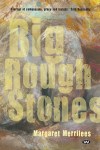
Margaret Merrilees, Big rough stones (#BookReview)

Margaret Merrilees, Big rough stonesIn her latest novel Big rough stones, Margaret Merrilees seems to have done for Australian lesbians what Armistead Maupin did for the American gay community in his Tales of the city series. It is the story, spanning roughly three decades from around 1970s on, of a character named Ro and her lesbian sisterhood in Adelaide. In so doing, it also encompasses some of the feminist activism and sociopolitical concerns of those decades.

Now, Merrilees has appeared here before – with her debut novel The first week (my review) and in my post on her essay about non-indigenous writers writing about indigenous people. I’ll return to this point later …

The novel’s title comes from Miriel Lenore’s poem, “the walls of lesbos”, which is quoted at the beginning of the book. It starts:

to build a lesbian wall
take big rough stones

don’t cut to fit

The poem concludes with the idea that the strength of the wall lies in the combination of the places where the stones touch and the gaps between. This idea perfectly encapsulates the relationships in Big rough stones, because there’s a real sense of a bunch of different individuals who support each other for the long haul. There are points at which they meet. They share political beliefs, for a start, and they share their lives (sometimes as lovers, sometimes in share houses, sometimes in work). But there are also the gaps, those individual differences that either make a community stronger or break it apart. Here, they make it stronger.

Ro, we soon realise, is not the easiest person to live with, not always the most responsible or reliable person, but she’s “sturdy and energetic, descended from a Welsh pit pony and a dour Scot.” She’s idealistic, passionate, and will give things a go. She’s our focal point. The novel is told third person but mostly through her perspective. However, we also get to know several of her friends and lovers, sometimes through her eyes, but sometimes we pop into their heads for a brief while too.

Besides this occasionally shifting third-person point of view, the novel also has an interesting, almost circular, 4-part structure: Now, A while ago, A long time ago, Now. At the novel’s opening – in Now – Ro is in her 60s and learns that she has terminal cancer (so, no spoiler here). We also learn that, at this stage in her life, she wishes she still had someone called Gerry in it. We then move back in her life, eventually reaching “a long time ago” where we meet Gerry and discover why she is no longer in Ro’s life. It’s a sad story. In the final “Now”, Ro is in the terminal stages of her cancer, being cared for by her friends. We see just how strongly that wall has been built. The story reminded me just a bit of Helen Garner’s The spare room – not that Ro tries ineffective alternative medicine, but in the challenges her friends face in caring for a seriously ill person. It isn’t easy.

So, the book is about relationships – lesbian ones, yes, but there’s much that’s universal here too. However, it is also about the times – about political ideals and feminist activism, about the environment and climate change. Several of the women, including Ro, work in a Shelter for abused women. They work as a collective, and we share in some of the struggles of making such arrangements work. We sit in on a collective meeting, after Ro has missed a shift without calling in. There’s discussion and dissension about Ro’s commitment, with one member suggesting this might not be the job for her. Lovely, loyal Maddie speaks up:

I don’t like this. We’ve never been into sacking people or any of that sort of patriarchal shit.’

‘Maybe that’s our problem,’ said Tilda. ‘The place would run a lot more efficiently if we were.’

But this was going a bit too far for the others.

‘No, that’s completely against what we value,’ said the oldest member. ‘People always come first, and that includes workers. It’s up to us to honour Ro’s strengths and figure out how to work with her.’

Ro herself was struck by Tilda’s echo of her own thought. We should have a few more rules, she wanted to say.

She doesn’t say it, though. Instead, she concedes that she was wrong, and offers to work on her relationship with Tilda. An uneasy truce is achieved!

Another quote from the novel that has been used in its promotion provides a good sense of what Ro and her friends were about:

‘You thought feminism would stop violence against women,’ said Julia. ‘And that would stop war. And stop people trashing the Earth. You tried.’

‘Not alone,’ said Ro modestly. ‘I had help.’

Truth-telling

I want to end, however, with Merrilees’ concern about representing indigenous Australians in our stories. Here’s something I quoted from her in my previous post:

To write about Australia, particularly rural Australia, without mentioning the Aboriginal presence (current or historical) is to distort reality, to perpetuate the terra nullius lie. However, for a non-Aboriginal writer to write about Aboriginal people is to run the risk of “appropriating” Aboriginal experience; speaking on behalf of … There’s been too much of that already.

This, as I see it, relates to the issue of truth-telling. There’s the formal truth-telling – via, say, a truth-telling and reconciliation commission – but there’s also the more informal truth-telling that we can all do. Truth-telling is about all Australians coming to a “shared understanding of our history”, which includes “the acceptance of mass killings, incarceration, forced removal from land and forced removal of Aboriginal and Torres Strait Islander children from their families”. The now standard welcome or acknowledgement of country statements are part of this.

So, in Big rough stones, Merrilees has taken a sensitive approach. She does not, here, as she did in The first week, have an indigenous character, but she acknowledges indigenous Australians by showing her characters being aware of the “truths”. For example, Alby, one of Ro’s friends gets a job at a mine. Ro is horrified, and says:

‘Shit, Alby. How could you? Mining. Probably on Aboriginal land.’

‘Certainly on Aboriginal land. The whole country is Aboriginal land. This pub is on Aboriginal land.’

True! On another occasion, after a protest in Alice Springs against Pine Gap, Ro ends up in gaol for a night. The cells are disgusting and Ro finds it hard to engage in the political debate about the US base:

The walls were covered in graffiti. The misery and degradation of the previous occupants hung in the air, a miasma, shockingly brutal. The protest about the US base lost its urgency. Here was racism, fundamental, elemental, an Australian truth most of them had never seen before. Not close up. This they should protest about.

She realises that:

She and the others had privilege that no Aboriginal prisoner ever had. They could give up their resistance and walk away any time. And eventually they did.

I think she has hit on a way of not continuing terra nullius but, at the same time, also not appropriating indigenous experience. It may not work in all situations, but here, with politically aware characters, it does.

Fundamentally, Big rough stones is a straightforward, accessible story with a lot of dialogue that keeps the story moving along – but this is not all it is. Like Tales of the city, it offers a realistic, but warm-hearted portrayal of a time and place, with all the attendant personal and political messiness. An engaging read.

Lisa (ANZLitLovers) also liked this novel.

AWW Badge 2018Margaret Merrilees
Big rough stones
Mile End: Wakefield Press, 2018
278pp.
ISBN: 9781743055526

(Review copy courtesy Wakefield Press.)

EM Forster, Howards End (#BookReview)

EM Forster, Howards EndWhere to start? Like all great classics, EM Forster’s Howards End has so much to think and write about that it’s difficult to know where to focus, not to mention what new angle I could possibly add. Perhaps I’ll just start at the beginning – with its epigraph, “only connect…” That’s a concept that’s sure to get idealists like me in!

First, though – a quick plot summary. Howards End is a place – and it was left, unbeknownst to her, to a young woman named Margaret Schlegel. The novel tells the story of how this came about and what happened after the owner died and Margaret was not told the place was intended for her. But, of course, this is Forster, so the story is not a simple inheritance plot. In fact, almost none of the central plot tensions relate to this little Wilcox family secret. Instead, the novel explores the lives and values of two – well, three, really – families: the business-capitalist-oriented Wilcoxes; the more intellectual, idealistic, arts-and-culture-focused Schlegels; and the poor, down-on-their-luck Leonard Bast and his ex-prostitute wife. You can surely see in this, where the theme of connection might play out.

The novel is described as a “condition-of-England” novel. It is set in the first decade of the twentieth century, the Edwardian period, and England was changing. Money and progress (symbolised by things like the automobile) were replacing more traditional culture and values (symbolised by things like Howards End). It was a time when socialist ideas were being discussed, and of course, it was the time of the women’s suffrage movement. It was a time when society was moving increasingly from a division between the leisured class and the (mostly agricultural) working class to one between those with “their hands on the ropes” in business and industry and the urban workers who had little control over their destiny. (At least farm workers, traditionally, had homes, for example. Not so, the urban poor.)

All this Forster explores through the relationships that develop between the Wilcoxes and the Schlegels – and the poor Basts who get caught in the middle of their complex economic and moral conflicts. This is not to say that the book is all about overt conflict. Our characters are “civilised”. There is a lot of discussion, of presenting ideas and values. But, most are set in their ways and it will, in the end, take more than discussion to shift understanding on.

Only connect …

A BIT OF A SPOILER

This is a classic, and has also been adapted to film and television, so I’m not sure how careful I should be, but it’s hard not to say that by half way through the novel Mr Wilcox (father, and widower of Mrs Wilcox who had “left” Howards End to Margaret) proposes to Margaret. Margaret’s more romantic, uncompromising sister Helen is horrified, and when some unfavourable information regarding Mr Wilcox comes out, she deserts the scene while Margaret – doing her best to “connect” in her own way – learns to accommodate this new knowledge.

Even before this crisis, however, Margaret has expressed (to herself) the “only connect” mantra:

Only connect! That was the whole of her sermon. Only connect the prose and the passion, and both will be exalted.

She wants to help Mr (Henry to her, now) Wilcox build within himself “the rainbow bridge” that will unify all the fragments of his soul, “the beast and the monk.” This is where Margaret and Helen differ. Helen has no time for the Mr Wilcoxes of the world, no time for business and industry, or for murky morals, while Margaret, who is “not a barren theorist”, makes the connections. She knows for example that Mr Wilcox had saved Howards End for Mrs Wilcox when it was all but lost, and she knows that their comfortable lives are underpinned by the industry that Helen so despises.

This difference between the siblings reminded of another writer – one whom EM Forster admired greatly – Jane Austen! Soon into the book, I felt there was a bit of Sense and sensibility going on here, a bit of sensible, practical Elinor versus romantic, idealistic, single-minded Marianne. Like Elinor, Margaret has a good heart, and deeply humane values, but she’s not blind to the world and how it works. Like Marianne, Helen sees only one way to live … and must learn something about compromise and moderation.

And so, the resolution, when it comes, sees Mr Wilcox and Helen coming to appreciate each other’s strengths, with Margaret’s more mature understanding prevailing. That said, the ending, while recognising the role of the Wilcoxes in the world, comes down firmly on the side of the importance of “the inner life”. It is only when Margaret finally makes a stand on the values most important to her – when she confronts Henry with his refusal to connect – that the rapprochements can begin.

Where to end?

I started this post by asking “Where to start”, and now I’m wondering “where to end?” Howards End is so rich – I took multiple notes and made many observations as I was reading it. I want to share them all, but that would be impractical (if not downright boring.)

So, I might just share a few things about the pleasure of reading this book. What makes a classic a classic – that is, a book that we keep re-reading – can be many things. Most important is that they have something new to say on each re-read and for each generation, that, in other words, their themes and/or understanding of humanity translate well into other times. This is certainly true of Howards End, given the philosophical and political schisms we are facing now.

But, we are, I think, only prepared to read these older books if their writing is also good – if they tell a good story, if their characters engage us, if their language and style woo us. Again, Howards End satisfies. The involving story of the Wilcoxes, Schlegels and Basts and the evocation of their individual characters get us in. These are why the book has been adapted for screen more than once. But it’s more than the story and characters that made this book such a wonderful read for me.

It’s also that it is so beautifully conceived and written. It starts with Helen’s letters from Howards End in which she describes the place and talks of Mrs Wilcox bringing in the hay, and ends with Helen, back at Howards End, but bringing in some hay herself this time. There is recurring imagery – such as frequent references to “grey” and “greyness” which convey the misery of impoverished lives, the impoverishment (of mind and spirit), and, more generally, the dullness of daily life. Here is Margaret near the end, reflecting on the importance of respecting and tolerating difference:

It is part of the battle against sameness. Differences – eternal differences, planted by God in a single family, so that there may always be colour; sorrow perhaps, but colour in the daily grey.

I also enjoyed EM Forster’s surprising, occasionally intrusive first person voice, and the sly irony that enhances, or complicates, the novel’s commentary. Some deeper analysis would be worth doing, in fact, on the narrative voice.

Howards End was my Reading Group’s classic for the year and while everyone enjoyed the writing, there were some understandable demurs, demurs which are comfortably explained or overlooked for some, but not for others. Aspects of the plot, for example, are improbable – but that’s not new in fiction. And some of the values and attitudes are problematic – particularly regarding the impoverished Basts, who seem more like pawns than real people. But, for me, these were not flaws. They marked the book as being of its time, and perhaps, of a time in Forster’s own life and thinking, but they do not destroy the integrity of the message, nor of Forster’s overall humanity.

Have you read – or re-read – Howard’s End? If so, did it speak to you?

Lisa (ANZLitLovers) posted on this back in 2016.

EM Forster
Howards End
Middlesex: Penguin Books, 1941 (1910 orig. ed.)
319pp.
ISBN: 140003118
Sue Williams, Live and let fry (#BookReview)

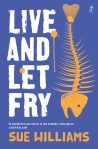
Sue Williams, Live and let fryWell, 2018 is clearly “the year of the Mallee” here at Whispering Gums, with Sue Williams’ Rusty Bore Mystery, Live and let fry, being my third Mallee-set book so far this year. The others are Jenny Ackland’s Little gods (my review) and Charlie Archbold’s Mallee boys (my review). By the time I visit the Mallee – next year I hope – I should know it well, though I might stay away from Rusty Bore. Fortunately, that won’t be hard as Rusty Bore is fictional. I say fortunately, because who wants to visit a place known for murders? It would be like choosing to visit Midsomer!

Seriously though, on with the book, starting with the fact that it’s the third in the Rusty Bore Mystery series. I haven’t read the first two, but I’d say this one stands alone well. There’s enough recap for the new reader to quickly pick up the main characters and their relationship with the protagonist, Cass Tuplin, who’s an unlicensed private investigator as well as the owner-operator of the Rusty Bore Takeaway. I’m not a big reader of crime fiction, but I do watch a bit on TV, and I can say that Cass fits the mould of many TV detectives – private or not, licensed or not – in that she has a messy personal life. She’s clearly had a fling with Vern, the owner of the town’s only other shop, but is now with Leo, who’s doing good works in Bolivia but is staying away significantly longer than he’d told her he would. Cass also has two sons – Dean, a not-very-successful policeman in Mildura (a real place), and the-not-very-sensible Brad who’s waiting his court case for “disseminating false information to the market.” There’s affection between mother and sons, but it’s not without tensions – either because Dean is fussing over his mother’s safety, not to mention her unlicensed detecting, or because Cass is too focused on this detecting to listen to Brad well enough to hear what’s happening in his life.

None of this need be taken too seriously, though. As the back cover blurb says, Williams is “Australia’s answer to New Jersey’s Janet Evanovich.” I haven’t, I admit, read Evanovich – shock! horror! – but Daughter Gums has, so I know enough to realise that her crime novels are bright, breezy affairs. And so, certainly, is Live and let fry.

Now, what to say? This is rural crime, and it starts with the disappearance of the aforesaid Vern’s new lady friend, Joanne, from the neighbouring town of Sheep Dip. (There’s nothing subtle in the town names here – Rusty Bore, Sheep Dip, Muddy Soak, Hustle.) Cass, like any self-respecting unlicensed private detective, is reluctant to become involved but, of course, you know she will – and she does. Pretty soon, a murder occurs – not Joanne’s though – and the plot rapidly thickens as we move into the murky world of developers and environmental protection. This has our intrepid Cass driving backwards and forwards across the Mallee in her “little Corolla”, getting into more and more serious scrapes, worrying her sons, irritating the police, and not always making the right calls – as you’d expect.

All this gives Williams the opportunity to provide us with a picture of the Mallee and its inhabitants, which she does in language somewhat different from that we’ve seen in those other Mallee books I’ve read. Here is the Mallee, for example:

As I got closer to Mildura the eucalypt-and-orange desolation gave way to irrigation green, the dark green of orange groves, the brighter, flamboyant green of grapevines, the camouflage khaki of olive trees. I drink it in – green’s not a colour we get that much of in Rusty Bore.

And here is one of its inhabitants:

Nola’s eighty-two and usually quite mentally robust, with opinions carefully cryo-preserved since 1953.

The writing is peppered with gentle, affectionate mocking like this, along with broad satire of various contemporary issues and preoccupations, such as “coffee condescension” from city-siders, and Cass’s own “artisanal” food. We’re also told that

Leo’s import-export business in Muddy Soak folded after the African knick-knack trade fell victim to the decluttering trend.

And there are digs at politics and politicians, such as:

I stood at the desk and waited. A TV flickering behind Taylah showed a surging crowd of middle-aged people in suits. Mostly men, looked like politicians. Another leadership spill? A new Royal Commission? There’d been a lot of debate lately about whether air exists. “If you can’t see it, can’t smell it, it can’t be there.” The slogan of one of the newer political parties.

It’s not subtle, but then Williams’ goal is less social or political commentary than maintaining a light breezy tone and conveying character.

Now, though, back to Cass. Does she get her man (or, not to be sexist, woman)? Well, this is what I’d call “cheery crime”, so yes, one way or another, she does. In other words, without spoiling anything, it all comes out right(ish) in the end and Cass lives to fight (or not, as she chooses) another day. I’m not sure I’ll read another Rusty Bore mystery as I feel I’ve got its measure now, but for those who love light-hearted crime, particularly with an Australian flavour, then Rusty Bore could be just the ticket.

AWW Badge 2018Sue Williams
Live and let fry
Melbourne: Text Publishing, 2018
295pp.
ISBN: 9781925603514

(Review copy courtesy Text Publishing)

Robyn Cadwallader, Book of colours (#BookReview)

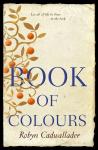
Robyn Cadwallader, The book of coloursWhat makes historical fiction worth reading for me is the exploration of universal ”truths”. Fortunately, Robyn Cadwallader’s second novel, Book of colours, does this, albeit I wish that some of the universals – gender inequity, class (meaning social and economic inequity), and fear of foreigners – were no longer universal! The book explores other more general universals, too, such as love, friendship, loyalty, courage, suspicion, fear. However, historical fiction needs something more of course. It needs to authentically evoke an historical time and place, preferably through engaging characters. Cadwallader does this too.

Book of colours is set in mediaeval England, specifically between 1320 and 1322, and concerns an illuminated book of hours. The narrative is structured into two main chronological threads – the story of the book’s creation and the people creating it, from late 1320 to 1322, and that of the noblewoman who commissioned it, Lady Mathilda Fitzjohn, after she has it in her hands, from May to September 1322. She lives in Hertfordshire, while the limners’ atelier is located in London, so we also see city and country life during this period. As the limner Gemma writes:

…let all of life be there in the book, from high to low, animal and monster, story and joke, devotion and dance … (from The art of illumination)

Now, I particularly like it when historical fiction writers provide some historical context to their story, preferably in an afterword, along with some references or sources. This Cadwallader does, with a four-page Author’s Note and two-plus pages of Further Reading. She explains the historical background, including that the period she chose encompasses the Great Famine and the Dispenser War, and she discusses where the facts are less well documented. The meaning of those bawdy or confronting marginal images in books of hours, for example, is little understood. Also, says Cadwallader, no women limners are listed in this period, but there is evidence that women did, in fact, undertake illumination. These notes support the novel’s political, socioeconomic and sociocultural context.

The story is told third person through three main perspectives: Mathilda’s and those of two of the atelier workers, journeyman-near-master Will Asshe and master-in-work-if-not-in-name Gemma Dancaster. The atelier is owned by Gemma and her husband John – well, actually, given the times, it is “owned” by her husband, but he inherited it from her father. Prefacing the atelier-based chapters are sections from the book The art of illumination which Gemma secretly writes for her apprentice son Nick.

“both beauty and chaos”

Towards the end of the novel, the widowed Mathilda – her rebel Marcher husband having been killed while fighting the Dispensers – realises that life is not “ordered” as she had thought but is, like the “delicate, bawdy and capering creatures” in her book, “both beauty and chaos.” It is this “beauty and chaos” that Cadwallader captures through her vivid characters. The atelier thread starts with the arrival in London of Will, a limner who is escaping something that happened in Cambridge where he had lived and done his training. As the story progresses we discover, of course, what that was, but all I’ll say here is that he’d been associating with a student named Simon who had filled his head with ideas about equality. These ideas make Will angry about “the rich and their ambitions” and resentful about “the marks of privilege” requested for the book of hours. He’s a bit fiery, our Will, and gets himself into several scrapes, all the while watched over by an animated gargoyle who represents, I’d say, Will’s conscience.

Meanwhile, Gemma, the would-be master limner, is frustrated about the inequalities she faces as a woman – particularly a woman having to cover for her husband who is, we soon discover, no longer able to draw and paint. Gemma, too, is aware of economic inequities. Southflete, the stationer and middleman who handles the commission, tells them that

the calendar pages must be beautiful scenes of life on the demesne, you understand … Chubby infants, well-fed peasants, colour, beauty …

Gemma is not impressed:

Beautiful. How, in a village farmer’s wife, would January be beautiful? Snow if the weather was kind, ice if it was not. And this past year, colder than ever. Frost that rarely lifted, and then only to snow or rain. London had clenched its teeth, frozen to the marrow, too cold to move. At least the cramped lanes and houses blocked some of the wind; what it was like in the country, she couldn’t bear to think.

She, like Will, makes her assumptions about their patron Mathilda’s life and values, but as is often the case, assumptions aren’t always completely right – and these too Cadwallader teases out as the book progresses.

There are other characters – including Gemma’s gentle husband, their quietly wise apprentice Benedict, and their son and beginning apprentice Nick. These, plus other residents of London’s book trade area, Paternoster Row, flesh out the story, adding depth to the narrative and to the history of this fledgling industry struggling to establish itself as a guild.

So, there’s beauty and chaos in life, but it is through their drawings that the limners convey their feelings and ideas. As the world changes around them – for reasons I can’t fully divulge – the limners draw and paint their reflections and reactions, their messages even, into the book. Both Gemma and Will remind Mathilda of who she is and of her responsibilities to herself and others, responsibilities that become more nuanced and more personal than their original simplistic view of the world at the start of the novel. The interplay between the artists’ ideas as they paint and Mathilda’s reflections as she considers their paintings is one of the joys of the book. It is as much through these, dare I say, “virtual communications” as anything, that our three main characters grow in understanding. It is through them, for example, that Gemma shares her feelings – feelings Mathilda doesn’t recognise as coming from any sermon she knows – about women’s need to stand strong in the face of men’s power.

Book of colours, in other words, is a delicious read, imbued with the life of a long-ago time but filled with people whose emotions, hopes and frustrations are very much our own. Latish in the novel, Mathilda realises that Will’s friend “Simon’s simple borders of right and wrong won’t hold. They leave no space to breathe.” This is the book’s message: to grow and change we need to expand beyond simple conceptions of right and wrong. We need to let each other breathe and be. Only then can true selves, true relationships and, hopefully, a true understanding of equity develop.

Note: Lisa (ANZLitLovers) loved this book, and Angharad Lodwick (one of last year’s Litbloggers) was also impressed. I also reported, back in April, on a Conversation with Robyn Cadwallader about this book.

AWW Badge 2018Robyn Cadwallader
Book of colours
Sydney: Fourth Estate, 2018
360pp.
ISBN: 9781460752210

(Review copy courtesy HarperCollins)

Laurie Steed, You belong here (#BookReview)

Laurie Steed, You belong hereMy first reaction as I started reading Laurie Steed’s debut novel, You belong here, was, “oh dear, another novel about a dysfunctional family”, but I was quickly disabused of that prejudice because while that is indeed the book’s “genre”, Steed writes it in such a fresh and engaging way, albeit seriously so, that I was soon engrossed in his Slater Family.

You belong here is an ambitious novel, spanning over four decades from 1972, when Jen and Steven are 16 years old, to 2015 when their grandchild turns 13. This is the span you’d normally find in a family saga of 400 pages or so, but Steed does it in under 250 pages. How does he do it?

First, though, the basic plot. It concerns the marriage and its subsequent breakdown, of the above-named Jen and Steven, and the impact on their three children, Alex, Emily and Jay. Australian author Melanie Cheng, whom I’m yet to read, says on the back cover that the family has “all the dysfunction of an Anne Tyler novel, but with a distinctly Australian feel.” Having read and loved Tyler’s novels (before my blogging days), I’d say this is a good call. Steed, like Tyler, deals with a very particular family – its idiosyncrasies, and shifting individual relationships – while also speaking to universals like love and loyalty, betrayal and breakdown, closeness and distance.

Now, back to the time span. The book is organised by chronological parts: 1972-1984; 1985-1995; 1996-1999; 2000-2002; and, 2015. To cover this ground it is, necessarily, episodic*. Each part comprises short, evocatively titled chapters, which contain scenes from a life, switching the point-of-view between the five main characters. These time-shifts (which aren’t all clearly signposted within the parts) and changing perspectives demand a level of concentration from us readers, but I didn’t find they slowed me down significantly. On the contrary, they kept me engaged and focused on the matter at hand – that is, on whose story I was reading now, what was happening to them and why.

A hairline crack. Small, but spreading.

So, the early parts of the book focus on Jen and Steven’s relationship, their falling in love and the subsequent stresses – three children in quick succession for Jen, and failure at work for Steven – which drive a wedge between them. Steed’s writing is evocative and tight – it has to be really – and I enjoyed it immensely. Take this description of Steven’s commute to his job at the airport:

Steven had lost track of time. Moments, hours, left scattered along the Great Eastern Highway while driving to and from work. Seconds entered in the till by an underpaid, overworked cashier. A day maybe two, left hanging in the change room at the airport. (Before a fall)

Or this of Jen, in the bedroom with Steven, after we discover she’s been having an affair:

She stared past him at the wall, beneath the windowsill. She’d seen it before, maybe weeks, months earlier. A hairline crack. Small, but spreading. (Wallpaper)

The staccato rhythm here is perfect. And Jen’s sadness is palpable.

As the novel progresses, the children grow up and we shift to their lives, with Jen and Steven receding somewhat from the narrative focus. Each child struggles in his or her own way to navigate the family and their place in the world. We are frequently devastated for them, while also applauding their will to survive. There are some lovely vignettes, such as a cricket innings played by Alex and his friend Walker. The whole is underpinned by pop-culture references to music and video games that were only vaguely familiar to me as a baby-boomer parent of late Gen-X early Gen-Y children. Knowing these better might have added to my appreciation of the novel, but I didn’t feel my lack greatly. That is, the novel seemed to work well for me anyhow.

The jerky, episodic structure may have grown out of the original short story concept, and for some it could result in frustration at not “knowing” the characters as fully as they’d like. But I thought it effectively mirrored both the family’s fractured relationships and the way they stick together despite it all. Over time, allegiances switch as particular stresses develop for one person or another, but the love between them, while it falters at times, comes through.

But then, Alex couldn’t make head or tail of any of it. He felt sad and sorry for his sister, his brother, and the fraught, familiar way that the family closed ranks when one began to sink. It felt tender if he touched upon it, like he’d picked up a peach and felt the bruise. (Skin I’m in)

Lest this sound a bit corny, let me say that this is a serious book. The impact on the children of their parents’ separation is unflinchingly exposed, particularly through mental health issues and the difficulties they face in forming long-lasting relationships. It isn’t a pretty picture, but the end, without giving too much away, suggests that with love, perseverance and loyalty, families can and do muddle through.

And so, a book that I thought at the beginning was just another novel about a dysfunctional family surprised me with its insights, warmth, relevance to us all, and above all, its writing pizzazz. Well-worth reading.

* WA writer-blogger Nathan Hobby’s review tells me that the book started as a short story collection, which makes sense. Lisa (ANZLitlovers) featured Laurie Steed in her occasional series on Debut authors.

Laurie Steed
You belong here
Margaret River Press, 2018
250pp.
ISBN: 9780648203902

(Review copy courtesy Margaret River Press)

Raphaël Jerusalmy, Evacuation (#BookReview)

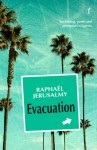
Raphael Jerusalmy, EvacuationRaphaël Jerusalmy, for those who, like me, hadn’t heard of him, is a French-born and educated writer living in Tel Aviv. He had a career in the Israeli military intelligence services, worked in humanitarian and educational fields, and is now an antiquarian book dealer in Tel Aviv, where his novella, Evacuation, is set. In some ways, the book is a love letter to Tel Aviv – but it is more than that, too …

Evacuation is a short, quick, but powerful read. The narrative is structured around a road trip, in which twenty-something Naor is driving his mother from her kibbutz home to Tel Aviv. As they drive he tells her what happened in Tel Aviv, after he, his girlfriend Yaël, and his grandfather Saba, had jumped off the bus that was taking them out of the city, as part of a mandatory evacuation process.

The thing about this book is that although we realise the war is part of the ongoing Middle-eastern conflict, no specifics are given. No dates, no enemy, just, later on in the story, that peace negotiations were taking place in Geneva. By the time the novel starts, that peace had been achieved (for the moment anyhow) and Naor is dealing with the aftermath. The lack of specificity universalises the story, focusing us on the characters’ experience more than on the whys and wherefores, rights and wrongs, of the war.

So, their experience. Firstly, I should explain that it was Saba and Yaël who had decided not to evacuate, with Naor feeling obliged to stay with them. They are all artists – Naor a filmmaker, Yaël a visual artist, and Saba a writer – so there is also an underlying thread about art and resistance. They go to friend Yoni’s house in the already evacuated part of the city, and from there they learn how to survive – how to find food, water, clothes – and how to occupy their time. They roam further and further, taking risks to enjoy a dip in the sea; they enjoy strolling down Tel Aviv’s beautiful Rothschild Boulevard; and, they decide to make a film, titled Evacuation, to Naor’s script and with Saba and Yaël acting.

It’s while filming a critical scene in a synagogue that a long-range missile attack occurs, forcing them to take cover. After this attack, Yaël decrees that they are not going to let air-raid sirens disturb their peace again – “From now on, we were going to behave as if there was no war” – setting us up for the tragedy that we have been sensing through Naor’s narration.

Now, I said that the novel focuses more on the characters and their experience, than the war. However, there are occasional references to Zionism and the ongoing political situation, including this on Saba’s opinion:

Deep down Saba wasn’t unhappy about what was happening to Tel Aviv … He said it did no one any harm to get a kick up the arse from time to time. And that we Israelis badly needed it. Because we had got stuck in a stalemate. Not only with the Palestinians, which was of course unfortunate. But also and especially with ourselves, which was much worse.

So the evacuation was timely. It gave us an undreamt-of chance to wipe the slate clean. To start again. In his mind, Zionism as an idea was not a failure. But it was stagnant. It had come unstuck in its application. Because of this and that. Those were his exact words. This and that. He spoke about restarting our attempts at Jewish socialism. About the importance of education. ‘Everything stems from that.’ And about being kinder in general. To poor people, and to Arabs.

There’s also Yaël’s stronger statement that Tel Aviv was the only place she “felt safe. From those at war with us. From those who have morality and justice on their side.” [my stress]

All this is narrated by Naor to his mother as they continue their trip – and as he does, certain things become clear. One is that there’s been some falling out between his mother and Saba, her father, and that this trip is partly a peace-making one (subtly paralleling the political war-and-peace background to the story.)

Now, I daren’t say any more for fear of giving the whole lot away. While it’s written nicely (albeit I read it in translation), its main appeal, besides the story, is its engaging narrative structure and gentle tone. I loved the way Naor’s story is interrupted regularly by comments from his mother (not to mention road signposts). These interactions, while hinting at some of the tensions needing to be resolved, also imbue the book with a lovely normal intimacy, unexpected perhaps in a book with such subject matter.

Evacuation is an open-ended book, one the reader can consider from various perspectives, including the choices we make, love and family, art and resistance, war and peace. I found it a surprisingly enchanting read, which I hope doesn’t make me sound insensitive to its seriousness, because I felt that too.

Raphaël Jerusalmy
Evacuation
(Trans. by Penny Hueston)
Melbourne: Text Publishing, 2018 (Eng. ed.)
150pp.
ISBN: 9781925603378

(Review copy courtesy Text Publishing)

WG Sebald, Austerlitz (#BookReview)

WG Sebald, Austerlitz

For the first time in my reading group’s 30-year history, we read a book recommended by a fictional character. It happened like this: after reading and discussing Rabih Alameddine’s An unnecessary woman (my review) in January, we thought it would be interesting if we all nominated which book mentioned by the “unnecessary woman”, Aaliya Saleh, that we’d most like to read. The book that got the most votes was Austerlitz. I was thrilled, because I bought my copy back in 2010 to read with one of my online reading groups, but never did, and because I had already read and been bowled over by his The emigrants.

But now where to start? A bit left field I think – which is probably not inappropriate given Sebald’s approach to literature. The “left field” happens to be one of my (few) never-forgotten book quotes. It’s from Toni Morrison’s Beloved, and is Sethe talking about “the day’s serious work of beating back the past.” Sethe is, as most of you probably know, an American ex-slave who is living with the trauma of her past life. Austerlitz, in Sebald’s book, is a man who, as a four-year-old, had been sent from Prague to England on a Kindertransporte in 1939, never to see his parents again. Indeed, he suppresses all memory of his past life – realising later

how little practice I had in using my memory, and conversely how hard I must always have tried to recollect as little as possible, avoiding everything which related to my unknown past.

This realisation comes some 50 years later, in the early 1990s, when, one day, having become “increasingly morbid and intractable” after the death of his only true friend, he is in the Ladies Waiting Room of the Liverpool Street Station – and a memory comes back of his arrival in England. At this point, his “self-censorship”, his “constant suppression of … memories” brings about a nervous breakdown. Upon his recovery, he begins researching his past life, resulting in trips to Prague to look for his mother, and to Paris to do the same for his father. Much of this is couched in discussions of architecture – because Austerlitz is an architectural historian – forcing us to consider the role architecture plays in human history and psychology. It’s compelling, but more than that, mesmerising …

However, this book has been written about with great insight and sensitivity by reviewers at, for example, the New York Times and The Guardian, so I’m going to do something a little different, and respond to that fictional woman, Aaliya, who recommended the book to my group!

“His style, drawn-out and elongated sentences that wrap around the page and their reader …”

And I will start with the seemingly mundane, the style, because it is this that confronts us most strongly with we start the book. If you’ve never read Sebald before it could be a shock. There are almost no paragraphs – well you could say there are 5 including the beginning of the book – which means there are no real chapters. The story just continues on and on, often through very long sentences containing multiple clauses and lists. We do have a narrator, the person to whom Austerlitz is telling his story and who relates it on to us.

Strangely though, I found the writing page-turning. There is something mesmerising about the almost flat, rather melancholic, tone suffusing the narration, that you want to keep reading. At least I did – and so did most of my reading group once they’d “got into it”. The style, in other words, wraps around you.

There are motifs and images which recur through the novel, making the whole cohere, creating the tone and developing the themes. There are shadows, there’s darkness more than light, and colours are muted, mostly grey. There are star-shapes, railway stations and other monumental buildings. There are references to ghosts. Places are more often empty or deserted, than heavily populated. And there’s the mysterious operation of time and memory. All these support the narrative’s mesmerising quality.

The book also includes black-and-white photographs, encouraging us to see it as non-fiction but no, this is fiction. Austerlitz is a made-up character – but, says The New Yorker, Sebald sometimes called his work “documentary fiction”. In other words, this is a very different sort of read.

“All I am is lonely. Before I go to bed, I must put away Sebald …

… both The Emigrants and Austerlitz. I can’t read him now, not in this state. He’s much too honest. I will read something else.” 

Our “unnecessary woman”, Aaliya, who lives in Beirut, has experienced war herself, been affected by its ravages. I won’t say more here, because I think what I have said about the story and it’s tone already makes clear why she feels this. Sebald is not a writer to be read at times of distress or melancholy, but his insights into what we call “the human condition” are … well, let me put it this way: this is not a book you explain, really, but one you feel. What you feel is something that affects the way you think about human history, about where we’ve been and where, unfortunately, it looks like we’re going.

“I am proud that I finished the Austerlitz project. I consider it one of the best Holocaust novels.”

Aaliya goes on to say that “I find that when a subject has been heavily tilled, particularly something as horrifying as the Holocaust, anything new should force me to look with fresh eyes, to experience previously unexperienced feelings, to explore the hitherto unexplored.” And this is why Austerlitz is powerful. Austerlitz was a young boy in a little Welsh town while the war was on so he did not experience the Holocaust directly. But, his experience of being displaced comes back to haunt him later. So this is not about a person who directly experienced the Holocaust, nor is it, though, about the second generation. It is about someone who lived at the time, but had not experienced it first-hand because his parents, who did, had removed him. He is in a sort of limbo generation – and “limbo” is probably a good description for how he feels through much of the novel.

He writes, describing his experience of another mental/physical collapse:

It was obviously of little use that I had discovered the source of my distress and, looking back over all the past years, could now see myself with the utmost clarity as that child suddenly cast out of his familiar surroundings: reason was powerless against the sense of rejection and annihilation which I had always suppressed and was now breaking through the walls of its confinement.

This statement struck me powerfully, because not only does it reflect another experience of the Holocaust – another way of looking at its impact – but it articulates the experience of our stolen generations, and, beyond that, of any children removed, for good or bad reasons, from their homes. “Reason was powerless against the sense of rejection and annihilation”. What more is there to say?

There is so much to talk about this book, so much I haven’t touched upon, but I’m going to finish with a brief reference to his discussion of time, the past and memory which underpins the novel. Here is Austerlitz late in the novel:

It seems to me then as if all the moments of our life occupy the same space, as if future events already existed and were only waiting for us to find our way to them at last, just as when we have accepted an invitation we duly arrive in a certain house at a given time. And might it not also be, continued Austerlitz, that we also have appointments to keep in the past, in what has gone before and is for the most part extinguished, and must go there in search of places and people who have some connection with us on the far side of time, so to speak?

I love this organic way of looking at time, this suggestion of how we might experience, approach or understand the events, particularly traumas, that happen to us.

Our unnecessary woman, Aaliyah, calls Austerlitz a great Holocaust novel, but I’d go one step further and simply say it is a great novel. Full stop.

WG Sebald
Austerlitz
(Trans. by Anthea Bell)
London: Penguin, 2002
415pp.
ISBN: 9780140297997