Leslie Geddes-Brown, Books do furnish a room

Book stacks

Book stack - part of the TBR pile

There was no resisting this book – Books do furnish a room – when I saw it on a table in the National Library of Australia’s bookshop. It’s rare for me to buy a coffee-table book but … this is one gorgeous book. It is lavishly illustrated with images of books in pretty well every room or area of a house from bathroom to bedroom, from stairwell to kitchen. It’s enough to make a booklover drool.

But, what really sold it to me was that, amazingly, it even has an example that justifies my practice shown right: “Surprisingly” says Geddes-Brown, “it is found in a home belonging to a former editor of South African House & Garden … his excuse is that he had no bookshelves and just piled books against his bedroom wall”. Love it! He can visit my house any time.

In her introduction Geddes-Brown, former Deputy Editor of World of Interiors and Country Life magazines, writes:

So books do furnish a room – but not always very well. This book, with images from stylish houses, taken by world-famous photographers, intends to show how it can be done.

Hmm…I do find the text a little simplistic but, what the heck, after all it is really an adult’s picture book. And, it does contain the odd bit of practical advice – particularly for those who have not thought a lot about such things – such as about shelf size, location, and lighting. The book is divided into four sections – Living with books; Working with books; Designing for books; and Making the most of books – with each section having a short introduction followed by lots of well-captioned images to lust after.

And that’s about all I’m going to say, because this is a book to look at not talk about. I will just leave you with this:

… in their way, books are like pictures on the wall; they reveal whether you are a minimalist with all covers hidden under plain wrappers, a maximalist whose every room has a generously filled bookcase, or an anarchist whose preferred method of storage is an untidy heap.

Which one are you?

Leslie Geddes-Brown
Books do furnish a room
London: Merrell Publishers, 2009
158pp.
ISBN: 9781858944913
Top non-fiction of 2009

Is it cheating to do separate lists for fiction and non-fiction? Some people list their top books regardless of form or genre, while others created separate lists. I’m going to do the latter because – well, because I get to choose more books for a start. Actually, I didn’t read a lot of non-fiction this year so my top non-fiction titles will almost be all the non-fiction I read. As with my top fiction, I am listing them in the order I read them.

I didn’t nominate a top fiction for the year, but I’m going to here – and it is the one I read before I started blogging: Chloe Hooper’s The tall man and so I’ll do a little mini-review of it now.

Chloe Hooper’s The tall man

In a nutshell the book, which is best described as “true crime”,  chronicles the fallout that results from the death in custody on Palm Island of indigenous man Cameron Doomadgee, fallout which includes the autopsy report and ensuing riots, and the homicide trial of policeman Chris Hurley. Hooper explores the awful disconnect between people in the communities involved, between white and black, and within the white and black communities. She shows how women (particularly those on Palm Island) are caught in the middle. They believed the policeman killed Doomadgee but, when the riot occurred, they didn’t want the police gone because “who will protect us from the men”.

Throughout the book, Hooper manages to bring what is a very complex situation into rather clear focus…showing, not surprisingly, that in the end it’s the whites who have the power. For example, she attends a police rally organised to support Hurley and notes how they, the police, were fashioning themselves as victim. She comments that “measured against two hundred years of dispossession and abuse, the idea is fantastic, but no-one in that hall was thinking about historical relativities”! This point regarding “historical relativities” is well-made: this is not simply a case of white devil versus black angel, but we know where the real “victimhood” lies. The book also touches on the notion of power corrupting – or, questions at least how police officers are chosen and trained in the first place.

Hooper manages to walk a fine line. You know where her sympathies lie (particularly as the book progresses and she teases out the evidence) but she takes an analytical approach encouraging her readers to also do so. This begs comparison with Helen Garner who takes a far more heart-on-sleeve approach to her subjects in her books, The first stone and Joe Cinque’s consolation.

Finally, she makes an important point when she describes Hurley’s trial as “a false battleground”. Truth and justice – those universal concerns – do need to come out, but the trial is not going to solve the underlying problems. The tall man is a highly readable book about some significant concerns (for Australia at least)…and, in my mind, well deserves the awards it has won. I have only one quibble with it: I wish it had an index!

POSTSCRIPT: Thea Astley also dealt with troubles on Palm Island in her novel The multiple effects of rainshadow. It deals with the event which occurred on Palm Island in 1930 when the supervisor at the time ran amok and killed his children, something which Hooper refers to in the book when she provides a little rundown of Palm Island’s history.

Chloe Hooper
The tall man: Death and life on Palm Island
Camberwell: Penguin Books, 2008
276pp.
ISBN: 9780241015377

Jennifer Forest, Jane Austen’s sewing box

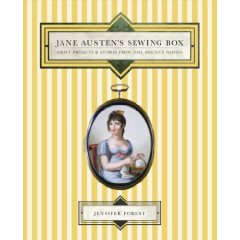
…and so the current Jane Austen juggernaut rolls on. The latest that has come to my attention is Canberra writer Jennifer Forest’s book Jane Austen’s sewing box. Must admit that I was a little sceptical when I first heard of it, but I saw it, bought it, and was pretty impressed. It’s a nicely produced book and represents a genuine attempt to look at the “crafts” of Jane Austen’s time – as well as being a “how to” book.

Jane Austen Sewing Box, by Jennifer Forest, Book cover

Cover from http://www.jennifer-forest.com/sewing-box.php, using Fair Dealing (I think)

The first thing to note, said the author when she attended my Jane Austen group’s monthly meeting last weekend, is that these are not all simply “crafts”. Many are, in fact, women’s work. Women made clothes, including men’s shirts and cravats, bags and purses, bonnets and so on. There was, in fact, a clear divide between “decorative” work and “useful” work and most women, including Jane Austen herself, did both. In fact, Penny Gay, writing in Cambridge University Press’s Jane Austen in context wrote:

Most houses had several sitting-rooms, in one of which the ladies of the household would gather after breakfast to ‘work’. By this is meant needlework, an accomplishment which was both useful and artistic, and which was considered a necessity for women of all social classes. Jane Austen herself was a fine needlewoman… If visitors called, it was often considered more genteel to continue with one’s ‘fancywork’ rather than ‘plain’ shirt-making or mending.

Forest also talked a little about how Jane Austen uses knowledge and skill in this work as part of her characterisation. In Mansfield Park, for instance, the work of the Bertram sisters is deemed not good enough for display in the public rooms (“a faded footstool of Julia’s work, too ill-done for display in the drawing room”) of the house – a clear indication that these girls are not to be admired. On the contrary, Henry Tilney in Northanger Abbey shows himself to be a solid young man and a loving brother by his knowledge of muslin. He could even be seen, many of us think, as the fore-runner of the SNAG (aka Sensitive New Age Guy)!

Forest introduced her talk with the quote that set her thinking about crafts in Jane Austen. It comes from the famous Netherfield scene in Pride and Prejudice in which Elizabeth Bennet, Mr Darcy, and Caroline and Charles Bingley discuss women’s accomplishments. The aways generous Charles Bingley believes all women are accomplished:

Yes, all of them I think. They all paint tables, cover screens and net purses.

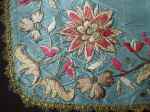
CrewelWiki

Crewel embroidery (from Wikipedia using Creative Commons CC-BY-SA)

Forest went on to describe these three “accomplishments” and more, such as crewel work, tambour work, and knotting. She also brought along a “show and tell” of the objects she had made in the course of writing the book. There is nothing like seeing and touching a hand-made bonnet or a netted purse to understand just how these women spent so much of their time. I am so glad I was born in the time of labour-saving devices!

This might not be a book for everyone. It is not academic but is nicely researched; and it is gorgeously produced with lovely period illustrations. I do have a quibble though – one that is, to me, quite serious – and that is its index. Why have a Table of Contents listing for “Muff and Tippett” and then have an Index listing for the same. If you want to find out what a Tippett is, you will not find it under T. Try M instead. How silly is that? Overall, the index is idiosyncratic and needs to at least double its existing size to be truly useful. That said, even if, like me, you are unlikely to make the 18  items described, take a look. Its readable discussion of “the accomplishments” of the period nicely illuminates the context of the novels – and this can only enhance our enjoyment of them.

Jennifer Forest
Jane Austen’s sewing box: Craft projects and stories from Jane Austen’s novels
Miller’s Point: Murdoch Books, 2009
224pp.
ISBN: 9781741963748