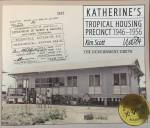
 Do you have a favourite house that you lived in? I do. It’s the lovely old Queenslander my family lived in for most of my primary school years. It was in Sandgate, Brisbane, and I still have vivid memories of those days, and that house and garden. Kim Scott, the author of Katherine’s tropical housing precinct 1946-1956, also has such a house, the one her family moved into in Katherine when she was three years old. It was a 1956-built Type D1 N.T.A. (Northern Territory Administration) house and she loved it so much that many years later, she bought herself a similar house, a Type L “New Series” house.
The thing about these houses – like my Queenslander – is that they were built for the tropical climate. For a start, they were elevated, and had louvres, both of which facilitate the management of airflow so essential to cooling. The effect of this is that they are comfortable to live in – and are energy efficient – but what Scott most loves is “the feeling of the outside coming in” that comes with this design. It’s none too soon, I’d say, to produce a book about building environmentally-suited houses, particularly when, even in Katherine apparently, the ubiquitous brick house has been taking over. Scott is very aware of this as she writes in her introduction:
My hope is that the historical significance of these first, high quality, permanent houses, which are a key part of Katherine’s housing career will be recognised. Additionally, I hope they might spark some interest in the construction of houses that are more suitable for living in the tropics and for the remote living conditions of outlying communities. Houses that use easily available, sustainable materials and are designed with a smaller footprint, specifically to make the most of the environment, as an alternative to the brick and concrete housing built today.
Now, a book like this risks being very dry but, while a lot of information is imparted in this just-over-100-page book, Scott’s personal engagement with the subject enables her to inject the book with some local flavour, with a sense of who lived in (including her own family) and built these houses. The book is logically structured, and liberally illustrated as you really want in a book like this. There are copies of original plans, old and contemporary photographs, and artist’s illustrations by Scott herself. The book starts with a brief history of tropical architecture in Australia, including the work of Beni Burnett in Darwin in the 1930s. (We loved seeing his houses there, in Myilly Point.) She then writes about land ownership in Katherine and the Commonwealth government’s housing program for Katherine, before getting onto more practical matters:
- the house designs and plans;
- the building contractors;
- the building materials; and
- the provision of essential services (like water, electricity, sewerage and rubbish collection).
In her final chapter, “Living in Commonwealth houses”, she shares her family’s experience of living in these houses, using both her own memories and documentary and verbal evidence from her family.
Scott also refers, at times, to the “local Aboriginal people”, noting, for example, some ongoing hurts “from Aboriginal families who owned titled property in Katherine but could not produce the title after the war, so lost their land”. Early in the book she notes that there is no heritage protection for the government tropical houses still remaining in Katherine. Maybe this book will provide an argument for rectifying this oversight!
It’s clear that this book was a real labour of love, one that Scott worked on for a long time. One of the things I greatly enjoyed about reading it was her sharing of her research process, not only because it was interesting but because it also assures the reader that the work is as authoritative as she could make it. There were many reasons why the book took a long time to write, one of which was being told, falsely as it turned out, that the original houseplans for these government designed and built houses had been lost during Cyclone Tracy. She engaged family members in the on-the-ground information gathering process in Katherine; she scoured archives and libraries in Adelaide, Melbourne, Brisbane, Canberra and Perth, as well as Darwin; and she read books on the subject, such as David Bridgman’s on Beni Burnett (BCG Burnett, architect). I loved her comment, after describing yet another serendipitous discovery, that she “was beginning to feel the whole process was dependent on the serendipity phenomenon”. I suspect that research is often like this, particularly in the early stages of projects that don’t have obvious (or easily available) paths to follow.
In her Conclusion, Scott returns to the points I quoted from her Introduction, but this time with a more personal spin. She writes:
If we had continued to build tropical housing that was specifically designed for Katherine’s climate, we would today have a town with a unique architectural style. One that perhaps may have drawn more people to our town and projected a more open, inclusive image of Katherine. I have seen the town develop from elevated, open homes with little privacy and security, with windows and doors flung open, to solid brick houses with their thick walls and windows tightly shut and barred. I know what image I would rather see.
Katherine’s tropical housing precinct 1946-1956 is a self-published book, but Scott has done the sensible thing and used a graphic designer and an editor. The result is a book that is nicely produced and that makes an excellent contribution to both the history of Northern Territory architecture and the local history of Katherine. Scott’s labour of love has, I’d say, borne worthwhile fruit of which she can be proud.
 Kim Scott
Katherine’s tropical housing precinct 1946-1956
Katherine: Kim Scott, 2019
103pp.
ISBN: 9781642045420
 OK, I’m going to show my hand here. I love animals – and hate animal cruelty – but I am not vegan. More to the point though, I am cautious about animal rights activists because they can sometimes act out the very violence and cruelty on humans that they condemn for non-human animals. I was, therefore, a little wary when I was offered for review David Brooks’ book, The grass library. However, Brooks, a poet/novelist/essayist/academic/one-time co-editor of Southerly, has
  Back in 2016, I completed a survey about online bookclubs, and answered some supplementary questions about “my” sort of club. I also took part in a follow-up telephone interview with the two American researchers involved, Grace Chao and Amanda Shapiro. Now, three years later, they have completed their research and self-published it in their book, Bookclub social: A reader’s guide to online book clubs. Of course I bought it, because although it’s some time since I’ve been active in online book clubs (or, OBCs), I am interested in reading communities of all sorts.








 Whispering Gums