Anna Krien, Us and them: On the importance of animals (Review)

Krien Us and them

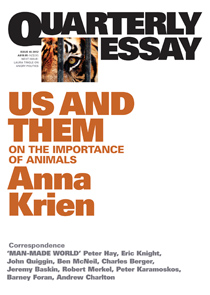
Quarterly essay cover (Courtesy: Black Inc)

I’ll admit it right up front, I am not a vegetarian or a vegan. I like to eat meat. I wear leather shoes. I like to think, though, that the source of these products has had a comfortable life and a quick, stress-free death. But I’m kidding myself, I know. And Anna Krien’s essay, Us and them, about the relationship between humans and animals, doesn’t reassure me.

In roughly 25,000 words, Krien, whose Into the woods I reviewed a couple of years ago, explores the complex relationship we humans have with our living, breathing co-inhabitants on this earth of ours. She exposes the underbelly of this relationship but resists simplistically declaiming the abuses and proclaiming that there is an easy solution. We all know there isn’t. As she says in the first section:

I’m not weighing up whether our treatment of animals is just, because it isn’t. That age-old debate is a farce – deep down we all know it.

The real question is, just how much of this injustice are we prepared to live with.

To try to answer this question she confronts the tension that exists in our relationship with “them” which is, as she puts it, the tension between seeing them as “beings” versus “objects”. She asks:

How to ensure that the butcher, the scientist, the farmer recognise that the creature in their care is a being, even as all the while they [and, I would say, by extension we] continue to use it as an object?

This is a well-structured essay. After an introductory section in which she sets the scene and poses her question, Krien explores the issues thematically, through the sorts of “encounters we have with animals”: Killing; Testing; Hunting,

These are, obviously, the encounters which are the most problematic. She spends little time on our positive and generally more mutually beneficial* encounters, such as in their roles as pets, guide dogs, and companion animals. That’s fair enough, given the serious questions she wanted to confront, but it’s a bit of a shame, nonetheless.

I like Krien’s writing. It’s well-researched, informative, and presents unpleasant facts with a light touch. She’s neither didactic nor conclusive but rather writes as one going on a journey with us. And she asks hard questions, such as these ones in the killing section:

  • Should Australia remain in the live animal trade and by so doing help other countries improve their animal welfare practices?
  • What does it say about our priorities when we have a World Society for the Protection of Animals but not one to protect women?
  • How do we explain the fact that more Australians empathised with the cows (being sent to Indonesia) than with people (such as those Indonesians for whom the cattle trade  means work and food, let alone the asylum-seekers plying the same seas as the cows)?

She explores the complexities of testing and here again disabused me of my head-in-the-sand hopes. I was surprised to read that the number of animals being used in research and teaching is increasing not decreasing. And again, the difficult questions. Is some testing acceptable, necessary even, and others not? And if so, on what basis do we decide? Why is there a disjunction between what scientists do in animal testing and believe is ethical, and what laypeople think?
Australian Women Writers Challenge 2012 Badge

Australian Women Writers Challenge (Design: Book'dout - Shelleyrae)

In her section on hunting, the focus is not so much on recreational hunting but on the hunting of animal pests – some native, such as dingoes, and some feral. She talks about apex predators, and the environmental impact of removing them. When the top predator goes, the ecological balance is severely disturbed. The loss of dingoes, for example, can be directly related to the extinction of small mammals. One solution to protecting farm animals that doesn’t involve killing dingoes is to use guardian animals like maremmas and alpacas. Hmm, methinks, introduced species aren’t always a good option – think camels, think cane toads – but so far so good it seems.

Late in the essay, Anna Krien writes that many scientists describe our current geological era as the Anthropocene, recognising the significant (negative) impact human activities are having on the earth. She follows this with biologist Edward O. Wilson‘s suggestion that what comes next will be “the Age of Loneliness” typified by “a planet with us and not much else”. I don’t want to think about what that would be like. There’s no easy answer to all this but, as Krien says, we must “acknowledge the questions” and continue the discussion. To do anything else is to deny that not only are animals are “important” in themselves but, to put it selfishly, they are important in multitudinous ways to us.

Anna Krien
“Us and them: On the importance of animals”
in Quarterly Essay, No. 45
Collingwood: Black Inc, March 2012
125pp.
ISBN: 9781863955607

(Review copy supplied by Black Inc.)

* Though I’m aware I’m making a human-centric assumption here!

Dorothy Porter, On passion (Review)

Do you read “little” books? You know those small books that are carefully placed on bookstore sales counters where you are buying the book you really came for? I don’t often, but every now and then one catches my eye. Today’s review is of such a book from Melbourne University Press‘s Little books on big themes series. It’s by Dorothy Porter and is titled On passion. She finished it just before she died in December 2008. I think I could be justified in calling that poignant, don’t you?

Australian Women Writers Challenge 2012 Badge

Australian Women Writers Challenge (Design: Book’dout – Shelleyrae)

Dorothy Porter was (is, really) a well-regarded, successful Australian poet. I reviewed her last collection, The bee hut, a couple of years ago. It’s a wonderful collection full of the pains and joys of living. It is, you could say, a passionate book. One of the poems I quoted in that review is about the passion for writing, for finding the perfect way to express an idea:

and your pen slashes ahead
like a pain-hungry prince
hacking through
the bramble’s dragon teeth
to the heart’s most longed for
comatose, but ardently ready
princess.
(“Blackberries”)

So, writing, of course, was one of her passions but in this little essay Porter explores all sorts of meanings of the word (for her). She starts with her adolescent passions – her youthful religious faith which was replaced by her “dark gods, Janis Joplin, Jim Morrison and Jimi Hendrix” whose “daemonic songs” were her “new hymns”.

From here she explores the various ways passion has been part of her life … woven always with poetry, hers and others, and music:

Music has been my draught of intoxication since the very moment I first heard the Beatles in early 1964 […] I have been a Beatles pop/rock music maniac ever since, and have written virtually all my poems to rock riffs and rhythm – the catchier, the darker, the louder, the gutsier the better.

She talks in one section of Dionysus and moderation, strange bedfellows, eh? She argues that Euripides best understood the Dionysian, by exploring “how best to respect and live with it”. She admits, though, that “moderation was not something I embraced with Delphic calm, but something I gutlessly and gracelessly caved into” because, for example, she and drugs did not mix!

Nature too features, snakes in particular. “Real and living snakes are sacred to me” she says and then explores Minoan snake worship versus “the debased and diabolical serpent-demon of the Judaeo-Christian Garden of Eden”. She talks of the Rainbow Serpent in Australian Aboriginal Dreaming but admits that, when she actually confronts a King Brown snake in the desert, her worship did not stop her getting “the shock of my life”. She also refers to DH Lawrence‘s poem “Snake”, which I fell in love with in my teens. Lawrence describes the visit of the snake  as “a sacred event”. Porter says she always forgets the ending, how Lawrence’s fear gets the better of him so that he scares the snake away. She remembers only the vision of the wild thing being watched (and appreciated) by the poet.

There are other passions, but I’d like to conclude on the one dear to the heart of readers. She writes

I wonder if some of the most deeply passionate experiences of my life have happened between the covers of a book.

Not only do I love the idea that books have such an effect on us, but I also like her qualification: “some”, she says! Life is, after all, important too!

She describes Wuthering Heights as “the most scorching novel in the English language”; says that “there is, paradoxically, much more convincing grown up sex in Jane Austen than in Emily Brontë“. Oh, yes! She talks of Sappho’s love songs; admires one of my favourite poets, Gerard Manley Hopkins, for “pushing language as hard as it will go into ecstasy – and despair”; and describes Ginsberg as convincing her “of the power of language to shock”. She talks of love and desire, of wanting “to find and deliver scenarios, characters and poems that are magnetic with sexual energy” but asks, provocatively,

… how many readers have we lost because we have ignored the ancient silent cry: ravish me.

Near the end she wonders if reading had been the greatest passion of her life. She says – reminiscent of Francesca Rendle-Short and Michael Sala’s comments that writing/reading is dangerous – that

… at a more profound level I recognise that there is something very unsettling about a book.

Absolutely … but what say you about books, reading, passion?

Porter, Dorothy
On passion
Carlton: Melbourne University Press, 2010
(Series: Little books on big themes)
96pp.
ISBN: 9780522858358

Bettye Rice Hughes, A Negro tourist in Dixie (Review)

"Colored" waiting room sign, Roma, Georgia, 1943

Colored Waiting Room sign, Roma, Ga, 1943 (Public Domain: Library of Congress, via Wikipedia)

I have plenty to read at the moment, but when I see a Library of America story come through that is set in the early days of the Civil Rights Movement in the American South, well, I can’t resist. I’ve never heard of  the author Bettye Rice Hughes, which turns out to be not surprising as the Library of America people don’t know much about her either. In fact, at the end of their brief, but always interesting, introductory notes they write “If any of our readers happens to have additional information about Bettye Rice Hughes, we’d love to hear from you at lists@loa.org.” So, if you do, please contact them!

Anyhow, the article. LOA starts with some background, describing the Freedom Rides which occurred in the American South in 1960-1961. Their aim was to test compliance with the September 1960 Interstate Commerce Commission‘s (ICC) rules prohibiting interstate carriers from using segregated bus terminals, and mandating that seating on buses be “without regard to race, color, creed, or national origin.” Despite this and an earlier Supreme Court decision prohibiting segregation in interstate bus terminals, several Freedom Ride buses had met with violence, two being firebombed. In the wake of all this, in 1962, Miss Hughes set out alone, on a bus

to see at first hand how many Southern states were complying with the ICC ruling; and I also wanted to see if a female Negro tourist traveling alone – unheralded and unprepared for – would receive a different reception from that which had greeted the Freedom Riders.

What a brave woman! She travelled through Arkansas, Tennessee, South Carolina, Florida, Alabama, Georgia and back home via Texas but, she writes

interstate passengers going from east to the west by Greyhound bus over the southern route never set foot on Mississippi soil.

In fact, the bus took a circuitous route to drive around Mississippi! I guess we ca guess why …

Without spoiling anything – after all this is an article not a piece of fiction – I can report that she returned home unscathed. But that’s not to say it was all smooth sailing. In most of the places she visited she found that the letter of the law was being followed. However, the segregated areas – waiting rooms, cafeterias and toilets – still existed and her black American co-travelers continued to use them. Hughes though always used the “main” facilities and while on occasions the staff tried to move her on to “the other restaurant where you belong”, she stood her ground and was (eventually) served. As her journey wore on, she felt she was being watched by her black travel companions:

The other Negro passengers, who went to the waiting rooms formerly designated as “Colored”, had started watching to see what I was going to do at rest and lunch stops. Several of them asked me, ‘Are you riding for us?’ I said that in a sense I was. But no one offered to go into the main waiting area with me.

She provides several anecdotes to describe her experience, and the article – less than 6 pages – is worth reading for these and for her reflections on them. While she made it through safely, she says, “the threat of violence was always there”. She concludes that “the advances that have been won through group action” now need to be “reinforced by individual action”. Southern white people need to “get used to seeing Negroes in waiting rooms, rest rooms, and cafeterias” and Southern Negroes also need “to get used to seeing other Negroes bypassing the segregated areas so that they may take courage and insist on the best facilities and services available for their money”.

All I can say, again, is, what a brave woman … and what a shame we don’t know more about her.

Bettye Rice Hughes
“A Negro tourist in Dixie”
First published in The Reporter, April 26, 1962
Available: Online at the Library of America 

Ana Menéndez, Celebrations of Thanksgiving: Cuban offerings

I love food and I enjoy reading about food. I particularly enjoy reading about food – and food traditions – from other cultures. And so, when Ana Menéndez’s story popped up on the Library of America last month I made a note to read it. The last piece of food writing that I read from LOA, John Duncan’s “A Virginia barbecue”, was also an example of travel writing. This piece, though, could also be described as immigrant literature: in it Menéndez describes her Cuban family’s Thanksgiving celebrations and how it changes over time as they become more American.

Menéndez commences by describing her how Cuban family celebrated Thanksgiving – what they called Tansgibin – with black beans and rice, fried plantains and yucca. They didn’t know, she said, that they were being “ethnic” or trendy” in eating this food! It’s all about perspectives, eh? She then describes how, as their stay in America lengthened, they went about transforming the meal. For Cubans that meant making pig (or roast pork) the central feature, rather than turkey.

The pig is marinated in mojo” which she describes as

the most important part of the equation and families lived and died by their mojo recipes. Today you can buy a strange chemical syrup in bottles labeled “mojo” – of which the best one can say about it is that it’s another sad example of the banality of exile.

To digress a little, this reminded me of my recent trip to Japan. Our host at a ryokan we stayed at told us that, traditionally, each family would have its own Miso Soup recipe but that now people tend to buy the instant variety in the supermarkets. He, however, wasn’t talking about “the banality of exile” but of the impact of commercialisation (and modernisation). It’s not only immigration, then, that sees cultural practices decline. Anyhow, on with the story …

The whole business, she writes – the preparing of the “mojo”, the digging of the pit and the preparation of the grill for the pig, the men tending to the meat with the women preparing the rest of the meal – was a ritual, and, more importantly, “a happy, bantering gathering”. In fact, she describes herself as

one of the few women of my generation who does not consider the kitchen a chore or an affront to my independence, but rather a place of warmth and sustenance.

I take her point – to a point! But that’s another story.

Menéndez then describes how, little by little, change occurred. Someone brings a pumpkin pie (breaching the wall, she says), then comes the cranberry sauce, and a stuffing … and the final blow, the pig is replaced by the turkey. Not only are there concerns that the pig might be unhealthy but it starts to seem like “an embarrassing extravagance, a desperate and futile grasping after the old days”. Our author admits to liking the change. As the younger member of the family, she had become annoyed by

my family’s narrow culinary tastes – which to me signaled a more generalised lack of curiosity about the wider world.

Fascinating how food (and attitudes to it), as she says a little earlier in the article, prefigures change. And yet, change doesn’t come easily. Her family didn’t know how to cook turkey so, what did they do? Well, they cooked it like they cooked their pig. And then they would bestow their best compliment on the cook: “This tastes just like roast pork”!

I enjoyed the article … it provides much food (sorry!) for thought. Even in my own Christmas celebrations I love to find a balance between maintaining family traditions – so that the meal feels like Christmas and not just another festive event – and injecting some change (or difference) each year so that the tradition doesn’t become stale. How much tricker though this challenge is for immigrant cultures. What do you keep? What do you let go? And why?

At the end of the article is her recipe for Mojo … so if you’d like your turkey next year to taste like pork (or, at least, Cuban), you can look it up (in the link below).

In addition to writing pieces like this, Menéndez has written two novels, Loving Che (2004) and The last war (2009). Before them, she published a short story collection, In Cuba I was a German Shepherd, which was a 2001 New York Times Notable Book of the Year.  LOA’s notes tell us that her overall theme, as in this story, is the experience of exile. I wonder if any readers here – Americans particularly – have read her? I’d love to know what you think.

Ana Menéndez
“Celebrations of Thanksgiving: Cuban offerings”
First published: US Society & Values, 9 (4), July 2004
Available: Online at the Library of America

J. Herman Banning, The day I sprouted wings

There are a couple of reasons why I decided to read  James Herman Banning‘s (1899-1933) short essay, The day I sprouted wings, which was this week’s offering from the Library of America. Firstly, it is about the first male* African-American who achieved his pilot’s licence, which ties in nicely with the novel, Caleb’s Crossing, that I recently reviewed, about the first African-American to graduate from Harvard. And secondly, his attempt to be, with Thomas Allen, the first African-American to fly cross-country, was partly funded by Franklin Delano Roosevelt’s presidential campaign, and I recently reviewed Hazel Rowley’s biography of Franklin and Eleanor. I like it when my reading criss-crosses like this, filling in gaps and/or expanding out from one topic into another overlapping one.

Banning’s essay was first published in the Pittsburgh Courier in 1932. According to LOA’s notes, the Pittsburgh Courier was one of the leading “race” papers of the day. The article is very short but worth reading, not only because he tells an entertaining story about his first solo flight but also because he has a lovely, natural and expressive storytelling style. I’ll just give two examples.

The first one occurs in the second paragraph where he describes the importance of the first solo flight for pilots:

This is the first time when the student pilot conclusively proves to the world at large that he has both nerve and ability. To himself he proves that he is nothing but a scared, witless fool who hasn’t had half enough flying lessons.

The second example comes near the end of the article when he is in flight:

I felt as only one who flies can feel – that here, at last, I have conquered a new world, have moved into a new sphere. I had sprouted wings, a rhapsody in air, but the stark realisation came to me that I had yet a landing to make!

“A rhapsody in air”! Love it. The article also chronicles how he “acquired” his first plane and the circumstances leading to his first flight. It’s a good story. Not surprisingly, racism is a factor in his life – particularly in the manner of his death – but it is not something he raises in his story here. I’d love to know why he doesn’t … but that is another story I guess.

J. Herman Banning
“The day I sprouted wings”
First published: Pittsburgh Courier, December 17, 1932
Available: Online at the Library of America 

* Bessie Coleman (died 1926) was the first female pilot of African-American descent and the first person of African-American descent to hold an international pilot licence.

Mary Austin, The scavengers

I’ve never heard of Mary Austin but when I saw this story (essay), “The scavengers”, appear as a Library of America offering, I had to read it, because it’s about the deserts of California – and I love those deserts. Mary Austin (1868-1934) was an early nature writer about the American southwest. LOA’s notes tell us that she moved in the literary/artistic circles of her times. She met Ambrose Bierce (whose work she admired though she was less pleased with the man!). She collaborated with Ansel Adams on Taos Pueblo, a hand produced photographic essay. And Willa Cather apparently wrote the last chapters of Death comes for the archbishop while staying in Austin’s home in Taos. Austin and her husband were also involved in the California Water Wars, that were documented so dramatically in the film Chinatown.

According to LOA, she was “among the first to write with careful attention about the desert, and to do so in a way that managed to capture its beauty without indulging in undue sentimentality”. This essay “The scavengers” was first published in 1903 in her book of essays and stories titled The land of little rain, a book that was so well received it enabled her to write for the rest of her life.

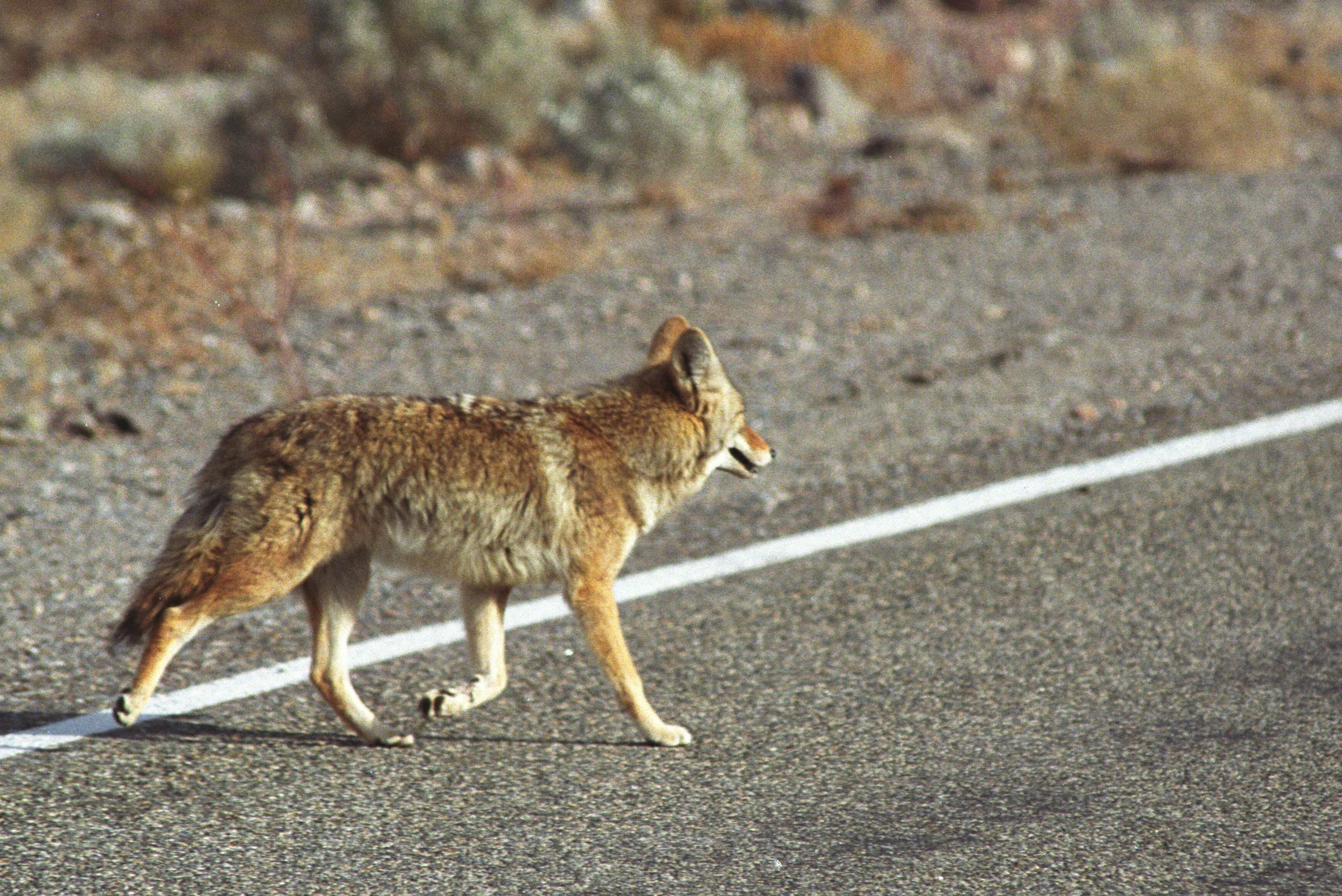
Coyote in Death Valley

Coyote in Death Valley, Dec 1992

And so to “The scavengers”. It is a short essay describing, unsentimentally, the buzzards, vultures, ravens (or “carrion crow”), coyotes and Clark’s crows (or “camp robber”) which survive on the death of others. The essay opens on a vivid image:

Fifty-seven buzzards, one on each of fifty-seven posts at the rancho El Tejon, on a mirage-breeding September morning, sat solemnly while the white tilted travelers’ vans lumbered down the Canada de los Uvas. After three hours they had only clapped their wings, or exchanged posts.

She was, clearly, a careful observer. A major theme of the essay is nature’s balance which, in this case, means that when there is drought some creatures die and others (the scavengers) thrive. She graphically describes the slow death by starvation of the cattle with the buzzards waiting patiently for the end (because they will not feed until the last breath is drawn):

Cattle once down may be days in dying … It is doubtless the economy of nature to have the scavengers by to clean up the carrion, but a wolf at the throat would be a shorter agony than the long stalking and sometime perchings of these loathsome watchers.

She goes on to describe vultures, comparing their qualities with those of the buzzards, and then moves on to the other previously mentioned scavengers. She sees the raven as the “least objectionable” of them, partly because “he is nice in his habits and is said to have likable traits”. I particularly enjoyed her observation on “the interdependence of wild creatures, and their cognizance of the affairs of their own kind”. She suggests we may never fully credit this, and she’s probably right, though she’d probably also be astonished by how far science has come in the last century in terms of ecological knowledge. Anyhow, I liked the following description of animal behaviour as coyotes bring down an antelope:

… Rabbits sat up in the chaparral and cocked their ears, feeling themselves quite safe for the once as the hunt swung near them. Nothing happens in the deep wood that the blue jays are not all agog to tell …

She wonders how much of this knowledge of each other is learnt by experience and how much is taught by their “elders”. Austin surely would have loved David Attenborough – or even been him (if you know what I mean!) – had she been born a few decades later.

As I said, a main theme is the balance (or economy, as she calls it) of nature but she concludes on another idea, and that is the role of mankind. Nature, she says, cannot account for the works of man:

There is no scavenger that eats tin cans, and no wild thing leaves a like disfigurement on the forest floor.

Mary Austin
“The scavengers”
Available online at Library of America
Originally published in The land of little rain, 1903

Willa Cather, When I knew Stephen Crane

American author Stephen Crane in 1899

Stephen Crane, 1899 (Photographer unknown; Presumed public domain, via Wikipedia)

I haven’t reviewed a Library of America offering for a while and so have decided it’s time I dipped again into its offerings. Willa Cather‘s essay/journalistic piece “When I knew Stephen Crane”, which they published last month, appealed to me because of a couple of synchronicities. One is that Lisa of ANZLitLovers reviewed Crane’s The red badge of courage a few days ago, reminding me that I have yet to read Crane. The other is a little more obscure. Colleen of Bookphilia wrote a post earlier this week in which she complained about Anthony Trollope‘s admission that he would, in order to meet a deadline, submit work that he believed was not very good. The synchronicity is that in her essay Cather writes that Crane

gave me to understand that he led a double literary life; writing in the first place the matter that pleased himself, and doing it very well; in the second place, any sort of stuff that would sell. And he remarked that his poor was just as bad as it could possibly be …

Not having read Crane, I don’t know whether he really did present poor stuff, but Colleen, I suspect, would not be impressed with this admission!

“When I knew Stephen Crane” was first published in 1900, two weeks after Crane’s death. It documents 21-year-old Cather’s meeting with 23-year-old Crane in 1895 at the offices of the Nebraska State Journal not long after the journal had published The red badge of courage. The introductory notes state that she changed some facts and suggests she did this “to foretell his tragic fate and to reflect [her] own interest in writing and literature”. I can believe this may be the case as the article is peppered with foreshadowings of his early death. Nonetheless, the notes argue that her report “sounds authentic”.

Certainly, she doesn’t try to present him in a heroic light. She describes him as “thin to emaciation, his face was gaunt and unshaven … His grey clothes were much the worse for wear … He wore a flannel shirt and a slovenly apology for a necktie.” He had, in other words, “a disreputable appearance”. She writes that she had read and helped edit, for the journal, The red badge of courage:

… the grammatical construction of the story was so faulty that the managing editor had several times called on me to edit the copy. In this way I had read it very carefully, and through the careless sentence structure I saw the wonder of that remarkable performance.

She writes eloquently of her moment of revelation from Crane, saying that

The soul has no message for the friends with whom we dine every week. It is silenced by custom and convention … It selects its listeners wilfully, and seemingly delights to waste its best upon the chance wayfarer who meets us in the highway at a fated hour.

Hmm … I think there’s a lot of truth in this, at least in my experience as a giver and receiver of such “messages”. Anyhow, Cather, on a night when “the white, western moonlight threw sharp, blue shadows below us”, felt lucky to have had such a moment with Crane, one in which he talks about his craft, “his slow method of composition”. He tells her that while The red badge of courage had been written in 9 days, he had been unconsciously working on it throughout his boyhood. He also tells her that it would be months after he got an idea for a story before he’d feel able to write it:

‘The detail of a thing has to filter through my blood, and then it comes out like a native product, but it takes forever’, he remarked.

Cather also briefly refutes the criticism by some that Crane is “the reporter in fiction”, arguing that his newspaper account of a shipwreck he’d experienced was “lifeless” but his “literary product” (“The open boat”) was “unsurpassed in its vividness and constructive perfection”.

She concludes the article on a somewhat sentimental note which is not surprising given its publication so soon after his death … but even this sentimentality is expressed in the robust language that we know Cather for:

He drank life to the lees, but at the banquet table where other men took their ease and jested over their wine, he stood a dark and silent figure, sombre as Poe himself, not wishing to be understood …

It is for Cather’s own writing and her insights into character, as much as for what I learnt about Crane, that I enjoyed reading this offering from LOA. I will still, however, read Crane one day.

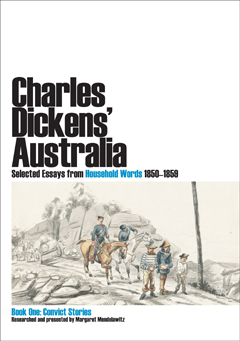
Margaret Mendelawitz, Charles Dickens’ Australia. Book 1, Convict stories

Charles Dickens' Australia, Book 1

Book cover (Courtesy: Sydney University Press)

So true may fiction be in the hands of a genius
(from “Convict in the gold region”, by Richard Horne)

Richard Horne, in his article “Convicts from the gold region”, describes a scene from Don Quixote in which Quixote meets and sets free some convicts by driving away their guards, only to have his generosity (which included delivering them “a noble speech”) met by ridicule and “a volley of stones”. Horne suggests that the convicts he met would do “the same thing to any eccentric philanthropist in a broad-brimmed hat who should set them free and make them an address on liberty and humanity”. An interesting analogy to draw and one, I might add, that he doesn’t test, but I did like the way he used it to see the truth in fiction!

Anyhow, I have now read Book 1 in this fascinating set of books from the Sydney University Press, and it pretty well does what Mendelawitz says in her introduction. That is, it provides a first-hand, informative and entertaining insight into mid-19th century Australia – in this case, relating to the role of convicts in that society. The focus is on social conditions and social justice but there’s no heavy-handed proselytising. Dickens’ aim was to create a magazine that would be “cheerful, useful and always welcome” but that would also “assist the reader’s judgement in his observation of men”. Badness and wrongdoing aren’t glossed over but, wherever possible, mitigating circumstances are also provided.

There are 15 articles in the book, written by 9 different authors, some in collaboration. The last 6 are written by Australian-born barrister, journalist, novelist John Lang and are short case studies of individual convicts, including those who were unjustly (or, at least, unfairly) transported, those who deserved what they got but made good, and those who couldn’t give up their criminal ways. Representing this last group are the convicts described in “Three celebrities”. Fox, Pitt and Burke were three thieves who were “transported under the names of the three most celebrated orators of their time”. For whatever reason, they did not knuckle down to honest work in the colony, but instead escaped and operated as bushrangers. Even in their story, though, a positive is given: by the time they were captured they had set up a well-stocked farm with an abode that “was in the neatest order” and land that “was very well-tilled”. At the opposite end of the spectrum is the rather melodramatic tale of star-crossed love and a stolen horse resulting in the transportation of young “Kate Crawford”. Noticed by Mrs Macquarie, the wife of Governor Macquarie, and placed in the home of the chief constable in Parramatta, she was pardoned within three years and (eventually) died a very wealthy woman. These 6 stories are told with a light touch and in a conversational tone as tales relayed by a woman who knew the convicts in question.

A few of the articles are set in – or tell of – the Norfolk Island penal colony, a colony I have written about before in reviews of Jessica Anderson‘s The commandant and Price Warung‘s Tales of the early days. Both of those were written after the events and people they describe, and it is reassuring to our search for the “truth” that the articles here basically confirm the worst and best of the colony as conveyed by Anderson and Warung in their fictional pieces.

The centrepiece of this volume though is the story of William Henry Barber, who was transported to Norfolk Island in 1844. The story, told over two articles “Transported for life [Part One]” and “[Part Two]”, chronicles his imprisonment, trial and conviction for a crime he claims he did not commit,  his transportation to Norfolk Island (including details of the long boat journey) and subsequent removal  to Van Dieman’s Land from where he was, in 1847, released. Not long after, he received a free pardon with acknowledgement of his innocence. The articles are told first person but in fact were written by journalist and novelist William Moy Thomas. The Notes on Contributors suggest that the articles were based on the account Barber wrote in 1853 of his experiences, an account which is known to have been in Dickens’ library. The aim, as stated at the beginning of the first part, was to show “what transportation, at the present time, really is”.

In my overview of this set I wondered whether Dickens’ tight control over style would result in the articles being somewhat formulaic but I’m pleased to say that they aren’t. While the tone is overall more light than heavy and the content informative with a light persuasive edge, the style does vary. Some are factual chronicles of a life or situation while others have a more literary bent, some use dialog while others comprise descriptive prose, some are a little more obviously didactic while others simply present the situation for the reader to draw conclusions. The message, though, is always there, whether stated or not, and it is essentially this:

It is no miracle that has been here performed; men bred to crime in England by the ignorance and filth we cherish, are bred out of crime again in Norfolk Island, by a little teaching and a little human care. (from “Norfolk Island”, by Irwin and Henry Morley).

I must add, in the services of “truth”, that Norfolk Island had a mixed history regarding treatment of convicts but there was a short period, under Alexander Maconochie, when rehabilitation was taken seriously.

To conclude I can’t resist a quote from pickpocket Barrington in another of John Lang’s case studies, “An illustrious British exile”:

There was a time when ladies boasted of having been robbed by Barrington. Many whom I never robbed gave it out that I had done so; simply that they might be talked about. Alas! such is the weakness of poor human nature that some people care not by which means they associate their names with the name of celebrity.

And we thought the celebrity culture was new? Once again history tells us otherwise!

Margaret Mendelawitz
Charles Dickens’ Australia: Selected essays from Household Words 1850-1858. Book 1, Convict stories
Sydney: Sydney University Press, 2011
187pp
ISBN: 9781920898670

(Review copy courtesy Sydney University Press)

Margaret Mendelawitz, Charles Dickens’ Australia: Selected essays from Household Words 1850-1859

It was not to be a high-brow intellectual periodical. Above all he wanted to reach and entertain the masses and, at the same time, help shape discussion and debate on the important social questions of the time. (from Introduction, by Margaret Mendelawitz)

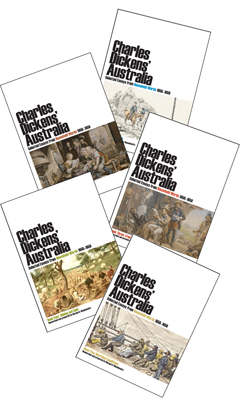
Five covers for the Charles Dickens' Australia set

Set book covers (Courtesy: Sydney University Press)

Charles Dickens‘ Australia is a set of five volumes containing essays, stories and poems relating to Australia from the magazine, Household Words, that Dickens established and editedThe magazine was published from 1850 to 1859 which, as Margaret Mendelawitz says in her introduction, was an “extraordinary decade in Australian and British history”. The discovery of gold in Australia (and California) transformed the world. Social justice was becoming a serious issue for debate and action. And it was when “the age of capital” really began.

So, it is rather fortunate that a writer of Dickens’ calibre produced a magazine in this period – and that he was sufficiently interested in Australia (as I described in a post last year) to actively seek and commission articles about life and social conditions here for his magazine. As you might expect, the magazine is available online (in gorgeous facsimile and for electronic downloading) but the value of these five volumes is that they have been carefully researched by Mendelawitz and contain the articles specifically relating to Australia. According to the Sydney University Press website, of the 3000 articles published in the magazine over its lifetime, only 100 dealt with Australia in some way. Unless you like the fun of the chase, these volumes are an excellent way to get to the Australian content without having to do the searching and sifting yourself.

This isn’t the only reason though for reading the articles via this set. It is a beautifully conceived anthology. Firstly, the articles have been thematically organised into five manageable volumes:

  1. Convict Stories
  2. Immigration
  3. Frontier Stories
  4. Mining and Gold
  5. Maritime Conditions

And there’s more. Each article  starts with a small panel containing a brief description of its content, its publication details (the volume and issue numbers, pagination, and date) and the amount paid for it! The articles are footnoted, with those original to the article clearly identified as such. Curiously, the editorial additions – the introduction, etc – are referenced differently, with the notes placed at the end of each piece rather than in footnotes. The additions are: a foreword by Geoffrey Blainey; an introduction by Mendelawitz; a list of contributors providing a brief, targeted biography and a list of their articles included in the set; and, a short but appropriate bibliography. These are all repeated in each volume, presumably so the volumes can stand alone.

I was initially perturbed that the article authors are not named in the table of contents, but then I read the introduction which tells us that “regardless of their source, all articles appeared anonymously”. Mendelawitz has followed that practice in her table of contents, but has identified the author/s on the articles themselves, providing another reason for reading this set because knowing the authors and their backgrounds adds a further dimension to the reading.

Mendelawitz covers a lot of ground in her introduction. She talks a little about Dickens himself and about the history of Household Words, she describes the era in which it was written, and she discusses the writers, the content and the “house” style. I found these last two particularly interesting. The articles, as I’ve said, were published anonymously. They were also carefully edited to meet what Elizabeth Gaskell called a “Dickensy style”. This meant they had to be bright, regardless of how dry the subject, and would characteristically start with a snappy, provocative paragraph. It also meant that those that did not accord with Dickens’ views were rewritten. I can’t help thinking that, if slavishly enforced, this adherence to a set style could result in the articles feeling formulaic. It’s something I’ll check out as I read the volumes in depth.

The final point I’d like to make in this overview concerns the issue of fact versus fiction. Mendelawitz argues that the articles are “literature, not history”. They are valuable, she says, for the insight they provide into 19th century Australia but this “does not depend on them being the literal truth”. She writes:

As a collection they demonstrate the complementary nature of storytelling between the writing of history and fiction. The stories in Household Words frequently draw a fine line between fact and fiction, giving voice to characters and events that could easily go unrecognised and unrecorded. In many ways they exemplify the fundamental problem  encountered by historians through the ages of how to separate and present fact, fiction, myth and truth.

Regular readers of this blog know that this issue interests me. I expect to come back to it when I review the first volume in the near future … from what I’ve read so far, I think I’m in for a fascinating ride.

Margaret Mendelawitz
Charles Dickens’ Australia: Selected essays from Household Words 1850-1858
5 volumes
Sydney: Sydney University Press, 2011

(Review copies courtesy Sydney University Press)

Mary Church Terrell, What it means to be colored in the capital of the United States

Mary Church Terrell

Mary Church Terrell (Public Domain from the National Park Service, via Wikipedia)

I heard a radio interview this week with Jane Elliott of the brown-eye-blue-eye experiment fame, and she suggested that racism is still an issue  in the USA (through the efforts of a vocal minority) and is best demonstrated by the determination in certain quarters that Barack Obama will not win a second term*. It’s therefore apposite (perhaps) that my first Library of America post this year be on last week’s offering, “What it means to be colored in the capital of the United States” by Mary Church Terrell (1863-1954). This essay originated, according to LOA’s introductory notes, in a talk Terrell gave at a Washington women’s club in 1906. It was then published anonymously, LOA says, in The Independent, in 1907.

Now, I’d never heard of Terrell, but she sounds like one amazing woman. Not only did she live an impressive-for-the-times long life, but she had significant achievements, including being, it is believed, the first black woman to be appointed to a Board of Education (in 1895). She also helped found the National Association of Colored Women. On a slightly different tack, she was a long-time friend of H.G. Wells. Interesting woman, eh?

I have a few reasons for being interested in this essay, besides Jane Elliott’s comment. I lived in the DC area – in Northern Virginia – for two years in the early-mid 1980s and was surprised by some of my own experiences regarding race there. And, as a teen in the 1960s and early 1970s, I was aware of and fascinated by the Civil Rights movement in the USA. I was surprised but thrilled to hear, late last year, an audio version of John Howard Griffin‘s book, Black like me, that I read and loved back in those days.

But enough background. To the essay… I’ll start by saying that I’m not surprised that it began as a talk, because it seemed to ramble a bit. However, as I read on, some structure did start to appear. She starts by listing the various areas in which she, as a black woman, was (or would have been if she’d tried) discriminated against in the national capital. These include finding a boarding house and a place to eat, being able to use public transport, finding non-menial employment, being able to attend the theatre or a white church, and gaining an education. She introduces her section on transport as follows:

As a colored woman I cannot visit the tomb of the Father of this country, which owns its very existence to the love of freedom in the human heart and which stands for equal opportunity for all, without being forced to sit in the Jim Crow section of an electric car …

The irony here is not subtle – but she’s in the business of education where subtlety would not get her far!

She then returns to many of these issues – and this is where I started to wonder about her structure – but what she does is move from introducing the issues by using herself as an example to exploring each one using real examples of people she knows or has heard of. She describes, for example, how employers might be willing to employ a skilled black person, but are lobbied by other staff and threatened with boycotts by clients and so take the easy path of firing (or not hiring) the black person in favour of a white person. In one case the employer is  a Jew,

… and I felt that it was particularly cruel, unnatural and cold-blooded for the representative of one oppressed and persecuted race to deal so harshly and unjustly with a member of another.

You can guess why, in 1907, this was published anonymously!

Anyhow, I won’t repeat all the examples she provides to demonstrate the extent of prejudice at play, because you can read the essay yourself. I will simply end with her conclusion:

… surely nowhere in the world do oppression and persecution based solely on the color of the skin appear more hateful and hideous than in the capital of the United States, because the chasm between the principles upon which this Government was founded, in which it still professes to believe, and those which are daily practiced under the protection of the flag, yawns so wide and deep.

Some 100 or so years later, the US sees itself as the leader of the free world and yet it seems that this chasm is still rather wide. What are the chances that it will completely close one day?

* Please note that this is not a holier-than-thou post. We Aussies have our own problems with racism and prejudice, and so I am not about to throw stones at anyone else.