Melissa Lucashenko, How green is my valley (Review)

Almost a year ago I reviewed a short story, “The silent majority”, by Melissa Lucashenko. It was published in the Griffith Review of November 2009. I enjoyed the story and so, in honour of NAIDOC Week and ANZLitLovers Indigenous Literature Week, I thought I’d review another of her Griffith Review contributions. This one, “How green is my valley”, is described as a memoir, and was published in Winter 2006.

I love how Lucashenko, with her dual Aboriginal and European heritage, traverses both in her writing. She commences “The silent majority” with the famous opening words of Pride and prejudice – “”It is a truth universally acknowledged”. The title of this piece immediately brings to mind Richard Llewellyn‘s classic novel How green was my valley, and clues us into her themes: beauty under threat, complicated relationships with land, and the precarious balances involved in maintaining it.

Lucashenko starts her memoir – though, really, I’d call it a personal essay – with a Mark Twain quote, which has a prescience now that he could not have guessed:

Everybody talks about the weather/but nobody does anything about it.

She then describes the experience of torrential rain in Bundjalung country, the coastal regions of north-east New South Wales/southeast Queensland. She’s moved, she says, to “one of Australia’s wettest shires”. The first half of the essay describes how residents manage – or don’t – the rain. She talks of students being let off school, of the weather not distinguishing between rich and poor, and of how community is fostered as people with 4WDs deliver food to the stranded who don’t. “The information we receive from land”, she says, “is tightly nuanced”. Farmers watch closely and know how the days will pan out once the rain sets in:

We who live on Bundjalung land know that eventually the rain will stop, the mould will retreat and the mud will dry. Whatever climate change is going to mean for our kids, in the short term life for us will return to normal.

Then, halfway through the essay, comes the sting in the tail: she reminds us that the inhabitants of Tuvalu will lose their home in the next few decades as their island is submerged, and the semi-traditional hunting lifestyle of the Inuit of the Arctic Circle “will be shattered by global warming even sooner”. She wonders whether indigenous people like the Inuit will be able to translate “the clan, the traditions of egalitarianism, stoicism and intensely valued community, to life in suburbs and towns.”

Lucashenko’s thesis is that it can be done, that it is possible to be “bicultural”, to span the chasm “between industrial and indigenous views of the ‘good life’ and what constitutes a proper society”. She argues that the egalitarian ethic espoused by Henry Lawson and Banjo Paterson

the traditions of mateship that faithfully mimic the brotherhood of initiated Aboriginal men and the myriad skills of surviving from and maintaining the land – were learned by some colonial whites from Aboriginal people.

Hmm … I haven’t heard that before. I suspect Australia’s mateship tradition has rather multi-pronged origins but this could certainly be part of it.

Lucashenko’s point though is to draw a parallel between white Australians’ love of land and indigenous people’s. She says that any Australian who has holidayed at the same beach every summer, or “diligently looked after” their own little patch, has “walked in Aboriginal footsteps” whether they know it or not. Hmmm … again I think this is a little bit of a long bow, in the sense that there are people all over the world who love their bit of land. But it doesn’t spoil her argument that it would have been good had the influence of Aboriginal knowledge and practice been greater, because then

More Australians might have learned not just to love the place (as some indisputably do) but to listen to the land more seriously. Had more Aboriginal philosophers been valued rather than shot or packed off to missions, all Australians might have learned the careful and intense attention to detail that many of us in the valley are still forced to practise as a matter of course.

With climate change breathing down our necks, will we all “be rooned”, she asks (alluding to one of my favourite old ballads “Said Hanrahan“). Will our “valley” be destroyed by our inability to tame our capitalistic consumerist urges, or will we learn in time how to be true custodians of our land?

Melissa Lucashenko
“How green is my valley”
Published in the Griffith Review, Edition 12, Winter 2006
Available: Online at the Griffith Review
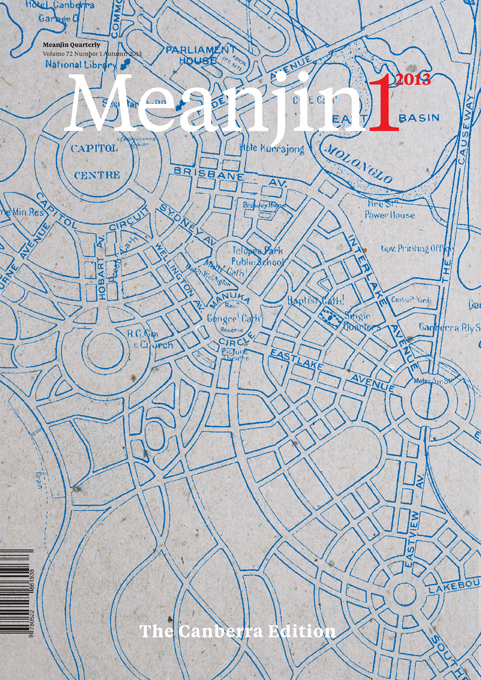
Christos Tsiolkas in Meanjin’s The Canberra Issue

Meanjin Canberra Issue 2013

Courtesy: Meanjin

I indicated in my recent review of Meanjin‘s special Canberra issue that I would write another post or two on the issue. This is one of those posts. It may, in fact, be the only one, for who knows where the spirit will lead me next? Right now though, I want to devote a post to the second last piece in the volume, “Me and my country, Where to Now?”. It’s a conversation between writer Heather Taylor Johnson and Christos Tsiolkas whose novel The slap was one of the first I reviewed in this blog. While the novel was well received critically – won awards and was short/longlisted for others – it was not universally liked. The Wikipedia article on the novel quotes Commonwealth Writer’s Prize judge, Nicholas Hasluck, describing it as “a controversial and daring novel”. It was that …

Before I continue, I should say that this piece has a fairly tenuous link to Canberra – Tsiolkas lived here for a short time in the 1990s I understand – but its inclusion is justified, I think, for the relevance of the ideas it covers. I don’t plan to summarise the whole conversation, interesting though it is, but pick out a couple of points that got my attention – and they mostly relate to The slap.

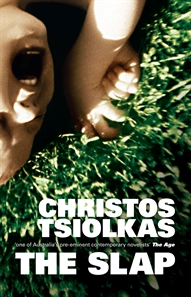
Courtesy: Allen & Unwin

Courtesy: Allen & Unwin

Johnson commences by asking Tsiolkas about the mini-series adaptation of The slap. While recognising that the mini-series was not his work, but the work of those who had “translated and transformed” it for another medium, Tsiolkas talks of his overall intention:

I felt a certain responsibility with the screening of the series, a hope that whatever criticism people had of it, that it would be understood as an authentic voice of contemporary, multicultural urban Australia. I share the frustration of so many people of immigrant heritage in this country who have rarely seen their lives portrayed with any complexity or realism on the Australian screen. I also know that there would be people of that experience who either don’t read fiction or can’t read fiction in English and for whom the moving-image media are the only source for story and representation. I wanted people to be angry, frustrated, enraged by The slap, but I also wanted their arguments with it to be based on an appreciation that the representations were neither patronising nor sentimental. My own view is that the series succeeded in doing that.

Although focused on the miniseries, this statement is also, I think, a manifesto for the novel. It’s a warts-and-all story of people, most of whom happen to be immigrants or minorities in some way, getting on with their often flawed lives.

One of the themes that came through to me in the novel was that of violence. I felt Tsiolkas was saying that violence lies just beneath the surface of many human relationships. Later in the conversation he talks about the principles and philosophies, the “politics”, that drive him – feminism, racial civil rights, sexual liberation, post-colonial and communist. A complicated and, as he admits, sometimes contradictory bunch of ideas. He says:

I think that one of the drives I have in my writing is to express the complexity and violence of this tension. It means that though gender and sexuality are among the themes and ideas I explore in all my work, I can’t give myself over to a liberationist idea that the transformation of the individual can resolve these tensions and contradictions.

Hmm … this is pretty complex thinking methinks and I’m not sure I was able to articulate his ideas at this deeper philosophical level, but I sensed something going on and this helps explain it (to me, anyhow). He continues to say that he believes that “sexuality and the body constantly undermine our attempts at mastery and transformation”. This brought to mind the terrible recent rape cases in India and some angry discussions I’ve just read on Facebook about the current court case concerning the gang rape of the 16-year-old girl in the USA. We are not making much progress.

There is so much in this conversation that I’d love to talk about, such as his comment that much “Anglophone and European contemporary literature is moribund”. He argues that the most electric writing is coming from outside the Anglo-European centre. That must, I suppose, pose a challenge to him given his background. But, I’ll move on.

Johnson asks him about controversy, particularly in relation to The slap. Again his response is complex, but his main point is that “I want to pose questions that are unsettling or troubling”. One of the things that bothered me about the conversations surrounding The slap was that people focused on “the slap” itself  – as in do you or don’t you hit a child, particularly one not your own – and not on the social, cultural and, yes, political issues inherent in the relationships involved. The fact that “the slap” plot is resolved way before the end of the novel tells us that this issue of hitting a child is not Tsiolkas’ main point. In fact, he says in this conversation with Johnson that “the language of moral absolutes … may be having a pernicious effect on much of contemporary writing”. And then he says:

I have given up reading blogs because so many people are dismissing work because they ‘don’t like the characters’ or because the resolution of a book is not neat, is not easy. We are reading for confirmation of ourselves rather than to challenge ourselves and I think that is a real danger.

He has more to say on issues that interest me – including Aboriginal dispossession and public education – but I think I’ll finish here, because I need to think …

in Meanjin 1, 2013, The Canberra Issue
University of Melbourne
pp. 178-188
ISBN: 9780522861938

(Review copy supplied by Meanjin)

Thea Astley, The monstrous accent on youth (Review)

I was going to start this post with that well-known quote by Sophocles – or was it Plato – complaining about the young people of today, but a little bit of research turned up the fact that that quote is somewhat spurious. It was probably inspired by Plato’s Republic in which he presents a dialogue with Sophocles about the ideal education, advocating a “stricter system” to ensure young people “grow up into well-conducted and virtuous citizens”. It was not a tirade on “the youth of today”. That permutation was the work of variously identified twentieth century writers/speakers.

So, instead, I’ll dive straight into Thea Astley‘s essay, “The monstrous accent on youth”. It was written in 1968 and reproduced in last year’s Meanjin anthology which contains a selection of essays organised by decade, starting with the 1940s. I plan to dip into the anthology over the year as there are essays by writers like Patrick White and David Malouf, poems by Judith Wright, and so on. A treasure for dipping into.

I was, I suppose, surprised by the Thea Astley essay, though in retrospect I probably shouldn’t have been. She was never one to go lightly and she sure doesn’t here in criticising the youth of the 1960s. She talks of discussing moral dilemmas in a “middle-class girls’ high school” and being horrified by her students’ callous responses to her questions about conscription during the Vietnam War:

Girls, like female spiders, want to have their men and eat them, too. I was appalled by the selfishness of their reactions and wondered if this were merely a by-product of thinking in a Liberal Party voting area.

She suggests that the generation of the 1960s were frank and (by implication “progressive”) about sex and drugs but had a “hard conservative core”. She then talks of discussions at Macquarie University and says attitudes were more liberal there, “particularly noticeable in the nuns”. (I went to Macquarie University in the 1970s and had many nuns and seminarians in my tutorials. She’s right. They were usually thoughtful tutorial participants.) But, she’s discouraged by the narrowness of the reading. Her students hadn’t read, she said, “Compton Burnett, Cheever, Edmund Wilson, Nabokov, Gordimer …”. Hmm, must say that, with the exception of Nabokov, I hadn’t read those writers then either – in fact, I didn’t even hear of Gordimer until the 1980s – and yet I called myself a reader.

She ponders the reading issue, wondering if that generation spent more time drinking than reading, and worries that “their livers are in more danger than their morals”! I found this fascinating given the current concerns about drinking and the young …

Anyhow, I started to be concerned that the essay was simply going to be a rant against the young and, while it is that to a degree, her main concern is more to do with social change, I think. She writes:

The permissiveness of our generation to the younger has created the monstrous over-rated importance of youth. Oldies – pregnant, sick, reeling – can tremble vertical upon trains and buses while thick-thighed youngsters cling to their seats.

“Thick-thighed”. That sounds like Astley. But, back to the argument. Here in this paragraph near the end of the essay is her main point: “life is so easy for the young and, because of this, so difficult”. She is, in other words, not completely critical of the young. She sees their behaviour in a wider social context, as something that’s partly of her generation’s own making. Perhaps she would have approved of Plato’s “stricter system”?

Thea Astley
“The monstrous accent on youth” (1968)
in Meanjin Anthology
Melbourne University, 2012
(Kindle ed.)

David Foster Wallace, Twenty-four word notes (Review)

David Foster Wallace got me in with the first few words of his essay “Twenty-four word notes”. They are:

Utilize A noxious puff word.

Oh yes! “Utilise” (as we down under spell it) is one of my pet peeves. Why use “utilise” when “use” is a perfectly good word? I regularly mutter.  Wallace is a little more direct:

Since it does nothing that good old use doesn’t do, its extra letters and syllables don’t make a writer seem smarter; rather, using utilize makes you seem either like a pompous twit or like someone so insecure that she’ll use pointlessly big words in an attempt to look sophisticated.

I wouldn’t quite have put it that way myself, but have quoted him so you can see the strength of Wallace’s feelings on the matter of words and usage. (By the way, did you notice the use of “she” here?)

Before I continue, though, I should say that I’m not sure that I’d call “Twenty-four word notes” an essay since it is exactly what it says it is, that is, it’s a set of musings and arguments about twenty-four rather ad hoc words. They do not seem to be presented in any particular order and there’s not really a coherent argument, but for those of us interested in language they are great fun to read … even if he touches the odd nerve or you don’t agree with his perspective. I was interested to discover in the Copyright Acknowledgements at the end of the book that this essay/article was originally published in the Oxford American Writer’s Thesaurus (in 2004, 2008 and 2012).

I enjoyed the piece for a number of reasons. Firstly, there are the pet peeves, of which “utilize” is just one. Another is “that”. There are two issues, as he says, with “that”. One is the “that” versus “which” issue, but I won’t go into that (ha) now. It’s the other “that” issue which (or, is it that!) intrigues me. You see, I had been given to understand by some Americans, that “that” can be used for people as in, say, “Wallace is the writer that wrote Infinite Jest“. Over here, down under, we learnt that “who” and “whom” are for people, and “that” and “which” are for things. Wallace agrees and in fact calls misuse of “that” for “who” or “whom” as a class marker! Hmm … that’s a bit strong … but, class marker or not, I know that I always cringe (internally anyhow) when I hear “that” used for people.

My other pet peeve that Wallace addresses is, hallelujah, “loan”. Wallace says, and I quote, because once again I’d only be muttering under my breath:

If you use loan as a verb in anything other than ultra-informal speech, you’re marking yourself as ignorant or careless.

But now here’s the thing. I have felt for a decade or more now that this loan-the-noun/lend-the-verb distinction is a losing battle. Language is, after all, a living thing. It changes. It has to, and, really, we want it to. This makes writing anything prescriptive like Wallace has done here a risky thing. Wallace doesn’t specifically address this issue of change but he does imply it. For example, immediately after the above statement about “loan”, he continues

As of 2004, the verb to lend never comes off as fussy or pretentious, merely as correct.

“As of 2004”. There’s his recognition, subtle though it is, that there are limits to prescription. I’m glad he makes that concession.

While there are other words about which he is similarly scathing regarding their misuse, not all words have been chosen for this reason. For example, there’s the word “pulchritude”* which he describes as an ugly word that is the complete opposite of its meaning. “Pulchritudinous” is even worse he says! I have to agree. He then goes on in this particular word note to list other words that are the opposite of what they denote, such as “big”, “diminutive” and “monosyllabic”. It is this sort of thing that makes language such fun, isn’t it?

Another word he discusses is one of my daughter’s favourites, “myriad”. I was anxious about reading this one for fear that he would be scathing about it too, but fortunately not. Rather he writes of the right and wrong ways to use it … and I’m pretty confident my word-loving, writing daughter gets it right.

Almost every word he discusses provided me with some entertainment or education – yes, I did learn “stuff” too – but I’m going to finish here on the last word he writes about. It’s “hairy” and his discussion of it is relevant to the book the article was written for – a thesaurus. This note – which in fact occupies some three pages – is about the huge number of descriptors for “various kinds of hair and hairiness” in the English language. I had heard of a few of them – such as “hirsute”, “glabrous” and “flocculent” – but others were a revelation. For example, the “cirrus” we use for clouds comes from the Latin for “curl” or “fringe” and gives rise to words like “cirrose”. And what about “hispidulous”? He describes this as a “puffed up form of hispid” and recommends avoiding it. I think I will. Then there’s “pilimiction”, which refers to an affliction we’d all like to avoid I reckon …

It is difficult to write on words and usage without being somewhat prescriptive, and Wallace isn’t afraid to be that. It is possible, I think, to write about words and usage without offending your readers, but this is not an example of that! Nonetheless, taken in the right spirit, it’s an interesting read and one which offers some good advice on writing. I enjoyed it.

David Foster Wallace
“Twenty-four word notes”
in Both flesh and not
Melbourne: Hamish Hamilton, 2009
ISBN: 9781926428185

*Wordpress’s spell-checker didn’t like this word either. Can you blame it?

David Foster Wallace, Federer as religious experience (Review)

David Foster Wallace‘s essay “Federer as religious experience” is several years old now. I did plan to read it a couple of years ago when I first came across it but, somehow, I didn’t. However, this week, Lisa at ANZLitLovers reviewed a David Foster Wallace essay collection which includes this essay*. She decided not to read it because tennis “is just running around on a court hitting a ball with a racquet”. I suggested in my comments that there’s some congruence, affinity perhaps, between sports and the arts in that sport is (can be) about drama, beauty and character. She dared me to review the essay on my blog, so here I am! Never let it be said I’m a wuss!

Roger Federer, Master Series Monte Carlo 2007

Roger Federer, Master Series Monte Carlo 2007 (Photo credit: Lijan Zhang, using CC-BY-SA 2.0, Wikipedia)

Unlike Lisa, I have read David Foster Wallace. Hmm, I’m cheating a little when I say this – something Roger Federer, the god of modern tennis, would be above I’m sure – because I’ve only read one short story, “All that”, which I reviewed two years ago. A couple of commenters on that post suggested that Wallace’s essays and magazine articles are a good place to start. I enjoy essays, so liked the sound of that.

Wallace does not specifically discuss the “drama” and “character” aspects of tennis, although drama is implied at times such as in his description of the 2006 Nadal-Federer Wimbledon final as a “revenge-narrative” and he does touch on some players’ personalities. However, I was thrilled to find the following discussion of “beauty” on page 2 of my printed out version:

Beauty is not the goal of competitive sports, but high-level sports are a prime venue for the expression of human beauty. The relation is roughly that of courage to war.

[ …]

Of course, in men’s sports no one ever talks about beauty or grace of the body. Men may profess their “love” of sports, but that love must always be cast and enacted in the symbology of war: elimination vs. advance, hierarchy of rank and standing, obsessive statistics, technical analysis, tribal and/or nationalist fervor, uniforms, mass noise, chest-thumping, face-painting, etc. For reasons that are not well understood, war’s codes are safer for most of us than love’s…

Beauty is not, really, the goal of literature either, but those of us who love reading love it best when the writing is “beautiful”. That beauty can take many forms, but we all know it when we see it – not, of course, that we all agree, but that’s partly the fun and challenge of it all. I’d say that Wallace’s writing in this essay is beautiful. It’s there in the way his language slides between the formal, the journalistic and the colloquial; in the way he slips in appropriate classical, literary and pop culture allusions expecting us to get them all even though he’s writing about something as pedestrian (!) as sport. It’s there in the touches of satire, the slices of tongue-in-cheek wit, and the sly digs at some of the hallowed aspects of the sport. (“Wimbledon is strange”, he writes. “Verily it is the game’s Mecca, the cathedral of tennis; but it would be easier to sustain the appropriate level of on-site veneration if the tournament weren’t so intent on reminding you over and over that it’s the cathedral of tennis”.) And it’s also there in the essay’s very structure and its shifts in tone. Despite all this beauty, though, I did get a little lost in the blow-by-blow description of an actual point played between Roger Federer and the hunky Rafael Nadal. Wallace is clearly a connoisseur of tennis.

Robert Atwan, the man behind Best American essays, defines the best essays:

To my mind, the best essays are deeply personal (that doesn’t necessarily mean autobiographical) and deeply engaged with issues and ideas. And the best essays show that the name of the genre is also a verb, so they demonstrate a mind in process–reflecting, trying-out, essaying.

Wallace’s essay embodies all of these. Wallace clearly loves the sport and knows his stuff. Not only can he identify all the tennis strokes, from cross-court backhands to forehands with topspins, but he knows the history of the game and has his own views on who was the progenitor of the power-baseline game. I particularly enjoyed his analysis of the game’s trajectory in the modern era and his assessment of Federer’s impact on it. There is also a sense, as Atwan likes, of his working out as he goes along what makes Federer Federer.

I would, though, add to Atwan’s definition, that the best essays have to be interesting (durr) and, I think, they need to surprise the reader with some new angles or fresh ways of seeing. Wallace does this too. He doesn’t knock Federer-worship – in fact he’s a worshipper himself – but he explores Federer from what he calls metaphysical and technical points of view. And he entertains us while doing so. That to me is a good essay.

David Foster Wallace
“Federer as religious experience”
Published in The New York Times’ Play Magazine, August 20, 2006
Available: Online nytimes.com

* The essay is apparently retitled “Federer Both Flesh and Not” in this collection.

Tim Flannery, After the future: Australia’s extinction crisis (Review)

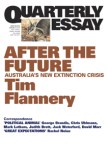
Quarterly Essay No 48 Cover

Quarterly Essay 48 cover (Courtesy Black Inc)

Tim Flannery is an Australian palaeontologist-cum-environmentalist who has been on the public stage for a couple of decades now. He has published several books on environmental issues, some best-sellers, including The future eaters and The weather makers. He was Australian of the Year in 2007, has starred in three television documentary series with comedian John Doyle, and is currently Chief Commissioner of Australia‘s Climate Commission.  With the environment being his passion, he is used to controversy, but many of us regard him as a national treasure. There, I’ve shown my hand!

Needless to say, I enjoyed his current Quarterly Essay titled After the future: Australia’s new extinction crisis. In it he analyses the causes of the second wave of extinctions, and suggests solutions.

The essay is divided into 8 short sections. Near the end of the second section, Flannery writes

I hope the message is loud and clear. Australian politics, and the bureaucracy that supports it, is failing in one of its most fundamental obligations to future generations, the conservation of our natural heritage.

It’s scary stuff. On the preceding page he discusses public ignorance, arguing that most people are unaware that a new wave of extinction is happening, and that those who are aware “commonly believe that our national parks and reserves are safe places for threatened species”. I fall into this latter camp, I’m afraid. I knew it wasn’t all hunky-dory but I had assumed that the parks and reserves were working. Apparently not. The reasons are complex. Funding is of course one aspect and underpins some of the issues he raises, such as the lack of resources and support for effective planning and management, and a decrease in scientifically trained staff able to research and monitor the situation.

However, Flannery argues there are more systemic issues, mostly relating to “politics”. One is the increasingly risk-averse behaviour of governments, resulting in their being prepared to do nothing rather than risk failure. Another is the fact that the environment is no longer the bipartisan issue it once was, with the right increasingly seeing the environment as a left issue. The conservatives are, paradoxically, losing interest in conservation! Environmental stewardship, Flannery argues, once inspired leaders of the right, like Theodore Roosevelt and Ronald Reagan in the USA, and Malcolm Fraser in Australia. It was Malcolm Fraser “who first used federal powers to prevent sand mining on Fraser Island, who proclaimed Kakadu a national park, and who ended whaling in Australia”. However, the rise of green parties (here and in other first world nations) is alienating the right, and yet are not always friendly to conservation. “Animal rights issues, such as opposition to the culling of feral species”, for example, “can sometimes get in the way of environmental stewardship”. The result of environmental issues being seen through the lens of party politics and ideology is that the effort to discredit conservation has resulted in the rejection of science as “a guide to action”. This, says Flannery, is dangerous territory.

While Flannery spends around a third of the essay setting out the problem and discussing the causes, his main thesis is that the current focus of environmental programs on preserving ecosystems is not working – and he presents some convincing arguments for changing the focus to saving individual species. He describes programs in the Kimberleys which are managed by the Australian Wildlife Conservancy (with which he is connected) in partnership with indigenous groups, using their fire management techniques. But his most impressive example is a privately managed program in Papua New Guinea, the Tenkile Conservation Alliance, focused on saving a tree kangaroo. He argues that it “is a prime example of saving an ecosystem by concentrating on saving a species”, and asks:

How is it that one Australian couple has almost single-handedly transformed the fortunes of a people and the biodiversity of a mountain range while trying to save  an endangered species of tree kangaroo? The answer is simple: the Thomases [zoologists] set clear goals, used scientific methods to monitor their progress, and reported back to the people.

I’m not sure I’d call that simple. Or, perhaps I’d say the process is simple, but deciding on environmental priorities and finding the right mix of people/organisations to manage it is not so simple. Flannery’s solution is there needs to be:

  • a legislative commitment to zero tolerance on further extinctions;
  • the establishment of a Biodiversity Authority [yes, I know, another bureaucratic body] that is independent of government, that has “unequivocal targets”, and which faces strong consequences [what, I wonder?] on failure to deliver; and
  • the acceptance and formal involvement of non-profit organisations in managing biodiversity programs.

The Conversation, an Australian academic and research sector blog, is currently running a weekly series on endangered species. A commenter on last week’s post suggested outsourcing the listing of endangered species to peak groups, pretty much mirroring Flannery’s argument regarding partnerships between the government and non-government sectors.

Overall, the essay is clearly argued, but occasionally Flannery makes a statement that jars. One is his statement that “even under Labor governments with a strong green bent, national parks are not always safe” which he supports using the example of the Bligh Government’s starting the process of de-gazetting a part of the Mungkan Kaanju National Park with a view to returning it to its traditional Aboriginal owners. He doesn’t elaborate on this. I wrote in the margin, “Is this wrong”? Not surprisingly, at least one indigenous leader, Marcia Langton, took offence. I suspect it was a case of Flannery finding a poor example to support his argument regarding national parks being threatened even by supposedly sympathetic governments, but I don’t know.

Despite odd moments like this, I did find his argument convincing. However, as I’m sure he’d say himself, it’s not a guaranteed solution. Early in the essay he makes a point of discussing scientific method, arguing that “science is not a search for the truth” but about “disproving hypothesis”.  The hypothesis he proposes here is surely worth testing given the failure of current methods. It begs his early questions, though, regarding political and social will, which may in fact be the critical variables that we need to resolve.

Tim Flannery
“After the future: Australia’s new extinction crisis”
in Quarterly Essay, No. 48
Collingwood: Black Inc, November 2012
107pp.
ISBN: 9781863955829

(Review copy supplied by Black Inc.)

William Gilpin and travel photography

Yes, I know that William Gilpin, about whom I wrote in my last post, died before photography, though only just. He died in 1804 and, according to Wikipedia, the first permanent photograph produced by a camera was made in 1826. However, the notion of cameras – through the camera obscura – was already well known. This, however, is not really the subject of today’s post. The subject is the third essay in his Three essays, which is titled “On the art of sketching landscape”.

The thing is that this essay reminded me of travel photography because his main focus is “taking views from nature” the intention of which, he says

may either be to fix them in your own memory – or to convey, in some degree, your ideas to others.

Aren’t these our two main aims in taking travel photographs? That is, to help us remember our travel and/or to share out experiences with others?

He then goes on to give advice about how to sketch, some of which is specifically about the tools and implements of sketching, but some of which relates more broadly to composing pictures. For example, he writes of getting “the best point of view” for the scene you wish to sketch (or, for us, to photograph), stating that “a few paces to the right, or left, make a great difference”. He’s right there. There are times when I’ve been too lazy, or felt I didn’t have enough time, to walk about looking for the best aspect, only to be sorry later when I’ve seen someone’s better photograph of the same scene.

And he talks about “scale”, that is,

how to reduce it [the scene] properly withing the compass of your paper: for the scale of nature being so very different from your scale … If the landscape before you is extensive, take care you do not include too much: it may perhaps be divided more commodiously into two sketches …

Today of course we can take panoramic photos, and we can enlarge (or crop) to our heart’s content when we download our images onto our computers. Still, the better the original photo, the easier later editing is, eh?

His advice then starts to get more interesting, because he goes on to differentiate between making a sketch that “is intended merely to assist our own memory” and one “intended to convey, in some degree, our ideas to others“. These latter sketches, he says, “should be somewhat more adorned”. Now, part of this adornment is simply about the detail. A sketch to remind us of what we have seen may only require “a few rough strokes”, while one that is to convey something to others who have no idea of the place, needs “some composition … a degree of correctness and expression in the out-line – and some effect of light”.

But, he then goes further to suggest that “nature is most defective in composition; and must be a little assisted”. In other words, it is alright “to dispose the foreground as I please”. Yes, fair enough. We do this often, don’t we, in composing or enlarging/cropping photos? But, it is also alright, he says, to take further liberties:

I take up a tree, and plant it there. I pare a knoll, or make an addition to it. I move a piece of paling – a cottage – a wall – or any removable object, which I dislike.

He qualifies this, though, by saying that “liberties … with the truth must be taken with caution”. We should not, he says, introduce “what does not exist” but can make “those simple variations … which time itself is continually making”.

All this made me think of photography, digital in particular, and how easy it is to remove or modify or manipulate an image to make it look better … and made me realise that no matter what tools we have to hand, this is something we have always liked to do. And this is the point that Gilpin is making with his theory of “the picturesque” because, if you remember the definition I gave in my previous post, it is about “that peculiar kind of beauty, which is agreeable in a picture”.

What I take away from all this – ignoring Gilpin’s tendency to pomposity and prescription, for which he was, fairly I think, satirised – is that he is talking about the difference between “reality”, or what is actually there, and an aesthetic “truth” relating to the ideas (and even feelings*) conveyed by the scene. And that makes sense to me.

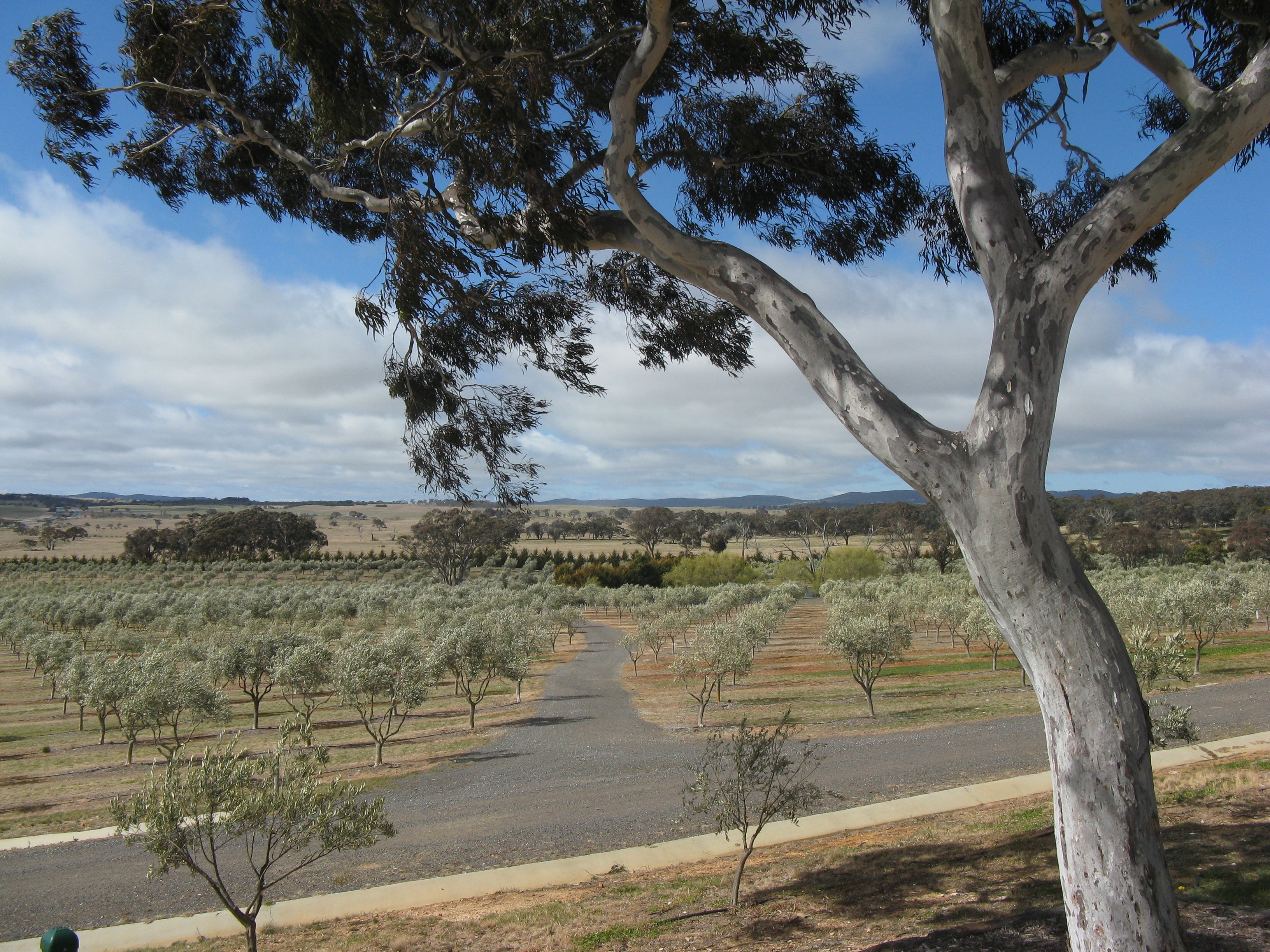
Fedra Olive Grove

Gilpin would not like the rows of olive trees here, but would probably like the irregular somewhat rough tree.

* There is, I believe, much academic debate about whether Romanticism rejected or extended the ideas of the Picturesque. I’m inclined to think it’s not a case of either/or but a more complex development.

William Gilpin, Jane Austen and the picturesque

I was introduced to William Gilpin by Jane Austen. Well, not by her so much as by her brother, Henry, who told us* that she was “enamoured of Gilpin on the Picturesque at a very early age”.

Engraving of Rev. William Gilpin.

William Gilpin (Harper’s New Monthly Magazine, No. 231, August, 1869.Public Domain, via Wikipedia)

This month my local Jane Austen group decided to look a little more deeply at Gilpin, his Picturesque, and what Jane Austen really thought. William Gilpin (1724-1804) was an English vicar, schoolteacher, prolific writer and amateur painter. He is remembered primarily for his theory of “the picturesque”. The “picturesque”, according to my Shorter Oxford English Dictionary, dates back to 1703 with the meaning, “in the manner of a picture; fit to be made into a picture”. In his Essay on Prints (1768), Gilpin defined it as “… a term expressive of that peculiar kind of beauty, which is agreeable in a picture”.

The blogger at Austenonly has written an excellent post on Jane Austen and Gilpin in which she proposes – and my group here agreed with her – that Austen was enamoured of him because he appealed to her sense of the ridiculous. He expresses his opinions so dogmatically, he is so opinionated, that she can’t help mocking him. How could she not satirise a man who seriously suggests (“Essay 1: On Picturesque Beauty”, Three Essays) that, when it comes to a portrait, “the highest form of picturesque beauty” is not “the lovely face of youth smiling with all its sweet dimpling charms” but “the patriarchal head” with its “lines of wisdom and experience … the rough edges of age”. Being a woman of a certain age, I rather like Mr Gilpin! But, seriously, is it really a matter of either/or?

Or someone who writes (in the same essay):

A piece of Palladian architecture may be elegant in the last degree. The proportion of its parts — the propriety of its ornaments — and the symmetry of the whole, may be highly pleasing. But if we introduce it in a picture, it immediately becomes a formal object, and ceases to please. Should we wish to give it picturesque beauty, we must, use the mallet, instead of the chisel : we must beat down one half of it, deface the other, and throw the mutilated members around in heaps. In short, from a smooth building we must turn it into a rough ruin. No painter, who had the choice of the two objects, would hesitate a moment.

We must presume that he is not speaking literally when he suggests taking a mallet to a pleasing building in order to make it picturesque! But Jane Austen is sure to have laughed and, as you’ll read in Austenonly’s post, there are many examples in Austen’s novels, particularly Pride and prejudice, Sense and sensibility and Northanger Abbey, in which she satirises the picturesque.

On the other hand, there are also places where she seems to exhibit an appreciation and understanding of Gilpin’s theory because, while Gilpin could be dogmatic, he also argued convincingly for a seeing nature with “a picturesque eye”. He writes in “Essay 2: On Picturesque Travel” about enjoying “the great works of nature, in her simplest and purest stile, open to inexhaustible springs of amusement”, and says

Nor is there in travelling a greater pleasure, than when a scene of grandeur bursts unexpectedly upon the eye, accompanied with some accidental circumstance of the atmosphere, which harmonises with it, and gives it double value.

I’ll illustrate this with two examples of travellers in Austen. First is her description of Fanny’s return to from Portsmouth in Mansfield Park:

Her eye fell everywhere on lawns and plantations of the freshest green; and the trees, though not fully clothed, were in that delightful state when farther beauty is known to be at hand, and when, while much is actually given to the sight, more yet remains for the imagination.

There is also a lovely, similarly genuine, description of the environs of Lyme in Persuasion in which she writes of a “sweet, retired bay, backed by dark cliffs, where fragments of low rocks among the sands make it the happiest spot for watching the flow of the tide …”

The question that comes to mind then is whether she is satrising the picturesque or slavish adherence to it or, even perhaps, its somewhat slippery nature. In fact, Jane Austen, landscape and the Regency is a pretty inexhaustible topic. And so, while I thoroughly enjoyed my brief introduction to Mr Gilpin, I’d love to find time to read more, particularly his travel writings about various parts of the British Isles. Meanwhile, I can’t resist leaving you with another Gilpin satirist, William Combe (1741-1823), who in 1809, as Dr Syntax, wrote the poem “The Tour of Dr Syntax in Search of the Picturesque”. It starts with

I’ll make a tour – and then I’ll write it.
You well know what my pen can do,
And I’ll employ my pencil too:-
I’ll ride and write, and sketch and print,
And thus create a real mint;
I’ll prose it here, I’ll verse it there,
And picturesque it everywhere.
I’ll do what all have done before;
I think I shall – and somewhat more.
At Doctor Pompous give a look;
He made his fortune by a book:
And if my volume does not beat it,
When I return, I’ll fry and eat it.

What a hoot …

* in his biographical note to the posthumously published first edition of Northanger Abbey and Persuasion

Djuna Barnes, Come into the roof garden, Maud (Review)

English: Djuna Barnes, writer

A stylish Djuna Barnes (Presumed Public Domain, via Wikipedia)

Okay, I’ll admit it, I’ve never heard of Djuna Barnes (1892-1982). However, I was intrigued when I saw her pop up in the Library of America‘s (LOA) Story of the Week program last month, and so decided to investigate. I discovered that, while I didn’t know her, many did, such as, oh, ee cummings, TS Eliot, Carson McCullers, and other contemporary literary luminaries. She even interviewed, apparently, James Joyce. She was a modernist writer, and, according to Wikipedia, a key figure in 1920s-30s Bohemian Paris.

LOA’s notes state that she wrote around 100 articles for various newspapers, and that these articles “straddle the line between fiction and journalism”. That’s certainly how I’d describe “Come into the roof garden, Maud”. I decided to categorise it, according to my minimal blog taxonomy, “Review – Essays”. It’s an uncomfortable fit, but it’ll do!

Anyhow, to the article I’m reviewing today. LOA’s notes describe it as “fictionalised, comic snapshots of the fashionable crowd chasing the latest craze of the 1910s: rooftop dancing”. I did enjoy it – partly because reading about New York in the early 20th century is a treat in itself, but mainly because it is so deliciously satirical and I do like a bit of satire.

I don’t usually do this, but I think I’ll quote the beginning paragraphs of the article:

First of all, enter the atmosphere.

And this, the atmosphere of a roof garden, is 10 per cent soft June air and 10 per cent gold June twilight, and a goodly per cent of high–hung lanterns and the music of hidden mechanical birds, swinging under the tangle of paper wistaria, fifty feet above, where, between guarding panes of glass, shine electric signs, plus a few stars, of Broadway.

A good deal of the grace of God is there, too. It is a majestic something that keeps a distance east of the champagne bucket, and goes out upon the dancing space not at all.

The thing that is really lacking is a sense of humour. There are not ten people with a really good laugh in their systems in a whole evening on a roof garden.

Doesn’t this – together with the clever title – want to make you read on? It did me …

She goes on to describe the “beautiful people” (though that’s my term, not hers of course) who frequent the roof gardens, skewering their superficiality and inability to have a good time because they are too “hung up” (oh, dear, another anachronistic 1960s term from me) on appearance and being seen. Her language and writing are delicious as she describes this one and that one attending roof garden events. Dancing is a big thing in (or is it “at” or “on”) roof gardens. I loved this description of a band conductor:

The conductor, a great, towering figure in white flannels, stands knee-deep in green foliage, which may or may not be false, but which looks extremely like asparagus gone to seed, fine and green and feathery – a soft accompaniment to a fearsome pair of legs.

And her description of those women “who can come in without looking interested – the very essence of refinement”. (Hmmm … Is this still the case? Are “refinement” and “enthusiasm” mutually exclusive? I fear they may be, at least in the eyes of those who define “refinement”.) There is, though, a couple who throw themselves into dancing … but they’re not American. Her criticism of refined New York is a little reminiscent of Edith Wharton – but reminiscent only. Wharton was three decades older, and her style rather different.

Do read the story: the link is below.

Meanwhile, my question to you is: Have any of you read Djuna Barnes, in particular, her novels? If so, I’d love to hear what you think.

Djuna Barnes
“Come into the roof garden, Maud”
First published: New York Press, July 14, 1914
Available: Online at the Library of America

Elia Kazan, Audience tomorrow: Preview in New Guinea (Review)

Photo portrait

Publicity still, c 1960, from the Elia Kazan Collection of the Cinema Archives at Wesleyan University (Photo credit: Wikipedia)

In my previous life I worked in a film library and film archive, so I was drawn to this week’s Library of America offering, “Audience tomorrow: Preview in New Guinea” by film director Elia Kazan*. My interest was strengthened by two more facts. Firstly, the title mentions New Guinea, which I visited twice in the late 1970s. Secondly, it was published in 1945 suggesting it might be about the war, and I am interested in reading about the two world wars. All up, it looked like an article for me.

Kazan, who made some great films including A Tree Grows in Brooklyn, A Streetcar Named Desire, On the Waterfront, and East of Eden, wrote “Audience tomorrow” about his visit to New Guinea during the war as an advisor to the military. “Our mission” he said, as quoted in LOA’s introductory notes, “was to set up self-entertainment units for the soldiers, to keep men from going nuts before they were shipped to other theatres of action or home. The soldiers didn’t think much of the USO shows”. Apparently, they liked the big name acts, but most shows were by “third-rate cabaret entertainers”.

Kazan’s visit to New Guinea was part of a wider Pacific tour. LOA’s notes state that while he was in the Philippines, his most recent film, A Tree Grows in Brooklyn, was screening. He was pleased that his film was being shown and that the soldiers seemed to enjoy it, but he wrote later in his autobiography that he was bothered by the “contrast between the terrible intensity and cost of what was happening around me and the sentimental fairytale I’d made”.

“Audience tomorrow” is a fascinating article, mainly for the insight it provides into Kazan. There’s very little of the horror of war here and it almost sounds like propaganda at times. The young soldiers are idealised:

The boys … were kids from around the block. You kept feeling that you recognised someone. They did not seem like soldiers. Their stance was easy and casual, their smiles shy and fresh, never arrogant or domineering. They were the citizen soldiers of a democracy: tow heads, red heads, Italians, Negroes, Greeks, Irish. The mood was congenial, the night soft, all about was harmony.

Also, “our army is beautifully organised, beautifully equipped”, and, after briefly mentioning the “ambulatory cases” and “the shell-shocked”, he praises the “New Medicine”:

I remembered with a start of joy that 97% of the wounded in our army recover. All thanks to the New Medicine.

He was there, after all, in the employ of the military.

It’s interestingly written. Its opening made me think I was about to read a short story – or a film script perhaps?:

Eddie Moran wasn’t going with us. He had a bad headache, and his bones ached. Someone suggested Eddie might have a touch of dengue fever …

But this is not a story about Eddie Moran, or any other character, in fact. The Eddie Moran reference enabled him to set the context: “the talk about dengue furnished a striking contrast to our ‘cocktails and dinner downtown’ before going to the theatre back in New York”. In other words, they were off to the theatre but one of a very different ilk to his usual experience. It was a “Soldier Show program”, that is, one produced by the GIs themselves. He was surprised about “the degree of hunger with which the men craved entertainment, the eagerness with which they offered to participate in programs”, both in front of and behind the scenes.

He describes the theatre (called “The Medicine Bowl” as it is at a hospital), the attendees (including the WACS who, my horrified feminist brain read, had curfews), and some of the acts in the show. Rain eventually forces the show to end – “there is hell in the bowels of the weather here” – but his article goes on to describe the post-show action in the Officers’ Club. Again he is positive about the quality of the young men whose:

language was highly technical, their faces new to a razor … these kids made me feel out of it. Something had passed me by. Folks, there’s a new generation.

Did I tell you that Kazan was 35 at the time? Anyhow, this “new generation” is the point of the article. He recognises that these men “are citizens, not soldiers” who want to go home. He suggests they have idealised the “States” but fears that the States “can’t hope to live up to the picture these boys have in their mind’s eye”. Interestingly, he argues that:

These twelve million men are potentially the greatest unified body of Public Opinion our country has ever known. They could, if brought together, insist that an organisation be found and made to function that would never permit a repetition and intensification of this nightmare.

This is an aside, though. His main argument is that these “fellows who come back will be demanding” of the entertainment industry. “We’ll have to be good to survive,” he says. “If we’re not, we’ll feel our failure where it really hurts: at the box office”. He concludes the article, which was published in Theatre Arts, with a plea to the industry

to make what is in the theatres a live experience for the people, not merely a kill-time. All the people of the nation have grown some during the war. Twelve million men have grown a lot. Some of us may not know it, but we are being challenged!

Kazan, Tennessee Williams and Arthur Miller went on to give it their best shot.

Elia Kazan
“Audience tomorrow: Preview in New Guinea”
First published: Theatre Arts, October 1945
Available: Online at the Library of America

*Kazan had a stellar but rather controversial film and theatre career. Wikipedia is a good place to start if you’d like to read more.