Kate Holden, The Romantic: Italian nights and days

kate Holden, The Romantic book cover

Book cover (Courtesy: Text Publishing)


The romantic, by Kate Holden, is hard to categorise. In an interview with Richard Aedy on ABC Radio’s Life Matters she comments that, despite the success of her memoir In my skin, she was “a little bit uncomfortable with memoir” because it felt a bit “narcissistic”. And so this, her second book, she intended writing as a novel, albeit based heavily on her experiences in Rome. However, as she tells Aedy, her editor told her that most of what she’d written was not fiction, but “life” and so she decided to write it as memoir. So why my opening statement? Well, it’s because this memoir is told in third person.

Who, then, is Kate Holden? Today she is a professional writer living in Melbourne, but she was not always so. In my skin, which I read before my blogging days, is an astonishingly honest chronicle of her twenties when she was a heroin addict and sex worker. The romantic is a sequel of sorts. It tells the story of her year or so in Rome and Naples where she went to further her recovery, to, as she says, find herself. She tells Aedy that she decided on third person to enable her to maintain “critical distance from my own former self” (since the events in the book occurred around 2003) and to give the reader the prerogative of that distance too. Which, I think, is not a bad thing – as this is one very explicit book about, as she says, “the permutations of love, sex and romance”. Sex, though, predominates this threesome, if you get my drift.

Okay, that might be a cheap shot, because Holden is, again, fearlessly honest. The book, told chronologically, is divided into 7 parts, most of them named for a sexual/romantic partner, and some of these partners overlap a little. Throughout the book she alludes to poets – particularly the romantic poets, Byron and Shelley. In fact, each part of the book is introduced with a quote from a poet. In her interview with Aedy, she said that she wanted to be “honest, sincere and authentic like the Romantic poets”. Well, she certainly seems to be that, even if much of what she is being honest about is not exactly “romantic” – unless, that is, we define ongoing self-questioning as “Romantic”.

And here, in a way, is the rub. Holden is not only a fearless writer, she is also a good one. She knows how to string a sentence together, she describes character and evokes place well, and she expresses emotion clearly. But, I’m not sure what the point is for the reader. There is a lot of detail here about relationships – and sex in particular – that is not particularly positive for her. Around the middle of the book she writes:

She wishes to be free, virtuous, brave, joyous. The men around her say she is needy, neurotic, manipulative, disingenuous, hurtful, promiscuous. She knows she is deceptive, duplicitous and cynical. Somewhere in all of this is a portrait. She thinks this; and buries her face in the pillow.

This sort of self-analysis is the flavour of the book so that, in the end, it feels more like something that is therapeutic for her than enlightening for the reader.

The seventh part of the book – a short one named Kate – is introduced by the following lines from Byron:

I am not now
That which I have been.

I certainly hope so because the Kate in this book has, by the end, still not quite found herself. However, her interview with Richard Aedy in 2010 reveals a composed, confident and articulate woman. I look forward to seeing what this woman produces next.

Kate Holden
The romantic: Italian nights and days
Melbourne: Text Publishing, 2010
240pp.
ISBN: 9781921656743

(Review copy courtesy Text Publishing)

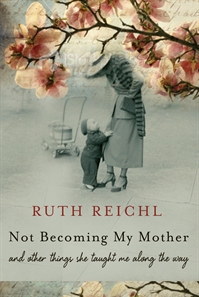
Ruth Reichl, Not becoming my mother

Ruth Reichl, Not becoming my mother
Book cover (Courtesy: Allen& Unwin)

Ruth Reichl and Kate Jennings were both born in 1948, the former in the USA and the latter in Australia. Both had problematic relationships with their mothers and have written about those relationships, Reichl in memoirs and Jennings in her autobiographical novel, Snake. In her first memoir, Tender at the bone (1998), Reichl tells a few (many of them funny) stories against her mother, and describes her urgent need to escape home. Some 20 years later in Not becoming my mother, she revisits her mother – but with the wisdom that time brings. Similarly, in Snake, Jennings’ major focus is “Girlie” and her mother, and particularly Girlie’s desperation to be loved by a woman who was fundamentally unhappy and unable to provide that love.

The thing is that these mothers* were born in the first two or three decades of the twentieth century. They experienced war, depression and, worse still, the awful restrictions imposed on women of that era. Not only were education and work not encouraged, but they were told that marriage was the only life for them. This is the story Reichl tells in Not becoming my mother, and in doing so explores who her mother really was and finally recognises (and appreciates) why her mother behaved the way she did. Here she is on her mother and her mother’s friends:

I have never seen so many unhappy people. They were smart, they were educated and they were bored. Some of them did charitable work, but it wasn’t fulfilling. Their misery was an ugly thing, and it was hard on their families. It was a terrible waste of talent and energy, and watching them I knew that I was never going to be like them.

The mother in Jennings’ novel tells her daughter:

‘She’ll be married at eighteen, a hag by the time she’s thirty’, continues Irene. ‘Don’t let it happen to you’.

Ruth’s mother, on hearing of Ruth’s engagement:

‘Isn’t this very old-fashioned?’ she asked, coolly … ‘I thought that these days people your age just lived together.’

I was certain that Mom would eventually warm to the idea. She did not …

She had introduced me to her friends, shown me the drawbacks of a traditional marriage and offered me what she herself had wanted – permission not to marry.

Both mothers – Ruth’s real one and Kate’s (semi)fictional one – seek meaningful things to do with their lives and to them this primarily meant (preferably paid) work. Both manage it in fits and starts but society was not enamoured of working women and did not make it easy for them. Both mothers experienced some degree of mental illness – which reflects that well documented fact that married women were (and still are, I believe) the highest risk group for mental illness.

These are not pretty stories but they need to be told. Interestingly, Reichl’s story has a positive ending. Late in her life, her mother does find meaning and spends her last years actively involved in her community. Jennings’ fictional story, on the other hand, ends far more equivocally. Despite these differences, both books are powerful reminders of what life was like for a whole generation of women. And they remind us why we need to keep working to ensure self-actualisation for everyone, regardless of gender or other socially imposed limitations.

By the time she wrote Not becoming my mother, Reichl had made her peace with her mother’s memory, had finally realised that much of her mother’s seemingly bizarre or erratic behaviour was borne of the frustration in her life and her desire that her daughter not follow her footsteps. Luckily for me, my mother, also born in the first third of the century, managed to convey similar messages about education, work and marriage, while also providing the love and support that all children need and deserve.

Ruth Reichl
Not becoming my mother, and other things she taught me along the way
Crows Nest: Allen & Unwin, 2009
112pp
ISBN: 9781741757538

* These are just two examples of sad, difficult mothers from those decades. There are many more, such as Jill Ker Conway‘s mother in The road from Coorain.

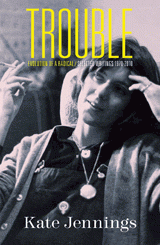
Kate Jennings, Trouble: Evolution of a radical

Kate Jennings, Trouble, bookcover

Bookcover (Courtesy: Black Inc)

I’m not going to beat about the bush but tell it like it is: I absolutely gobbled up Kate Jennings’ Trouble: Evolution of a radical: Selected writings 1970-2010. It took me a fortnight to read it, partly because I’ve been pretty busy but also because there was so much to savour and take in that I did a lot of stopping and thinking. That said, I do have one whinge, so I’ll get it over with now: it has no index. The book is described as an “unconventional” or “fragmented” autobiography and it is chock full of content. She mentions people, she discusses books and genres, she talks about politics, economics and feminism, not to mention all sorts of enthusiasms including, would you believe, swimming pools and shopping! I can see myself wanting to refer to it again and again but each time I’ll have to flip through it to find the idea or topic that I want to explore. Just as well I’m a marginalia person is all I can say!

So, who is Kate Jennings (b. 1948)? She is an Australian-born writer (poet, novelist, short story writer, essayist) and feminist, who stunned Australia with her Front Lawn speech in 1970, confronting progressive men, in particular, with their sexism. She moved to New York at the end of the 1970s and, in one of her iterations, worked as a speechwriter for a couple of large Wall Street firms in the 1990s. Somehow, she seems to have managed to do that without losing her critical eye. I have not yet read her novels, but will (finally, and rather coincidentally) be reading Snake in the next month or so.

Why did I like the book? This is how Jennings describes it in her preface:

This book, then, is a stand-in memoir. I’ve assembled pieces  – essays, speeches and poems, along with short stories and passages from my novels that actually happened – so that a reader might have a narrative of sorts.

On reading this you could be forgiven for fearing a mish-mash but fortunately that’s not what you get. The book is divided into 9 parts, each introduced by Jennings with a current reflection on the aspect of her life and career covered by that part. These parts move more or less chronologically through her life, though the readings themselves jump around a bit. This is because, like most of us really, she revisits some parts of her life many years after they occur, while others are documented at the time of their occurrence. The press release which came with my copy describes it in the following terms: “no-holds-barred” and “pull-no-punches”. What’s that, you say? They’re clichés! They are, but they describe the book perfectly, because this is a fiercely honest book written by a rather formidable woman. How else to describe someone who defiantly affirms, in almost one breath, her commitment to feminism and Jimmy Choo shoes, who calls herself a pragmatist but also argues passionately that “these are times of moral poverty”.

I think at this point I will just dot-point the parts to give you a sense of what she covers, because I fully intend to explore many of her ideas in more detail in the coming weeks/months.

  • Presumption: the making of her intellect, covering the years from 1970 to the late 1980s.
  • A child of grace, a landscape of progress: her childhood in the Riverina area of New South Wales, told mainly through excerpts from her novels and poems.
  • Cause and not symptom: her youth, focusing particularly on her introduction to alcohol (and subsequent joining of AA).
  • You don’t understand! What do you know! You don’t live here!: the life of an Australian expat in the USA explored mostly through her interviews with three other expat writers: Sumner Locke ElliottShirley Hazzard and Ray Mathew.
  • Catching a man, Eating him: her romantic life, which, with some self-mockery, she views through the songs of Dusty Springfield.
  • Crazed, delinquent fabulousness: an eye-opening sampler of her essays from 1990 to 2009 showing what a hard woman she is to pin down!
  • A bright, guilty world: more essays, these ones about her life as a speechwriter on Wall Street during the 1990s, including the full text of her Quarterly Essay 32, titled “American revolution: The fall of Wall Street and the rise of Barack Obama“. She has much to say about the GFC.
  • Irrelevance is deadly: how literature has (or hasn’t) dealt with the issue of business and finance.
  • Cut the shit: two no-holds-barred (yep, bring on the cliché!) essays which, she says, bring us back full circle to her main themes: “The first, a foray into my dusty childhood and Aussie alcoholism and masculinity through the re-release of the movie Wake in Fright, and the second, into poetry and the reasons I forsook it – or it, me – and a pet peeve: closed minds”.

I know it’s a bit of a copout, but I feel I can’t do justice to this book without writing my own Quarterly Essay and so, as I’ve already said above, I will return to it in future posts. In the meantime, the question to ask is: How does it work as an autobiography or “stand-in memoir”. I say very well. It does the things I look for: it tells me the main facts of her life, it shows me her interests, beliefs and values, and it gives me a sense of her personality (which is intelligent, opinionated, fearless and principled). Fragmented it might be in structure, but coherent it is in portraying a life.

In one of the poems she includes in the book, she writes:

… Saying simple things

well or complicated things simply is an art
that is fast disappearing …

Fortunately it is an art that Kate Jennings has not lost.

Kate Jennings
Trouble: Evolution of a radical: Selected writings 1970-2010
Melbourne: Black Inc, 2010
319pp.
ISBN: 9781863954679

(Review copy supplied by Black Inc.)

P.T. Barnum, In France

P.T. Barnum, by Matthew Brady

P.T. Barnum (Presumed Public Domain. By Matthew Brady, via Wikipedia)

When I saw that this week’s Library of America story was by P.T. Barnum, I knew I had to read it. Like most people I’ve heard of Barnum and his travelling shows, but had never read anything by him.

“In France” is not a short story, as most of the Library of America offerings are, but an excerpt from his 1869 memoir Struggles and triumphs. The whole memoir can be read online at the Internet Archive, here. While “In France” is the title of Chapter 12 in the memoir, the Library of America has not selected the whole chapter. Rather, they have published the middle of it, focusing on the story of how Barnum managed to present “General Tom Pouce” (ie Thumb), wearing his famed Napoleon Bonaparte costume, to the anti-Bonapartist King Louis Philippe. This was 1844, and Stratton (Tom Thumb) was just 6 years old!

You don’t read this for the writing. As memoir, or as travel writing, it is pretty prosaic. He doesn’t do much reflection – at least in this excerpt. You do not get a sense of how he felt about what he was doing, and you certainly get no idea of how his “exhibit”, General Tom Thumb, felt about being dressed up in costumes and paraded. However, it is interesting for its insights into Barnum’s modus operandi – particularly his economic and diplomatic nous. He knew how to work the system, though we are given the impression that he was a hard but not a dishonest negotiator. There is a funny little story running through this excerpt about the licence fee he needed to pay for exhibiting “natural curiosities”. Barnum felt the fee (25%) was too high and succeeded in negotiating a lower one, partly because the official involved did not believe that Barnum would make much money. When it came time for renewal, the official realised his mistake but was once again (legally) finessed by Barnum who argued that Tom Thumb should not be seen as a “natural curiosity” but as a “theatrical” performance (which incurred a much lower 11% tax)!

He also talks about how he worked his promotion – and makes this delightful comment on the French versus the English:

Thus, before I opened the exhibition all Paris knew that General Tom Thumb was in the city. The French are exceedingly impressible; and what in London is only excitement, in Paris becomes furor.

I don’t know when merchandising associated with the arts/performance first took off, but in Paris in 1844 it was in full flight. Barnum writes that:

Statuettes of ‘Tom Pouce’ appeared in all the windows, in plaster, Parian, sugar and chocolate; songs were written about him and his lithograph was seen everywhere. A fine café on one of the boulevards took the name of ‘Tom Pouce’ …

While this merchandising, generated by others for their own benefit, clearly also served Barnum well, there’s no mention of his licensing Tom Thumb’s image for promotional purposes. I can’t help thinking that the master showman missed an opportunity here!

Like the previous Library of America offering this is a short piece: it’s well worth reading for our “historical” if not “natural” curiosity!

Richard Appleton, Appo: Recollections of a member of the Sydney Push

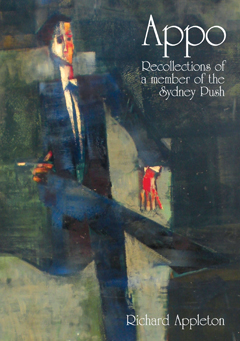
Richard Appleton, Appo

Appo book cover (Courtesy: Sydney University Press)

I wanted to start my review of Richard Appleton’s memoir, Appo: Recollections of a member of the Sydney Push, with a mention of its evocative cover, but I now see that my friend Lisa, at ANZLitLovers, has already done this, so I’ll start more boringly with definitions instead! According to Wikipedia, the Sydney Push was a left-wing intellectual group that operated in Sydney from the late 1940s to the early 1970s. On the back of the book, the Push is described as “our most original Bohemia”. What Appleton (1932-2005) describes in his memoir though is something rather less romantic, rather more earthy, than these descriptions connote. In fact, it seems that drinking and sex were about as important as protest and debate.

At the beginning of the book, Appleton lists what he sees as the strands of Sydney Libertarianism which defined the Push:

  • sexual liberty (as “a necessary precondition for political liberty”)
  • permanent protest (which Push member and academic Jim Baker describes as “the permanent struggle to keep alive libertarian values and interests”)
  • pluralism (which he describes as “the recognition of different and frequently conflicting interests, both within and between societies”)

I’m sure readers here know what Libertarianism is but, to make it simple, here is the neat definition from Wikipedia: “term for political theories that advocate the maximisation of individual liberty in thought and actionand the minimisation or abolition of the state.” This equates with Wikipedia’s description of the Push as being defined by “rejection of conventional morality and authoritarianism”.

At first glance the title raises the expectation that the book is about the Push but, when you look at the title carefully, what it actually says is that it is “the recollections” of  “a member of the Push”. That means, really, that it’s about him! And it is. There is a lot of Push in it, because clearly the Push and the relationships he formed within it, frame his life, but it is not a thorough history of the Push. He talks as much about his membership of the Communist Party of Australia and of the Australian Labor Party (ALP), his various forays into work in rural Australia, his poetry, and his work as an editor/encyclopaedist, as he does about the Push. And that’s fair enough, given the title!

Like most memoirs, it’s a pretty straightforward read. The style is chatty, with light attempts at humour that sometimes work, but  can sometimes be a little smart-alecky (“A new cycle of Push deaths had by then begun, and I had no wish to conform to that mortifying fashion”). He is (mostly) honest about his failings, which is something I like in a memoir. Structure-wise, the book is largely chronological, with the odd thematic tangent but he signposts these for us, such as this at the end of chapter 18: “While I was involved in politics I still had of course a professional and a private life. Both are dealt with, in that order, in the following chapters”.

It’s a frustrating book at times – partly because to preserve people’s privacy he is selective about what he does and doesn’t cover, and partly because there are many anecdotes (often drinking stories) in the book which seem to add little to our understanding of the Push or of him. Or perhaps that’s the point – and they do! Because the Push, as he describes it and I have no reason to argue with him, seems to be a very slippery beast. Also, presumably in the same attempt to maintain privacy, he drops hints that he doesn’t follow up. For example he refers a few times to his obsessive compulsive disorder, implying he was diagnosed late, but he never does really explain this. I found that a little mystifying, but perhaps it is this very “condition” which informs the way the book plays out.

All this aside, I did enjoy the book. It is at its most lively when he describes his several forays into rural Australia for work. His aim was to work and save money so he could return to Sydney and support his Push life of writing (poetry) and drinking. He worked hard at a wide range of jobs – destroying rabbit burrows and then catching rabbits was one such job – but for one reason or another, none of these jobs resulted in the benefits he desired. They made for some good stories though – and they provide insight into the times. I also enjoyed hearing about his life as an active member of the ALP (particularly the machinations of the factions that underpin that party) and about his experiences as an editor/encyclopaedist. He worked on The Australian Encyclopaedia, and was editor-in-chief of two editions. I would like to have heard more on this – it would, I’m sure, make a book in its own right. I also enjoyed the references to people in the Push, some of whom, just a generation older than I, have crossed my path (some in person, some by hearsay, and some through their writings). It’s interesting seeing them in (their often formative) context. The most well-known, to me anyhow, members include feminist/author Germaine Greer, author/commentator Clive James, artist John Olsen, writer Frank Moorhouse, poets Les Murray and Harry Hooton, and film producer Margaret (née Elliott) Fink.

Since Lisa started with the cover, I’ll end with it. It comprises a portrait of the author by David Perry (an Australian avant-garde filmmaker). It is shadowy, with just a few telling details; it teases us with the possibility of a bigger story. One could almost say the same of the book. It is what it is, a set of recollections, and as such provides a readable entrée to the world of the Push, but it is not, and does not pretend to be, the main course.

Richard Appleton
Appo: Recollections of a member of the Sydney Push
University of Sydney: Darlington Press, 2009
300pp.
ISBN: 9781921364099

(Review copy supplied by the Sydney University Press)

Barack Obama, Dreams from my father

Dreams from my father, Australian paperback (Cover: Courtesy Text Publishing)

Dreams from my father, Australian paperback (Cover: Courtesy Text Publishing)

I must be about the last person on earth to read Barack Obama’s autobiography, Dreams from my father. However, that’s not going to stop me adding my voice to the accolades heaped on the book! When it was originally published in 1995, it was subtitled “A story of race and inheritance”. This does not appear on the cover or title page of my 2009 reprint of the 2004 edition. Why is that? Maybe they just thought they’d keep it simple?

Anyhow, this aside, there’s a lot that can be said about this book – and in fact a lot has been said. I don’t really want to go over that ground again. Yes, it has a three part structure (Origins, Chicago and Kenya). Yes, it’s beautifully written with some lovely reflective prose. Yes, it contains the germ of his philosophies about race and politics. But, what did I get out of it?

Well the main thing is that it’s one of the most authentic explorations of identity crisis that I have ever read. Here is a man born of a mixed race marriage, who was brought up by the “dominant” race’s family without any real contact with the minority race family but who, by the time he reaches adolescence, finds that those around him identify him with that minority race. Consequently, much of the book is spent on his working out how to live (and grow) as a black man in a white society. He is very honest in chronicling his path from rather wild, disaffected youth to thoughtful more together young man. He starts to make this transition when, in his early 20s, he leaves the high corporate life in New York for the life of a poor community organiser in the Southside of Chicago. And here I must admit I could NOT get that Jim Croce song out of my head:

Well the south side of chicago
Is the baddest part of town…

Some readers, I know, found the Chicago section slow-going, and  I suppose I did too but that doesn’t mean I didn’t find it engrossing because it is in this section that he really explores the many faces of race relations and starts to work through his own views and values. After all, it is here that he gets first-hand experience of what it is like to be poor, powerless and black and it is here that he not only starts to develop his philosophy but also hone his organisational skills. He’s pretty modest about it but it is clear that he is an empathetic person who engenders confidence in people. The other interesting thing about this identity crisis aspect of the book is that while, unlike many of the people he worked with/for he had not “grown up black”, he is one of the rare Americans to actually have direct African roots, something he explores in the third part of the book. All this actually makes him a bit of an insider/outsider in both white and black society. The resolution, when it comes at the end, is emotional and yet rather ordinary. He writes:

I felt the circle finally close. I realised that who I was, what I cared about, was no longer just a matter of intellect or obligation, no longer a construct of words. I saw that my life in America – the black life, the white life, the sense of abandonment I’d felt as a boy, the frustration and hope I’d felt in Chicago – all of it was connected with a small plot of earth an ocean away, connected by more than the accident of a name or the colour of my skin. The pain I felt was my father’s pain. My questions were my brothers’ questions. Their struggle my birthright.

The other thing I got out of it was the exploration – mostly just subtly alongside other discussions – of the concepts of truth and authenticity. An historian he talks to in Nairobi towards the end of the book says, when discussing the historical challenges facing, say, post-colonial Africans, that “truth is usually the best corrective” and elaborates on this by suggesting that possibly “the worse thing that colonialism did was cloud our view of the past”. There’s much to think about in that statement! On a more personal level she says that what she wants for her daughter is less to be “authentically African” and more to be “authentically herself”. I can’t think of a better point on which to finish this little review of mine!

Peter Godwin, When a crocodile eats the sun

[WARNING: SOME SPOILERS]

Saltwater crocodile

Saltwater crocodile

We know it happens – is happening – but it is shocking to come face to face with it, that is, with the experience of living in a situation which was once ordered and safe but which, almost overnight, becomes chaotic and downright dangerous. This is the story Peter Godwin chronicles in his most recent memoir of life in Zimbabwe, When a crocodile eats the sun. The title comes from an old Zulu and Venda belief that a solar eclipse occurs when a crocodile eats the sun. They see it as the worst of omens, “as a warning that he [the celestial crocodile] is much displeased with the behaviour of man below”. Two eclipses occur in the space of two years during the writing of the book. If you were not superstitious before, you might be after reading this! There is, however, an added layer to the crocodile motif: an old woman now living in a nursing home spends her time reading and rereading an old English magazine containing an article in which Churchill warns the English that “appeasement is feeding the crocodile, hoping it will eat you last”. There’s a reason I think that Godwin tells us this story twice in the book.

I might as well come clean now. I am not very good at keeping up with all the world’s trouble-spots and so was rather horrified last year by the events surrounding the elections in Zimbabwe. I had thought Mugabe was doing a good job – and I think he did in the very beginning – but clearly I had taken my eyes off the ball long ago because as most of you will know I’m sure things had been going downhill there for well over a decade. It is the political change in Zimbabwe since about 1996 that forms the backdrop to this book.

Morgan Tsvangirai, 2009 (Photo: Harry Wad)

Morgan Tsvangirai, 2009 (Photo: Harry Wad, using CC-BY-SA licence)

Godwin recounts how with increasing violence Mugabe (who is 80 by the end of the book), through various groups and organisations such as his ZANU-PF, seizes land, uprooting both white and black farmers and workers – any one who appears to oppose him – in his quest to retain power.

Excluding the prologue, the book starts in July 1996 and ends in February 2004, with each chapter titled by the date of a visit Godwin, now residing in the USA, makes back to his home country. During these trips, many of them justified by a journalistic assignment, Godwin visits, with some bravery it seems to me, besieged white farmers and the families of people who have been murdered. However, while the conflict between Morgan Tsvangirai’s MDC and the ZANU-PF is central to the book, Godwin also explores his family, particularly in relation to his discovery, in middle age, that his father was a Polish Jew who had been sent to England to avoid the coming Holocaust. Without labouring the point, Godwin draws some parallels between the experience of Jews and of white farmers in Zimbabwe. He also, on a more personal level, parallels himself with his father: “Like Poland was to him, Africa is for me: a place in which I can never truly belong, a dangerous place that will, if I allow it to, reach into my life and hurt my family”. In a lovely bit of – hmm, je ne sais quoi – his father, who started life as Polish Jew but who lived most of it as an English Christian, is buried as an African Hindu.

Godwin has a lovely style – some nice turns of phrase without being over-florid. Here’s one such: “It is winter in Africa, when the warm breath of day dies quickly on the lips of dusk”. The book is rich in anecdotes and observations. Topics as wide ranging as the legend of the hippopotamus’s creation, the story of Livingstone, and the life-cycle of the aid worker are all neatly fitted into the narrative. He  tries a little to explain and perhaps even justify the role of whites in Africa – methinks he is on somewhat shaky ground here but I suppose, like all colonial societies, what’s done is done and we need to find ways for peaceful co-existence. Too late now I suppose to worry about the rights and wrongs of the past…but he could perhaps have been a bit more cognisant of the entrenched inequities beneath the current strife.

At the heart of the book though is the people – the strong-willed parents who despite themselves start to become the children, the rebel-broadcaster sister who flees to England, the white farmers and black supporters of the MDC who face each day with amazing (to me, anyhow) bravery, the black workers and labourers who struggle along often quite loyally while nothing really improves for them, and so on. This is its richness.

Near the end of the book, Godwin makes one albeit backhanded concession to Mugabe:

Mugabe has managed to achieve something hitherto so elusive; he has created a real racial unity – not the bogus one portrayed in the beer commercials of the new South Africa, but something more substantial, a hard-won sense of comradeship, a common bond forged in the furnace of resistance to an oppressive rule.

Perhaps the crocodile hasn’t quite yet had its day!

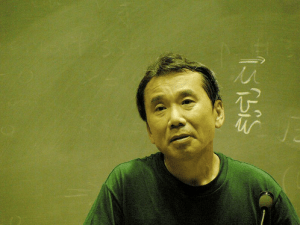
Haruki Murakami, What I talk about…

Haruki Murakami (Photo by Wakarimasita, Wikipedia, under Creative Commons Attribution ShareAlike 3.0)

Haruki Murakami (By Wakarimasita, Wikipedia, using Creative Commons Attribution ShareAlike 3.0)

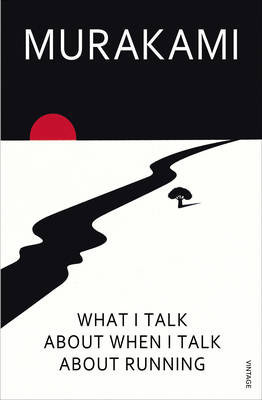
What a strange little book! I guess it’s not surprising that Haruki Murakami’s notion of a memoir is not quite that of the rest of us. This is not because it has any of the, shall we call it, weirdness you find in his novels, but because in its 180 pages, What I talk about when I talk about running talks quite a bit about – yes – running.

The book was written over a period covering August 2005 to October 2006, and the chapters read largely like diary entries. In the foreword he says:

Somerset Maugham once wrote that in each shave lies a philosophy. I couldn’t agree more. No matter how mundane some action might appear, keep at it long enough and it becomes a contemplative, even meditative act.

So, what does this book tell us about Murakami? He is not competitive, he is not particularly comfortable socially and in fact enjoys being alone, he is tenacious, he is highly self-motivated … and he is modest. We learn all of this through his attitude to running. Early in the book he draws some parallels between his life as a runner and as a writer, but by the end of the book his focus is almost solely on running (and triathlons). He says that running marathons and writing novels are similar in that the point is not whether you win or lose, but whether “your writing attains the standards you’ve set for yourself”. The book describes in some detail the standards he sets for himself as a runner and how he goes about (or not as the case maybe!) achieving them.

I enjoyed the book, but I must admit that I was really hoping for more insight into why he writes the sorts of books he does. Fairly early in the book he writes of his years of owning/running a jazz bar in Tokyo. He says:

Thanks to this…I met all kinds of offbeat people and had some unusual encounters. Before I began writing, I dutifully, even enthusiastically, absorbed a variety of experiences.

Aha, I thought, we are getting to the meat of things but, in fact, he doesn’t expand on this. Regarding his writing goals, he very simply says that his “duty as a novelist” is to ensure that each work is “an improvement over the last”. Regarding writing as a profession he says you need three things: talent, focus and endurance. You need these same things for long-distance running too.

While running is clearly in his bones and he plans to run long distances for as long as he can, he does say at the end “the main goal of exercising is to maintain, and improve, my physical condition in order to keep on writing novels”. Oh, and his philosophy? It seems to be this:

Exerting yourself to the fullest within your individual limits: that’s the essence of running, and a metaphor for life – and for me, for writing as well.

Book coverI’m glad I read the book – Murakami seems like a decent, gentle man with some thoughtful things to say about life – but I really don’t think it gave me any real insights into his work. It really is mostly about running!
Haruki Murakami
What I talk about when I talk about running
Vintage Books, 2009

Boori (Monty) Pryor, Maybe tomorrow

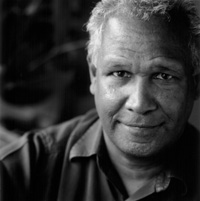
Boori Pryor
Boori Pryor

I wonder why I didn’t read this book when it was published about 10 years ago? In the 1960s, when I was in my teens, I read poems like Kath Walker’s (later Oodgeroo Noonuccal) We are going; in the 1970s when I was at university it was more academic works such as the white anthropologist CD Rowley’s The destruction of Aboriginal society; and in the 1980s it was Sally Morgan’s My place. Later, in the 2000s it was Leah Purcell’s Black chicks talking. These and other books have both moved and educated me with their portrayals of the richness of indigenous culture in Australia and of the dispossession of its people. And yet, in the 1990s, I missed this treasure (written in collaboration with Meme McDonald).

It is a treasure because, although Boori Pryor and his family have experienced huge tragedy and significant intimidation, he is able to preach reconciliation and mutual respect. Classed as a biography and often promoted as a book for young adults – indeed it was shortlisted in the Children’s Book Council of Australia awards – the book has a much wider ambit. While we learn a lot about Boori’s life, that is not his purpose in writing the book. His purpose is to encourage white society to understand – really understand – where Aboriginal people are coming from, and particularly the far-reaching implications for them of Invasion Day, and to encourage Aboriginal people to trust in their roots and to recognise the importance of their stories, their cultural tradition, to their individual survival as well as to the survival of their people.

Much of the book deals with his work in schools where he aims to encourage students to develop an understanding of and respect for Aboriginal people and for the land. He believes that all people need to have and know their “place”: the first chapter is subtitled “To be happy about yourself you have to be happy about the place you live in”. He talks about the thoughtless and insulting things young people say to him and how he handles it. He says

You have to be the water that puts out the fire. If you fight fire with fire, everything burns.

He seems to be able to “maintain the rage” regarding what has been done to his people while at the same time working wisely and calmly to make things better.

Boori says in the book that storytelling is part of who his people are. After reading this book – with its mix of anecdote, metaphor, analogy and humour – I, for one, would not argue with him.

Boori Monty Pryor with Meme McDonald
Maybe tomorrow (1998)