Barbara Hanrahan, The scent of eucalyptus

Writer-artist Barbara Hanrahan was born half a generation before I was and in the city of Adelaide not a country town in Queensland, but the childhood she depicts in her first novel, The scent of eucalyptus, could almost have been mine. Almost, but not quite, as I was brought up in a standard nuclear family and she by three women – her mother, grandmother, and Aunt Reece (who had Downs Syndrome) – resulting in a somewhat different experience of home-life even if not of wider society.

And there’s another more crucial difference. The half generation time lag accounts for a major change appearing on the horizon – in the education of women. Hanrahan, like my mother who was born nearly half a generation earlier, suffered from the reduced opportunities and low expectations that were women’s lot back then. Both were expected to undertake commercial training at high school – rather than join the academic streams they desired – in order to fulfil “the plan” as Hanrahan calls it:

“( … Our expectations were swallowed by shorthand symbols, hammered by typewriter keys, imprisoned by the columns of a neatly-ruled ledger whose credit column never balances its debit.)

I was part of a school that was a factory, pumping forth each year, from the swollen Commercial class, the girls of fifteen who would go to work as typists and clerks. At eighteen they would be engaged, at twenty, married, at thirty – old. These were the girls I stood with under the lacquered fig trees in the Grade Seven photograph. (They are at their prime at the age of twelve … )

How sad that is. I loved this book from beginning to end. The writing is poetic – not the sort of poetry that is full of allusions and ambiguities in which you have to work hard to locate meaning, but the sort that paints word pictures of both the physical and emotional landscape. An example is her description of a visit to relations in the hills:

“I remember rising while it was still dark to visit them; … watching the sky turn pale and frayed with light; seeing houses jump forward from the darkness; hearing the cold voices of first roosters, the kookaburra’s ruffled peal.”

The writing is rhythmic. There are few wasted words, there is effective use of repetition, there is stream of consciousness, and she uses punctuation precisely to control flow and meaning.

Hanrahan tells her story more or less chronologically, with thematic chapters interspersed at appropriate points and occasional asides foreshadowing her future. The novel spans her life – this is an autobiographical novel – from birth to puberty. It’s not strong on plot, but there is a powerful story here about the development of self. For example, in chapter 2, we see the origins of the artist she was to become: “As a child and ever after, the minute, hidden facets of things intrigued me”.

The first few chapters introduce us to the significant people – the “important” three – in her life. Here she is on her mother:

“My mother was a lark whose tongue was cut; a gull with clipped wings. She learned to expect nothing that she did not strive for … My mother trod a familiar path; hedged by as many briers as Sleeping Beauty’s ever was”.

Such economy of expression that conveys so much. She writes similarly of her grandmother and aunt, and we learn how “the three” love and support each other but also harbour disappointments. These, though, our narrator is barely aware of:

“(I was deceived by familiarity. I didn’t see, couldn’t see, forgot to reason.)”

And so the novel progresses through infancy, kindergarten, and primary school until we reach the point at which I began this post. She paints perfect pictures of school days, of special holidays, of childhood friendships, of fears and hobbies, of a flirtation with religion, and of a sense throughout, but becoming stronger as she grows older, of being “different”:

“And as I grew older I became adept at leaping quicksilver from one of my selves to the other. And as I grew older the split grew deeper, yet I forgot it was there.”

This is a delicious novel – the language is almost mesmeric, capturing a world that has passed and yet is still part of our cultural landscape. I will finish with one final excerpt which delighted me. She, like most Australians, grew up with the image of outback Australia, our “sunburnt country”, firmly entrenched in her mind, but she, also like most Australians, was “a city child” and so she asks:

“But where were the hills of the history book, stitched with the pathways of Burke and Sturt and Leichhardt?- the hills of the sun-burned earth and budgerigar grass, and azure skies and fiery mountains we sang about at school before the flag spangled with all the stars of the Southern Cross I was never sure of seeing? Where were the old dark people I did not link with the lost couples on suitcases at the railway station? Where were the crocodiles and brolgas, the billabongs and snakes? Where were the flowers that wilted in blistered clay, the rusty waves of Spinifex that looped the cliff?

… I looked about me for the sunburned land. In vain.”

This is not the end of the book … but is as fine a place as any to end my review because it, as much as anything, conveys the paradox of her childhood – the knowing one thing but the seeing of/the being something else. This is a book for all Australians to read … and for anyone else who is interested in a thoughtful, lyrical rendition of a childhood.

Barbara Hanrahan
The scent of eucalyptus
St Lucia: University of Queensland Press, 1973
188pp.
ISBN: 0702225169
Ruth Park, Missus

Missus was the last written in Ruth Park‘s Harp in the South trilogy, but is the first in terms of chronology. The first two novels, Harp in the South and Poor man’s orange, were published in 1948 and 1949 respectively, while Missus was not published until 1985.

These first novels, which met with some controversy on publication, are set in early post-war Sydney, the tenements of Surry Hills, and deal with the lives of Mumma and Hughie Darcy and their daughters. Missus is set in the 1920s, in country New South Wales, and relates Mumma and Hughie’s youth and courting days. I have only just read Missus, partly because I read the first two in my teens which was, I have to admit, before Missus appeared on the scene.

You can tell that the writer of Missus is the writer of Swords and crowns and rings (1977). The latter is larger scale – and deals more consciously with its historical time-frame. That is, it more specifically addresses the wars and the Depression, and their impact on the main characters. However, the First World War and the coming Depression do provide the backdrop to Missus. Both books depict rural life and characters with convincing realism.

WARNING: SPOILER, IF YOU’VE NOT READ HARP IN THE SOUTH

Now, the plot. For those who’ve read the first two novels, the interest here is not whether Mumma (Margaret Kilker) and Hughie get together but how they get together and who they are. The first chapter – after a brief introduction to the town of Trafalgar including how the early settlers cruelly despatched the Indigenous inhabitants – introduces us to Hughie and his family. We meet his brother Jer (Jeremiah), who is born with “his feet back to front”, and we learn of the failure of his parents marriage, his mother’s early death and his being turfed out by his father when he was around 14 years old. Jer goes with him, and becomes both millstone and support from then on.

In Chapter 2, we are properly introduced to Margaret (who makes a brief appearance in the first chapter) and her family. Unlike Hughie, she grew up in a large, loving family, though not one without its stresses and losses. Margaret, we learn, has taken a shine to Hughie, much to her mother’s concern, because she sees Hughie for what he is, “a wild goose of a boy … [who’s] got flighty feet”, a “shifty article”. This mother (Rowena) is, in fact, a powerful presence. I love this description of Rowena after she decided to give up on (“on” being the operative word) her first true love:

Her chest ached as if it had a skewer stuck in it, but she tossed her head more often than she hung it.

From here on the story progresses chronologically as Hughie moves around the countryside obtaining and losing or leaving jobs, while Margaret stays at home waiting for Hughie’s occasional visits. The characters of our characters, if you know what I mean, are illuminated by the actions of, or their interactions with, other characters. Margaret’s younger sister, the jealous Josie, provides an interesting foil for Margaret as well as an opportunity for Park to explore women’s lack of rights. Josie marries young – for the wrong reason to the wrong man – and the marriage fails. She’s intelligent and manages to obtain accountant qualifications, but her attempt to set herself up as an accountant in the town fails because no-one will use a woman accountant. Other characters include Alf, Margaret’s long-suffering but sensible aunt who works as a housekeeper for the local priest and who, at different times, provides shelter and monetary support for Josie and Jer; the Biddles (the mustard-gas damaged Joe and his common law wife) who take in Hughie and then Jer at one time in their lives; and the redoubtable Bids Tookey who … but that might give away what little plot there is.

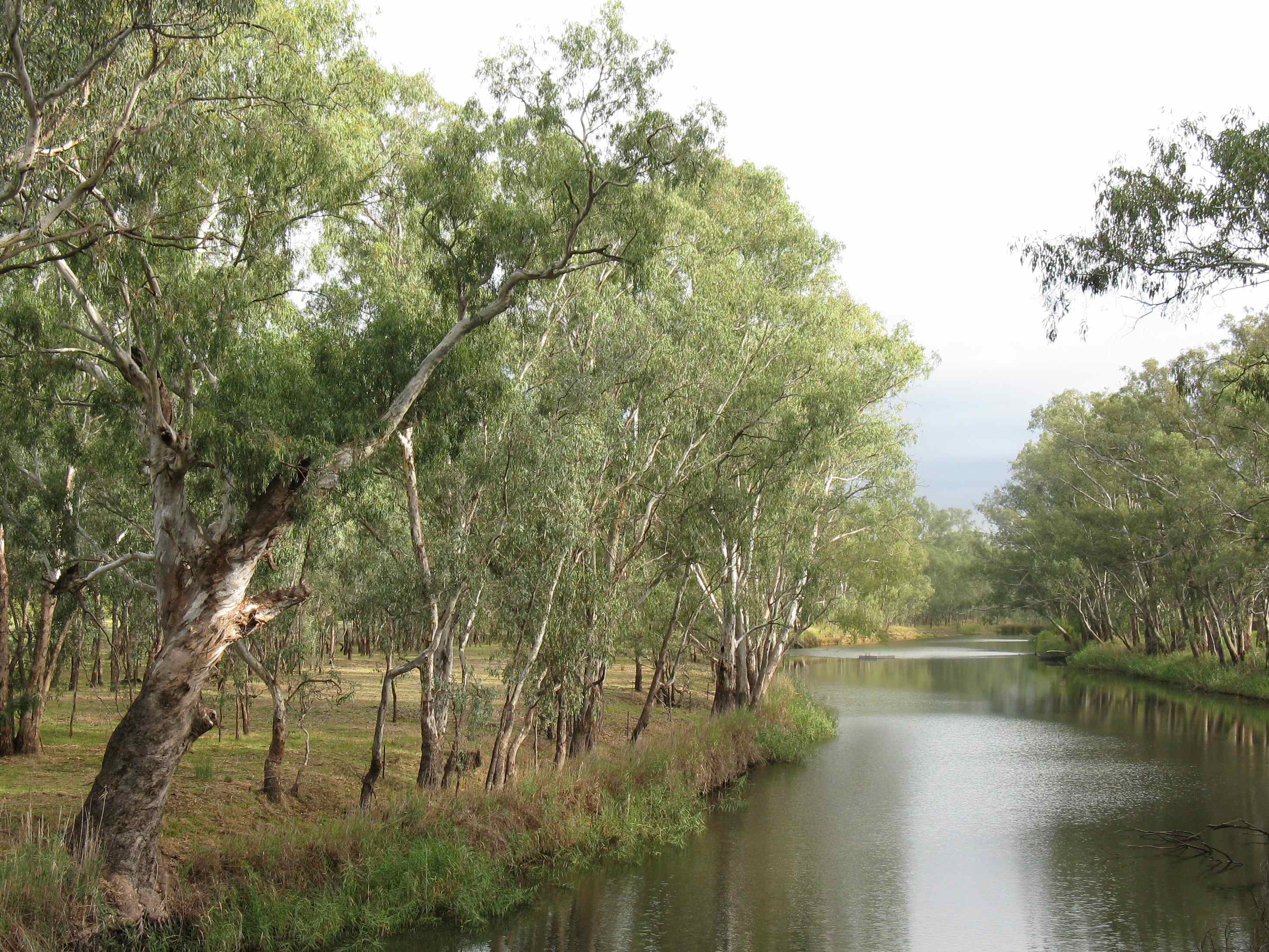
Sunday Creek, near Rutherglen

Australian country creek, lined by eucalypts

In just 250 pages Park paints a rich picture of 1920s life in rural Australia while at the same time developing Hughie and Margaret’s characters. Her characters are all flawed, some more than others, but she draws them with a clear-eyed warmth. She sees them for who they are but she respects them nonetheless. There’s no sentimentality here, but neither is it cynical or bitter. Her themes are universal ones: innocence and experience, familial and romantic love, deception and loyalty, most of it overlaid with that pragmatism that is necessary for survival in a hard place in hard times. As I wrote in this week’s Monday Musings, it’s not surprising that these books still resonate.

Finally, the language is lovely – simple, direct and evocative. Read this from the last few pages of the novel:

In the unkempt garden bloomed freesias and grape hyacinths. The eucalypt twig flushed red, the four creeks overflowed, lambs appeared on the hills, white as mushrooms and as sudden.

‘Them two had better wed quick,’ said Eny ominously, ‘or I won’t answer for Margaret’.

Ha! I think I’ll leave it there – pregnant with possibility …

Ruth Park
Missus
Ringwood: Penguin Books, 1985
247pp.
ISBN: 0140089438

Jeanette Winterson, Oranges are not the only fruit

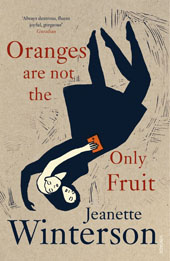
Winterson, Oranges are not the only fruit, book cover

Book cover: Used by permission of the Random House Group Limited

As I was reading Jeanette Winterson’s novella Oranges are not the only fruit, the question, rightly or wrongly, that was uppermost in my mind was “What is it with the oranges?” Is there something about oranges that I don’t know? Something specific that they symbolise?  I racked (wracked) my brain for something in my literary past that would give me a clue, but I came up with nothing. I guess she wanted to choose a motif to represent her mother’s limiting interactions with her and an orange seemed as good as anything? Certainly oranges are a recurring motif, and her mother regularly insists they are “the only fruit” until the end when a “pineapple” makes its appearance. I’m not sure, however, that this change heralds anything in their relationship other than compounding the paradoxes that seem to underpin this novel.

This is an intriguing book. It is a semi-autobiographical coming-of-age novel which tells the story of the first person protagonist, Jeanette, who was adopted by a religious zealot and is being brought up to be a missionary. However, around the age of 16 she discovers that her (homo)sexual leanings do not meet her mother’s (or her church’s) approval and, well, the plot is slim but perhaps I will leave it here nonetheless…

The novel exhibits some of the hallmarks of postmodernism, of which the most obvious is its metafictional elements, the way it contains stories within stories and plays around with the idea of stories in relation to “truth”. It all begins with Winterson naming the main character after herself and modeling that character’s life on much of her own, resulting in our being, from the start, teased by notions of what is “true” and “real”.

The book is divided into chapters titled appropriately, given Jeanette’s upbringing, by books of the Bible, such as Genesis, Joshua and Ruth. These titles are descriptive but also symbolic and even a little satirical; Jeanette, for example, has walls to confront just like Joshua. And the narrative, while roughly chronological, intermittently leaps from “reality” to “fantasy” as Jeanette tries to escape or make sense of her experience of life. Sometimes these stories – such as the Winnet story near the end – represent a parallel fantasy life for what is happening to her, but other times the reference point is more indirect, and draws on history and myth such as the King Arthur legend (and Sir Perceval’s search for the Holy Grail).

And this brings me to “story” and “history”. Readers of my blog will know that these notions, and the related one of “truth”, fascinate me when they are played out in fiction. I tend to enjoy reading books that deal self-consciously with them, that recognise the challenges and ambiguities inherent in them – and this is one of those books. Jeanette, the character, has some interesting things to say on these topics around the time the “truth” of her life, her sexuality, is becoming clear. She says in the short chapter titled Deuteronomy: The last book of the law:

Of course that is not the whole story , but that is the way with stories; we make them what we will. It’s a way of explaining the universe while leaving the universe unexplained … People like to separate storytelling which is not fact from history which is fact. They do this so they know what to believe and what not to believe. This is very curious …

And she goes on to discuss how history, the past, “can undergo change” because “the lens can be tinted, tilted, smashed”. She recognises that “perhaps the event had an unassailable truth” but we all see it through our own lens. Tellingly, near the end of the book, in the chapter titled Ruth, she runs into Melanie, her first lover (now married with a child):

…she [Melanie] laughed and said we probably saw what had happened differently anyhow … She laughed again and said that they way I saw it would make a good story, her version was just the history, the nothing-at-all facts.

Melanie, it seems, does not have the imagination to re-vision her “story”.

So, did I enjoy this book? Yes, pretty much. I like her attempt to make sense of what was a very particular childhood, and to try to draw from it some larger “truths” about how we might all manage the “stories” of our lives. It is not a straightforward read – and it is first novel with, perhaps, a little of the overdone in it. I’m not sure why, for example, she suddenly decides to include a little rant against Pol Pot. It usefully supports a point she is making about the uses of history, but it is odd in a story that is nowhere else political. Perhaps that’s just being post-modern!

In her introduction to my 1991 Vintage edition, Winterson claims to have written an experimental, anti-linear novel. Well, it is a bit of that I suppose, though not dramatically so. I would have called it reasonably linear – at least in the chronological sense – but perhaps the ideas in it do “spiral” (as she calls it) a bit in the way she toys, through the various narratives, with the idea of “story” and what it means to us. What it means, I think, is not always clear – we like stories but we cannot (perhaps need not) always draw conclusions from them. That is the paradox of our lives. As she says near the end

…not all dark places need light. I have to remember that.

Jeanette Winterson
Oranges are not the only fruit
London: Vintage, 1991 (orig. 1985)
171pp.
ISBN: 9780099935704

Sawako Ariyoshi, The doctor’s wife

The doctor’s wife is the third Ariyoshi novel that I’ve read. The other two – The River Ki and The twilight years – I read well over a decade ago. According to Wikipedia The doctor’s wife is considered her best novel. All, though, are fascinating reads providing an insight into a culture which is so different from my own but in which, at the same time, people experience similar desires, pressures and emotions.

The twilight years is set in 1970s Japan and beautifully captures the cultural changes that were occurring around the time as Japan was (and still probably is) moving from  feudal/traditional parent child relationships to our more modern independent ways, with women caught in the middle. The River Ki chronicles three generations of women from the late 19th to mid 20th century, exploring changing attitudes and expectations of women. You are probably getting a picture here and you’d be right: Ariyoshi’s overriding theme concerns the role of women in Japanese society, both historically and in modern times. (Ariyoshi died in 1984.)

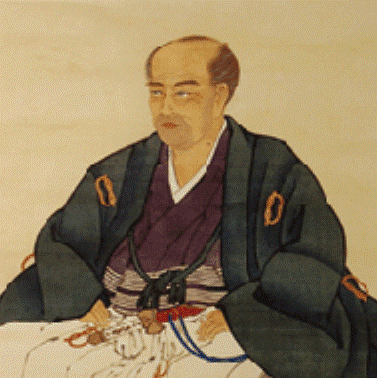
Hanaoka Seishu

Hanaoka Seishu (Public domain, via Wikipedia)

The doctor’s wife is an historical novel, spanning 70 years from around 1760 to 1830 and based on the life of famous Japanese doctor Hanaoka Seishu. A quick plot summary. The doctor’s wife is Kae, a young woman from a wealthy family, who is lured to become Seishu’s bride by his ambitious mother Otsugi, herself a woman married from a wealthy into a poorer family. The novel then chronicles Kae’s life in this extended family household as Seishu develops his medical skill and training until, near the end, he performs the world’s first surgery under anaesthetic (1804, breast cancer)*. While Seishu’s development as a doctor frames the novel, the real plot concerns the relationship between Kae and Otsugi.

The novel is told in third person, mostly the more objective omniscient voice, but occasionally we feel we are specifically in the heads of Kae or Otsugi. According to my edition’s introduction, Ariyoshi had access to Seishu’s personal records, diaries and books. However, being a man of his time and a doctor focused on his research, he did not, I assume, document much of his family life. The story, then, of the women is largely fictional. Mostly through dialogue, with description as needed, Ariyoshi describes how the loving supportive role Otsugi initially presented towards her daughter-in-law changes when her son (who had been married to Kae in absentia some three years before) returns home from his medical studies in Kyoto. Overnight, the relationship, to Kae’s shock and distress, changes into a competitive one – a competition that has serious consequences as they vie to be guinea pigs for his experiments in anaesthesia. Both women are presented as flawed, but as it is Kae who opens the novel and is the more powerless, it is with her that we are most keen to identify and empathise.

Why has Ariyoshi chosen to tell this story of conflict and competition within an historically based story of a great man? Does the historical “truth” add credibility to her exploration of familial power discrepancies? I’m not sure it’s necessary, but perhaps it helps … It is a very human tale – the grand gestures made by the women to support his research are small in the scheme of things though the impact on them, particularly on Kae, is immense. Ariyoshi realistically explores the nuances of their relationship through the normal day-to-day patterns of life (weaving, cooking, house management, childbirth) suggesting that this sort of conflict doesn’t have to be but that it often (traditionally, even) is. In fact, we readers are lulled into seeing it as the norm – the lot of women – until we are shocked out of that frame of mind near the end by Seishu’s unmarried sister who says (in broken speech because she is ill):

I think this sort of tension among females . . . is . . . to the advantage . . . of . . . every male.

She continues to explain her particular perspective on women’s secondary lot, and pronounces that:

as long as there are men and women side by side on this earth, I wouldn’t want to be reborn a woman into such a world.

Clearly, given the story Ariyoshi has told, she rather agrees  – or, at least, agrees for such societies as she depicts here in which women’s lot is not only an inferior one but which work to discourage them from cooperating and supporting each other. The novel may be set in Japan, but the fundamental truths, unfortunately, are not so confined.

What I have described here is the main story, but there’s more here that can be discussed, including the development (or history) of medicine in the east and west, the experimentation on animals and humans, and Japanese social life and customs in the Tokugawa period.

It’s a short but engrossing read. It falters a little I think right at the end when the historical facts are presented so prosaically that they threaten to overwhelm its novelistic achievements, but the last line fuses the two so beautifully that you forgive this.  The doctor’s wife is a fascinating and keenly observed novel that deserves to be read.

*Ironically, in 1811, novelist Fanny Burney underwent a horrific mastectomy without anaesthesia because it was unknown in the west!

Sawako Ariyoshi
The doctor’s wife
(trans. by Wakako Hironaka and Ann Silla Kostant)
Tokyo: Kodansha International, 1966 (orig ed), 1978 (trans)
174pp.
ISBN: 0870114654

Elizabeth Jolley, My father’s moon

‘No one,’ she says, ‘can write anything till they’ve had experience. Later on perhaps. You will write later on.’ (Elizabeth Jolley, My father’s moon, 1989)

Although fiction demands imagination, it must be based on  some kind of genuine experience. (Elizabeth Jolley, “Only Connect”, essay first published in Toads, 1992)

My father’s moon is the first book in Jolley’s semi-autobiographical trilogy, the others being Cabin fever and The George’s wife. It won The Age Book of the Year Award in 1989.

I am an Elizabeth Jolley fan – and, along with Helen Garner, another Jolley fan, I enjoy the way she repeats and revisits stories and characters from one book or story to another. In this book is the chapter, “Night Runner”, which was published as a short story in Meanjin in December 1983, and again in a short story anthology, Room to move, published in 1985. The narrator of the story – and of the novel – typifies Elizabeth Jolley’s alienated protagonists and their often peculiarly self-centred and self-deluded ways of coping with their loneliness. Clearly Jolley decided that this was a character she wanted to develop further. And clearly she also drew a lot from her own experience to develop this character. Like Vera, Jolley was brought up as a Quaker, her parents sheltered refugees before and during the Second World War, and she trained as a nurse. Like Vera, Jolley probably experienced loneliness and alienation. However, this is fiction and so we need to be careful about how far we take these analogies between Vera and her creator. Much as I can empathise with Vera’s predicament, I must admit that I would hate to think she is Elizabeth Jolley.

It’s an uncomfortable novel. Vera, the first person narrator, is not a highly sympathetic character but neither is she totally disagreeable either. What she is, though, is lonely. The book has a somewhat challenging structure – and I had to concentrate to keep track of where I was. It starts with Vera, a single mother, leaving her parents’ home, with her young daughter, to live and work in a boarding school. Her hopes for a lovely life there among people “who feel and think as I do” are dashed. Such people “are not here as I thought they would be … I am by my own mistakes buried in this green-leafed corruption and I am alone”. In this first chapter are flashbacks to the past, and gradually the book moves into the past, providing us with insights into her character and how she has ended up where she is. Most of this past takes place in the hospital where she trains as a nurse during the war. The book finally returns to the beginning of the novel with Vera resolving to make a step towards alleviating her loneliness. However, we are by no means convinced she will.

Moon, by atomicshark @ flickr, licensed under Creative Commons CC-BY 2.0

Moon, by atomicshark @ flickr, licensed under Creative Commons CC-BY 2.0

The book comprises titled chapters, many if not all of which could be (and some have been) published separately as short stories. This gives it a somewhat disjointed feel – but seems appropriate for the story of a person like Vera. It is full of wonderfully drawn characters, with some very funny (if often dark) scenes and dialogue. Just think nurses and hospitals! There are many references to music – something that is common in Jolley’s works. Music is usually a comforting force for her characters, offering them respite from what is often a cruel world – and this is the case here, with Vera being drawn to characters who love and play music. There is a lot of irony, some of it subtle, some of it less so as in Magda’s comment to Vera who has fantasised about an affair with her husband: ‘You are so innocent and good … Don’t ever change’. Naive perhaps, innocent no!

So, what about the title? Funnily enough(!), it refers to Vera’s relationship with her father, a major stabilising influence in her life. He tells her throughout her childhood that wherever she is she can always look at the same moon he is looking at, ‘And because of this … you must know that I am not far away. You must never feel lonely’. A lovely concept and one to which Vera regularly returns in the book.

My father’s moon is not, I think, the easiest Jolley to read, and there are some things that might become clearer on a second reading. However, its concerns are very representative of her work – loneliness and alienation, homosexuality, parenting, memory, music and religion. While Vera is deeply lonely, while she often behaves selfishly, she can also be kind. She is also no quitter. For that I rather like her.

Pramoedya Ananta Toer, This earth of mankind

Nationalism, in today’s western world, is pretty much a dirty word – and yet it is the idea of nationalism which underpins Indonesian writer Pramoedya Ananta Toer‘s Buru Quartet, of which I have just read the first book, This earth of mankind. Toer’s concept of nationalism was formed under colonial rule of his country by the Dutch and then under military rule by Indonesians. His notion of nationalism encompasses ideas of individual freedom and dignity, and the right of individuals and, by extension, the nations which they form, to be self-determining. None of these are well supported under colonial or military regimes.

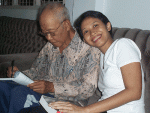
Toer & a translator. Photo: Michael Scott Moore at radiofreemike.com

Toer & a translator. Photo: Michael Scott Moore at radiofreemike.com

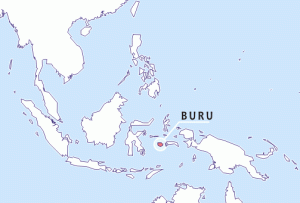
Toer (1925-2006) spent quite a bit of his life as a political prisoner and, in fact, this novel was first told orally to co-inmates in 1973 when he was imprisoned on the Buru Island penal settlement. He was first imprisoned (1947-1949) by the Dutch government after an anti British and Dutch revolution, and then later by the Indonesian government, first in 1963 when he supported Chinese minorities, and then after a military coup in 1965.  On this third occasion, he was imprisoned until 1979, though after that was essentially kept under house arrest until 2002. The first two novels were published in 1979/1980, and were translated into English in 1981 by Australian diplomat in Indonesia, Max Lane, who was recalled to Australia that same year as a result. Clearly, the Indonesian government was not amused. Indeed, the books were banned by that government in 1981.


From Wikipedia, under GNU Free Documentation License

From Wikipedia, under GNU Free Documentation License

This earth of mankind is set in 1898, and provides a fascinating look at colonial life in Indonesia at that time. It tells the story of a Native, the only one to attend an elite school. Being a Native he has no formal name, and so throughout he is called several names – Sinyo or Nyo, Gus, and most commonly Minke. Early in the novel, he is introduced to a succesful concubine Nyai Ontosoroh and her beautiful daughter, Annelies, and is gradually drawn into their lives. The novel follows his – and their – fortunes as the colonial authority does its best to see that a Native does not rise above his station. Life turns out to be a paradoxical one for Minke – on the one hand his education teaches him to think and argue and believe that all things are possible while on the other hand the colonial structure, within which he lives, works to ensure that little is possible.

The novel is peopled with a wide range of characters of various ethnic backgrounds – primarily Dutch, Indo (people with Dutch and Native parentage), and Natives, but also French and Chinese. This ensures that the strictly enforced layer of colonially-decided rights is set against a wide variety of political and personal opinions and provides the reader with an excellent insight into a complex society. This is perhaps also the cause of its main flaw because it is, at heart, an ideological novel. And, like many ideological novels, characters and plots are simplified and exaggerated to make the point. So, in simple terms the story can be seen as poor clever boy meets rich powerful concubine and falls in love with her beautiful but weak daughter only to be crossed by the wicked brother. The story has a melodramatic edge and there’s not a lot of complexity – of greys – to the characters. They are there to serve a purpose.

That said, it is a rivetting read. Told, first person, in Minke’s voice, the novel immediately engages us with him and his situation. He is, in fact, a little more rounded than the others: we get a sense of his uncertainty as he makes his various decisions throughout the book. This is largely because it is also a coming-of-age novel: paralleling the ideological issues underpinning the novel is the story of Minke’s emotional, social and intellectual development. A major thread is that of education and what can (should) be expected of an educated person. Early in the novel his “mentor”, the French artist, Jean Marais, tells him:

You’re educated Minke. An educated person must learn to act justly, beginning first of all with his thoughts, then later in his deeds. That is what it means to be educated.

This advice underpins Minke’s thought and actions from that point on: at each test or decision point he tries to apply his education.  There’s bitter irony here though because it is the source of that education – Europe – that causes his major problems at the end. As Minke is fast learning, you have to be strong to survive.

There’s a lot more that can be teased out in this book – including the role played by language in controlling and enforcing power and status – but rather than ramble on, I will end with the words of Minke’s favourite teacher, Magda Peters. She says:

…without a love of literature, you’ll remain just a lot of clever animals

It is not surprising then that Minke, Toer’s alter ego in this book, becomes a writer!

(Translated by Max Lane)