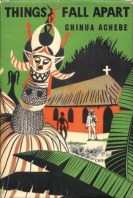
First edition, from Heinemann (via Wikipedia)
At last I’ve read that classic of African literature, China Achebe’s Things fall apart. It all came about because this year ABC RN’s classics book club is doing Africa. As I’ve been wanting to read this book for a long time, and as my reading group has been making a practice of choosing one ABC RN bookclub book a year, I recommended Things fall apart and – woohoo – they agreed. I am so happy! OK, so I’m easily pleased, but …
The funny thing is that as I started it, I did wonder what all the acclaim was about. Yes, I was finding the writing gorgeous, and yes, I found all the detail about life in the little Igbo village of Umuofia fascinating, but were these enough for its huge reputation? Then, I got to Part 2 – this is a classic three-part book – and the arrival of white man and the missionaries in southeastern Nigeria. The plot started to thicken – but, not just the plot. The whole gorgeous structure of the novel, its complexity and its sophisticated analysis of human society and the colonial imperative started to become clear.
Here, though, is my challenge – a challenge faced by all bloggers writing about much-analysed classics – what can I add? I haven’t actually read any of the analysis, except for my edition’s introduction, so I risk either going over the same old ground, or heading off on a completely irrelevant tangent, but I’m going to try. And how I’m going to try is to talk about a few of the aspects of the book that stood out to me, which, as is my wont, will focus more on how it is written than with the story itself.
However, I will start with a brief synopsis of the story, just in case there are others out there who haven’t read it. The plot is fairly simple: it tells the story of Okonkwo. Born to an “ill-fated”, “lazy and improvident” man, he decided early in life that he would not be like his father. He becomes a powerful and respected “warrior” in his community, one known to be hardworking but who could also be cruel to his family or to anyone who showed weakness. He is determined to be a “man”, to never show a “female” side. Male-female dichotomies are, in fact, an underlying thread in the novel. Whenever things go wrong for him, his response is always aggressive: if you aren’t confronting a situation head on, you are a “woman”. This inflexibility, his unwillingness to waver from his tough-minded course, results in his downfall. He could be seen I think as a classic tragic hero, as the man who could have been great but for a tragic flaw, an inability to be flexible, an unwillingness to marry his two sides.
This idea of two parts is fundamental to how the novel is structured and how the themes are developed – and Achebe conveys it through dichotomies and parallels. There’s the male-female one, which Okonkwo battles within himself. “When did you become a shivering old woman” he asks himself regarding the distress he feels after engaging in a violent act. Later, he is surprised to hear of a husband who consulted his wife before doing anything:
‘I thought he was a strong man in his youth.’ ‘He was indeed,’ said Ofoedu. Okonkwo shook his head doubtfully.
But there are other dichotomies, and two, in particular, that I found interesting. One is between Okonkwo and his friend Obierika. Both are respected men in the village, and both adhere to their traditions and conventions, but Okonkwo, who is “not a man of thought but of action” is so fearful of appearing weak he follows the “laws” rigidly. Obierika on the other hand is more thoughtful:
Obierika was a man who thought about things. When the will of the goddess had been done, he sat down in his obi and mourned his friend’s calamity. Why should a man suffer so grievously for an offence he had committed inadvertently? But although he thought for a long time he found no answer. He was merely led into greater complexities. He remembered his wife’s twin children, whom he had thrown away. What crime had they committed?
A similar dichotomy is set up between two missionaries:
Mr Brown’s successor was the Reverend James Smith, and he was a different kind of man. He condemned openly Mr Brown’s policy of compromise and accommodation. He saw things as black and white. And black was evil. He saw the world as a battlefield in which the children of light were locked in mortal conflict with the sons of darkness.
So, we have dichotomies established within the two cultures he’s describing – the African and colonial/missionary – but these two sets of dichotomies also work as parallels for each other, reflecting the differences, the conflicts in fact, that can occur within both (all) cultures.
Now I get to more uncomfortable ideas. Okonkwo’s tragedy could be seen to mirror Africa’s, but this is a tricky thing to consider. Okonkwo’s flaw we know. Did Africa, likewise, have a flaw or weakness? We criticise colonialism – and surely it is a bad thing, the subjugation of one people by another, the taking of one people’s land by another – and yet … Achebe himself benefited from the education brought by the missionaries, and in Things fall apart he tells us that some Igbo villagers saw positives:
The white man had indeed brought a lunatic religion, but he had also built a trading store and for the first time palm-oil and kernel became things of great price, and much money flowed into Umuofia.
Some even saw positives in the religion.
So, Achebe is not uncritical of either side of the colonial equation – the colonisers and the colonised – but his final point in the novel makes clear his attitude to the colonial project. In the last paragraph we learn that District Commissioner plans to write a book. Its title, “The Pacification of the Primitive Tribes of the Lower Niger”, euphemistically describes the colonisers’ mostly violent/aggressive subjugation of African people as “pacification” and demonstrates an arrogant assumption that a society not like their own is “primitive”. For Achebe, then, the overriding point of Things fall apart is not so much to present the positives and negatives within the two opposing cultures, but to expose the disdain with which the colonisers treated African people, and the way they denigrated African culture.
This is such an honest and provocative book, one that would bear multiple re-readings – like all good classics. Have you read it?
Chinua Achebe
Things fall apart
London: Penguin Classics, 2001 (orig. pub. 1958)
ISBN (e-book): 9780141393964










 Whispering Gums