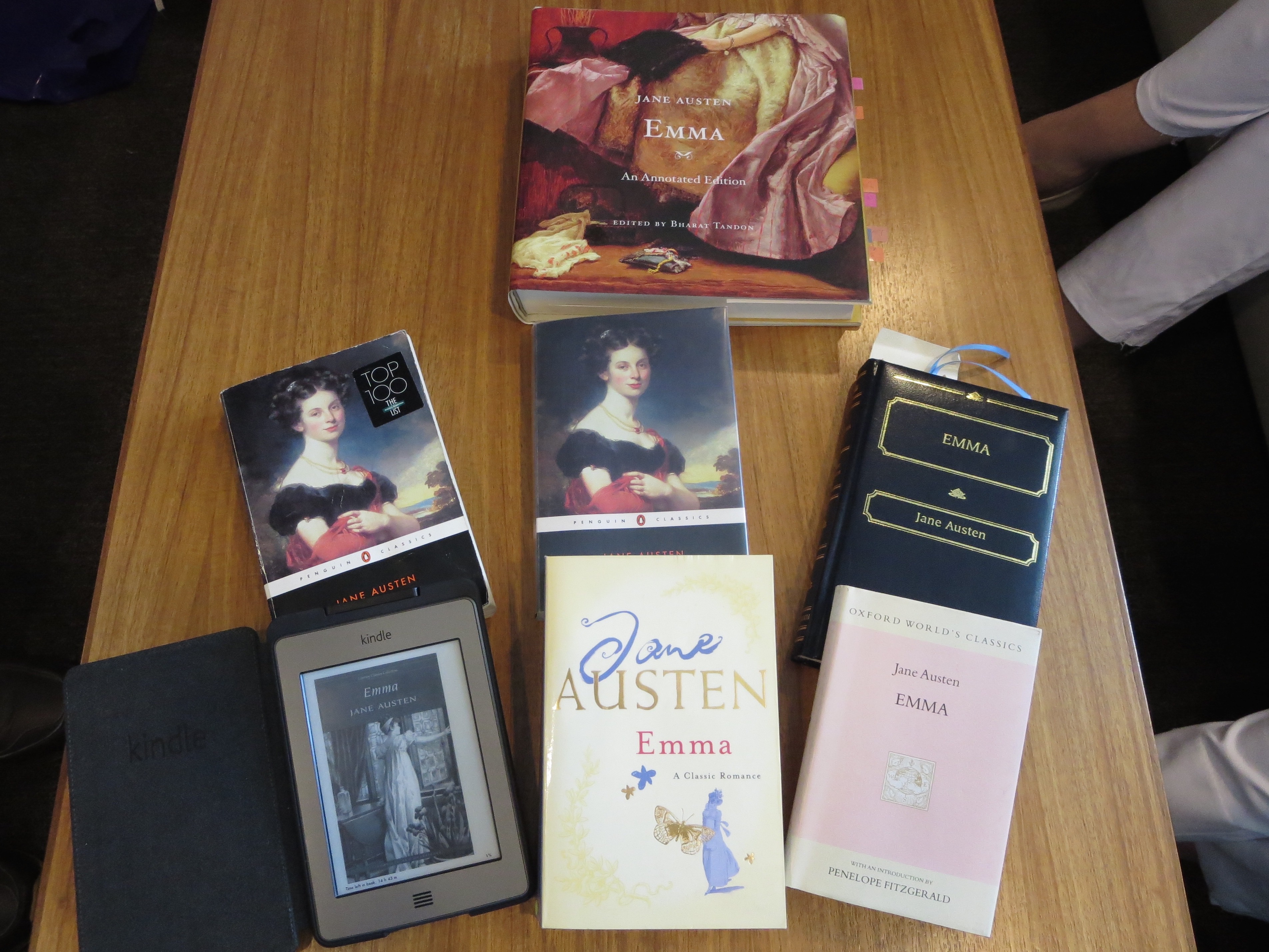
Jane Austen, Emma (Vol. 2, redux 2025)

EmmaCovers

In April, I wrote a post on Volume 1 of Emma, sharing the thoughts that had come to me during my Jane Austen’s group’s current slow read of the novel. This month, I’m sharing some ideas that Volume 2 raised for me.

I wrote in my Volume 1 post that, during this read, what popped out for me was the idea of young people lacking guidance. It relates to issues like character development and to themes like parenting (which Austen regularly explores in her novels.) The question with these slow reads always is, will an idea that pops up in one Volume continue in the next? Well, in this case my answer is yes and no.
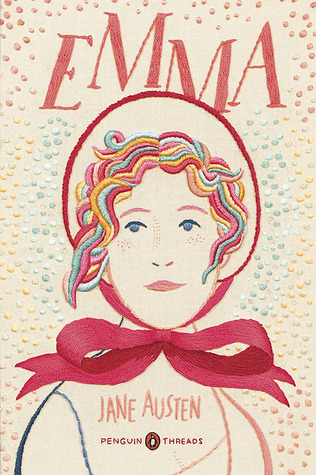
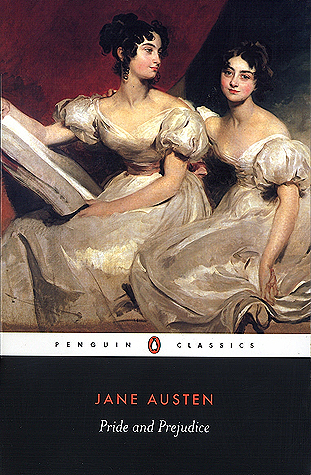
Jane Austen, Emma, Penguin

What I mean by this is that this notion expanded for me in Volume 2 to encompass the idea of “nature versus nurture”. Now, I’m not saying that Austen was specifically engaging in that debate, but that she has a lot to say about both aspects of our character. Before I continue, I will just share that I did wonder when the “nature versus nurture” debate started?

My searches, including via Wikipedia and two AI services, revealed that while ideas about innate (nature) vs. learned traits (nurture) can be traced back to ancient philosophy, the “nature versus nurture” debate, as a formal concept, began in the mid-1800s with Francis Galton, a cousin of Charles Darwin, who coined the term in his 1874 publication, “English Men of Science: Their Nature and Nurture”. In case you are interested, Chat GPT advised that philosophers like Plato and Aristotle debated discussed the role of “heredity and environment in shaping individuals” with Plato leaning towards nature (“innate knowledge”) and Aristotle towards nurture (“experience and environment”). And Wikipedia identifies Chen Seng having asked a similar question in 209 BCE. These aren’t the only people to have thought about the question, and Wikipedia’s article is useful if you are interested. But I’ll move on as the history of the debate is not my focus here.

What kept popping up for me – as I looked to see how my guidance-of-young-people theme was developing – were various comments Austen was making about nature and nurture. I’ll share just a few.

The first one to come to my attention in Volume 2, concerned Jane Fairfax, who was orphaned as a toddler and brought up, at first, by her grandmother, Mrs Bates, and aunt, Miss Bates. Austen describes her as a three-year-old

her being taught only what very limited means could command, and growing up with no advantages of connection or improvement to be engrafted on what nature had given her in a pleasing person, good understanding, and warm-hearted, well-meaning relations.” 

So, “nature had given her” a good start, and her relations had nurtured her as best they could with their “very limited means”. However, soon after, the Campbells (the family of a friend) had taken her in:

“She had fallen into good hands, known nothing but kindness from the Campbells, and been given an excellent education. Living constantly with right-minded and well-informed people, her heart and understanding had received every advantage of discipline and culture”.

And then, Austen seems to make the point that Jane Fairfax’s innate character, her disposition, was such that good nurturing had found fertile opportunity: “Her disposition and abilities were equally worthy of all that friendship could do…” Unfortunately, with no money, her destiny looked likely to be governessing, which the Campbells knew and did their best to prepare her for, but that’s another story …

As for Frank Churchill, in my last post regarding guidance, I noted that Austen suggests that, with his guardian family (his aunt and uncle at Enscombe), he had been left to his own devices with little guidance other than “his own comfort”. In this volume, Austen says more about his nature

“He seemed to have all the life and spirit, cheerful feelings, and social inclinations of his father, and nothing of the pride or reserve of Enscombe.”

It seems that at least some of the Churchills’ nature had not been nurtured into Frank. Ironically, it’s Emma’s father, Mr Woodhouse, who identifies some flaws in his behaviour, calling him “not quite the thing”, though his reasons are fussy.

And then there’s the third character whom we meet in Volume 2, Mrs Elton. These are Emma’s thoughts, and she is a snob, but nonetheless, she hones in on some points relevant to my thinking:

and the quarter of an hour quite convinced her that Mrs. Elton was a vain woman, extremely well satisfied with herself, and thinking much of her own importance; that she meant to shine and be very superior, but with manners which had been formed in a bad school, pert and familiar; that all her notions were drawn from one set of people, and one style of living; that, if not foolish, she was ignorant, and that her society would certainly do Mr. Elton no good.

We don’t know how much of this comes from Mrs Elton’s nature, but Emma does lay a much blame for her behaviour and character on her nurture.

Then there’s sweet Harriet, whom we met in Volume 1, and whom Emma considered, then, “not clever, but she had a sweet, docile, grateful disposition” and only needed to be “guided by any one she looked up to”. In Volume 2, her nature is again referenced, in terms of “the many vacancies of Harriet’s mind”! Poor Harriet. What will happen to her? Wait for Volume 3!

Finally, it’s Emma’s brother-in-law Mr John Knightley, who shows particular sense, when he provides these instructions to Emma on caring for his sons while he’s away:

” .. Do not spoil them, and do not physic* them.” 
“I rather hope to satisfy you both,” said Emma; “for I shall do all in my power to make them happy, which will be enough for Isabella; and happiness must preclude false indulgence and physic.”

[* Meaning, don’t medicate them as their mother, Emma’s sister, is wont to do.]

There’s no reference here to specific moral, or any other education, but we can infer from this, and our knowledge of the man, that he is well aware of the importance of good nurturing to his sons.

Of course, there were other issues that intrigued me in Volume 2, but these ideas are the ones I want to document this go round with Emma.

Any thoughts?
Jane Austen, Emma (Vol. 1, redux 2025)

EmmaCovers

As long-time readers here will know, my Jane Austen group did a slow read of Austen’s novels over several years, starting in 2011. In 2022, we decided it was time to repeat the exercise, and are again reading them chronologically, one each year, making 2025 Emma’s turn.

Our slow reads involve reading and discussing the chosen novel, a volume at a time. We “try” to read as though we don’t know what happens next, to help us focus closely on what we think Austen is doing. Of course, we can’t read like a first-time reader, but it’s a useful discipline.

We always wonder whether this time, after so many reads, we will see anything new or fresh. But, we always do. Just the march of time, with its impact on our knowledge, experience and tastes, means we see the books differently. Take Emma, for example …

Jane Austen, Emma, Penguin

A few re-reads ago, what stood out for me was its beautiful plotting. There’s barely a word or action that doesn’t imply or lead to something telling, even if we are unaware at the time. From my last major re-read, in 2015, I noticed how often the word “friend” or the notion of “friendship” was appearing. The novel starts with Emma losing her governess-then-companion Miss Taylor to marriage. They’ll remain friends but Emma is left alone with her gentle but fussy father. So, she nurtures a friendship with the 17-year-old Harriet. In my post on rereading Volume 1, I explored the idea of friendship, and then watched in Volumes 2 and 3 to see whether the idea continued. It did. This is not to say that what we might identify in a slow read will overtake previous ideas, but that these re-reads enable us to tease out more of the details, which usually results in a deeper understanding of the whole.

So, what would I find this time? I did consider choosing something to look for, like the role of letters or music in the novel, but decided to just see what played out. Sure enough, something popped up, the idea of young people lacking guidance. It relates to issues like character development and to themes like parenting. And, I found it all there in the first few chapters.

The novel begins:

Emma Woodhouse, handsome, clever, and rich, with a comfortable home and happy disposition, seemed to unite some of the best blessings of existence; and had lived nearly twenty-one years in the world with very little to distress or vex her.

This can be teased out in many ways, but, remembering that “very little to distress or vex her”, I’m focusing on where Austen goes next. As explained above, the novel opens with Emma’s governess-then-companion Miss Taylor having just married, so Emma, who lost her mother when she was very young, is left alone with her “valetudinarian” father, “a nervous man, easily depressed”. She indulges him, as only a devoted daughter can, but otherwise, she is untrammelled. Austen describes her life, to this point, in the third and fourth paragraphs:

Emma doing just what she liked; highly esteeming Miss Taylor’s judgment, but directed chiefly by her own.

The real evils indeed of Emma’s situation were the power of having rather too much of her own way, and a disposition to think a little too well of herself.

And there it is, “directed chiefly by her own [judgement]”. Neither Emma’s “nervous” father nor the mildly-tempered Miss Taylor/Mrs Weston question or guide her. However, in the same chapter, we learn that there is one who does, her brother-in-law Mr Knightley, “a sensible man about seven or eight and twenty”. Austen writes that:

Mr. Knightley, in fact, was one of the few people who could see faults in Emma Woodhouse, and the only one who ever told her of them …

We see several examples of his chiding her in Volume 1, including about her interference in Harriet’s response to a marriage proposal. We also see him discussing Emma with Mrs Weston, telling her that she had been a good companion to Emma but had also been better at submitting her will to Emma than in giving Emma the “complete education” he thinks she needed.

Now, moving on to Chapter 2, we hear of another young person, the three or four and twenty, Frank Churchill. His mother, too, had died when he was very young, and, for a number of reasons, he

was given up to the care and the wealth of the Churchills [aunt and uncle], and he had only his own comfort to seek, and his own situation to improve as he could.

The implication here is that he too had been left to his own devices with little guidance other than “his own comfort”. It occurred to me, during this reading, that he is being set up as a parallel and perhaps eventual foil to Emma. But, hold that thought, because Frank does not physically appear in Volume 1. There is, however, a telling discussion at the end of the Volume about his not coming to Highbury to meet his father’s new wife, Mrs Weston. Mr Knightley – note, it’s him again – argues that while Frank’s aunt and uncle are given as the reason:

There is one thing, Emma, which a man can always do, if he chooses, and that is, his duty.

Frank simply needed to use the “tone of decision becoming a man”, and there would have been “no opposition”.

Finally, there is a third example, the aforementioned Harriet Smith, who is introduced in Chapter 4. She

certainly was not clever, but she had a sweet, docile, grateful disposition; was totally free from conceit; and only desiring to be guided by any one she looked up to.

The natural child of an unknown person who had paid for her schooling and now for her boarding at that school, Harriet has no parent to guide her, only school teachers – and now, the flawed Emma. By the end of Volume 1, it is not going well for Harriet, who has lost one real and one imagined suitor due to Emma’s guidance.

So, as Volume 1 progresses through its 18 chapters, we see some of the fallout of Emma’s being a law unto herself and ignoring the wisdom of others. I look forward to seeing if this idea is followed through in Volume 2. Is it important to Austen’s world view? Watch this space …

Slow reading: Jane Austen’s Pride and prejudice

Pride and prejudice book covers
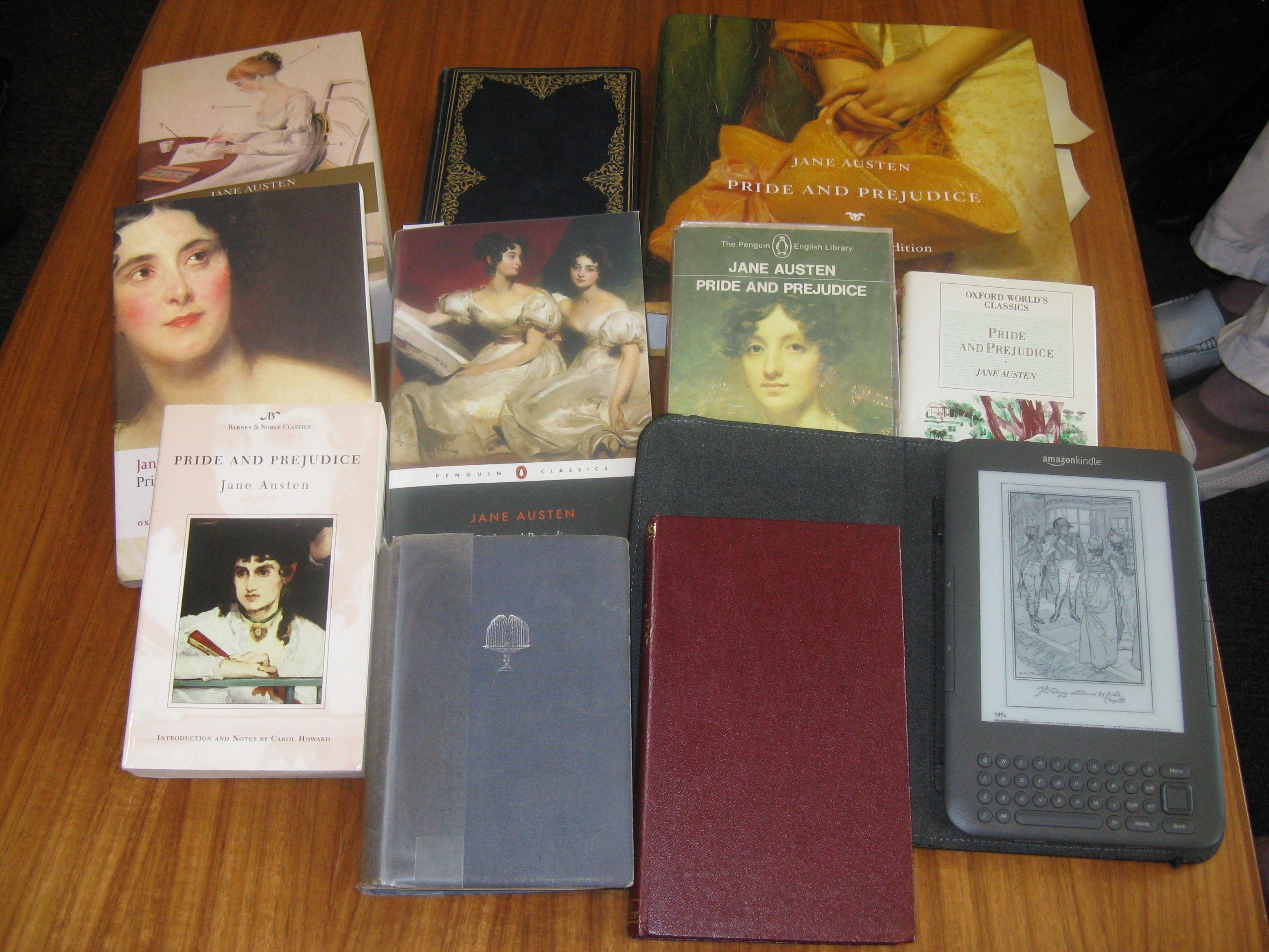
Some of the editions of Pride and Prejudice owned by my JA group

Back in the early to mid-2010s, my local Jane Austen group undertook a program of slow reading Jane Austen’s novels, coinciding with those books’ 200th anniversaries. Given that began around a decade ago, we decided last year that it was time to do another slow read program, and to stick with a chronological approach – that is, chronological in terms of publication. This meant that we did Sense and sensibility last year, and have just completed this year’s book, Pride and prejudice.

It is truly amazing just how much “new” we can find to talk about with books most of us have read not once, not twice, but multiple times, proving I suppose Italian writer Italo Calvino’s definition of a classic. Hmmm, no, not “definition” but “definitions”. He has fourteen of them, but here are the two that are most applicable to my post:

4. A classic is a book which with each rereading offers as much of a sense of discovery as the first reading.

6. A classic is a book which has never exhausted all it has to say to its readers.

These explain why slow reads can be particularly enjoyable with classics: once you know the plot, you are freed to discover how the author did it, to think about why they did it, and to notice more of the things they were telling you that you didn’t notice on the first read in your rush to find out what happens.

So, over the last three months, my group’s discussions have ranged across all of these, including finding some questions that we hadn’t thought to ask before. In Austen there are always those things she doesn’t tell us because they were known to her audience. These are the things we gradually pick up over years of Austen reading and research, such as the entail. But on this read, members raised questions regarding plot events that many of us hadn’t thought to ask before. For example, when Mr Darcy tells Elizabeth, on their meeting accidentally at Pemberley, that his sister “wishes to be known” to her, we wondered what had he told her about Elizabeth? Had he unburdened his heart to this shy young girl? Or, was it just an excuse to encourage Elizabeth to hang around a bit longer? And, when Lady Catherine visits Elizabeth because she fears there’s an engagement (or “an understanding”) between her and Darcy, where had she got this idea from?

We also found – yet again – that we had changed our minds about some of the characters, though sometimes these were diametrically opposed. For example, one remembered that when she first read the book as a schoolgirl, she felt “enormously sorry for ‘poor misunderstood Mrs Bennet’” but now she “would willingly strangle her”. For me, it’s the opposite. I had little sympathy for Mrs Bennet in my first readings, but now, understanding her worries about her daughters’ futures and Mr Bennet’s negligence in providing for them, I feel some sympathy for her – though her behaviour, all the same, is ridiculous. By contrast, in my early readings of Pride and prejudice I was far more sympathetic to Mr Bennet than I am now.

In fact, many of us in fact had little epiphanies regarding different characters that we shared with the group. Sweet Jane Bennet was thought just far too saccharine by one member, but she read some analyses that likened the angelic Jane to the sentimental 18th century heroines. Philosophers David Hume and Adam Smith argued, she told us, that feeling rather than reason provides the grounding for morality – and Jane exemplifies this. She sympathises with everyone, and behaves graciously to all. Our member wondered whether she should temper her view of Jane – though by the end she still felt Jane was just “too nice (to be real)”.

Some of these changes are due to the way slow reading exposes subtle clues that we don’t see on early reads, but some, I’m sure are due to life experiences. Austen is the perfect writer for illuminating (and then informing) our individual experiences of life.

We discussed which characters changed over the course of the novel, and, surprise, surprise, we didn’t all agree. No, let me rephrase that: we all agreed that Elizabeth and Darcy change, but some felt Mr Bennet did too, while others of us felt not – or, perhaps, only for a moment!

And then there’s the writing and the plotting. On each read we find more examples of just how beautifully, and cleverly, Austen writes. As one member said this week, as soon as he starts reading her sentences he’s drawn in – more than with any other writer. And then he shared a funny little quote from the novel that I had picked out too. It’s when Elizabeth first sees Pemberley from the outside, and takes in its beauty and grandness,

and, at that moment she felt that to be mistress of Pemberley might be something!

Book cover

Such an understatement … but of course the novel is full of statements like these, of satire and little ironies, of big and little insights. We also found interesting parallels, such as between those two ridiculous women, Mrs Bennet and Lady Catherine, who, said one member, are silly and illogical in different ways. Which brings me back to sweet Jane. Writing to Elizabeth to tell her about Lydia’s running off with Wickham, she says of her mother’s overwrought behaviour that “Could she exert herself, it would be better; but this is not to be expected.“But this is not to be expected” tells us that Jane knows her mother very well – and more, I’d argue, that Jane, while generous towards people, is not so taken in that she doesn’t see what’s what when it’s there in front of her. She just gives people the benefit of the doubt. I like that.

I fear this has been a self-indulgent ramble that hasn’t said much of substance, but it’s the best I can do right now!

Meanwhile, to those of you who do slow reads, why do you like doing them, and what you most get out of them?

Jane Austen, The Watsons (Unfinished) Redux

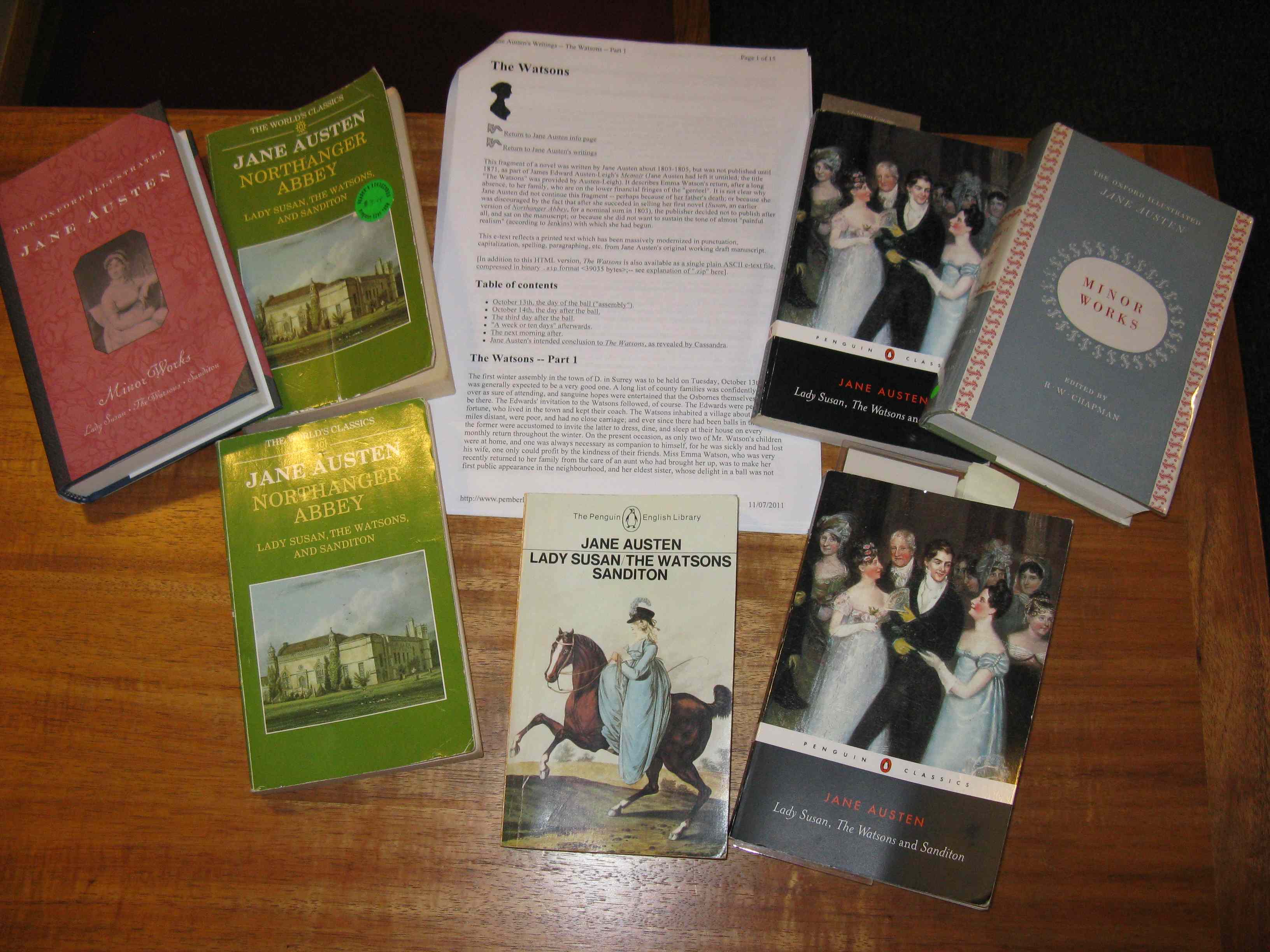
Book covers for Jane Austen's The Watsons

Book covers for Jane Austen’s The Watsons

Jane Austen fans, as you probably know, do a lot of re-reading. Given we only have six complete novels, plus her juvenilia and a couple of unfinished novels, we have little choice. Fortunately, it’s not a chore! And so, having completed rereading all her novels over the last few years for their respective 200th anniversaries, my local Jane Austen group decided to return to her two unfinished novels, starting this month with The Watsons. This was the third time we’ve done it in our relatively short existence. We did it in 2008 and again in 2011 (at which time I wrote my own reflections for this blog).

I do not plan here to write a “proper” review, so if you are interested in my thoughts, please check the link above. However, there are a couple of additional comments I’d like to make, starting with the question I posed in my 2011 post. The question relates to its unfinished nature. There are in fact two main questions regarding this: why did she stop writing it and why didn’t she pick it up again? And here I’ll quickly recap the novel’s background for those who don’t know it. The Watsons was written in Bath probably around 1803-1805, though there isn’t complete consensus about this. It’s commonly believed that she abandoned it after her father’s death in 1805 because of sadness and the resultant uncertainty in her living conditions. Whether this is true or not, it is true that she didn’t take up serious writing again until she settled in Chawton in 1809.

Now, it was at Chawton that she took up two earlier works, which became her first two published books, Sense and sensibility and Pride and prejudice. Why did she not then take up The Watsons and rework/finish it too? This is the more interesting question, I think, than why she stopped it in the first place. There are some theories around, though I haven’t investigated them thoroughly. However, her nephew James Austen-Leigh, who wrote the first “memoir” we have about her life, conjectures that Austen had become aware of “the evil of having placed her heroine too low, in such a position of poverty and obscurity” but I’m not sure I buy it.

My group discussed this idea, and we all felt that Austen had other “poor” heroines, of whom Fanny Price is the obvious example. But, the Dashwood girls were not well-to-do either. It’s true that Austen’s plan for The Watsons, as Cassandra reported, was for things to get worse for our heroine, but still …

No, my idea is different. The Watsons is broadly about four sisters and their marriage prospects – as is Pride and prejudice and Sense and sensibility. When we look at The Watsons, which Austen started after drafting those two books, we can see characters and storylines which remind us of these first two books. And so, I wonder whether, having published P&P and S&S, Austen felt she didn’t have enough new ideas to add to this storyline and wanted to try something different. Certainly, the next book, Mansfield Park, was something different. The marriage plot is still there, but it’s about a poor relation who is taken in by her wealthier ones. The interesting thing is that The Watsons commences with the return of 19-year-old Emma Watson to her family having spent 14 years with a wealthy uncle and aunt. Perhaps Austen decided to explore the story of the poor relation from a different angle, from the time of arrival at the new home?

Another thing about The Watsons is that as well as having characters who remind us of those first two novels, it also has characters reminiscent of some in later books, particularly in Emma. This suggests that while she didn’t finish The Watsons, her work on it wasn’t wasted – and she knew it.

We’ll never know of course. There’s so much we don’t know about our Jane, but it is fun trying to fill in the gaps.

A couple of apposite quotes

There’s more I could explore about this tiny fragment of around 17,500 words, but I’ll save those for the next re-read! Instead, I’ll conclude with two excerpts which grabbed my attention this time.

Gender and money

The first is a conversation between the heroine Emma and the wealthy aristocrat, Lord Osborne, who is interested in her, though his regard is not returned. In this conversation, he suggests that all women should ride horses:

‘I wonder every lady does not. – A woman never looks better than on horseback. –’
‘But every woman may not have the inclination, or the means.’
‘If they knew how much it became them, they would all have the inclination, and I fancy Miss Watson – when once they had the inclination, the means would soon follow.’
‘Your lordship thinks we always have our own way. – That is a point on which ladies and gentlemen have long disagreed. – But without pretending to decide it, I may say that there are some circumstances which even women cannot control. – Female economy will do a great deal my Lord, but it cannot turn a small income into a large one.’

Here we see Emma’s mettle. She stands up to Lord Osborne – to his assumptions about women and to his obliviousness that not all people have the means he has.

On reading to escape

And finally, The Watsons contains another of those wonderful quotes by Austen about books and reading. Here, right near the end of the fragment, Emma is thinking about the downturn in her fortunes through the death of her uncle:

The evils arising from the loss of her uncle were neither trifling, nor likely to lessen; and when thought had been freely indulged, in contrasting the past and the present, the employment of mind, the dissipation of unpleasant ideas which only reading could produce, made her thankfully turn to a book.

So, even in 1805, reading was seen as a way to occupy the mind and so escape, for a while, the troubles of life.

Jane Austen
“The Watsons”
in The Oxford illustrated Jane Austen. Vol VI, The minor works (ed. R.W. Chapman)
London: Oxford University Press, 1969
pp. 315-363

Jane Austen, Lady Susan (Review)

AustenLadySusanPenguinIt is a truth universally acknowledged – I know this is a tired old joke but I seem programmed to do it – that Jane Austen fans will collect multiple editions of her works. There are many reasons for this behaviour, but one of them is our interest in different introductions. And so, although I already had a copy of Lady Susan, in the Minor works volume of R.W. Chapman’s The Oxford Illustrated Jane Austen, I bought the Penguin edition for my Kindle because it had an introduction by Margaret Drabble. And I have a second confession to make: this is a rereading, but my reason for rereading has little to do with the reasons I gave in my recent post on Flanagan. The reason is simple – my local Jane Austen group decided to schedule it for our October meeting. I was happy with that. As far as I’m concerned all bets are off my usual “rules” when it comes to Jane Austen.

If you’re not an Austen fan, you may not have heard of Lady Susan. It is a complete novella that sits between her Juvenilia and her adult novels. It was written, we believe, in 1793/4 when Austen would have been 18-19 years old, but was not published until 1871, well after her death, when her nephew James Edward Austen-Leigh included it in his memoir of her.  It is epistolary in form, something she tried again with Elinor and Marianne. While this latter one she rewrote in her well-known third person omniscient voice, retitling it Sense and sensibility, for some reason she didn’t go back to Lady Susan. One reason might have been its subject matter.

 “the most accomplished coquette in England” (Reginald of Lady Susan)

Lady Susan is a beautiful, 35-year-old widow of four months, who is already on the prowl for a new, wealthy husband. The novel opens with her needing to leave Langford, where she’d been staying with the Manwarings, because she was having an affair with the married man of the house, and had seduced his sister’s suitor, Sir James Martin. She goes to stay with her brother-in-law Charles Vernon and his wife Catherine, whom she’d done her best to dissuade him from marrying. She’s not long there before Reginald, Catherine’s brother, arrives to check her out because, from what he’s heard,

Lady Susan possesses a degree of captivating deceit which must be pleasing to witness and detect.

Of course, the inevitable happens and the artful Lady Susan captivates him. Meanwhile, Lady Susan wants her 16-year-old daughter, Frederica, to marry Sir James, the man she’d seduced away from Miss Manwaring – but sweet, sensible Frederica wants none of this weak “rattle” of a man.

You’ve probably worked out by now that this is not Austen’s usual fare. Lady Susan belongs to the 18th century tradition of wickedness, lasciviousness and adultery, forced marriages, and moralistic resolutions. The novel’s characters tend to be types rather than complex beings, and it is racily written, with a broad brush rather than a fine pen. And yet …

“Lady Susan is not wholly a villain” (Margaret Drabble)

This is also where Austen’s mature touch starts to appear. For all Lady Susan’s self-centred “bewitching” machinations, she is also, as Drabble says, “witty, energetic, intelligent and charming”. Drabble and other critics argue that Lady Susan’s spirit can be seen in characters like Elizabeth Bennet, Emma Woodhouse and, particularly, Mary Crawford who, like Lady Susan, comes from London where she moved in “fast” circles. How could a teenaged country parson’s daughter imagine into being such a duplicitous character? Austen was, we know, a great reader and read the gothic novels of her day. She also knew the behaviour of Mrs Craven, the mother of her neighbour Mrs Lloyd. According to Drabble, Mrs Craven “had treated her daughters shockingly, locking them up, beating them and starving them, until they ran away from home …” just as Lady Susan’s daughter ran away from school. And, as her letters demonstrate, Austen was capable of bite.

We don’t know why Austen didn’t pursue this book, besides making a good copy of it in 1805, or why she didn’t try again to write about a beautiful 35-year-old widow.

Hints of what’s to come

All this is well and good, and I loved the read, but my main reason for reading these early Austens is their insight into the writer to come – her wit and irony, and her commentary on human nature. Lady Susan, having been written on the cusp of her maturity, is particularly interesting in this context. The melodrama, for example, is toned down, compared with the books Austen would have been reading. Frederica isn’t locked up as she might have been in Walpole’s Castle of Otranto (my review), there are no rapes as we see in Richardson’s Clarissa. Austen is moving, in other words, towards the naturalism of her favourite topic, “3 or 4 families in a Country Village”.

I love Austen’s irony, and there’s plenty in evidence here. A good example is when Reginald, completely convinced by Lady Susan, writes to his father of how she has been misrepresented, saying that this

may also convince us how little the general report of any one ought to be credited … I blame myself severely for having so easily believed the scandalous tales invented.

The joke is on him because, of course, he should believe these “scandalous tales”. One of the complexities of the novel is this issue of gossip – who should believe what and whom? As Austen readers know, gossip plays a significant role in her characterisation and plots.

Other ideas and themes that we see in later novels also appear in Lady Susan. Bad mothering is one. Another, more specific, is this delightful comment on accomplishments, reminding us of the discussion between Mr Darcy, Miss Bingley and Elizabeth at Netherfield. Lady Susan writes to her equally scheming friend Alicia Johnson:

Not that I am an advocate for the prevailing fashion of acquiring a perfect knowledge in all the languages arts and sciences; it is throwing time away; to be mistress of French, Italian, German, music, singing, drawing etc., will gain a woman some applause, but will not add one lover to her list.

And then there’s that main reason I love Austen – her terse, pithy commentary on human behaviour. There’s much in Lady Susan, including

but where there is a disposition to dislike a motive will never be wanting

and

Silly woman, to expect constancy from so charming a man!

Have I convinced you to give it a go? I do hope so.

Jane Austen
“Lady Susan”
in Lady Susan, The Watsons, Sanditon
London: Penguin Books, 2003
Kindle Edition EISBN: 9780141907901

Available in e-text.

Helene Hanff, 84 Charing Cross Road

Before you all (well, those of you of a certain age at least) gasp and wonder how it could be that I haven’t read this delightful little tome before, I assure you that I have. However, on our drive home today from our week at the coast, we listened to an unabridged audiobook version, and I can’t resist sharing some thoughts from this most recent acquaintance with the book.

For those of you who haven’t read it, 84 Charing Cross Road could I suppose be described as a sort of epistolary memoir. It comprises the correspondence between an American writer and bibliophile, Helene Hanff, and Frank Doel of Marks & Co, a London bookshop specialising in secondhand and antiquarian books. The correspondence starts in 1949 and covers the next two decades. Over time, others in the Marks & Co family join in, but the essential relationship is always that between bookbuyer Helene and bookseller Frank. In a horrible bit of blurb writing, it is described on the back of my (almost antiquarian itself) paperback as “the very simple story of the love affair between …”. Well, that cheapens it because it’s not a love affair in the usual sense. It’s a business relationship that also becomes a friendship. He is married, she is not … and no romance ever ensues.

I am not going to write a full review of the “story”, about how Helene sent “care packages” to the staff of Marks & Co to brighten up their postwar rations-ridden lives, about its humour and humanity. Rather, I thought I’d just share a couple of the comments she, a true bibliophile, makes about books and reading.

One is to do with marginalia. Hanff, like me, likes marginalia. She does it herself, and she likes it in the secondhand books she buys. She says in response to a book received as a gift:

I wish you hadn’t been so over-courteous about putting the inscription on a card instead of on the flyleaf . It’s the bookseller coming out in you all, you were afraid you’d decrease its value. You would have increased it for the present owner. (And possibly for the future owner. I love inscriptions on flyleaves and notes in margins, I like the comradely sense of turning  pages someone else turned, and reading passages some one long gone has called my attention to.) (16 April 1951)

Another year, another book gift, and here is her response:

I do think it’s a very uneven exchange of Christmas presents. You’ll eat yours up in a week and have nothing left to show for it by New Year’s Day. I’ll have mine until the day I die – and die happy in the knowledge that I’m leaving it behind for someone else to love. I shall sprinkle pale pencil marks through it pointing out the best passages to some book-lover yet unborn. (12 December 1952).

Hanff was clearly a slow-reader and liked re-reading, but she was not sentimental about books per se. Here she is on managing her books:

I houseclean my books every spring and throw out those I’m never going to read again like I throw out clothes I’m never going to wear again. It shocks everybody. My friends are peculiar about books. They read all the bestsellers, they get through them as fast as possible, I think they skip a lot. And they NEVER read anything a second time so they don’t remember a word of it a year later. But they are profoundly shocked to see me drop a book in the wastebasket or give it away. The way they look at it, you buy a book, you read it, you put it on your shelf, you never open it again for the rest of your life BUT YOU DON’T THROW IT OUT! NOT IF IT HAS A HARD COVER ON IT! Why not? I personally can’t think of anything less sacrosanct that a bad book or even a mediocre book. (18 Sept 1952)

Ellen of Fat Books and Thin Women would agree I think. Check out her recent post in praise of re-reading, and see for yourselves. Those of you who’ve been reading my blog for a while will know that I too am not averse to a bit of re-reading. There is a special joy in revisiting loved books and learning from them anew, isn’t there?

Finally, (only) because I’m missing my Jane Austen meeting today due to the aforesaid travel, I will share with you her discovery of Jane Austen. Hanff, you see, was not one for “stories”. “It’s just stories. I don’t like stories” she wrote in an undated letter around 1963/64. She preferred history (“i-was-there-books”), essays, poetry and the like. However, in 1952, she discovered Jane Austen “and went out of my mind over Pride & Prejudice …”. I’m sure I would have liked Helene Hanff.

Helene Hanff
84 Charing Cross Road (Audio CD)
Read by Juliet Stevenson and John Nettles
Hachette Audio (orig. pub. 1970)
2 hrs (approx) on 2 compact discs
ISBN: 9781405502559

Margaret Atwood, The Penelopiad

Margaret Atwood, The Penelopiad

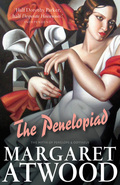
The Penelopiad bookcover (Courtesy: Text Publishing)

This is the second time I have read Margaret Atwood’s The Penelopiad. Much as I enjoyed it the first time around, I probably wouldn’t have read it again if it hadn’t been scheduled for one of my online bookgroups. However, given that scheduling and the fact that I had recently listened to Simon Armitage’s dramatisation of The odyssey, I didn’t mind reading it again – and it is short! My rereading though ended up being a little disjointed as I was trying to finish off a number of competing contracts at the time as well as prepare for a ten-day trip to our warm Top End. This review may be similarly disjointed!

The book is part of Canongate’s Myths series in which recognised writers were asked to retell well-known myths. At the time of publication, Atwood said that she tried a number of myths and had nearly given up when she suddenly recollected the story of Penelope and her hanged maids – and her childhood reaction to it. The result is a rather fresh – and cheeky – look at the story told through Penelope’s and the hanged maids’ eyes, from, not surprisingly, a feminist (or at least female) perspective.

The story is told through a large number of short chapters in Penelope’s voice, and these are interspersed with commentary from the hanged maids, emulating, appropriately enough, the idea of a Greek chorus. The way Atwood uses it, the chorus provides a satiric perspective on Penelope’s view of the story. The story is told in flashback, with the narrators all speaking from Hades, where they now reside. It is not a standard revisionist feminist treatise that simplifies the world to one of gender power discrepancies (even though that is what underlies it all). We get to “feel” what it might have been like to have lived then. Atwood’s characters are “real” and operate in a complex world where game-playing and manipulation are de rigueur if you are going to survive.

In Homer, Penelope is presented as “the quintessential faithful wife” (Atwood’s introduction) who brings up their son and cleverly fends off suitors while waiting patiently for Odysseus’ return. When he returns, he kills the suitors and twelve of Penelope’s maids. Atwood, again in her introduction, says that in choosing to tell the story through Penelope and the maids she wanted to focus on “what led to the hanging of the maids, and what was Penelope really doing?”. Her Penelope is something rather more than the constant wife of The odyssey. She, the part daughter of a watery Naiad, is a slippery character to pin down. She is highly jealous of her beautiful cousin Helen (she of Troy fame) and she is capable of making her own power plays. She is of high birth, contrasting her with the twelve maids who, by their own admission “were born to the wrong parents. Poor parents, slave parents, peasant parents, and serf parents…”.

What I enjoyed most about this book – besides the story Atwood tells – is its sly humour. It is genuinely funny, albeit in a dark or sometimes gruesome way. Much of the humour arises out of Penelope’s playing with the truth. In fact the book plays continually with the idea of “stories”. In the first chapter, Penelope says:

Now that all the others have run out of air, it’s my turn to do a little story-making. I owe it to myself. I’ve had to work myself up to it; it’s a low art, tale-telling … So, I’ll spin a little thread of my own.

A little further on in the book, she says, when reporting one of the prevailing stories about her, that “there’s some [my emphasis] truth to this story”. And so, as we read we need to remember that she too is telling us a story, and that there’s no guarantee that her story is any more “true” than another’s. This idea is reinforced by the fact that the maids comment on what Penelope tells us. Their and Penelope’s perspectives are not always the same. That is, their truths are different. This notion of stories versus stories is made even more clear in the chapter titled “Waiting” in which Penelope recites all the opposing stories and rumours about what Odysseus was doing/what was happening to him during the 10 years of his return. Reader beware, I say. In fact, at one point in the book where Penelope questions whether the “maids were making some of this up”, I wrote in the margin “Where is the truth”? I love the way Atwood plays with myth-making in a book about a myth – and, in doing so, also calls into question her own storytelling. Very postmodern!

I won’t go on. It’s a little uneven, with the maids’ story in particular being not quite as well integrated as it perhaps could. And yet, I’d recommend it, if you haven’t already read it. It’s clever, funny and compassionate – but its compassion is not a naive one. Rather, it has wide open eyes and knows that nothing is ever as simple as it looks – particularly when you find yourself in a situation where there is imbalance of power. Games will be played – and the powerless, such as women and particularly poor maids, will usually lose. And this, in the end, is Atwood’s (somewhat heavy-handed) point. As Penelope says in her last chapter:

Even with my limited access I can see that the world is just as dangerous as it was in my day, except that the misery and suffering are on a much wider scale. As for human nature, it’s as tawdry as ever.

Margaret Atwood
The Penelopiad
Melbourne: Text Publishing, 2005
199pp.
ISBN: 9781920885953
NB: Cover image used above is from the new 2007 edition.

Helen Garner, The children’s Bach

I’ve said a few times now that I rarely reread books, and then go on to write about something I’ve re-read. I must look like a liar, but the fact is that if I’ve liked a book so much that I’ve reread it it’s likely to find its way here. The funny thing is, though, that my reason for rereading The children’s Bach was not so much because I loved it first time around (though I did enjoy it) but because I read a critic who described it as one of the four best short novels – ever! It’s hard to ignore a commendation like that, isn’t it? And so I read it again …

It’s set in Melbourne, and concerns a couple, Athena and Dexter, who lead a self-sufficient life with their two sons, one of whom is severely disabled. This apparently comfortable life is disrupted by the arrival of Elizabeth, from Dexter’s past. With Elizabeth come her sister Vicki, her sometime lover Philip, and his prepubescent daughter Poppy. Through them, Athena and Dexter are drawn into a world whose ideas and values test the foundations of their relationship.*

This sounds like a pretty standard plot, but from it Garner draws something quite special, something tight and marvelously observed, and something, in the way that Garner has, that is brutally honest. This is the thing that I admire about her most – even though I don’t always agree with her: she doesn’t flinch from unpleasant “truths”. And so, in this book, she tackles the challenge of parenting a severely disabled child. While there are people who talk about the joy and meaning a disabled child brings to their lives there are others who feel quite differently. This is the shock at the centre of this book.

Garner introduces a sense of uneasiness right at the beginning with a photo of Tennyson and his family (why Tennyson, I’m not quite sure) which shows them together but not quite together and which is described simply as “the photo of a family”. The photo is old but Dexter keeps sticking it back up again. This beginning is followed by a fairly idealised image of Dexter and Athena as a loving, supportive couple – “she loved him. They loved each other” (p. 4) – and then Garner slowly reveals the cracks. Dexter’s idealisation of Athena is one cause, but the disabled child who holds Athena back, is another. The arrival of Elizabeth and her entourage – with their different and challenging ways of viewing the world – is just the catalyst.

Athena’s harsh attitude regarding Billy, her disabled son, is psychologically real, but is shocking to see in a character who is idealised as the earth-mother. Our readerly assumptions take a knock! Early in the story Athena looks at handprinted cards of places for rent:

… Athena was … scanning the window covered in handprinted cards on which people advertised rooms to let in their rented houses. Athena lived, for as long as it took to read a card, in each sunny cottage, each attractive older-style flat, spacious house, quaint old terrace, large balcony room with fireplace, collective household with thriving veggie garden. Her children dematerialised, her husband died painlessly in a fall from a mountain. What curtains she would sew, what private order she would establish and maintain, what handfuls of flowers she would stick in vegemite jars, how sweetly and deeply she would sleep, and between what fresh sheets.

This could be typical daydreaming but it’s pretty specific in detail (children dematerialised, husband dead): it’s Garner telling us that Athena feels trapped and is ready for change. Then Philip comes along and she is attracted to him; she’s not morally repulsed the way Dexter is by his behaviour: “Dexter lay rigid as a board … but Athena slept, and dreamed that she was in a garden….”.

And so, Garner writes, “The edifice crumbles”. The cracks have been there, in the edifice, but Dexter is (has been) oblivious to them. He’s a kind man but he’s pretty unaware of how other people feel; he expects them all to see life as simply, as happily as he does. But this is not the case – as he finds out …

All this is told in tight, expressive language.  Here is a delicious description of Dexter’s mother:

Like many women of her age whose opinions, when they were freshly thought and expressed, had never received the attention they deserved, Mrs Fox had slid away into a habit of monologue, a stream of mild words which concealed the bulk of thought and knowledge as babbling water hides submerged boulders. (p. 101)

Garner focuses on the gap between appearance and reality, particularly regarding the problems of idealisation (of self and/or of other). Athena is idealised but is shown to have feet of clay; Dexter is also idealised and idealises himself – until his own fall from grace: “he was in its moral universe now, and he could never go back”.

We can read this book in two – not totally exclusive – ways. One is psychological and relates to the realisation of self, particularly for Athena. The other is social and relates to role definitions, again particularly for Athena in terms of the expectations of her as wife and mother. One of the things that Garner tends to do well, in fact, is explore the point where social expectations of how we should feel meet and often clash with our real emotional selves. We see this clearly in The spare room where the character Helen shocks us with her anger at her dying friend.

I have really only touched the surface of this book – there is the music motif to consider, and the conflict of values represented by the intrusion of Elizabeth and her entourage into Dexter and Athena’s world – but I have talked about some of the issues that grabbed my attention and that, I think, will do!

* This is, essentially, the plot summary I wrote a couple of years ago for the Wikipedia article on the book.

Helen Garner
The children’s Bach
Penguin Modern Classics, 2008 (first published 1984)
180pp.
ISBN: 0869140299

Jim Crace, Being dead

The old “so many books, so little time” mantra means that I very rarely read a book more than once (other than my Jane Austens of course), but I have read Jim Crace’s Being dead twice. I love this book. I know some find the subject matter unappealing but I find it not only fascinating but rather beautiful.

Beach near Bermagui, New South Wales

Beach near Bermagui, New South Wales

For those who haven’t heard of this novella (really), its plot centres on a murder. Joseph and Celice, a middle aged couple (and, significantly, zoologists), are bashed to death on a secluded part of a beach at the book’s beginning and, from this point, the story moves in multiple directions to explore a number of before and after scenarios relating to this event. In fact, one of the things I like about the book is its four-part structure, and its forwards-backwards movement in time as the different strands of the story are played out. Crace moves backward from the moment of their death to the beginning of that day, and alongside this he recounts forward the story of their relationship from the point of their meeting. The third strand concerns their daughter as she reacts to the news of their disappearance, and the final strand, which is the one that turns off some readers, chronicles the decomposition of their bodies as they lie undiscovered in the dunes. It’s not for nothing he makes them zoologists!

Near the end of the book is a clue to why Crace has chosen this structure. He writes that “Earth is not a visionary and can’t be blamed for what’s ahead. It is retrospective … It is the past that shapes the world, the future can’t be found in it”. It seems to me to be a pretty fatalistic – what will be, will be – view of the world, and one I rather like. I don’t think he’s quite saying we can’t change our world but he is saying that what we do, what is now, shapes it and our lives, that there’s no future mystery out there waiting to make something of us. Right near the end is this:

Nothing could be changed or amended, except by the sentiment of those who were not dead. That’s the only Judgement Day there is. The benefits of hindsight. The dead themselves are robbed of hindsight.

So what about the characters who are the focus of all this? Crace has in fact chosen pretty ordinary, fairly unlovable (except to themselves) not-particularly-admirable characters. By doing this he makes the point that we all have our lives, that the only really important thing is love, and that there is dignity in that. As he writes: “Love songs transcend, transport, because there is such a thing as love”.

And it is all told in language that is rhythmic and oddly beautiful despite the horror of the subject matter:

The corpses were surrendered to the weather and the earth, but they were still a man and wife, quietly resting; flesh on flesh; dead, but not departed yet.

Crace is a great stylist, I think, which is why he can tell such a story in four parts but in less than 200 pages. Take the title for example: the use of the present participle “being” is very telling. Present participles imply action, continuation, ongoingness, but death is usually seen as the end. In this book there are several continuations: the world, the natural world in particular, continues, and Joseph and Celice’s love continues. Oh, and they stay dead. Great title.

So, to labour the point, his message is that we and only we make our lives:

There is no remedy for death – or birth – except to hug the spaces in between. Live loud. Live wide. Live tall.

Carpe diem I suppose – but an oh so eloquent evocation of it!