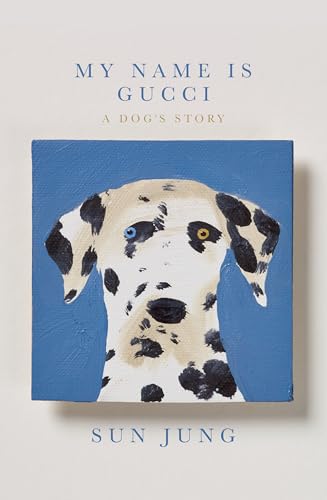
Some reading synchronicities – those coincidental connections that happen between books we read in a short period of time – are zeitgeist-related. For example, grief is not my go-to, but it is a common theme in contemporary writing so it’s not entirely remarkable that I have written three reviews since January about books focused on grief. What is remarkable is that, in the same period, I have read two books, written nearly 80 years apart, which are told from the perspective of dogs. This surely takes synchronicity to a whole new level – wouldn’t you agree?
A canine perspective is, however, where the synchronicity ends, because Dusty (my review) is told third person through two main voices, Dusty’s and his owner’s, and Dusty is very much a dog. He has no knowledge beyond what he knows as a dog. Gucci, in Sun Jung’s My name is Gucci, is something very different. Not only is he the novel’s sole first person narrator, but he has been reincarnated many times, so has a wealth of knowledge and experience way beyond that of a typical dog. Indeed, as he tells us, he is a “sage”, and an erudite one at that. Now, before you click away, thinking non-human narrators and ideas of reincarnation are not for you, do read on, because Jung makes this work, creating a story that is not only charming and often delightfully humorous, but also thoughtful about life and the connections we make.
Gucci is a Dalmation-like bitzer. At the book’s opening, he is five-years-old and living in a Singaporean animal shelter. He’d given up ever being rescued, when, seemingly out of the blue, “she” appears, and whisks him off to Sydney. Is this destiny? This never-named she, it turns out, has been connected to Gucci, in earlier lives, through their inyeon. Inyeon, the book’s glossary explains, is “Karmic relation or destiny”, but in fact our two are connected through the rarer form of “perpetual-inyeon”. This is “a persistently recurring Karmic relation between two beings through their numerous past lives”, one built on the understanding that “interactions must be mutually beneficial”. Gucci tells us:
I have been reborn three times during her present life; interestingly, and quite unusually, all three rebirth were dogs and all had one absolute karmic duty – to help her to collect and rekindle the shattered smithereens of inyeon that she had long lost.
Notwithstanding this idea of inyeon, the obvious question is, of course, why choose a dog as narrator. Telling a story through a non-human character is not only not easy, it’s a risk, so why? I don’t know Jung’s reasons, but the driver must surely be that unusual narrators have something useful to offer – tone, maybe, or experience or a different way of thinking. Gucci meets all of these. He has some painful things to share about her life, but does so in a lighter tone, which feels more acceptable from a non-human character. Further, as a dog who has experienced the world differently from humans, he can offer different insights into her experiences, not to mention those of humans in general. And, finally, he can illuminate important things about human-animal relationships.
“nothing is absurd”
My name is Gucci is not a hard read, but it does require concentration because we move back and forth in time, in her life, as it intersects with Gucci’s lives – as Nari, the Jindo dog, who dies in an accident when she is 9; as General, the Sapsal-cross dog, who was forced to work as a fighting dog, and is euthanased when she is 13; and of course as Gucci in her present life, now helping her confront and perhaps reconcile the traumas of her past. She had a difficult childhood in Korea, which is where Nari and General know her. The product of an adulterous union between a married man and a melancholic young woman (jageun umma), she is removed from this birth mother when she is 4 years old to live with her father’s wife (keun umma). Keun umma accepts her, with kindness and love, but not so keun umma’s mother, the “old hyena”, who is cruel to this “filthy child” brought into her home.
The time shifting, then, occurs between her past life in Korea, with Nari and General, and her current life in Sydney’s Kings Cross and Darlinghurst, where she is married to an Irishman, but haunted by her past. It’s no surprise to Gucci that she is a “horror novelist … [of] … spinechilling and gory urban mythologies”. In telling his and her story, Gucci is often insouciant if not downright playful, but he is also wise and philosophical, as he guides her and us through the challenges of coping with past experiences which threaten to undermine the present.
Closely associated with this idea of past and present is that of “destiny”. It is a constant thread in the book, and it discomforted me a little, perhaps because as a Westerner, the idea of destiny doesn’t sit easily with my world view. However, if we reframe it to encompass the way past experiences impact present and future actions, then it works – for me, and for the book, where the idea of fate/destiny/luck is variously respected, or upended or foiled, or treated sceptically by her Irish husband. There’s no one answer – just perspective and tolerance for difference.
Much of this story is serious. Bad things happened to her in her childhood, and Gucci reflects on the hows and whys. Early on, she is ostracised at school because of her “impure heritage”. Thinking back to their Seoul home in the suburb of Itaewon, which means “village of strangers”, Gucci wonders “what is being strange or different? Different to what?” Why do humans demonise, or make fun of, those who are different? My name is Gucci is full of good questions and wise ideas, but they are not laboured. Instead, Gucci keeps the story moving forward, with warmth and compassion, leavened by humour that is, at times, lightly satirical. There is a delightful scene when she takes her young Irish boyfriend to Korea, and, after a boozy night they go out for a “hangover cure” breakfast:
Bleary-eyed and with a severe hangover, he could not believe his misfortune as he stared at the abalone congee bowl.
Finally, there are the stories about human-animal relationships. Some of the funniest scenes in the book come from these, such as the Kings Cross apartment dog-wars, between dog-lovers and dog-haters. But there are tough stories too, like the sport of dog-fighting which destroys General’s life. This book pays tribute to the importance of our relationships with our animals.
Early on, Gucci forestalls our potential scepticism about his story by claiming that “if you look at everything in the world as connected by the complex web of inyeon, nothing is absurd”. Well, I have a high tolerance for the absurd, anyhow, but even if I didn’t, Gucci is such a delightful guide that I was in for the duration. If you want to read something that’s meaningful but doesn’t weigh you down, try this one.
Sun Jung
My name is Gucci: A dog’s story
Melbourne: Transit Lounge, 2024
254pp.
ISBN: 9781923023178
(Review copy courtesy Transit Lounge, via Scott Eathorne, Quikmark Media)





 Whispering Gums