Andrea Goldsmith, Reunion

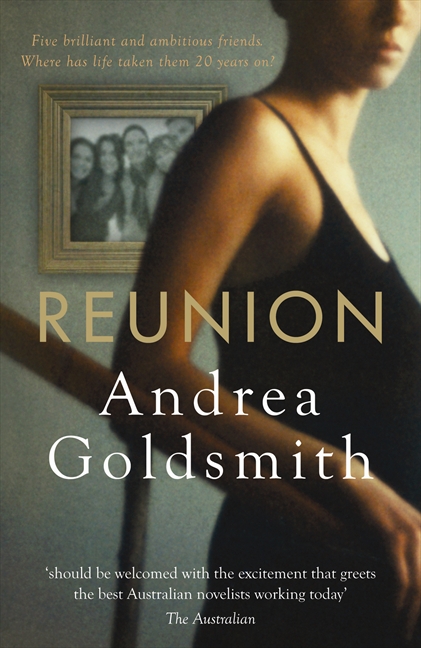
Andrea Goldsmith, Reunion bookcover
Reunion bookcover (Courtesy: HarperCollins Australia)

I wanted to love Andrea Goldsmith’s Reunion. And I expected to, as I remember enjoying the last book of hers that I read. But, somehow, I found it a bit of chore to read, though it did pick up towards the end. I think I understand why it was not listed for the 2010 Miles Franklin Award.

Friendships become swaddled in invisible protective layers and nothing short of a cataclysmic blow can break through to the inevitable stress points beneath.

The plot is fairly straightforward. Four university friends (three students, borderline baby-boomers and now in their mid-40s, and a lecturer, now around 60) find themselves all living in Melbourne again after some 20 years apart. All four had met in Melbourne, had moved together to England to continue studies and work, but had then gone their separate ways. At the beginning of the novel Jack, an academic and Islamic expert, is single and still in love with Ava; Ava, a novelist, is married to the unpopular Harry; Helen, a scientist, is a single parent; and Connie/Conrad, a philosophy lecturer, is on his third marriage but still philandering. Harry, who met them in England, is on the outer, but it is he who has engineered the reunion under the auspices of an organisation he has created, NOGA (Network of Global Australians).

The novel, then, is about this time of reunion: it explores who they are now, and the state of their relationships with each other. Sounds like the sort of thing that would interest me – Melbourne setting, characters with whom I would expect some level of identification, themes exploring love and friendship, and a writer whom I’ve enjoyed before. None of these, I should add, are essential for my reading enjoyment – I also like books set in exotic places and about very different characters – but familiarity often appeals too (doesn’t it?).

And yet, for me the book fell a little flat. It just didn’t feel quite original enough – in either ideas or language. It felt a little same-old-same-old. That said*, I found the characters interesting and convincing, although only one, Jack, changed in any significant way as the novel progressed. The narrative mode is multiple 3rd person subjective, with Jack’s perspective starting and ending it. It is told, chronologically, but with flashbacks to fill in the past. All this is well controlled and keeps the story moving nicely.

Goldsmith ranges across a lot of themes – love and friendship (of course); truth and fiction; secrets and memory; passion and obsession; modern communications; revenge and forgiveness; and science, ethics and politics. It is probably here that the novel palled most for me because many of these themes seem to go nowhere. Take the truth and fiction one. Those of you who read my blog know that I enjoy seeing this issue explored, but in this novel it’s raised, often with a nice level of irony, but is not really developed. For Ava, the novel writer, “there was no better vehicle for truth” than fiction, whereas for the scientist, Helen, “Ava’s work is only fiction – none of it is true”. Well, I thought, Goldsmith will unpack the ironies contained in these, but she doesn’t really. Perhaps that’s OK, perhaps it’s enough for us to notice them, but I wanted more.

At other times, the themes seem more like the author’s soapbox than ideas fully integrated into the story, albeit that the characters are her mouthpieces. Here, for example, is Jack expressing a rather stereotyped view of modern communication:

Whenever Jack looked back to his university experience and compared it with today’s university student life, so much seemed to have changed – even friendship itself. Without computers and mobile phones, face-to-face communication ruled the day.

The implication is that modern friendships are somehow less meaningful, but what does he really know and, further, what does the novel show us about it? Nothing really. Similarly, Helen rages about political interference in science, but the issue, while valid enough, seems a little fabricated in the context of the novel.

There are some funny set pieces, such as the young television make-up artist trying to hide Connie’s aging neck. Goldsmith does irony well – something I, as a Jane Austen aficionado, rather enjoy – and she peppers the novel with a lot of effective literary allusions – to Waugh, Wharton, James, and others. Moreover, there are some lovely descriptions, such as this one on Ava’s discomfort during her first weeks in England: “It was like being stranded on a sheet of clear glass with nothing but blackness underneath”. I’m not sure why I like this, but I do.

I’ve struggled to write this review, really, because there are things to like about this book. I decided to do a quick review of reviews out there and what I mostly found were positive reviews that each had some little reservation: “despite that minor misgiving”, “a rich and at times frustrating novel”, “despite a few stylistic glitches”, and “the novel was marred but not spoiled for me by …”. None though explored these reservations in any depth.

And so, rather than labour any more, I will close with the words of Helen’s teenage son, Luke. He says, in that simple, direct way that the young can do:

The truth can hurt. But that doesn’t make it less right.

The final irony is that Harry is hurt by a truth – but the truth he is hurt by and the real truth of the matter are two quite different things. And that, in the end, made the novel an interesting if not totally engaging read.

For a more positive perspective on this novel, check out Lisa’s at ANZLitLovers.

Andrea Goldsmith
Reunion
London: Fourth Estate, 2009
414pp.
ISBN: 9780732287832

*See my previous post on words to avoid!
David Malouf, Ransom

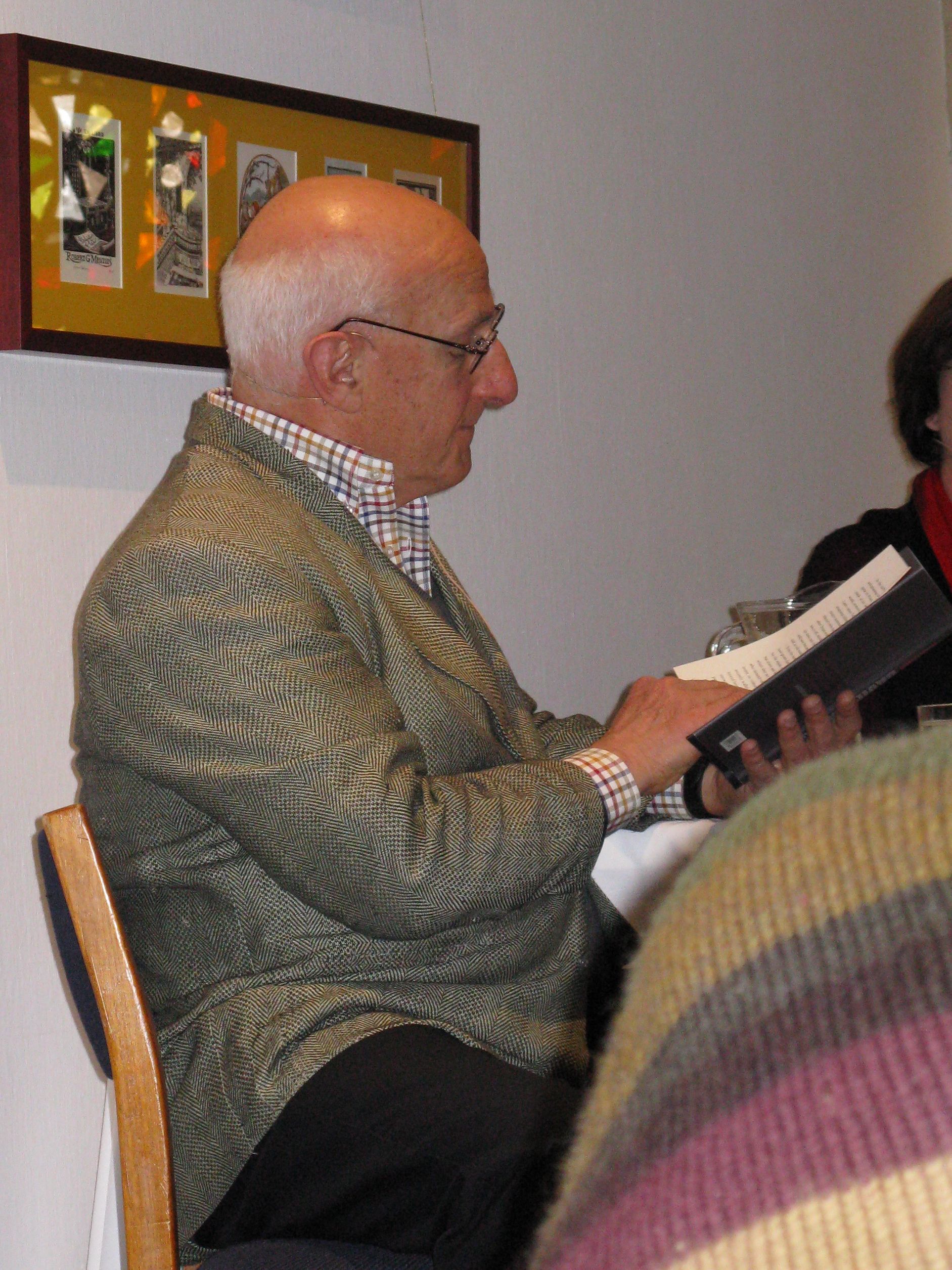
David Malouf reading Ransom

Malouf reading Ransom, National Library of Australia, August 2009

Words are powerful. They too can be the agents of what is new, of what is conceivable and can be thought and let loose on the world. (p. 61)

Is risk-taking only the province of the young? Do desperate times call for desperate measures? Or, more to the point, can the impossible be made possible? These are some of the questions that form the core of David Malouf’s most recent novel, Ransom.

WARNING: Spoiler if you don’t know the Iliad!

Ransom, as I wrote in my post last year, is Malouf’s re-visioning of the section of the Iliad (from Books 16-24) which chronicles Patroclus’ death at the hands of the Trojans, Achilles’ revenge killing of the Trojan prince Hector and his subsequent abuse of Hector’s body, and Priam’s visiting Achilles to ask for his son’s body back. Malouf says that he wanted to suggest a new kind of human, non-heroic consciousness, by re-visioning how Priam does this through deciding “do something extraordinary” (Malouf’s words). As Priam discusses with his wife Hecuba

I believe … that the thing that is needed to cut this knot we are all tied up in is something that has never before been done or thought of. Something impossible. Something new. (p. 58)

and

there might be another way of naming what we call fortune and attribute to the will, or the whim of the gods. Which offers a kind of opening. The opportunity to act for ourselves. To try something that might force events into a different course. (p. 61)

Ah, I thought, here is going to be Malouf’s vision (or recipe even) for our conflict ridden times. He wants to show, through Priam’s desire to do “something impossible. Something new” that  there is another way of managing conflict. But sadly, that is not what he is about. Sure, Priam does do something audacious – he enters Achilles’ compound as an ordinary man on a plain mule-driven cart driven by an even more ordinary man, the humble carter, Somax. But, I was disappointed, because after a lovely interval of humanity the story plays out as it always does with Achilles dying, and Priam being brutally killed by Achilles’ son. What I hoped Malouf was setting me up for wasn’t his goal at all. It was something both bigger and smaller. Smaller because he is not (really) making a political statement for our times, and bigger because he re-visions the story as one of humans rather than of heroes, and as one in which humans can be self-directed rather than at the whim of the gods. There is some irony here though because, as well as being accompanied by the humble Somax, he is for a while escorted by the god Hermes who facilitates their entry into Achilles’ compound. I did wonder about the meaning of this unlikely trio – common man, king, god – but it is in the original and so is not really part of a new message. That said, this is, as I am sure you are starting to realise, quite a complex book despite its small size – and I am only going to touch the surface here.

Some of the loveliest parts of the book are in fact the most human ones, such as the conversation Priam has with Hecuba when he reveals his idea, and Priam’s journey with Somax in which he learns to enjoy ordinary human (as against royal) pleasures. (“It had done him good, all that, body and spirit both”).

In the end after a beautifully rendered meeting with the conflicted Achilles, Priam achieves his goal and brings Hector’s body back for burial. It is a triumph of his vision, but

It is only a provisional triumph, of course; the gods are not to be trusted when they tilt the balance momentarily in your behaviour. And what sort of triumph is it to be bringing home the body of a son? But he has done something for which he will be remembered for as long as such stories are told …

Yes, he is “a man remade” because he has done a “deed that till now was never attempted”. Achilles too has been transformed (at least for a while): he is “visited by a lightness that is both new and a return”. But, and unfortunately there is a but, the story plays out as it always has…

So, what is it all about – besides, that is, the underlying themes relating to fathers and sons, grief, will versus fate, and humanity versus the gods? Perhaps it is simply this, that you can dare to try the impossible, and you can triumph. How big that triumph is, how long it lasts, is perhaps not the right question. The right question is the original one, “Dare I dream, and dare I do it?” It is also about the power of stories. Priam’s action will now be remembered “for as long as such stories are told”, while his killer, Achilles’ son, Neoptolemus, is not so lucky. The murder is a messy one and so “for him … however the story is told and elaborated, the raw shame of it will be with him now till his last breath”.

David Malouf Ransom

UK edition cover (Used by permission of the Random House Group)

In its rather ironic and paradoxical way, then, Ransom is redemptive … and is beautiful for all that. And yet, I do have this little nagging feeling that I’d have liked it to have been a little more. I did in fact want a recipe for our times, a suggestion that we can move our humanity forwards!

David Malouf
Ransom
North Sydney: Knopf, 2009
224pp.
ISBN: 9781741668377

Sarah Waters, The little stranger

The little stranger, by Sarah Waters

The little stranger (Book cover courtesy: Virago Press)

I’m not quite sure I know where to start with this one –  the ghost story that isn’t. Or is it? The little stranger is my second Sarah Waters’ novel. I found The night watch riveting, and I did see and enjoy (but not read) her very Dickensian Fingersmith.

Like The night watch, The little stranger was shortlisted for The Man Booker Prize. It’s an easy read, and rather a page-turner, but by the end I have to say that I felt a little unsure about what I’d read. In one of those interesting bits of reading synchronicity, I recently read Helen Simonson’s Major Pettigrew’s last stand. It is very different to this one, and is set a few decades later, but they both deal with the loss of “old families” and the breaking up of their estates. Waters, though, is the far superior writer.

So, what is the plot of The little stranger? Its first person narrator, Dr Faraday, was born to the working class but, through family sacrifice, has pulled himself up into the professional middle class. After a brief flashback to a childhood memory of Hundreds Hall, where his mother had worked as a housemaid, he proceeds to chronicle the relationship he develops with the Hall’s family when he is in his late 30s and practising in the nearby town as a GP. The family comprises the mother, Mrs Ayres, and her adult children, Caroline and Roderick. The book is set soon after World War 2, and the story he tells occurs over the period of about a year, but is told from the vantage point of some three years later.

Waters is best in her vivid description of the house, its inhabitants and its increasing dilapidation. I’m tempted to read the house as a metaphor for the society it represents – for the days of elegance and upstairs-downstairs that are now on the way out.  And, extending this idea, “the little stranger” (or “dark germ”) that seems hell-bent on bringing about the house’s destruction could then be seen as a metaphor for the rapid modernisation that was occurring in post-war England and that was pushing the old families to the brink of economic and, thereby, social ruin. After all, servant Mrs Bazeley reassures the young servant girl Betty that “it” is not interested in them.

To support this way of looking at the novel, here is Dr Faraday early-ish in the novel:

But Hundreds Hall had been made and maintained, I thought, by the very people they were laughing at now. After two hundred years, those people had begun to withdraw their labour, their belief in the house; and the house was collapsing, like a pyramid of cards. Meanwhile, here the family sat, still playing gaily at gentry life, with chipped stucco on their walls, and their Turkish carpets worn to the weave…

And here is Dr Seeley (to whom he later goes for advice):

The Ayreses’ problem … is that they can’t or won’t adapt … Class-wise they’ve had their chips. Nerve-wise, perhaps they’ve run their course.

Quotes like these support a social change interpretation. And yet, perhaps it is more psychological? Dr Seeley suggests that part of one’s psychology, one’s dream-self , can break loose and become some sort of “psychic force”:

The subliminal mind has many dark, unhappy corners, after all. Imagine something loosening itself from one of those corners. Let’s call it a – a germ. And let’s say conditions prove right for that germ to develop – to grow … What would this little stranger grow into? A sort of shadow-self, perhaps a Caliban, a Mr Hyde. A creature motivated by all the nasty impulses and hungers the conscious mind had hoped to keep hidden away: things like envy, and malice and frustration…

Somewhat supporting this interpretation is Caroline’s report of her mother as saying:

the house knows all our weaknesses, and is testing them one by one.

And so what do you think? Psychological/psychic or social? Or perhaps bit of both? That is, the arrogant upper class family out of touch and unable to adapt (social) releasing all its weaknesses (psychic). I’m not sure that Waters makes the case clearly enough – partly I think due to the ambiguity posed by the narrator.

Her characterisation is in fact coherent and convincing, except for the narrator. How are we to read him? Is he genuine – does he really care for the family? Does he genuinely care for the house and its history? Or, is he a social climber who wants his way into the house any way he can. I must say I couldn’t fully work him out. Is he reliable? The tone is quite reminiscent of that in Ishiguro’s wonderful Remains of the day. Like Ishiguro’s butler, Dr Faraday tells the story from some time after the events, and he peppers his account with such words as “recall”, “I think I noticed”, “must have”, words that suggest that all may not be as he sees it. And in some ways it isn’t, but there is no intriguing twist, neither is there a traditional resolution. As I read I wondered whether he was stringing me along, whether he was the cause of the malevolence. He did after all chip away a decorative acorn from the house on his youthful visit:

I was  like a man, I suppose, wanting a lock of hair from the head of a girl he had suddenly and blindingly become enamoured of.

If he was the malevolence, there is no evidence to suggest it is anything other than unconscious. And further, if he was, it certainly makes the whole class divide story more complex – and, more interesting.

Regardless, though, of how the end comes about, of “who” (one? many? none?) is responsible, it is pretty clear that the winners – if there can be such things in the messy game of life – are the old underclass. Hundreds was, in Dr Seeley’s view, “defeated by history, destroyed by its own failure to keep pace with a rapidly changing world”. It is not surprising, I suppose, that by the end the narrator is both “baffled and longing”.  Social change never has been easy!

Sarah Waters
The little stranger
London: Virago, 2009
450pp.
ISBN: 9781844086023

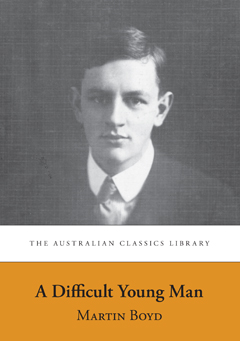
Martin Boyd, A difficult young man

Martin Boyd's A difficult young man
Difficult but handsome (Courtesy: Sydney University Press)

I’m not sure what I was expecting, but I certainly wasn’t expecting the delightful sly wit I found in Martin Boyd’s A difficult young man, which, I understand, is the second book in the “Langton Quartet”. This novel though can clearly stand on its own – otherwise, why would Sydney University Press publish it alone as part of its Australian Classics Library? Is it the best written of the four? The most readable? The one most commonly studied (which goes back to the original question anyhow)? Or was it simple a case of eeny-meeny-miny-moe? (Even “eeny meeny miny moe” has a Wikipedia article – how great is that?) Whatever  the reason, my appetite has been whetted, and the first book, A cardboard crown, will now be promoted in my TBR pile.

Anyhow, back to the serious stuff. I know it was written in a completely different place and oh, nearly a sesquicentenary later, but there’s more than a whisper of Jane Austen about Boyd’s book. Superficially, this book and Austen’s works are very different: this is not a romance – but then neither is that Jane Austen’s focus either; its main characters are male rather than female; it has an autobiographical thread which none of Austen’s novels do; and it uses first person rather than Austen’s omniscient third person narrator. The similarities are, rather, in language (their wit and irony) and form (both write what can be described as social satire). I may be the first person to have put these two authors in the same sentence, but, well, that’s the fun of being a blogger: you can say it as you see it! And what I see is that both writers make me chuckle with their observations on human nature.

So what is the plot? The story is narrated by Guy Langton (a veiled Martin), who is the fourth son of Steven and Laura Langton. He focuses on the late adolescence-early adulthood of the eldest living son, Dominic (inspired by – but not – Merric), the “difficult young man” of the title, who, as the story progresses, manages to fail in, or otherwise mess up, pretty well everything he does. Through the course of the book the family moves from Australia (Melbourne and environs) to the family seat in England and back to Australia again. The book chronicles a number of domestic crises, at the root of which is usually Dominic who somehow undermines “the various attempts to fit him into some place in the world”.  In many ways though, the book is just as much about Guy who, through the process of narration, works to find a balance between “the unaltered impression” of “my childish mind” and “the glaze of adult knowledge”. This is a clever book which reads like, but is not, an autobiography.

It’s an engaging story – not so much for its rather episodic plot as for its array of wonderful and mostly eccentric characters, from the social-climbing arriviste Aunt Baba (who thinks anyone who does “a kindness from which they received no benefit” is silly) to the gentle, wise but somewhat ingenuous father, Steven. My favourite aspect of the book though is its style. I usually enjoy self-conscious narrators, and Guy is definitely that. He regularly addresses the reader directly, reminding us that he can use “the mask of a character in the story” and advising us of which “glaze” he is applying at the time. In this way he lets us know which parts might be more suspect than others in terms of the “facts”, which he recognises as being different from the “truth”:

..but the reader must take certain wild statements as intended for fun, though they contain an element of truth too subtle to be confined within the limits of accurate definition. One can make exact statements of fact, but not of truth, which is why the scientist is forever inferior to the artist.

And this brings us to another concern of the novel – the importance of the imagination. In many ways the book is a hymn to the creative life, a statement of the Boyds’ belief that a life lived without imagination is probably a life not worth living. It also makes a plea for humane values, for peace not war, for gentle not brutal discipline of children, for education that is not conformist. The book is set in the years leading up to World War 1 and the point is made that life before the war – the “secure civilisation” – was to change irrevocably after.

In addition to irony, Boyd uses a wide range of literary techniques rather effectively, such as foreshadowing (which teases us while at the same time directing our understanding), analogies, contradiction, and allusions (particularly to art and literature). All of these imbue the book with a reflectiveness that undermines a focus on plot.

There are so many strands to this novel – its style, diverse subject matter, and characterisation – that would be fun to explore, but that would leave nothing for the rest of you to talk about, so I will finish with a statement made by the narrator towards the end of the novel:

This is really what I am seeking for throughout this novel, the Memlinc in the cellar, the beautiful portrait of the human face, lost in the dissolution of our family and our religion.

I am doubtless romanticising the Bynghams [maternal ancestors], but there is an element of truth in what I write, which is all I ever claim. Also everyone romanticises what interests him.

As he does so often in the novel, he says one thing here and then undermines it immediately after. But it works, and it works because life is messy and contradictory and yet out of this mess and contradiction comes a vision of something that is real and enduring – and that is the transcendence of family, and the importance of imagination.

Martin Boyd
A difficult young man
Sydney: Sydney University Press, 2009 (orig. pub. 1955)
223pp.
ISBN: 9781920898960

(Review copy supplied by Sydney University Press. This is the last of 12 books that my friend Lisa (aka ANZLitLovers) and I received to review. We believe more will be published in this series: if these 12 are anything to go by we are in for a real treat – and the cause of Australian literature can only profit from that.)

Geoff Page, The scarring

Geoff Page (born 1940) is a Canberra-based poet who has been active in the Australian poetry scene for many decades now. He was also, for nearly three decades, an English teacher. Page has published several volumes of poetry and at least three verse novels, of which The scarring is his first.

The scarring, which I read a few years ago but have been wanting to review here, is, I have to say, one of the most gut-wrenching works I have read. Page has set it in the landscape – rural northern New South Wales – of his childhood and says it was inspired by rumours he heard as a child (but it is not a “true” story). The story spans around seven decades from the 1910s to the 1980s, and chronicles the lives of a couple from their youth and courtship through to old age. As the blurb on the back cover says, “their separation through war sows the seeds of their eventual destruction”.

One of the things I love about the book is the way Page weaves so much of the social and political history of twentieth century Australia through the lives of this couple – war, the Great Depression, the boom of the 1950s, city versus country life and values, and of course gender inequity and the old double standard! The scene is set from the first line:

Breed em tough, the old man says.

Little do we know what lies beneath this seemingly innocuous opening – and I’m not about to give it away to you now. Let’s just say that Page deftly weaves the breeding motif through his tale of a young couple running a cattle property.

Here is an example of how history is told alongside life on the farm:

the new white stiffness of the sheets
where Sally will be his forever

‘Forever’ moves on two years more.
The set of skills they share between them
shoves them sideways from the news:
Sudetenland, then through to Munich,
Kristallnacht and into Prague.
It rattles in through bakelite
and once or twice on Cinesound
showing at the flicks in town,
that lifted arm and square moustache
relishing a massed salute.

And so the story moves on to its more or less inevitable – given the events that occur – conclusion. This is not flowery poetry. Page tends more to a spare style that is well suited to his setting and subject.  The poetry’s insistent rhythm draws you on, and Page’s use of repetition slowly but subtly builds up the tension. This is a novel that you’ll want to read in one sitting.

Page is, I think, a little too unsung … but then, isn’t that the case with most poets?

Geoff Page
The scarring
Alexandria: Hale & Iremonger, 1999
111pp.
ISBN: 0868066826

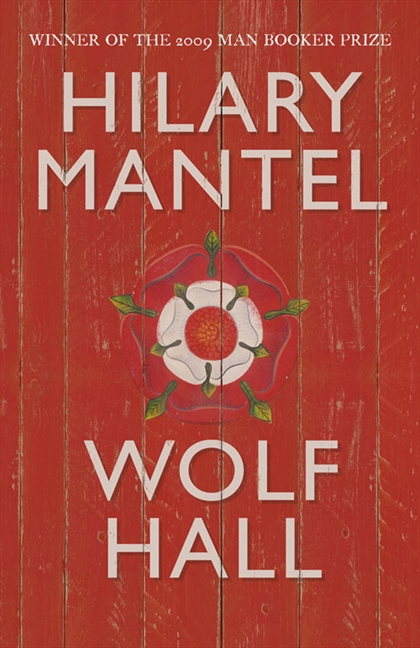
Hilary Mantel, Wolf Hall

An interesting question to ponder when thinking about Hilary Mantel’s Wolf Hall is the significance of the title. While the place Wolf Hall, the family seat of the Seymour family, does get a few mentions it does not really function as a location. Wolves, however, are one of the subtle motifs running through the novel. As its protagonist remembers late in the book:

…homo homini lupus, man is wolf to man.

Hilary Mantel, Wolf Hall

Cover image (Courtesy HarperCollins Publishers)

And, after reading the novel, it would be hard to refute this notion! Wolf Hall is set in England between 1500 and 1535, with most of the action taking place between 1527 and 1535. It deals primarily with the lead up to and first years of Henry VIII’s marriage to Anne Boleyn, but as seen through the eyes of Thomas Cromwell. Its plot centres on the machinations involved in dissolving Henry’s marriage to Katherine (Catherine) of Aragon, who had failed to produce a male heir, so he could legally marry Anne Boleyn; its real subject matter, though, is far wider than that. Its time period – the early years of the English Reformation – and its plot mean that it deals with the major issues of the time, including England’s separation from Rome, the translation of the Bible into English and the relaxing of rules regarding access to the Bible, the Act of Supremacy, and succession to the throne. Running through this are the jostlings for power, the skullduggery, and the betrayals (and suprising acts of loyalty) that are the hallmarks of the Tudor Court. Man was indeed wolf to man then (and I sometimes wonder how much has changed?).

This is an exquisite – though large! – novel. It won the 2009 Booker Prize: I can’t compare it with the others because I haven’t read them, but I did enjoy this immensely. In my recent review of The enchantress of Florence – and what fascinating synchronicity to read these two in sequence – I said that the one word I would use to describe it was “paradoxical”. The word I would use for Wolf Hall is “subtle”. It is subtle in so many ways – in its narrative style, its humour, its irony, its symbolism, its descriptions, its juxtapositions. Nothing here is heavy-handed or overdone.

But first, its narrative style. I was forewarned about Mantel’s use of “he” in this novel and perhaps this helped, because I rarely found it difficult or confusing. In fact, I rather liked the style. It’s a bit like a first-person novel told in third person – third person subjective (limited) point of view, I guess – and so the use of “he” reminds us that it is HIS perspective we are getting. Everything we know we know through him, through his thoughts and through his interactions with others. I found this approach intriguing – it gave immediacy and distance at the same time. And this brings me to the man himself.

Thomas Cromwell, for those who don’t know their English history, rose from very humble beginnings to being Henry’s trusted chief minister. He did this by dint of his character and the timely beneficial patronage of Cardinal Wolsey. He became street-smart in his youth but he also educated himself in the culture (literature and art) of the times. He could speak Latin, Italian and French. He was an accountant and lawyer.  He knew about trade. He was no slouch in the kitchen either. He was, indeed, a jack-of-all-trades. Here is a description early in the book (1527):

Thomas Cromwell is now a little over forty years old. He is a man of strong build, not tall. Various expressions are available to his face, and one is readable: an expression of stifled amusement … It is said he knows by heart the entire New Testamant in Latin … He is at home in courtroom or waterfront, bishop’s palace or inn yard. He can draft a contract, train a falcom, draw a map, stop a street fight, furnish a house and fix a jury…

A man, that is, not to be trifled with – and yet he is a man who develops a large and loving household full of loyal children, relatives and “wards”. Some of the loveliest sections of the book are set in his home, Austin Friars. He is also loyal – sticking by Wolsey, for example, in his decline – and firm, hard even, but not cruel.

However, I don’t want this review to be as long as the book and so shall move on. I loved Mantel’s descriptions – they are always short but highly evocative. Here is the Duke of Norfolk:

The duke is now approaching sixty years old but concedes nothing to the calendar. Flint-faced and keen-eyed, he is lean as a gnawed bone and cold as an axe-head;  his joints seem knitted together of supple chain links, and indeed he rattles a little as he moves, for his clothes conceal relics…

And here is another telling description (after charges against Wolsey have been written):

It is a wan morning, low unbroken cloud; the light filtering sparely through the glass, is the colour of tarnished pewter. How brightly coloured the king is, like the king in a new pack of cards: how small his flat blue eye.

Delicious aren’t they?

The novel ends at an intriguing point – but I won’t give that away here except to say that it does not conclude with the end of Cromwell’s life. That, we believe, is the subject of a sequel.

I would love to keep writing about the characters, the language, the way Mantel puts it all together – such as the way she drops hints then explores them later – but that could become boring. Better for you to read the book (if you haven’t already). Instead, I will end with what is probably the book’s overarching theme – that of “how the world works”, and that is through machinations behind the scenes:

The fate of peoples is made like this, two men in small rooms. Forget the coronations, the conclaves of cardinals, the pomp and processions. This is how the world changes: a counter pushed across a table, a pen stroke that alters the force of a phrase, a woman’s sigh as she passes and leaves on the air a trail of orange flower or rosewater…

It was ever thus, eh?

Hilary Mantel
Wolf Hall
London: Fourth Estate, 2009
653pp.
ISBN: 9870007292417

POSTSCRIPT: Steven, at A Momentary Taste of Being, posted a link to this fascinating article by Hilary Mantel on Thomas Cromwell. It is well worth a read.

Arnold Zable, Sea of many returns

He leaps through centuries, tears apart myths, and reassembles them in his own way.

Sea of Many Returns cover

Cover image courtesy Text Publishing

These words that are said of one of the characters in Arnold Zable’s Sea of many returns could just as easily be said of Zable himself – not only of this book, but of his earlier ones such as Cafe Sheherazade. Zable loves telling stories, stories that weave between each other in an attempt to understand the impact of dislocation and exile on the human psyche – well, on his characters’ psyches but it is not hard to universalise this.

Sea of many returns is, essentially, a dual point-of-view novel:

  • the first person narrator, Xanthe, who was born in Melbourne to an Ithacan father and who tells her story; and
  • the third person story of Mentor, her paternal (also Ithacan) grandfather whose journals she is translating.

The story roams, backwards and forwards, from 1895 to present time as Xanthe and Mentor tell of the lives of their family members in Greece and Australia…about all their leavings and returnings, for work or adventure, or more terribly for war or, simply, to find a better life:

The stories I have heard, and am yet to hear, are echoes of one refrain: Is there somewhere on earth where I can find peace and prosper? Once the question is posed, the agony begins, the eternal dilemma: to stay or leave? To retreat behind fortifications, or cast our fate to the winds? (Xanthe, p. 203)

Underpinning this dilemma is the yearning for Ithaca – which translates, really, to the yearning for place, for home. Towards the end of the novel Mentor discusses the notion of “nostalgia” or “the pain of longing for the return”. Put this together with “the Ithacan phobia, the fear that I may never return” and the result is a melancholic – but not depressing – tone, since it is mostly accompanied by, if not always strength of mind, a resilience of spirit.

Not surprisingly, it’s the men who travel, at least in the earlier times of the book. As Xanthe’s aunt says, resignedly, “Let your men roam distant lands. Let them do what they must. What choice do we have? Bend your back to the mountain. Sow and reap”. And so, while Xanthe talks to some of the women in her Greek family, it is the men whose stories she seeks as she tries to understand her father, the angry Manoli, and her grandfather, Mentor. However, the book’s final section, titled “Epilogue: The resident tiller of the soil”, focuses on 90-something year old Irini who, quite paradoxically Xanthe realises, has not left Ithaca since her arrival there 90 years before and yet “is both voyager and teller, Odysseus and Homer”. This is perhaps a little elliptical but it has a certain resonance nonetheless! And Andreas does mutter in the previous section, “To know one place is to know all places”.

While the novel takes on a mythic overtone, it is “history” which provides its backbone and puts flesh on its characters: there are, for example, the way-too-many wars (to which many men go and from which some return), the 1916 anti-Greek riots in Kalgoorlie, the 1953 earthquakes in Ithaca, and the building in Melbourne of Cafe Australia and the Capitol by the Chicago architects, Walter Burley and Marion Mahoney Griffin. This last one seems a bit odd in terms of the overall thrust of the book but is interesting to one who lives in the city they planned!

I have only touched on a little of what this novel contains – there are the references to the Homeric quest and the story of Odysseus, there is the drunk but wise Niko, there is the beauty of the language in its rhythms and descriptions, and there is music – but if I go on, I might, like its storytellers, never stop. As Andreas says to Xanthe near the end

I have told you one version of the story and tomorrow I may tell it with a different slant. Each word I utter is true and false at the same time …

Paradoxical? Yes! But that is the essence of this lyrical and mesmerising but also rather mystifying – or, is that mythifying – book!

Arnold Zable
Sea of many returns
Melbourne: Text Publishing, 2008
307pp.
ISBN: 9781921351532

Marion Halligan, Valley of grace

Valley of Grace book cover (Courtesy: Allen & Unwin)

Valley of Grace book cover (Courtesy: Allen & Unwin)

Delicious but sly are the first words that come to mind when I think about Marion Halligan’s latest novel, Valley of Grace. Take this for example:

You know, people think flowers are pretty. Sentimental. Frivolous even. But the fact is, everything begins in the garden. Humans. Society. Civilisation. Evil. Things bud, bloom, weather, age, die. There is as much decay as there is burgeoning. Gardens offer emblems of our passage through the world.

Sly because you know she is alluding to the Garden of Eden here but, without the snakes, apples or trees, the garden symbolism is wider, more encompassing than the simple biblical Fall of Man. Delicious because the language flows so beautifully – and it’s typical of the sure writing that’s found throughout the book. The style is relaxed and flowing, even when it is staccato (if that makes sense). It feels conversational, and yet it is not colloquial. And, it contains Halligan’s hallmarks – wonderful descriptions of food and wine, of home and gardens.

The novel is set in contemporary Paris and chronicles a few years in the life of Fanny and her family and friends. At the beginning of the novel she is 25, single, and working with the gay Luc in his antiquarian bookshop, but very soon she marries builder and restorer of old buildings, Gérard, who is 38. There’s no mystery about this – you can see it coming and it comes. What doesn’t come after that is a baby.

There are no big dramas in this book so if that’s what you like, this is not for you. It is however the book for me, because while I can enjoy a book with drama, that’s not what I read books for. I read them for the very things that I got out of this book: astute observation of humans and how we think and behave, combined with writing that delights, inspires and grabs. Valley of Grace explores all the sorts of things that make up human experience – love and friendship, betrayals, secrets, appearance versus reality, and more besides – but most of all it is about babies and children. The having of them, the not having of them, the healthy and the damaged, the child and the god-child, and the wild child are all covered in this neat little book.

And, in fact, as Halligan told us at our bookgroup meeting tonight (to which we’d invited her and she’d wonderfully accepted), children were a major inspiration for the book. She lived in Paris in 1989 and, from her apartment window, could see the church, Val de Grâce, which was built by Anne of Austria as her part of a bargain with God to give her a child (Louis XIV, no less). This story fed into Haligan’s thinking about fertility (the presence of it and the absence of it) and about how in the past women came to “a bad end” if they didn’t have a baby or had a baby at the wrong time. She said that in the 1960s we thought this would all change but in fact it hasn’t quite turned out that way because women are having babies later and the result is more problems (such as infertility, increased miscarriages, “damaged” babies). This book is, then, her meditation on children – who they are, what they mean to us. And the following will show you just what Halligan thinks they mean:

Taking an angry or maybe anguished baby and changing it from a stiff protesting awkward bundle into a relaxed kitten-like creature seems to Fanny as important a thing as anybody could ever do.

The novel is told in third person but from different perspectives in different chapters – with some wonderful set-pieces, such as the story of Sabine and her arrogant philosopher husband Jean-Marie to whom she delivers “the pavilion girls”. Halligan said that telling the story this way replicates the way life goes – we are the heroes of our own stories, but bit-players in those of others. This makes sense – and certainly works well in the book.

There is a luminous quality to the book, conveyed largely through imagery to do with light and colour (mainly yellows). Mostly it is comforting, but sometimes it is not. Here is Fanny in the Val de Grâce:

She looks up at the immensity of the pale grey stone. Even with all the decoration, the cherubs, the frescos, the marble and gilt columns, it has a bareness, a coldness. It’s the colour of concrete, There’s no stained glass. The light is silvery; when the sun shines, lemony. There is no comfort in it, as there is in her house.

And then in her apartment:

She looks at the graceful space of the apartment. At the light, greenish gold today with summer sun and the fresh leaves on the chestnut trees, their milky white flowers buzzing with bees.

It’s a short book – just under 250 pages – and a rather gentle one. It’s sometimes a little sad, but other times it has a wry humour.  It’s well researched, but the research hangs lightly on it. Its ending is one of the most inspired I’ve read for a long time – but you’ll have to read it yourself to see if you agree.

I have read a few Halligans over the years – Lovers knots, The golden dress, The fog garden and The point – and have enjoyed them all. I’ll close this post with a favourite line from The fog garden because I think it describes this book to a T:

Read a wise book and lay its balm on your soul.

Barack Obama, Dreams from my father

Dreams from my father, Australian paperback (Cover: Courtesy Text Publishing)

Dreams from my father, Australian paperback (Cover: Courtesy Text Publishing)

I must be about the last person on earth to read Barack Obama’s autobiography, Dreams from my father. However, that’s not going to stop me adding my voice to the accolades heaped on the book! When it was originally published in 1995, it was subtitled “A story of race and inheritance”. This does not appear on the cover or title page of my 2009 reprint of the 2004 edition. Why is that? Maybe they just thought they’d keep it simple?

Anyhow, this aside, there’s a lot that can be said about this book – and in fact a lot has been said. I don’t really want to go over that ground again. Yes, it has a three part structure (Origins, Chicago and Kenya). Yes, it’s beautifully written with some lovely reflective prose. Yes, it contains the germ of his philosophies about race and politics. But, what did I get out of it?

Well the main thing is that it’s one of the most authentic explorations of identity crisis that I have ever read. Here is a man born of a mixed race marriage, who was brought up by the “dominant” race’s family without any real contact with the minority race family but who, by the time he reaches adolescence, finds that those around him identify him with that minority race. Consequently, much of the book is spent on his working out how to live (and grow) as a black man in a white society. He is very honest in chronicling his path from rather wild, disaffected youth to thoughtful more together young man. He starts to make this transition when, in his early 20s, he leaves the high corporate life in New York for the life of a poor community organiser in the Southside of Chicago. And here I must admit I could NOT get that Jim Croce song out of my head:

Well the south side of chicago
Is the baddest part of town…

Some readers, I know, found the Chicago section slow-going, and  I suppose I did too but that doesn’t mean I didn’t find it engrossing because it is in this section that he really explores the many faces of race relations and starts to work through his own views and values. After all, it is here that he gets first-hand experience of what it is like to be poor, powerless and black and it is here that he not only starts to develop his philosophy but also hone his organisational skills. He’s pretty modest about it but it is clear that he is an empathetic person who engenders confidence in people. The other interesting thing about this identity crisis aspect of the book is that while, unlike many of the people he worked with/for he had not “grown up black”, he is one of the rare Americans to actually have direct African roots, something he explores in the third part of the book. All this actually makes him a bit of an insider/outsider in both white and black society. The resolution, when it comes at the end, is emotional and yet rather ordinary. He writes:

I felt the circle finally close. I realised that who I was, what I cared about, was no longer just a matter of intellect or obligation, no longer a construct of words. I saw that my life in America – the black life, the white life, the sense of abandonment I’d felt as a boy, the frustration and hope I’d felt in Chicago – all of it was connected with a small plot of earth an ocean away, connected by more than the accident of a name or the colour of my skin. The pain I felt was my father’s pain. My questions were my brothers’ questions. Their struggle my birthright.

The other thing I got out of it was the exploration – mostly just subtly alongside other discussions – of the concepts of truth and authenticity. An historian he talks to in Nairobi towards the end of the book says, when discussing the historical challenges facing, say, post-colonial Africans, that “truth is usually the best corrective” and elaborates on this by suggesting that possibly “the worse thing that colonialism did was cloud our view of the past”. There’s much to think about in that statement! On a more personal level she says that what she wants for her daughter is less to be “authentically African” and more to be “authentically herself”. I can’t think of a better point on which to finish this little review of mine!

J.M. Coetzee, Diary of a bad year

Coetzee, Poland, 2006 (Photo: Mariusz Kubik, from Wikipedia)

Coetzee, Poland, 2006 (Photo: Mariusz Kubik, from Wikipedia)

J.M. Coetzee is one of those rare novelists who pushes the boundaries of what a novel is. The progression from his mid-career novel, the spare but terrifying Disgrace (1999), through Elizabeth Costello (2003) to Diary of a bad year (2007) is so dramatic that there are those who question whether these last two are even novels. It’s actually been a year or so since I read Diary of a bad year but it is currently being discussed by one of my reading groups so now seemed to be a good time to blog about it here.

One of the first things to confront the reader who picks up Diary of a bad year is how to read it. It has three (two to begin with) concurrent strands running across the top, middle and bottom of the page. Some readers try to read the three strands as concurrently as possible while others read the strands sequentially. Following this latter path, though, means you risk missing the way the strands comment on each other. The three strands are:

  • the narrator’s formal voice, basically taking the form of essays he is writing
  • the narrator’s informal voice in which he talks about his life as he is writing the essays
  • the voice of Anya, his “little typist”, and, through her, of her boyfriend, Alan

The three characters represent three modes of viewing the world: the narrator’s is primarily theoretical, while Anya’s is more pragmatic and Alan’s rational. Through these modes, Coetzee teases out the moral conundrums of the early 21st century both in terms of the political (the events confronting us) and the personal (how are we to live).

Towards the end, Coetzee refers to his love of Bach. To some degree the book is a paean to Bach: its three-part structure in which each part counterpoints the others seems to be a textual representation of Bach’s polyphony. The essays running across the top of the page, while a little uneven and dry on their own, are counterpointed by the views of the characters in the other two strands, resulting in our being presented with different ways of viewing the same world.

The characterisation is interesting: Senor C, the writer of the essays, is the logical, moral but somewhat pessimistic thinker; Anya is practical, down to earth, but with a strong moral sense; and Alan is the economic rationalist for whom money is essentially everything. The views of the two men are strongly contrasted, while Anya is caught in the middle. There is a Darwinian sense in Alan of the survival of the fittest, while Senor C spurns competition as a way of life, preferring collaboration. For all his “moral” views, though, Senor C is not presented as a paragon and we are discomforted at times by his attitude towards the beautiful Anya.

The overall theme seems to be how do we live in a world full of paradoxes and contradictions, a world that seems to be pervaded by dishonour and shame (the things Senor C explores in the essays). He talks about ordinary people and how they (we) cope with things they (we) don’t approve of. He wonders why they (we) don’t do something about it, but suggests in the end that they (we) practise “inner emigration”. He says:

The alternatives are not placid servitude on the one hand and revolt against servitude on the other. There is a third way, chosen by thousands and millions of people every day. It is the way of quietism, of willed obscurity, of inner emigration.

I like that concept though it does smack of burying one’s head in the sand. He also talks about collective guilt, and about bearing the dishonour of what’s gone on before. Through choosing a “novel” form like no other, one which blends but in no way harmonises fact and fiction, Coetzee shows in a very concrete way that difficult times need new ways of presenting ideas. He offers no neat conclusions, no easy outs;  he is quite subversive really. Late in the book he ponders the value of writing, and says:

Are these words written on paper truly what I wanted to say?

This then is another step in Coetzee’s path of trying to find the best, perfect perhaps, way of saying what he wants to say. I, for one, will be ready for his next step.