Albert Camus, The plague (orig. La peste)

All I maintain is that on this earth there are pestilences and there are victims, and it’s up to us, so far as possible, not to join forces with the pestilences. (Tarrou)

and

… to state quite simply  what we learn in a time of pestilence: that there are more things to admire in men than to despise. (Dr Rieux)

Albert Camus 1957

Camus 1957 (Public domain from the New York World-Telegram and Sun Newspaper Photograph Collection, via Wikipedia)

I love Albert CamusThe plague. I loved it when I first read it in my teens, and I’ve loved it every time I’ve read it since. Why is this? Well, firstly, I have always loved Tarrou’s quote above. As Tarrou goes on to say, “This may sound simple to the point of childishness; I can’t say if it’s simple, but I know it’s true”. Someone once said to me in our current more cynical century, “Oh, but that means accepting victimhood!”. I don’t see it that way though … and neither I think did Camus.

Tarrou’s, and Rieux’s, statements, then, are one reason I love this book. Another is that it can be read on multiple levels … but first a quick rundown of the plot for those who haven’t read it. It is set in the town of Oran, on the Algerian coast, in the late 1940s. The town is stricken by the plague, and so closes itself off for the duration of the disease. The novel then follows the progress of the disease and how the citizens cope with such a pestilence and its impact on their lives. We see the story through the actions and conversations of several characters including Dr Rieux, Tarrou (a “goodhumoured” but somewhat mysterious visitor to the town), Rambert (a visiting journalist), and more secondary characters including the Priest Paneloux,  Grand (a minor government official), and Cottard (a criminal).

That’s the basis of the literal story … but there are other levels. It can be seen as an allegory of the French occupation in World War 2, but I prefer to see it more broadly as a metaphorical story about how to live in an “absurd” (that is, inherently irrational) world. It might have been inspired by the Nazi occupation and the French Resistance, but I think Camus’ concerns are more universal.

So, how to talk about this book? In the sixty plus years since its publication, it has been under almost constant analysis from every angle you can think of. What can I add? I’m not sure but I’ll give it a go – and talk about what I see as the three critical concepts explored in the novel:

  • pestilences;
  • their impact;
  • how we are to live in a world in which they occur.

Camus sees the world as “absurd”, that is, one in which the irrational can, and will, happen:

Everybody knows that pestilences have a way of recurring in the world; yet somehow we find it hard to believe in ones that crash down on our heads from a blue sky. There have been as many plagues as wars in history; yet always plagues and wars take people equally by surprise.

Camus’ point seems to be that it doesn’t matter where this “irrationality” comes from – man or nature – but that it  does come, and it’s always a surprise. “Pestilences” is his word for the things that come and destablise us; they are the “impossible” things that make normal life not possible.

The impact of these pestilences is, in Camus’ view, very specific – loss of freedom, loss of individuality, loss of planning for the future, and apathy:

They fancied themselves free, and no-one will ever be free as long as there are pestilences.

and

They forced themselves never to think about the problematic day of escape, to cease looking to the future.

and

They maintained saving indifference.

So, how do we react to and live under pestilences? Camus explores three main reactions – rebel, escape and accept – and decides, not surprisingly, that the only real response is to rebel. Rebelling to him, though, doesn’t require a heroic taking to the hustings. It can simply mean not giving in. Here is Rieux:

What’s true of all the evils in the world is true of the plague as well. It helps men to rise above themselves. All the same, when you see the misery it brings, you’d be a mad man, or a coward, or stone-blind to give in tamely to the plague.

And so you do the decent thing, you do what you can to “fight” the plague and help your fellow humans. This is what Rieux, Tarrou and Grand do – and what Rambert eventually decides to do (saying that “this business is everybody’s business”) after spending much of the novel trying to escape. Rieux, Tarrou and Rambert spend a lot of time intellectualising the plague, while Grand gets on with it. Grand could be a laughable character – he devotes his spare time trying to find the right words for the first sentence of his book – but the narrator doesn’t laugh at him. Grand:

was the true embodiment of the quiet courage that inspired the sanitary groups. He had said ‘Yes’ without a moment’s hesitation and with a large-heartedness that was second nature to him.

When Rieux thanks him Grand says in surprise:

Why, that’s not difficult. Plague is here and we’ve got to make a stand, that’s obvious.

Meanwhile, Father Paneloux tries to understand the plague in terms of religion. His first reaction is that traditional one of God visiting his wrath upon a sinful people. But, as the plague sets in and he sees an innocent child die a painful death, he is forced to rethink his religion. He sees two options: to reject God or to totally accept whatever God presents. Since he is not willing to reject God, he decides that he must surrender totally to God’s will. Camus, it’s clear, doesn’t buy it!

Then there’s the criminal Cottard who flourishes under the plague. I won’t labour his story, but just say that one of the issues for him is that he’s safe from the police while the plague exists, and he relishes the fact that suddenly he’s not the only one who is miserable. In fact, as the townspeople become more miserable, the cheerier he becomes. He’s not prepared to join Rieux et al in their fight:

It’s not my job … What’s more, the plague suits me quite well and I see no reason why I should bother about trying to stop it.

The irony is that the person who most cares about Cottard is Grand!

Well, I have gone on about this novel, and could go on more. I’ve barely touched on its literary technique (its narrative style, structure, characterisation and language) but I think I’ve written enough. I will end with Rieux’s assessment of what it all means, because it means as much today as it did when it was written. That makes it a universal work.

None the less, he knew that the tale he had to tell could not be one of a final victory. It could be only the record of what had had to be done, and what assuredly would have to be done again in the never-ending fight against terror and its relentless onslaughts, despite their personal afflictions, by all who, while unable to be saints but refusing to bow down to pestilences, strive their utmost to be healers.

Camus’ worldview here is a moderate form of humanism, one that is realistically rather than idealistically based. It makes a lot of sense to me.

Albert Camus
(Trans. by Stuart Gilbert)
The plague
Middlesex: Penguin Books, 1960 (orig. 1948)
252pp.
ISBN: 0140014721
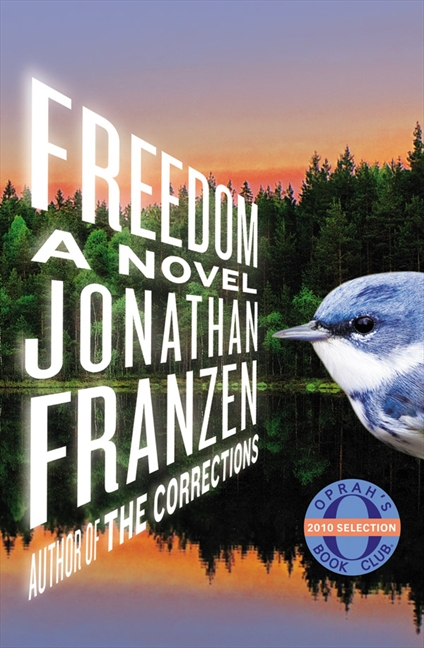
Jonathan Franzen, Freedom

Freedom bookcover, by Jonathan Franzen

Freedom bookcover (Courtesy: HarperCollins Australia)

Hmm … where to start? Half way through this book I was tiring. I wanted to say to Franzen “Enough already” (which, if you’ve read the book, has a certain appositeness). I also started to think of those song lines, so well-known to my generation:

Freedom’s just another word for nothing left to lose.

In fact, I thought of starting this post with that quote, but decided it would be just a little too twee – but somehow it ended up in the first paragraph nonetheless.

In some ways, Jonathan Franzen‘s latest novel, Freedom – which I must be the last blogger to read – is an interesting companion piece to Peter Carey‘s Parrot Olivier in America. They are wildly different in tone, style and historical setting but both explore the foundation upon which America is based, that of freedom of the individual. America tends to parlay this word about a little too, shall I say, freely, a little too unaware at times that freedom is not a simple concept but one that needs to be modified by a few “ifs” and “buts”. It’s these “ifs” and “buts” that confront Franzen’s characters, and that are recognised in those now immortal song lines. In other words, what Franzen’s characters find is that freedom in and of itself is no great shakes. It cannot exist in a vacuum …

But first, the plot. It chronicles the relationship of nice-guy Walter and mixed-up Patty Berglund (and, along the way, their family and friends). The opening paragraph starts around the middle of the chronology, with a rather teasing statement that Walter “had made a mess of his professional life” and then tracks back a few years to the early years of Walter and Patty’s marriage, before tracking back further to their youth and courtship, and then returns to the starting point and on to their future. Through this journey, Walter and Patty, residents of the Twin Cities, grow up, get married, have children, move east, get into a range of “pickles”, and … but that would be telling so I’ll leave the plot there.

It’s a rather complicated structure that owes a lot to postmodernism with its forwards-backwards movement, stories within a story (that is, Patty’s autobiography, told third person, in two distinct parts), a certain intratextuality (such as Patty’s autobiography being read by characters in the novel), the odd font change, and shifting points-of-view. It’s not, however, postmodern in its concerns – and is instead rather earnest, which is part of its problem. I’m not saying that it needs to be postmodern – we don’t need more self-conscious irony and clever playing with the idea of fiction – but it needs something fresh and challenging in characterisation, language and/or tone to carry it right through its 560 pages. Instead, it gets bogged down in too much earnest detail about life in modern America. It’s as though Franzen had a lot of things he wanted to say – about middle-class life, parenting, education, the environment, gentrification, politics, and music – and he was darned sure he was going to say them. We get, therefore, references to 9/11, Cheney and Bush, the war in Iraq, Obama, hints about the GFC, and so on. It’s a bit like Dickens, but without the sustained satire.

That said, there are some funny set pieces, such as the interview Richard (Walter’s friend and rival, and also lately successful rock star) gives to a young fan who wants to use Richard to attract a girl. Richard likens rock music to making chiclets, to being part of not against corporate, capitalist America. And I did love the description of why Walter preferred the aggressive driving of his young assistant, Lalitha, to driving himself:

Walter had come to prefer the anxiety of being her passenger to the judgmental anger that consumed him when he was at the wheel – the seemingly inescapable sense that, of all the drivers on the road, only he was traveling at the right speed, only he … [and on it goes for a page of road-rage inducing complaints].

But, getting back to the main game, what is this “freedom” all about? Most of the characters yearn for and/or experience freedom of one sort or another – they want to live their own lives their way. This can include not working, following one’s own heart regardless of the needs of those around you, having sex with whomever whenever you please, not being responsible for others, not doing the hard yards. And most find that the end result is not a satisfying one.

Walter, whom I presume is Franzen’s main mouthpiece, says:

The reason the system can’t be overthrown in this country … is all about freedom. The reason the free market in Europe is tempered by socialism is that they’re not so hung up on personal liberties … The Europeans are all-round more rational, basically. And the conversations about rights in this country isn’t rational. It’s taking place on the level of emotion, and class resentments, which is why the right is so good at exploiting it ..

This makes sense to me … but, the thing is that there are so many references to freedom that it is hard to locate the main message. This one is political. There are also more personal messages. Here is a description of Walter’s grandfather:

(The personality susceptible to the dream of limitless freedom is a personality also prone to, should the dream ever sour, to misanthropy and rage.)

And of Walter’s father:

He hated the blacks, the Indians, the well-educated, the hoity-toity, and especially, the federal government, and he loved his freedoms (to drink, to smoke, to hole up with his buddies in an ice-fishing hut) the more intensely for their being so modest.

We see parents giving children a “free pass” only to find those children, such as Walter’s brother Mitch, being a “free man” in the sense that he has no home, no secure job, no responsibilities. We see men, like Richard and Joey, thinking the freedom to have sex with anyone anytime will make them happy, but Joey, for example, after an amusing (to the reader!) scene in which he tries to live his fantasy, discovers who he really is:

This wasn’t the person he thought he was, or would have chosen to be if he’d been free to choose, but there was something  comforting about being an actual definite sometime …

And at this point he starts to grow up …

There is a lot to enjoy about this book, despite its bagginess. The characters do engage, flaws and all, and Franzen’s heart is, for me, in the right place. When I got to the end, I smiled and felt that Franzen had achieved something, even if it is simply to show that Freedom is a far more complicated concept than people like to think.

Jonathan Franzen
Freedom
London: Fourth Estate, 2010
562pp.
ISBN: 9780007318520

Mario Vargas Llosa, The feast of the Goat

Mario Vargas Llosa, signing books

Mario Vargas Llosa signing books in 2010 (Courtesty: Daniele Devoti, via Wikipedia, using CC-BY-2.0)

If Nobel Laureate Mario Vargas Llosa‘s The feast of the goat had been a traditional historical novel, chances are it would have started with the assassins concocting their plan and then worked chronologically to its logical conclusion. But, it is not a traditional historical novel, as is reflected in the structure Vargas Llosa has chosen to tell his story.

Before we get to that though, the plot. The central story revolves around the dying (literally) days of the 30-year Trujillo (“the Goat”, “the Benefactor”, “the devil”) regime in the Dominican Republic. This means the main action takes place in 1961. However, overlaying this is the perspective of Urania, the daughter of one of Trujillo’s head honchos. She’d left the country days before the regime ended and cut herself completely off from her father – for thirty-five years, until her sudden return at the novel’s start. The novel is told from these two time perspectives – 1960/61 and 1996 – and from multiple points-of-view*, the main ones being:

  • Urania
  • Trujillo
  • The conspirators/assassins

But this isn’t all there is to this novel’s structure and narrative style. I’m not quite sure how Vargas Llosa gets away with it, but he has written a book that is very accessible (once you get across the intricacies of Latin American names) and yet also rather complex. This complexity is found, primarily, in the structure. The book can, essentially, be divided into two parts. Chapters 1-16 proceed pretty systematically, cycling through, in turn, the stories of Urania, Trujillo (usually with one of his offsiders), and the Conspirators (usually focusing on one of them in particular). By Chapter 16 the two major crises of the book have occurred or been introduced. The last 8 chapters continue to cycle through different points-of-view but not in the same systematic order. In other words, the narrative structure becomes erratic and the rhythm more urgent, as chaos and uncertainty take over.

And yet, there’s more. For example, the novel is told primarily in third person, with the point-of-view changing chapter to chapter. But, every now and then, for just a sentence or two, or maybe a paragraph, the voice lapses into second person. This happens most often with Urania and conveys the sense that there has been some trauma that she hasn’t been able to fully integrate/recover from. We discover the origins of this trauma in Chapter 16, but it is not fully revealed until the last chapter.

… You were still a girl, when being a girl meant being totally innocent about certain things that had to do with desire, instincts, power, and the infinite excesses and bestialities that a combination of those things could mean in a country shaped by Trujillo. She was a bright girl … (Chapter 16)

This little slip into second person in Urania’s story is telling.

Okay, so this is the architecture, the behind-the-scenes technical stuff, but why write it this way? Well, the reasons are intellectual and emotional. Intellectual in that the multiple alternating points-of-view enable us to get a number of “stories” first hand. Through the eyes of the perpetrators and the disaffected, we explore the regime, and how, as happens so often with dictatorships, the early benefits are gradually (but surely) overshadowed by the corruption and violence perpetrated to maintain power, and how this leads to the assassination conspiracy. And emotional in that the constant shifting in perspective, particularly from people we can trust to those we can’t (to the best of our knowledge), and back again, unsettles and discomforts us … just as those who lived through the regime were kept on edge.

It’s impossible, without writing a thesis, to cover all the angles in this book, so I’m just going to look at one more – the characterisation of Trujillo himself. A historical novelist (rather like a biographer) has to choose what to include and what to exclude when describing a person. Vargas Llosa was lucky, really, that Trujillo had some traits that made this choice rather easy, traits that work on both the literal level and the ironic and metaphoric. Fairly early in the novel is this description of Trujillo

…that master manipulator of innocents, fools, and imbeciles, that astute exploiter of men’s vanity, greed and stupidity.

Fairly typical, wouldn’t you say, of a dictator? But, Trujillo was also fastidious about cleanliness and appearance, believing that

Appearance is the mirror of the soul.

If that’s so, then Trujillo’s “soul” is a very superficial thing because his disdain for the rights and feelings of others is palpable. Throughout the novel, Vargas Llosa sets Trujillo’s obsession with personal care (“the man who did not sweat, did not sleep, never had a wrinkle on his uniform, his tuxedo, or his street clothes”) against the coldness of his mind. That his mind is cold is made perfectly clear through his attitude to his offsiders (whom he liked to scare – “it cheered him to imagine the sizzling questions, suppositions, fears, suspicions he put into the head of that asshole who was the Minister of the Armed Forces”) and to women. This regime values machismo above all: it’s brutal to those those less powerful, and has careless disregard for the innocent. Women, of course, bear the brunt:

Again the memory of the girl at Mahogany House crossed his mind. An unpleasant episode. Would it have been better to shoot her on the spot, while she was looking at him with those eyes? Nonsense. He had never fired a gun gratuitously, least of all for things in bed. Only when there was no alternative, when it was absolutely necessary to move this country forward, or to wash away an insult.

Trujillo was nothing if not a master of self-justification.

How it all falls out, what happens after Chapter 16, is both expected and unexpected as those involved do or don’t do what they’d committed to. The end result is a devastating portrayal of how the political becomes the personal! Not a new message, perhaps, but The feast of the Goat is a compelling read that engaged my heart and mind. I recommend it.

Mario Vargas Llosa
(Trans. by Edith Grossman)
The feast of the goat
London: Faber and Faber, 2002
475pp.
ISBN: 9780571207763

* As in most historical fiction, the novel is peopled with historical characters and fictional ones. Most, in fact, are historical but Urania and her father, though based, I understand, on real people, are fictional.

Peter Carey, Parrot and Olivier in America

Alexis de Tocqueville.

Alexis de Tocqueville (Presumed Public Domain, via Wikipedia)

It’s not surprising, really, that after living in America for two decades Peter Carey should turn his pen to it. Having lived in the US twice myself, I well understand the fascination of trying to understand that large and paradoxical country. In Parrot and Olivier in America, then, Carey sets out to explore America through the eyes of two men from early nineteenth century Europe: Olivier Jean-Baptiste de Clarel de Barfleur de Garmont, a French aristocrat whose parents had barely survived the French Revolution, and John ‘Parrot’ Larrit, a poor Englishman who had been brought to France as a boy by another French aristocrat.

Olivier was born in 1805, the same year that French writer and historian Alexis de Tocqueville was born. This is not a coincidence as the novel is Carey’s loose re-imagining of Tocqueville’s trip to America, with a friend, to study American prisons. Like Tocqueville, Olivier undertakes his trip with the support of the July monarchy, but Oliver’s companion is not an equal. Rather it is Parrot, servant-class and twice Olivier’s age. An unlikely pair, really, but perfect for Carey’s purposes …

… which are to pry into, poke at, and peer under that great American experiment, Democracy. Through having two protagonists of such diverse backgrounds and perspectives, Carey is able to explore the issues from different angles, that of master and servant. And through choosing the picaresque as his form (or style), he is able to do so without being ponderous. In other words, the tone is comic, as befits a picaresque novel, and the narrative comprises a series of adventures in which our “heroes”, Parrot and Olivier, meet a range of characters along the way who test them and their ideas. The novel is told in alternating, and well-differentiated, first person voices – starting with Olivier and ending, very even-handedly, with Parrot. It is basically chronological, but there are flashbacks to fill in gaps and frequent overlaps caused by one telling a story followed by the other giving his version.

That’s the nuts and bolts of it, but how does it come across? Well, in a word, exuberantly. That’s not to say it doesn’t have its serious side, but just that it’s rather fun to read. At least, it was for me, though that could be because of my personal history with America. Here, for example, are some of the observations which caught my attention:

On not needing government (Parrot talking with a tradesman):

‘When there is enough for all,’ the nail-maker said, ‘there is no need for government.’
‘But what of the poor.’
‘No man who will work can be poor.’

A little myopic methinks – but an idea that seems to be still entrenched in America?

On the focus on money and trade (Olivier):

No matter how strong their religious sentiments, or their passion about the reform of criminals, the Americans quickly revealed themselves to be obsessed with trade and money … They had got their hands on a mighty continent from which the least of them could, by dint of some effort, extract unlimited wealth. There being so much to be extracted it scarcely mattered how they were governed, because there is no need to argue when there is plenty for all.

For all, that is, if you are able to work, are not black and not indigenous! Even aristocratic Olivier noticed some of these contradictions.

On the ability to be self-made (Peek, the banker, to Olivier):

‘Experiment,’ he cried, laughing too violently for my taste. ‘There is no experiment. We make this transformation every day. It is called rags-to-riches …’

And on the possibility of art and culture in a democracy (Olivier):

… They [paintings in Philadelphia] made me think that the taste for ideal beauty – and the pleasure of seeing it depicted – can never be as intense or widespread among a democratic as an aristocratic people.

Hmm…Peter Carey is on record as expressing concern for the survival of culture. He said in his closing address at this year’s Sydney Writers’ Festival that ‘We have yet to grasp the fact that consuming cultural junk … is completely destructive of democracy’. In other words, Olivier/Carey question whether “high” art and “total” democracy are mutually exclusive? Somewhat related to this is Carey’s ongoing interest (see My life as a fake, and Theft: a love story) in authenticity in art. He explores it here through Olivier’s love of art, and the artistic endeavours of several characters, including Parrot and his mistress.

As for the story itself, there is a lot to enjoy. Olivier and Parrot have a complex relationship that develops from mutual disdain to a cautious friendship as the novel progresses. For all his attempts to be open-minded, Olivier never totally accepts the notion of equality between “men”, but Parrot, from both his early training and a generous nature, manages to tolerate and even accommodate this. Besides these two, there are characters from all strata of society: aristocrats, printers, bankers, land-owners, artists, actors, and so on. And, of course, there are romances, with Olivier’s playing out to a rather ironic conclusion.

One little demur, though. The book did not really engage me emotionally – something I tend to expect in longer novels – and I wonder whether this is partly due to the picaresque genre whose episodic and comic nature can have a distancing effect. Is this a failing? I think not, but it was noticeable, and means that the writing and ideas have to be powerful enough to carry the reader along. And mostly they do here, largely due to the novel’s pacing.

So, what is Carey’s conclusion? Well, it’s pretty even-handed, with both the aristocrat and the servant summing up their experience of America. But, in a twist on Tocqueville, the last words are Parrot’s. As a reader who always looks to see if structure informs the meaning, I wonder if this tells us something. Then again, there could be an element of irony in it. However you read it, there is no real answer to the question in the epigraph:

Can it be believed that the democracy which had overthrown the feudal system and vanquished kings will retreat before tradesmen and capitalists? (Alexis de Tocqueville)

Prophetic words, eh.

Peter Carey
Parrot and Olivier in America
London: Faber and Faber, 2010
578pp
ISBN: 9780571253319

David Mitchell, The thousand autumns of Jacob de Zoet

‘Oh I found ways to live to tell the tale. It’s my chief hobby-hawk is the noble art of survivin’.’

‘Loyalty looks simple,’ Grote tells him, ‘but it isn’t.’

‘…Expensive habit is honesty. Loyalty ain’t a simple matter, Di’nt I warn yer…’

It’s interesting that some of the main themes of David Mitchell‘s The thousand autumns of Jacob de Zoet are conveyed by one of its lesser (in terms of status) and more questionable (in terms of morality) characters, the Dutch cook, Arie Grote. Interesting because such a slippery and relatively minor character expresses some critical themes and because Mitchell’s making this choice provides a clue to the book’s tone and style. It has, in other words, a rather wry undertone.

Dejima model, Nagasaki

Model of Dejima, at Dejima Wharf, Nagasaki

So, what is its plot? Broadly, it is about the Dutch East India Company‘s activities on Dejima, a walled island in Nagasaki harbour, during Japan’s isolationist (or, “Cloistered Empire”) period, with most of the action taking place between 1799 and 1800. It follows Jacob de Zoet, a young man who arrives in 1799 to work as a clerk (and to make his fortune so he can return home to marry his love, Anna). What he finds is a multicultural community comprising Dutch, Japanese, a Prussian, an Irishman and others including Malay slaves, living and working within a complex web of ambitions, animosities and allegiances. He discovers pretty quickly that he’s going to need good survival skills to make it through. The question is: will he make it through, and will he do it with his integrity intact?

There is a love triangle of sorts, involving a young Japanese midwife named Orito. And there’s a drama centred on her “abduction” to a horrifying (invoking, for me, Margaret Atwood‘s The handmaid’s tale) monastery/nunnery called Mt Shiranui, which is overseen by the evil lord/abbot, Enomoto. This sounds, I admit, a bit melodramatic and in a way it is, but it seems to work, largely because of the characterisation.

The novel has a huge cast of characters, as this Character List (source unknown) shows and, over the course of 450+ pages, Mitchell gives us the backstories to many of them. At times I felt there was too much detail – as in “why do I need to know all this?” – but the stories were so interesting that I didn’t really mind. Mitchell is not, I have to say, a taker-outer and so, if you like your stories to move along at a fast clip, this is not for you. Many of the characters, from bottom to top of the hierarchy, are corrupt, as they scheme, bribe and manipulate for money, power and/or prestige, but not all are. Some of the most interesting characters are those who are not corrupt but are not perfect either. They include Jacob; the doctor/scientist, Dr Marinus, who tests Jacob somewhat cruelly; the young interpreter, Ogawa Uzaemon, who overlooks Jacob’s illegal importation of his Christian psalter; and John Penhaligon, the gout-ridden English captain who makes a play for Dejima late in the novel.

Having read and enjoyed Cloud atlas, I must say I kept expecting some, shall we call it, literary “tricksiness” but it never really appeared. This is historical fiction told in a linear fashion, albeit with the odd digression and some shifting perspectives. In fact, while not particularly “tricksy”, the style is not simple. There is a lot of variety in the telling:

  • dialogue (and italicised thoughts of characters, as conversations or action occur);
  • backstories;
  • set-ups that don’t always follow through as you would expect (such as that concerning Jacob’s hidden psalter);
  • scenes in which the main action is interspersed by something else going on (such as Cutlip preparing his boiled egg while Penhaligon negotiates with the slippery Prussian, Fischer);
  • action and adventure; and
  • a good deal of humour (including the scene in which a Japanese translator tries to translate a scientific lecture being given by Dr Marinus).

The language is similarly diverse. Mitchell uses irony, metaphor and symbolism, wordplay, and repetition, to name just a few techniques. Here, for example, is a rather lovely oxymoron:

The creeds of Enomoto’s order shine darkness on all things.

And here is a moving description related to an honourable death (without naming names):

An inch away is a go clamshell stone, perfect and smooth …
… a black butterfly lands on the white stone, and unfolds its wings.

I was impressed by the array of literary devices he used and how it never felt overdone. It was his language and characterisation, more than anything else, that kept me engaged.

The book does suffer a little, though, from the breadth of its concerns. I flicked through the book to jot down its themes and ran out of space on my page! So, I grouped them:

  • Political/historical: commerce, nationalism, colonialism and slavery
  • Philosophical: fate, faith and belief, truth
  • Social: education, oppression of women, science and enlightenment
  • Personal/psychological: loyalty and betrayal, honesty, love and integrity, survival

That’s a pretty broad church and, although some naturally overlap, the effect is to dilute the book’s impact somewhat.

So, how would I encapsulate it? Well, I’d sum it up as being about “imprisonment”, both literal and metaphorical. The Dutch are imprisoned on Dejima, the Japanese are imprisoned within their self-imposed isolationist policy, Orito and her “sisters” are imprisoned at Mt Shiranui. And people are imprisoned by their roles and/or culture. For example, women’s options are restricted, slaves have little control over their lives, and many of the characters, including Jacob, are imprisoned by their lack of economic resources that would enable them to freely choose their lives.

This is one of those rather unwieldy books that is hard to pin down but, despite this, I did rather enjoy watching Jacob and co. going about “the noble art of survivin'” in an intriguing place and time.

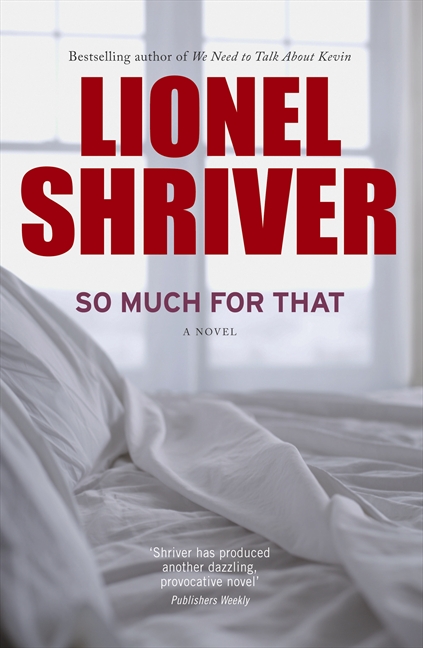
Lionel Shriver, So much for that

Lionel Shriver, So much for that

Book cover (Courtesy: HarperCollins Australia)

Having had my own rather traumatic experience of the American healthcare system back in the 1980s I was rather keen to read Lionel Shriver‘s latest offering, So much for that. And, I wasn’t disappointed – or, let me rephrase that, I found it an interesting and engaging page-turner though not a top-ten-of-the-year one.

First a quick plot summary. The book starts with 48-year-old nice-guy Shep Knacker planning to escape the American rat-race to his dreamed of, and as it turns out ironically named, AfterLife in Pemba off Zanzibar. Unfortunately, his plans turn sour with his wife’s announcement that she has a rare aggressive cancer called peritoneal mesothelioma and will need him to continue working, for his health insurance. Paralleling Shep and Glynis’ experience of health service and insurance – and told in roughly alternating chapters – is that of their good friends Jackson and Carol whose 16-year-old daughter, Flicka, was born with the degenerative disease, familial dysautonomia.

So, at the start we have a terminal cancer diagnosis and a child with a disease that is not likely to see her making old bones. Through the course of the novel, two more health issues are thrown in to round out the mix – aged care for Shep’s father after he falls and breaks his femur, and elective shall-we-say “vanity” surgery undertaken with disastrous results by Jackson. This all felt a little contrived to me – as did the occasional preachy dialogue that seemed to be there to make sure we got it. (Shriver is not a taker-outer I think!)

But, somehow, Shriver made it all work – right through to the rather surprising and, thus, risky ending. I liked the fact that she balanced the health care polemics with some wider issues such as the psychology and language of illness and the soul-destroying nature of the American (in particular) rat-race. And I liked the way she offset the plot and structural contrivances with a warm but unsentimental regard for her characters. Glynis and Flicka are not “pin-up” patients but “real” people who are angry with their lot and exhibit selfishness and petulance more often than meek forbearance. Glynis, like the character in Helen Garner‘s The spare room, is in denial about her fate pretty much to the end, and Flicka sees little value in living the sort of life she does. Both consequently feel little need to make it easier for those around them.

Most of Shep’s chapters commence with a statement of his net worth, which at the beginning of the novel is around $730K but which decreases with alarming rapidity as the months wear on and his poor insurance cover doesn’t begin to meet the costs of Glynis’ treatment. If you knew nothing before about co-payments, deductibles, co-insurers, out-of-network providers and lifetime payment caps, you’ll know all about them by the time you finish the book. (Apparently the most common cause of personal bankruptcy in the USA is medical debt.) But this is just the background – the polemics if you will – because the more interesting story is that of Shep and Glynis’ complicated but loving relationship, and of how friends and family react to the diagnosis. We feel Shep’s pain as he realises “he couldn’t fix things”. We understand Glynis’ eventual epiphany that “her husband had misguidedly hoarded his pennies, when the only currency they spent that had ever counted was time”. We cringe when we recognise ourselves in the friends who don’t visit often enough, who offer lip-service assistance rather than actual help. And we start to understand the real implications of cancer-speak that encourages an unrealistic belief in positive thinking, that suggests you can win the battle if you fight hard enough:

I know you mean well [says Shep to the oncologist], but after all this military talk she now equates – dying – with dishonor. With failure. With personal failure.

Near the end Shep asks the doctor what the $2 million spent on Glynis’ treatment (to date) had bought:

“Oh, I bet we’ve probably extended her life a good three months.”
“No, I’m sorry, Dr Goldman,” Shep said on the way out. “They were not a good three months”.

… leaving the real question, which Shep had previously asked his father, hanging:

“is there also a limit to how much you should pay to keep any one person alive?”

Lionel Shriver does not specifically answer this question in the novel but – despite the ending – you know exactly what she thinks.

There is more I could say about the novel. The story of Jackson and Carol, for example, offers the book more than a simple confirming parallel. There are some genuinely funny moments, particularly those between Shep and his free-loading sister Beryl, and those when Jackson pronounces yet another long-winded title for the book on “mugs and moochers” that he never will write. And there are some interesting discussions about art and artists, and about parenting in modern USA. But I’ve said enough I think to give a sense of what this book is about.

Shep says at the end that he’d “rather live a good story than read one”. I’ll leave you to ponder the implications of a novelist writing that line … and simply say that while this is not a perfect novel, I don’t begrudge having given up a bit of my good life to read it!

Lionel Shriver
So much for that
Sydney: Fourth Estate, 2010
433pp.
ISBN: 9780732287030

Ian McEwan, Solar

Ian McEwan Solar bookcover

Bookcover (Used by permission of the Random House Group Ltd)

I don’t know whether I believe your story, but I’ve enjoyed it.

So says McEwan’s latest creation, Michael Beard, to a character he has “done wrong”. This more or less sums up my feelings about Solar, the novel in which this statement appears. I am a McEwan fan and have greatly liked most of the 5 or 6 of his books that I’ve read but, while I found this one readable, I’m not convinced that it completely comes together into a coherent whole. This may have something to do with the fact that McEwan has tried for something lighter here and hasn’t quite pulled it off.

Do I need to describe the plot? It’s been reviewed so much by now that I presume most readers here already know it. However, to be on the safe side, here goes. It’s all about Nobel Laureate physicist, Michael Beard, who at the start of the book is 53 years old, 15lbs overweight and at the end of his 5th marriage (due to his incurable, it seems, womanising). On top of this he is struggling to keep his career alive: he is surviving, mostly on speaking engagements, while he waits, hopes, for a new inspiration. This is the set up. And, as is typical of McEwan, a little way into the book an event occurs that will be life-changing. In Beard’s case it will kickstart his career. How that occurs – and its eventual fallout – forms the rest of the book.

The novel is divided into three parts, labelled simply 2000, 2005 and 2009. If Beard was 15lbs overweight in 2000, in 2005 he is 35lbs overweight and by 2009 that has increased to 65lbs. This might tell you something about him: he is out of control in every aspect of his life – physically, emotionally, intellectually and morally. He is not, as you might gather from this, a likable man, but it is mainly through his eyes – told third person – that we experience the novel.

As the title suggests, the book’s subject matter is solar energy and climate change. And some of the best parts are those in which McEwan satirises the politics of climate change. In an amusing sequence, Beard is invited to the arctic along with a number of artists (making him the proverbial sore thumb) to experience climate change first hand. While he is there he observes the increasing chaos in the “bootroom” where the outdoor clothing is kept. From day one, the “bootroom” doesn’t work as people take items from pegs that are not their own resulting by the end of the week in no-one wearing a complete outfit that fits them. This works pretty well as a metaphor for the chaos and disorganisation in the climate change community. Add to this scenes like the idealistic climate-changers scooting about the ice in their gas-guzzling skidoos and you get a rather funny, and pointed, episode in the book.

The tone of the book is, in fact, comic-satiric which is a bit of a departure for McEwan who has tended to write books that are more dramatic, many with a “thriller” component. Here, though, there are even moments of slap-stick, such as when Beard early in the book pretends that he has a woman in the house in an attempt to make his wife jealous – all to no effect, but in terms of the novel’s plot it results in a deeply ironic statement:

Clearly he had been in no state to take decisions or to devise schemes and from now on he must take into account his unreliable mental state and act conservatively, passively, honestly, and break no rules, do nothing extreme.

Not long after this episode he does the complete opposite. Some of the members of my reading group found the book very funny but for me it fell a little flat. I saw the satire and thought it was clever at times, but it was sometimes more pathetic than highly comic, and at other times a little heavy-handed. Here, for example, is Beard on the bootroom:

How were they to save the earth – assuming it needed saving, which he doubted – when it was so much larger than the bootroom?

Now, most readers would already have got the point. I’m not sure that we needed to have it hammered home like this.

The focus of the book, as you will have gathered by now, is Beard and we spend a lot of time in his head. This is not a problem in itself, except that he never seems to change. He’s a gluttonous, arrogant, self-centred womaniser at the beginning and is the same at the end. He is also morally bankrupt – something you will discover soon enough if you read the book. Does a character have to change for a book to work? Not necessarily – think Jean-Baptiste Grenouille in Perfume – but we do have to stay interested in the character and Beard, for me, became a little boring. There was too much of the same – too much womanising, too much alcohol and fatty, fast food, too much self-aggrandisement – that I started to think “enough already”.

The key question to ask, then, is why has McEwan chosen such a character? The answer seems to be that McEwan wanted to express his fear – cynicism even – about 21st century humankind’s ability to enforce change. Early in the novel is this:

Beard was not wholly sceptical about climate change. It was one of a list of issues, of looming sorrows, that comprised the background to the news, and he read about it, vaguely deplored it and expected governments to meet and take action … but he himself had other things to think about …

Himself, basically. Is McEwan saying Beard is us, is Everyman? If so, I can’t help thinking he’s got a point, but I’m not sure he’s written the book – like, say, Animal farm – that sustains the trope well enough to last the distance.

Oh dear, I fear now that I have been more critical than I meant to, because I did find the book readable. I did want to know what happened. I liked a lot of the language. And I did enjoy many of the observations McEwan makes throughout the book – about reason and logic versus idealism, about feminism, and of course about politics. Take for example the following, which is very apposite given that we downunder are in the middle of a Federal election campaign:

He was aggressively apolitical – to the fingertips, he liked to say. He disliked the overheated non-arguments, the efforts each side made to misunderstand and misrepresent the other, the amnesia that spooled behind each ‘issue’ as it arose.

I can relate to that …

Finally, there is a sly bit of self-deprecation running through the book about stories, imagination and the arts. I had to laugh at Beard’s comment that:

People who kept on about narrative tended to have a squiffy view of reality, believing all versions of it to have equal value.

I’ll leave you to decide what you think of McEwan’s version here.

Ian McEwan
Solar
London: Jonathan Cape, 2010
283pp.
ISBN: 9780224090506

M.J. Hyland, This is how

Bookcover (Courtesy: Text Publishing)

If you want to read a book that is quick (and seemingly simple) to read and yet satisfyingly complex, then MJ Hyland’s This is how is for you. I’ve been wanting to read Hyland for a while and, having now done so, this won’t be the last.

So where to start? The novel is a first person story told by a young, somewhat disengaged 23-year-old man, Patrick Oxtoby. It is set in the late 1960s, perhaps early 1970s, but the setting and period barely matter really, as this is very much a book about character (and, humanity in general).

Now, my problem is what to say about the plot without spoiling the first third of the novel, so I think I’ll say nothing except what the back cover tells us. It says that “it is a novel about crime; though not a crime novel” and that “it has an almost stately pace and yet it’s thrilling”. These, together with my opening comment that it is simple but complex, should convey what a rather paradoxical read this is. The novel opens with the following:

I put my bags down on the doorstep and knock three times. I don’t bang hard like a copper, but it’s not as though I’m ashamed to be knocking either.

Who is this? Why does he describe his knocking in such terms? Well, we soon learn that Patrick, newly jilted by his fiancée, has come to this little seaside town to start a new job as a mechanic. He’s intelligent – though dropped out of university – and comes with good recommendations as a mechanic from his previous employer. But he is a very singular person, one who is not totally comfortable in his own skin. This is apparent from the beginning: here is more from the first page:

‘I thought you’d be here hours ago.’
It’s after ten and I was due at six. My mouth’s gone dry, but I smile, friendly as I can.
‘I missed the connection,’ I say.
I’ve not meant the lie, but she’s forced me.

Hmm, now I really was wondering who this is and, given the suggestion that the novel is about a crime, I wondered whether he is the criminal and whether he had already committed a crime? I also started to wonder as I continued to read the first few pages whether he was an unreliable narrator. But no, he is essentially reliable; he is, in fact, very much himself – but himself is a complex (aren’t we all) human being who carries quite a bit of baggage. I’m not quite sure how Hyland does it but throughout the novel she manages to unsettle her readers and keep us that way: at times we empathise with Patrick and feel sympathy for him and then suddenly he distresses if not horrifies us – and we wonder anew, Who is this man?

MJ Hyland

MJ Hyland, London, 2008 (Courtesy: MJ Hyland via Wikipedia, using CC-BY-SA 3.0)

In my opening para I said it was a quick and seemingly simple read. This is because the style is simple and direct. Patrick tells his story in present tense, with just the occasional flashback. Sentences are mostly short and simple, and the paragraphs tend to be short too. There is quite a lot of dialogue and not a lot of description. And what description there is tends to be short, sharp and vivid (“This blow is like a dose of poison in my veins, a hot sharp shot through my legs and arms, through my bowels and bladder”). Patrick is introspective at times but he doesn’t wallow in it. All this gives us a picture of a pretty simple character, which he is – and isn’t at the same time. There is, we are aware, quite a gap between what he says and thinks (most of the time) which could make him seem coldly manipulative. Yet, he’s not that. It’s more that he’s a somewhat damaged soul trying to survive in a world that doesn’t seem to go the way he would like – and it is this that leads to his trouble.

He likes to be in control (“I wanted her to go, and now she’s gone it’s like rejection, feels like it was her idea and not mine”) but he doesn’t try to bend others to his will. He has an uncomfortable relationship with the truth (“She put her hand on her heart and gives me a big smile and I’m reminded of when I told the girl in the theatre foyer that I was nervous and how the truth got a good reaction out of her as well”) but it’s more to do with self-protection than with any specific desire to deceive others. He has a complicated relationship with his family and they with him, but most of what we know is from his perspective so it is difficult to know the “truth” (if  a simple “truth” there can be in families). As he says:

I’m not sure if the truth will make any sense. The truth is, I thought I was rejecting my mother when I left home … But it turns out she was the one doing the rejecting and it’s just the same with my father.

The “real” truth, though, is probably somewhere in between.

Does he* grow throughout the novel and is there a resolution? To some extent he does get to know himself better but the resolution seems to be more that he learns to live with his situation (“life’s shrinking to a size that suits me more”) rather than grow as a person. But maybe that’s what maturity/development is really about?

Whatever the case, this is one of those truly original creations – a character who, as the back blurb says, “is fully himself and yet stands for all of us”. I haven’t been so intrigued by and engrossed in a character for a long time. The plot is slim but I barely noticed. I’ll definitely be reading more Hyland.

MJ Hyland
This is how
Melbourne: Text Publishing, 2009
376pp.
ISBN: 9781921656484

Review copy supplied by Text Publishing.

* An aside. I couldn’t help wondering at times whether Patrick, with his social awkwardness and slightly obsessive behaviour, might be autistic to some level, but this never comes out and I am uncomfortable ascribing a pathology to a character when the author hasn’t done so.

Louann Brizendine, The female brain

Louann Brizendine (Courtesy: Andy Feinberg)

Louann Brizendine, 2009 (Image: Andy Feinberg released into the Public Domain, via Wikipedia)

Beware – the F-word is coming! Yes, Feminism. It might be a dirty word in some quarters, but I regard myself as a feminist – 1970s style – and so I approached Brizendine’s best-selling book, The female brain, with my cautionary antennae out. It’s not the sort of book I would necessarily have chosen myself but it was a bookgroup read and my number one reading priority is my bookgroup’s schedule. And, really, I’m glad I read it because it is good to keep up with the various arguments and debates going on.

The way I see it – and it’s pretty obvious really – the influences on our behaviour are threefold:

  • biological/biochemical
  • genetic
  • environmental/social

The BIG question is, then, in what proportion do these play out in our lives? Clearly men and women are not the same – you just have to look at us to see that – but as a young woman I believed that environmental factors were the strongest in determining the course of women’s lives. And I still think that’s largely the case. Environmental (or socio-cultural) factors may not necessarily be the determining factors in our individual behaviours but I believe they still do play a major role in the trajectory of women’s lives. As I’m sure they do for men too – but I believe that women still tend to draw the shortest straw.

And yet, there’s a niggle. Statistics – and the obvious evidence around us – show that the proportion of women in leadership roles, for example, in boardrooms, in politics, and so on, is way below what would be pro rata. Why is this? Is it the glass ceiling? Or, is there something else going on? Brizandine suggests women have “superior brain wiring for communication and emotional tones”. Does this discourage us from seeking these leadership roles which, in our current western capitalistic environment at least, tend to be adversarial if not downright aggressive. And then, the thinking and the niggles get murkier. What happens in non-western-capitalist societies? And in indigenous societies? In these (with some notable matriarchal exceptions), women also tend not to be the leaders. Why? Is human society inherently adversarial and aggressive – or is it just that men have made it so. If the latter, can women – with their superior emotional wiring! – change the nature of society?  You see, what happens? Round and round in circles.

And this brings me back to Brizendine, neuropsychiatrist and founder of the Director of the Women’s Mood & Hormone Clinic (which rather suggests where she is coming from). Her book focuses pretty much exclusively on biology. The backcover blurb describes the book in these terms: Brizendine “reveals how the uniquely flexible structure of the female brain determines not only how women think and what they value, but how they communicate and whom they will love”. It’s all in the biology you see! We are “programmed” to seek out the most symmetrical (yes, really, or so she says) good-looking male because it is all about reproduction of the species. Occasionally she qualifies her statements, such as “Humans are not quite so biologically determined [as Syrian hamsters, for example!]” (p. 132) but the  qualifications are minor and infrequent.

It all reads a little simplistically. Like any good non-fiction work, the book is comprehensively referenced with 23 pages of citations/notes and nearly 80 pages of references. However, she herself agrees that it is difficult to properly research the workings of the brain and so many of her arguments are made using either anecdotes, drawing conclusions from the animal world, or based on one-off studies. I don’t have the resources to check all her citations but the Nature magazine reviewer found them wanting in terms of  “scientific accuracy and balance”*. A quick search of the ‘net brings up counter arguments, such as those of Insitut Pasteur neurologist Catherine Vidal, who states that “the differences [in brain development] between individuals of one and the same gender are so great as to outweigh any differences between the genders”. And regarding male versus female test results in, say, mathematics, she says that the main factor is socio-cultural:

The second study, conducted last year with a sample of 300,000 in 40 countries, showed that the current socio-cultural environment is conducive to gender equality. ‘More girls are getting good test scores in maths,’ Dr Vidal highlighted. ‘In Norway and Sweden, the results are comparable, and in Iceland, the girls beat the boys.’ It should be noted, however, that the boys beat the girls in Korea and Turkey.

Of course, she’s talking more about intellectual/academic skills/achievement rather than behaviour which is more Brizandine’s focus – but it serves nonetheless to sound a warning about ascribing causes too simply.

I’m late reading this book which apparently caused quite a flurry when it was published in 2006. I’ll end with Deborah Tannen’s conclusion to her review in the Washington Post (2006):

Paleontologist Stephen Jay Gould once said he despaired of the constant question “Is it nature or nurture?” because “biology and environment are inextricably linked.” Ideally, readers will sift through the case studies, research findings and scientific conjectures gathered in this non-technical book and be intrigued by some while questioning others, bearing in mind the caution that hormones and brain structure play a role in gender differences but are not the whole story. And if this book joins a “nature” chorus that has swelled as a corrective to the previous pendulum swing toward “nurture,” we can assume that another corrective will follow. But given the character — and rancor — of our dichotomous approach to the influences of biology and culture, readers likely will be fascinated or angered, convinced or skeptical, according to the positions they have staked out already. That would be a pity.

Fair enough … and meanwhile, for me, the bottom-line remains: regardless of how similar or different we are, and why, all humans deserve to be respected and treated equally regardless of gender, race or religion.

*Nature, Vol. 443, 12 October 2006.

Louann Brizendine
The female brain
London: Bantam Books, 2007 (First pub. 2006)
352pp.
ISBN: 9780553818499

Eva Hornung, Dog boy

Eva Hornung, Dogboy

Dog boy cover (Courtesy: Text Publishing)

I first read Eva Hornung when she was writing as Eva Sallis. It was her second novel The city of sealions, which is a pretty passionate and evocatively written exploration of cultural alienation and dislocation brought about primarily by migration.

In some ways Dog boy explores similar concerns, but its alienation is played out in a different way – through that fascinating archetype of the feral or wild child. In the novel, Hornung refers to a few modern examples of feral children, such as Oksana from the Ukraine; in an interview on the Literary Minded blog she says that the novel was inspired by a news story about a child living with dogs in Moscow. Guess where this book is set? You got it – Moscow! This intrigued me somewhat. Why would an Australian novelist read about a feral child in Moscow, go there to research and then write a novel? But Eva Hornung seems to be no ordinary novelist. She did her PhD in the Yemen and her settings – even if not her overriding theme – range rather widely.

And so to Dog boy. At the beginning of the novel Romochka, 4 years old, is alone in an apartment. He hasn’t seen his mother for a week or more and suddenly his uncle does not return. He senses the apartment building is being emptied and so after a couple of days being alone he heads out, and manages to get himself adopted by a dog, Mamochka, who lives with her four young puppies and two older offspring. How and why he is left alone is not the concern of this novel (which reminded me a little of Cormac McCarthy’s The road in which the cause of the devastation is also not the point). The novel tells the story of his life with the dogs and of what happens when he, four years later, comes to the attention of humans, specifically two scientists/doctors working in a children’s rehabilitation centre.

[WARNING: MINOR SPOILERS]

The story is told chronologically, and is divided into 5 parts. The first two parts cover Romochka’s first two years in the lair and how he gradually learns “to be a dog”. In the third part, Mamochka introduces a baby to the pack – to provide human company for Romochka. The baby is, ironically, called Puppy (by Romochka). Without giving any important plot points away, the final two parts deal with the boys’ renewed contact with the human world. It’s told in 3rd person but the perspective does shift, particularly in the last two parts where we see what’s happening through different eyes – the two scientists, Dmitry and Natalya, and Romochka himself. But even before this, we occasionally move between Romochka’s and the author’s perspective. It’s a technique that encourages us to understand, if not empathise with, the various experiences as they play out.

As I read this book, I felt I was in the hands of someone who knew what she was doing – even though at times I wondered exactly why she was telling this story. Not only does she viscerally describe Romochka’s gradual acceptance into the dog clan, his learning to hunt and his slow rise to dominance, but she starts to introduce humans at a time when our interest in an ongoing dog story would start to pall. This shift starts with Romochka’s increasing interest in people and builds up to the more or less inevitable conclusion – but that conclusion is not simple and is open-ended.

The language is evocative – sometimes beautiful but more often earthy and confronting to our senses. Hornung evokes Romochka’s life with the dogs with such attention to detail that it is entirely believable. She describes his animality, without being heavy-handed – he moves in “a wide lope”, uses his “paws”, and carries with him a horrible “stench” – but also shows his ability to use human logic and reasoning. At the time of his first capture, Romochka’s inner dog-human conflict is obvious:

Romochka wished bitterly … for true doghood. Were he really a dog, he would understand only their bodies, and not their words. Were he really a dog, he wouldn’t know their names, and their kids’ names. He wouldn’t … be paralysed by these lives that stretched before and after the station: he would know only their smell, only their aggression and torments; and what they ate.

The fight went out of him altogether. He stared dumbly, balefully without growling or snapping, unresistant even when he was pushed around. He was no longer sure that hiding his human side would get him released, but he remained a dog …

The big question to ask is, Why did Hornung choose to tell such a story? There is the obvious reason, that of our ongoing fascination with the wild child phenomenon and what it might tell us about what it means to be human. But there is also Hornung’s ongoing interest in alienation and, related to that, the abuse of humans by other humans (particularly where there is social disintegration). For all our horror at the way Romochka lives, we also see that he is not only safe but well nurtured in his life with the dogs. Was this boy, Natalya and Dmitry ponder, “better off living with dogs than with humans”. This question, that comes towards the end, represents a big shift from Dmitry’s earlier “proper awareness of the philosophic and scientific divide between man and animal”. The second part of the novel, in fact, explores this question at some depth. How big is the divide really? And to what extent is man a beast? All this is explored with more than just a little skepticism about scientific research and the tension between nice neat theory (and the chance it offers for professional glory) and messy reality. There is a lot in this book for keen readers to consider. It’s one that I will remember for some time.

Dog boy is Sallis aka Hornung’s 6th novel. She has won or been nominated for awards for many of her novels and yet she is not particularly well-known. Her change of name may have contributed to this but, whatever the reason, I think it’s a shame. Her writing is clear, accessible and evocative – and yet has a depth and passion that is worthy of the prizes she wins. May we see more of her.

Eva Hornung
Dogboy
Melbourne: Text Publishing, 2009
293pp.
ISBN: 9781921656378

(Review copy supplied by Text Publishing)