Wayne Bergmann and Madelaine Dickie, Some people want to shoot me (#BookReview)

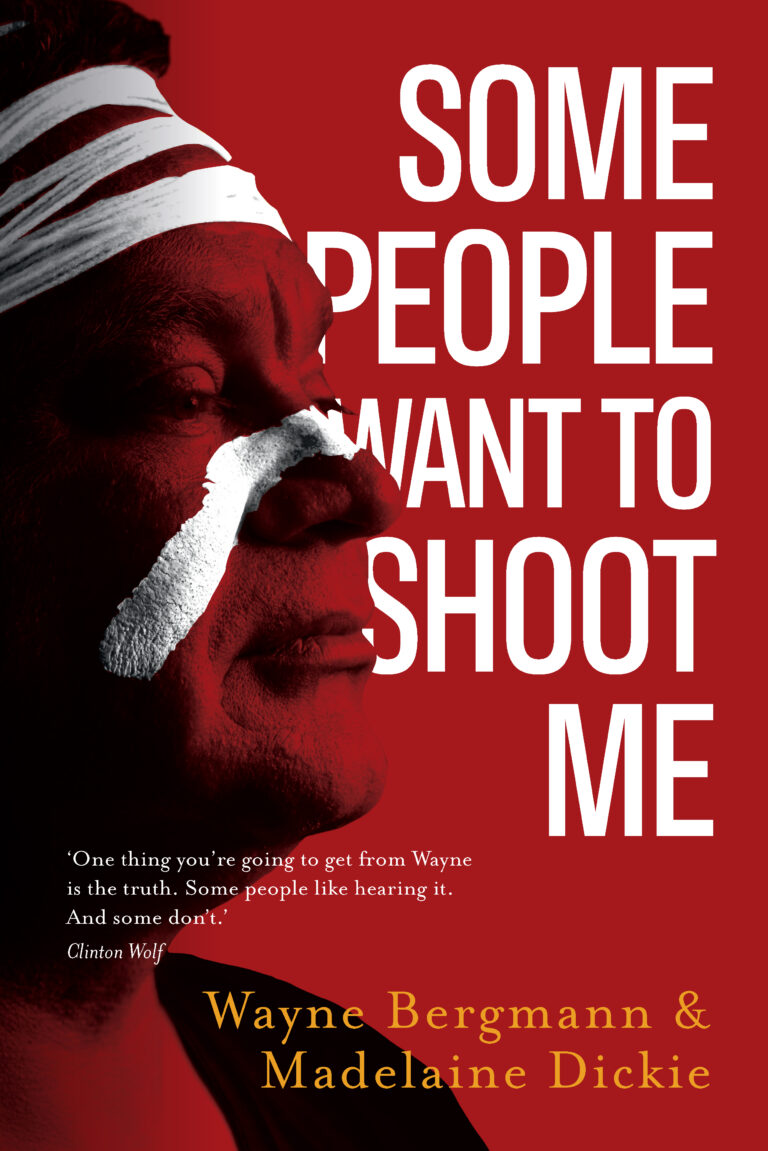
Having finally read Wayne Bergmann and Madelaine Dickie’s Some people want to shoot me, I am not surprised that it has been shortlisted in the Nonfiction category of this year’s Western Australian Premier’s Book Awards. It is moving; it is clearly written; and it is informative about big issues. Wayne Bergmann is a Nyikina* man and Madelaine Dickie a kartiya (white) woman, making this one of those collaborative novels I wrote about recently.

Before I continue, a little on its form. This is a work of nonfiction. It is essentially memoir, written in third person by Bergmann and his collaborator, Dickie. And, being a memoir, it has a specific focus. In this case, it is one underpinned by a powerful sociopolitical message concerning the right of First Nations people to survive and prosper on their own land.

“walking in two worlds”

So … Some people want to shoot me is about a man who realised he must walk in two ways – the kartiya way and the old people’s way, that is the white way and the way of his traditional culture. For his heart and soul he needed to walk the traditional ways, but in his head, seeing the suffering and the social and economic dysfunction caused by dispossession and powerlessness, he had to walk the kartiya way. The book exposes just what a tough balancing act this was – and is. It demanded (demands) strength, bravery, nous, clarity of purpose – and the support of family.

The book opens with a Prologue which sets the scene. It’s 2011 and Bergmann, who is at breaking point after years of negotiating on behalf of Kimberley Traditional Owners, walks out of a meeting with a mining company and heads, with his wife and children, back to country:

to the mighty Martuwarra, the Fitzroy River – lifeblood of Nyikina country, Wayne’s country, his children’s country – made by Woonyoomboo when the world was soft.

From here, the book starts in Chapter 1 the way memoirs usually do – at the beginning. For Bergmann, the beginning is Woonyoomboo who tasked the Nyikina people to look after country. This they did, until the arrival of white settlers in the late 19th century, when things “radically changed”. The first two chapters chronicle some of this change through the lives of Bergmann’s forbears. It depicts a world where the legacy of nuns, monks, ethnographers, pastoralists and miners “was still felt acutely”, where “frontier massacres had occurred within living memory”, and “where justice, under whitefella law, didn’t often grace Kimberly Aboriginal People”. Bergmann, who was born in 1969, saw this, felt this, and took on the pastoralists, mining companies and governments to “upend the status quo”.

Of course, such upending doesn’t come easily, and the people doing this upending aren’t always understood and appreciated, which is where we came in at the Prologue. The book details, chronologically, Bergmann’s work, from his early work with the KALACC (Kimberley Aboriginal Law and Culture Centre) and his realisation that for Aboriginal people to be empowered under Western law and able to make systemic changes, “they needed to understand the kartiyas’ law system inside out”. So, he did a law degree, and then, at the age of 33, became CEO of KLC (Kimberley Land Council) and here is where the really hard work started, and it was not pretty. It demanded every ounce of energy, intelligence and resilience, he could muster.

Bergmann had to be clear about the role, which was, as a native title representative body, “to facilitate a process and follow procedure in accordance with native law to allow Traditional Owners (TOs)” to make decisions “about their country”. This meant consulting with the TOs and ensuring they understood what they were being asked for and what was being offered. When stakes are high, emotions also run high. Some environmentalists, for example, would turn against TOs (and thus the KLC) when their views diverged, but sometimes TOs believed that some development was advantageous to their people. Then, of course, there were times TOs didn’t agreed with each other, or when there was disagreement between TOs and others in their communities. This is to be expected, of course. Do all kartiyas agree? But, it makes for very difficult times, and Bergmann was at the centre. As well as working with the relevant Kimberley TOs, Bergmann was also negotiating with the Western Australian government and, for example, the Woodside mining company, negotiating not only the actual agreements, but for money and resources to carry out consultations so that the TOs could come to the table well informed. All this is explained clearly in the book, making it well worth reading for anyone who has not followed native title cases closely. It’s both enlightening and chastening.

Bergmann made some significant deals, but it was a bruising time, so after a decade, wiser and with a clear view ahead, he moved on to establish KRED Enterprises. A charitable business, wth the tagline of “walking in two worlds”, its aim was (and is) to support cohesive Aboriginal economic development in the Kimberley, to encourage businesses run by and for Aboriginal people. The rest of the book covers Bergmann’s work – under the KRED umbrella and in other areas (including buying a newspaper, the National Indigenous Times) – all focused on the one goal, to pull his people out of poverty and disadvantage, to ensure they have the opportunities available to all Australians, and in so doing to improve their lives and outcomes. Nothing less will do.

We had to create some wealthy Aboriginal organisations, and wealthy Aboriginal people, so we could shape our own future, on our own country.

Woven through the accounts of Bergmann’s work are stories about his personal life, some good times but also the egregious attacks his wife and children faced at the height of his KLC work. We come to see the truth of Dickie’s description of him in her Introduction, as “demanding, smart, intensely political and visionary”. This is a man who puts himself on the line because he is driven to see First Nations Australians prosper.

Some people want to shoot me packs a lot into its 223 pages. That it covers so much, with great clarity and readability, is due to the writing. It’s well structured, and employs some narrative techniques, including evocative chapter titles and the occasional foreshadowing, which keep the story moving. At the end of the book is an extensive list of Works Cited and a Select Bibliography, which provide authority for what has gone before, if you need it.

Meanwhile, here are some words by another First Nations leader, Clinton Wolf:

One thing you’re going to get from Wayne is the truth. Some people like hearing it. And some don’t.

This book tells Wayne’s story, and I did like hearing it. It’s a great read about a great Australian, telling truths we all need to hear.

* First Nations cultures are orally-based, which results in inconsistent spellings when their languages are written. This post uses the spellings that Bergmann and Dickie use in their book.

Wayne Bergmann and Madelaine Dickie
Some people want to shoot me
North Fremantle: Fremantle Press, 2024
223pp.
ISBN: 9781760992378

Andrea Goldsmith, The buried life (#BookReview)

Titles are intriguing things, and we don’t always pay them the attention they deserve, but the title of Australian writer Andrea Goldsmith’s ninth novel, The buried life, is worth thinking about. It is the third novel I’ve read by Goldsmith, and, like the others, is a contemporary story focusing on relationships and the stresses her characters confront, stresses that we will know ourselves or recognise in those around us, stresses that make her characters relatable. The title, however, hints at the direction this novel will take, which is to look at the way these stresses can often be hidden for years. But they will out, one way or another.

This is a confidently written novel, using techniques I love. First, Goldsmith calls on music, art and literature to illuminate her ideas. What reader doesn’t enjoy that? And then, she uses a formal structure, comprising four named parts, each of which contains named chapters that open with a revealing epigraph. Part 3, for example, is titled “The buried life” and its first chapter’s epigraph comes from Matthew Arnold’s same titled poem:

But often, in the world’s most crowded streets,
But often, in the din of strife,
There rises an unspeakable desire
After the knowledge of our buried life

If we hadn’t realised it by this time, the point is clear. This novel, which explores big themes encompassing friendship, love and death, is also about the thoughts and feelings we bury inside – hidden from others, and sometimes also from ourselves. We have three people – 43-year-old Adrian, an academic specialising in Death Studies, his 28-year-old neighbour Kezi, an artist who makes paper by hand, and 57-year-old Laura, a social scientist who works in town planning. At the beginning of the novel, Adrian and Kezi are friends, and do not know Laura. However, a chance meeting between Adrian and Laura in a Melbourne city cheese shop brings her into the fold, and our trio is complete.

the “carefully constructed life”

Each of these characters has things that are buried, just waiting to resurface. For the “temperate” Adrian, suffering the break-up of a 10-year relationship, it’s his parents. They had died when he was very young and he was brought up by loving grandparents – so lovingly, in fact, that he had denied for decades the impact on his life, including his chosen career, of his parents’ early deaths. For the outwardly confident lesbian, Kezi, it is also parent-related. Rejected in her late teens by her highly religious – read fundamentalist – parents for her sexuality, she craves their love and acceptance. And then there’s Laura, a successful career woman who seems to have the perfect marriage. “Seems”, however, is the operative word because very quickly the reader realises that her narcissistic husband is dismantling her, “piece by piece”. But Laura cannot see that her constant modifications to keep Tony happy is self-destructive. It’s worth it, she feels, for what she believes he gives her.

Goldsmith slowly unfolds her characters’ stories in such a way that we, like others in their circles, understand their buried lives long before they do. Adrian’s academic colleague, Mahindra, not to mention his ex-lover, Irene, sees what Adrian doesn’t about his choice of a career in Death Studies, but Adrian continues to insist that his childhood was simply his “normal” and had nothing to do with it. Laura’s sister Hannah and friend Jules constantly point out to her the way her husband undermines her, and the harm it is doing, but, despite knowing she tiptoes around him, she is convinced “she had become a better person with Tony”. He is her “normal”. The younger Kezi is more in touch with her inner self. Her pain and desires are not so much buried as kept at bay. She “wanted her parents’ love … she wanted them to love her as she was, and not as they wanted to her to be”. This want is threatening to sweep away “her carefully constructed life”.

So, three characters, all waiting – in our minds at least – for the trigger that will reveal their inner selves in a way that can no longer be ignored, that will force them to “shed their old skins”. In Part 3, Adrian, thinking that whatever relationship he’d been building with Laura was over, walks to the cemetery, listening to Mahler, whom he has recently discovered. As he sits on a fallen log, the “past rushes in”. Memories of his father and the loss he’d endured come to the fore, and he finds himself “crying for the little boy, crying for the grown-up man … mourning the buried life”. Back home, he picks up Arnold’s poem and recognises that for him

it was not desire, as in Arnold’s poem, that had pulled up the past from ‘the soul’s subterranean depth’, rather he had been ambushed by what insisted on at last being acknowledged.

As the novel progresses from here, Laura and Kezi are also forced to acknowledge the truths they had been resisting. It’s a powerful novel about how hard we work to deny the truths right in front of us, and it works well because it does this through characters that are so utterly believable. We will them to work it out.

However, the novel is also about death. It is never far away, given Adrian’s research and the deaths that surround our characters. Indeed, the final epigraph, which comes from Philip Roth, tells us that “Life’s most disturbing intensity is death”. Those of you who know Goldsmith will know that she lost her beloved partner, the poet Dorothy Porter, back in 2008. Porter’s last poetry collection, The bee hut (my review) ends with a poem written just a couple of weeks before her death from cancer. It concludes with “Something in me / despite everything / can’t believe my luck”. Death is sad, but some writers can write about it with such beauty, as Porter does in this poem. Penelope Lively also does it at the end of Moon tiger. And Goldsmith does it at the end of this novel, because you won’t be surprised to know that in a book with this title and subject matter, someone does die. It brought me to tears, not so much the death, terribly sad though it is, but the writing of it. It is inspired.

The buried life is a moving read, one made even more so if, as you read it, you play some of those Mahler pieces Adrian loves. I dare you to be disappointed.

Andrea Goldsmith
The buried life
Transit Lounge, 2025
321pp.
ISBN: 9781923023253

(Review copy courtesy Transit Lounge via Scott Eathorne, Quikmark Media)

Elizabeth Strout, Olive Kitteridge (#BookReview)

Elizabeth Strout’s Pulitzer prize winning novel Olive Kitteridge has been around for 17 years, but it’s only now that I have managed to read it. And that’s because my reading group scheduled it as our June read. It’s not that I didn’t want to read it – I really did – but other books kept getting in the way. I realise now that I should not have let that happen because Olive Kitteridge is a wonderful read.

Now, how to describe it? The first thing is its form. It’s more like a collection of linked stories, or what its Wikipedia article calls a short story cycle. Although I’ve read many linked short story collections, I haven’t come across this term before. I’d like to explore it some time, but not now, because I’m keen to talk about the book. I will say, though, that some in my reading group found the episodic form somewhat disconcerting at first. However, despite this, almost all of us thoroughly enjoyed the book. Why? Well, as it turned out, the form is partly what makes it such a strong and moving read.

As most of you will know, the novel is set mostly in the late 20th and very early 21st centuries in the fictional small-town of Crosby, in coastal Maine. It comprises 13 chapters – or stories – that explore the life of retired schoolteacher Olive Kitteridge and her relationships with family and friends. In some of the chapters Olive is front and centre, but in others she makes a cameo appearance, sometimes just as a passing reference. The end result is as much a picture of a small town as it is of Olive, though Olive is our lynchpin. As one of my reading group members said, her question as she read each story was, “Where’s Olive?”

everyone thinks they know everything and no one knows a damn thing. (“River”)

So, while my reading group talked about the form and the gorgeous writing, we mostly focused on the picture painted of a small town – which, said one, provides an antidote to the “apple-pie” image we typically get of small-town America – and on the character of Olive. She is complex and not easy for readers to like, but we found her real, and most of us did like her. The opening story, “Pharmacy”, doesn’t pull any punches in its depiction of Olive. She comes across as curmudgeonly, uncompromising. She is cutting about her husband Henry’s new young pharmacy assistant and unwilling empathise with her. She is prickly and vengeful with her son’s new bride, Suzanne (“A Little Burst”), while Bob in “Winter Concert” wonders how Henry can “stand” her.

However, there are many occasions where Olive is kind and compassionate, where she sees need in others and helps or offers to help, where, as Henry describes it, “all her outer Olive-ness” is stripped away. For example, ex-student Julie remembers Olive telling a class

“Don’t be scared of your hunger. If you’re scared of your hunger, you’ll just be one more ninny like everyone else.” (“Ship in a bottle”)

And Rebecca recollects Olive saying to her at school, “if you ever want to talk to me about anything you can” (“Criminal”). Olive also quietly talks a young man, an ex-student, down from suicide (“Incoming tide”) and she and the truly “nice” Daisy try hard to help the young anorexic Nina (“Starving”).

Olive, too, can be insightful. In “Security”, for example, we read that sometimes she had “a sense of just how desperately hard everyone in the world was working to get what they needed”. And she suffers, especially from a “rupture” with her beloved son, and from grief over husband Henry’s massive stroke.

So, what we have is a character who can be tough and acerbic – even engage in a little schadenfreude – but also be sensitive and empathetic. This led me to see the book as being about more than a picture of a small town, much as that is a central and engaging part of it. The form – the interconnected short stories about life in the town – supports this view of the novel. However, this form also supports another way of looking at it, one encompassing something fundamental about our humanity.

In each story, we see characters confronting some crisis or challenge in their lives – some big ones, some quieter ones. We never see these stories fully through. They are vignettes, even those featuring Olive. This made me think about how little we know others, and perhaps even ourselves? We never fully know what others think of us, or what impact we have on others, but in this book – largely because of its form – we do see, for example, how Olive is, or has been, viewed or remembered, both positively and negatively. No one perspective is right, but each contributes to a picture of a person. This is how life goes. We see little parts of people’s lives, and sometimes we are little or big parts of people’s lives, but what do we truly know?

A bleak interpretation of this could be that it exposes our essential aloneness, but a more positive perspective is that it reminds us that we are all “real” people with good and bad, hard and soft selves. Books like Olive Kitteridge encourage us to look around corners, to not take one aspect of a person at face value, to be generous to others and ourselves. It also reminds us that we never stop learning about ourselves (or others). Certainly, at the end of this book, Olive, in her early 70s, is still discovering things about herself and her feelings. She isn’t giving up, no matter how tough things have become.

In my group’s opening discussion, I said that I thought the novel offered many truths, albeit often uncomfortable ones. For example, in “Tulips”, which is a story about things going terribly wrong, Olive reflects, “There was no understanding any of it”. But, my favourite occurs in “Security”, when some rapprochement is being made with her son, and Olive thinks

whatever rupture had occurred… It could be healed. It would be leaving its scars but one accumulated these scars.

One surely does!

There’s so much more to talk about in this book – the spot-on descriptions, the quiet humour, the many beautifully wrought characters and their trials, and the political references such as to 9/11 and George W Bush which provide context. But the main story is the human, the personal. The novel closes with Olive reflecting deeply on her life and her choices, on how much had been “unconsciously squandered”. She realises that, while

It baffled her, the world. She did not want to leave it yet.

I love getting inside the heads of characters like Olive, and so I loved Olive Kitteridge. I’ll be reading more Strout I’m sure.

Brona and Kate both read and enjoyed this long before I did!

Elizabeth Strout
Olive Kitteridge
London: Simon & Schuster, 2008
270pp.
ISBN: 9781849831550

Percival Everett, James (#BookReview)

Well, let’s see how I go with this post on Percival Everett’s Pulitzer Prize winning novel James. I read all but 30 pages of this novel before my reading group’s meeting on 27 May. I was not at the meeting as I was in Far North Queensland, but I wanted to send in some notes, which I did. The next day, our tour proper started and I did not read one page of any novel from then until the tour ended. So, it was some 15 days later before I was able to pick it up to finish it. I found it surprisingly easy to pick up and continue on but, whether it will be easy to remember all my thoughts to write about it, is another thing. However, I’ll give it a go.

I greatly enjoyed the read. The facts of slavery depicted here are not new, but Everett offers a clever, engaging and witty perspective through which to think about it, while also being serious and moving. In terms of form, it’s a genre-bender that combines historical and adventure fiction, but I would say these are overlaid with the road novel, a picaresque or journey narrative, those ones about freedom, escape and survival rather than adventure.

Now, I’m always nervous about reading books that rewrite or riff on other books, particularly if I’ve not read the book or not read it recently. I’m not even sure which is true for Huckleberry Finn, given I came across that book SO long ago. Did I read it all in my youth? I’m not sure I did, but I don’t think it mattered here, because the perspective is Jim’s, not Huck’s. More interesting to me is the fact that at times James reminded me of Toni Morrison’s Beloved, such as when James says “we are slaves. What really can be worse in this world” (pt 2, ch 1) and his comment on the death of an escaping slave, “she’s just now died again, but this time she died free” (pt 2 ch 6).

Before I say more, however, I should give a brief synopsis. It is set in 1861 around the Mississippi River. When the titular slave, James, hears he is about to be sold to a new owner some distance away and be separated from his wife and daughter, he goes into hiding to give himself time to work out what to do. At the same time, the young Huck Finn fakes his own death to escape his violent father, and finds himself in the same hiding place as James. They set off down the river on a raft, without a firm plan in mind. The journey changes as events confront them, and as they hear news of a war coming that might change things for slaves. Along the way they meet various people, ranging from the cruel and brutal through the kind and helpful to the downright brave. They face challenges, of course, and revelations are shared. The ending is satisfying without being simplistic.

“It always pays to give white folks what they want” (James)

All this makes for a good story, but what lifts it into something more is the character and first-person voice of James. Most of you will know by now that Everett portrays James as speaking in educated English amongst his own people but in “slave diction” to white people and strangers. On occasion, he slips up which can result in white people not understanding him (seriously!) or being confused, if not shocked, that a black man can not only speak educated English but can read and write. Given the role language plays as a signifier of class and culture, it’s an inspired trope that exemplifies the way slavery demeans, humiliates and brutalises human beings.

James – the book and the character – has much to say about human beings. There’s a wisdom here about human nature. Not all slaves, for example, see things the same way. Some are comfortable in their situation (or, at least, fear change), while some will betray others to ingratiate (or save) themselves. But others recognise that there is no life without freedom and will put themselves on the line to save another. We meet all of these in the novel. And, of course, we meet white people of various ilks too. Some of the most telling parts of the novel are James’ insights into the assumptions, values and attitudes of white people and into how slaves, and presumably coloured people still today, work around these. It would be funny if it weren’t so deadly serious:

“White folks expect us to sound a certain way and it can only help if we don’t disappoint them … The only ones who suffer when they are made to feel inferior is us. Perhaps I should say ‘when they don’t feel superior’ …” (pt 1 ch 2)

AND

It always made life easier when white folks could laugh at a poor slave now and again. (pt 1 ch 12)

Everett piles irony upon irony, daring us to go with him, such as when James is “hired” (or is he “bought”, he’s not quite sure) to perform with some black-and-white minstrels, and has to be “painted black in such a way as to appear like a white man trying to pass for black”:

Never had a situation felt so absurd, surreal and ridiculous. And I had spent my life as a slave. (pt 1 ch 30)

There are other “adventures” along the way of course – including one involving a religious revival meeting. James is not too fond of religion, differentiating him, perhaps, from many of his peers.

Is James typical of slaves of the time? I’m not sure he is, but I don’t think that’s the point. This is not a realist novel but a novel intending to convey the reality of slavery and what it did to people. James jolts us into seeing a slave’s story with different eyes. We are forced to see his humanity – and perhaps the joke is on “us” white people. Making him sound like “us” forces us to see him as “us”. We cannot pretend he is other or different. This is seriously, subversively witty, I think.

And this brings me to my concluding point which is that the novel interrogates the idea of what is a “good” white person. No matter how “good” or “decent” we are, we cannot escape the fact that we are white and privileged. No matter what we say or do, how empathetic we try to be, it doesn’t change the fundamental issue. James makes this point several times, such as “there were those slaves who claimed a distinction between good masters and cruel masters. Most of us considered such to be a distinction without difference” (pt 1 ch 15). I suppose this is “white guilt”, but I don’t really know how to resolve it. Talking about it feels like virtue signalling, but not talking about it feels like a denial of the truth. There were times when the book felt a little anachronistic, but that’s not a deal-breaker for me because historical fiction is, fundamentally, the past viewed through modern eyes. And how are we really to know how people felt back then?

I’d love to know what you think if you’ve read the novel (as for example Brona has!) 

Percival Everett
James
London: Mantle, 2024
303pp.
ISBN: 9781035031245

    Stella Prize 2025 Winner announced

    The 2025 Stella Prize winner was announced tonight at a special event at the Sydney Writers’ Festival, and the winner is …

    Michelle de Kretser’s Theory & practice

    How happy am I that a book I reviewed only last week won the award! It is a provocative and thoroughly engrossing book in all the ways. I don’t feel I did full justice to it, but I did love thinking about what she was doing. It’s playfully mind-bending, but is also very serious about the art of the novel, what it can be, and what it can say. I can’t of course say whether I would have chosen it, as I’ve only read two of the shortlisted books. However, it is a wonderful book, and, when it comes to acceptance speeches, de Kretser is up there with the best. (You can see it at the Stella site) She was compassionate and eloquent. She made a beautiful but pointed statement commemorating two groups of women: the Stella founders who rejected business as usual in the literary world, and the women and girls of Gaza who are suffering under the business-as-usual actions of Israel’s genocide in Gaza.

    She also said:

    “I’m still afraid. But I’ve just accepted a prize that is not about obedience. It’s not about feel-good narratives, it’s not about marketing, it’s not even about creativity – Stella is about changing the world.”

    Michelle de Kretser on a screen

    It was pure class.

    The announcement was made at a special event at the Sydney Writers’ Festival. It involved: an introduction by Fiona Sweet, Stella’s CEO; a discussion between three of the judges (Astrid Edwards, Leah-Jing McIntosh and Rick Morton) about the shortlisted books; the awarding of the prize; Michelle de Kretser’s recorded acceptance speech (see here); and a conversation between her (in Sussex) and Rick Morton.

    Just to remind you, the short list was:

    • Jumaana Abdu, Translations (fiction, kimbofo’s review)
    • Melanie Cheng, The burrow (fiction, my review)
    • Santilla Chingaipe, Black convicts: How slavery shaped Australia (non-fiction/history)
    • Michelle de Kretser, Theory & practice (fiction, my review)
    • Amy McQuire, Black witness: The power of Indigenous media (non-fiction/essays)
    • Samah Sabawi, Cactus pear for my beloved: A family story from Gaza (memoir/non-fiction)

    And the judges were Gudanji/Wakaja woman, educator and author Debra Dank; teacher, interviewer/podcaster, and critic Astrid Edwards; writer and photographer Leah-Jing McIntosh; Sudanese–Australian media presenter and writer, Yassmin Abdel-Magied; and journalist and author with a special focus on social policy, Rick Morton. Astrid Edwards was the chair of the panel.

    I have now read nine of the 13 winners: Carrie Tiffany’s Mateship with birds (2013, my review), Clare Wright’s The forgotten rebels of Eureka (2014, my review), Emily Bitto’s The strays (2015, my review), Charlotte Wood’s The natural way of things (2016, my review), Heather Rose’s The museum of modern love (2017, my review), Alexis Wright’s Tracker (2018), Vicki Laveau-Harvie’s The erratics (2019, my review), Jess Hill’s See what you made me do (2020, my review), Evie Wyld’s Bass Rock (2021), Evelyn Araluen’s Dropbear (2022, my review), Sarah Holland-Batt’s The jaguar (2023), Alexis Wright’s Praiseworthy (2024), and Michelle de Kretser’s Theory & practice (2025, my review).

    Thoughts anyone?

    Michelle de Kretser, Theory & practice (#BookReview)

    Michelle de Kretser’s latest novel, Theory & practice, is a perfect example of why I should follow my own reading advice, which is that as soon as I finish a book I should go back and read the opening paragraphs, if not pages. I like to do this because there often lies clues to what the book is really about. It certainly is with Theory & practice.

    Theory & practice starts like a typical novel, whatever that is. We are in Switzerland in 1957, with an unnamed 23-year-old Australian geologist who is waiting for a bus to go up the mountain. Meanwhile, back in Australia “rivers of Southern Europeans are pouring into Sydney”. The story continues, with a flashback to his living in the country with his grandmother when he was six years old. During this time he steals her precious ring, and lets her blame her “native” worker Pearlie. The story, told third person, returns to 1957 and a potential tragedy when, writes the narrator, “the novel I was writing stalled”. And, just like that, we switch to first person.

    I wrote to my American friend after I finished it, that I needed to do a bit of thinking. I saw an underlying thread concerning colonialism, I wrote, but how does that tie in with the idea of “theory and practice”, and with my glimmer of something about the messiness of life and how it can be represented in art. And, to make things more complicated – in this rather slim book – the narrator is writing a thesis on Virginia Woolf’s The waves, in which Woolf attempted to play with the novel form, calling her novel a “playpoem”. In Theory & practice, de Kretser also plays with the form, but by using fiction, essay and memoir in a way that nods a little to autofiction, but that feels more intensely focused on ideas than narrative.

    So, here goes … With the jump to first person, our narrator introduces us to an essay titled “Tunnel vision”, by the British-Israeli architect Eyal Weizman, that she read in the London Review of Books. In this essay Weizman discusses what de Kretser characterises as “the application of Situationist theory to colonising practice”. She kept finding herself returning to the idea of “theory and practice” and her recognition that “the smooth little word ‘and’ makes the transition from theory to practice seem effortless” when she knew was not the case. She knew all about “the messy gap between the two”. Her novel had stalled because it wasn’t what she needed to write. What she needed to write about was the “breakdowns between theory and practice”.

    We then shift gear again, and flash back to when the narrator is a child and learning the piano, learning both musical theory and piano practice. The relationship between the two might have been obvious to her teacher but it wasn’t to her.

    “messy human truths” (p. 38)

    Are you getting the drift? I thought I was, but the novel shifted gear again to 1986 when the narrator, at the age of 24, moves from Sydney to Melbourne to undertake an MA in English. Her topic is to be Virginia Woolf and gender, drawing on feminist theory. She soon uncovers a confronting thread of racism in Woolf’s diaries – a reference to “a poor little mahogany coloured wretch”. This was E.W. Perera, a Ceylonese barrister, politician and freedom-fighter man who, according to Woolf, had only two subjects, “the character of the Government, & the sins of the Colonial Office”. He made Woolf uncomfortable, though husband Leonard sympathised. The problem for our “mahogany-coloured” narrator is that Woolf’s discomfort makes her uncomfortable, but her thesis supervisor, Paula, won’t agree to her changing direction to explore racism. Our narrator’s solution, on the advice of an artist friend, is to “write back to Woolf”, to find or create her own truth in Woolf’s story.

    Throughout the novel various parallels are drawn which illuminate the theme, even if they don’t resolve the mess. In her personal life, the narrator’s “practice” – a love affair with a man attached to another woman he claims to love – keeps butting up against her understanding of feminist theory and its key idea of supporting the sisterhood. Desire and obsession, she was finding, trumps theory every time. How to reconcile this? We are thrown into academia, with its politics and jealousies, and St Kilda’s colourful bohemian life, as she reaches for answers to questions both academic and personal.

    Concurrently, there is the mother-parallel, one in which regular phone calls from her mother offering practical help and advice interrupt the text and narrative flow, and contrast with the Woolfmother whose abstract presence continues to complicate our narrator’s research and understanding. On the one hand, says our narrator, Woolf said ‘”Imagine” and opened the doors to our minds’, but on the other, she was “a snob and a racist and an antisemite”. Both are as complicated – “messy”, dare I say – as any mother-daughter relationship.

    All this is told in prose that is captivating with its changing rhythms from the tersely poetic – “the evening felt jumpy, spoiling for a fight” – to realistic description, and natural dialogue.

    Eventually our narrator manages to squish her “ideas about Woolf’s novels into the corset of Theory”, but, perhaps recalling her earlier awareness that “theory taught us … to notice what was unimportant”, it does not fill her with pride. It does, however, fulfil the university’s requirements and she can move on.

    And so does the novel, making another leap to the end of the twentieth century, and on into the 21st century. She has more to say about the ways humans abuse others – as she’d been abused as a child, as Woolf and her sister had been abused, and as Donald Friend, in an interesting late discussion in the novel, abused young Balinese boys. Such is the legacy of sexism, racism and colonialism.

    Now, how does this short but invigorating novel bring all this together? By reminding us, as the novel has done all the way through, that life is messy, that neither art (including the novel) nor theory can provide the answer, though they might provide insights. This is why, I’d say, de Kretser continues to play with the novel form, to find ways to convey the reality (not the realism) of life. I will end with a Woolf quote shared by de Kretser two-thirds through the novel, because I think she would apply it to herself:

    “I will go on adventuring, changing, opening my mind & my eyes, refusing to be stamped & stereotyped.”

    Kimbofo also loved this book.

    Michelle de Kretser
    Theory & practice
    Melbourne: Text Publishing, 2024
    184pp.
    ISBN: 9781923058149

    (Review copy courtesy Text Publishing)

    Helen Garner, The season (#BookReview)

    In 2023, The New Yorker published a piece on Helen Garner. Written by Australian journalist, Helen Sullivan, its title, “The startling candor of Helen Garner”, captures exactly what I like about Garner, as does this a little further on:

    Her writing is elegant but colloquial, characterized by an impulse to say and share things others might keep private.

    Garner’s latest book, The season, is a gentler book than most, if not all, of her previous books, but these things – the writing and the honesty – are still in play. BeeJay Silcox, in conversation with Garner about the book, described it as “a graceful book, a love letter from a grandmother to boys and men” and suggested that it’s “not very different” from Garner’s other books as some have said. As is my wont, I take a middle ground. I did find it quieter, less contentious, but it still has her openness, her often self-deprecating honesty, and her clarity about what she is and isn’t doing.

    “a nanna’s book about footy”

    What Garner isn’t doing in this book, and what surprised many of those she spoke to as she was writing it, is some sort of social or societal analysis of footy. “Blokes”, for example, who’d been “formed by footy”, expected “fact and stats and names and memories”, while others, particularly women, assumed she was writing “something polemical, a critical study of football culture and its place in society” (like, say, Anna Krien’s Night games. Indeed, in my review of that book, I reference Helen Garner’s writing.) These assumptions panicked Garner somewhat. She was not writing these, but “a nanna’s book about footy”, a book

    about my grandson and me. About boys at dusk. A little life-hymn. A poem. A record of a season we are spending together before he turns into a man and I die.

    Pure Garner: it describes what her book is, but belies the insights and observations that lie within. However, both sides are described and hinted at in the opening pages of the book, when Garner writes about her grandchildren. She understands her granddaughter she says, but

    having never raised a son, I now began to learn about boys and men from a fresh angle, to see their delicacy, their fragility, what they’re obliged to do to themselves in order to live in this world, the codes of behaviour they’ve had to develop in order discipline and sublimate their drive to violence.

    During Melbourne’s extended pandemic lockdowns, Garner watched more footy, and saw it in a new light. She glimpsed “what is grand and noble, and admirable and graceful about men”.

    Given all this, and the fact that Amby (Ambrose) is her youngest and last grandchild, she wanted to better know him, “before it’s too late”. She wanted to “learn what’s in his head, what drives him; to see what he’s like when he’s out in the world, when he’s away from his family, which I am part of”. She decided to follow his Under-16s football team, driving him to training and attending their matches.

    “It’s boys’ business. And my job is to witness it.”

    The footy season starts, and there is Garner, “a silent witness” on the sidelines, with notebook in hand. She’s the quintessential invisible woman, and happy to be so, albeit she asked Amby’s and the new 21-year-old coach’s permission first. What follows is something that reads rather like a diary. In the aforementioned conversation, Garner said she initially struggled to turn her experience into a book. She started writing it in the past, but that gave it an historical feel, so she changed to present tense, and voilà, she had her story. And she was right. It feels fresh and personal.

    The book, essentially a memoir, is well-paced, partly because of the chronological drive implicit in the training-playing season, but also because of the way Garner mixes gorgeous description and small snatches of dialogue, with astute reflections and self-questioning. There are times when she loses heart: it’s cold on the sidelines; is she “trespassing on men’s territory, ignorant of their concerns and full of irrelevant observations and thin-skinned responses”; who does she think she is, “intruding on his [Amby’s] privacy, feeding off his life”. But she “slog[s] on”, because writing is what she does.

    What she also does – whether it be a novel about a dying friend (The spare room) or a true crime book about the trial of a man accused of killing his children (This house of grief) – is capture life in all its messiness. If you’ve read any Garner, you will know that she understands messiness and will not shy away from it. Here, it encompasses her own aging and being a grandparent who can only ever be on the periphery; an adolescent boy’s challenge in coping with school, girls, and training; and the emotional ups and downs of football, the rigours of training, the errors that let the team down, the wins and losses.

    I am not into football, but I found The season compelling. I enjoyed spending time with Garner again, but I also appreciated her insights into masculinity. Throughout, Garner asks the men and boys around her – Amby in particular, but also coaches, trainers, fathers – pertinent questions, such as why have a mullet (haircut), what is good about tackling, is he proud of his battle scars. The answers are sometimes surprising, occasionally funny, but nearly always enlightening. Amby tells why he likes tackling:

    “I guess it’s basically inflicting physical harm but with no actual hard feelings. It’s just aaaaapchwoooooo and then you get up and keep playing, and then at the end you shake hands, and no one remembers anything.”

    Football, Garner sees, is “a world in which a certain level of violence can be dealt with by means of ritual behaviour”. I never will understand this violence and men thing, but Garner’s sharing her time with the boys and men – particularly her willingness to ask the right questions, to listen and to reflect – did continue my education (and hers).

    However, it’s not all about masculinity. There are all sorts of other observations, some self-deprecatingly humorous, such as this reflection on a match where Amby’s team “verses” a bigger, stronger team:

    How quiet our team’s supporters are! We stand there like inner-city intellectuals, analysing our boys, criticising their every move, using modal verbs in knuckle-rapping tenses: should have, ought to have.

    This made me laugh, but it also conveys Garner’s ability to mix tone, and to flip modes, between the grittiness of football and quiet, humorous, compassionate observations.

    The season is exactly what Garner intended, a warm-hearted “life-hymn” about a season spent getting to know her youngest grandson as he transitioned from boy to man. It’s an attempt to understand what makes men tick, and the role footy can play in forming young boys into men. I find it hard to buy the “warrior” stuff that goes with male sport, as Garner seems to, but I can understand where it comes from, because there can be nobility and grandeur in sport.

    If, like me, you are not a football follower, don’t let that put you off. The season is not a sporting memoir full of facts, figures and rules. Instead, it’s a nanna’s story about time spent with a loved grandson, a story with footy at its centre but that is, fundamentally, about the things Garner does best, character, drama, and emotion.

    Kimbofo also loved this book. It would make a good companion to Karen Viggers’ novel about youth football (soccer), Sidelines.

    Helen Garner
    The season
    Melbourne: Text Publishing, 2024
    188pp.
    ISBN: 9781922790750

    Irma Gold, Shift (#BookReview)

    If Australian writer Irma Gold suffered from Second Book Syndrome while writing her second novel, it certainly doesn’t show. Her debut novel, The breaking (my review), is well-written and a great read. However, in Shift, I sense a writer who has reached another level of confidence in fusing her writing, story-telling, and the ideals and beliefs the drive her. She is passionate about her subject matter, as she was in The breaking, but in Shift she ups the ante to encompass wider themes about art. The result is a strong read that offers much for its readers to think about.

    Shift is not the first novel I’ve reviewed about post-apartheid South Africa, but it is my first by an Australian author. Published, says MidnightSun (linked below), in the 70th anniversary year of the Freedom Charter, which outlined the principles of democracy and freedom in South Africa, Shift is set in Kliptown, where this charter was signed. Protagonist, Arlie, is a thirty-something art photographer who has just sold his first work to a significant gallery. It’s potentially career-changing and he should be happy, but he can’t “get his shit together”. He can’t keep girlfriends and while he gets on well with his happily established brother, his relationship with his parents is fraught. He feels his successful architect father has expectations he can’t (or doesn’t want to) meet, and his mother refuses to talk about her South African upbringing. But, Arlie wants to know.

    So, after yet another relationship break-up, Arlie decides to go to South Africa, and ends up in Kliptown, in Soweto. He becomes immersed in its life, mixing with visionary choirmaster Rufaro, singer Glory and her younger brother Samson, and other locals such as his favourite photographic subject, the 80-something, “sassy as hell” Queenie. Can he create an exhibition out of his experience? Rufaro would like that …

    “sold a dream”

    The bulk of the novel comprises Arlie’s experiences in Kliptown, where he is the only white person. Through his eyes, we see the dire situation the people find themselves in. Early in the novel, he goes on a date with Glory to a spoken word evening at Soweto Theatre, where he hears some truths:

    The people here had been sold a dream and yet more than two decades on they found themselves still in the same relentless poverty. Mandela was the broker of broken freedom.

    Which is not, necessarily, to say that Mandela achieved nothing, but that life is far more complex than a “god”, as Mandela was to Arlie’s mother, can ever be. What Arlie sees, then, is poverty, drug addiction, violence and hopelessness. He sees young people, like Samson, not believing there’s any point to school. He sees a settlement without proper sewerage, electricity, or running water to their homes, not to mention with “asbestos sheeting everywhere”. However, on the flip side, he also sees community, hard work and hope.

    So, back to my opening claim about Gold and her second novel. Taking the writing and the storytelling first, the writing is tight. It has the confidence of an editor, which Gold is, but mostly of one who is passionate about her material. The descriptions are fresh and vivid. We can visualise the place, with, for example, its “ramshackle tapestry of shacks constructed from discarded materials, each one rippling into the next”. The characters – who are drawn from Gold’s travels to the region (see here) – feel authentic. They are not stereotypes, but breathe life into the story with their thoughts, worries, fears and hopes. Arlie questions his actions, are they that of “a white saviour”? The colourful Glory, with her orange hair and fake orange nails, doesn’t “try to please”. She has her own views, and “plays her own game … take it or leave it”. The visionary Rufaro is passionate about the power of singing. It shows everyone, he says, who they are, that “we will be more … we are more”. Samson is a boy on the cusp of manhood, exuding bravado one moment, begging to play soccer the next.

    The novel, too, is well structured. It opens with a shocking event to which we return at the end, and then follows a chronological arc from Arlie’s personal crisis and his decision to go to South Africa, through his time there, to his ultimate return home. There is drama along the way. Arlie’s father Harris visits, and Gold perfectly captures the discomfort between them alongside their unspoken love for each other. There is no simple resolution, just, perhaps, another step along the way to understanding. There is also love, violence and tragedy, but I won’t spoil those.

    “make the invisible visible”

    Shift is a story about a forgotten, if not betrayed, community, but one that survives all the same. It’s about a man who cannot keep a girlfriend, who is at odds with his father and distanced from his troubled mother, but who wants better relationships. It is a multi-layered love story – to a community and its people, and between Arlie and the people he cares for. But, most of all, it is a story about the power of art – or, if not that, at least about hope for art’s power. From first meeting Arlie, Rufaro has a dream that he will create “an exhibition that will show the world the truth about Kliptown”. He tells his choristers that Arlie

    is going to expose what the government is doing here. That they have forgotten us. The pressure must come from outside, because our government does not listen to us.

    Arlie, Gold writes later in the novel, “had always believed that art could change minds, that if enough minds were changed then the world changed” but, when it comes to it, he wonders “what could his photos possible achieve?” Can he “make the invisible visible”?

    This brings me back to my opening paragraph and Gold’s wider themes. Shift is a strong, moving novel about a struggling community that has been left behind, for all the promises of freedom. However, it is also a novel that believes art can expose truths and, through that, shift our thinking and thus nudge the world towards being a better place. Gold has written her heart out in this novel to “make the invisible visible” – and to make room for hope. The next move is ours.

    Irma Gold
    Shift
    Rundle Mall, SA: MidnightSun, 2025
    269pp.
    ISBN: 9781922858566

    (Review copy courtesy MidnightSun Publishing)

    Sun Jung, My name is Gucci (#BookReview)

    Some reading synchronicities – those coincidental connections that happen between books we read in a short period of time – are zeitgeist-related. For example, grief is not my go-to, but it is a common theme in contemporary writing so it’s not entirely remarkable that I have written three reviews since January about books focused on grief. What is remarkable is that, in the same period, I have read two books, written nearly 80 years apart, which are told from the perspective of dogs. This surely takes synchronicity to a whole new level – wouldn’t you agree?

    A canine perspective is, however, where the synchronicity ends, because Dusty (my review) is told third person through two main voices, Dusty’s and his owner’s, and Dusty is very much a dog. He has no knowledge beyond what he knows as a dog. Gucci, in Sun Jung’s My name is Gucci, is something very different. Not only is he the novel’s sole first person narrator, but he has been reincarnated many times, so has a wealth of knowledge and experience way beyond that of a typical dog. Indeed, as he tells us, he is a “sage”, and an erudite one at that. Now, before you click away, thinking non-human narrators and ideas of reincarnation are not for you, do read on, because Jung makes this work, creating a story that is not only charming and often delightfully humorous, but also thoughtful about life and the connections we make.

    Gucci is a Dalmation-like bitzer. At the book’s opening, he is five-years-old and living in a Singaporean animal shelter. He’d given up ever being rescued, when, seemingly out of the blue, “she” appears, and whisks him off to Sydney. Is this destiny? This never-named she, it turns out, has been connected to Gucci, in earlier lives, through their inyeon. Inyeon, the book’s glossary explains, is “Karmic relation or destiny”, but in fact our two are connected through the rarer form of “perpetual-inyeon”. This is “a persistently recurring Karmic relation between two beings through their numerous past lives”, one built on the understanding that “interactions must be mutually beneficial”. Gucci tells us:

    I have been reborn three times during her present life; interestingly, and quite unusually, all three rebirth were dogs and all had one absolute karmic duty – to help her to collect and rekindle the shattered smithereens of inyeon that she had long lost.

    Notwithstanding this idea of inyeon, the obvious question is, of course, why choose a dog as narrator. Telling a story through a non-human character is not only not easy, it’s a risk, so why? I don’t know Jung’s reasons, but the driver must surely be that unusual narrators have something useful to offer – tone, maybe, or experience or a different way of thinking. Gucci meets all of these. He has some painful things to share about her life, but does so in a lighter tone, which feels more acceptable from a non-human character. Further, as a dog who has experienced the world differently from humans, he can offer different insights into her experiences, not to mention those of humans in general. And, finally, he can illuminate important things about human-animal relationships.

    “nothing is absurd”

    My name is Gucci is not a hard read, but it does require concentration because we move back and forth in time, in her life, as it intersects with Gucci’s lives – as Nari, the Jindo dog, who dies in an accident when she is 9; as General, the Sapsal-cross dog, who was forced to work as a fighting dog, and is euthanased when she is 13; and of course as Gucci in her present life, now helping her confront and perhaps reconcile the traumas of her past. She had a difficult childhood in Korea, which is where Nari and General know her. The product of an adulterous union between a married man and a melancholic young woman (jageun umma), she is removed from this birth mother when she is 4 years old to live with her father’s wife (keun umma). Keun umma accepts her, with kindness and love, but not so keun umma’s mother, the “old hyena”, who is cruel to this “filthy child” brought into her home.

    The time shifting, then, occurs between her past life in Korea, with Nari and General, and her current life in Sydney’s Kings Cross and Darlinghurst, where she is married to an Irishman, but haunted by her past. It’s no surprise to Gucci that she is a “horror novelist … [of] … spinechilling and gory urban mythologies”. In telling his and her story, Gucci is often insouciant if not downright playful, but he is also wise and philosophical, as he guides her and us through the challenges of coping with past experiences which threaten to undermine the present.

    Closely associated with this idea of past and present is that of “destiny”. It is a constant thread in the book, and it discomforted me a little, perhaps because as a Westerner, the idea of destiny doesn’t sit easily with my world view. However, if we reframe it to encompass the way past experiences impact present and future actions, then it works – for me, and for the book, where the idea of fate/destiny/luck is variously respected, or upended or foiled, or treated sceptically by her Irish husband. There’s no one answer – just perspective and tolerance for difference.

    Much of this story is serious. Bad things happened to her in her childhood, and Gucci reflects on the hows and whys. Early on, she is ostracised at school because of her “impure heritage”. Thinking back to their Seoul home in the suburb of Itaewon, which means “village of strangers”, Gucci wonders “what is being strange or different? Different to what?” Why do humans demonise, or make fun of, those who are different? My name is Gucci is full of good questions and wise ideas, but they are not laboured. Instead, Gucci keeps the story moving forward, with warmth and compassion, leavened by humour that is, at times, lightly satirical. There is a delightful scene when she takes her young Irish boyfriend to Korea, and, after a boozy night they go out for a “hangover cure” breakfast:

    Bleary-eyed and with a severe hangover, he could not believe his misfortune as he stared at the abalone congee bowl.

    Finally, there are the stories about human-animal relationships. Some of the funniest scenes in the book come from these, such as the Kings Cross apartment dog-wars, between dog-lovers and dog-haters. But there are tough stories too, like the sport of dog-fighting which destroys General’s life. This book pays tribute to the importance of our relationships with our animals.

    Early on, Gucci forestalls our potential scepticism about his story by claiming that “if you look at everything in the world as connected by the complex web of inyeon, nothing is absurd”. Well, I have a high tolerance for the absurd, anyhow, but even if I didn’t, Gucci is such a delightful guide that I was in for the duration. If you want to read something that’s meaningful but doesn’t weigh you down, try this one.

    Sun Jung
    My name is Gucci: A dog’s story
    Melbourne: Transit Lounge, 2024
    254pp.
    ISBN: 9781923023178

    (Review copy courtesy Transit Lounge, via Scott Eathorne, Quikmark Media)

    Stella Prize 2025 Longlist announced

    Last year the Stella Prize longlist announcement took place on a Monday, gazumping that week’s Monday Musings. This year it’s a Tuesday, and it was again streamed online from the Adelaide Festival Writers Week …

    As I say every year, I don’t do well at having read the Stella Prize longlist at the time of its announcement. In recent years the most I’ve read has been two (in 2019). Last year I’d read none at the time, but have read one since. This year, I have read one of the longlist (see below). I have read 8 of the 12 winners to date, which means I am falling behind! It’s not that I necessarily disagree with the winners, but just that my reading has been leading me in other directions.

    In Stella’s spirit of keeping their judging panels fresh, none of this year’s judges were on last year’s panel, though some have judged before. This year’s panel comprises Gudanji/Wakaja woman, educator and author Debra Dank; teacher, interviewer/podcaster, and critic Astrid Edwards; writer and photographer Leah-Jing McIntosh; Sudanese–Australian media presenter and writer, Yassmin Abdel-Magied; and journalist and author with a special focus on social policy, Rick Morton. Astrid Edwards was the chair of the panel, and made the announcement.

    The longlist

    Here is the list, in alphabetical order by author, which is also how they were presented:

    • Jumaana Abdu, Translations (novel)
    • Manisha Anjali, Naag Mountain (poetry)
    • Melanie Cheng, Burrow (novel, my review)
    • Mantilla Chingaipe, Black convicts: How slavery shaped Australia (nonfiction)
    • Michelle de Kretser, Theory and practice (novel, on my TBR, kimbofo’s review)
    • Dylin Hardcastle, A language of limbs (novel)
    • Emily Maguire, Rapture (novel, my CWF Sessions 2 and 3)
    • Amy McQuire, Black witness: The power of Indigenous media: A family story from Gaza (nonfiction)
    • Samah Sabawi , Cactus pear for my beloved (nonfiction)
    • Mykaela Saunders, Always will be (short stories)
    • Inga Simpson, The thinning (novel) (Brona’s review)
    • Cher Tan, Peripatetic: Notes on (un)belonging (nonfiction)

    So, seven fiction (including one short story collection), four nonfiction and one poetry collection, this year. You can read about the longlist, including comments by the judges at the Stella website.

    Prior to the announcement, I pre-loaded this post with 15 potential longlistees, as a little test to myself on how many I might identify of the 12. I picked only three, partly because I hadn’t heard of some of the books the judges listed and partly because I didn’t know a lot about many of the others.

    As always, I am not going to question the selection. The Stella is a diverse prize that aims to encompass a wide range of forms and styles, including some I don’t necessarily chase, and I haven’t read widely enough from 2024’s output, anyhow. But I have read one here, and gave a couple of the others to family members at Christmas. One was Rapture and it was loved. I’m keen to read the novels and the short story collection, in particular.

    Last year there was an interesting panel discussion between the judges, but I don’t know whether there was one of not this year, because the YouTube link dropped out just as Astrid Edwards was finishing the list. Darn it.

    Each of the longlisted authors receives $1000 in prize money, donated by the Copyright Agency’s Cultural Fund. The winer will receive $60,000. There were over 180 submissions this year.

    “Literary prizes are subjective beasts, but I assure you, the works on this year’s longlist are remarkable.” Astrid Edwards

    The shortlist will be announced on 8 April, and the winner on 23 May. You can seen more details on the Stella 2024 page.

    Any comments?