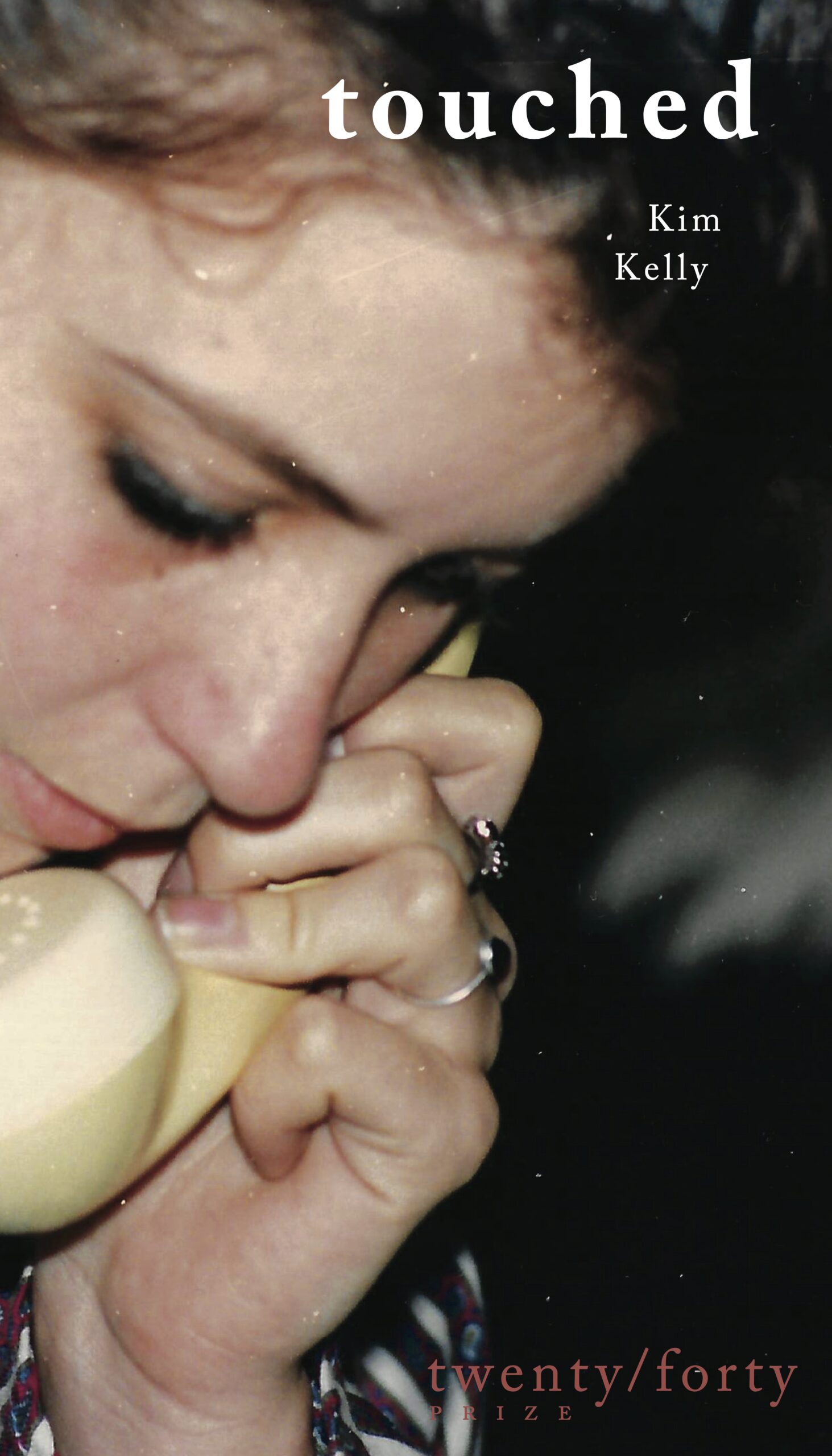
Kim Kelly, Touched (#BookReview)

In 2023, novelist Kim Kelly was one of the two winners of Finlay Lloyd’s inaugural 20/40 Publishing Prize, with her 1920s-set historical novel, Ladies’ Rest and Writing Room (my review). Publisher Julian Davies had hoped at the time to award one fiction and one nonfiction prize, but there was a dearth of good nonfiction entries. That was rectified in 2024, with Sonya Voumard’s book on dystonia, Tremor (my review), being one of the two winners. This year, Kim Kelly returned with a nonfiction work on anxiety, titled Touched: A small history of feeling – and won again.

There is an obvious similarity between these two nonfiction winners, given both deal with medical conditions that impinge significantly on their writers’ lives. However, as quickly becomes apparent, the similarity is superficial, probably due to their writers’ origins. Voumard and Kelly are both published authors with other books to their names, but Voumard is a journalist while Kelly is a novelist, and this I think informs their different approaches to their subject matter.

Finlay Lloyd describes Touched like this:

Why this book is different
Documenting the damaging role of anxiety in our lives is hardly new, but Touched takes us inside the destabilising riot of a three-day panic attack with such insight, honesty and humour that the perspective we gain is revelatory and overwhelmingly hopeful.

Why we liked it
This book has a wonderful breadth of understanding—of the author’s own crazily complex family, of the wider issue of anxiety across society, and of her own voyage as a highly competent yet vulnerable being in a worryingly unhinged world.

Both Voumard and Kelly use a personal narrative arc to frame their discussions. For Voumard it’s the brain surgery she is about to undertake as her book opens, while for Kelly it’s the three-day panic attack she has leading up to her Masters graduation ceremony. Kelly’s focus is this attack. She takes us into it, viscerally. It is the emotional and narrative core of this book. Voumard, on the other hand, weaves her own story through a wider story about dystonia, in which she explores its different forms and treatments through the experiences of others as well as her own. Both writers situate their conditions within a wider societal context, but very differently.

And here I will leave Voumard. After all, she has her own review already!

Kelly starts her book with an (unlabelled) author’s note in which she explains that memory is slippery, so dates and details may not be precise, but “everything in this memoir is true, in essence and in feeling”. I like this, because no-one can remember all the tiny details, and in most cases – crime, excepted – they are not important. What is important is being truthful to the experience, and this, I feel, Kelly achieves.

“It’s exhausting, being human”

Touched is divided into two parts – the lead up to graduation day, and then graduation day and its aftermath. Within these parts are single-word titled chapters starting, logically, with “contact”, and her contradictory responses to “touch”, to how physical touch can settle her but can also produce anxiety when it involves people she doesn’t know well, like, say, hairdressers, doctors and dentists. As for masseurs, no way! But “touched” of course has other meanings, including:

To be in touch, to communicate. To have the touch, a skill at something. To be touched, to be momentarily captured by some sentiment. To live in a vague state of craziness. To feel. Small word, wonderfully big inside its tight dimensions of spelling and sound.(p. 14)

Kelly, who is a book editor as well as a novelist, loves words, so her memoir is written with the eye of someone who is deeply engaged with the meanings of words and how they convey feelings. As graduation day approaches, and she and her partner drive to Sydney for it, she suffers an excruciating panic attack which she describes with a clarity that is revelatory for those like me who have not experienced that degree of psychic distress. At the same time, she looks back to history – including to the Ancient Greeks and philosophers like Aristotle – for ideas on anxiety. And she flashes back to her own past, exploring how and where and why it all began. Her Jewish roots, the experiences of poverty and war in her Irish Catholic tree, the insecurities of her parents, her own childhood fears, and wider societal issues like the imposter syndrome that is particularly common among women, all come into the frame.

It’s not all distress and misery, however, because in between her mulling she shares her wins, her strategies, and her optimistic self that keeps on going. The writing is beautiful, slipping between information-sharing, straight narrative, and light or lyrical, rhythmical moments when she takes a breath and so do we.

Touched is a personal story, and so, by definition, it can be intensely self-focused at times. However, the intensity serves a purpose for those unfamiliar with what anxiety can do. Further, with a keen sense of tone, Kelly regularly reins it in so it never wallows. At the time of her writing, she tells us, around 17% of Australians had experienced some form of anxiety disorder. That’s nearly one in five of us. This book is for all those people – and for the rest of us who know someone who has experienced it, or who might ourselves experience it one day. We just never know. We should thank Kim Kelly for putting herself out there, so beautifully and so honestly.

Read for Novellas in November (as novella-length nonfiction) and Nonfiction November, but not quite finished in time!

Kim Kelly
Touched: A small history of feeling
Braidwood: Finlay Lloyd, 2025
142pp.
ISBN: 9780645927030

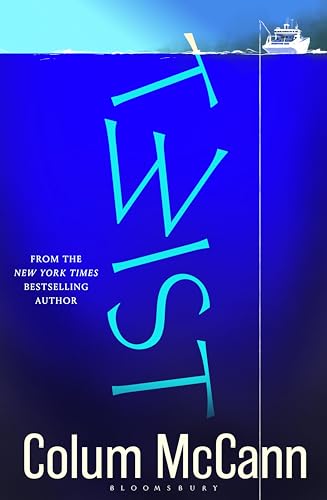
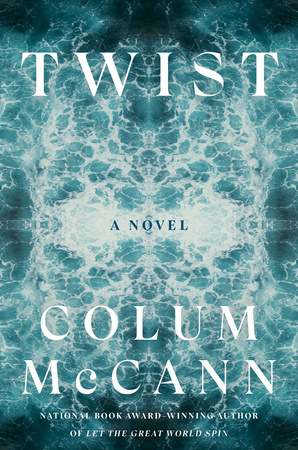
Colum McCann, Twist (#BookReview)

Colum McCann said during the conversation I attended back in May that books are never completed until they are in the hands of readers who tell back what a book is about. This is essentially reception theory, which, referencing Wikipedia, says that readers interpret the meaning of what they read based on their individual cultural backgrounds and life experiences. In other words, “the meaning of a text is not inherent within the text itself, but is created within the relationship between the text and the reader”.

Although I don’t adhere to any theory absolutely, this makes some sense to me – as does my extrapolation from this that the reader’s background and life experiences contribute not only to the meaning they obtain from a work, but their assessment of it.

Colum McCann’s latest novel Twist was my reading group’s last book of the year. All of us were fascinated by its underlying story about the data – our data – travelling around the world via undersea cables, and the fragility or vulnerability of this data. But, when it came to assessing how much we liked the book, other things came into play, things that say as much about who we are as readers, what we look for in books, as they say about the book itself. For example, readers who look to empathise with appealing, rounded, human characters might assess Twist quite differently from those for whom ideas play a significant role in their preferences.

I’ll return to this, but first more on the novel. Twist is narrated by 50-something Irish novelist, Anthony Fennell, whose career had stalled. It “felt stagnant”, and he was feeling disconnected from life, “the world did not beckon, nor did it greatly reward”. He was, in fact, “unsure what fiction or drama could do anymore”. He needed, he tells us, “a story about connection, about grace, about repair”. Fortuitously, into his lap falls an assignment to write a long feature about a cable repair vessel, which is led by a man called John Conway (whose name, we soon realise, contains allusions to Joseph Conrad and also perhaps to that other well-known JC).

So, in the first few pages of the novel, we know we are being told a story from after the event by a writer who was there as it happened. We know this event relates to Conway because Fennell tells us on the opening page that something had happened to him, and that he is going to tell his version of what happened as best he can, which might take some “liberties with the gaps”. Conway, then, is central to the narrative arc, but we also know that the subject matter is data and the internet, and that the theme will concern ideas like connection and disconnection, brokenness and repair, fact, fiction and the limits of storytelling. It’s impressive, in fact, just how much of the rest of the book is set up in the first couple of pages.

The narrative proper then starts. It’s January 2019, and Fennell meets Conway, and his partner Zanele, in Cape Town, before joining the Georges Lacointe on its journey up the western African coast to the site of a cable break. It takes some time to get there, so we get to know Conway a bit more. He is a good leader, and his multicultural crew of men respect him. The first and main cable break is repaired at the end of Part One, and then things go seriously awry. Zanele, who was performing in her unauthorised climate-change-focused version of Waiting for Godot in rural England, suffers an acid attack. Life starts to “unravel” for Conway who cannot get away to help her. Indeed, as the back cover says, Conway disappears.

I will leave the plot there. It does get more complicated, so I’ve not spoiled it I believe. I will return instead to my opening point about readers and their assessments. Most of those in my group who had reservations focused on the characters. Conway and Zanele were too shadowy; they were not well-rounded; we didn’t know them well. And, why choose a hard-to-identify-with man like Fennell as a narrator? I understand these questions but they don’t concern me, because I read the book differently – so let’s look at that.

Twist draws from, or was inspired by, two classic novels, F. Scott Fitzgerald’s The great Gatsby, with its story of a man’s obsessive love for an unattainable woman, and Joseph Conrad’s Heart of darkness and its story about the darkness at the centre of colonialism. While the narrative arc clearly owes much to Fitzgerald, McCann said during the aforementioned conversation that Conrad’s novel provides the more obvious literary parallel. Those tubes along the seabed, he said, follow old colonial routes, and suggest corporate or digital colonialism.

“There is no logic. The world is messy.” (Fennell)

Looking at the novel through this perspective provides a way of understanding why McCann has written it the way he has. It is not about Conway and Zanele. We only see them through the eyes of Fennell. They are established enough to draw us in but their prime role is to support the ideas – disconnection, connection, turbulence, repair – rather than to be the subjects of the story. We know Fennell somewhat better, as we need to. He is a flawed man, stalled in life and feeling disconnected from it. It is his journey through the narrative that carries our hopes for repair.

If I had any criticism, it would more likely concern the writing. McCann’s is an exuberant, epigrammatic style. It’s not hard to see what he is doing, the games he is playing with meaning and metaphor. However, I can enjoy this sort of writing. It keeps ideas to the fore. And they were ideas that interest me – zeitgeist issues about the fragility of our data; the line between doubt/certainty, connection/disconnection (emotionally, spiritually, technologically), and break/repair; and the messiness of life. It’s not hard to find quotable quotes, like “opinion, the obscene certainty of our days” (p. 218) and “the disease of our days is that we spend so much time on the surface” (p. 25). I enjoy these too!

Part Two opens with:

It is, I suppose, the job of the teller to rearrange the scattered pieces of a story so that they conform to some sort of coherence. Between fact and fiction lie memory and imagination. Within memory and imagination lies our desire to capture at least some essence of the truth, which is, at best, messy.

By the end, McCann has told a story which illuminates the messiness of our time. The truth is that there is no real coherence. There is – and probably always has been – just all of us trying to muddle through the best way we can. This is not earth-shattering news, but McCann exposes some of the issues, many driven by technology, that affect our trying today. The light he throws on these – and the personal progress Fennell makes – are why I enjoyed reading this novel.

Colum McCann
Twist
London: Bloomsbury, 2025
239pp.
ISBN: 9781526656957

Margaret Atwood, Negotiating with the dead: A writer on writing (#BookReview)

My reading for Buried in Print Marcie’s annual MARM month has been both sporadic and minimal, to say the least, but this year I finally got to read a book that has been on my TBR shelves for a long time and that I have planned to read over the last few MARMs. It’s Atwood’s treatise (or manifesto or just plain ponderings) on writing, Negotiating with the dead. Interestingly, in 2003 it won the Independent Publisher Book Award (IPPY) for Autobiography/Memoir. I hadn’t quite thought of it that way, though on reflection I can see it does have a strong element of memoir.

Its origins, however, are not in memoir but in the series of lectures she delivered at the University of Cambridge in 2000, the Empson Lectures, which commemorate literary critic, William Empson. (I recently – and sadly – downsized his most famous book, Seven types of ambiguity, out of my library). Atwood turned those lectures into this set of essays that was published by Cambridge University Press in 2002 (and that I leapt on when I saw it remaindered in 2010).

Subtitled “A writer on writing”, this book is probably not quite what most of us would expect, unless we really know Atwood. As she says in her Introduction, it is not so much about writing as about something more abstract, more existential even, about what is writing, who is the writer, and what are the writer’s relationships with writing, with the reader, with other writers, and with themself. It’s also about the relationship between writing and other art forms, like painting and composing. She says in her Introduction that “it’s about the position the writer find himself in; or herself, which is always a little different”. (Love the little gender reference here.) It’s about what exactly is the writer “up to, why and for whom?”

I rarely do this, but I’m sharing the table of contents for the flavour it gives:

  • Introduction: Into the labyrinth
  • Prologue
  • Orientation: Who do you think you are? What is “a writer,” and how did I become one?
  • Duplicity: The jekyll hand, the hyde hand, and the slippery double Why there are always two?
  • Dedication: The Great God Pen Apollo vs. Mammon: at whose altar should the writer worship?
  • Temptation: Prospero, the Wizard of Oz, Mephisto & Co. Who waves the wand, pulls the strings, or signs the Devil’s book?
  • Communion: Nobody to Nobody The eternal triangle: the writer, the reader, and the book as go-between
  • Descent: Negotiating with the dead Who makes the trip to the Underworld, and why?

There is way too much in the book for me to comment on, but I don’t want to do a general overview either, so I’m just going to share a couple of the ideas that interested me.

One of her main threads concerns “duality” and “doubleness” in writers’ lives. There’s a fundamental duality for a writer – a novelist anyhow – between “the real and the imagined”. She suggests that an inability to distinguish between the two may have had something to do with why she became a writer. This interested me, but it’s not what interested me most in this book. Rather, it was the idea of the writer’s “doubleness”, which she introduces in chapter 2, “Duplicity”, the idea that there is the person who writes and the other person who lives life (walking the dog, eating bran “as a sensible precaution”, and so on). She explains it this way:

All writers are double, for the simple reason that you can never actually meet the author of the book you have just read. Too much time has elapsed between composition and publication, and the person who wrote the book is now a different person.

It’s obvious, of course, but we don’t often think about it. Writers do, though. Take Sofie Laguna, for example. In the recent conversation I attended, she said she wished she’d kept a diary when she was writing her novel to capture the “dance” she’d had between the conscious and the subconscious as she worked through the issues she was confronting. In other words, the Sofie in front of us was not the Sofie who had written that book. In chapter 5, “Communion”, Atwood addresses this issue from a different angle when she talks about the relationship between writers and readers.

Back to the writer, though, Atwood talks about, gives examples of, how different writers handle this doubleness, the degree to which they consciously separate their two selves or don’t. This brought to my mind Brian Castro’s Chinese postman (my review) in which he regularly – consciously of course – shifts between first person and third for the same character, a character who owes much to Castro himself but is not Castro. This may be similar to the example she gives, Jorge Luis Borges’ short story “Borges and I”. It’s also something Helen Garner has often discussed, such as in her essay “I” published in Meanjin in Autumn 2002. Even in her nonfiction works, she “creates a persona”, one that “only a very naive reader would suppose … is exactly, precisely and totally identical with the Helen Garner you might see before you”. My point in saying all this is that I think Atwood is exploring something interesting here. Is it new? I don’t know, but it captures ideas I’m seeing both in statements like those of Laguna and Garner, and in recent fiction where I’m noticing an increasing self-consciousness in writers who are explicitly striving for new forms of expression.

Another double Atwood discusses – one related to but also different from the above – is that between the writer and the writing. The writer dies, for example, but the writing lives on. It brought to mind that murky issue concerning posthumous publication (which was discussed on 746 Books Cathy’s Novellas in November post about Marquez’s Until August). It’s a bit tangential, I guess, but Atwood’s separation of the writer and the writing, her sense of the doubleness of writers, puts another spin on this conundrum.

She discusses other issues too, including that of purpose, to which she gives two chapters (3 and 4), setting the art-for-art’s sake supporters against the moral purpose/social relevance proponents, and which of course touches on that grubby issue of writing to earn money!

It’s an erudite book, in that she marshals many writers, known and unknown to me, to illustrate her ideas, but the arguments are also accessible and invite engagement. I did have questions as I read, but she managed to answer most of them. A good read.

Read for Marcie’s #MARM2025

Margaret Atwood
Negotiating with the dead: A writer on writing
Cambridge: Cambridge University Press, 2002
219pp.
ISBN: 9780521662604

Angus Gaunt, Anna (#BookReview)

Last month, I posted on the winners of the 2025 Finlay Lloyd 20/40 Publishing Prize, of which Angus Gaunt’s Anna was one. I am thrilled with this prize, not only because I love the novella form, but because of the variety of stories we are seeing. So far the fiction winners have been an historical novel from Kim Kelly, a contemporary coming-of-age novel from Rebecca Burton, and an audacious “what if” story from PS Cottier and NG Hartland. Three very different books, and now Anna makes it four.

When I started reading Anna, I thought I was heading into a dystopian novel. It is told third person from Anna’s perspective, and starts with her walking in the woods. A young man is following her. The woods are not identified, and neither is the young man, but she recognises him as a guard from the place she’s just left. Through their initial interaction, we learn that “the war is over” and the gates had been opened. Therefore, she firmly implies, he has no jurisdiction over her.

Anna, we discover as her journey continues, is about 15 years old, and had been taken to a labour camp with her family about three years ago. Her parents had died but she’s hoping her remaining siblings are ahead of her, safe in the exodus she’d missed. We know nothing about the woods – but they do not sound Australian – nor do we know the time setting. It is cold. There are some generic animals and plants – deer, hares, mushrooms, berries. The story focuses on Anna’s thought processes and her survival. There is almost nothing about the sociopolitical situation that got her there. We do know that Anna and the guard speak different languages, which suggests an invasion or some sort of oppression of minorities, but Gaunt does not go there. The notes I made during my reading, include this: “Timeless, placeless, non-political, means not dystopian? More allegory?”

The judges don’t call it either of these, but on “why this book is different” they say:

Winter is only beginning to thaw in a remote forest as Anna treks for her survival, accompanied by someone she cannot trust. With distilled clarity, this short novel carries the reader on a journey from victimhood to self-possession.

So, it is about survival, or, more precisely, about the inner resources you need to develop to overcome a dire situation.

Anna is a moving and absorbing read. Gaunt quickly engages our sympathy for his protagonist, young and defenceless in the woods. The language in the first two paragraphs sets up uncertainty. It starts:

Anna had already walked further than she meant to, but did not want to go back, not yet. She was basking in the sun … also in the silence. She had not done something like this for a long time … (p. 9)

Then she stops and looks up, where she sees “a large predatory bird … floating on secret air currents, delicate wing tips spread”. “Predatory” but “delicate”. Should we be worried? Then she sees the young guard, later identified as Yevgeny. He’s very young, uncertain, and in a show of bravado he tries to shoot the bird, but fails. He’s never shot anything before. And so the narrative and its main characters are established. Anna is alert, sensitive, intelligent and has some nous and wisdom about her. The guard, also young, lacks confidence, experience and nous, and is confused about his role as a man, a soldier, a human. This makes him potentially dangerous but also vulnerable. We – like Anna – are on the watch for which way he might go.

And so the novel progresses as this uneasy, wary-of-each-other pair journey through the woods, looking for the railroad and its promise of civilisation. Early on, during a brief time when she and Yevgeny are not together and she has returned to the camp, Anna meets a dying man who gives her his last food. Then later, together, they come across a cottage containing a barely surviving couple.

This brings another literary form to mind, the journey narrative, the search for home, a new one or old one, and – perhaps – for self. In journey narratives, physical and spiritual or emotional challenges are faced, and people are met. The journeyer must rely on inner resources to overcome the challenges, including assessing whether the people met are to be trusted or not. This is what we watch Anna do. We are privy to her thoughts as she goes, as she draws together past knowledge and present experience, and we gain confidence in her ability to make good decisions. Nearly half way through the story, her mind drifts to the schoolroom. It is comforting, but she stops herself,

recognising that she was attracted by the emotion of it rather than its practical application. There was not room for emotion. She was glad of this thought. Feelings and emotion could only cloud the mind, waste precious resources. All resources were precious. Her mind was clear now. She had a choice to make and she made one. (p. 56)

Of course it’s not a straight line, and Anna, like any journeyer under stress, slips back several times before getting a grip once more.

Anna is beautiful to read, from the first sentence. The language is tight but expressive. The necessary tension is off-set by moments of tenderness and hope, not to mention some subtle foreshadowing. And the characterisation is warm and empathetic.

I concluded my post on last year’s winner, The thirty-one legs of Vladimir Putin, that it was an audacious “what if” story. Anna is also audacious, in a different way. It calls on the tropes of established forms, like allegory and the journey narrative, but makes them into something new, something that confronts issues like trust and power in a way that feels both modern and timeless.

Read for Novellas in November.

Angus Gaunt
Anna
Braidwood: Finlay Lloyd, 2025
110pp.
ISBN: 9780645927047

Review copy courtesy Finlay Lloyd.

Helen Garner and Sarah Krasnostein in conversation with Beejay Silcox

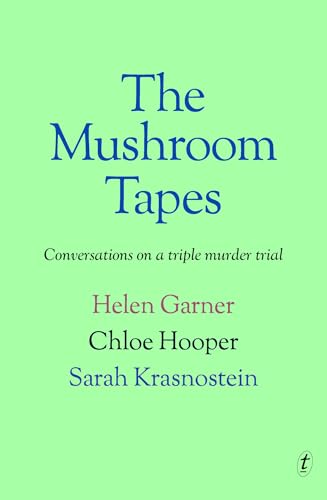
Last night’s ANU/Meet-the-Author event was a sold-out affair, in a 500-seat theatre. And why not? Helen Garner, Chloe Hooper, and Sarah Krasnostein are among Australia’s top writers of narrative nonfiction, and they have just produced a book about the Leongatha mushroom murders. Indeed, it’s only because they have written about it that I am interested in reading about this case. Of course I knew about it, but I didn’t follow it intensely because these tragic criminal cases that capture the public’s attention so often become unedifying spectacles in which emotion overtakes reason in much of the public discourse. And I don’t want to go there.

As always, Colin Steele did the introductions, including explaining that Chloe Hooper had had to pull out due to her young son being sick. He referenced Jen Webb’s recent article on The mushroom tapes in The Conversation, and quoted her statement that “If I were asked to pick three people to write about this dramatic, yet banal, crime story, I’d choose them”. Yes! He then handed the floor over to Beejay Silcox.

The conversation

I was disappointed not to see Chloe Hooper because I have seen Helen and Sarah in action before, and because Kate (booksaremyfavouriteandbest) loved the event she attended with the three of them. So, Chloe’s absence created a significant hole, but Helen and Sarah filled it wonderfully – and graciously. They were open, thoughtful, and, as Kate found, still discovering new things to talk about.

Beejay started by quoting Janet Malcolm, who, she clearly knows, is a favourite of Garner’s. Malcom has argued that what journalists do is “morally indefensible” because of the way they draw in and then report on their subjects. But, continued Beejay, good journalists will overcome this risk by not rushing in, by, I think she said, applying “a tilt” to the way they look at things. And these writers are “masters of the tilt”.

On working together

The conversation covered the sorts of things you would expect for a book like this, including our complicity as readers/spectators, why this case, the need to resist easy answers, their process, their thoughts on the trial, and where the trust in each other had come in.

Sarah noted that there is no division between Helen’s work and her person, which of course is what so many of us love about her, but which has also brought her criticism. They all respected each other – not surprisingly – so had no doubts about each other’s personal processes. Helen said they were like people who had been in and survived a car crash. They were friends for life now.

Beejay referred to the fact that each had shared what their opening line would have been had they written the book alone (though they wouldn’t have, they said). Their lines (pp. 4-5) capture something about their individual approaches. Helen’s, which plays on lines by Sir Walter Scott, sounds baroque, Shakespearean. It speaks of empathy and the question of where is the line that an ordinary person crosses to commit such a crime. Chloe’s is more sociological (as in, what in society created this), while Sarah’s is more legal. As Sarah said, each had her own tone and vibe, her own interest in what they were observing.

Sarah commented on how the case had “asserted itself into public discourse with velocity”.

There was more talk about how and why they decided to write this book. They admitted to bristling at the assumption from others that it was “their story”. They found the sensationalism repellent. (In a humorous interaction, Helen dobbed Sarah and Chloe in as readers of the Daily Mail, which she eschews, but didn’t mind their passing on its news!)

It was an exhausting process, given the trial lasted 10 weeks. Helen talked of how you cope with something like this, on defending yourself against awfulness and pain of the trial, how the mind turns off. They noticed early that the journalists had formed a gang, presumably their way of coping. Beejay suggested that humour is another way, and that Helen provided some of the book’s comic relief.

On the court – and their approach to understanding it

The court is a workplace, said Sarah, so alongside extraordinary grief and distress are all the administrative aspects, such as when to have lunch, managing a juror needing a toilet break. They shared examples of humour and drama in the witness box. Sarah described their work as an “ethnography of a micro-world”, one in which they tried to capture the humanity of court.

Observing that their book is more about watching, than about the judgement, Beejay asked what was important to see, that we normally wouldn’t. Helen’s answer came quickly. It was distress and suffering. You see the survivors. Helen said they dreaded people thinking they were taking suffering lightly. Sarah agreed, adding that one of the heaviest things is that this is not a story of exceptionalism but more of “there but for the grace of god …”

They talked about emotions versus the banality, the quotidian details, such as, for Helen, Erin’s toe in the hiking sandals she would wear. She commented on being nearly undone by the domestic nature of it all, such as survivor Ian talking about having “a nice bowl of porridge” in the morning with his wife of many years, and now she’s gone.

Beejay described the book as both spectacle and literature, and quoted Helen’s comment in it that “everything could become a metaphor here“. The discussion went roundabout here, but essentially they agreed that in a case like this, metaphor must be handled carefully. In fact, Helen suggested that the urge to get metaphorical doesn’t belong in nonfiction. Sarah shared something from documentary filmmaker Ken Burns. He said that to find a detail that stands for the whole is a gold nugget, but then realised that that detail (from his Vietnam War film) represented the piece of a man’s soul that had come at great cost – so “gold nugget” was not appropriate. So, said Sarah, you must handle metaphor carefully, as you are dealing with human meaning. Helen had never heard Sarah say this. They agreed that nonfiction deals with facts you must honour, that it is chained to reality in a certain way.

On Erin

This led to a conversation about Erin, how the public had turned her into “a character”, and how information that had come up in the pre-hearings (such as probable earlier attempts on her husband’s life) was deemed inadmissible in court because there was no evidence. This decision would enrage a family, Sarah said, but is necessary to protect the presumption of innocence. (There was humour in the conversation here because Daily Mail readers knew this information, but Helen didn’t – and had felt an idiot!)

But, who was Erin? Mostly, women kill to protect, so Sarah had gone into the hearings with this understanding, but as information came out she had to reassess her thinking.

Helen found Erin a strange person, but thought the court artists’ depiction of her as evil, witch-like, was appalling. Later, they described the way the media/the public feasted on her was a form of horror.

Sarah said that when Erin started speaking on the witness stand, she was articulate, funny, recognisable, but gradually, as she was questioned, this picture melted. It was hard to separate Erin’s self from the persona. The unpalatable parts of her personality were on display. The bad-tempered teacher-like tone she used in response to the prosecutor was a misstep. It’s a middle-class story, said Helen.

Re explaining Erin’s crossing that line into murder, Helen was surprised to find that the prosecution doesn’t have to find a motive. She doesn’t have an answer. Like most humans, Erin embodied various people, mother, crabby teacher … Sarah added that Erin is not legally insane but is a deeply disordered person, so how do you apply “order” to her? We want answers, but we can often be mysterious to ourselves. Erin is recognisable as a mother, but like many of us can also harbour a primal rage.

Q & A

On how such an intelligent, well-educated woman could think she could get away with it: Helen has a theory about murderers. They have a great desire to do it, and a fantasy about how they are going to do it, but this all stops at the lethal blow because they haven’t thought about what happens next. So, for example, Erin hadn’t concealed evidence of her ownership of the dehydrator. This was astonishing,

On ethical issues they considered during the process: There were many, including the children, the community, whether they should look at sites (like the home). Are you adding to harm or does not looking do harm too? They questioned whether they were looking out of human curiosity, were they just perving? Sarah said that Helen has a view about “utility”. Courts are public, so we should understand them, we should ask questions about what they are doing. Hannah Arrendt described such crimes or behaviour as “a rent in the social fabric”. The law is being acted in our name, so we have duty to know what the law is doing. Part of the “utility” is to add complexity to our understanding, to show that the law, and these cases, are not simple.

On the role of gender in how the case played out publicly: Gender absolutely played a role. Had the crime been committed by a man it would not have held the public’s attention for so long. This was a middle class mum, set around something domestic, the serving of a meal. Her behaviour was a violent inversion of a major archetype of what women are. The gleeful mocking tone employed by some commentators was an insult to victims. (And reminiscent of how Lindy Chamberlain was “feasted upon”.)

Finally…

Beejay described the book as “a love letter to doubt”, to which Helen responded that she is a fan of ambivalence. Yes! She is not the god of all knowing consciousness; she wants readers to be there, questioning along with her. Doubt comes in different forms. At times, Helen and Sarah would be sentimental and mushy, while Chloe would remonstrate, “Guys, she’s planning to poison them”. They agreed that their essential subject matter was the preservation of doubt

Beejay concluded by asking them what they wished we all knew or felt. Sarah named the mockery, caricature, parody that was applied to the case. Why do people do this? These are people’s lives, and it affected a family and an entire community. Helen agreed, adding that “you want to preserve the tenderness in the story”. The old people who died kept disappearing from the story, but they were plain country people with faces of kindness, people who had helped Erin in need (which she recognised).

So, another excellent conversation with some meaningful takeaways encompassing how we respond to crimes like this, how we value writers who bring them to us in a considered thoughtful way, and how doubt and acknowledging complexity should be our mantras.

ANU/The Canberra Times Meet the Author
MC: Colin Steele
Lowitja O’Donoghue Cultural Centre, Australian National University
19 November 2025

Sofie Laguna in conversation with Karen Viggers

I don’t know how it has happened, but tonight’s conversation between Sofie Laguna and Karen Viggers is the first ANU/Meet-the-Author event I’ve attended this year. I did book one featuring Omar Musa a month ago, but I came down with laryngitis, as did, I believe, his interlocutor. (The show went on, with Karen Viggers, in fact). My problem is a busy schedule combined with regular trips to Melbourne and a couple of holidays. They get in the way of normal life!

Anyhow, the event – which was for Sofie Laguna’s latest novel, The Underworld – started as usual with Colin Steele acknowledging the traditional owners, introducing the participants and thanking supporters, before handing the floor to Karen Viggers. He thanked Karen in particular for turning up because last Sunday, while in Ubud for the Writers Festival, she was run down by a motorcycle and was somewhat bruised and battered!

The conversation

Now, I have seen Karen converse with Sofie Laguna before (back in 2017) and it was one of the most delightful conversations I’ve attended, so, I was looking forward to this one. It didn’t disappoint. Sofie Laguna is a joy and a hoot, in the open way she engages in discussions about her work. It’s a way that manages to feel fresh, as though the conversation is a journey for her, not the same-old same-old. Whether that’s Sofie or Karen or the chemistry they have, I don’t know, but it works.

On coming-of-age and young people

Karen started by introducing the novel as a coming-of-age story, which encompasses violence, love and transformation. She loved that Sofie takes the reader on a journey with Martha. The novel starts in 1973, with her protagonist Martha in Year 9 – at which point there was a little discussion between Sofie and Karen about how old that made her, and whether that was the same as Third Form. Whatever! The point is she’s around 13 or 14, is at an elite private boarding school in the Southern Highlands, and has parents who are ”trapped in a loveless marriage”. Here, there was another little discussion about whether they were in fact “trapped” and whether it really was “loveless”. As you can see, this really was a conversation.

Karen asked Sofie about the dedication, which she suspected implied a spark? It is an In Memoriam to her Latin teacher, who was both dedicated and elitist, but created a dynamic learning space. This led to a discussion about the role of teachers in guiding young people, and the fact that teachers are woven in different ways through most of Sofie’s novels. She doesn’t do this consciously, but realises teachers have had a pivotal role in her books. They have an incredible influence, they can draw out of students who they are. For Sofie, whose home was unconventional, school was a safe place, that gave her boundaries.

On the writing

We then moved on to voice, and the fact that Martha’s voice came to Sofie at a basketball gym where her son was playing. She began writing there and then in the voice of a women in her 50s, a woman who was funny, heartbroken, intellectual. She “knew something had happened”. She felt an urgency, and it was exciting because things were coming out that she didn’t know she knew. This sort of writing is easy to do because it wants to happen, but the book wasn’t easy.

She knew she had to go back and learn what Martha’s life was like at 14. It would be untidy. Puberty is messy, and she’d never properly written about it before. It’s a time of transition, challenging for everyone, as our bodies, ideas, sexuality change.

Karen then returned to why this book had been difficult. Was it because she was closer to Martha? Yes, but it was difficult in many ways – more difficult to get a sense of the whole, more difficult to get a straight line, more nuanced. And then as Sofie does, she asked Karen whether that made sense!

Karen noted that Martha attends a privileged private boarding school, which is a shift from the hardscrabble lives she usually writes about. This resulted in Sofie sharing another difficulty she’d had. Was she was “allowed”, in current times, to describe wealth, privilege? Was it permissible to describe pain experienced by a privileged white person? But, that’s who Martha was! So, she kept on, but she had to work hard to give herself permission to do this.

She wishes she’d kept a diary, that she’d captured this “dance” she’d had between the conscious and the subconscious as she worked through the issues.

On the Underworld

Next was the Underworld, Martha’s place of escape. Sofie explained that the Underworld, which comes from Greek and Roman mythology, is not the same as the Christian idea of hell. Everyone goes to the Underworld. We all know about Charon the Ferryman who takes souls across the river, but what is the Underworld? How did it work? Was it a watery place? There are many interpretations, but nobody knows, which gave Sofie – and Martha – the freedom to imagine it for themselves.

For Martha, suggested Karen, it is layered – mythic, sexual, academic, and more. Sofie agreed. It’s a metaphor for the darker parts of our psyche. Martha is obsessive, which makes it difficult to grow up, difficult to come to terms with her self, so the Underworld is a safe place.

On family and pets

Karen and Sofie then discussed Martha’s family. The opening paragraph describes the distance between mother and daughter. The mother, Judith, is aloof, remote, beautiful, tall, comes from old money, and is largely unavailable, though Martha remembers a time of closeness – underwater in a pool – when she was young.

Martha is more like her father, Andrew, but he is absent physically and emotionally. Her parents shared a love story. He was from the wrong side of the tracks, so why did Judith choose him? Was she rebelling against controlling mother, Babs, a snob who is the third party in the marriage?

They all love Martha, but they all fail her. Yet, Babs could be seen to save Martha. She’s an example of a character who starts as a role or function, but who becomes fully human with good traits and flaws.

Pets also play a role in the novel. They are like teachers. Martha’s grandmother has little dogs, but then Martha meets three big Irish wolfhounds, who ground her, who see her need. This scene at the farm was a joy to write. Sofie tries to write her novels from beginning to end, but if a scene needs to be written she will do it, and slot it in later. She returned to the idea of difficulty, and how surprising it was to find it so easy to write that scene but not the scenes before and after it.

Sofie said that Martha doubted herself, and this was what the writing was like. Some scenes would drag. She has depended all her writing life on her intuition, but with this book she needed an outside eye in a way she never has before. When she got that, she was able to write “with gusto”. That person gave her “permission”, reminding her that certain scenes can happen off the page, which is something she normally knows herself. This book she did the hard way, but she couldn’t give up on Martha!

On the 1970s setting

Sofie said there is some crossover between her life and Martha’s. This was a time when it was taboo to be gay, and feminism was growing but Martha could still cut off. Sofie found the research “thrilling”, and loved it when she found the extant female poet Sulpicia, whose authorship was contested by male academics. This was a great way for Martha to enact her own form of feminist activism.

During the Q&A, there was a brief discussion between Sofie and Karen re trauma, after Karen commented that there is trauma in each of Sofie’s books. Trauma, which comes from the Greek word for “wound” said Sofie, shapes people. All lives have “trauma”. You can’t avoid heartbreak, loss, acute pain. Karen observed, however, that trauma’s impact can depend on how and when it happens.

Before we went to the Q&A, Sofie apologised for being tired and getting tongue-tied, but we didn’t notice.

Q & A

On whether Martha represents Sofie (whom this questioner knew at school as a warm, passionate and curious girl) or a combination of girls: Both, she is a combination but also a “more true me”, said Sofie. She is awkward, prickly, can’t do eye-contact, until she meets horses and dogs. She’s a presence outside of Sofie, but is also “a soul twin’; she is both Sofie and separate.

On whether she had to kill any darlings: No, because whatever she killed were not darlings, as they were not working. Her aim is to find the structure, the shape, so she is always happy to lose things that are spoiling the shape, that are distracting from the story. Sofie laughed that she was using various metaphors – music, forest, sculpture – to answer this question, but essentially, once she has the path it’s a joy filling in the picture.

Vote of thanks

Features editor, Sally Pryor – who wore orange especially to coordinate with the book’s cover – gave the vote of thanks. Martha felt so much like a real person, she said, but is really just words on a page. How does that happen? Sofie replied that those marks on a page go from her soul to ours!

Another great meet-the-author event! We are very lucky, as Sally said.

ANU/The Canberra Times Meet the Author
MC: Colin Steele
Kambri Cinema, Australian National University
6 November 2025

Brian Castro, Chinese postman (#BookReview)

Serendipity is a lovely word, and is even lovelier when it touches my reading. Such was the case with my last two books, Olga Tokarczuk’s House of day, house of night (my review) and Brian Castro’s Chinese postman. The connections between them are simple and complex. Both focus more on ideas than narrative, are disjointed in structure (or, at least, in reading experience), and draw consciously on their author’s lives. They also seem to be questioning the nature of fiction itself, a question that is true of two other books I’ve read in recent times – Michelle de Kretser’s Theory & practice (my review) and Sigrid Nunez’s The vulnerables (my review). None of these books are fast reads, but they are rewarding ones.

The other thing that connects these books is that, because narrative provides more of a loose structure than a driving force and because they blend that narrative with ruminations, memoir, essay, vignettes, anecdotes, recipes even, they exemplify the idea that every reader reads a different book. This is not only – or even primarily – because we are not all men in our mid-70s with mixed ethnicity, to take Castro (and his protagonist) as an example. Rather, it is because we all think about and weigh differently the issues and ideas these authors focus on.

In The vulnerables Nunez refers to Virginia Woolf (as does de Kretser) and her “aspiration to create a new form. The essay-novel”. She also refers to Annie Ernaux’s nonfiction book The years, describing it as “a kind of collective autobiography of her generation”. I’ve digressed a bit here, but my point is that these writers have things to say about their time, their generation, the state of the world – and they are looking for better ways to say it. They are suspicious of pure narrative, and yet I think they also recognise, to some degree at least, that “story” is a way to reach people. Therein lies the tension that each tries to deal with.

So now, Castro! There is a story, a sort of narrative, running through Chinese postman, and I’ll let publisher Giramondo explain it:

Abraham Quin is in his mid-seventies, a migrant, thrice-divorced, a one-time postman and professor, a writer now living alone in the Adelaide Hills. In Chinese Postman he reflects on his life with what he calls ‘the mannered and meditative inaction of age’, offering up memories and anxieties, obsessions and opinions, his thoughts on solitude, writing, friendship and time. He ranges widely, with curiosity and feeling, digressing and changing direction as suits his experience, and his role as a collector of fragments and a surveyor of ruins. He becomes increasingly engaged in an epistolary correspondence with Iryna Zarebina, a woman seeking refuge from the war in Ukraine…

The narrative arc, then, concerns this email correspondence with Iryna. It starts when she emails him:

Dear Professor, I am reading one of your books on the doorstep of war. You once wrote about war eloquently, so the critics said. I do not believe anyone can write eloquently about war. If you could find the time, could you please answer that question. (p. 29/30)

He doesn’t reply “of course”, because he suspects it’s a scam. But, the problem is, it’s got him thinking about his ‘”eloquence” in writing about war’. At this point, readers who have read the epigraphs will remember that one of them quotes John Hawkes*, who said, “Everything I have written comes out of nightmare, out of the nightmare of war”.

War – Ukraine, Vietnam, World War 2, and others – is, then, a constant presence in the novel. As is the aforementioned Iryna because, although she’s “probably a bearded scammer”, he does write back. He asks her about the “dogs in the Donbas”, hoping this “will shove aside the irritating accusation of eloquence”. And so a correspondence begins in which war and dogs, among other issues, are discussed. In other words, dogs become another thread in the novel, as do toilets, aging and its depredations, solitude, the writing life and more.

This is a “big” book, one that, as I’ve intimated, will be read differently by different people. Those concerned about where the world is heading will engage with the issues that mean something to them. Those of migrant background might most relate to his experience of discrimination and othering. Those of a certain age will relate to thoughts about mortality and managing the aging body. (To test or not to test is one question that arises.) Those of a literary bent will love the wordplay and clever, delightful allusions (and wonder how many more they missed. I loved, for example, the allusions to TS Eliot’s “The love song of J. Alfred Prufrock”, a poem about anxiety and indecision which reflects Quin’s inner questioning about action and inaction. I also loved the wordplay that made me splutter at times.) And those interested in the form of the novel will wonder about where this is all leading!

“the unreliability of reason” (p. 232)

There is so much to write about this book, and I’m not sure I can capture the wonder of reading it, how ideas are looked at from every angle – inside out and upside down – in a way that illuminates and stimulates rather than confuses. It’s quite something.

I’ll try to explain something of this through two of the interweaving motifs – toilets and dogs. Both mean multiple things as Castro is not one to close things off. So, early on, toilets reflect the sort of cleaning work migrants must do to support themselves, as Abe does at University. Later, they are part of the aging person’s concern about bowel health. But, in between they could also symbolise feelings of disorder and helplessness, his “anxiety in the gut”, including just coping with “the difficult things of ordinary life”. Similarly dogs epitomise the instinctual, simple life, but, in stories like their being used for target practice, they could also represent innocent victims of war. Here of course, I’m sharing my personal responses to these motifs. There are many others.

No wonder Quin worries about the writing life. It’s something he, a writer, is driven to do, “it pushes fear into the background”, but does it achieve anything?

I’ve always believed it is the novel that carries all the indirect notes of empathy. It may even be violence that brings empathy to war and its suffering. It may be anything. Yet, the plasticity of the novel bends to all the obtuse emotions and accommodates them. Then all is confined to the scrapheap of having been read, having been experienced, having been second-hand and second-read. Major libraries are throwing out paper books. (p.140)

Chinese postman was my reading group’s September book, and it proved challenging, but that is a good thing. We had a lively discussion during which disagreement was not the flavour, but a genuine and engaged attempt to understand what Castro was on about. Whether we achieved that, who knows, but I am glad I have finally read Castro. I won’t be forgetting him soon.

* Wikipedia des John Hawkescribesa (1925-1998) as “a postmodern American novelist, known for the intensity of his work, which suspended some traditional constraints of narrative fiction”. !

Brian Castro
Chinese postman
Artarmon: Giramondo, 2024
250pp.
ISBN: 9781923106130

Louise Erdrich, The night watchman (#BookReview)

Louise Erdrich’s Pulitzer Prizewinning The night watchman is historical fiction about a community fighting back against a government set on “terminating them”. Erdrich, whom I have reviewed before, is an enrolled citizen of the Turtle Mountain Band of Chippewa Indians of North Dakota and it is the story of this community’s response to something called the House Concurrent Resolution 108 that she tells in The night watchman.

Passed by Congress on August 1, 1953, this Resolution would, says Erdrich in her Afterword, “sever legal, sacred, and immutable promises made in nation-to-nation treaties”. Or, as Wikipedia explains, it would “end reservations and tribal sovereignty” and “integrate Native Americans into mainstream American society”.

As it happens, Erdrich’s grandfather, Patrick Gourneau, was Chairman of the Turtle Mountain Band of Chippewa Advisory Committee at the time and recognised this resolution for what it was. He is the inspiration for Thomas Wazhushk, one of Erdrich’s two protagonists. Thomas is a man of two cultures:

Watching the night sky, he was Thomas who had learned about the stars in boarding school. He was also Wazhashk who had learned about the stars from his grandfather, the original Wazhashk. (p. 17)

Throughout the novel Thomas strategically draws on these two selves in order to perform his role, which is to keep the community safe (or, at least, safer, than they would be if the Government’s plans came to fruition).

This is both a sophisticated and a grounded novel. Grounded in the way Erdrich uses her storytelling ability to create a compelling narrative peopled by a large cast of wonderfully individuated characters. We are interested in them all, and this makes the novel a darned good read. Sophisticated in how Erdrich subtly layers her story to enrich its meaning. The overall structure comprises two parallel but related stories or journeys: Thomas’s fight for his community’s survival, and his niece Patrice’s journey to find both her missing sister and her own path in life. Erdrich’s writing is simple, plain, but also imbued with gorgeous lyricism, metaphor and symbolism. The novel is threaded, for example, with physical holes, wells, caves, ship holds, and falls, which never let us forget the precariousness of these people’s lives.

She also peppers the story with humour, which reminds us no matter how serious things are, people can still have a laugh. There are many laugh-out-loud moments, alongside a recognition of humour’s role in how we navigate the things we confront. In Minneapolis, Patrice finds herself in a strange and potentially dangerous situation, and has

the sort of feeling and thinking that could only be described in Chippewa, where the strangeness was also humorous and the danger surrounding this entire situation was of the sort that you might laugh at, even though you could also get hurt… (p. 131)

“Survival is a changing game” (Biboon)

Overlaying all this is Erdrich’s exploration of how language works, how it can be used to clarify or obfuscate, to inspire or deflate. Her writing embodies this knowledge. So, for example, Thomas receives the Resolution papers and reads them carefully. He sees

their unbelievable intent. Unbelievable because the unthinkable was couched in such innocuous dry language. Unbelievable because the intent was, finally, to unmake, to unrecognize. To erase as Indians … his people, all of us invisible and as if we never were here, from the beginning, here. (p. 79)

His people were being targeted, the papers said,

for emancipation. E-man-ci-pation. Eman-cipation. This word would not stop banging around in his head. Emancipated. But they were not enslaved. Freed from being Indians* was the idea. Emancipated from their land. Freed from the treaties that Thomas’s father and grandfather had signed and that were promised to last forever. (p. 80)

Later, the once dapper but now frequently drunk Eddy Mink cuts to the chase, stunning officialdom with his plain language statement:

The services that the government provides to Indians might be likened to rent. The rent for use of the entire country of the United States. (p. 200)

Meanwhile, as Thomas builds his case, Patrice, who works in the Turtle Mountain Jewel Bearing Plant where Thomas is the titular night watchman, sets off for Minneapolis to look for her sister. Vera had gone there with her new husband but had not been heard of since. What Patrice finds in the city, how people can be exploited, is shocking, and she returns home somewhat wiser but with more to learn about herself and the ways of humans.

Surrounding Thomas and Patrice is a large community of people – family, friends, neighbours, work colleagues, teachers, coaches, visiting missionaries, and even a ghost. The interactions between these people build up a picture of a community that functions despite external stresses and the usual internal disagreements. This makes engrossing reading because these characters are so real, including the two Mormon missionaries who not only add humour and pathos but also represent the naiveté of supporters of a faith – in the form of Utah Senator Arthur V. Watkins – that was driving the Resolution.

Similarly, our protagonists’ interactions with specific individuals make great reading while also advancing the narrative and the ideas. When Thomas is with his father Biboon and Patrice with her mother Zhaanat, we feel their spiritual connection with their culture, and their desire to learn from their elders. When Thomas is with the white teacher and boxing coach, Barnes, we see how little non-Indian society understands the existing situation and the implications of the Resolution. Thomas patiently – and generously – explains to the clueless Barnes why Indians are not, and can never be, “regular Americans”. And, why he, Barnes, cannot be an Indian! Just look at this writing:

“If I married an Indian woman,” said Barnes, “would that make me an Indian? Could I join the tribe?”
He was awed at the possible sacrifice he could be making.
Thomas looked at the big childish man with his vigorous corn-yellow cowlicks and watery blue eyes. Not for the first time, he felt sorry for a white fellow. There was something about some of them—their sudden thought that to become an Indian might help. Help with what? Thomas wanted to be generous. But also, he resisted the idea that his endless work, the warmth of his family, and this identity that got him followed in stores and ejected from restaurants and movies, this way he was, for good or bad, was just another thing for a white man to acquire.
“No,” he said gently, “you could not be an Indian. But we could like you anyway.”

In statements like “he was awed at the possible sacrifice he could be making”, Erdrich conveys more about cultural superiority than just this man’s thoughts.

When Patrice is with her girlfriends and workmates, Valentine and Doris, we see how her goals diverge from their more girlish ones, and when she is with Wood Mountain we see her inner conflict about her chosen direction. As a young person, her journey is more personal than Thomas’s but they coalesce when it comes to saving the community.

“Assimilation. Their ways become your ways.” (Roderick)

I loved spending time with these characters. In fact, so did most of my reading group, as this novel was our September read. We enjoyed her vividly drawn characters – and their perfect names, like Juggie Blue, Wood Mountain, Louis Pipestone, Millie Cloud, and Patrice not Pixie. We teased out the complexity of the storytelling, the way Erdrich seemed to effortlessly incorporate complex ideas into a compelling narrative. This starts right at the title, The nightwatchman, which is both literal, Thomas’ job, and metaphorical, in his role of keeping watch as the community’s Chairman. I was reminded a little of Melissa Lucashenko’s novels, in which tough stories are told with compassion and humour to paint a picture of real people confronting a world that’s against them.

Early in the novel, Thomas moves that the Committee call the Resolution the “Termination Bill [because] Those words like emancipation and freedom are smoke”. This bill heralded what is now called the Termination Era (1953-1968). As Erdrich explains in her Afterword, this is what happened to 113 tribal nations. Although some regained recognition, “31 are now landless” and “24 are considered extinct” (p. 447).

The night watchman is one of those books that hits the spot – the heart spot and the mind spot. Recommended.

* The novel is set in 1953, and Indian is the term most commonly used when the specific Chippewa is not.

Louise Erdrich
The night watchman
London: Corsair, 2020
453pp. (Kindle edition.)
ISBN: 9781472155337

Helen Trinca, Looking for Elizabeth: The life of Elizabeth Harrower (#BookReview)

Elizabeth Harrower The watch tower

Like many, I was astonished when I read Elizabeth Harrower’s The watchtower (my review), upon its publication by Text Classics in 2012. Astonished not so much for its writing, though that is excellent, but for its subject, which is what we’d now call coercive control. The astonishment comes from the fact that The watchtower was first published in 1966, at a time when domestic abuse was hidden. Harrower recognised it, however, and called it out. The book made a splash at the time, but then disappeared from public view, though not completely from academia. Then, in 2012, Michael Heyward and his Text Publishing Company decided to publish it, and so began what biographer Helen Trinca calls, her “second act”.

Looking for Elizabeth is the second literary biography I’ve read by Trinca, the first being Madeleine: A life of Madeleine St John (my review). Trinca must like challenging subjects, because Harrower, like St John, was challenging to write about, albeit in Harrower’s case, Trinca had the benefit of knowing her.

So, what made Elizabeth Harrower such a challenge? Trinca had many conversations with her from 2012 on, including formal interviews for newspaper articles, and Harrower had placed her papers (including letters, reminiscences, and novel drafts) with the National Library, to which Trinca apparently had full access. But interviews and papers don’t tell the full story, particularly if the subject has spent her life “curating” or shaping it, destroying many of her papers along the way, including, as she told Text editor David Winter in 2013, “more than 400 foolscap pages of literary thoughts – part journal, part stories, part eye-witness accounts, secrets and so on”.

Trinca’s biography draws on a variety of sources, which she documents in her Author’s Note. Besides her personal connections with Harrower, which included meetings, phone calls and emails, and Harrower’s papers, she used the papers of others (including Shirley Hazzard, Kylie Tennant, and Judah Waten), all sorts of other records, and interviews with family and friends. Gaps in information are frequently noted within the text – and are sometimes speculated about using that thing that many literary biographers do, the works themselves. How much can – and do – they tell us about the person who held the pen?

Many writers say they begin their project with a question. In Trinca’s case, the framing question seems to have been, Why did Elizabeth Harrower stop writing at the height of her powers? Because, this is indeed what she did. Having written and published four well-received novels – Down in the city (1957), The long prospect (1958, my review), The Catherine wheel (1960), and The watchtower (1966) – she withdrew her fifth completed novel, In certain circles, from publication in 1971, and never published a novel again, despite many encouragements from her friends including Patrick White and Christina Stead. She wrote a few short stories, but gave up writing altogether by the end of the 1970s.

From this literary trajectory, Trinca weaves a moving and interesting story about a fascinating woman. Like Madeleine, this is a traditional, chronologically told biography. It is well-documented, using clear but unobtrusive numbers pointing to extensive notes at the end, and there is a decent index.

“I’ve lived dangerously” (Elizabeth Harrower)

I am not going to tell the story of Harrower’s life, because the biography does that. Essentially, she was born in industrial Newcastle in 1928, and lived with her grandmother after her parents divorced, before joining her mother in Sydney. She never got over, it seems, being “a divorced child”. It dislocated her. Her mother remarried, and Trinca suggests that her stepfather was behind men like The watch tower’s Felix Shaw. She lived in London from 1951 to 1959, before returning to Australia, rarely leaving Australia after that. She did not marry, but had an intense, emotional relationship with the older, married Kylie Tennant, which raises questions that Trinca isn’t able answer, though she points to other “crushes” on older women. Do we need to know?

Through Harrower’s life she mixed with some of Australia’s significant people, including writer Patrick White, politician Gough Whitlam, and artist Sid Nolan. She had a long correspondence with Shirley Hazzard (about which I wrote after attending the launch of a book of those letters.) She died in 2020, suffering from Alzheimer’s. (Her life dates closely mirror my own mother’s.)

Now, rather than detailing this life more, I’ll share some of the threads that run through Trinca’s story, as they provide insight into who Harrower was, and what makes her writing, and her persona, so interesting. They also give the biography a narrative drive.

These threads include that aforementioned one regarding why she stopped writing. Another concerns what drove her to write. Trinca writes about an interview Harrower had with broadcaster Michael Cathcart in November 2015:

She reprised a comment she had often used in the past: ‘I always had an alarming and dangerous interest in human nature. And so recently, I think I was answering some questions, and I said that I felt I had urgent messages to deliver. I wanted to tell people things’.

These things are the emotional truths we find in her books. In an interview with Jim Davidson for Meanjin in 1980, she discouraged people from finding her life in her books, saying that the “emotional truth” is there but “none of the facts”:

None of the books are actual accounts by any means. They are less extreme than reality because reality is so unbelievable. Besides which, people can only take so much. You don’t want to frighten them do you, or do you?

This is the “wounded wisdom” that critics like America’s James Wood identified. It’s not surprising, given the life that led to this “wisdom”, that Harrower was wary, guarded, in her dealings with people, which is another thread that runs through the book. Harrower was polite and genuinely interested in people – “she listened with intent” – but always turned questions back on them rather than give herself away. In 1985, she admitted that, in interviews, “my whole intention seemed to be to give nothing away, to disguise myself”.

Which brings me to the final thread I want to mention, the idea of having “lived dangerously”. Several times through the biography, Trinca refers to Harrower’s saying that she had lived dangerously, but what did she mean? It seems she meant something psychological, metaphysical even. In 2012, she said to Trinca:

In my own mind I have lived dangerously, dangerously in the sense of finding out more and more about human nature. … At this age, you are aware of some very contrary and dangerous things you have done with your life as if you were going to be immortal. This is the irritating thing, now it is dawning on me that I am not immortal.

She said something similar in 1985, “I consider that in my life I’ve lived dangerously, and I haven’t lived a self-protective sort of life”.

“To have lived dangerously”, writes Trinca near the end of her book, “was a badge of honour for Elizabeth”. I read this as Harrower believing that, for all her wariness, she had let herself be open to life and its difficult emotional challenges.

What it actually means probably doesn’t greatly matter, despite Trinca’s “looking”. Nor do the gaps. What matters is the body of work she left, however she lived her life. It’s beautiful, unforgettable, precious, and Trinca tells that story so well.

I now look forward to Susan Wyndham’s biography which is due out soon. How will she fill in the gaps? Will she delve more into Harrower’s political leanings, and what conclusions will she draw about Harrower, who she was and why she wrote what she did?

Helen Trinca
Looking for Elizabeth: The life of Elizabeth Harrower
Collingwood: La Trobe University Press, 2025
309pp.
ISBN: 9781760645755

Winnie Dunn, Dirt poor Islanders (#BookReview)

Book cover

When my reading group chose our books for the second half of the year, the shortlist for the Miles Franklin Award had not yet been announced. However, wonderfully, the three books we chose from the longlist, all ended up on the shortlist. One of those was Winnie Dunn’s debut novel, Dirt poor Islanders. It is the first novel published by a Tongan Australian, and adds a welcome strand to the body of Australia’s second and third generation migrant literature.

Dirt poor Islanders spans around a year when its protagonist Meadow is approaching 12 years old. It can, therefore, also be read as a coming-of-age novel. It is a raw, earthy, honest and sometimes confronting read that exposes the challenges faced by Australian-born migrant generations, who are caught between two worlds.

This is not a new story. However, what is impressive here is that Dunn, in her first novel, has found her own strong and clear voice. It’s there in the way she gets right into the head of her protagonist Meadow, who is, admittedly, modelled on herself. It’s there in the way she interweaves English and Tongan language, capturing the vitality in her migrant community. It’s also there in her use of repetition, some of it onomatopoeic, to give her writing rhythm and create a tone that’s sometimes melancholic, sometimes humorous. Dunn also doesn’t spoon-feed her readers. She expects us to go with the flow and make the necessary connections. It’s not hard reading, but it does require attention.

“this way of seeing myself as half … and never enough” (Meadow)

So, who is Meadow? She’s a young girl who lost her birth mother at the age of 4. At the novel’s opening she is the eldest of six children in a blended family comprising three children from her birth mother, one from her step-mother, and two from this second marriage. Another is on the way. Her father is 30 years old. Meadow is grappling with what it means to grow up Tongan, particularly one who is hafekasi (half-Tongan half-White) and feeling caught between two worlds, neither of which fully accept her. She is desperate for a mother, and feels closest to her namesake, aunt Meadow, who lives in Mount Druitt with our Meadow’s paternal grandmother and another four aunts.

We follow Meadow through a tumultuous year. Early on, she spends most weekends at her Nana’s house surrounded by the five aunts, but when her father buys a new house in Plumpton, he wants Meadow, her sister Nettie and brother Jared, to call that home. With her birth mother gone, however, Meadow feels “stuck” and insecure. Aunt Meadow, also known as Lahi, is her “mother-aunt” and her rock. The narrative is built around the wedding of this Lahi, who, Meadow believes, is more interested in women. She fears for her boyish aunt, but she also fears for herself, that she will lose this mother figure to whom she clings with all her being.

Now, Meadow wants to be a writer, so she’s an observant girl, well able to express her feelings. She sees the messiness – literal and figurative – of Tongan lives, and she shares the lessons she is learning about being Tongan, not all of which are pretty. For example, “Tongan meant dirty” (p. 37), “being a joke” (p. 73) and “second best” (p. 102). But, there are positives too. “Togetherness was what it meant to be Tongan” (p. 40) and “being Tongan meant eating together and being grateful to eat together” (p. 118).

Dirt poor Islanders, then, depicts a migrant family living under stress. Big families and low-paying jobs with long hours mean a chaotic home. Meadow’s scalp is nit-infested, and her home, decorated with second-hand goods, much picked off roadsides, is cockroach-infested. Her parents work hard to keep the family sheltered and fed, but the mess overwhelms. Flipping between maturity and immaturity, Meadow sees all this – the hard work, the exhaustion, the love – but she struggles to find her place, to accept her Tongan heritage.

It all finally comes to a head, and her father organises for her to go to Tonga, because, he says, “it’s time for youse to know what being a Tongan truly means” (p. 239).

Migrant literature encompasses both memoir and fiction, with the latter mostly being autobiographical or autofiction. Dunn confirmed in her Conversations interview that much of the novel’s family background comes from her life, but the novel diverges from real life in its narrative arc and the resolution of Meadow’s inner turmoil. This answered the question I had as I was reading, which was why Dunn had chosen fiction, like Melina Marchetta did in Looking for Alibrandi, over memoir, like Alice Pung did in Unpolished gem. It’s a choice. What matters are the truths conveyed, not the facts, and Dirt poor Islanders feels truthful.

This truth is not all raw and confronting as I may have implied at the beginning. It is also warm and humorous. Meadow, who doesn’t like rich, fatty Tongan food tells us:

If it came out of a can covered in sugar and sodium, Tongans were eating it. But back then, all I wanted was food that came out of a window. (p. 37)

Preferably at Maccas! There are also funny scenes, many relating to the wedding which occupies the novel’s centre, and which is another nod – besides the title and epigraph – to the book that clearly inspired Dunn, Kevin Kwan’s Crazy rich Asians.

“no one could live as half of themselves” (Meadow)

However, Dunn’s book is fundamentally different from Kwan’s, whose aim, he said, was, to “introduce a contemporary Asia to a North American audience”. Dunn did want to introduce Tongan Australian culture – and counteract the image presented by Chris Lilley in Summer Heights High – but through Meadow, she also explores the excruciating difficulties children caught between cultures face. By the end of the novel Meadow comes to understand a little more the “messy truth” of being an Islander, and that:

No one could live as half of themselves. To live, I needed to embrace Brown, pālangi, noble, peasant, Tonga, Australia – Islander. (p. 275)

Dirt poor Islanders is both shocking and exciting to read, which is probably just what Dunn intended. I feel richer for it!

Winnie Dunn
Dirt poor Islanders
Sydney: Hachette Australia, 2024
293pp.
ISBN: 9780733649264